Stanbic Bank
Stanbic Bank
26.3 C
Kampala
Stanbic Bank
Stanbic Bank
Home Blog Page 1126

Pictorial: NRM Secretary General renews her marriage vows with Patrick Lumumba

lumumba

The Secretary General of National Resistance Movement (NRM), Justine Kasule Lumumba has renewed her Marriage with husband Patrick Lumumba.

The two have been in marriage for 20 years. Speaking after renewing the marriage vows, Mrs. Lumumba lauded everyone who has been part of their journey for the last 20 years.

“I thank everyone that joined Mr Patrick Lumumba and I at Lubaga Cathedral yesterday where we renewed our marriage vows as we marked and celebrated having made 20 years in holy matrimony,” she said.

Stories Continues after ad

Umeme secures Shs259b loan for grid expansion

Technician doing repairs

Uganda’s electricity distributor Umeme Ltd has secured US$70 million (about Shs259 billion) in a syndicated loan to finance infrastructure upgrades and national grid expansion.

The loan was agreed with the World Bank’s private lending arm International Finance Corporation (IFC), South Africa’s Standard Bank and Dutch development bank FMO.

Company officials said investments will be carried out within three years and will involve revamping sections of the distribution network, increasing grid connections and boosting supply reliability.

“This financing will enable us to mobilise and deploy the much-needed long-term capital expenditure urgently needed to evacuate the new generated power,” the company said in a statement.

The Karuma Hydro Power plant, a 600 megawatt (MW) China-funded power plant on River Nile, is expected to be commissioned by next February. Another hydro power plant on the Nile also funded by Beijing, the 183MW Isimba Hydroelectric Power Station, was commissioned early this year.

Uganda’s national grid currently reaches just 26 percent of the nation’s 44 million people. When Karuma is operational, Uganda’s total power generation is expected to hit nearly 2000MW.

Umeme said the funding will also help it connect more of its customers to prepaid meters, a strategy it began rolling out in 2011 to help cut rampant customer defaults and power thefts.

Umeme is listed on the Uganda and Kenya stock exchanges. Its largest shareholder is Uganda’s state-controlled National Social Security Fund NSSF.

Other key shareholders include South African funds, such as Allan Gray, Kimberlite Frontier Africa and Investec Asset Management.

Last year, the company said it plans to spend US$1.2 billion over seven years to revamp and expand the grid, including extending lines and building new substations.o

Stories Continues after ad

A Role for Financial and Monetary Policies in Climate Change Mitigation

William Oman

By William Oman

July 2019 was the hottest month ever recorded on earth, with countries across the world experiencing record-breaking temperatures. A prolonged drought is affecting millions of people in East Africa, and in August 2019 Greenland lost 12.5 billion tons of ice in one day.

A review of the literature by IMF staff aims to spur discussion of what policies to mitigate climate change could or should include. The review suggests that, while fiscal tools are first in line, they need to be complemented by financial policy tools such as financial regulation, financial governance, and policies to enhance financial infrastructure and markets, and by monetary policy.

The stakes are high. There is a broad scientific consensus that achieving sufficient mitigation requires an unprecedented transition to a low-carbon economy. Limiting global warming to well below 2 degrees Celsius requires reductions of 45 percent in CO2 emissions by 2030, and reaching net zero by 2050. Despite the 2015 Paris Agreement, greenhouse gas emissions are high and rising, fossil fuels continue to dominate the global energy mix, and the price of carbon remains defiantly low, reinforcing the need for complementary policies.

The case for policy action beyond carbon pricing

Our review of academic and policy studies suggests that, currently, there are insufficient incentives to encourage investment in green private productive capacity, infrastructure, and R&D. At the same time, investments continue to pour into carbon-intensive activities. These undesirable economic outcomes prevent the needed decarbonisation of the global economy. Decarbonisation requires a transformation in the underlying structure of financial assets—a transformation that, studies suggest, is hindered by several deficiencies in the way markets function.

First, financial risks may not reflect climate risks or the long-term benefits of mitigation, given many investors’ shorter-term perspectives. Moreover, financial risks are often assessed in ways that do not capture climate risks, which are complex, opaque, and have no historical precedents.

Climate change put in text

Second, there is a wide gap between the private profitability and the social value of low-carbon investments. High uncertainty around their ability to reduce emissions, as well as the future value of avoided emissions, makes low-carbon investments unattractive to investors, at least in the short run.

Third, corporate governance that favors short-term financial performance may amplify financial “short-termism,” while constraints in capital markets can lead to credit rationing for low-carbon projects.

The above review of previous literature suggests that, because they directly influence the behavior of financial institutions and the financial system, financial and monetary policies can play a key role in addressing these issues.

Possible policy tools suggested by studies

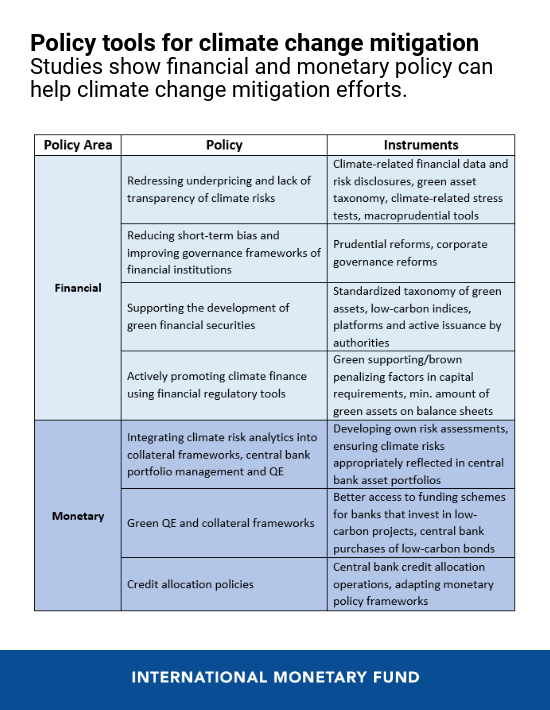
The table below summarizes financial and monetary policy options for climate change mitigation, based on the above review of previous studies.

Policies that have been proposed in the literature can be divided into two categories: climate risk-focused and climate finance-promoting.

Climate risk-focused tools aim to correct the lack of accounting for climate risks for individual financial institutions and support mitigation by changing the demand for green and carbon-intensive investments, as well as their relative prices.

On the monetary policy side, examples include developing central banks’ own climate risk assessments, and ensuring that climate risks are appropriately reflected in central banks’ collateral frameworks and asset portfolios. On the financial policy side, tools include reserve, liquidity and capital requirements, loan-to-value ratios, caps on credit growth, climate-related stress tests, disclosure requirements and financial data dissemination to enhance climate risk assessments, corporate governance reforms, and better categorization of green assets by developing a standardized taxonomy.

Climate finance-promoting policies seek to account for externalities and co-benefits of mitigation at the level of society—that is, to account for how economic activity harms the environment but could instead, in addition to mitigating climate change, generate social value through, for example, reduced air pollution or more rapid technological progress. These policies could help shift relative prices and increase investments. However, the fact that they add new goals to existing policies makes them more controversial.

Monetary instruments to promote climate finance include better access to central bank funding schemes for banks that invest in low-carbon projects, central bank purchases of low-carbon bonds issued by development banks, credit allocation operations, and adapting monetary policy frameworks.

Financial policy instruments to actively promote climate finance revolve around “green supporting” and “brown penalizing” factors in banks’ capital requirements, and international requirements of a minimum amount of green assets on banks’ balance sheets.

What’s the bottom line?

More work is needed. The literature remains limited on the desirable package of measures to address climate mitigation. Nonetheless, financial and monetary policy tools can complement fiscal policies and help with mitigation efforts. All hands are needed on deck, for, as Mark Carney of the Bank of England has warned, “the task is large, the window of opportunity is short, and the stakes are existential.”

Stories Continues after ad

Global airline industry expected to improve in 2020

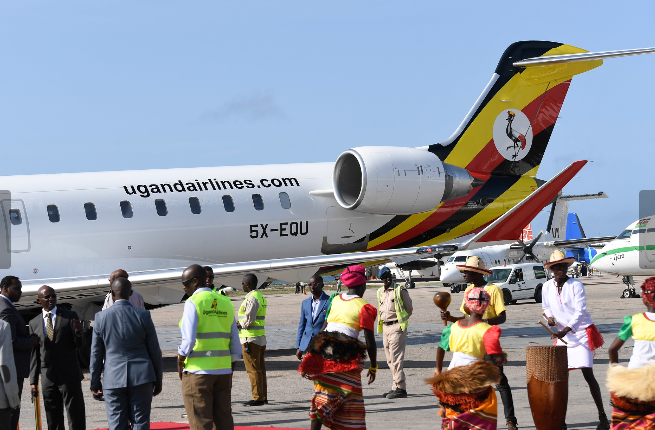
Uganda Airlines plane at Entebbe International Airport

The International Air Transport Association (IATA) says the global airline industry will produce a net profit of $29.3 billion in 2020, improved over a net profit of $25.9 billion expected in 2019 (revised downward from a $28 billion forecast in June). If achieved, 2020 will mark the industry’s 11th consecutive year in the black.

Highlights of expected 2020 industry performance include:

  • The return on invested capital is forecast to be 6.0% (improved from 5.7% expected in 2019).
  • The net profit margin is forecast at 3.4% (up from 3.1% for 2019).
  • Overall industry revenues are forecast to reach $872 billion (+4.0% on $838 billion in 2019).
  • Industry operating expenses are projected to climb 3.5% to $823 billion from $796 billion in 2019.
  • Passenger numbers are expected to reach 4.72 billion (up 4.0% from 4.54 billion in 2019).
  • Freight tonnes carried are expected to recover to 62.4 million, a 2.0% increase over 61.2 million tonnes carried in 2019, which was the lowest figure in three years.
  • Stronger economic growth should support passenger traffic (RPKs) growth of 4.1% similar to 2019 (4.2%) but below historical trends.
  • Average net profit per departing passenger of $6.20 ($5.70 in 2019)

2019 Performance

Economic performance in 2019 was weaker than had been anticipated at the time of the June forecast. This aligns with weaker global GDP growth of 2.5% (versus 2.7% forecast in June) and world trade growth of just 0.9% (down from 2.5% forecast in June). These negative developments contributed to softer passenger and cargo demand and corresponding weaker revenue growth, as passenger yields fell 3.0% and cargo yields dropped 5.0% compared to 2018.

Operating expenses did not rise as much as anticipated (3.8% vs. 7.4% June forecast) largely owing to lower-than-expected fuel costs; but this was not enough to offset the softness in revenue.

“Slowing economic growth, trade wars, geopolitical tensions and social unrest, plus continuing uncertainty over Brexit all came together to create a tougher than anticipated business environment for airlines. Yet the industry managed to achieve a decade in the black, as restructuring and cost-cutting continued to pay dividends. It appears that 2019 will be the bottom of the current economic cycle and the forecast for 2020 is somewhat brighter. The big question for 2020 is how capacity will develop, particularly when, as expected, the grounded 737 MAX aircraft return to service and delayed deliveries arrive,” said Alexandre de Juniac, IATA’s Director General and CEO. “

Performance Drivers for 2020

Economic Growth: GDP is forecast to expand by 2.7% in 2020 (marginally above the 2.5% growth in 2019). World trade growth is expected to rebound to 3.3% from 0.9% in 2019, as election year pressures in the USA contribute to reduced trade tensions. Growth is supported by actions from central banks as well as easing fiscal policy.

Fuel Costs: Slower-than-expected global economic growth in 2019 contributed to lower energy demand, with crude oil prices averaging around $65 per barrel (Brent), compared to $71.60 in 2018. Oil supply is also plentiful, boosting inventories. As a result, oil prices are expected to dip further in 2020 to $63 (Brent). Jet kerosene prices are also expected to dip, averaging $75.60 per barrel versus $77 per barrel in 2019. The expected industry fuel bill of $182 billion will represent 22.1% of expenses, down from $188 billion or 23.7% of expenses in 2019.

Labor: Total employment by airlines is expected to reach 2.95 million in 2020, up 1.6% on 2019. Productivity (ATKs/employee) is expected to rise 2.9% over 2019 as capacity growth picks up. Unit labor cost ($/ATK) is expected to be virtually flat at $0.12, as better productivity offsets increasing wages.

Passenger: Passenger demand (RPKs) is expected to grow 4.1% in 2020, in line with 4.2% growth in 2019. In fact, this masks a GDP-growth-driven pick-up since the underlying growth rate fell to less than 4.0% in 2019. However, whereas passenger capacity (ASKs) rose 3.5% in 2019, it is forecast to grow 4.7% in 2020 – as aircraft deliveries rise significantly, causing load factors to slide to 82% from 82.4% in 2019. This will maintain pressure on yields, which are expected to slide 1.5% after falling 3.0% in 2019. Passenger revenues, excluding ancillaries, are expected to reach $581 billion (up 2.5% from $567 billion in 2019).

Cargo: Cargo traffic turned negative last year for the first time since 2012. The 3.3% annual decline in demand was the steepest drop since 2009 during the Global Financial Crisis. Freight carriage, meanwhile, slipped to 61.2 million tonnes from 63.3 million tonnes in 2018. Cargo traffic is expected to rebound moderately with 2.0% growth in 2020, with tonnes forecast to reach 62.4 million, which is still below the 2018 result. Yields will continue to slide with a 3.0% decline forecast for 2020, an improvement from a 5.0% decline in 2019. Cargo revenues will slip for a third year in 2020 with revenues expected to total $101.2 billion, down 1.1% from 2019.

Regional Outlook

The regional profit picture is mixed in both 2019 and 2020. Africa, Middle East and Latin America are all expected to lose money in 2019, with carriers in Latin America returning to profit in 2020 as regional economies strengthen. Airlines in North America continue to lead on financial performance, accounting for 65% of industry profits in 2019 and around 56% of aggregate earnings in 2020. Financial performance is expected to improve or remain the same compared to 2019 in all regions except for North America, where expected capacity growth owing to new aircraft deliveries could put pressure on earnings.

North American carriers are expected to post a net profit of $16.5 billion (down from $16.9 billion in 2019). That represents a 6.0% net margin and a net profit of $16.00 per passenger. The region managed to improve profitability in 2019, as the still strong economy and structural improvements in the industry allowed unit revenues to hold up much more than in other regions. But in 2020, unit revenue and profitability are expected to reduce. This will be the result of a slowing economy and a significant increase in aircraft deliveries particularly with the expected return to service of the 737 MAX fleet.

European carriers are forecast to report a $7.9 billion net profit in 2020 (up from $6.2 billion forecast for 2019) as airlines in the region benefit from the opposite pattern of the developments expected in North America. Economic growth is forecast to pick up and, as a result of substantial cuts in expansion plans, capacity growth is expected to be moderate, helping to improve the supply-demand balance. The net profit per passenger is expected to be $6.40 (3.6% net margin). This relatively good aggregate performance for the region hides a long list of airlines just breaking even or making losses, which is why there were a series of European airline failures in 2019.

Asia-Pacific carriers will be helped by the modest recovery in world trade and air cargo, showing a $6.0 billion net profit in 2020 (up from $4.9 billion in 2019) for a 2.2% net margin. Asia remains the manufacturing center of the world and revenues from transporting many of those goods are a significant proportion of sales for many of the region’s airlines. But the trade war is assumed just to be on hold; trade tariffs are not reversed. Consequently, the rise in trade and cargo volumes is moderate. The net profit per passenger is anticipated to be $3.34.

Middle Eastern carriers are continuing a restructuring process and announced schedules point to a substantial slowdown in capacity growth for 2020. After very weak economic growth in 2019, which limited local traffic, some rebound is expected in 2020. Restructuring and stronger growth will boost performance. But this will take time and a loss is expected for a third consecutive year, estimated at $1 billion, trimmed from $1.5 billion in 2019.

Latin American carriers are expected to benefit from improvements to the underlying economies and restructurings and return to the black next year with a small profit of $100 million. Apart from currency weakness in 2019, the region’s economy slowed sharply to just 0.2% due to problems in Mexico, recession in Argentina and a decline by around one-third in the size of the Venezuelan economy. In 2020 airlines will be helped by the rebound to 1.8% growth forecast by the IMF, led by stronger growth in Brazil and Mexico and less severe contractions in Argentina and Venezuela. This represents a $500 million positive swing compared with an expected loss of $400 million in 2019.

African carriers continue to suffer structural problems of high costs—in large part owing to government taxes and fees–and low load factors. Economic growth in the region has been relatively good and is expected to rise in 2020, but markets are extremely fragmented and inefficiently served in the absence, so far, of a Single African Air Transport Market. As a result, they are projected to show a loss of $200 million, similar to 2019

Air Transport’s Economic Contribution

Some key indicators of the benefits from increasing global connectivity include:

  • The 2020 average return airfare (before surcharges and tax) is expected to be $293 (2018 dollars), which is 64% below 1998 levels after adjusting for inflation.
  • Average air freight rates in 2020 are expected to be $1.66/kg (2018 dollars) which is a 66% fall on 1998 levels.
  • The number of unique city pairs served by airlines is forecast to grow to 23,162 in 2020 (up 4.2% from 22,228 in 2019), and up 126% on 1998 levels.
  • The global spend by consumers and businesses on air transport is expected to reach $908 billion in 2020 up 4.0% on 2019 and equivalent to 1.0% of global GDP.
  • The value of trade carried will reach $7.1 trillion dollars, up 5.1% over 2019.
  • The value of the tourism spend associated with air travel will be $968 billion, up 7.3% over 2019.
  • Airlines are expected to contribute $136 billion to government coffers in tax revenues in 2020 (a 5.2% increase over 2019).
Stories Continues after ad

Ham Enterprises, trustees and others dragged to court for mortgaging Nakivubo Stadium at US$7m

Hamis Kiggundu of Ham Enterprises is said to be developing Nakivubo Stadium

Just a few days after government said it intended to amend Nakivubo War Memorial Stadium Trust Act, 1953 to improve governance of the facility, it has emerged that two Ugandan citizens, George Nyanzi and Joseph Asiimwe days ago sued Ham Enterprises alongside four others for allegedly conniving to mortgage the famous stadium at US$7 million (about Shs25.9 billion). The mortgage arrangement is said to have taken place on March 4, 2019.

Through their lawyers of Muwema & Co Advocates, the plaintiffs aver that Ham Enterprises, the trustees of the stadium, ABSA Bank Uganda (formally Barclays Bank Uganda), Kampala District Land Board and the Commissioner Land Registration jointly and severally created a lease and subsequent mortgage of the stadium “for unauthorized gain knowing it was illegal to do so.”

The plaintiffs through their lawyers argue that leasing the stadium to Ham Enterprises and the company using the same to acquire US$7 million mortgage from ABSA Bank Uganda is an abuse of public authority and in contravention of the law.  Ham Enterprises is owned by Kampala businessman Hamis Kiggundu.

The plaintiff want court to cancel any purported rights or interests created over the stadium, saying it is illegal. Specifically the plaintiffs say the transaction contravenes the Nakivubo War Memorial Act.Cap.47 and Article 26 of the Constitution of Uganda.

The plaintiffs through the lawyers want court to order the Commissioner Land Registration to cancel the lease awarded to Ham Enterprises and revert it into the names of Trustees of Nakivubo War Memorial Stadium Trust. The plaintiffs argue that Ham Enterprises currently runs the Stadium as a private property, have been given a lease in disregard of the laws.

The plaintiffs accuse Uganda Trustees of Nakivubo War Memorial Stadium Trust, Kampala District Land Board and the Commissioner for Land Registration of conniving and transferring the stadium’s lease from the names of   Uganda Trustees of Nakivubo War Memorial Stadium Trust to Ham Enterprises so as to enable him mortgage to ABSA Bank Uganda at US$7 million. They want the mortgage cancelled as well.

The plaintiffs say they have all evidence to prove their case against the defendants.

On Monday the government of Uganda said it plans to amend the Nakivubo War Memorial Stadium Trust Act, 1953 in a bid to allow its redevelopment to required standards.

The main objectives of amending the Nakivubo War Memorial Stadium Trust Act as stated by Cabinet, 1953 include; strengthen the legal framework for re-development and upgrading the Stadium to meet the required modern and Global Standards, prohibit the Board from selling, leasing, disposing of or otherwise dealing in the scheduled (Trust) property or any part thereof (of it) as stated in the current Act and  provide for robust and proactive stadium management by providing for and guaranteeing good Corporate Governance Principles.

The stadium that was initially established in 1926 was improved and modernised in 1954 by the British colonial government to commemorate the lives of Ugandans killed during the Second World War following the passage of the “Nakivubo War Memorial Act” by the Parliament of Uganda.

In early 2013, the stadium was closed by the Uganda Revenue Authority for a period of about one month, over “accumulated debts.” It was re-opened after payment arrangements had been agreed upon.

The stadium was also shut down in May 2011, but re-opened after only a week after payment plans were negotiated.

The stadium was reopened and hosted the third round, second leg of the CAF U-17 Championship, a game between Uganda and Zambia, on 27 September 2014.

In 2017, major renovations began at the stadium, involving improvement to the grounds, increasing seating from 30,000 to 35,000 and the construction of retail shops inside the outside walls of the facility.

The renovations are a joint venture between the government of Uganda and Ham Enterprises, a local enterprise, headed by Ham Kiggundu.

ROKO Construction are carrying out the work, began in June 2017 and was expected to conclude in 2019, at an estimated cost of US$49 million. Football clubs-SC Villa and Police SC moved their games as a result of the renovation.

Stories Continues after ad

One of East Africa presidents establishes home, businesses in Equatorial Guinea

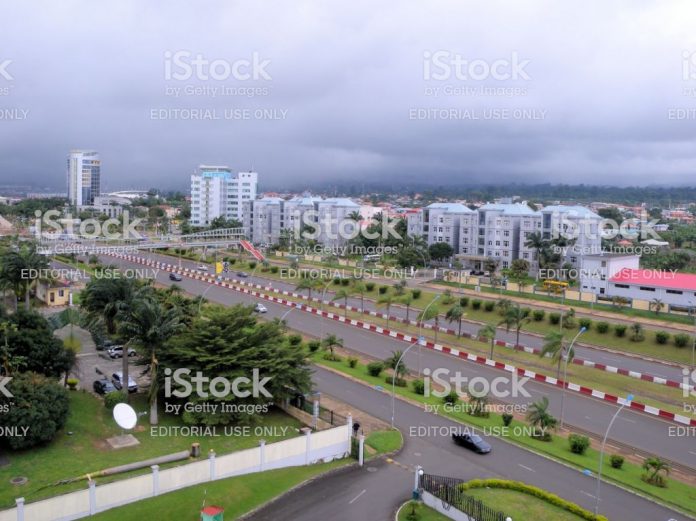
Malabo, Equatorial Guinea: view over the modern Malabo Motorway / Autopista de Malabo - GEPetrol tower on the left


Exile has never been an option for any leader or a peasant but rumour has it that one of the presidents in the East African region has established a home and business empire in Equatorial Guinea.

According to sources, Equatorial Guinea, the said leader who wields political clout around the region is said to have considered Guinea because of its close to sea and laidback in terms of influence from Western powers.

In 2017, former Gambian strongman Yahya Jammeh fled his country to Equatorial Guinea where he is exiled. It is reported that he invested most of his money he looted back in Gambia in Malabo.

The leader whom we cannot describe but widely traveled and respected but also has a lot of political clout back in his country is said to be considering Malabo as his retirement home when he retires.

Stories Continues after ad
Tech giants Facebook, Google drop out of top 10 ‘best places to work’ list

Facebook and Google

Big tech companies like Facebook Inc. and Alphabet Inc.’s Google, long seen as some of the world’s most desirable workplaces offering countless perks and employee benefits, are losing some of their shine.

The Silicon Valley companies dropped out of the Top 10 “best places to work” in the U.S., according to Glassdoor’s annual rankings released Tuesday. HubSpot Inc., a cloud-computing software company, grabbed the No. 1 ranking while tech firms DocuSign Inc. and Ultimate Software were three and eight, respectively.

Facebook, which has been rated as the “best place to work” three times in the past 10 years, was ranked 23rd. It’s the social-media company’s lowest position since it first made the list in 2011 as the top-rated workplace. Facebook, based in Menlo Park, California, was ranked seventh last year.

Google, voted “best place to work” in 2015 and a Top-10 finisher the previous eight years, came in at No. 11 on Glassdoor’s list. Apple Inc., once a consistent Top-25 finisher, was ranked 84th. Amazon Inc., which has never been known for a positive internal culture, failed to make the list for the 12th straight year.

Microsoft Corp. was one of the lone big technology companies to jump in the rankings. The Redmond, Washington-based software company moved to No. 21 from 34 a year ago.

The annual list ranks companies using employee reviews on areas such as compensation, benefits, culture and senior management. Many of the big tech companies, including Facebook and Google, have been criticized this year for a myriad of issues, and in some cases employees have publicly opposed executive decisions.

At Google, employees have protested against the company on a number of topics, including the company’s “intimidation” tactics against worker organizers. The results of an internal employee poll at the internet search giant, reported by Bloomberg in February, showed that fewer employees were inspired by Chief Executive Officer Sundar Pichai’s vision than a year earlier. It also found fewer workers believe senior management could successfully lead the company into the future.

At Facebook, which just like Google provides employees with perks including free meals, corporate transportation and laundry services, workers have pushed back internally against leadership on some policy issues, such as the decision not to fact-check political advertisements. – Bloomberg

Stories Continues after ad
Digital guide launched to help African countries fast-track SDGs, Paris Agreement and AU’s Agenda 2063 implementation

Agenda 2063

Three leading development partners have presented a digital application at the COP 25 climate conference in Madrid to help African countries grappling with the simultaneous implementation of key global initiatives.

The United Nations Development Programme (UNDP), African Development Bank Group, and the African Union Development Agency-NEPAD (AUDA-NEPAD) on Tuesday unveiled the Guide for Integrated Planning in Africa.

The guide will help  mainstream the Sustainable Development Goals, AU Agenda 2063the Paris Agreement on Climate Change/Nationally Determined Contributionsthe Sendai Framework for Disaster Risk Reduction and The New Deal for Engagement in Fragile States into African countries’ national development plans. The step-by-step guide provides African planners with a new generation of national development strategic and operational plans that mainstream these global initiatives.

Aliou Dia, UNDP Resident Representative in Togo, called the guide a welcome addition. The new guide “will help governments in the continent to accelerate the delivery of the SDGs in the decade of implementation; it will also support the implementation of UNDP’s Climate Promise whichs help countries revise and submit enhanced NDCs by 2020, and reflect them into their new national development plans,” he said.

“Good planning tools enable us to streamline our work; better planning facilitates efficient resource allocation and effective delivery. We are committed to working with Regional Member Countries to mainstream the global development agendas in the national development plans with the ultimate goal of ending poverty, generating jobs for youth and protecting the planet,” said Anthony Nyong, Director for Climate Change and Green Growth at the African Development Bank Group.

Estherine Fotabong, Director of Programme Innovation and Planning at the African Union Development Agency, said: “The Guide supports our vision to harness knowledge to deliver the Africa we want, fostering the development of the continent through effective and integrated planning, coordination and implementation of Agenda 2063 with Member States, Regional Economic Communities and Pan-African institutions, by leveraging partnerships and technical cooperation.”

The Guide for Integrated Planning in Africa will be available as a digital application, and in handbook format. The digital application will make it easier for African planners to search for and apply tools for developing a new generation of national development plans. Additional features include interactive pages that allow planners to apply tools directly on the online platform and deliver outputs, such as results frameworks or the theory of change.

Stories Continues after ad

Please ERA, we want profile for Bonang Power and Energy (Pty) Ltd

Yoram Banyenzaki

By Yoram Banyenzaki

Following the public uproar, the Minister for Tourism, Hon. Ephraim Kamuntu, informed Ugandans that cabinet had agreed to stop the planned dam at Murchison Falls as it would affect the scenery, beauty and the falls. This was in August 2019.

However, in November 2019, cabinet approved a feasibility study to be undertaken for development of a dam at the Uhuru Falls, which are located near Murchison Falls. A dam at Uhuru Falls would affect Murchison Falls.

After the cabinet approval, on Tuesday December 3, 2019, the Minister for Energy, Hon. Irene Muloni, informed Ugandans during a media briefing in Kampala that a memorandum of understanding had been signed with Bonang.

The minister said that Bonang, a South African company, would undertake a detailed feasibility study to establish whether a hydropower dam at Uhuru Falls in Murchison Falls National Park and tourism can co-exist.

OUR REQUEST

In view of the above, we hereby write to you in accordance with Article 41 of the 1995 Uganda Constitution to:

  • Request ERA to avail us with a profile indicating Bonang’s technical and financial expertise to conduct the feasibility study and;
  • Request you to inform us how ERA and government selected Bonang to undertake the feasibility study for a dam at Uhuru Falls.

Our requests are made in light of the fact that our investigations on Bonang Power and Energy (Pty) Ltd led us to believe that the company lacks the technical and financial track record needed to undertake a feasibility study and develop a dam in an environmental and human rights-compatible manner.

We cannot let a company whose track record on construction of hydropower dams is unclear to touch the iconic Murchison Falls, which are visited by over 30% of the 100,000 tourists that visit Murchison Falls National Park.

Who is Bonang?

Our investigations showed the following about Bonang Power and Energy (Pty) Ltd:

  • The company was founded on January 16, 2014 with a registration number of 2014/008439/07.
  • The company’s director is Mr. Ernest Moloi.
  • The company was deregistered on April 11, 2016 due to failure to file annual returns.
  • The company was thereafter re-registered on December 5, 2017.
  • It filed annual returns on June 26, 2019.

A search of the company’s physical location reveals little to nothing. Before the company’s website was pulled down from the web (See https://www.bonangpower.co.za/our-partners), the company’s listed physical address on its website was 195 Jan Smuts Avenue, Randburg, 2196 in South Africa. A search for this address led one to The Business Exchange, Rosebank – a commercial property that also offers co-working and virtual office space.

Surely, a company that seems to have no office of its own, lacks a web presence, lacks clear information on what hydropower projects it has undertaken cannot be trusted with one of Uganda’s most prized tourist attractions, the Murchison and Uhuru Falls.

An investigation of the hydropower works that Bonang Power and Energy Ltd has undertaken reveals unconvincing results. On its website before it was pulled down, the company listed hydropower projects that were ongoing in Africa.

However, the company’s linkage to those hydropower works was unclear as the company was not mentioned among the dams’ developers.

Do due diligence on Bonang

The signatories to this letter suspect that Bonang is a front for corrupt Ugandan officials and unless ERA, which is Uganda’s only mandated energy sector regulator, undertakes due diligence and informs Ugandans about Bonang’s technical and financial capacity, the Murchison and Uhuru falls will be destroyed.

This will hurt tourism, which is one of Uganda’s biggest foreign exchange earners. The sector earned the country $1.6 billion in the 2018/2019.

The signatories to this letter also wish to remind you that failure to exercise due diligence by government has previously cost taxpayers huge amounts of money. For instance, Uganda lost over Shs. 24 billion to Eutaw Construction Company Inc., a fictitious branch of a US firm, in the infamous Mukono-Katosi road scandal.

Among others, influence peddling by the former Minister for Works and Transport, Abraham Byandala, resulted in the loss.

It is also common knowledge that the country lost about Shs. 4.7 billion in the bicycle scam when a sham company, Amman Industrial Tool and Equipment (AITE), was procured to deliver 70,000 bicycles for local council one (L.C.1) chairpersons. To date, no bicycles have been delivered yet taxpayers’ money was paid for them.

Avoid risks

To avoid risks of Ugandans losing their much-needed money to briefcase companies that work with government officials to defraud the state, we request that you investigate and profile Bonang’s technical and financial capacity.

We request you to avail the above information on the company with us. In addition, we reiterate our call to government, through you, to avoid conducting a feasibility study and developing a dam at the Murchison or Uhuru Falls.

We thank you in advance for your co-operation.

Yours faithfully,

Yoram Banyenzaki,

Chairperson, Guild Presidents’ Forum on Governance (GPFOG)

SIGNATORIES:

  1. Guild Presidents’ Forum on Governance (GPFOG);
  2. Citizens Concern Africa (CICOA);
  3. Action Coalition on Climate Change (ACCC);
  4. South Western Institute for Policy and Advocacy (SOWIPA);
  5. World Voices Uganda (WVU);
  6. Oil Refinery Residents Association (ORRA);
  7. Africa Institute for Energy Governance (AFIEGO)
  8. Great Lakes Institute for Strategic Studies (GLISS)
  9. Centre for Constitutional Governance (CCG)
  10. Twimukye Womens Organisation
  11. Graffen Organisation –Butimba
  12. Youth Action for Environment -Kiryandongo
  13. Center for Energy Governance
  14. African Initiative on Food security and Environment
  15. Water and Electricity Consumers’ Association

CC:

  • The President, Republic of Uganda
  • The Speaker of parliament
  • The Minister of Energy and Mineral Development
  • The Chairperson, Natural Resources Committee of Parliament
  • The Chairperson, Parliamentary Public Accounts Committee
  • The Inspector General of Government (IGG)
  • The Executive Director, The Public Procurement and Disposal of Assets Authority (PPDA)
  • State House Anti-Corruption Unit
  • The Executive Director, Uganda Wildlife Authority
Stories Continues after ad
Hearing of murder case against Mathew Kanyamunyu set for next year

From left, Joseph Kanyamunyu, Cynthia and Matthew Kanyamunyu

The hearing of murder case against the Executive Director of Quantum Express Logistics, Mathew Kanyamunyu, his brother Joseph Kanyamunyu and his girlfriend Cynthia Munwangari is to be held last year.

High Court Judge Moses Mukiibi has set January 8-10, 2020 for hearing of the case.

The three are accused of shooting Akena on November 12, 2016 around Lugogo bypass. Prosecution alleges that on November 12, 2017 while at Game Stores, Kanyamunyu, in company of his girlfriend, allegedly shot Akena and drove him to Norvik hospital, where he died.

His brother Joseph Kanyamunyu is implicated on the condition that the telecom printouts indicated that he was contacted immediately after the incident, which puts him in position to be having some knowledge on the incident.

The prime suspects are currently on bail granted by Nakawa Grade one magistrate Noah Sajjabi on March 28, 2017. Mathew Kanyamunyu was bailed on October 4, 2017.

Stories Continues after ad