Facebook Twitter
  • Home
  • Politics
  • Business
  • Investigation
  • Opinion
  • Magazine
  • Education
  • Health
  • Regional
  • Games & Sports
Search
Stanbic Bank
Stanbic Bank

Eagle Online

Eagle Online

22 C
Kampala
Facebook
Instagram
Linkedin
Twitter
Stanbic Bank

Eagle Online

  • Home
  • Latest
    • Politics
    • World
    • Africa
    • Regional
  • Opinions
    • Our Take
  • Money
  • Games & Sports
  • Arts
    • Gossip
    • Health
    • Travel
    • Entertainment
  • Magazine
Stanbic Bank
  • Home
  • Latest
    • Politics
    • World
    • Africa
    • Regional
  • Opinions
    • Our Take
  • Money
  • Games & Sports
  • Arts
    • Gossip
    • Health
    • Travel
    • Entertainment
  • Magazine
Home Blog Page 1136

Over seven million people receive record levels of lifesaving TB treatment , 3m still miss out

By
Agencies
-
October 17, 2019
WHO


More people received life-saving treatment for tuberculosis (TB) in 2018 than ever before, largely due to improved detection and diagnosis. Globally, 7 million people were diagnosed and treated for TB – up from 6.4 million in 2017 – enabling the world to meet one of the milestones towards the United Nations political declaration targets on TB.

WHO’s latest Global TB Report says that 2018 also saw a reduction in the number of TB deaths: 1.5 million people died from TB in 2018, down from 1.6 million in 2017.  The number of new cases of TB has been declining steadily in recent years. However, the burden remains high among low-income and marginalized populations: around 10 million people developed TB in 2018.

“Today we mark the passing of the first milestone in the effort to reach people who’ve been missing out on services to prevent and treat TB,” said Dr Tedros Adhanom Ghebreyesus, WHO Director-General.

“This is proof that we can reach global targets if we join forces together, as we have done through the Find.Treat.All.EndTB joint initiative of WHO, Stop TB Partnership and the Global Fund to Fight AIDS, TB and Malaria”.

WHO’s latest Global TB Report, released today, highlights that the world must accelerate progress if it is to reach the Sustainable Development Goal of ending TB by 2030. The report also notes that an estimated 3 million of those with TB still are not getting the care they need.

In many countries today, fragile health infrastructure and workforce shortages make it difficult to provide timely diagnosis and the right treatments for TB. Weak reporting systems are another problem: health providers may treat people but fail to report cases to national authorities, leaving an incomplete picture of national epidemics and service needs. Further, up to 80 per cent of TB patients in high burden countries spend more than 20 per cent of their annual household income on treating the disease.

Dr Tedros added: “Sustained progress on TB will require strong health systems and better access to services. That means a renewed investment in primary health care and a commitment to universal health coverage.”

Last month heads of state agreed a political declaration on Universal Health Coverage at the United Nations in New York, highlighting the importance of expanding service coverage and committing specifically to strengthen efforts to address communicable diseases like HIV, TB, and malaria.

One way to improve coverage is to adopt more people-centered comprehensive approaches. Better integrated HIV and TB programmes already mean that two thirds of people diagnosed with TB now know their HIV status. In addition, more people living with HIV are taking treatment.

But child health programmes still do not always focus adequately on TB: half of children with TB do not access quality care and only a quarter of children under the age of 5 in TB-affected households currently receive preventive treatment.

Drug resistance remains another impediment to ending TB. In 2018, there were an estimated half a million new cases of drug-resistant TB. Only one in three of these people was enrolled in treatment.

New WHO guidance aims to improve treatment of multidrug resistant TB, by shifting to fully oral regimens that are safer and more effective. The guidance is part of a larger package of steps released on 24 March 2019 — World TB Day — to help countries speed up efforts to end the disease.

“WHO is working closely with countries, partners and civil society to accelerate the TB response,” said Dr Tereza Kasaeva, Director of WHO’s Global TB Programme. “Working across different sectors is key if we are to finally get the better of this terrible disease and save lives.”

The fight against TB remains chronically underfunded. WHO estimates the shortfall for TB prevention and care in 2019 at US$3.3 billion. International funding (which is critical for many low- and middle-income countries) amounts to US$0.9 billion in 2019, with 73% coming through the Global Fund. Last week’s successful replenishment of the Global Fund will be critical to strengthen international financing.

The largest bilateral donor is the US government, which provides almost 50% of total international donor funding for TB when combined with funds channeled through and allocated by the Global Fund.

There is an urgent need for funding of TB research and development, with an annual shortfall of US$1.2 billion. Priority needs include a new vaccine or effective preventive drug treatment; rapid point-of-care diagnostic tests; and safer, simpler, shorter drug regimens to treat TB.

“To accelerate TB research and innovation, WHO is developing a global strategy,” adds Kasaeva. “We are collaborating with academia, research networks such as the BRICS TB Research network, and partners including the Bill & Melinda Gates Foundation, UNITAID and others in a quest to bring innovations into practice to break the trajectory of the TB epidemic”.

Stories Continues after ad

High Net-Worth Investors driving Hospitality Sector in Francophone Africa

By
Agencies
-
October 17, 2019
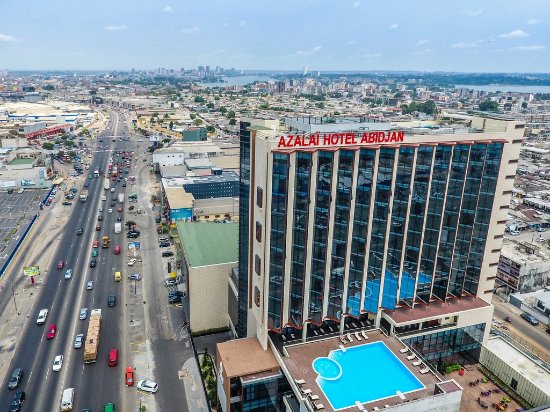
Azalai Hotel Abidjan


Francophone Africa’s burgeoning hospitality market continues to be a critical opportunity for “global hospitality brands and investors,” says the host of the second annual bilingual Franco Real Property Investment Forum, Kfir Rusin.

Taking place in Abidjan, Ivory Coast on October 29-30,  2019, the Summit is hosted by the continent’s leading pan-African real estate networking and conferencing company, African Property Investment (API) Events

According to regional hospitality analysts and advisor, Clemence Derycke of Horwath HTL, Francophone Africa’s hospitality sector is attractive to a broad spectrum of High Net-Worth Individuals (HNWIs), Private Equity, Institutional, French and Anglophone African Investors due to the lack of branded supply, and its stable CFA currency and strong demand drivers.

“Proparco has invested in Azalaï hotel and Teyliom (Mangalis Hotel Group), and at the same time, Grit Real Income Group has just acquired the Club Med Cap Skirring property in Senegal,” says Derycke.

According to Derycycke, the market is very active with global and regional brands “targeting hotel openings in the majority of the region’s major cities.”

“Accor has been very active in Francophone Africa. It has more hotels and its pipeline remains robust, while the Radisson Hotel Group (RHG) has recently been very dynamic with opening flagship hotels in most capital cities. They are now looking for new development in the resort or the midscale segments,” says Derycyke.

While these brands are currently leading development in the region, other international brands, including the Marriott and the Sheraton Four points are also expanding into what is Africa’s hottest hospitality market.

According to RHG Development Director for Francophone and Lusophone Africa, Erwan Garnier, the region is a primary focus for the group with the international brand aiming to add significantly to its portfolio over the next five years.

As one of the Francoreal’s Forum’s numerous international and returning industry speakers, the two-day conference is “a great networking opportunity” he says.

As Garnier adds, “We currently have 16 hotels and over 3, 000 rooms in operation and a further 13 hotels and almost 2,000 rooms under development in Francophone Africa.”

FRANCOPHONE STRATEGY

To fuel its growth strategy, the group has created a specialized French-speaking development team which can align to the group’s Africa development strategy of focusing on capital cities, financial hubs and resort destinations.

Being fluent in the language and local market dynamics, helps the Radisson Hotel Group to be focused and “competitive in the market,” says Garnier.

“We have identified seven pro-active cities in which we are focusing our efforts for scaled expansion. The two primary focus cities are Abidjan and Dakar, followed by Douala, Yaoundé, Kinshasa, Mauritius and Seychelles,” he says.

Adding that the group has opened two new hotels in Algeria and Niger, with the group employing a development strategy that is focused on the business segment for hotels, resorts, serviced apartments and mixed-use developments.

The Radisson Blu Hotel & Conference Center Niamey, Niger is the first five-star hotel to be built in the country and ‘made development history, for good measure”, says Garnier.

“The hotel was the first five-star hotel to be completed from design to construction in 11 months,” says Garnier.

With two more hotels set to open in 2019, including a second hotel in Morocco (Casablanca), the market provides value for the hospitality group, and is very attractive for real estate investors, particularly “High Net-worth Individuals (HNWIS) investors,” many of whom are the biggest sources of current investment, says Garnier.

For Rusin, the value of the conference is to highlight the opportunities for investors in one of Africa’s most exciting markets across the ecosystem. “Hotels provide significant opportunities for global brands and investors, but beyond this sector, we look forward to exploring opportunities in retail, logistics, housing and more.”


Stories Continues after ad

Gov’t takes over water supply in refugee camp

By
Francisco Adongo
-
October 17, 2019
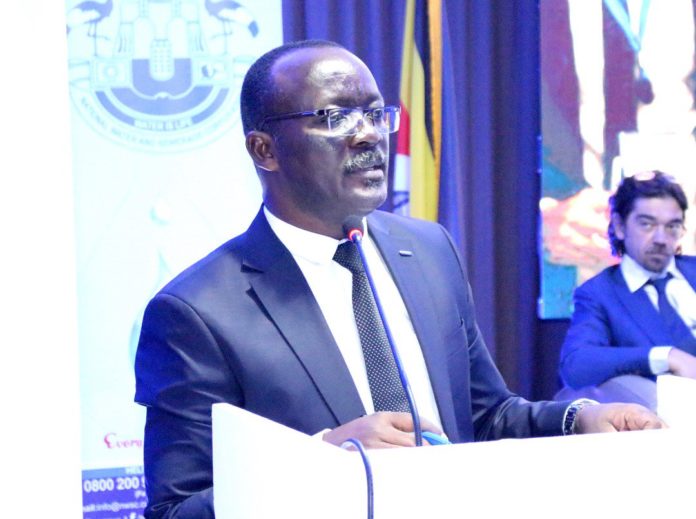
NWSC MD, Dr. Silver Mugisha .


National Water and Sewerage Corporation (NWSC) and the UN High Commissioner for Refugees (UNHCR) signed today a landmark agreement that will ensure reliable water provision for more than 84,000 refugees and local Ugandans in the south-west of the country.

Under the Memorandum of Understanding, the NWSC will take over the management of the water distribution system and assets from UNHCR and the Office of the Prime Minister (OPM) in Rwamwanja refugee settlement, Uganda’s Kamwenge district. The system has been managed and maintained by UNHCR and OPM since 2012, when the settlement was reopened to receive new refugee arrivals from the Democratic Republic of the Congo (DRC).

In Rwamwanja settlement, water is currently supplied through six motorized boreholes (five solar-generator hybrid and one fuel-driven), 82 manual boreholes and shallow wells and six protected springs, which now will be integrated into the national water supply system.

While this is the first pilot of this kind in Uganda, refugee and local communities in and around the settlement will receive an average of 20 litres per person per day (l/p/d) once the scheme becomes fully operational, up from the current supply of 17.5 l/p/d. As part of the initiative, the existing water network will be further extended, bringing water closer to the communities and reducing the waiting time at water collection points.

“We are grateful for the ongoing efforts of the Government of Uganda to integrate refugees in government service delivery systems,” said Joel Boutroue, UNHCR Representative in Uganda. “This is in line with the spirit of the Comprehensive Refugee Response Framework (CRRF) and the need to leverage government institutions in providing more sustainable solutions for refugees and their hosts,” said Boutroue adding that the support from development partners is critical to take initiatives like this to scale.

“We are happy to be able to provide water to this vulnerable section of our population. We will provide safe clean water and guarantee efficient and reliable service. NWSC is committed to providing water for all,” said Dr. Eng. Silver Mugisha, Managing Director of NWSC adding that this initiative is in line with NWSC’s current Service Coverage Acceleration Project (SCAP100), seeking to connect water to 12,000 villages by the end of 2020

Uganda is currently home to approximately 1.34 million refugees, with more than 79,000 new arrivals since January this year. The government launched the CRRF in March 2017, calling for a whole-of-society approach to better manage refugee influxes and find long-term solutions to address the needs of refugees and the communities that host them.

Stories Continues after ad

Police arrests two for killing own child

By
Isaiah Mwebaze
-
October 17, 2019
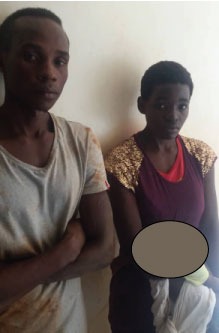
Patrick Busulwa and his wife at Wakiso police Station.

Police in Wakiso have arrested two suspects for allegedly murdering their child one Patrick Ssimbwa aged two and half years.

The incident happened in Ssumbwe village, Ssumbwe Parish, Wakiso sub county in Wakiso district.
The deceased was murdered by his biological father one Patrick Busulwa M/A aged 23 years old, local plumber, resident of the above address.The suspect hit the deceased on the floor of their house and later packed him in blue cavera, dumped in the nearby swamp and on night of  October 16, 2019 at 2130 hours,he later on transferred the body and dumped in the pit latrine.
The incident of murdering the deceased occurred on October 13, 2019 at about 2130/c from the above address area.
The crime scene was visited by DPC Wakiso, DCIO, OC CID Buloba Police station,OC Post Bulaga, SOCO,Fire Brigade and other investigating officers.

The body of the deceased was retrieved from the pit latrine by fire Brigade.
The father to the deceased and step mother to the deceased one  Allen Mukirwa F/A aged 18 year were arrested and detained at Wakiso main station.
The body of the deceased has been taken to Mulago City mortuary for post mortem and the suspects are being charged with murder.

The case was first registered as disappearance vide above reference by the father to the deceased after area local council authorities put him on pressure to account for whereabouts of the deceased.
Later police was called in and interrogated him and he confessed to the killing as
he led Police to Mr. Noah Nsereko’s pit latrine, where the body was found.

Stories Continues after ad

Justice Tsekooko praised for his honest service

By
Simon Kabayo
-
October 17, 2019
Justice Tsekooko


Departed former Supreme Court judge John Wilson Tsekooko has been praised for his incorruptible service to the judiciary and the country at large by mourners during the funeral service at St. Luke Church of Uganda-Ntinda.

Speaker after speaker eulogized Justice Tsekooko as a man of integrity and truth. Chief Justice Bart Katureebe described him as a straight forward person who always spoke and wrote what was the truth.

State Minister for Environment, Dr. Goretti Kituutu who doubles as woman Member of Parliament for Manafwa praised Justice Tsekooko for mentoring her into a leader she is today.

“He was a honest man and to some of us, he was a great pillar, I remember he was a great friend of my father and in turn my father was his campaign manager and indeed, not like the case today with the youth, that time, my father directed me to vote for him as our area member of parliament. However, when I was elected into parliament, I consulted him and indeed he gave me wise counsel” Dr. Kituutu eulogized.

Justice David Wangutusi, the head of Commercial Court who spoke on behalf of family friends told mourners that he was introduced to the late Justice Tsekooko by his father who was a friend with Mr. Tsekooko but warned him the man he was introducing to wasn’t incorruptible.

“I was still a young man study at Makerere University but I would often pay visits to my father at his office and Justice Tsekooko was his friend as they shared the building where their offices where located, one day, he introduced me to him but said “This man does not eat bribes and that is the man I have known until his departure”. Justice Wangutusi said.

Dr. Denis Bwayo, the son to the late Justice Tsekooko paid tribute departed father as being a committed family man but who loved to read. “My daddy loved reading and until his being hospitalized, he had two libraries with so many books to read”

The service was attended by who is who in the judiciary; former retired justices and judges of the court. Others include former Forum for Democratic Change leader, Dr. Kizza Besigye and a number of members of parliament.

After service, his remains were transport to Mbale for a night vigil at his home at Senior Quarters on Plot 6B Masaba Road before another funeral service at St. Andrews Cathedral. Justice Tsekooko will be laid to rest on Saturday at his ancestral home in Bunakhaima village, Butiru Sub-County Manafwa district.


Stories Continues after ad

Four ideas for your business on how to celebrate information overload day on October 20th

By
Guest Writer
-
October 17, 2019
Ram Kezel


By Ram Kezel


 It’s an Information Overload Day this Sunday October 20, 2019. It reminds us that too much information can have a negative impact on people’s happiness and productivity. Your business communication shouldn’t be the reason for such impact. So here are 4 ideas on how your business can commemorate the day of information overload.

Avoid Making Cold Calls 

A phone call is a great way to get all the person’s attention. During a call, people stop doing whatever they were doing and concentrate on the conversation only. Marketers like to grab all the attention, but cold calls irritate people. Therefore, people avoid answering their phones, because they don’t want to pause their activity for an unknown number.

Bankmycell conducted a millennials survey to understand why they avoid picking up the phone.  Main answers were these:

§  75 per cent of respondents said they don’t answer because calls eat up their time;

§  64 per cent said they won’t answer if the person calling them is a “whiny” or “needy” type of person;

§  55 per cent of calls are avoided because the millennial is busy and needs to turn up to an event.

Survey respondents are people born between 1981 and 1996, but the results seem to be quite universal. Calls from unknown numbers can be seen as unnecessary information. If you want to celebrate Information Overload Day, cut your cold calls.

Make Sure Your Emails Are Not Spam

With the cold calls off the table, you can use emails and newsletters to inform about your business products, services or special offers. Even Medium states, that newsletters become popular again. The important part is to keep in mind the newsletters’ quality and frequency.

The worst scenario for a newsletter is to be marked as spam. To avoid landing in spam inbox it is beneficial to check the people’s opinion, what kind of emails they consider as spam. TechnologyAdvice did a survey on this and asked people “For what reasons have you marked a business’ emails as spam?” Top three answers were these:

§  8 per cent – They emailed too often;

§  4 per cent – I didn’t purposefully subscribe;

§  6 per cent – They sent irrelevant content.

This survey gives you the best advice for this Information Overload Day. To make your newsletters welcome in people inboxes, do the exact opposite of what people dislike. Send your letters in moderate frequency. Contact only those who subscribed to your newsletter. And craft the content specifically for your audience.  

Create Your Website In A Minimalistic Manner

You make calls and send emails when you want to reach people. But quite often people want to reach you and then they check your business website. When creating a website, remember that people usually have several tabs open at the same time. There are also emails and work chats going in the background. That’s a large flow of information. So it’s beneficial to have a minimalistic business website in order to maintain attention.

Balys Krikščiūnas, CEO of hosting provider Hostinger, suggests these steps for your business website on this Information Overload Day:

§  First, disable all the auto play content. People tend to instantly close the website that has a song or a video playing in the background;

§  Check your website content. Avoid using professional slang when you can say the same thing in simpler way;

§  Work on your buying process. It shouldn’t have too many steps. People should be able to provide all the necessary information within just a few clicks.

“Another important part is the design of your website. It should be clean and minimalistic. This helps to highlight your content, products or services. And people won’t be distracted by it.” – says B. Krikščiūnas.

You don’t need all those hashtags

As for social media, there is no single rulebook for dos and don’ts. But one thing can be really overwhelming for people – it’s the hashtag overload. Hashtags are a good tool to label your content. But too much of them make no sense at all.

Marketing specialist Rebecca Kowalewicz warns in her Forbes article: “Forcing hashtags into a Facebook post, or any social post, takes away from the tone of the message or conversation.” On this Information Overload Day better concentrate on your business social media content quality rather than the number of hashtags.

Your business is up there for people. Remember this when communicating with them. Your communication flow should be tailored to inform people, not overwhelm them. You should take good care of your communication all year round. But this Information Overload Day can be a great time to check new ideas and put them in use for your business.


The writer is Public relations coordinator at Hostinger


Stories Continues after ad

Wife avails evidence indicating Sebuliba is son to tycoon Mohan Musisi Kiwanuka

By
Geoffery Serugo
-
October 17, 2019
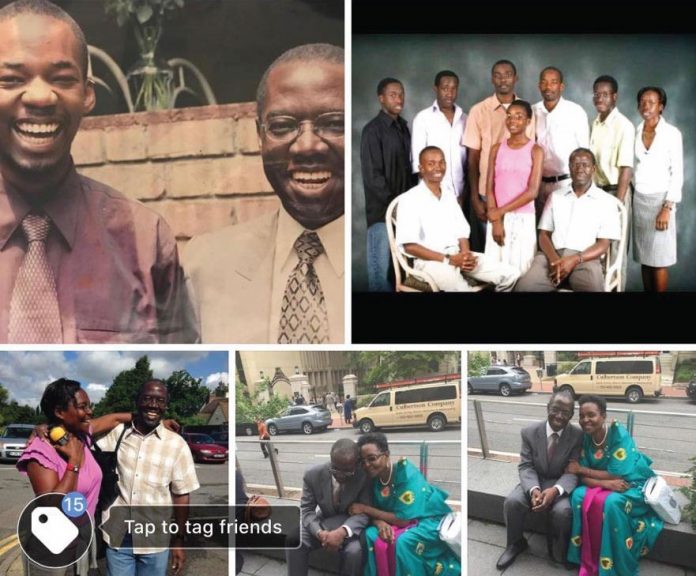
The Kiwanukas


Mrs. Beatrice Luyiga Kavuma Kiwanuka, the mother of a doubted son, Jordan Sebuliba Kiwanuka, has come out to say that her first born belongs to the city tycoon, Mohan Musisi Kiwanuka.

Availing a number of documents which included, Mohan Musisi Kiwanuka’s letters addressing the Sebuliba as his natural son, Beatrice said the son belongs to him. Recently, there was a feud between Beatrice and Mohan after he denounced Jardona Sebuliba Kiwanuka as his son.

According to supreme laws of the land, one can only be a son or a daughter to someone either by adoption or by birth and this can only be proved through deoxyribonucleic acid (DNA) conducted from both a parent and the child.

Recently, Mohan said Beatrice Luyiga Kavuma Kiwanuka was impregnated by a man from western region when she attended a conference in Entebbe. He said he noticed that she was pregnant and asked her to do a DNA for the baby (Sebuliba). However, Beatrice declined convincing him that the baby belongs to him and tossed him till he decided to look after him as his son.

According to a letter dated December 11, 2012, addressed to the Visa section, embassy of the republic of South Africa, backing Sebuliaba’s application for the visa, Mr. Mohan addressed the Sebuliba Kiwanuka as his natural son and enclosed the air ticket and hotel bookings for him.

The son was travelling to South Africa on a holiday between December 25, 2012 and January 3, 2013. At the time, Mr. Kiwanuka, the father was the manager of Bank of Africa Uganda limited and the chairperson of Oscar industries, a company that deals in the manufacturing of stationery and printing.

In another letter dated April 11, 2012, supporting the son’s application for a two year multiple entry visitor’s visa to United Kingdom, Mr. Kiwanuka still addressed Sebuliba as his natural son. “Sebuliba is accompanying his natural sister Janine Kiwanuka to tour various universities that had granted her admission for undergraduate degree study,” reads part of the letter.

On October 20, 2008 the chairman also jotted another letter to South African embassy supporting sebulime’s application for a visa. According to the letter, Sebulime who he regarded as his natural son was accompanying him to visit his daughter Janine Kiwanuka at half term and they spent there eight days. He also said Sebulime will be stepping in to fulfill his duties in case he (Mr Kiwanuka) was incapable of doing so.

Mohan Kiwanuka wrote various letters supporting visa applications for various family members who included his wife Beatrice Luyiga Kavuma Kiwanuka, and Jordan Kiwanuka who were going to visit Janine in South Africa.

Contested son has been part of the family activities and he was part of the family members who attended the wedding of Jordan pearl Kiwanuka and Michael Hass in Germany in 2015. This however is insubstantial to show that he is a son to the city tycoon.

In August, Jordan Sebuliba Kiwanuka lounged a case against his father Mohan Musisi Kiwanuka claiming that the respondent is suffering from a debilitating and degenerative condition of Alzheimer’s or dementia, which is presumed to have been progressive over the last six or so years but has become quite severe and imposing on the respondent’s health in the recent past.

According to the application, Sebuliba asked court to subject the respondent to a medical examination and if it is established that the respondent was of mind then the applicant be appointed as a Personal representative/Manager of the Estate of the respondent.

To his dismay, high court judge Ssekaana Musa, dismissed the application and ordered both parties to meet their costs.

After court ruling, Mohan, said it all started from a disagreement over one of his properties, Seven Trees Gardens located in Kololo along Dundas Road that Sebuliba had occupied without his permission, a vice that had never been done by any of his siblings. He has occupied the property for the past 10 years without remitting any monies to his dad nor paying rent for it.

He said Sebulime used to rent out the venue for parties among other events and earned over Shs600 million every year and went ahead (Sebuliba) to ask court to compel his father to pay him shs1.6 billion for him to leave the premises.

“What amuses me is the person (Sebuliba) fighting over my property when I’m still alive is not my biological son. I raised him as my son. I even took him to good schools, including to a University in UK from where he studied his law degree,” he said.

Stories Continues after ad

REVEALED: Dfcu Bank in search of new Chairman to replace Jimmy Mugerwa

By
Our Reporter
-
October 17, 2019
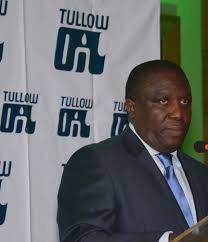
Mr. Jimmy Mugerwa, the board chairman of Dfcu bank who is accused by some shareholders for the bank's poor management.

After the departure of Jimmy D. Mugerwa to Tullow Oil plc in London only in August, emerging reports indicate that Dfcu Bank is on the clandestine hunt for a new person to replace him as Chairman of the board of directors.

“We are looking for Mugerwa’s replacement and anytime we shall announce that person,” a top executive at the bank said on condition of anonymity for he is not authorised to speak to the press on such sensitive matters.

He added that the bank is looking for the person with integrity who can help it redeem its image that was tarnished after it was established it controversially acquired its rival Crane Bank Limited (CBL) in January 2017.

The new Chairman, if appointed will work hand -in-hand with the new Chief Executive Officer Mathias Katamba who only joined the bank in January 2019 after the resignation of Juma Kisaame whose reign at the helm of that institution would later create controversy due to bad business deals he signed as CEO of the bank.

The source further said the new Chairman will be tasked to normalize work relations between top managers of the bank who he says are antagonistic to each. It should be remembered that before Katamba was brought in from Housing Finance Bank, it was rumoured the then Chief of Business and Executive Director of Dfcu Bank William Sekabembe would take over from Kisaame.

The appointment of Katamba, according to insiders did go well with Sekabembe especially that he declined to take up the role of Managing Director at KCB Uganda in anticipation that he would succeed Kisaame. “He felt unappreciated by the board after Katamba was appointed,” a source said.

Now among others, the new Chairman being hunted will have to work hard to ensure that top managers at the bank work together to take it to higher levels.

Meanwhile, Mugerwa, the first Ugandan General Manager for oil company Tullow Oil Uganda was recalled to Tullow Oil PLC in London in a move analysts said was a result of the bad press Mugerwa had been attracting as Dfcu bank’s board chairman. This, according to insiders, had been tarnishing Tullow Oil’s international image.

Mugerwa got the job because of his experience as a top manager at Shell and his expertise in government relations, which Tullow needed badly.
Mugerwa who previously worked in Shell’s East Africa business where he was General Manager of Sales & Operations and served as Shell Kenya Country Chairman, a position he has held since October 2009, has however had a rough corporate ride both at Tullow and Dfcu.

Mugerwa was appointed Tullow Oil General Manager when the partners within the Lake Albert Graben were about to embark on a major oil development which would see Uganda enter the league of oil producing nations.

However, Mugerwa’s stewardship at Tullow Oil Uganda had not achieved much, with the farm down facing challenges as US $900 million oil block sale in Albertine Graben remains to be concluded due to tax disagreement between government and Tullow Oil as well as Total and CNOOC.

As chairman Dfcu bank, Mugerwa helped the bank to acquire Crane Bank Limited, which became controversial, leading to the resignation Kisaame after receiving assets of CBL at only Shs200 billion, paid in installments, without interest on top.

The investigation by the Auditor General and the probe by Uganda Parliament on the seven banks closed by the Bank of Uganda (BoU), unmasked Dfcu bank as a player in fraudulent transactions that led to the purchase of assets of Crane Bank Limited and Global Trust Bank Uganda in January 2017 and 2014 respectively.

The bad press that followed Dfcu and BoU left Mugerwa and other top bank managers open to professional criticism over their judgement and decisions taken.

Mugerwa also watched as Sebalu $ Lule Advocates misadvised the bank to transfer freehold land titles CBL/ Meera Investments Limited into its names after acquiring the former rival. Dfcu Bank is currently searching for other rental spaces in a bid to move some of its branch operations from the contested properties.

Stories Continues after ad

Nairobi to host two-day forum to increase the impact of banking and microfinance in EA

By
Our Reporter
-
October 17, 2019


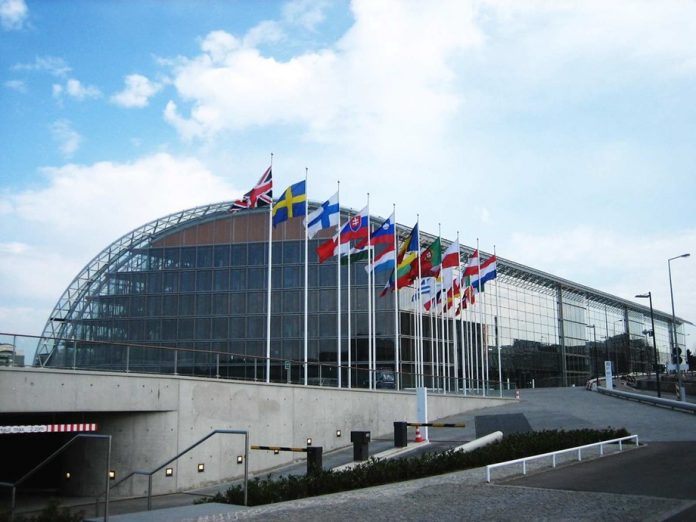
Nairobi will this week host the EIB Eastern Africa SME and Microfinance Banking Forum.  The event, being held for the second time in the Kenyan capital, seeks to improve the economic and social impact of private sector financing supported by the lending arm of the European Union in East Africa (EA).

“Ensuring access to finance and increasing the impact of business investment is key for Kenya’s future. The European Investment Bank has proven technical and financial experience supporting successful private sector businesses in Africa. The EIB Eastern Africa SME and Microfinance Banking Forum is a unique opportunity for Kenyan finance and microfinance professionals and business leaders to share best-practice and contribute to economic and social development across East Africa. This week’s meeting builds on the strong track record of close cooperation between the EIB, the European Union and the Kenyan finance and business community; providing financing to help business growth and improve skills that expand the impact of responsible banking.” said Sheila M’Mbijjewe, Deputy Governor of the Central Bank of Kenya.

“Enabling a thriving private sector is essential to create jobs, unlock economic opportunities and improve social development. In recent years cooperation between African and European partners here in East Africa has enabled the European Investment Bank, the EU Bank, and EU supported technical assistance to strengthen the impact of tailor-made lending programmes. The two days of discussions this week will share lessons learnt from successful financing for businesses across the region and banking best practice.” said Ambassador Simon Mordue, Head of the European Union Delegation in Nairobi.

Sharing experience from EUR 1 billion private sector support in East Africa

Over the last decade the European Investment Bank has provided more than EUR 1 billion in East Africa for private sector investment across East Africa.

“Thousands of companies across East Africa have benefited from the close cooperation between African and European partners and the skills of more than 9,000 business finance professionals strengthened through dedicated training programmes. The European Investment Bank looks forward to intense discussions in Nairobi this week with microfinance and banking partners from four countries in the region to ensure even stronger impact of future private sector investment in the years ahead.” said Catherine Collin, Head of the European Investment Bank Regional Representation in East Africa.

The two-day EIB Eastern Africa SME and Microfinance Banking Forum, hosted by the European Investment Bank in partnership with the Trade and Development Bank and AFC Consultants, will enable international finance experts to share experience and best practice with leading regional banks and microfinance institutions.

Increasing access to finance by refugees and supporting vulnerable smallholders

During the EIB Eastern Africa SME and Microfinance Banking Forum regional banking experts will learn from recent innovative financing partnerships and discuss how successful schemes could be replicated.

This will include examining how refugee communities across Uganda are benefiting from banking services for the first time following  a successful training to ensure increased access to finance  refugee communities, organised  in cooperation with Centenary Bank and UNHCR.

Experience gained from the EIB’s first dedicated support for long-term agriculture investment in Kenya,  working with Equity Bank across the country will also be shared. The scheme launched earlier this year is helping agriculture companies to modernise and harness the full economic, employment and export potential of agriculture. The programme is enabling local currency financing for farmers and access to seven year loans.

Sharing local understanding and international best banking practice

This week’s event will bring together more than 110 regional banking, microfinance and business leaders, international finance experts and foreign Ambassadors to share experience and best practice. Local businesses will also get direct feedback to improve business plans and enhance their growth strategies.

The EIB supported 60 projects across Africa in 2018 with €3.3 billion in investment. €1.6 billion went to private companies in sectors such as telecommunication, energy and agriculture.

The EIB is the long-term lending institution of the European Union owned by its Member States. It makes long-term finance available for sound investment in order to contribute towards EU policy goals.


Stories Continues after ad

Calling ‘enemy’ fire ‘friendly forces’: Villa Somalia new modus operandi

By
Guest Writer
-
October 17, 2019
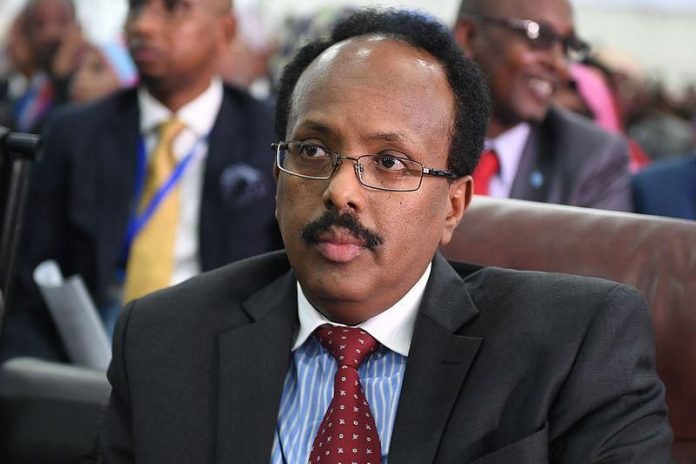
Somalia President Abdullahi Mohamed Farmajo

Eight months into the reign of president Farmaajo, on October 14, 2017, two trucks laden with bombs exploded in Muqdishu killing over 500 people. This attack was the single deadliest act of terrorism in Somalia and Africa at large. It also represented the third deadliest terrorist bombing attack and the seventh-deadliest act of terrorism in modern history, surpassed only by the 1990 massacre of Sri Lankan Police officers in Sri Lanka, the 2008 Christmas massacres in the Democratic Republic of the Congo, 2007 Yazidi communities bombings, the 2014 Camp Speicher massacre in Iraq, and the September 11 attacks in the United States. The lead up to the commemoration of the anniversary of this heinous act of terror is always a sacred time for most Somalis due to the significance of the attack.

The lead up to the second anniversary of the attack was anything but comparable to the previous one. Coming on the backdrop of a bitter contest between the federal government and the leadership of the semiautonomous Jubbaland, where villa Somalia’s overtures seemed to lose to the determination and commitment of the people of Jubbaland to remain independent of the Muqdishu corruption, there were bound to be some reckoning. The last straw in the contest was the federal government trying to block the validation of the election by blocking attendees to the inauguration of Madobe, they fell short on this one too as several local and regional leaders found their way to the highly successful ceremony.

Upon the peaceful conclusion of the Jubbaland election, the head of UNSOS Lisa Filipetto made plans to visit both Kismayu and Dhobley and meet Madobe, from the UN compound in Muqdishu. NISA, the Somalia intelligence agency headed by ‘former’ Al-Shabaab amniyaat Fahad Yassin came to learn this at a time Villa Somalia would do anything to stop another Madobe photo op with an influential individual. Having become aware of the procedures at the UN compound, NISA was well cognisant that the quickest way to halt the plans was to have the threat level against the Director and his team elevated.

NISA advised the president that the simplest way to stop the planned visit and the eventual photo op was to have the threat level elevated in the UN compound. Aware of the repercussions of using the Somali National military soldiers in an attack necessary to their desired outcome, they decided to call on their buddies across the battle lines or so we have always thought these lines did and do still exist. The line between the Farmaajo government and the Al-shabaab has eroded overtime and the confluence of their interests have never seemed more aligned. This attack and several others that have served the crooked interests of the current president are all proof of this unholy alliance.

The complicity of the current Somalia president seated in Muqdishu in the attack on the UN compound in the capital has been proven in all but a video of Farmaajo and the Al-Shabaab leadership toasting to a successful attack. All intelligence reports have suggested, with evidence that the attack was carried out on the direction of, on the behalf of and for the selfish interests of the president and his cronies.

The president having tasked his relatives, friends and associates in the terror group responsible for the deaths of thousands of innocent Somali women and children; bombed out of their precious souls in their day to day living in restaurants, market places, streets and homes, stayed easy awaiting the execution of his malevolent plan.

On October 13, 2019, being the eve of the 2nd anniversary of the deadliest terrorist attack on Somali soil, the terrorist group responsible for that attack shelled the UN facility with mortars, the people funding and directing the peace initiative beside many other humanitarian efforts, at the behest of the president of the same people.

The president was elected and sworn into office to protect the people of Somalia from Al-Shabaab and lead them to prosperity but he and his evil clique betrayed them by working with a terror organization hell bent on not only destroying the fragile fabric of the state of Somalia and curtailing efforts to bring back peace and prosperity but also taking hundreds of lives in the process.

If the federal government of Somalia can connive with the Al-shabaab terror group to shell a UN installation with mortars in order to stop a UN official from visiting a duly elected regional leader without any regard to the probability of loss of life or the repercussions to the people for who’s welfare he is responsible for should the UN fold up and leave the country to its own means, what else is he capable of?

The betrayal, the evil acts and the duplicity of Farmaajo and his evil circle at Villa Somalia cannot and should not continue unabated. The people of Somalia and the organizations championing the peace process in the country must learn that the current Somali government is carrying water for concern groups or individuals with interests contra to the wellbeing of the state and the people of Somalia.

Mohammed Ise Khayre

The writer is a Somali national and an anti-corruption activist

Find him on twitter @Ise_Khayre

Stories Continues after ad
1...1,1351,1361,137...2,376Page 1,136 of 2,376
Eagle Online

© Eagle Online. All rights reserved.

Facebook
Twitter

About Us

  • About us
    • Our Staff
    • History
  • Employment Opportunities
  • Contact Us
  • Privacy Policy
  • Eagle Online

Popular Category

  • News13746
  • Business3328
  • Games & Sports2356
  • Africa1078
  • Entertainment933
  • Health700

Editor Picks

Commonwealth Resort Munyonyo named among four hotels with five-star status in UTB new rankings

February 19, 2026

Games, Markets and Money: Rethinking Risk and Regulation in Uganda

February 19, 2026