Stanbic Bank
Stanbic Bank
22.5 C
Kampala
Stanbic Bank
Stanbic Bank
Home Blog Page 1153

NRM wins Hoima and Kaabong Women’s Parliamentary seats.

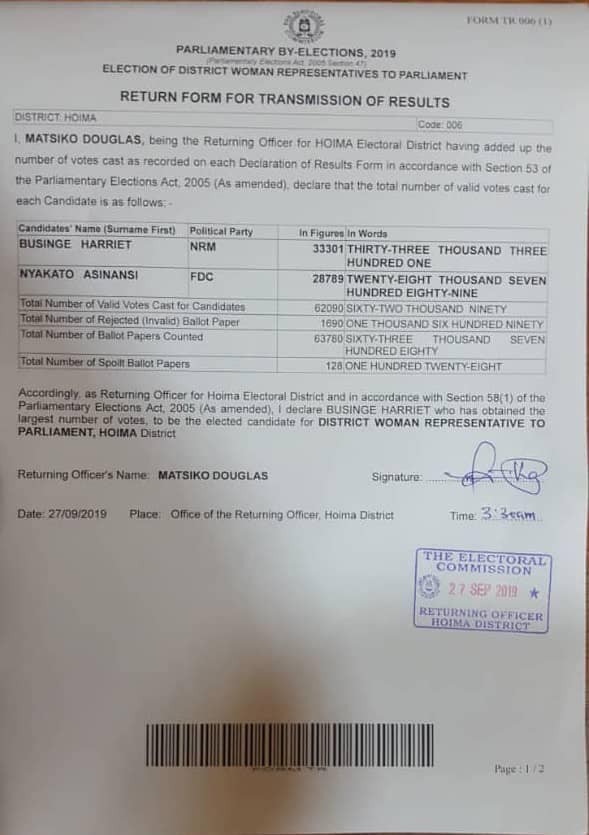
Busingye Harriet has been declared the duly elected Woman Member of Parliament representing Hoima District.

Hoima district returning officer Matsiko Douglass declared Businge winner of the women’s seat after beating her rival Nyakato Asinasi of the Forum for Democratic change with 33,301 votes against twenty 28,789.

The by-election was intended to fill a vacancy left behind after former Hoima District Woman MP, Kaahwa Tophace Byagiira crossed to represent a newly created district of Kikuube.
Hoima district in mid-western Uganda is comprised of two (2) Counties, one (1) Municipality, 17 Sub Counties 69 Parishes and total number of 143,272 Voters on the register.

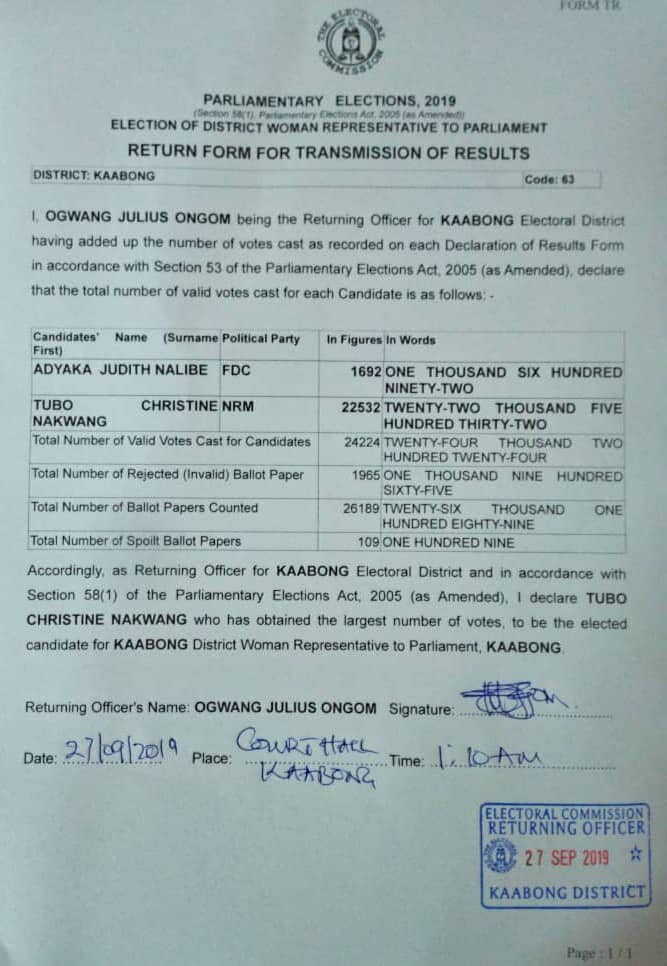
Meanwhile NRM was able to win Kaabong district as Christine Tubo Nakwang got 22532 votes against FDC rival Judith Adyaka Nalibe who got 1692 votes though she had withdrawn from the race against the wishes of her party.
HOIMA AT A GLANCE

In elections were held in 266 polling stations, 69 parishes, and 17 Sub Counties that make up Hoima District.
According to election observers, polling in about 20 percent of the polling stations did not commence on time – because the mandatory five (5) voters to witness the opening of the polling were not present;

In about 10 percent of the polling stations, voting commenced after 7:30am because of delayed delivery of polling materials.  Voting at Kyarwabuyamba Mosque – north and south polling stations in Bujumbura Division started after 9:00am due to late arrival of voting materials;

Polling Officials at all polling stations observed were however present and in time to commence polling at 7:00am;

Polling Personnel:

Polling Officials including a Presiding Officer (1), Polling Assistants (2) and Polling Constable(s) (1-2) were present at each polling station throughout Hoima District;

Whereas Polling Officials appeared knowledgeable about their role in election administration, in about 5 percent of the polling stations visited, officials did not appear confident to execute their duties independently.  The Presiding Officer at Hoima Municipal Council K-Z polling station was not confident enough to verify the quantities of the polling materials received from the EC.  It had to take the intervention of superior EC staff to confirm the quantities of the polling materials received, for polling to commence (after 9:00am);

Women, Youth and PWDs Participation on Election Day:

There was an\ impressive participation of women and youth in the process on Election Day as polling officials, security agents and voters. In 90% the polling stations visited, remarkable attempt was made to satisfy gender balance in the composition of polling officials.  At least 50% of the polling officials were female;

Neither the EC nor political parties and candidates recruited Persons with Disabilities (PWDs) either as polling officials or candidate’ agents – in the polling stations observed;

There was a higher presence of female voters at 85% of the polling stations visited.  Hoima Boma polling station in Kahoora Division for instance had 334 registered voters; 179 of these were female.  By 7:30am, eight (8) of the ten (10) voters in the queue were female.

Political Party Agents:

The polling stations had presence of candidate’ agents (National Resistance Movement and Forum for Democratic Change);

Political party/candidate’ agents arrived at almost 80% of the polling stations before 7:00am;

Each of the candidates’ agents had a copy of the voters’ register.  Agents appeared to be vigilant and well trained about their roles.  At Hoima Municipal Council polling station, a candidate agent identified three (3) persons on the voters’ register who she claimed were ineligible voters (dead);

Voting Process

The voting process was generally orderly and appeared to be well understood by the voters. Polling staff assisted voters that required clarity on the procedure and process. In at least 60% of the polling stations, priority was given to the aged, pregnant women, voters with infants and persons with disabilities. In accordance with election regulations, voters who required assistance were also allowed to vote with assistance from a person of their choice;

There was higher prevalence of assisted voting in the rural areas of Hoima district;

Some people were not in the voters register despite having Voter Location Slips allocating them to specific polling stations.  For instance, at Kihule trading center polling station and Bwikya Muslim polling station A-K in Mparo Division, four persons with Voter Location Slips were turned away from the polling stations because their details could not be found on the voters register;

Throughout the polling day, there was numerous allegations and counter allegations of voter bribery as well as claims and counter claims of pre-ticked ballots by both FDC and NRM political parties.  It was hard to verify the allegations though.

There was also high levels of vigilance by voters throughout the polling process.  Whereas some voters stayed around the polling stations after casting their votes, others left and returned to their respective polling stations at least fifteen (15) minutes to the closure of the polls;

Accessibility of Polling Stations:

Most of the polling stations were conveniently located for easy access by the voters. About 89% of the polling stations were located in public places and voting was conducted in the open. The number of registered voters in each polling station was manageable as most stations had less than 550 registered voters (on average).  It was however noted that polling stations in Sub Counties such as Mparo, Kyabigambire and Kitoba were distantly located requiring voters to move longer distances (more than 2 kms) to access their respective polling stations;

Biometric Voter Verification Process:

The Biometric Voter Verification Kits (BVVKs) generally functioned well. In almost all polling stations visited, the voter verification process was fast and lasted under three minutes for a voter;

At Kyarwabuyamba Mosque – north and south polling stations voting delayed to commence because the Presiding Officers mixed up the BVVK codes.  A supervisor from the EC responded and fixed the problem;

Security on Polling Day:

There was presence of uniformed security personnel during the by-election. The role of security on the polling day was largely limited to escorting electoral materials to polling stations as well as patrolling in the 17 Sub Counties of Hoima District.  Polling Constables were also present at all the polling stations observed;

Whereas there was tension reported in Kabaale Sub County due to arrests of the opposition candidate’s agents, it was noted that polling in that area proceeded without interruption or any major incidents;

Most polling stations closed on time (4:00pm) without voters in the queue.  Counting commenced immediately at almost all polling stations.

The counting process at polling stations was transparent, open and in compliance with the electoral procedures and regulations.


Stories Continues after ad

Use of-social media to manipulate public opinion now a global problem, says new report

Social media logos


The new report ‘The Global Disinformation Order: 2019 Global Inventory of Organised Social Media Manipulation’, co-authored by Professor Philip Howard, Director of the Oxford Internet Institute (OII), and Samantha Bradshaw, Researcher at the OII, is the only regular inventory of its kind to look at the use of algorithms, automation and big data to shape public life.

The report explores the tools, capacities, strategies and resources employed by global ‘cyber troops’, typically government agencies and political parties, to influence public opinion in 70 countries.

Key findings include:

o    Organized social media manipulation has more than doubled since 2017, with 70 countries using computational propaganda to manipulate public opinion.

o    In 45 democracies, politicians and political parties have used computational propaganda tools by amassing fake followers or spreading manipulated media to garner voter support.

o    In 26 authoritarian states, government entities have used computational propaganda as a tool of information control to suppress public opinion and press freedom, discredit criticism and oppositional voices, and drown out political dissent.

o    Foreign influence operations, primarily over Facebook and Twitter, have been attributed to cyber troop activities in seven countries: China, India, Iran, Pakistan, Russia, Saudi Arabia and Venezuela.

o    China has now emerged as a major player in the global disinformation order, using social media platforms to target international audiences with disinformation.

o    25 countries are working with private companies or strategic communications firms offering a computational propaganda as a service.

o    Facebook remains the platform of choice for social media manipulation, with evidence of formally organised campaigns taking place in 56 countries.

Professor Philip Howard, Director of the Oxford Internet Institute, University of Oxford said:

“The manipulation of public opinion over social media remains a critical threat to democracy, as computational propaganda becomes a pervasive part of everyday life. Government agencies and political parties around the world are using social media to spread disinformation and other forms of manipulated media. Although propaganda has always been a part of politics, the wide-ranging scope of these campaigns raises critical concerns for modern democracy.”

Samantha Bradshaw, Lead author of the report and Researcher, Oxford Internet Institute, University of Oxford said:

“The affordances of social networking technologies – algorithms, automation and big data – vastly changes the scale, scope, and precision of how information is transmitted in the digital age. Although social media was once heralded as a force for freedom and democracy, it has increasingly come under scrutiny for its role in amplifying disinformation, inciting violence, and lowering trust in the media and democratic institutions.”

The report explores the tools and techniques of computational propaganda, including the use of fake accounts – bots, humans, cyborgs and hacked accounts – to spread disinformation. The report finds:

o    87 per cent of countries used human accounts

o    80 per cent of countries used bot accounts

o    11 per cent of countries used cyborg accounts

o    7 per cent of countries used hacked or stolen accounts

In addition, Oxford researchers examine how cyber troops use different communication strategies to manipulate public opinion, such as creating disinformation, mass-reporting content or accounts, and employing abusive strategies such as trolling, doxing, or harassment. The report finds:

o    52 countries used disinformation and media manipulation to mislead users

o    47 countries used state sponsored trolls to attack political opponents or activists in 2019, up from 27 countries in 2018

Professor Howard adds;

“A strong democracy requires access to high quality information and an ability for citizens to come together to debate, discuss, deliberate, empathise and make concessions. Although there are an increasing number of government actors turning to social media to influence public attitudes and disrupt elections, we remain optimistic that social media can be a force for good creating a space for public deliberation and democracy to flourish.”

The 2019 report draws upon a four-step methodology employed by Oxford researchers to identify evidence of globally organised manipulation campaigns. This includes a systematic content analysis of news articles on cyber troop activity, a secondary literature review of public archives and scientific reports, generating country specific case studies and expert consultations. The research work was carried out by Oxford researchers between 2018-2019.


Stories Continues after ad

Prof. Balunywa’s transformation of MUBS in the past five years

Prof. Wasswa-Balunywa


Makerere University Business School (MUBS) is one of the best ranked Business School in Africa. The university has over the past four consecutive years produced the overall best student at the Makerere University Graduation.

Over the past five years, not only have the education standards improved, but also improvements on infrastructure and new buildings in the institution have been set up to give the students a better learning environment.

Prof. Wasswa Balunywa’s new developments in the School have given the MUBS community reason to smile.

Construction of around and completion of the main library

The construction work to complete the MUBS main Library resumed in August 2016. The work started with constructing a metal grill around the main library and construction of concrete slabs for reading benches in library gardens. The other part of the library known as the Library Tower is now also complete and will facilitate lectures for the Masters students.

Faculty of Computing and Informatics Building

The African Development Bank through the Ministry of Education and Sports availed funds for the construction of the Faculty of computing and Informatics at Makerere University Business School. The construction worked kicked off on June, 29, 2015 upon site possession by Ambitious construction Company and was completed on June 29, 2016. The building has ample space to host seminars and conferences.

New MUBS office block

Construction of the MUBS Main Gate and Fence

The School management commenced on plans to relocate and redevelop the Institutions’ Main Gate to give MUBS a new face uplift and also to reduce traffic congestion at the Campus during peak hours. The main gate is relocated 30 metres into the School from its current position and it is redeveloped into a two-lane to reduce traffic congestion.

This is one of the ongoing constructions in the school this year. All historical artifacts of the main gate such as the emblem will be preserved. It is believed the new renovation, which will include the installation of lights will help to combat crime around the campus, which tends to be a big threat within the institution. The construction work has also involved a much improved block fence, roads and pathways within the School.

Construction of St. James’ MUBS Chapel

MUBS started the construction of the church since May 2018. The Chapel has a seating capacity of 1,200 people. The overall construction work cost almost Ugx.340M. The development is a way of promoting God’s work in the School plus the financial support it renders to set up of permanent places of worship for the different religious sects in the MUBS community.

New Office Block (Formerly known as Block 1)

MUBS completed the construction of the New Office Block that was formerly known as Block 1. It has been reconstructed and the offices that will be housed are; Human Resource Directorate, Bursar’s Office, Procurement and Disposal Unit, Internal Auditor, Strategy and project’s office.


Stories Continues after ad

Hoima by- election: FDC’s Nyakato takes early lead over NRM rival

Asinansi Nyakato

The joint opposition candidate in Hoima by- election, Asinansi Nyakato of the Forum for Democratic Change (FDC), has taken an early lead according to provisional results.

Nyakato is up against NRM’s  flag-bearer Harriet Businge Mugenyi aka Baby Face in a race to become the next Woman MP for that district.

According provisional results obtained from this website’s reporters, Nyakato is leading the race.  Hoima public library Nyakato 95-Baby face 42,  All saints Hoima town parish Baby face 31- Nyakato 60, Hoima public P/S Nyakato 86- Baby face 64,  Mandela o-z Businge 41- Nyakato 76 Counting still going on.

HOIMA UPDATE
Bukerege polling station:
Nyakato 63
Businge 94

Siba kapapi
Nyakato 354
Businge 60

Birungu catholic
Nyakato 166
Businge 131

Kibingo itara
Nyakato 213,
Businge 131
Birungu headquarters
Nyakato 157
Businge 180
Bucunga cou. Kiryabana cell
Nyakato 135
Businge 132
Busiisi East
Nyakato 144
Businge 84
Ruyanja
Businge 140
Nyakato 152
Chambers B
Nyakato 160
Businge 76
Katasiha fort cell,
Businge 127
Nyakato 189
Kibegenya
Businge 84
Nyakato 56
Kyesiiga kijwenge
Businge177
Nyakato167
Kyesiiga East
Businge 202
Nyakato 216
Kyesiiga West
Businge 87
Nyakato 72
Kisabagwa
Businge 288
Nyakato 227
Kezara polling station kiryatete
Nyakato 510
Businge 314
Kabaale polling station
Businge 195
Nyakato 107
Kalyabuhire
Businge 116,
Nyakato 216
Kibati Catholic Church,
Harriet 82
Nyakato 102
Duhaga
Nyakato 333
Businge. 199
Kikwite Hoima mixed
Businge 119
Nyakato 182
Kibugubya
Businge 361
Nyakato 168

Earlier police arrested Dr. Hilderman aka Hillary Kiyaga, who have been working as a polling agent of Nyakato. His where about is not yet established.

The two women are fighting hard to fill  the gap created by the former district woman MP Tophace Kaahwa Byagiira who crossed to represent the newly created Kikuube district Recently.

The opposition led by Dr. Kizza Besigye, Kyadondo East MP Robert Kyagulanyi and NRM chairman who double as the president of Uganda Yoweri Museveni camped in the area to canvas support for their respective candidates.

Stories Continues after ad

ICAO commends CAA’s security performance

Commended for good job, CAA Deputy Managing Director, Fred Bamwesigye.


Uganda has received an International Civil Aviation Organization (ICAO) Council President Certificate in Aviation Security at a special ceremony at the ICAO Headquarters in Montreal during the 40th Session of the ICAO Assembly running from September 24 to October 4, 2019.

The recognition follows an outstanding performance in the Universal Security Audit Programme, Continuous Monitoring Approach (USAP-CMA) conducted by the International Civil Aviation Organization (ICAO) in 2017,

The ICAO Council President Certificate in Aviation Security, which was established in support of ICAO’s ‘No Country Left Behind’ initiative, was received at a colorful ceremony at the ICAO Assembly on September 24, 2019.

Uganda’s delegation is led by the Minister of State for Transport, Aggrey Bagiire.  The delegation also comprises the Uganda Civil Aviation Authority (UCAA) Board Chairman, Eng. Edward Mike Ndawula and Director General, Prof. David Kakuba, among others.

“I am pleased to inform you that, in recognition of your State’s progress in resolving aviation security oversight deficiencies and improving the Effective Implementation of applicable ICAO Standards and Recommended Practices (SARPS), your state has been selected to receive an ICAO Council President Certificate in Aviation Industry.” said Dr. Olumuyiwa Benard Aliu, the ICAO Council President.

The eligibility criteria used for this recognition are objective and transparent and are based on the results of the ICAO Universal Security Audit Programme – Continuous Monitoring Approach (USAP-CMA) activities”, he said in an earlier letter to UCAA’s Director General.

Uganda scored 81.8 per cent in the most recent ICAO USAP-CMA audit conducted in 2017.  This was well above the global average of 73 per cent and the African and Indian Ocean (AFI) states average of 58 per cent.

Stories Continues after ad

From Stablecoins to Central Bank Digital Currencies

By Tobias Adrian and Tommaso Mancini-Griffoli


As privately issued stablecoins continue to encroach on more traditional forms of money—like cash and bank deposits—policymakers will not simply look on from the sidelines. They will arbitrate. Their rules and actions will determine how we will eventually pay for everyday items like a cup of coffee, and, more importantly, will affect the structure and risks of our financial sector.

Our last blog introduced stablecoins—cryptographic tokens that can be easily exchanged, benefitting from minimal price volatility relative to cash. Consumers might quickly adopt these new, cheaper, faster, and more user-friendly services integrated into their social media platforms. However, these also come with notable risks that require prompt regulatory action.

One possible regulatory path forward is to give stablecoin providers access to central bank reserves. This also offers a blueprint for how central banks could partner with the private sector to offer the digital cash of tomorrow—called synthetic central bank digital currency (sCBDC)—as discussed in the IMF’s first Fintech Note .

The regulatory imperative

Whether stablecoins are indeed stable is questionable. Stablecoin providers must privately generate trust in their liabilities—the very coins they issue. Many do so by backing coins one-for-one with assets of the same denomination. So if a stablecoin owner wanted to redeem her 10 euro coin for a 10 euro note, the stablecoin provider could sell the assets for cash to be pay out on the spot.

Or could it? Much depends on the safety and liquidity of the underlying assets, and on whether they fully back the coins in circulation. It also depends on whether assets are protected from other creditors if the stablecoin provider goes bankrupt.

Will the stablecoin owner get her money back any time she wants? Even if her peers attempt to sell their coins all at once, in a panic?

Regulation must eliminate these risks. One option is to require that stablecoin providers hold safe and liquid assets, as well as sufficient equity to protect coin-holders from losses. In essence, the call would be to regulate stablecoin providers despite them not being traditional banks; not an easy task we have found out.

Central bank backing

Another approach is to require stablecoin providers to fully back coins with central bank reserves—the safest and most liquid assets available.

The solution is not novel. The People’s Bank of China, for instance, requires giant payment providers AliPay and WeChat Pay to do so, and central banks around the world are considering giving fintech companies access to their reserves—though only after satisfying a number of requirements related to anti-money laundering, connectivity between different coin platforms, security, and data protection among others.

Clearly, doing so would enhance the attractiveness of stablecoins as a store of value. It would essentially transform stablecoin providers into narrow banks—institutions that do not lend, but only hold central bank reserves. Competition with commercial banks for customer deposits would grow stronger, raising questions about the social price tag.

But there are also clearer-cut advantages. Chief among these is stability, as backing is in perfectly safe and liquid assets. Another is regulatory clarity, as narrow banks would fit neatly into existing regulatory frameworks. Moreover, different stablecoins could be seamlessly exchanged thanks to the central bank settling all transactions. This would enhance competition among stablecoin providers. Additional benefits include support for domestic payment solutions in the face of foreign-currency stablecoins offered by monopolies that are hard to regulate; and better monetary policy transmission if pressure on currency substitution were alleviated, and interest rates were paid on reserves held by stablecoin providers—however distant the prospect.

Next step: a central bank digital currency?

If stablecoin providers held client assets at the central bank, clients would indirectly be able to hold, and transact in, central bank liabilities—the essence, after all, of a “central bank digital currency.” In practice, the coins would remain the liability of private issuers, and client assets would have to be protected against the bankruptcy of the stablecoin provider.

This synthetic central bank digital currency—or “sCBDC” for short—offers significant advantages over its full-fledged cousin, which requires getting involved in many of the steps of the payments chain. This can be costly—and risky—for central banks, as it would push them into unfamiliar territory of brand management, app development, technology selection, and customer interaction.

In the sCBDC model, which is a public-private partnership, central banks would focus on their core function: providing trust and efficiency. The private sector, as providers of stablecoins, would be left to satisfy the remaining steps under appropriate supervision and oversight, and to do what they do best: innovate and interact with customers.

Whether central banks jump on board at all is another matter. Each central bank would weigh the pros and cons related to payment system stability, financial inclusion, and cost efficiency as discussed in a recent IMF staff paper. To the extent that central banks wish to offer a digital alternative to cash, they should consider sCBDC as a potentially attractive option.

Will sCBDC turn out to be the central-bank money of the future? One thing is sure: the world of fiat money is in flux, and innovation will transform the landscape of banking and money. You can bet your bottom dollar on it.

This blog is the second in a two-part series on IMFBlog covering digital currencies.

Stories Continues after ad

KCCA eager to qualify for CAF Champions League group stages

KCCA- FC team


Ugandan league champions KCCA FC are aiming to qualify for the CAF Champions League group stages for their second time in history when they host Angolan side Petro de Luanda on Friday 27th September at the StarTimes stadium in Lugogo.

The two sides played out a goalless draw in the first leg in Luanda, Angola a fortnight ago.

KCCA will need a only win to qualify while a draw involving goals will see them knocked out on away goals rule. A goalless draw in normal time will take the game to spot kicks.

Simon Serunkuma will be in line to feature for the club while Erisa Sekisambu, Revita John and John Egbuonu Odumegwu or Keziron Kizito will have to wait until the team makes the group stages for them to feature.

Mike Mutebi will rely on Allan Okello, Mike Mutyaba and Kizza Mustafa for the goals plus the experience of Muzamiru Mutyaba to overcome a tricky match against a hard opposition.

Ahmed Imtehaz Heeralall from Mauritius will be the center referee and will be assisted by his compatriots Pithia Jean Marc and Ram Babajee as the first and second assistant referees.

He was the man in charge when KCCA defeated Club Africain 2-1 at Lugogo back in May 2017.

Ganesh Chutooree will be the fourth official while Burundian Aimable Habimana will the Match Commissioner.

The Kasasiro Boys have good memories of their last match against Angolan opponents, after they knocked out CD Primeiro de Agosto in 2017 in the Caf Confederations Cup.

The winner will advance to the group stage, while the loser will enter the Confederation Cup play-off round.

A win for KCCA FC will see them qualify to the CAF champions league group stages for the second time since 2015.

Caf Champions League

Friday 27th September 2019

KCCA vs Petro de Luanda (first leg: 0-0)

StarTimes stadium, Lugogo (4pm)

Stories Continues after ad

Coca-Cola contributes to improved access to clean drinking water in Rubaga division

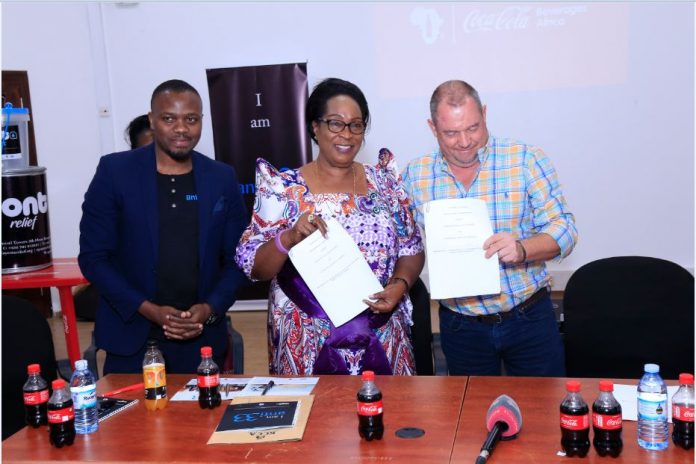
Mr. Conrad van Niekerk, Managing Director of Century and Rwenzori Bottling Companies and Ms Ssebugwowo at the event.


Coca-Cola Beverages Africa in Uganda, through Century and Rwenzori Bottling Companies, has launched a collaboration with Nyonta Relief to provide increased access to safe water for vulnerable households in Ndeeba, in Kampala.

Supporting the project “Nyonta Tree For Life”, Coca-Cola Beverages Africa will supply 100 ‘Nyonta Kits’ to families in Ndeeba, which will give them clean drinking water for use in their households for drinking, cooking and other uses.

The Nyonta Kit uses gravity to purify over 100 LPD of any water from a fresh water source making it safe for human consumption. The contribution is valued at Shs33 million and will go to 500 people in the Ndeeba community.

Conrad van Niekerk, Managing Director of Century and Rwenzori Bottling Companies, said the company support to the vulnerable communities in Ndeeba was underpinned by the belief that all people around the world deserved a chance to access safe water for life.

“It is therefore critical for us, as part of the world’s leading beverage company, to use water responsibly in our operations and also lead in giving it back. We work to protect local water resources and provide safe, clean drinking water to communities in need,” he said.

He said Water was a key issue for the Coca-Cola system around the world and pledged that the company would continue using water responsibly to ensure that the bottling operations in Uganda reduced water use and supported the provision on safe, clean drinking water to communities.

Explaining the project, Nyonta Relief Patron, Ms. Joyce Nabosa Ssebugwawo, said that In Uganda, it is estimated that 33 children die every day due to diarrhea from contaminated drinking water.

“That is why we launched the ‘Anti33’ campaign; to bring together people and organisations who feel the moral obligation to help reduce the number of children dying of preventable drinking water diseases. We are happy that Coca-Cola Beverages Africa has joined us today,” she said.

Lubaga division Mayor, Nabbosa Ssebugwawo, said that since mothers are the custodians of household health, ensuring the availability of drinking water in homes is their direct responsibility. She encouraged all women to join the campaign.

“Having access to clean drinking water is key to a healthy life. Additionally, availability of clean drinking water has the power to encourage gender equality, stable education for children in a home and income generation for mothers who will have ample time since sickness in a home is eliminated.” She said

It is worth noting that millions of people across the world are deprived of this essential need. The issue is particularly problematic in Southern Africa. According to UNICEF, in Uganda it is estimated that 60 per cent of the population has no access to potable water, leading to the death of 33 children every day.

The Ministry of Water and Environment in July this year presented Coca-Cola Beverages Africa with an award for Water Usage Efficiencies at the Mbarara Plant, after a sector audit covering 24 companies in Uganda.


Stories Continues after ad

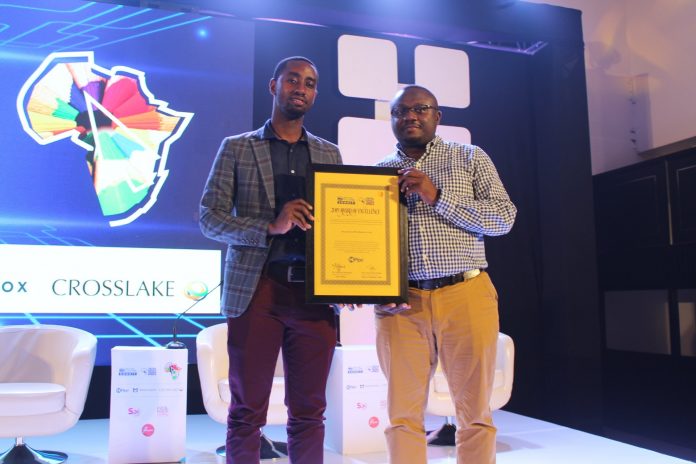
Dfcu Bank recognized for enabling financial literacy at the 2019 Digital Impact Awards Africa.

Dfcu Bank's Edgar Ntwali (L) and Lloyd Jonathan Busuulwa at the 2019 Digital Impact Awards Africa gala


Dfcu Bank has won the Digital Awareness Initiative award at the just concluded Digital Impact Awards Africa (DIAA) that took place at the Mestil Hotel, Kampala.

The bank has been spearheading the use of digital technology to drive financial literacy and inclusion in Uganda. Dfcu Bank received the award for its ‘Dfcu Battle for Cash’ campaign which is a regional activity that teaches people on saving and financial literacy. Some of the topics covered in the training included; Why and how to save, where to invest money so it can grow, things to think about when thinking of investing and so much more.

The Digital Impact Awards Africa bring together tens of C-Level Executives, Senior Digital and IT executives each year, in series of events that recognize and celebrate strategic trends and technologies which are shaping the Digital, IT and business worlds.

The awards were held under the theme “Include Everyone”, calling for various stakeholders and industry players in the country’s digital landscape to put in place and enforce solutions, approaches and innovations that will enable financial inclusion across Uganda.

Speaking at the awards gala, Dfcu Bank’s Ag. Head Alternative Channels, Lloyd Jonathan Busuulwa noted that the recognition reflected the bank’s tremendous efforts towards enabling financial literacy in Uganda.

“As a market leader in the area of financial literacy, we are determined to utilize our products, services, initiatives and partnerships to make both financial literacy and inclusivity a reality countrywide,” he said.

In the pic; Dfcu Bank’s Edgar Ntwali (L) and Lloyd Jonathan Busuulwa at the 2019 Digital Impact Awards Africa gala


Stories Continues after ad

Police defends transfer of Hoima police commander hours before by-election

Police Spokesperson Fred Enanga


Police has defended the transfer of Hoima District Police Commander (DPC), Christopher Katumba, a few hours to  to the hotly contested Woman Member of Parliament by-election now underway in that district.

According to police spokesperson, Fred Enanga, Katumba was transferred to the Environmental Protection Police Unit and replaced by  DPC of Mubende District, Martin Okoyo.
“Mr. Katumba was not transferred due to political influence rather by institution’s policy framework in place that allows for transfers and postings of police officers to various posts.”

He said it was a placement committee’s decision, whose end goal is to appraise and monitor the performance of all officers, whether competent or incompetent, was set up, to ensure all transfers and postings, are transparent and merit based.

“The committee works independently and looks at features such as civil service values and code of ethics and conduct. Therefore, those who are attempting to bring propaganda in matters of our transfer and postings, must know that it is a prerogative of the placement committee, which should not be circumvented citing political influence,” he said.

Enanga said that bye elections taking place in Hoima and Kabong are isolated policing events, out of the wider initiatives in place. They are being policed, based on a policing plan and not tagged to an individual. So far, the polling exercise is progressing well in both electoral areas, without any significant crime and safety concerns.

“The appraisal and monitoring of all officers, is a key tool in our service delivery and development mandate. It also promotes clear linkages between the command and tactical levels and helps us build on our achievements and also address shortcomings,” he said.

The by-election is peddled at filling the vacancy left behind by the former district woman MP Kaahwa Tophace Byagiira who crossed to represent the newly created Kikuube district. The stiff competition is between NRM flag-bearer Harriet Businge Mugenyi and FDC’s Asinansi Nyakato, the joint opposition candidate for the Hoima Woman MP.

Recently, the opposition led by Dr. Kizza Besigye, Kyadondo east MP Robert Kyagulanyi and national resistance movement (NRM) led by its chairman who double as the president of the country Yoweri Museveni camped in the area to canvas support for their respective candidates.

Stories Continues after ad