Stanbic Bank
Stanbic Bank
19.7 C
Kampala
Stanbic Bank
Stanbic Bank
Home Blog Page 1160

Construction of national oil roads: MPs blast UNRA for signing contracts without approval of parliament

UNRA Executive Director, Allen Kakuyo Kagina

Government is facing financial challenges in regards to the upgrade and construction of the national oil roads in western Uganda even though the Uganda National Roads Authority (UNRA) on behalf of government, signed agreements with Chinese road construction companies without the approval of parliament, a decision Mps on Committee of National Economy said must never be taken again by any government entity.

“Government agencies should desist from making commitments on behalf of Government before seeking approval of Parliament; and in future, if any government official, ministry, department or agency commits government in such a manner, they should be held personally liable and should be dealt with in accordance with the law. In future, any loan presented before Parliament with this kind of provision shall not be approved,” Mps warn.

UNRA signed contracts with China Communications Construction Company Ltd, Chongqing International Construction Corporation (CICO) and China Wu yi Co. Ltd to construct the roads but it has not been an easy ride for UNRA due to lack of funds it committed to provide, as the manager of national roads in the country.

UNRA is in need of about US$456.4 million to finance the construction of the roads. But the loan is yet to be approved by parliament which would give a go-ahead for the Exim Bank of China to ready the money as government pushes with plans to produce first commercial oil by 2020-2023, much as sector analysists say this might not be possible with the recent pulling out of joint venture partners from the East African Crude Oil Pipeline (EACOP) project.

The roads in dire need of money include; Masindi-Kasanja/Park Junction, Tangi (Packwach) Juction-Paraa-Buliisa Road (159km), Wanseko-Bugungu Roads), Hoima-Butiaba-Wanseko (111 km ) and Buhimba-Bulamagi-Igayaza-Kakumiro ((93km). The three roads need US$, 18,888,518.4, us$179,538,545.59 and US$ 138,488,356.00 respectively.

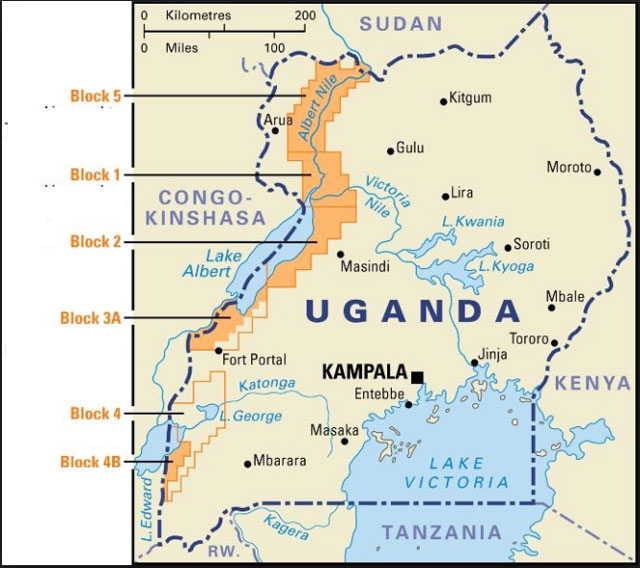
Gov’t embarked on the construction of the roads after commercial crude oil reserves were discovered in 2006, amounting to 6.5 billion barrels of oil, of which 1.4-1.7 billion barrels are estimated to be recoverable. The deposits are mainly located on the East Bank of Lake Albert and in the Nile Delta north of Lake Albert.

The roads are meant to ease transportation of materials and other items for building of oil infrastructure as well as transportation of oil products for export.

It should be recalled that the request for the money was presented to parliament by the Minister of Finance, Planning and Economic Development on May 16, 2019 and accordingly referred to the Committee of National Economy for consideration.

The total estimated project costs for the three road projects is US$ 537 million, which will be financed through borrowing of US$ 456.4 million (85%) from China Exim Bank, while Government of Uganda will provide counterpart funding of about US$ 80.5 (15%)million.

The Contract Agreements for the above three road projects between Government of Uganda represented by Uganda National Roads Authority (UNRA) and the three contractors was to the effect that the contractors were to pre-finance and execute works for a period of 12 months from the commencement date and Government of Uganda would refund the contractors for works executed.

However, according to the report of parliament’s Committee of National Economy, the construction of the road is facing a number of challenges such as lack of funds, environment, procurement and land related matters. Land acquisition process has been delayed due to lack of adequate funds, progress of works on the three road projects slowed down due to cash flow constraints.

A total of US$ 90.44 million was expected to be paid to the contractors by the end of pre-financing period in July 2019 for works executed since April 2018. However, only US$ 27.72 million was released by the finance ministry in July 2019 and it has been paid to the respective contractors. There is need for more releases to enable UNRA pay the remaining balance of US$62.72 million to be able to meet the target of 2020.

To save UNRA from embarrassment, the Committee has recommended parliament to authorise government to borrow up to US$ 456,370,000 million from the EXIM Bank of China to finance the upgrade and construction of the roads in question.

Meanwhile, MPs on parliament’s Committee of National Economy have observed that much as oil roads are critical infrastructure projects in aiding delivery of the first oil in the year 2020-2023, available information indicates that the first oil cannot be achieved as anticipated by Government.

They add: “If the status quo is maintained, government will remain with a huge debt without producing the first oil. The Committee recommends that Government should fast-track the Final Investment Decision (FID) with oil companies to ensure that the first oil is delivered per Government timelines.”

Stories Continues after ad

Weasel involved in car accident

Douglas Mayanja commonly known by his stage name ‘Weasel manizo’ has this morning been involved in a motor accident, his management team confirmed.

A statement was shared on the official Radio and Weasel social media pages by the management who said that he was involved in an accident while he was going for a scheduled morning interview.

The management further revealed that he is in good condition but undergoing medical checks to ensure his health is perfect and hence won’t be able to attend the scheduled interview.

“This Morning Our Artist Was Involved in a car accident hence missing some of the scheduled interview.

“He is in good condition & undergoing Medical Checks. Apologies for the inconveniences caused. Management.” Radio and Weasel Management posted

Stories Continues after ad

Sudhir tops Forbes table of top Ugandan entrepreneurs

Mr. Sudhir Ruparelia


Ugandan businessman, Sudhir Ruparelia has kept his position at the top in the latest Forbes list of top 10 successful entrepreneurs in Uganda.

According to the list, there are no surprises in the top 10, which list is ruled by Ugandans of Asian origin with Karim Hirji, returning in position two while Mr Alykhan Karmali of the household Mukwano Group is number 3.

Businessmen Charles Mbiire, Gordon Wavamuno, and Patrick Bitature, who is in number 10 position make the portion of the indigenous Ugandans on the list.

Mr Ruparelia has consistently remained top of the list ever since Forbes started publishing it a few years ago.

Sudhir this year has unveiled a number of assets to his name key among them, Speke Apartments, Electrical Plaza and the magnificent Kampala Kingdom Mall. The businessman invests in hospitality, real estate, education and flouriculture among others where he employees a good number of Ugandans.

The list is as:

1.      Sudhir Ruparelia

Sudhir Ruparelia has consistently been topping this powerful list for several years.

Sudhir is famed for rising his fortune from US$25,000 which he saved from his hustle in the United Kingdom before he returned to Uganda in mid-1980s as a beverages merchant and later as a foreign currency dealer.

The city businessman has from scratch, built his empire that includes; hotels and other investments in the hospitality industry, real estate, floriculture education and the media, insurance and forex and until recently banking before his Crane Bank was controversially transferred to DFCU bank by the Central Bank.

2.     Karim Hijri

Regarded as the main force behind the presence of Dembe Group of Companies, Karim Hijri has attained an impressive feat as Uganda’s second wealthiest person. As the Dembe Group of Companies continually thrives through its subsidiaries such as Imperial Group of Hotels, Karim Hijri is declared to be worth US$750 million.

3.     Alykhan Kharmali

Until his death recently, the founder of Mukwano Industries, Alykhan Kharmali has been among the richest Ugandans for several decades.

According to Forbes Magazine he is one of the business architects of Uganda’s resurgence in 1990s with his popular household flagship.

Mukwano family has interests in banking, manufacturing, agriculture and real estate.

3.     Mohammed Hamid

Having emerged into Uganda’s class of richest personalities at a youthful age, Mohammed Hamid is considered a fortunate business colleague with huge investments in areas such as transportation, real estate, and manufacturing.

As the owner and originator of the Aya Group, which forms part of Uganda’s thriving companies, Mohammed Hamid’s net worth swirls around US$400 million.

5.     Charles Mbire

Since many of the richest Ugandans are of foreign descent, Charles Mbire claims a notable position as the wealthiest native Ugandan.

With his entire worth valued at US$350 million, Mbire is well known for his diverse business investments which span across transportation, agribusiness, pharmaceuticals, telecommunications, real estate, energy, and finance.

6.     Sikander Lalani

Other than his investment dealings which largely centre on the manufacturing sector, Lalani is the vital force behind the existence of Roofing Groups. Having established himself as an entrepreneur for a very long time, Sikander Lalani has acquired a sum of US$300 million as net worth.

7.     Aaron M. Mukooza

With regard to his large investments which heavily span across the media together with the banking sector, Mukooza has amassed some net worth valued at US$200 million.

8.     Gordon Wavamuno

As the best part of his wealth is believed to have stemmed from his automotive business, Gordon Wavamunno is immensely linked with the ownership of Spear House together with Spear Motors –his automotive company. Meanwhile, according to Forbes, he has the sum of $100 million as his overall worth.

9.     Mukesh Shukla

Shukla is reported to have acquired US$100 million as net worth mainly from his ownership of Shumuk Group of Companies –a successful company concerned with cooking utensils.

10. Patrick Bitature

Bitature is a wealthy personage who acquires the largest portion of his money through a giant telecom company, Simba Telcom, which he presides over.

As Simba Telcom Ltd is regarded as Uganda’s biggest seller/merchant of MTN airtime, Bitature’s wealth has surged perpetually. This year, he bounced back as the Chairman of the giant utility company, Umeme. His interest in hotel and hospitality has seen him immensely invest in hotel business with the opening of Naguru—Protea Hotel, and Marriott Protea Hotel in Kampala.

His current net worth is estimated to be US$100 million.

Stories Continues after ad

Digital Currencies: The rise of stablecoins

Stablecoins


By Tobias Adrian and Tommaso Mancini-Griffoli


A battle is raging for your wallet. New entrants want to occupy the space once used by paper bills or your debit card.

The adoption of new, digital payment methods could bring significant benefits to customers and society: improved efficiency, greater competition, broader financial inclusion, and more innovation. But it could invite risks to financial stability and integrity, monetary policy effectiveness, and competition standards, as outlined in a recent IMF staff paper, the first of a new series of Fintech Notes.

Stablecoin adoption

Adoption of new forms of money will depend on their attractiveness as a store of value and a means of payment. New entrants like stablecoins, however, are significantly different from the popular incumbents: cash or bank deposits.

While many stablecoins continue to be claims on the issuing institution or its underlying assets, and many also offer redemption guarantees at face value (a coin bought for 10 euros can be exchanged back for a 10-euro note, like a bank account), government-backing is absent. Trust must be generated privately by backing coin issuance with safe and liquid assets. And the settlement technology is usually decentralized, based on the blockchain model.

Times are changing. USD Coin recently launched in 85 countries, Facebook announced Libra, and centralized variants of the stablecoin business model are becoming widespread. So why are stablecoins taking off?

The strength of stablecoins is their attractiveness as a means of payment. Low costs, global reach, and speed are all huge potential benefits. Moreover, stablecoins could allow seamless payments of blockchain-based assets, and can be embedded into digital applications thanks to their open architecture, as opposed to the proprietary legacy systems of banks.

But the strongest attraction comes from the networks that promise to make transacting as easy as using social media. Payments are more than the mere act of transferring money. They are a fundamentally social experience linking people. Stablecoins offer the potential for better integration into our digital lives and are designed by firms that thrive on user-centric design. Large technology firms with enormous global user bases offer a ready-made network over which new payment services can quickly spread.

Risks of stablecoins

Risks abound, however—so policymakers must create an environment that maximizes benefits and minimizes risks. Policymakers will need to innovate and collaborate across countries, but also across functions. Here are six observations for them to consider.

First, banks may lose their place as intermediaries if they lose deposits to stablecoin providers. But banks are not sitting ducks. They will surely try to compete by offering their own innovations (and higher interest rates). Also, stablecoin providers could recycle their funds into the banking system, or decide to engage in lending by extending deposits themselves. In short, banks are unlikely to disappear.

Second, new monopolies could arise. Tech giants could use their networks to shut out competitors and monetize information, using proprietary access to data on customer transactions. New standards are needed for data protection, portability, control, and ownership. And services need to be interoperable to facilitate entry.

Third, weaker currencies could face threats. In countries with high inflation and weak institutions, local currencies might be shunned in favor of stablecoins in foreign currency. This would be a new form of “dollarization” and might undermine monetary policy, financial development, and economic growth. As countries are forced to improve their monetary and fiscal policies, they will have to decide whether to restrict foreign-currency stablecoins.

Fourth, stablecoins could promote illicit activities. Providers must show how they will prevent the use of their networks for activities like money laundering and terrorist financing by enforcing international standards. New technologies offer opportunities to improve monitoring, however supervisors will need to adapt to the more fragmented and geographically diverse value chain of stablecoins.

Fifth, stablecoins could provoke the loss of “seigniorage,” where central banks capture profits from the difference between a currency’s face value and its manufacturing cost. Issuers could siphon off profits if their stablecoins do not carry interest but if the hard currency backing them earns a return. One way to address this issue is to promote competition so issuers of coins would eventually pay interest.

Sixth, policymakers must reinforce consumer protection and financial stability. Customer funds must be safe and protected from bank runs. This calls for legal clarity on what kind of financial instruments stablecoins represent. One approach would be to regulate stablecoins like money market funds that guarantee fixed nominal returns, requiring providers to maintain sufficient liquidity and capital.

Stablecoins thus present as many conundrums as they do potential benefits—and policymakers would be wise to envision far-sighted regulatory regimes that will meet the challenge. The policies adopted today will mold the world of tomorrow. We explore one such avenue in our next blog.

This blog is the first in a 2-part series on IMFBlog covering digital currencies.


Stories Continues after ad

Uganda Cranes remain static in latest FIFA rankings

Uganda Cranes


Uganda Cranes have remained unchanged in the latest world football rankings released today by the world’s football governing body FIFA.

The Cranes remain placed 80th in the world with 1305 points and sit 16th in Africa.

Neighbours Kenya also remained at 107, Tanzania moved up by 2 slots to 135, Burundi settle in position 144 while Rwanda at 130. Eritrea at 207 is the lowest ranked nation in the Cecafa region.

Senegal (20), Tunisia (29), Nigeria (34), Algeria (38) and Morocco (39) are the top five countries on the continent.

Belgium remain top of the FIFA/Coca-Cola World Ranking after an action-packed number of weeks in international football which saw 78 friendlies, 74 continental qualifiers and 60 FIFA World Cup Qatar 2022 qualifiers take place.

Though the teams in the top ten remain unchanged, there has been some movement. France (2nd, up 1) and Brazil (3rd, down 1) have traded places, while Spain (7th, up 2) are the top ten’s biggest movers.

Other notable upwardly mobile nations include Jamaica (47th, up 5) who have broken into the top 50, Republic of Ireland (28th, up 4), Russia (42nd, up 4), Guatemala (133th, up 11), Suriname (142th, up 9), Montserrat (187th, up 9) and Djibouti (186, up 9), who recently overcame Eswatini (150, down 11) over two legs to advance to the second round of African World Cup qualifying for just the second time.

The Cook Islands are not ranked in the latest standings due to not playing an international “A” match in the last four years. After their next international “A” match, they will be included in the ranking table again with their points total from July 2019 plus/minus the points won or lost in the new match.

The next FIFA/Coca-Cola World Ranking will be published on 24 October 2019.

Stories Continues after ad

Petitioner drags ISO to IGG over Shs10b paid to illegal staff

Col. Frank Kaka Bagyenda who has been appointed Uganda's Ambassador to Angola.


A concerned Ugandan has dragged top officials of the Internal Security Organisation (ISO) to the Inspectorate of Government for allegedly paying about Shs10 billion in salaries to staff that should have retired long ago.

“Under regulation 33(1) (2) of the security organisations regulation 2018, an officer may after his or her retirement be called to render special service to the security organisation on contract for three years and shall not exceed two terms. However, the said terms which came into existence in 1987 and as amended in 2018 have suffered a setback since they are not followed at all by the leadership,” the petitioner who preferred to remain anonymous says.

The whistle blower says that in 2012, eight members of staff who were retired under the terms before their amendment in 2018 have continued to be on the establishment under non clear terms. Even when the leadership was too formalized, then their two years contract would have ended in 2008 without further renewal. This has resulted into continuation on establishment and no- compatible payments of salaries on the eight for 11 years.

He said by the end of 2016 before the amendment of terms in 2018, 37 members of staff were salted for retirement under the old terms and therefore could not be accommodated by the amended terms to qualify for pension since they were already above 60 years by 1st July 2017.

“Most of the senior management team fall under this category and Col. Don Mugimba who falls under this category has vowed to fight the implementation of the amended terms without his  category benefiting by having the terms amended again to their benefits. This means that 37 staff have been on the establishment and earning salaries for now over two years without contracts,” he says.

“in 2017 and 2018, 48 staff pending retirement under the amended terms which  means that by 1st July 2019, they were entitled to their pension and gratuity as provided for under the amended terms, but still this has remained unclear due to the insider fighting,” the petitioner says adding that 48 staff have been working  and earning a salary for now two  years without contracts.

He also says at the beginning of July 2019, 16 members of staff were due for retirement and they were entitled to their pension and gratuity as provided for under the amended terms.  However, he says, this has remained unclear due to the insider fighting and efforts to award them contracts is not forthcoming because the retirees under three consider themselves as the determinants to award contracts to themselves and others who applied for contracts but who they consider not worthwhile.

The whistle blower also notes that the pensions and gratuity funds could have been diverted by the leadership for personal gains.

When contacted for a comment, IGG, Justice Irene Mulyagonja acknowledged receiving the petition and said her office was still studying document before the launch investigations.

“It is true, I have received that petition but for now, the issues raised are being studied by our officials before we commence inquiries into them” Justice Mulyagonja said in an interview.


Stories Continues after ad

Court dismisses libel and offensive communication cases against Drone Media journalist

Pidson Kareire


By our reporter

Makindye Chief Magistrates Court has dismissed a case in which Pidson Kareire, a Drone Media Journalist was accused of criminal libel and offensive communication by Middle East Consultants Limited, a labor export company in Uganda.

This came after HRNJ-Uganda’ counsel Daniel Walyemera prayed to court to have the matter dismissed under section 119 of the Magistrates Court Act after the prosecution lawyer Charles Nsubuga of Muwema & Co. Advocates as well as Gordon Mugyenyi, the complainant failed to appear in court for three consecutive times.

Counsel Walyemera further prayed to court for compensation and the legal costs that the accused person had incurred under section 196 of the Magistrates Courts Act which is to the effect that upon dismissal of any private prosecution by a magistrate’s court, the court may order the private prosecutor to pay to the accused person, in addition to his or her costs, a reasonable sum as compensation for the trouble and expense to which the person may have been put by reason of the charge.

However, court presided over by Grade One Magistrate Okumu Muwonge dismissed the matter for want of prosecution, but did not grant the prayer for compensation and costs, and advised that if the accused person is interested in compensation and costs, he should institute a civil suit.

“I am happy that the matter was dismissed, although I wanted compensation which was not granted. I will however file a civil suit to gain damages and costs,” said Pidson Kareire.

Middle East Consultants which instituted the matter by private prosecution alleged that Pidson Kareire published statements on the internet to the effect that they extort money from job seekers. They claimed that the statements were not true and were intended to defame and expose them to hatred, contempt and ridicule. They further contended that the statements were made with no purpose of legitimate communication and were aimed at disturbing the peace and right of privacy of Middle East Consultants.

“We welcome this new development from Court. It’s unfortunate that people with economic muscles have resorted to framing charges against journalists as a way of intimidating them from holding them accountable. We urge journalists to always carry out their work diligently without fear for intimidation notwithstanding. We also appeal to the judiciary to always exercise its independence and deliver timely justice to victims,” said the HRNJ-Uganda Executive Director, Robert Ssempala

Stories Continues after ad
COMESA records annual inflation rate at 21.8% in July 2019

Currencey notes of Comesa members


The Common Market for Eastern and Southern Africa (COMESA) region has recorded a 1.3 percent increase in the year-on-year inflation rate due to the escalation in prices of goods and services. This has been measured by the Harmonized Consumer Price Index (HCPI-COMESA) indicating an upsurge from 20.5 per cent recorded in June 2018 to 21.8 per cent in July 2019. However, this figure is a drop from the 22.5 per cent recorded the same time the year earlier.

According to the HCPI-COMESA monthly news release issued in Lusaka, the month-on-month inflation rate in the region stood at 3. 9 per cent for the month of July 2019, up from 2.3 per cent registered in June 2019. It was 2.9 per cent in July 2018.

The HCPI-COMESA comprises of twelve divisions of expenditure. These divisions registered the following average price changes during the month of July 2019 compared with July 2018.

Some of the items that necessitated the increase include food & non-alcoholic beverages, alcoholic beverages and tobacco clothing and footwear; housing, water, electricity, gas and other fuels. Furnishings, household equipment and routine household maintenance, health ,transport, communication, recreation and culture, education, restaurants and hotels,  miscellaneous Goods and services also contributed to the rise in the figure.

Participating Member States that contribute to HCPI-COMESA registered the following rates of total inflation in July 2019 compared to July 2018:-

Burundi(+1.8 per cent); Democratic Republic of Congo (+4.1 per cent); Djibouti (+6.8 per cent); Egypt (+9.2 per cent); Ethiopia (+11.7 per cent); Kenya(+6.0 per cent); Madagascar (+4.8 per cent); Malawi (+9.6 per cent); Mauritius(+2.1 per cent); Rwanda (+1.7 per cent); Seychelles (+1.5 per cent); Sudan (+54.3 per cent); Eswatini (+1.9 per cent); Uganda (+2.6 per cent); Zambia (+10.5 per cent); and Zimbabwe (+257.2 per cent).

Stories Continues after ad

Parliament approves Euro 101.8m loan for irrigation project

Some farmers have borrowed money for irrigation


Parliament has approved a Euro 101.8 million loan to develop a solar powered irrigation and water supply system across the country.

The loan will be borrowed from the UK Export Finance (UKEF) and will go towards developing 920 water supply systems for domestic use and irrigation across the country, and will be implemented through the Ministry of Water and Environment over a three-year period.

According to MPs, many regions in Uganda have faced dire situations of drought and have often failed to access water to support agriculture that is a major source of livelihood, as well as water for basic human survival.

“We need this loan because our farmers urgently need irrigation projects in their areas. The drought has affected some communities so hard that people borrow water from each other to survive each day,” said Bukooli Central MP Solomon Silwany

Kumi Municipality MP, Monicah Amoding, said the loan would support people in arid areas to attain access to water but called for parity in distribution of the project.

“Teso region is a dry area and we do not often get rain, that is why this project will go a long way in supporting our people but there must equal distribution of the irrigation pumps that will be set up countrywide,” she said.

The Chairperson of the Committee on National Economy, Syda Bbumba, said that the goal of the project is to improve the quality of life and livelihoods of the population through enhanced agricultural production and increased access to safe water.

“The project will benefit youth and women and will empower them economically through increased production from irrigated growth of high value crops. The project will create more jobs in the agricultural sector and also reduce walking distances,” she said.

Some MPs, however, raised concerns that could likely hinder the progress of the project when the loan is approved, including among others, the availability of land on which to set up the irrigation schemes.

“We have a problem of landholding in Uganda that has affected water production. This project is welcome but we need to advise our people against land fragmentation that could impact on this project,” said Jonam County Emmanuel Ongiertho

The House also tasked Government to present a clear report on the performance of a previously approved loan to support water projects across the country, and suggested the project ought to target areas that actively engaged in agricultural production.

Stories Continues after ad

Mubiru names final Cranes squad to play Burundi in CHAN 2020 qualifier

Cranes players in training


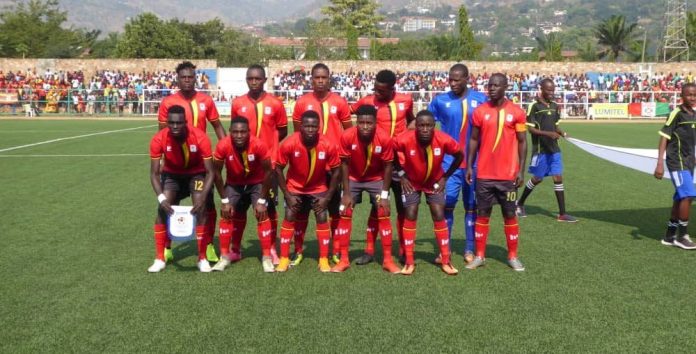
Uganda Cranes interim head coach Abdallah Mubiru has confirmed 18 players that will travel to Burundi for the first leg of the second round of the 2020 African Nations Championship (CHAN) qualifiers.

The team was named after days of intense residential training which climaxed with a friendly match against the Hippos that ended in a goalless draw.

Joel Madondo (Busoga United), Paul Mucureezi (Mbarara City, David Owori (SC Villa), Saidi Kyeyune, (URA FC) Mugabi Yasin (Wakiso Giants), Benson Tahomera (Kyetume FC) and Galiwango Arafat (Police FC) are the players who miss out on the final squad.

The most notable inclusion is KCCA FC forward Sulaiman Mike Mutyaba who last played for the Cranes in 2014 in a world cup qualifier match against Liberia. He had retired in February 2017 but made a U-turn in 2018 when called coach Mike Mutebi recalled him.

FUFA Executive Committee member Rogers Mulindwa is the head of delegation.

Uganda Cranes eliminated Somalia in the first round of the qualifiers with a resounding 7-2 aggregate win.

The first leg will be played on 20th September in Bujumbura and the 2nd leg on 18th October 2019 in Kampala.

The aggregate winner over the two legs will qualify for the final tournament in 2020 that will be staged in Cameroon.

Uganda Cranes are seeking for their fifth appearance at the 16-team tournament, having played at four CHAN champions in 2011 (Sudan), 2014 (South Africa), 2016 (Rwanda) and lately 2018 (Morocco).

The competing national teams in this championship must be composed of only players playing in their domestic league. That is, a Ugandan player is only eligible to play for the Uganda Cranes if he is playing for a Ugandan club.

Democratic Republic of Congo (DRC) have won it twice, holding it the most times while Morocco are the defending champions.

The competition will be hosted between January and February 2020 in Cameroon. It is held after every two years.

Squad:

Goalkeepers: Alitho James, Charles Lukwago

Outfield players: Halid Lwaliwa, Mustafa Kizza, Paul Willa, John Revita, Paul Patrick Mbowa, Bright Anukani, Nicholas Kasozi, Musitafa Mujuzi, Shafiq Kagimu Kuchi, Allan Okello, Muzamiru Mutyaba, Yusuf Ssozi, Dan Muzeyi Serunkuma, Mike Mutyaba, Fahad Bayo Aziz, Viane Ssekajjugo


Stories Continues after ad