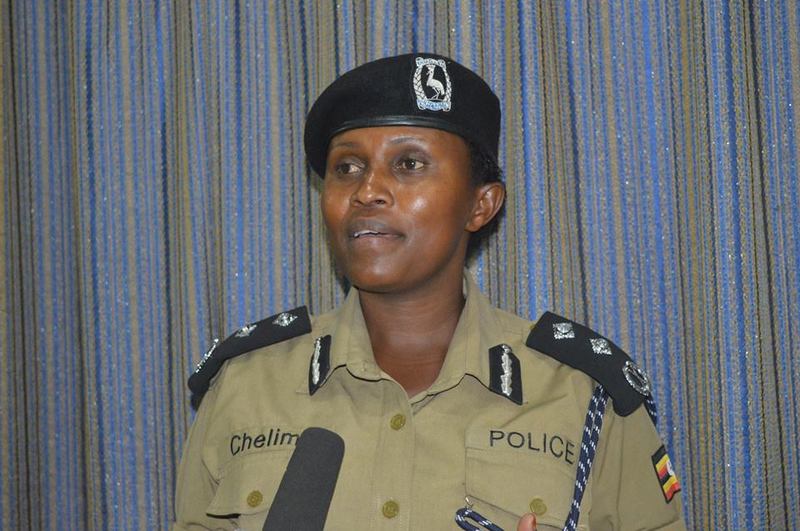
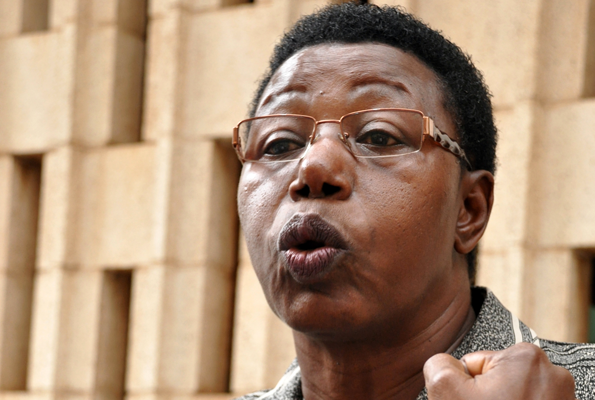
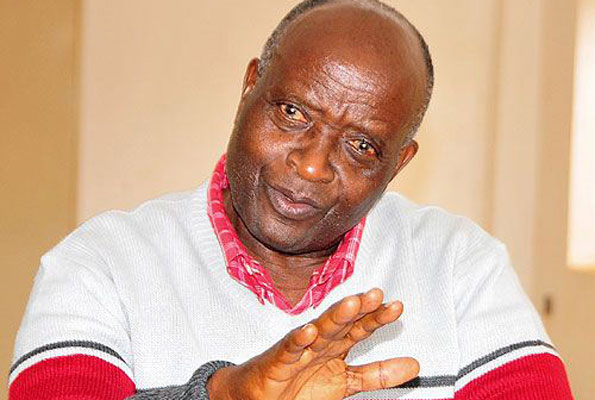
Kampala-Commissioner of Police and head of the women desk in Uganda Police, CP Chelimo Beata has been transferred to head the police compliance unit.
Inspector General of Police, Gen. Kale Kayihura made few changes that saw John Gray Ambayo from Police Training School Kabalye to the directorate of operation in Kampala.
Below is the statement
The Uganda Police Force has made fresh transfers and appointments of gazetted officers. The following transfers/appointments are hereby ordered with immediate effect. They include:
1. CP CHELIMO BEATA IS HEREBY APPOINTED THE HEAD OF POLICE COMPLIANCE UNIT
2. SSP AMBAYO JOHN GRAY IS TRANSFERRED FROM PTS KABALYE TO THE DIRECTORATE OF OPERATIONS-POLICE HEADQUARTERS
3. SP EMITU EZEKIEL IS TRANSFERRED FROM NALUFENYA BASE COMMAND TO PTS KABALYE AND APPOINTED AS DEPUTY COMMANDANT OF THE SCHOOL, HE WILL ALSO HANDLE THE YOUTH PROGRAMME AT THE CENTRE OF EXCELLENCE IN COMMUNITY POLICING AT THE SCHOOL
4. ASP NYESIGIRE DAVID KATUNDA TO TAKE ON THE NALUFENYA BASE COMMAND PENDING APPOINTMENT OF SUBSTANTIVE COMMANDANT
5. ASP WATHUM BENSON’S TRANSFER TO CIID HQTRS IS HEREBY CANCELLED. HE INSTEAD MOVES TO POLICE COMPLIANCE UNIT.
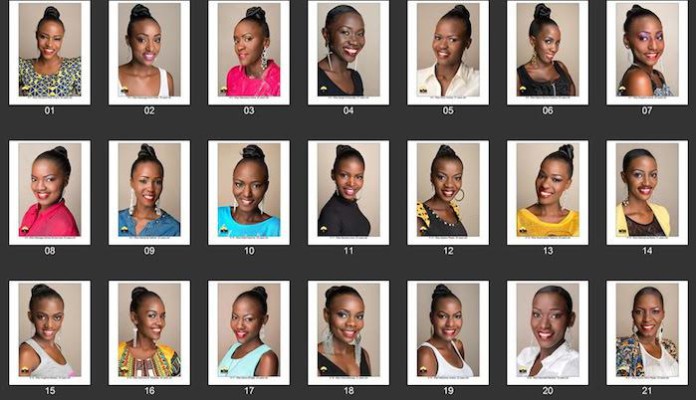
Miss Uganda 2015 finalists were on Thursday night unveiled at Serena Hotel, Katonga Hall. The 21 finalists, (of which 90% are students) are vying for the crown of the finest girl in the land, replacing the incumbent, Leah Kalunguka, who was last year crowned not because of her beauty, but her agricultural brains.
Themed “Beauty with Purpose,” the Miss Uganda pageant seeks to crown one youthful girl that will spearhead all charity runs for youths countrywide under Kezi Entertainment. The winner will also represent Uganda in the Miss World pageantry that seeks to crown the finest girl in the world.
#1 – Miss Wanyaya Ritah Engrid, 20 years old
#2 – Miss Nakayaga Dimit Hilda, 19 years old
#3 – Miss Nabukeera Aisha, 20 years old
#4 – Miss Ijanga Immaculate, 21 years old
#5 – Miss Atino Victoria, 21 years old
#6 – Miss Naava Nankya Noeline, 20 years old
#7 – Miss Mugisha Leticia, 20 years old
#8 – Miss Nakiyaga Zahara Muhammed, 23 years old
#9 – Miss Nakitende Safinah, 24 years old
#10 – Miss Alobo Daphine, 23 years old
#11 – Miss Namara Loice, 22 years old
#12 – Miss Sabano Peace, 22 years old
#13 – Miss Akankwatisa Patience, 20 years old
#14 – Miss Nabimanya Diana, 21 years old
#15 – Miss Angelina Nakaazi, 23 years old
#16 – Miss Makwine M. Rossette, 20 years old
#17 – Miss Sanyu Bridget, 23 years old
#18 – Miss Viola Kebirungi, 21 years old
#19 – Miss Nabwowe Juliana, 23 years old
#20 – Miss Namuddu Barbara, 19 years old
#21 – Miss Husna Hakim Rajab, 22 years old
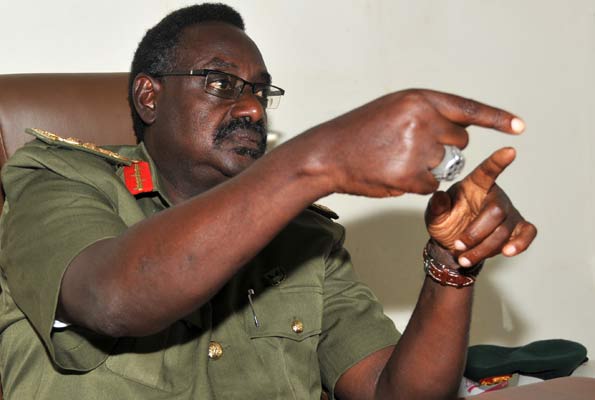
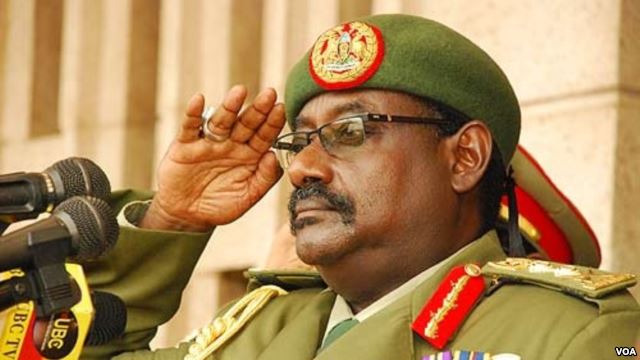
Police today picked up a full general like they would a tomato vendor accused of eloping with IGP Kale Kayihura’s relative in downtown Kampala. Gen. David Sejusa was detained at Jinja Road Police Station on charges Frying Pun is not interested in knowing. Our interest was in talking to the man himself.
“Thanks for agreeing to meet us, General. But first things first: You and the IGP are bush war comrades. Even the other serving generals like Elly [Tumwine] and Katumba Wamala just couldn’t arrest you like that. While in the act, why didn’t you speak to them and you settle the matter on the spot instead of having yourself dragged here?”
Sejusa chuckled and looked around the room that smelt of muck and grubs as if to survey for some bugs. He then said: “Who says they are the ones who arrested me? I think you got your tip wrong. It’s these boys here who brought me here for a mug of tea. Do I look like I have been arrested?”
“Well, if you were not arrested, what we know is that you are being detained currently,” the Pun said. “I had expected to find full generals who delivered you here around but all I hear is that it is Seya coming to help secure your release. What is not going on here?”
“It’s these boys who brought me here and I am waiting to know exactly why,” he said.
“So you mean these weather-beaten chaps… I mean, cops, have the powers to arrest a full general and detain him at a police station?” Pun went on. “Did Museveni approve your resignation from the military?”
“It’s not how it works everywhere. Uganda is not the US. In an ideal world, only full generals deserve the right to arrest me,” Sejusa said. “Even Kayihura wouldn’t dare. But in Museveni’s regime, it’s about the end justifies the means. But this too shall pass. Can you imagine these lumpens say I, David Tinyefu… sorry, Sejusa, a full general, was wrong to allow a few boda boda cyclists follow me from the bank toward Entebbe? I was in my car, I wasn’t on the bodas, neither did I give them fuel…”
“So you are saying the current regime knows no protocol and a full general can just be heckled by some diaper-clad Evelyn Anite, should I also assume that the whole drama for which you are here is meant to divert attention from the storm Amama Mbabazi has caused?” we asked.
“I don’t know about that,” he replied.
“But people are apprehensive of you. You seem to be the only one who believes you have left the system you helped bring and entrench in power with the viciousness of a mother slapping a mosquito that tried to land on her baby’s butt. A case in point was how the country ignored your arrival from Sembabule to Kampala…”
“That is why Ugandans will not defeat Museveni,” the feared general said. “People don’t know what they want in life or government for that matter. But that will not stop us from continuing with the determination to remove Museveni and his recurrent failures from government.”
“General, I dare you to back Mbabazi openly…”
“Who is Mbabazi?” he asked, not hiding his scorn. “If that man offers something tangible, something different from Museveni, I will consider it. Mbabazi is a joke. A big joke.
“So what exactly is your game? This arrest, the public feels, was just another of those explosive things that happen to divert attention. No one actually believes a general can be picked up like a cabbage and dumped at this rundown police station. You would at the army mess in Makindye, not here,” we said.
“My game plan? To fight for democratic ideals, the ideals for which we sacrificed in the bush. But at the end of the day, I have to recognize the fact that these boys couldn’t just put a hand cuff on me. They have no right and the powers to do so, even if they brought me here. That is why I have been giving them orders. Do I look like I am under arrest?”
“No, but you sure are in detention at the moment. So, when does Sejusa, the former Tinyefuza, announce that he is running for the presidency?” Pun asked.
“Presidency is not everything. It’s about good leadership, not ‘who-is-in-leadership’ as many of you think,” Sejusa said.
The head of the Liberian FA, Musa Bility, has told the BBC’s Focus on Africa that he will stand for the presidency of Fifa when Sepp Blatter steps down towards the end of the year.
”Football is facing a difficult moment… and it is in difficult moments that leaders emerge,” he told the BBC’s Sammy Darko.
”We are the largest group in Fifa – we must take the lead to reform the organization,” he said.
He comes at a time when FIFA is ridiculed with corruption scandals after the resignation of former FIFA President Sepp Blatter. Africa is biggest voting bloc in FIFA.
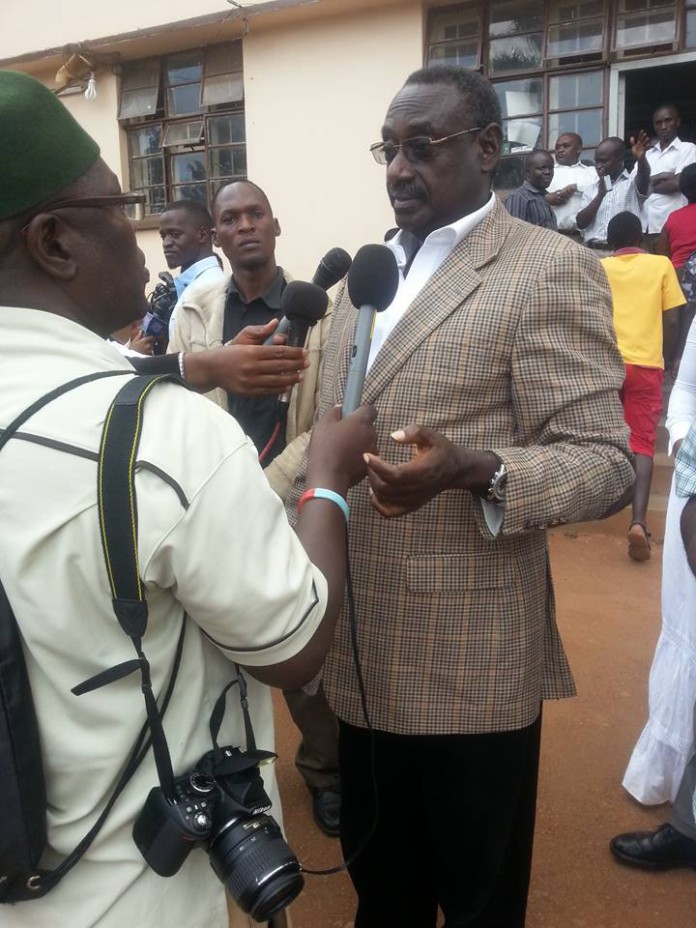
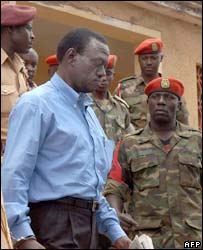
Gen. Sejusa talking to the press at Jinja Road Police Station soon after he had been cautioned.
Gen. Sejusa talking to the press at Jinja Road Police Station soon after he was cautioned and left to go.
rwanambwa@eagle.co.ug
Kampala-Gen. David Sejusa, the outspoken former Coordinator of Intelligence Services has been released from Jinja Road Police Station after being cautioned on why he allowed a Boda Boda procession.
Sejusa had been earlier arrested as he left Centenary Bank and he was being detained at Jinja Road Police Station.
Police intercepted Gen. Sejusa along Jinja road on why he allowed Boda Boda to follow him and yet it contravenes the Public Order Management Act which states that – for any procession or meeting of more than five people, one needs to seek police permission.
In April 2013 the renegade army general penned a dossier, claiming that government planned to eliminate prominent persons including among others, then Prime Minister Amama Mbabazi and former Chief of Defence Forces Gen. Aronda Nyakairima and him.
After the dossier that was addressed to the Director General of Internal Security, Brig Ronnie Balya leaked; Sejusa fled the country in May and went into exile in the United Kingdom, staying there for over a year till his secret return to Uganda on December 14, 2014.
Then, about three weeks later Sejusa was to meet President Museveni on Saturday, January 3 at State House Entebbe, where the two, in the company of bush war colleague and former Army Commander of the National Resistance Army (NRA) Gen. Elly Tumwiine, met and discussed Sejusa’s woes.
Sejusa has always shown signs of defiance and in 1996 he tried to retire from the Uganda Peoples Defence Forces (UPDF) but was stopped after a grueling legal battle at a time when Mr Amama Mbabazi was the Attorney General.
A lawyer, 61-year old Sejusa, who holds a Masters degree in law joined the NRA in 1981, and is one of those who reportedly put up a spirited effort during the five-year war.While in exile Sejusa lost his father, Mzee Simon Bwajojo and brother under unclear circumstances
Kampala- Police have arrested the former Coordinator of Intelligence agencies and is now detained at Jinja Road Police Station.
It’s not clear why he has been arrested and why an active army officer would be detained in a police cell.
According to Jinja Road Police Station, Sejusa was arrested for allegedly entertaining Boda Boda riders to escort him which contrary to the public order management bill.
Police has refused to allow journalists to talk to the military General who returned from exile last year.
This week former Prime Minister John Patrick Amama Mbabazi dropped the bombshell: ‘I am going to contest for presidency come 2016’.In what is deemed a ‘big’ fallout with his former close ally Yoweri Museveni, JPAM, as he is referred to, said his aim was to cause change in the country and he outlined his ‘eight-point programme’.
But Mbabazi is just one of the former bush war colleagues to fall out with the system and below Eagle online brings you some of pillars of the regime now opposed to it.
Col. Amanya Mushega
Hails from the greater Bushenyi and was instrumental in building the Movement system that later turned into NRM. He did mobilize for the system and the party in an area which was predominantly an opposition stronghold. Bushenyi used to be a stronghold of Uganda Peoples’ Congress (UPC). He first served as Assistant Minister for Defence soon after National Resistance Army/Movement (NRA/M) captured power in 1986. Subsequently he was appointed Minister for Public Service and then Education. He was later posted to Arusha, Tanzania, serving as the second Secretary General of the revived East African Community (EAC) but upon his return, he joined opposition Forum for Democratic Change where he was elected Deputy President in charge of Western Region.
Maj.John Kazoora
He comes from Kashari County, Mbarara district. He represented Kashari County in the 6th and 7th Parliament and was vocal, a thing that led him to clash with President Museveni. He was among the Members of Parliament that started a pressure group called Parliamentary Advocacy Forum (PAFO) that united with Reform Agenda to give birth to FDC. After the capture of power in 1986, Kazoora was posted as Special District Administrator (District Commissioner) for Kampala.He later joined the Internal Security Organisation (ISO) as Director of Finance
Maj. Gen. Mugusha Muntu
He hails from Ntungamo district and his father was a closed comrade of late President Apollo Milton Obote. However, Muntu rejected all the pleas not join the bush war but opted to fight a regime that was friendly to his family. After capture of power, Muntu went on to serve as Director of the Directorate of Military of Intelligence (DMI) with Paul Kagame as his deputy. While at the rank of Lieutenant Colonel, Muntu was seconded for a military course in Russia and upon his return, he was promoted to Colonel and posted to Gulu as 4th Division Commander. And, skipping the rank of Brigadier, he was promoted to Major General and made the Army Commander, the equivalent of Chief of Defence Forces (CDF) today. He retired from the army and joined politics as a member of the East African Legislative Assembly. He joined FDC after the merger of PAFO and Reform Agenda. He is the current party president of FDC and should his party field him as a flag bearer, he will likely face his former Commander-in-Chief in 2016 general elections.
Sarah Kiyingi
She comes from Rakai district which she represented in the 6th and 7th Parliament. She was named Minister of State for Ethics and Integrity. When a Parliament committee on legal affairs which was chaired by the then Omoro County and then Uganda Peoples’ Congress, cadre, Jacob Oulanyah cleared the amendment of the Constitution to lift term limits she opposed and even opposed the Kyakwanzi resolution and she was sacked.
Miria Matembe
She hails from Kashari and she twice served as Mbarara District Woman Member of Parliament and served as a Minister of State for Ethics and Integrity. Like Kiyingi, Matembe opposed the amendment of the Constitution to lift term limits and she was sacked. She remains vocal on topical issues although she hasn’t joined mainstream opposition politics.
Augustine Ruzindana
He was the first Inspector General of Government (IGG) and is credited with creation of infrastructure of the current inspectorate. He hails from Ntungamo district has he represented Ruhama County in both 6th and 7th Parliament. He was vocal against the regime and coming from a predominantly NRM area, he was subsequently challenged by the First Lady, Janet Museveni who defeated him. He is currently the Secretary for Strategy and Research in the FDC.
Dr .Kizza Besigye
In political terms, one of the victims of this government is probably Dr. Kizza Besigye. But at the same time, the man from Rukungiri was one of the very few confidants of the regime in its early stages. He was a Physician during the armed struggle in the bush. After capturing power, he continued as a personal Physician to the President, while also serving as a junior Minister for Internal Affairs. He later went to head the Mechanized Brigade Commander in Masaka before he bounced back as the National Political Commissar at the defunct Movement Secretariat.
In 1999, he wrote an internal document critiquing how the system was working and how the NRM had diverted from its 10- point programme. He was threatened, intimidated with Court Martial but stood his ground. In 2000, on the day he received his certificate of discharge from the army, he announced his candidature to challenge Mr Museveni and he has challenged him thrice, to remain the country’s most formidable opposition politician
Winnie Byanyima
She is the current Executive Director of Oxfam International and wife to Dr. Besigye. Ms Byanyima hails from the powerful political family of Mzee Boniface Byanyima, and she was once Uganda’s representative to UNESCO in France. She returned and became Secretary for Information at the then Movement Secretariat and later on Member of Parliament for Mbarara Municipality. She fell out with the regime but was still seconded by Government to the Africa Union as Director for Gender Affairs.
Jaberi Bidandi Ssali
He was the long serving Minister of Local Government and was instrumental in preaching the National Resistance Movement (NRM) gospel in Buganda. He started with Museveni as Secretary General of Uganda Patriotic Movement (UPM), a party for which Museveni was flag bearer in the 1980 presidential election. Bidandi Ssali fell out with Museveni over the amendment of the 1995 Constitution. He was subsequently sacked and then started his party, the Peoples’ Progressive Party. He stood for President in 2011 and lost.
James Wapakhabul
Wapa as he was fondly referred to by his colleagues, parted ways with Museveni when he too opposed the amendment of the constitution. He wrote a document criticizing the process and was neglected. He was represented Mbale Municipality and was a member of the external wing of the struggle.
Prof. Gilbert Bukenya
He was the longest serving Vice President under Museveni and served in many other cabinet portfolios before becoming VP. He was dropped as VP in 2011 and. He is now opposed to the status quo
Prof. George Kanyeihamba (SC)
He served as minister in the first days of the regime before becoming a judge in the judiciary. He now totally opposed to his former boss
Gen. David Sejusa
He authored a letter to Director General of Internal Security Organisation (ISO) inquiring about the “Muhoozi” project. He fled the country and has been in exile until last year. He is opposed to the regime and is too critical of its undertakings.
David Pulkol
He was a minister in early days of the Museveni establishment; he became Director General of External Security Organisation. It is alleged that he disagreed with his boss and joined FDC before crossing to UPC. However, his membership to opposition is highly doubtable by his colleagues.
Bidandi Ssali fail out with Musveni over constitutioanal amendments.
Bidandi Ssali fail out with Musveni over constitutioanal amendments.
You have been declared winner by the Electoral Commission and Your Excellency is obviously jubilating. All the political parties that participated in the electoral exercise have termed the exercise a sham because of malpractices that have characterised the entire process dominantly perpetrated by the NRM under your leadership.
Political parties, civil society organisations, including all religious leaders and international partners, cautioned you well in advance about the need for your government to create a level ground for the 2011 general elections. I personally wrote to you about the need to amend the relevant electoral laws well in time.
Your response was that “there was no need for any amendments except the cleaning up of voters’ registers to prevent the opposition from stealing votes”. Now your “cleaned up” voters’ register is one of the major tools that the NRM and the Electoral Commission used to produce the current electoral debacle in the country.
The result has created despair and disenchantment over elections in the country for many Ugandans. This has produced a politically explosive situation in the country which has even forced you deploy mambas and other kinds of artillery at almost every sub-county in Uganda ready to maw citizens who dare raise a finger expressing their discontent.
As I chaired the Executive Committee of the People’s Progressive Party last week discussing the way forward for the country and our party, I recalled a meeting you chaired as Chairman of the Uganda Patriotic Movement (UPM) at Kintu Musoke’s residence in 1980 discussing the way forward for Uganda and UPM. This was after what we then termed sham election results announced by the military commission following an electoral exercise that had been characterised by vote falsification by the UPC leadership in control at the time.
The UPM Executive Committee discussed two options that is, going back to the people and build the UPM or going to the bush to take up arms to fight the Obote regime. In anticipation of what would be the cost in human life that had to be paid by Ugandans, the Executive Committee resolved for the former option to which some of us stuck.
You stormed out of the meeting declaring that you had taken the armed option. To date your decision is epitomised by a devastated Luweero Triangle scattered with monuments of human skulls, and a devastated northern region still wailing the massacre of more than one million Ugandans with more unaccounted for.
As I write, other political parties are also discussing the way forward for the country and their parties. Some of them have resolved as a preliminary reaction to the rigged election results, to call upon the disgruntled people of Uganda express their displeasure through a peaceful demonstration. Your response has been “Anybody who dare goes to the streets for demonstration will be killed” and your armed groups are already deployed in positions ready to execute the order!
Your Excellency is so imbued with military prowess that you are convinced that you will be able to preside over a police state you are creating pitched on patronage, the might of the gun and the power of money. The sustainability of such a state Mr. President is not borne out by any example in recent history.
My concern Mr. President is what is next for our country. You are convinced that the situation is very much under your control and that every Ugandan will be cowered down because of the presence of the military hardware and threats you keep dishing around. They remind me of a similar scenario by the Obote regime as you went to the bush! They were so sure of their invincibility.
You are so sure! Many Ugandans are convinced that the situation is politically volatile and that it needs a statesman’s approach to avert a chaos that can anytime turn bloody during or even worse, after our lifetime you and I. Surely Mr. President, Uganda should never be subjected to another spate of blood-letting and self destruction. We need to create a political environment in which all seeds of hatred and strife amongst the people of Uganda are never given opportunity to germinate.
In Kenya and Zimbabwe, such seeds were allowed to sprout into blood-letting and destruction of property. It was after extensive loss of human life, destruction of property and the intervention by the international community that Kibaki of Kenya and Mugabe of Zimbabwe came to their senses and a formula was struck for each country which have kept their countries in relative peace to date. But then the said formulae would have been reached before hundreds of thousands died and many communities displaced.
It is amazing the way you brag over what is going on in the Arab countries such as Egypt, Tunisia and Libya. “None of those people spent 13 years fighting to defend their country” you are quoted by the media. To you the almost three weeks street battles in Cairo between citizens and the armed forces without the latter opening live bullets to the demonstrators was lack of your 13 years experience on the part of former President Mubarak! No Mr.
President, I believe it was because much as he wanted and stuck to power, the lives of Egyptians far outweighed his unbridled lurk for power. This stance was fortified by the same consideration by the leadership of the Egyptian armed forces. They did not shoot citizens in the streets or in their houses like was the case with your armed groups during the September riots in Nateete and Busega.
Mr. President, you have put the future of our youth and the country at large in jeopardy. Because of extreme poverty in the country, the youth are being lured into political thuggery perpetuated by your leadership. Recently, you recruited hundreds of youth at almost every sub-county in the country ostensibly for security during the elections. Some of them executed their duties during the postponed Kampala mayoral elections when they beat up innocent voters with sticks embedded with nails. I am sure you watched the debacle on TV. What will be the fate of their future with such training?
Mr. President I have a belief that the euphoria that currently engulfs the NRM over the so called landslide victory contains seeds of self destruction incubated within the subdued emotions of hate and revenge in the hearts of many Ugandans. Some are only temporally gripped with fear and others by the lure of money given the abject poverty in which the bulk of the population is trapped. But sooner or later fissures will develop along which those emotions may volcano out Rwandan style. Mr. President this must not be allowed to happen. It is not your style of the brutal might of the gun and torture that will prevent it but through the power of the human heart of a leader as he feels for the people he leads.
The way forward
Mr. President with due respect I appeal to you to try and develop a new stance towards the opposition in Uganda. Start considering the leaders of other political parties as colleagues and not as enemies vying to snatch “your” power, your mutual deep rooted abhorrence between Your Excellency and my younger brother Besigye not withstanding! As my colleague Mao has been reported to have suggested, you may wish to consider a transitional national unity administration in which all the dominant political shades will participate.
This olive branch will bring about an environment which will engender reconciliation and harmony. Should some parties rebuff the branch, the door should be left open for any future change of mind as tempers calm down.
Obviously, this will leave you at the helm until a fresh election considered free and fair by all stakeholders is organised. Needless to say under such election to be organised under a new Electoral Commission as soon as practical, you would definitely have no fear of losing, “after all the just ended elections gave you almost 70%”.
This will be a home grown solution not imposed by the international partners after people of Uganda have once again murdered themselves silly.
Besigye under key and lock at Luzira Prisons in 2005 soon after he returned from South Africa.
Besigye under key and lock at Luzira Prisons in 2005 soon after he returned from South Africa.
On Friday December 17, 2005, then opposition leader Rtd Col. Dr. Kizza Besigye wrote from Luzira Prison where he was remanded, replying President Yoweri Museveni about his (Besigye’s) arrest and trial. Museveni had said the Forum for Democratic Change (FDC) leader created the problems resulting in his arrest and that the government could only have principled and not opportunistic resolution of the situation.
Below is the letter from Luzira
Earlier, on December 11 President Yoweri Museveni had issued a statement saying Besigye is characteristic of his dishonesty.
That the NRM (read Museveni) has been firm in dealing with wrongdoers: It is an indisputable fact that under the Museveni regime, ‘wrongdoers’ are not treated equally as demanded by the Constitution. In Uganda, there are three criminal Justice systems:
a) One for Museveni loyalists.
b) One for the general public.
c) One for Museveni’s political opponents, imaginary or real.
Numerous commissions of inquiry have compiled evidence and recommended prosecution of senior military, public and political leaders. The Museveni loyalists, far from being arrested and prosecuted, have been promoted and praised for ‘liberating’ our country!
On the other hand, crimes have been invented for members of the political opposition, who are promptly arrested, tortured and detained for long periods before the DPP (Director of Public Prosecutions) ‘loses interest’ in the cases. Some people have been in prison for more than five years, without trial. My wife, Winnie Byanyima, was arrested three times, and the charges were either dropped or dismissed by Court. This is Museveni’s “firmness with wrongdoers”.
Principled reconciliation: In Museveni’s world, “principled reconciliation” can only happen when the “wrongdoer first admits his/her mistake”. Obviously, he cannot understand that reconciliation is not about managing “wrongdoing”, but rather about managing opposed or conflicting situations towards an amicable solution. That is why reconciliation is usually managed by mediators or facilitators, who help the conflicting parties to appreciate each other’s position and to move towards a harmonious solution. Naturally, in the process of reconciliation, wrongdoing on either side may be found and accordingly managed; without losing the primary goal of creating a harmonious understanding known as ‘reconciliation’.
For that matter, the DPP, the Courts of Law and the Military Court Martial cannot be the appropriate agents for reconciliation. I advise President Museveni to seriously consider the statement by religious leaders of UJCC (Uganda Joint Christian Council) published in The Daily Monitor of December 14, 2005 and the offer they make.
The cases of Kizza Besigye: When I came back to Uganda to face the so-called criminal charges against me, I did not ask or expect to be treated preferentially by the justice system or by anyone in authority in respect of the charges that have been preferred against me.
I only ask, and EXPECT to be treated fairly and in accordance with the law and its due process. As a matter of fact, I rejected ‘preferential treatment’, which came in the form of an offer by President Museveni, to remove me from prison “immediately” and put me under “house arrest” at my residence.
This was partly because I thought it was irregular and inevitably shrouded with many uncertainties. I also rejected Museveni’s preferential treatment that if I should sign amnesty papers, I would immediately be discharged of all my cases, including rape! The Government of Uganda knows that I have a significant team of lawyers who would be aware of the Amnesty Law. Why then, would it be the Government, the law enforcer, pressurizing me to apply for amnesty? Does President Museveni consider this a legitimate role of political leaders in handling criminal matters?
My concern and the concern of many people and organisations that have made public expressions are the following:
Timing and management of my cases
i) The cases I am charged with were allegedly committed between 1997 and 2003. Until November 14, 2005, no charges against me had ever been brought before any court, this in spite of the fact that I have publicly and repeatedly demanded over the past five years that if there were any charges against me, they should be put before court and that I was prepared to face the law. President Museveni’s letter to his Cabinet just before my return stated that “there were long-standing criminal charges that would be brought against” me if I came back, although the DPP had just denied any knowledge of impending cases against me.
ii) The Uganda Government knew exactly where I was living in South Africa; if I was plotting to overthrow it, why wouldn’t they complain to the friendly government of South Africa. Indeed, shortly before my return to Uganda, President Museveni boasted that if his government needed me to answer any charges, they could easily ask for my extradition from South Africa. So why did he not arrange to extradite me, if I had “long-standing criminal charges” known to his government all those years?
iii) My co-accused were arraigned in court more than a year ago. I only became part of their case on November 15, 2005. All this suggests that these cases were not managed transparently and in accordance with the established legal process. This concern is further accentuated by the fact that I was arrested while very busy doing political work in preparation for the oncoming presidential elections. Further, every effort has been made to deny me bail.
Trial by Military Court Martial
Through our lawyers, we opposed trial by the Military Court Martial because:
i) The UPDF Court Martial is not an independent and impartial court to which people have a constitutional right. It is really a service court intended to enhance discipline among errant, serving soldiers. It is therefore inherently not intended to be impartial because:
It is headed by the Commander-in-Chief, who is the President.
All the Court Martial members, including the prosecutor, are senior UPDF officers, appointed by the President and operating under his continuing and direct command. He deploys them, promotes them etc.
It is to him that an aggrieved soldier appeals in case of delays of their trial, etc. There is therefore no way this court can be impartial to a person seeking to replace the President. Certainly, I would never willingly subject myself to the jurisdiction of the UPDF Court Martial and expect justice through it. On the other hand, I would be prepared to battle any number of charges in a civilian court.
ii) We believe the Court Martial action was intended to defeat the ends of justice to deny us bail. This was precisely the reason for the “Black Mambas” abomination and why the High Court hearing of my bail application was delayed so that I could be charged and remanded by the Military Court Martial, first! If the military prosecutor had fresh evidence necessitating fresh charges, why couldn’t they just pass it on to the DPP to institute these further offences against me?
iii) The Court Martial case is based on exactly the same facts as those for the treason case before the High Court. Therefore, we are being tried in two courts for the same alleged acts.
iv) The Military Court Martial was established to regulate the discipline of soldiers, deriving authority from Article 210 of the Constitution. It is not right to try civilians who have nothing at all to do with UPDF under its court, more so, when it violates their fundamental right to appear before an independent court or tribunal.
v) The Court Martial is not authorized to try the case of terrorism with which we have been charged in that court (that of illegal possession of firearms being an alternative charge). Section 6 of the Anti-terrorism Act, 2002 states as follows:
“The offense of terrorism and any other offences punishable by more than 10 years’ imprisonment under this Act are triable only by the High Court and bail in respect of those offences may be granted only by the High Court”.
It is for those reasons that we have petitioned the Constitutional Court and High Court for appropriate action.
President Museveni claims that the use of the Military Court Martial to try civilians has helped deal with crime since civil courts were overstretched. This assertion is an insult to Ugandans. Some people have been waiting in prison for over four years for their cases to be disposed of by the General Court Martial since 1999. From the information I have received while in prison, people who were arrested by Wembley and VCCU (Violent Crime Crack Unit) operations since 2002 are 560 people, of whom 448 have not yet been tried:
250 people are in Kigo Farm Prison.
130 people are in Luzira Upper Prison.
60 people are in Makindye Military Police cells.
98 people have been released on GCM bond after paying a bribe of between sh500,000 and sh2,500,000.
12 detainees have died in prisons, mainly from untreated torture injuries.
Only 10 people have had their cases disposed of by the GCM.
The 440 people pending GCM trial, whose names and details I have compiled have been in prison for one to four years, yet Section 190 of the UPDF Act provides that a person triable under military law who has been detained in custody for 90 days before commencement of her/his trial shall be freed all the 440 illegally detained men have families; most with very young children.
These families have fallen into destitution as a result of the GCM, to which the President of Uganda is happy to divert cases from civil courts. Such is President Museveni’s sense of justice!
President Museveni is wrong. As a prisoner of conscience, I neither seek nor expect preferential treatment from him or from anybody else. I will willingly fight the political battle both politically and in the Civil Courts of Law, and I am confident that the truth will set me free, but I will never subject myself to his idea of “preferential treatment” or his dubious and impartial GCM.
I may be imprisoned but the political issues I have raised and my resolve to fight for freedom will never be imprisoned. Let’s all work to keep hope alive.
James Wapakhabulo is credited with the enactment of the 1995 constitution.
James Wapakhabulo is credited with the enactment of the 1995 constitution.
On November 19, 2003, the late Second Deputy Prime Minister and Minister for Foreign Affairs, James Wapakhabulo wrote to Museveni stating that a Referendum could not determine the term limit issue.
This was just before deliberations to amend the Constitution, to pave the way for lifting of the two-five year terms. However, despite Wapakhabulo penning a lengthy legal argument, Parliament amended the Constitution, lifting the term limits. It is said, at the time, the NRM MPs were each given Shs5 million, something many Ugandans have persistently described as a ‘bribe’.
Below is Wapa’s letter;
Your Excellency, I am putting my views in writing regarding this matter because I was not able to attend Cabinet in Soroti this morning. The reason was that my Ministry was not able to finance the trip and find a suitable vehicle to travel to Soroti and back.
Last time I endeavoured to travel to Soroti in an old Mercedes Benz but it broke down near Mbale and it has been in the garage since.
Minister wrong
Regarding the above-mentioned article, I wish to disagree right from the outset with the advice the Minister of Justice and Constitutional Affairs is rendering to Cabinet. Her advice on page 9 of her paper is that Article 105 (2) being unentrenched would be repealed through a Referendum held under Article 255 of the Constitution.
If taken, her advice would set up a fourth window through which to amend the Constitution. This is clearly unconstitutional because that would contravene Chapter 18 of the Constitution.
Chapter 18 of the Constitution is exhaustive on the question of amending the Constitution. It sets out only three ways through which the Constitution maybe amended. Under Article 259 of the Constitution, the power to amend certain provisions of the Constitution is shared between the Parliament and the population.
Under Article 260, the responsibility to amend the provisions of the Constitution relating to Local Government is shared between the Parliament and the District Councils. Under Article 261 Parliament is empowered to amend all the remaining provisions not mentioned under Article 259 and 260 by sitting alone and taking decisions that achieve not less than two-thirds absolute majority, i.e. of all Members of Parliament, on the second and third reading of the amending Bill.
On page 9 of her paper, the minister wrongly states that Article 105 (2) of the Constitution is not entrenched. Ordinarily, Parliament takes its decisions by simple majority, i.e. the majority of the members present and voting subject to the requirements of quorum. Article 105 (2), which requires two-thirds absolute majority, is in fact entrenched. There is no provision in our Constitution, which is not entrenched.
The power to repeal Article 105 (2) is therefore solely in the hands of the Parliament and cannot be swept aside whether by Referendum or otherwise.
It would appear her position has currency among some sections of government, and should therefore be dispelled right away.
When construing a legal document, more so the Constitution, the principle is that a particular provision on any matter excludes the general provision. Article 261 is found under the chapter, which deals solely with amendments to the Constitution and more particularly Article 261 contains exhaustive provision for amending Article 105(2).
In view of this, it is not necessary nor is it legally acceptable to seek assistance of a general provision under Article 255 of the Constitution which is found in chapter 17 that relates to general and miscellaneous provisions.
The Bill now before Parliament, The Referendum and other Provisions Bill, 2003 will not be of help here. The results of such Referendum held under that proposed law to determine the question whether Article 105 (2) should be repealed, even if favourable, has propaganda value only and nothing else.
Members of Parliament are not delegates. They are representatives.
Further more, courts will find it difficult to accept her line of approach for fear of its wider implications as far as the integrity and sanctity of the Constitution is concerned. For instance, can it be argued that because Article 126 (2) provides that judicial power derives from the people, therefore a referendum held under a law pursuant to Article 255 may sideline the jurisdiction of any court of law in the judicial system? Of course not.
There is yet another legal argument and I am avoiding buttressing my arguments with legal authorities and other legalese in the interest of communication. I am trying to keep my arguments as simple as possible. Constitutions are normally not amended indirectly.
Amending Constitution
A Constitution is amended directly through a law that is made for the sole purpose of amending the Constitution.
The United Kingdom where their Constitution is not written is the only exception to this rule. An Act of the British Parliament may be enacted without reference to an existing law and the existing law shall be deemed to have been amended, including amendments to their constitutional arrangements, i.e. the two laws are read together, and in case of conflict, Parliament shall be taken to have changed its mind, and the provisions of the new law will apply.
Otherwise in the rest of the Commonwealth jurisdictions, Uganda included, it is a requirement that the Constitution is amended textually, i.e. law is drafted setting out the provisions that have to be amended, making it very clear that it is a law that is made for the sole purpose of amending the Constitution.
This is what Article 258 (2) of our Constitution seeks to capture. The rationale behind this rule is that a constitution is a summary statement of the rights and obligations of the citizens and must be clear on all issues at a given time so that the citizen is at all times fully aware of his or her obligations and rights.
In fact in some countries such as Australia, this requirement is extended to taxation laws so that a law made in Australia to impose a tax cannot deal with any other matter except the imposition of a single tax, e.g. a law to impose wholesale tax is not the same law that imposes a retail sales tax.
Contention
It is my considered view that courts will find it difficult to accept that through indirect means, by way of a Referendum held under a law, made pursuant to Article 255 of the Constitution, Article 105 (2) of the Constitution is repealed.
I spoke to the Solicitor General and expressed my concerns outlined above. His view was that since the repeal of Article 105 (2) has become so contentious, it was only right that other provisions of the Constitution such as Article 1 (1) (all power belongs to the people) and clause 1 (4) (providing for the right of the people to express their will and consent as to who shall govern them) are called in to resolve the issue.
This argument is misconceived. What is contentious is not the forum in which Article 105 (2) of the Constitution is to be repealed. What is contentious is whether it should be repealed at all.
In this case, it becomes a question of numbers. If you have the numbers in Parliament, you carry the day, if you do not have the numbers, too bad. My advice therefore is that we should look for numbers in Parliament and not resort to creative interpretation of the Constitution, which will later give grave complications. The approach being proposed will not, even if the results of the Referendum were successful, create certainty in the electoral process.
There are those who will say that through a referendum, Article 105(2) was repealed. There are those, on the other hand, who will maintain for the reasons given above and others that Article 105 (2) was not repealed.
They may seek to support their position through court action seeking an injunction at the time of nomination. Even if this were overcome and the nomination went ahead, nothing stops them renewing objections in the Supreme Court on the ground, among others, that a person who was not qualified to stand for election was allowed to stand. This will call for a wide-ranging review of the constitutionality of the elections, the outcome of which is difficult to foretell. This is apart from the destabilising effect, executive [versus] the judiciary that would ensue.
Two transitions
I tried in Cabinet to propose an approach, which would, in my view, leave us united in Parliament so that we can address the question of amending Article 105(2), but my proposal was dismissed immediately by some members of the cabinet.
My proposal was this: let us first concern ourselves with the establishment of the party. Let us carry out elections in the Party applying rules of internal democracy, from the grassroots to the top.
After the organs and structures of the Party are in place we would then address the question of who should be our flag bearer in the Presidential elections of 2006.
It is my submission that with proper guidance, the various organs of the Party shall come to the conclusion that it is not in the interest of the country to seek to undergo two transitions at the same time, namely change from the Movement to multiparty and also change at the top of management of the country. At that stage, we would make a strategic decision to address one transition at a time, namely from Movement to multiparty.
As a party united, we would then say, let us present our most successful and winning card, i.e. the incumbent President. It is at this point that we would be faced with the impediment arising from the provisions of Article 105 (2) of the Constitution.
Given our dominant position in Parliament and our unity achieved through discussions and internal democracy, I personally see no difficulty in maintaining that Parliament repeal or amend as required, Article 105(2) of the Constitution. There will be some dissenters but that is the time to apply Party discipline.
Finally, let me point out that I am making this presentation in good faith and I am motivated by the desire to see harmonious political development in the country and nothing more.