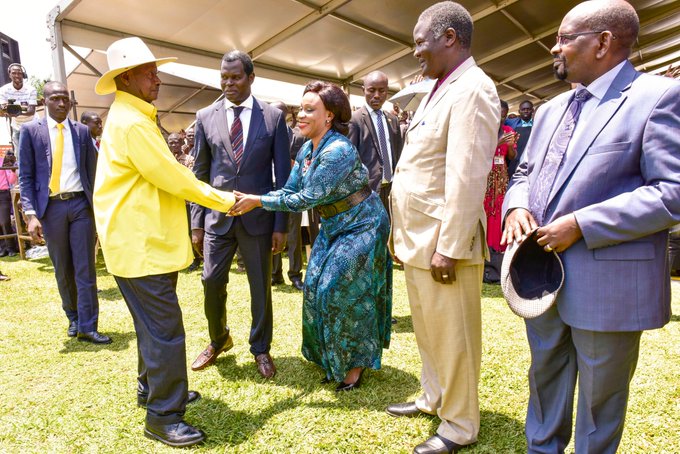
President Museveni being seen off by head of public service, John Mitala, Presidency Minister, Esther Mbayo and security chiefs.
President Yoweri Museveni has left for Japan to attend the seventh edition of the Tokyo International Conference for African Development (TICAD) summit aimed at promoting high-level policy dialogue between African leaders and development partners.
TICAD is a multilateral forum whose participants include not only African countries but also international organisations, partner countries, private companies and civil society organisations involved in development.
Participants will engage in fruitful discussions on African development, bringing together a broad range of global know-how and efforts of the international community. TICAD provides an open forum that generates innovative discussion, among various stakeholders, on African development.
The government of Japan has been leading this conference since 1993, co-hosted by United Nations, United Nations Development Programme (UNDP), World Bank and African Union Commission (AUC). The next TICAD will be held on 28th – 30th August, 2019 at Pacifico Yokohama, Yokohama city, Japan.
TICAD has been an evolving element in Japan’s long-term commitment to fostering peace and stability in Africa through collaborative partnerships.
In this context, Japan has stressed the importance of ‘Africa’s ownership’ of its development as well as of the partnership between Africa and the international community. The exchange of views amongst the conference delegates serves to underscore the case for more, not less assistance from the major world economies.
KCCA FC are aiming to qualify for the CAF Champions League group stages for their second time in history when they face Angolan giants Petro de Luanda in a two-legged tie of the final round of the qualification stage.
KCCA qualified for the final preliminary round with a 4-3 aggregate over Namibia’s African Stars while Petro Launda eliminated Lesotho’s Matlama FC 3-0 on aggregate.
Allan Okello and Mustapha Kizza scored for KCCA to overturn a 3-2 defeat from the first leg in Namibia to continue their unbeaten record at Lugogo in CAF competitions.
The Kasasiro Boys have good memories of their last match against Angolan opponents, after they knocked out CD Primeiro de Agosto in 2017.
The 16 winners of the first round advance to the group stage, while the 16 losers of the first round enter the Confederation Cup play-off round.
The first legs will be played between September 13 to 15, and the second legs between September 27 and 29.
Congolese officials and the World Health Organization officials wear protective suits as they participate in a training against the Ebola virus near the town of Beni in North Kivu province of the Democratic Republic of Congo, August 11, 2018. REUTERS/Samuel Mambo
Congolese health agencies vaccinated more than 200,000 people against Ebola in August, the government said on Sunday, using a Merck vaccine they hope will help rein in the world’s second worst epidemic.
Figures released by the government’s Ebola committee showed that 204,044 people had been inoculated since August 8. A total of 1,980 people have so far died in this epidemic, of 2,950 people suspected to have been infected — clinically confirmed cases are a little lower, at 2,845.
It remains the second biggest death toll in the disease’s history, after a 2014-16 outbreak in West Africa that killed 11,300 people.
The U.S. Department of Health and Human Services (HHS) said on Wednesday it will fund the manufacturing of Merck & Co Inc’s investigational Ebola vaccine called V920. Another vaccine by Johnson and Johnson is available but authorities have yet to deploy it for fear of creating confusion among an already sceptical and sometimes hostile population.
“The only vaccine that has been used in this epidemic is (the one) … manufactured by Merck,” the committee statement said.
Ebola appears to be under control in the city of Goma in Congo but it has flared in other parts of the country, where aid workers are combating insecurity and misinformation on social media.
The Uganda National Bureau of Standards (UNBS) has directed manufacturers of alcohol and spirits in the country to recall all alcohol sachets and bottles below 200mls from the market.
The move is aimed at strengthening the ban on packaging and selling alcohol in sachets and bottles below 200mls.
In 2017, the government through a cabinet directive issued a ban of the aforementioned products, urging manufacturers to transit to packaging alcohol in plastic and glass bottles of 200mls minimum.
Alcohol sachets and bottles below 200mls were expected to be out of the market by 30th May 2019, and as such, UNBS recently sealed off and closed over 167 sachet-filling machines belonging to at least 37 alcohol-manufacturing companies in Kampala, Wakiso, Mukono, Jinja and Mityana. Packaging materials used in production of sachets were also seized and confined.
However, the products are still sneaked onto the market, an illegal act that the UNBS Principle Certification Officer, Ronald Ahimibisibwe warned the manufacturers against.
According to the UNBS Principal Surveillance Officer, Linda Kobere, the resolutions were made to have non-conformities off the market;
UNBS to urge manufacturers to recall all non-conforming products from the market
UNBS to seal off any company whose non-conforming product is found on the market.
UNBS to name and shame any company sealed off due to non-conformities.
Urge manufacturers to advocate for self-regulation.
The revelations were made during UNBS engagement with alcohol and spirits manufacturers on Wednesday at the UNBS headquarters in Bweyogerere.
The meeting was aimed at ironing out issues hindering alcohol and spirits manufacturers’ compliance to the set standards.
The manufacturers raised concerns over non-compliant competitors dealing in crude waragi which is uncertified, and asked UNBS to take quick action against their activities.
The Acting Deputy Executive Director in charge of compliance, Andrew Othieno also clarified that local manufacturers importing raw materials, machinery and spare parts do not have to undergo PVoC, but ship the items to Uganda and obtain import clearance. This is aimed at supporting local manufacturers grow.
He further urged the manufacturers to get the Quality mark (Q) because it is mandatory and eases product penetration into the East African Market.
Mr. Sudhir and his son, Rajiv Ruparelia listening to the ruling.
Kampala businessman Sudhir Ruparelia has won a case in which Bank of Uganda/Crane Bank in receivership (BoU) sued him and his Meera Investments Limited.
BoU sued Sudhir and Meera Investments Limited on allegations that they fleeced Crane Bank Limited of Shs397 billion.
On Monday morning Commercial Court, Justice David Wangutusi, dismissed the case, agreeing with the submissions of Sudhir’s lawyers and ordered that BoU pays costs of the suit.
“The person (petitioner) should pay cost and that is non other than Bank of Uganda because Margret Kasule filed on behalf of Bank of Uganda. They knew Crane Bank was in receivership as it wasn’t in existence but they went ahead to sue it” read the judgement.
On his part, Sudhir thanked, his son Rajiv Ruparelia and his legal team led by Peter Kabatsi from Kampala Associated Advocate for the good work but wondered why people who had stolen his bank were asking him to pay $100 million.
“They sue me for $100 for the money they stole but how?. We are going to put a counter claim . They have stolen several banks previously but this is a landmark case”.
During last month’s court hearing, Mr Joseph Matsiko, one of Mr Ruparelia’s lawyers, argued that on October 20, 2016, Bank of Uganda (BoU) took over the management of Crane Bank pursuant to Sections 87 (3) and 88 (1) a & (b) of the Financial Institutions Act and that on January 20, 2018, BoU placed it under receivership. “The suit was filed on the 30th day of June 2017 when Crane Bank Ltd was in receivership. The issue, therefore, is whether a suit can be filed by a financial institution in receivership,” Mr Matsiko submitted.
He further argued that the Supreme Court has since ruled in a similar case that it would be wrong for any court to confer the right to sue when Parliament did not find it necessary to do so.
Mr Ruparelia, in an affidavit, also contended that under Uganda’s Constitution and the Land Act, Crane Bank in receivership could not own or hold freehold property and was, therefore, not capable of holding the suit property in its names.
But Dr Joseph Byamugisha, who represented Crane Bank in receivership, had argued that when a financial institution is placed under receivership, it does not lose powers to commence or continue with lawsuits.
Sudhir was happy with the ruling saying that what the judged ruled on what was not new since parliaments’ committee on Commissions State Authorities and State Enterprises (COSASE) had faulted BoU on giving CBL freely to its rival DFCU Bank and has been making huge profits as a result of the acquisition.
As a recap, on June 30, 2017, BoU filed a suit against Sudhir and his Meera Investments Limited, which the businessman says was in breach of clause 12 of the Confidential Settlement and Release Agreement (CSRA) that was reached by both parties after BoU closed and liquidated CBL for allegedly being undercapitalized.
The clause stipulates that, “Without prejudice to the immediate forging should any legal or administrative proceeding of any kind ensue against SR [Sudhir Ruparelia] as defined in the agreement, the agreement stands voided and BoU shall immediately return to SR the value of the settlement.”
In a counter claim, Sudhir wants BoU to pay him US$8 million (about Shs28.8 billion) for breach contract. Sudhir argues that on January 25, 2017, BoU sold, at an undisclosed sum, assets of Crane Bank to Dfcu bank Limited yet by mid-January 2017, the central bank had approached and urged him to settle the dispute.
The businessman, who runs Ruparelia Group of companies, says that between January 29 and March 20, the parties held a series of meetings meant to amicably resolve the dispute. He adds that under clause 3.1 of the CSRA, they agreed that he pays US$60 million in part cash and property.
In return for the above payments, Sudhir says they agreed that BoU would assign a number of loans totaling to Shs63.6 billion to him, release all securities of those loans, and remove Crane bank from receivership.
On April 4, 2017, Sudhir says that David Mpanga, one of BoU’s lawyers, wrote on behalf of himself and MMAKS, the other BoU lawyers, setting out the implementation timeline of the CSRA, clearly spelling out what each party was required to do in the said agreement.
In the letter, Mpanga said Sudhir was to provide the property list with an aggregate fair market value of US$42 million and that BoU would avail the assigned deed and loan statements to Sudhir with respect to the agreed loan.
That upon receiving the first installments, Mpanga wrote that BoU would release securities of loans worth about US$8million on the account of Sunbury Investments (U) Ltd and Main Freight ICD Limited. That upon receipt of the balance of US$10 million, Mpanga wrote that BoU would release the securities of the remaining portion of the agreed loans.
Sudhir consults lawyers
“A joint valuation team would determine the value of the properties and would compile a list that would constitute the settlement titles,” reads Mpanga’s letter, which is copied to BoU governor Emmanuel Tumusiime-Mutebile, and Justine Bagyenda, the BoU executive director for supervision.
Sudhir claims he went ahead to implement the agreement by giving up his properties to BoU, which included titles for land found in FRV 130 folio 18 plot M418 Nakawa Industrial Area and LRV 1239 folio 2 plot 7 Parliamentary avenue Kampala.
On April 19, 2017, Sudhir claims, BoU acknowledged receipt of US$1.1 million as payment towards the agreed loans and informed him that his deficit on the first installment of US$8 million was $6.9m, which they demanded he must pay that very day.
On April 20, 2017, Sudhir says he paid BoU US$6.9 million. That meant he paid a total of US$8 million on the same day. Despite paying the said money, he said, BoU never released securities of loans representing a total value of approximately $8m on the account of Sunbury Investments, Main Freight and also the central bank did not return his land titles.
That, Sudhir says, was a total breach of the CSRA. In compliance with the agreement, Sudhir says, he had supplied a list of titles, 10 of which were in the names of Mahmoud Bharwani, who had agreed to surrender his titles to settle his indebtedness to Crane bank.
Earlier on April 7, 2017, he said he arranged a meeting between Mpanga and Bharwani after BoU raised a number of issues in regard to Bharwani’s land titles and that it’s Mpanga who wrote the minutes.
“Mr Mpanga’s minutes indicated that the professional valuer conducts the joint valuation to avoid unilateral conclusion by one party. Any defect in title would be established in the joint valuation process,” Sudhir claims.
He said he put an additional eight titles to the property list to give BoU comfort. Nevertheless, Sudhir says, BoU in further breach of the CSRA implementation agreement and the Bharwani meeting, backtracked on the joint valuation.
The winning team, Kampala Associated Advocates who represented Sudhir.
As if that was not enough, Sudhir says that BoU threatened criminal prosecution if he did not agree with their demands, which were not in accordance with the CSRA.
On June 28, 2017, he says, Mpanga sent him an email with a notice to sue, demanding that by close of business on June 29, he unequivocally undertakes in writing to pay the balance of $52 million and that the payment must be made in cash by July 15.
He said that on June 30, BoU filed a suit against him in court, which was in breach of clause seven of the CSRA.
BoU sold some of CBL’s assets to its rival Dfcu Bank at Shs200 billion in January 2017. Dfcu bank would in first half of 2017 earn Shs114 billion in net profit, with a great percentage of the profits attributed to the acquisition of Crane Bank Limited.
During COSASE probe of BoU between late October 2018 and Late Feb 2019, its officials would disagree on how much CBL was undercapitalized. But Ben Sekabira, the then Director of banking , told MPs on COSASE that CBL at the time of its closure only needed Shs150 billion to remain operating, much as BoU claimed to have injected Shs478 billion in CBL as liquidity support while it was under receivership. During COSASE probe BoU officials failed to account for Shs478 billion.
In the preliminary suits of the main case, Sudhir succeeded in ensuring that conflicted lawyers of MMKAS Advocates, David Mpanga of AF Mpanga-Bowmans and Sebalu & Lule Advocates were barred from representing BoU and any party in cases involving Ruparelia Group, having worked for the company.
Chairman of Ruparelia Group, Mr. Sudhir Ruparelia.
The Head of Commercial Court, Justice David Wangutusi has delivered his ruling on the preliminary objection by city tycoon Sudhir Ruparelia in the case in which the Bank of Uganda took him to court, with the aim of recovering Shs397 billion.
The commercial court today ruled that BOU cannot use “Crane Bank in receivership” to sue; that there was no cause of action to sue Sudhir, that BOU receivership of CB ended when they sold to DFCU, that the freehold in CB branches belong Sudhir and BOU should pay costs of the suit.
Bank of Uganda (BoU) /Crane Bank in Receivership sued Sudhir Ruparelia and Meera Investments Limited of allegedly fleecing the defunct Crane Bank Limited (CBL) of Shs397 billion that the central bank wants refunded. However, Mr. Sudhir maintains his bank was fraudulently taken by BoU and subsequently given away to Dfcu bank.
Sudhir Ruparelia has won the case and we will share more details as they arrive.
VP Ssekandi in middle. In gomesi is Minister Sseninde and her daughter Jean next to VP
The Vice President Edward Kiwanuka SSekandi has appealed to parents to let their girl-children to pursue sport disciplines like their male counterparts and stop the prejudice and discrimination against them.
During a meeting with the FIFA Women’s Football Chief, Sarai Bareman, who was accompanying the CEO Sseninde Foundation, Jean Sseninde at the new Government Building in Kampala, Ssekandi said that many females who have greatly developed their talents in the fields of Football and Boxing can match the stature of men and could even beat them if it were allowed to hold mixed gender sporting competitions.
He said that female gender sports disciplines are steady taking firm root in the country and said that government is committed to supporting women teams in various national and international tournaments like FIFA women’s world cup, IAAF Athletic competitions, International Federation Netball world cup, among others, upon their qualification.
Nigeria’s Minister for Sports and Youth Development, Solomon Dalung, who was part of the delegation said that women are pivotal in development and that sports is the new lucrative sector that Africa’s women must be allowed to pursue to full professionalism and which will ably improve the welfare of their communities back home.
State Minister for Primary Education, Rose Mary Nansubuga Sseninde, flanked by her Husband Zephaniah Kizza Sseninde regretted her earlier position of stopping her daughter Jean Sseninde from chasing her footballing dream on the assumption that it was unwomanly especially in the African setting, but thanked her husband for staying firm and encouraging their daughter, Jean Sseninde, who is now a professional Footballer in the UK and who is also trotting the globe to encourage other young women into professional women football ranks.
FIFA Women’s Football Chief, Sarai Bareman, said that FIFA attaches great importance to the development of Women’s football and added that many countries are now benefiting from the wages of their sports women at the level of national teams and at clubs in Europe and Americas.
Sseninde Foundation has organized a female youth women’s football tournament and talent search that will be taking place at Kayeka Sports Ground in Mbarara town commencing this Saturday.
Chairman of Ruparelia Group, Mr. Sudhir Ruparelia.
The Head of Commercial Court, Justice David Wangutusi is next week on Monday expected to deliver his ruling on the preliminary objection by city tycoon Sudhir Ruparelia in the case in which the Bank of Uganda took him to court, with the aim of recovering Shs397 billion.
Bank of Uganda (BoU) /Crane Bank in Receivership sued Sudhir Ruparelia and Meera Investments Limited of allegedly fleecing the defunct Crane Bank Limited (CBL) of Shs397 billion that the central bank wants refunded. However, Mr. Sudhir maintains his bank was fraudulently taken by BoU and subsequently given away to Dfcu bank.
Lawyers representing both sides already submitted arguments in favour of for their clients and Justice Wangutusi will base his ruling on the submissions of either side. The general public and the members of banking sphere are waiting for the ruling expected to topical in the local banking sector.
As a recap, on June 30, 2017, BoU filed a suit against Sudhir and his Meera Investments Limited, which the businessman says was in breach of clause 12 of the Confidential Settlement and Release Agreement (CSRA) that was reached by both parties after BoU closed and liquidated CBL for allegedly being undercapitalized.
The clause stipulates that, “Without prejudice to the immediate forging should any legal or administrative proceeding of any kind ensue against SR [Sudhir Ruparelia] as defined in the agreement, the agreement stands voided and BoU shall immediately return to SR the value of the settlement.”
In a counter claim, Sudhir wants BoU to pay him US$8 million (about Shs28.8 billion) for breach contract. Sudhir argues that on January 25, 2017, BoU sold, at an undisclosed sum, assets of Crane Bank to Dfcu bank Limited yet by mid-January 2017, the central bank had approached and urged him to settle the dispute.
The businessman, who runs Ruparelia Group of companies, says that between January 29 and March 20, the parties held a series of meetings meant to amicably resolve the dispute. He adds that under clause 3.1 of the CSRA, they agreed that he pays US$60 million in part cash and property.
In return for the above payments, Sudhir says they agreed that BoU would assign a number of loans totaling to Shs63.6 billion to him, release all securities of those loans, and remove Crane bank from receivership.
On April 4, 2017, Sudhir says that David Mpanga, one of BoU’s lawyers, wrote on behalf of himself and MMAKS, the other BoU lawyers, setting out the implementation timeline of the CSRA, clearly spelling out what each party was required to do in the said agreement.
In the letter, Mpanga said Sudhir was to provide the property list with an aggregate fair market value of US$42 million and that BoU would avail the assigned deed and loan statements to Sudhir with respect to the agreed loan.
That upon receiving the first installments, Mpanga wrote that BoU would release securities of loans worth about US$8million on the account of Sunbury Investments (U) Ltd and Main Freight ICD Limited. That upon receipt of the balance of US$10 million, Mpanga wrote that BoU would release the securities of the remaining portion of the agreed loans.
“A joint valuation team would determine the value of the properties and would compile a list that would constitute the settlement titles,” reads Mpanga’s letter, which is copied to BoU governor Emmanuel Tumusiime-Mutebile, and Justine Bagyenda, the BoU executive director for supervision.
Sudhir claims he went ahead to implement the agreement by giving up his properties to BoU, which included titles for land found in FRV 130 folio 18 plot M418 Nakawa Industrial Area and LRV 1239 folio 2 plot 7 Parliamentary avenue Kampala.
On April 19, 2017, Sudhir claims, BoU acknowledged receipt of US$1.1 million as payment towards the agreed loans and informed him that his deficit on the first installment of US$8 million was $6.9m, which they demanded he must pay that very day.
On April 20, 2017, Sudhir says he paid BoU US$6.9 million. That meant he paid a total of US$8 million on the same day. Despite paying the said money, he said, BoU never released securities of loans representing a total value of approximately $8m on the account of Sunbury Investments, Main Freight and also the central bank did not return his land titles.
That, Sudhir says, was a total breach of the CSRA. In compliance with the agreement, Sudhir says, he had supplied a list of titles, 10 of which were in the names of Mahmoud Bharwani, who had agreed to surrender his titles to settle his indebtedness to Crane bank.
Earlier on April 7, 2017, he said he arranged a meeting between Mpanga and Bharwani after BoU raised a number of issues in regard to Bharwani’s land titles and that it’s Mpanga who wrote the minutes.
“Mr Mpanga’s minutes indicated that the professional valuer conducts the joint valuation to avoid unilateral conclusion by one party. Any defect in title would be established in the joint valuation process,” Sudhir claims.
He said he put an additional eight titles to the property list to give BoU comfort. Nevertheless, Sudhir says, BoU in further breach of the CSRA implementation agreement and the Bharwani meeting, backtracked on the joint valuation.
As if that was not enough, Sudhir says that BoU threatened criminal prosecution if he did not agree with their demands, which were not in accordance with the CSRA.
On June 28, 2017, he says, Mpanga sent him an email with a notice to sue, demanding that by close of business on June 29, he unequivocally undertakes in writing to pay the balance of $52 million and that the payment must be made in cash by July 15.
He said that on June 30, BoU filed a suit against him in court, which was in breach of clause seven of the CSRA.
BoU sold some of CBL’s assets to its rival Dfcu Bank at Shs200 billion in January 2017. Dfcu bank would in first half of 2017 earn Shs114 billion in net profit, with a great percentage of the profits attributed to the acquisition of Crane Bank Limited.
During COSASE probe of BoU between late October 2018 and Late Feb 2019, its officials would disagree on how much CBL was undercapitalized. But Ben Sekabira, the then Director of banking , told MPs on COSASE that CBL at the time of its closure only needed Shs150 billion to remain operating, much as BoU claimed to have injected Shs478 billion in CBL as liquidity support while it was under receivership. During COSASE probe BoU officials failed to account for Shs478 billion.
In the preliminary suits of the main case, Sudhir succeeded in ensuring that conflicted lawyers of MMKAS Advocates, David Mpanga of AF Mpanga-Bowmans and Sebalu & Lule Advocates were barred from representing BoU and any party in cases involving Ruparelia Group, having worked for the company.
For a few, delegating comes easily, maybe too easy. For others who are perfectionists, letting go of even the most trivial task is almost impossible. If you are in this second category, you probably don’t like the references behind your back that you are a “control freak” or a “micro-manager.”
London business school professor John Hunt notes that only 30 percent of managers think they can delegate well, and of those, only one in three is considered a good delegator by his or her subordinates. This means only about one manager in ten really knows how to empower others.
The challenge is delegating the right things, and not delegating the wrong things. If you don’t get it right, you are busy, but working on the wrong things. Almost every entrepreneur needs to improve their skills in this area, so I did some research on the basics. Jan Yager, in her classic book “Work Less, Do More,” has outlined eight key steps to effective delegation which I endorse:
Choose what tasks you are willing to delegate. You should be using your time on the most critical tasks for the business, and the tasks that only you can do. Delegate what you can’t do, and what doesn’t interest you. For example, non-computer types should consider delegating their social media, website, and SEO activities.
Pick the best person to delegate to. Listen and observe. Learn the traits, values, and characteristics of those who will perform well when you delegate to them. That means give the work to people who deliver, not the people who are the least busy. This requires hiring people with the right skills, not the least expensive or friends and family.
Trust those to whom you delegate. It always starts with trust. Along with trust, you also have to give the people to whom you delegate the chance to do a job their way. Of course the work must be done well, but your way or the highway is not the right way.
Give clear assignments and instructions. The key is striking the right balance between explaining so much detail that the listener is insulted, and not explaining enough for someone to grasp what is expected. Think back to when you were learning, when you were a neophyte.
Set a definite task completion date and a follow-up system. Establish a specific deadline at the beginning, with milestones. In this way you can check up on progress before the final deadline, without fuzzy questions like “How are you doing?”
Give public and written credit. This is the simplest step, but one of the hardest for many people to learn. It will inspire loyalty, provide real satisfaction for work done, and become the basis for mentoring and performance reviews.
Delegate responsibility and authority, not just the task. Managers who fail to delegate responsibility in addition to specific tasks eventually find themselves reporting to their subordinates and doing some of the work, rather than vice versa.
Avoid reverse delegation. Some team members try to give a task back to the manager, if they don’t feel comfortable, or are attempting to dodge responsibility. Don’t accept it except in extreme cases. In the long run, every team member needs to learn or leave.
Almost everyone who has grown their startup from a one-person entity to a going concern with many employees has struggled with letting go of any task. On the other hand, executives who come from a large company to a startup tend to delegate too much, resulting in high costs and lack of control.
Finally, every entrepreneur needs to set aside their fear of delegating. If you do it right, as outlined above, every task will likely be done better than you could do it. The only thing you can’t delegate is “the buck stops here” role. That can only be done by the person in charge, and it better always be you.
The writer is a veteran startup mentor, executive, blogger, author, tech professional, professor, and investor. Published on Forbes, Entrepreneur, Inc, Huffington Post, etc.
I woke up to pictures of Villa Park being graded by tractors for the construction of the Clock-Tower Flyover. This is the place of my first contact with Ugandan football when I was just 11 years old and instantly started my lifetime love with SC Villa. The theatre for Uganda’s greatest footballers that I ever saw is now history and this is the reality. This is simply because we did not plan for posterity. We continued to write history on water for over 40 years. This has inspired me to write this article and kindly appreciate my emotions.
As a non-Ugandan who has worked with Ugandans for a long time, I have no option but listen to his mind. I quote Mr. Milutin Sredojević aka Micho that Ugandan’s are famed for finding fault, claiming glory and making excuses
It is not part of us as Ugandans to stand up and take fault and be sorry neither is it in our DNA to stand in front of those we consider mighty and point out their fault. Many a people just keep quiet for fear of the ire of the popular wrong. Many praise things they know are wrong for their instant benefit or for popularity. I love the fact that I have as many friends as foes over my being straight in giving my mind even if it is unpopular
Property is acquired from the bona fide owner by purchase, donation, inheritance or in some cases by creation and documentations are required to certify ownership. Staying long in a place cannot give you ownership
The British allocated land to the parties that took interest in the early 1900s and the following entities did not buy but were allocated land in square miles
Churches, Mosques, Schools, Markets, Hotels, Hospitals, Universities, Police, Army, Prisons, Kingdoms, Industries, forests etc and the rest of the unallocated land was handed to the Government of Uganda as the custodians on behalf of Ugandans. Sport was not helped by the fact that there was no strong central entity that would hold land on behalf of the sports fraternity and only Nakivubo by the 1954 Nakivubo Act of Parliament and Lugogo allocated to the Uganda Sports Union were the only pieces reserved for Sports. In the countryside the Stadiums and Boma Grounds, reserved for community activities and not specifically sports, were left in the hands of the local governments that have since given them all away in the name of development
The challenge we are facing as Sport and football in particular is that there was no plan to own or demand for land by the forefathers of FUFA and the Clubs. The bitter fact is that the principal owners of the land in Uganda did not buy it from anyone neither was it allocated to them by God. They simply took advantage of being present at the sharing table. As sport we are unfortunate not to have been present then. This is the price we are paying and a reality we must deal with now and not tomorrow.
The Baganda have a saying that “ Enkoko yo mutamivu ….” Literally meaning that a chicken belonging to a drunkard only counts the night it says. This is the scenario of sports activities squatting on others peoples land.
There is no club in Uganda which is not in the same boat with SC Villa. The posterity minds must look clearly at matters beyond the current status.
1) Does KCCA FC own the Star Times Stadium?
2) Does SC Vipers own the St Mary’s Stadium?
3) Does any other Club own any sports infrastructure?
We now all aware that Express FC is also a squatter as Mutesa II Stadium
Sport, one of the fastest world growing industries, is an industry without infrastructure and without legislation but serving over 80% of Uganda’s population
It is therefore important to raise the bar of sports management in this country to start engaging the authorities for posterity. The Government is the biggest holder of land and has demonstrated that it can give out land to foreign investors who make a case. The Sports Fraternity should as well be allocated land by the government. We need to make a case not petty bickering.
As FUFA, we are going to organise a stakeholders’ workshop about sports infrastructure and engage the authorities in a civilise manner so that Sports is allocated land throughout the country.