Stanbic Bank
Stanbic Bank
20.4 C
Kampala
Stanbic Bank
Stanbic Bank
Home Blog Page 1215

Off-grid solar firm Azuri named as top 100 fastest growing UK companies

Nigel Preston, Vice President of Product Management at Azuri Technologies, pictured with one of Azuri’s off-grid solar systems helping to bring power to the millions without mains electricity in Africa.


The annual Sunday Times Hiscox Tech Track 100 league table ranks Britain’s fastest growing privately held companies by sales growth over the last three years. Ranked 42 in the league table, Azuri is paving the way in next-generation energy access in Africa.

Azuri’s innovative application of solar power combined with mobile payment technology and energy efficient appliances is enabling off-grid African families to experience modern digital technologies such clean LED lighting and satellite TV for the first time. More than 600 million people in sub-Saharan Africa still lack access to electricity.

Being named as one of the UK’s top-performing private companies comes hot on the heels of Azuri’s announced investment of US$26 million, led by Fortune 500 company Marubeni with additional participation from existing shareholders, including FTSE 250 company IP Group plc.

Since launching in 2012, Azuri is one of the leading providers of pay-as-you-go solar power lighting and TV systems, operating in Kenya, Tanzania, Uganda, Zambia and Nigeria. To date, the company has sold over 150,000 systems and the capital injection will enable Azuri to expand operations in current territories and beyond.

From solar home lighting to satellite TV, Azuri-designed solutions deliver world-class performance at an affordable price to off-grid customers across Africa. Azuri’s vision is to create a level playing field where all African consumers can access and benefit from the digital economy, wherever they live.

“Following several years of sustained growth, Azuri is delighted to be recognised as part of the Sunday Times Hiscox Tech Track 100. This growth reflects a rapidly expanding sector and increasing demand from African consumers for affordable clean energy and access to modern life-changing technology,” commented Simon Bransfield-Garth, CEO of Azuri Technologies.

Inclusion in the Tech Track 100 continues the award wins for Azuri during the last 12 months, including being named in the CleanTech 100, the FT1000 list of the fastest growing companies in Europe, and the Financial Innovation Awards for innovative clean tech solutions.

Azuri is one of only four Cambridge-based companies to be listed in the Tech Track 100 league table.


Stories Continues after ad

Don’t bow to oil companies: CSOs urge gov’t over oil pipeline suspension

Uganda's Energy Minister Eng. Irene Muloni.


Over 10 Civil society organisations (CSOs) working to promote good governance in the oil and gas sector in Uganda have urged government not to bow to pressure being exerted by oil companies as far as the development of the oil pipeline is concerned. The pressure is being exerted over the collapse of negotiations by Tullow Oil (U) to sell 21.57 per cent of its Lake Albert oil stake to Total and CNOOC.

The collapse followed a two and a half year disagreement between Tullow Oil and government over the assessment and payment of Capital Gains Tax (CGT) in addition to other taxes due to government from the planned farm down. Because of the failed farm down, Total E&P decided to suspend all activities on the East African Crude Oil Pipeline (EACOP) project.

CSOs meet

The CSOs made the call following a meeting organised by Africa Institute for Energy Governance (AFIEGO) on Thursday September 5, 2019 at AFIEGO’s offices in Kampala. The meeting discussed the failed farm down, tax dispute and the consequent suspension of all activities on the EACOP project.

“Uganda’s laws including the Income Tax of 1997 provide that where a company makes money off the sale of its business, then that company must pay CGT. Tullow Oil must therefore pay the tax of $167million and any other tax assessed in accordance with the laws of Uganda.

The oil companies, whose activities have led to displacement of thousands of communities and have caused a lot of suffering, should not gang up against government to pressure it to abandon its demands for the CGT. The country needs taxes to provide for her citizens,” AFIEGO’s Mr Dickens Kamugisha said while communicating the outcomes of the recent meeting .

Companies should stop hurting businesses

The CSOs further noted that it was wrong for oil companies, which excited Ugandans into accepting them by promising jobs, to abuse Ugandans’ goodwill by laying off workers and suspending tenders given to businesses in order to further pressure government.

Reports indicate that some workers have been laid and tenders to businesses have been suspended. “Ugandans should learn their lesson. Oil companies and government have been exciting them by telling them that the oil and gas sector will create 150,000 jobs.

Ugandans believed them despite assessments such as those by Assaye Risk Consults showing that Ugandans lack the necessary skills and are unlikely to be gainfully employed in the oil sector. “ Today, these companies are using Ugandans as pawns and have discarded them without a thought to pressure government.

Businesses that were also excited into borrowing money with promises that they will supply goods to the oil sector have also been discarded. This is unfortunate. Ugandans should know that the much-touted jobs in the oil sector will benefit very few and should therefore be cautious about being excited by talk of jobs by selfish companies,” Mr Yoram Banyenzaki, a youth leader belonging to the Guild Presidents’ Forum on Governance (GPFOG) said.

Gov’t must review production sharing agreements and tax laws

While the CSOs maintain that government must continue demanding that Tullow Oil pays tax, they are also blaming government for signing bad Production Sharing Agreements (PSAs) with oil companies that have continually made it hard for government to get the CGT due to it.

“When Heritage Oil sold its assets to Tullow in 2010, the company disputed the CGT of $434 million that government said it had to pay. Long court battles that were only resolved in London ensued. Later, when Tullow Oil sold two thirds of its assets to Total and CNOOC in 2012 at US $2.9 billion, another tax dispute ensued.

Tullow did not want to pay the US $407 million CGT it was assessed to pay. The company ended up agreeing to only pay US $250 million and out of pressure and corruption, government accepted. This resulted into the country losing $199 million in taxes. It’s Tullow that profited from the lost tax. Today, we see another battle between the same Tullow and government over CGT. Total has joined this battle by suspending its EACOP activities.

Government keeps telling Ugandans that they negotiated and signed the best PSAs in the world on Ugandans’ behalf. How can such good PSAs fail to save Ugandans from tax disputes? Government needs to review the PSAs that were signed.

Government also needs to reform tax laws to address the source of tax disputes. Further, government should address the challenge of corruption in the country” Mr Robert Byaruhanga, an oil and gas consultant, said.

 Use oil revenue to benefit citizens

The CSOs noted that since the discovery of oil in 2006 to date, government has collected over $1 billion in oil revenues. However, these oil revenues have been abused.

“Ugandans will recall that when government won the CGT dispute against Heritage Oil, the president ‘rewarded’ 42 government officials with UGX 6 billion for winning the case. This wasteful reward was against provisions of the Public Finance Management Act [PFMA] that provides that oil revenues must be spent on development projects, and not consumption.

Government also continually withdraws oil revenues from the Petroleum Fund prior to parliamentary approval contrary to provisions in the PFMA. 3 The business of government ‘misusing’ oil money must stop. When government abuses oil revenues, it fails to build social capital that it would now be relying on to rally citizens to support it in the ongoing disputes with oil companies,” Mr Gard Benda of World Voices Uganda said.

The CSOs also observed that oil activities are going to negatively impact climate, agricultural productivity, tourism and public health. They noted that government needs to stop abusing oil money and should invest it.

“Oil revenues should therefore be invested in public infrastructure to support citizens who are going to lose their jobs, cultural heritage, access to water, food security and good health. Government should also stop all oil activities in protected areas,” Ms Esther Abigaba of the Oil Refinery Residents Association (ORRA) said.

The CSOs’ final call was to the National Environment Management Authority (NEMA). They noted that NEMA has issued Environmental Impact Assessment (EIA) certificates for projects such as Tilenga in violation of EIA laws.

“If Ugandan government agencies violate laws, they not only put our environment at risk but lose the moral authority to demand that companies respect the laws as well. Government also needs to invest in clean energy so that it is not desperate for oil. Such desperacy is used against it by oil companies,” Kamugisha said.

Stories Continues after ad

More success as Victoria University holds 4th graduation

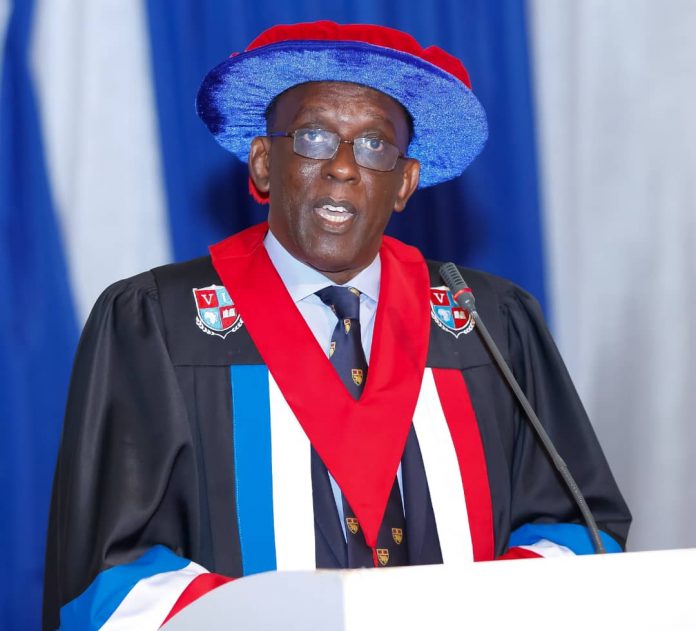
Dr Ham Muliira, former Minister of ICT and now Presidential Advisor Speaks at the Graduation that was held at Speke Resort-Munyonyo.


It was another milestone on Friday as Victoria University, one of the leading private institutions of higher learning in Uganda held its fourth graduation ceremony at Speke Resort Munyonyo in Kampala.

The graduation ceremony was held under the theme, ‘Developing Agents of Change’.

50 students from the Faculty of Health Sciences, Technology, Humanities and Social Sciences, and Business and Management received their testimonials to mark the successful completion of their university studies.

Victoria University Chancellor Dr Martin Jerome Aliker, Vice Associate Prof Krishna N. Sharma, University Promoter Rajiv Ruparelia presided over the graduation.

Other notable dignitaries that graced the event are Dr David Byatike Matovu the Chairman University Council and Senior Presidential Advisor on ICT Dr Ham Muliira.

Announcing the graduation ceremony last month, University Vice Chancellor Associate Professor Sharma said that the graduands were all ready to hit the job markets after gaining knowledge from classroom, exposure through internships and enough preparation by the experienced lecturers and experts.

Mr. Rajiv Ruparelia, director of the university and his wife Naiya Ruparelia arrive for the graduation.

“We have prepared them with good knowledge in the classroom, good skills, practices and good exposure through internships from best placements which fit their programs”

He adds, “We have also did a special workshop for our graduands called total graduate where we taught them such skills like how to write cv, how to dress up, how to appear in the interview, mingling with people, how to crack a deal, stress management at work and how to be spiritual, so we prepared them for all of this”

Graduands following the proceedings.

One of the graduands told this reporter that she is feeling great. It is been a long time coming. I am excited about life after school” she said, adding that there have been opportunities such as networking and so many learning experiences.

Victoria University has ensured that its students are exposed by allowing open door policy where students easily access the administration, said another student who hopes to join the banking industry as an IT specialist.

Another one said the university provides great internship opportunities that give working experiences to students.

The university will also use the same occasion to recognize the foundation students who have undergone one year course at the university.

The university supports students through the Ruparelia foundation with sponsorships of up to 70 percent.

In a bid to address the challenges of unemployment, the university has been very instrumental in creating entrepreneurs and developing talent through various initiatives like fashion, sports and games plus entertainment among others.


The university is owned by Ruparelia Group and it is accredited by the National Council for Higher Education and Uganda Nurses and Midwifery Council.

Recently the university entered into a partnership with the Chartered Institute of Logistics and Transport (CILT) to launch an Advanced Diploma in Logistics and Transport.


Stories Continues after ad

BoU top official behind old notes scandal as Mbarara currency centre workers are investigated 

Money

The Bank of Uganda departments of operations as well as currency are the reason why the central bank has had its image tainted and it will take long for the central bank to gain its credibility. But insider sources say a top executive is behind the majority of most of the scandals that have ensured that money goes into his pockets.

The official’s name appeared prominently in the closure of certain commercial banks in Uganda where the central bank failed to follow the laid down guidelines and procedures in closing the banks, with the prominent ones being Crane Bank Limited (2016), Global Trust Bank (2014) and National Bank of Commerce (2012).

The official was also tried so much to fail the audit of BoU by the Auditor General John Muwanga and tried to use legal means to sabotage the probe only for Speaker of parliament Rebecca Kadaga to insist that Muwanga had to do his work given that BoU is public entity and therefore not immune to such probe, despite having a bit of independence.

The same official and others hid documents related to the sale of Crane Bank Limited and especially those to do with the accountability of Shs478 billion the central bank claimed to have injected as liquidity support in former Crane Bank Limited while under receivership.

It was later discovered by Muwanga that Shs290 billion of that money could not be accounted for. Yet later on the same official wanted Muwanga to repeat audit of Shs478 billion. But Muwanga dashed away his request, saying that only parliament could order him to repeat the process which the official wanted to use to hoodwink the Auditor General and clear his name.

It is also claimed that the top official was instrumental in ensuring that Crane Bank Limited’s assets were transferred to DFCU Bank at Shs200 billion, paid in installments, moreover interest free. The official and others, according to insider sources at BoU shared money from this bogus transaction where some analysts have said DFCU Bank acquired assets of its rival Crane Bank Limited free of charge in 2017.

It is said the top official is also behind the ill-advised suit where BoU wants Sudhir Ruparelia and Meera Investments to pay Shs397 billion alleged to have been stolen from former Crane Bank. The official sought by using Crane Bank In Receivership as a plaintiff, BoU would be favoured by court but days ago head of commercial court, Justice David Kutosi Wangutusi dismissed the suit, saying Crane Bank In Receivership has no right to sue.

It is said a top manager at BoU has been behind the recent scandals where officials have involved themselves in theft.  For instance the issue of Shs90 billion that was printed without the authorization of BoU Governor Emmanuel Tumusiime-Mutebile, is not resolved yet as investigators are yet to release the report.

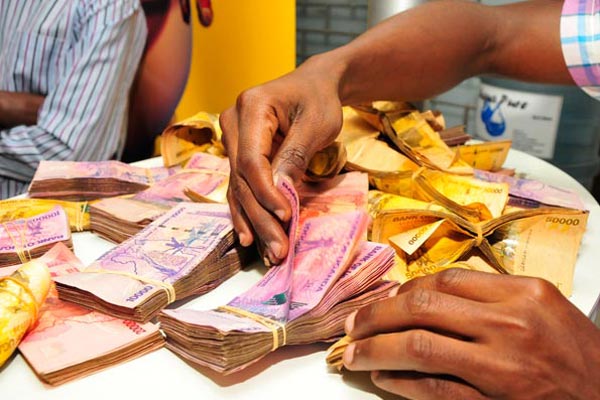
As if that one is not enough the latest is the recent arrest of BoU staff at its Mbale branch where they were trying to smuggle out old shilling notes that they were supposed to destroy before disposing them off. This habit, according to insider sources in BoU has been going on for years now and no wonder old shillings notes still circulate in the economy despite efforts by the central bank to get rid of them in partnership with commercial banks and other financial entities.

Reports also indicate that other BoU officials at Mbarara Currency Centre are also under investigations in relations to smuggling out old currency notes, with the official said to be heavily involved.

Insiders at BoU say the junior staffs are directed by the top official to carry out the illegal activity that brings back the old notes in circulation. They say staffs involved in this bad activity have bought and build themselves mansions, set up real estate businesses within the shortest time. The staffs and the top official saw old notes as an opportunity to grow personal wealth.

In fact according to a recent report on BoU, the official has a clique of staff that he works with to frustrate the good intentions of governor Tumusiime-Mutebile. Staffs who were asked by a committee appointed by President Yoweri Museveni said that such cliques are responsible for poor operations at BoU and the said senior staffs want this top manager dismissed if the institution is to stabilize and gain public trust again.

The official who heads operations at BoU is said also not to be at good terms with his junior who was hired in February after former executive director for bank supervision Justine Bagyenda was fired by Tumusiime-Mutebile for underperformance. Insiders say the official wants to take over some of the roles his junior.

Ugandans are now waiting to see what government will do to the BoU official involved. Most probably, according to analysts, after investigations they will be asked resign or sacked or prosecuted in courts of law. However, other citizens argue that government should seize the properties of the culprits to teach others a lesson. The said top official behind the scandals at BoU is extremely rich, with the wife and children running multi-billion businesses.

Stories Continues after ad

Entebbe expressway shooting: Joshua Rushegyera’s family declines to attend burial  

Late. Joshua Rushegyera


A scuffle has erupted between the late Joshua Rushegyera’s family members contesting decision taken by the few powerful members attached to the first family to lay him to rest at his maternal Uncle’s place in Kazo.

Joshua Rushegyera was shot dead on Thursday night alongside one Merina Tumukunde , a 37 year old female at Nambigirwa Bridge, along the Kampala Entebbe Express Highway.

Alluding to preliminary findings availed by police spokesperson Fred Enanga, the deceased were going to Millennium Hotel in Zana, where they had arranged business transaction, with a car dealer, identified as Robert Suubi.

In a statement released by Martin Rushegyera (the Heir) on behalf of Rushegyera Family, the tragic demise of Joshua Rushegyera has left the family devastated.

“We cannot express in words our heartfelt grief, Joshua you will forever remain in our hearts, especially the manner in which the merciless killers ended your precious life in cold blood.” He said he  had called on authorities to do their part for killers to be brought to book and account for shocking crime they committed.

“As a family we thought we would lay you to rest by the resting place of your mother in Kasharari or near your father’s grave in Rwenjeru Bushenyi. We are disheartened that some people, so powerful on your late mother’s side have dictated to bury your remains at your maternal Uncle’s place in Kazo in total disregard our linage and ancestry customs.” He wrote

“This is a very big embarrassment and disappointment not only to the Rushegyera Family, but to the people of Kasharari, Rwenjeru and Bushenyi District, and the Basingo Clan. We have therefore, as a family resolved not to go to Kazo for burial, but wish our son and brother an eternal rest.” he said in a statement.


Stories Continues after ad

Parliament tasks gov’t to find lasting solutions to the rampant blood shortages in the country

Minister Sarah Opendi

Members of Parliament have called on government to find lasting solutions to the rampant blood shortages in the country.

Legislators reported that their constituents are facing challenges travelling long distances to access blood, which in most cases is in short supply.

“In Pakwach, we do not have a general hospital and so my people walk all the way to Arua district to access blood, which I am also told is in shortage,” Jane Pacuto Avur said.

Pacuto was equally concerned that Pakwach district lacks an ambulance that would otherwise ease access to blood from Arua Hospital. She said that “If government does not come quickly to address blood shortage in the  district, the number of deaths will be worrisome”.

Aruu County MP, Samuel  Odonga Otto, said that private facilities are selling blood to patients saying that it could partly explain why there are blood shortages.

“In some hospitals in Kampala, you pay Shs3 million to get blood; it is sad that people are giving blood freely but hospitals attach a cost to it,” Otto said.

Odonga Otto asked the Ministry of Health to update Parliament on the state of blood stock in the country and to reprimand health facilities engaged in selling blood.

On ambulances, State Minister for Health in charge of General Duties, Sarah Opendi told Parliament that the Health Ministry has come up with an ambulance policy and is awaiting consideration by cabinet.

Opendi added that the ambulance network would operate just like the Uber taxi system where patients can be directed to a nearby ambulance.

“We propose to have stand-alone ambulances away from health facilities so that if there is any need, somebody makes a call and the call centre detects a nearby ambulance just like how Uber operates,” Opendi explained.


Stories Continues after ad

Police officer arrested in the Express Highway killing

Late Merina Tumukunde, wife to Mark Rugyenza of Bugolobi flats


Police has issued a statement indicating one of their own has been arrested in connection to the killings that happened on Kampala-Entebbe Express Highway.

A Police Constable known as Davis Taremwa is alleged to have been part of the group with the deceased before they departed from Entebbe to Millennium Hotel.

“We have meanwhile arrested our officer and placed him under criminal investigation. He is being examined for traces of evidence that could have remained on him, especially gun powder to help place him at the scene or not. In addition his movements from Hidden Treasure Hotel where he was picked at 8pm, to Millennium Hotel, till 2pm when he returned to the Hotel are thoroughly being investigated.”

Police in the statement say the woman killed was Merina Tumukunde, 37 years and wife to Mark Rugyenza of Bugolobi.


Below is Police Statement in full


The Directorate of Criminal Investigations is actively investigating a suspected car shooting which occurred on the 5/09/2019, at around 1o:30 pm, at Nambigirwa Bridge, along the Kampala Entebbe Express Highway, and claimed the lives of two victims, who were occupants in a Black Toyota Land Cruiser under Reg.no.UAW 534B.

The first victim has been identified as Nteyireho Ruhegyera Joshua, a 38 year old male adult, who was found lying dead, outside the car, towards the rear; with gunshot wounds. An AK47 gun was found lying along his side. The second victim was later identified by her husband Mark Rugyenza of Bugolobi flats as Tumukunde Merina, a 37 year old female adult, who died in a seating position, in the hind seat, and with a single bullet wound to the head. She is a Ugandan from Mbarara District (we regret the error in names). The two bodies were retrieved and transported to Mulago City Mortuary for post mortem examination to establish the cause of the death. Our Joint Security response teams arrived at the scene at around 11pm and cordoned it off. It was documented by forensic experts and material scientific evidence recovered.

The Directors of Criminal Investigation and Forensic Services are revisiting the scenes for better reconstruction and documentation. At this stage, the exact motivation towards the double shooting and murder is not yet established.

However, preliminary findings indicate that the male victim and PC Taremwa Davis have been very close friends. It is on friendly terms, that he requested the officer who was on guard duties, at Hidden Treasure Hotel Entebbe to escort him to Millennium Hotel in Zana, where they had arranged business transaction, with a car dealer, identified as Suubi Robert. The officer withdrew from his beat (an act which was not justified based on the law and his training) and the 3 drove together to the Hotel. The circumstances surrounding their movement from Millennium Hotel, up to the stage where the shooting occurred at Nambigirwa Bridge, Mpala are still unclear. It is what the task team of investigators and forensic experts are working to determine.

So far 3 cartridges, an AK 47 gun, mobile phones to the deceased, a magazine porch and headdress have been recovered in addition to the scientific evidence that is of material value. The CCTV footage along the highway have also been retrieved for further analysis. The body of the male victim is also being examined for traces of gun powder as part of investigations.

We have meanwhile arrested our officer and placed him under criminal investigation. He is being examined for traces of evidence that could have remained on him, especially gun powder to help place him at the scene or not. In addition his movements from Hidden Treasure Hotel where he was picked at 8pm, to Millennium Hotel, till 2pm when he returned to the Hotel are thoroughly being investigated.

Our thoughts and prayers go out to the families of the deceased as we pledge to conduct very objective and thorough investigations to ensure those responsible are brought to justice.

We strongly believe that the evidence gathered thus far, will enable us determine, whether the shooting occurred from within the car, whether there was an altercation in the car, a transaction gone bad, a drive- along shooting or a murder and suicidal incident.

We further implore anyone with information surrounding the incident to come forward and contract the Homicide Department on telephone number 0718-357460.

CP Enanga Fred

Police Spokesperson

6th.Sept 2019


Stories Continues after ad

BoU admits theft of old bank notes by staff

Bank of Uganda

The Bank of Uganda has conceded that some its staff tasked with the destruction of Uganda currency old notes have been going against the guidelines and instead they have been stealing to notes to enrich themselves.

Central Bank’s communications director, Ms Charity Mugumya is quoted by the Daily of Uganda staffs who stole old banks notes at the currency center in Mbale and that some staff have already been asked to go on forced leave.

“There were allegations of pilferage involving cancelled stock at Mbale Regional Branch. The Bank is conducting internal investigations to ascertain the veracity of the allegations. As a result, some staff were sent on leave to pave way for investigations. Details will be available as and when investigations are complete.”

BoU) is back in the spotlight following a week of scandal, in which officials at its Mbale currency centre, including cleaners were sacked for stealing cash, withdrawn from the market.

The scandal has left top managers at the central bank carrying shame in their faces, as members of the public continue asking questions as regards to the integrity of the employees at one of Uganda’s premier institutions.

The scandals at BoU have left Governor Emmanuel Tumusiime Mutebile in a mess with his management skills being questioned as scandal after scandal evolves.

Finance minister Matia Kasaija months ago said that changes at BoU were in the pipeline, based on the COSASE report that pinned the central banbk over the controversial closure of seven commercial banks such as Crane Bank Limited, Global Trust Bank Uganda, National Bank of Commerce and others.

In the latest scandal, the central bank has issued new rules on accessing machine rooms at its currency centre following reports of theft of old notes at its Mbale currency centre.

Dr Bazinzi Natamba, the BoU acting Currency Director, has barred staff not belonging to the machine room not to access it.

“In order to mitigate risks and strengthen internal controls in our currency operations, please observe the following; No Note Examiner should access a Counting/Machine Room of another Currency Branch without the required authorization and No staff other than Note Examiners should participate in the Counting/ Machine Room activities such as sorting, punching and strapping of stocks,” the directive issued on Monday, September 2, reads in part.

Dr Natamba added that there will be closer use of CCTV cameras to monitor operations of the currency strong room after it emerged that some bank staff were earlier caught on CCTV camera stealing old notes that were meant to be destroyed.

Apparently, the Central Bank issued notice in a bid to save face following rising cases of operational loopholes including the sacking of all staff at the Mbale currency centre after an investigation established that some of them were involved in theft of hard cash.

Sources said more security was last Thursday deployed at the currency centre in an attempt to reinforce monitoring and supervision.

Sources said all staff at the centre from cleaners to senior managers were fired after some of them were caught on CCTV camera picking old currency that is destined to be destroyed.

Whereas the allegations of theft surfaced some months ago, sources said BoU management decided to conduct a thorough investigation to establish the extent of the matter.

The investigation revealed that huge sums had been stolen from the strong room, hence the latest action.

The revelation comes months after investigations into the extra cargo that was loaded on a Bank of Uganda (BoU) chattered plane was extended to currency centres in Mbale, Kabale and Fort Portal. The head of BoU Currency Centres in Kabale and Mbale were also questioned for failure to detect the extra consignment on a chartered plane with sensitive government cargo.

The Central Bank has over the last year been in the news for the wrong reasons. Recently, the committee, which was formed by President Museveni in February following concerns about Governor Emmanuel Tumusiime Mutebile’s sweeping staff changes, recommended sweeping changes in the management of the central bank.

In their report, the Committee reported to Mr Museveni that the central bank was polarised by cliques. The report said all the staff interviewed indicated in a way that they belong to at least a clique aligned to either Mr Mutebile or Mr Louis Kasekende, the BoU deputy governor.

To ease the tensions at BoU, the tripartite committee also recommended the separation of the position of the governor from that of the board chairman and also highlighted the need for the president to create a second position of deputy governor.

Meanwhile a private members bill is in the offing to cut the powers of the governor and his deputy who act as chairman and vice chairman of the board of BoU.

Stories Continues after ad

Police statement on latest murders on Entebbe Expressway

Police Spokesperson Fred Enanga
On the 5/9/2019 at about 2300hrs the DPC Entebbe Sp Kawonawo Baker recieved information of shooting at Nambigirwa bridge along Kampala-Entebbe express highway in katabi town council wakiso district.

Police Action:
1.The crime scene was responded too by a team of detectives, being headed by Dpc,soco, dog handler and backed by flying squad and JAT and other sister agencies.

2.Crime scene was examined by the soco.

3.The police dog was introduced to the crime scene to track the suspect(s).

4.One AK-47 riffle No.UG POL56-3100699022697 with 27 rounds of live ammunition recovered at the scene.

5.Three empty cartridges were recovered at the scene.

6.One Counter Terrorism Uganda police cap and a magazine porch was recovered from motor vehicle reg.No.UAW 534B Prado TX black in colour at the scene.

7.Evidential documents, National ID and driving permit belonging to one Nteyireho Ruhegyera Joshua were recovered from the body at the crime scene.

8.Two bodies were taken to mulago city mortuary for post mortem examination.

9.The motor vehicle was towed to the police station.

Findings:

1.It was established that m/v reg no.UAW 543B Prado TX black in colour was found well positioned/parked aside the road at Nambigrwa bridge along Entebbe Express Highway while the engine was still hidroling with lights on while facing the direction of Mpala(Kampala-Entebbe road) with codrivers door open.

2.In the m/v a body of a one Maya Kamukazi Florence was found in seating position in the behind seat of the co driver with a bullet wounded on the head .

3.Out side the motor vehicle at rare was a body of Nteyireho Ruhegyera Joshua which was lying in a pool of blood with bullet wound on the head while the left hand holding an AK-47 smg riffle.

4.In the motor vehicle was a a piece of paper bearing particulars of No.32693 D/Sgt mutesi and two mobile phones were recovered.

Outstanding Inquiries:

1.Retrieve the post mortem reports from Mulago.

2.Obtain relevant witness statements.

3.Subject the riffle and cartridges to the ballistic expert for examination.

4.Forward the particulars of the motor vehicle to Uganda Revenue Authority with of 17a.to retrieve the particulars of ownership of the m/v.

5 .Getting the printout data of the deceased’s phones got in the motor vehicle.

6.Tracking down the suspects to brought to book.

7.Reconstructing the crime scene.

Progressive report to follow.

Stories Continues after ad

A Role for Financial and Monetary Policies in Climate Change Mitigation

William Oman


By William Oman


July 2019 was the hottest month ever recorded on earth, with countries across the world experiencing record-breaking temperatures. A prolonged drought is affecting millions of people in East Africa, and in August 2019 Greenland lost 12.5 billion tons of ice in one day.

review of the literature by IMF staff aims to spur discussion of what policies to mitigate climate change could or should include. The review suggests that, while fiscal tools are first in line, they need to be complemented by financial policy tools such as financial regulation, financial governance, and policies to enhance financial infrastructure and markets, and by monetary policy.

The stakes are high. There is a broad scientific consensus that achieving sufficient mitigation requires an unprecedented transition to a low-carbon economy. Limiting global warming to well below 2 degrees Celsius requires reductions of 45 percent in CO2 emissions by 2030, and reaching net zero by 2050. Despite the 2015 Paris Agreement, greenhouse gas emissions are high and rising, fossil fuels continue to dominate the global energy mix, and the price of carbon, remains defiantly low, reinforcing the need for complementary policies.

The case for policy action beyond carbon pricing

Our review of academic and policy studies suggests that, currently, there are insufficient incentives to encourage investment in green private productive capacity, infrastructure, and R&D. At the same time, investments continue to pour into carbon-intensive activities. These undesirable economic outcomes prevent the needed decarbonization of the global economy. Decarbonization requires a transformation in the underlying structure of financial assets—a transformation that, studies suggest, is hindered by several deficiencies in the way markets function.

First, financial risks may not reflect climate risks or the long-term benefits of mitigation, given many investors’ shorter-term perspectives. Moreover, financial risks are often assessed in ways that do not capture climate risks, which are complex, opaque, and have no historical precedents.

Second, there is a wide gap between the private profitability and the social value of low-carbon investments. High uncertainty around their ability to reduce emissions, as well as the future value of avoided emissions, makes low-carbon investments unattractive to investors, at least in the short run.

Third, corporate governance that favors short-term financial performance may amplify financial “short-termism,” while constraints in capital markets can lead to credit rationing for low-carbon projects.

The above review of previous literature suggests that, because they directly influence the behavior of financial institutions and the financial system, financial and monetary policies can play a key role in addressing these issues.

Possible policy tools suggested by studies

The table below summarizes financial and monetary policy options for climate change mitigation, based on the above review of previous studies.

Policies that have been proposed in the literature can be divided into two categories: climate risk-focused and climate finance-promoting.

Climate risk-focused tools aim to correct the lack of accounting for climate risks for individual financial institutions and support mitigation by changing the demand for green and carbon-intensive investments, as well as their relative prices.

On the monetary policy side, examples include developing central banks’ own climate risk assessments, and ensuring that climate risks are appropriately reflected in central banks’ collateral frameworks and asset portfolios. On the financial policy side, tools include reserve, liquidity and capital requirements, loan-to-value ratios, caps on credit growth, climate-related stress tests, disclosure requirements and financial data dissemination to enhance climate risk assessments, corporate governance reforms, and better categorization of green assets by developing a standardized taxonomy.

Climate finance-promoting policies seek to account for externalities and co-benefits of mitigation at the level of society—that is, to account for how economic activity harms the environment but could instead, in addition to mitigating climate change, generate social value through, for example, reduced air pollution or more rapid technological progress. These policies could help shift relative prices and increase investments. However, the fact that they add new goals to existing policies makes them more controversial.

Monetary instruments to promote climate finance include better access to central bank funding schemes for banks that invest in low-carbon projects, central bank purchases of low-carbon bonds issued by development banks, credit allocation operations, and adapting monetary policy frameworks.

Financial policy instruments to actively promote climate finance revolve around “green supporting” and “brown penalizing” factors in banks’ capital requirements, and international requirements of a minimum amount of green assets on banks’ balance sheets.

What’s the bottom line?

More work is needed. The literature remains limited on the desirable package of measures to address climate mitigation. Nonetheless, financial and monetary policy tools can complement fiscal policies and help with mitigation efforts. All hands are needed on deck, for, as Mark Carney of the Bank of England has warned, “the task is large, the window of opportunity is short, and the stakes are existential.”

The writer is an economist at the International Monetary Fund, where he focuses on macrofinancial issues and climate change within the Monetary and Capital Markets Department.


Stories Continues after ad