Stanbic Bank
Stanbic Bank
21 C
Kampala
Stanbic Bank
Stanbic Bank
Home Blog Page 1244

Equity Group’s gross profit jump 10%

Dr James Mwangi, CEO Equity Group Holdings Plc


A growth in lending created a 10 per cent rise in first half pretax profit at Kenya’s Equity Group Holdings plc, according to the latest financial statement.

The Group’s chief executive officer, James Mwangi said he was confident the government would remove a cap on lending rates, further boosting demand for credit.

The cap, introduced in 2016 to curb high interest rates on loans, prevents banks from charging more than four percentage points above the central bank’s benchmark lending rate, currently 9 per cent.

The move has resulted in borrowers perceived as too risky being locked out of the market, squeezing economic growth, Mwangi told investors on Thursday.

“We are very optimistic (it will be removed). The pains of this interest capping have been a big challenge,” Mwangi said.

“The interest cap has done its last breath.”

The finance ministry proposed removing the cap in June, saying it had starved small businesses of credit. However, some lawmakers have vowed to block the repeal.

Equity, which also operates in Uganda, Tanzania, South Sudan, Democratic Republic of Congo and Rwanda, made a first half pretax profit of KShs17 billion Kenyan shillings ($165 million), with interest income up 9 per cent to KShs27.7 billion.

Net loans to customers rose 17 per cent to KShs320.9 billion, topping the group’s target of 10 to 15 percent, Mwangi said.

He attributed the growth to new distribution channels, including mobile phone lending apps.

Equity’s banking business in Kenya, where it is the biggest lender by customers, provides the bulk of profits. Regional businesses contributed 18 percent to the first half total, unchanged from the same period last year.

The net interest margin dipped to 8.0 per cent from 8.2 percent the year before, while the bad debt ratio rose to 8.6 per cent from 8.4 percent, but held well below the Kenyan industry average of 12.7 per cent, Equity said.

Customer deposits jumped to Ksh458.6 billion from 393.69 billion the year before, while total assets rose to Kshs638.7 billion from KShs542.02 billion.

 

Stories Continues after ad

Parliament tasks recruitment companies to bring back Ugandan workers stranded in Arab countries

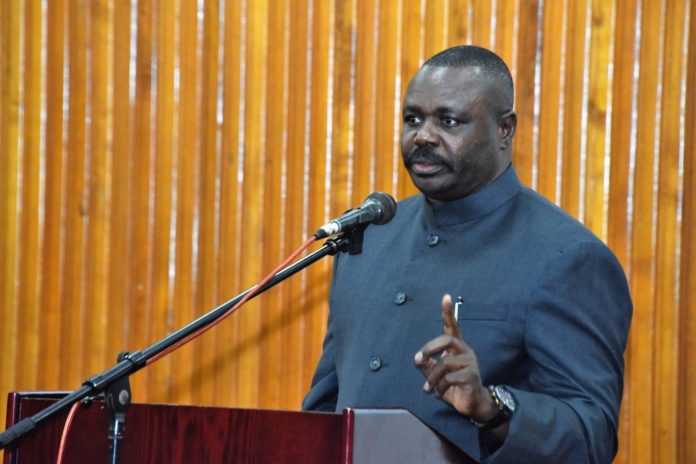
Speaker Jacob Oulanyah

Parliament has tasked the Uganda Association of External Recruitment Agencies (UAERA) to expeditiously handle the repatriation of workers stranded in Arab countries, with some said to be  under working under harsh conditions.

The Deputy Speaker, Jacob Oulanyah, said labour export agencies that are licensed and operating within the law, subscribe to UAERA through payment of insurance, and should handle repatriation or treatment of workers.

“So there should not be any burden to any parent that their child is stranded somewhere and they are looking for money to repatriate them or that they should refund money before they are brought back,” said.

The Deputy Speaker made the remarks in response to a concern raised by Mukono Municipality MP, Betty Nambooze. Nambooze said that youth who sought employment abroad through labour agencies were stuck and unable to return to Uganda.

Nambooze noted that following the Deputy Speaker’s directive on18 July 2019, several girls are stranded at the Uganda embassy in the United Arab Emirates as they wait for support to return home.

“The ambassador was even captured on video chasing the girls away. It is very painful that a Ugandan in Dubai is being chased away by their own ambassador,” said Nambooze.

She observed that there are new cases of Ugandans stranded abroad and that victims of trafficking by unlicensed recruitment agencies had increased.

“It is very sad that one of my constituents died in Riyadh last week under circumstances yet to be established; so we need guidance on how to handle these new cases,” Nambooze said.

According to the Coordination Office for Prevention of Trafficking in Persons under the Ministry of Gender, Labour and Social Development, as of 10 May 2017, there were 66 licensed private recruitment companies.

Stories Continues after ad

Erisa Sekisambu joins KCCA FC

Erisa Sekisambu in the middle.


KCCA FC have signed Erisa Sekisambu from Kenyan side Gor Mahia on a one year deal.

Sekisambu becomes Mike Mutebi’s first signing in this transfer window and it is confirmed he has been given shirt number 11.

The number 11 shirt has been formerly worn by Allan Kyambadde who has now requested to wear shirt 20 during the next season.

“I am glad to be joining a winning team, because my ambition is to win trophies. I cannot wait to get started.” Sekisambu is quoted by kcca fc website.

The Uganda Premier League is very familiar to Sekisambu who played for SC Villa, Express, URA and Vipers before moving to Gor Mahia where we played football from 2018/19 season winning the Kenyan Premier League.

Statistics about Erisa Sekisambu;

2011/12 – he played 10 games for SC VILLA and scored two goals.

2012/13 – he played 13 games for Express and scored six goals.

2013/14 – he played 14 games for URA and scored seven goals.

2014/15 – he played 31 games for SC VILLA and scored 14 games.

2015 – 2018 – he played 78 games for Vipers SC and scored 46 goals

Attachments area

Stories Continues after ad

Court convicts Stella Nyanzi on cyber harassment, stands to serve three years in prison

Dr Stella Nyanzi, File photo.
 

Buganda Road Magistrate’s Court has convicted the controversial Makerere University researcher, Dr. Stella Nyanzi for cyber harassment and acquitted her of charges of offensive communication.

DR Stella Nyanzi who has been on remands for eight months, was arrested in November last on accusations of insulting President Museveni and his mother, the late Esteri Kokundeka through a vulgar Facebook post.

Appearing before court this afternoon, Buganda Road Magistrate Gladys Kamasanyu found her guilty of charges of cyber harassment and acquitted her of offensive Communication charges.

“Facebook post corrupts the minds of young generation and that it doesn’t in anyway communicate any message. It is vulgar. It was offensive.” She said in her ruling. Dr. Nyanzi stands to face three years in prison or pay a fine of Shs1.4 million.

In December last year, court presided over by Ms Kamasanyu, remanded Nyanzi to Luzira prison until January 10, 2019 after she objected to the charges of alleged cyber harassment on grounds that they are defective and cannot stand.

Dr. Nyanzi once in court turned down court’s offer of releasing her on bail. Still claimed that the president should go to court and testify on how she insulted him and his mother.

Her case has since faced a number of adjournment on issues of the absence of Magistrate Kamasanyu. In December, she adjourned the matter was to give the state time to respond after they claimed they had been ambushed by the defence lawyer Isaac Ssemakadde who had filed to court asking that the case be dismissed for duplication among others.

She later ran to High Court seeking for an order to be retried on the same matter saying the sitting magistrate had been biased and didn’t accord her a fair hearing.

In her ruling High Court Judge Jane Francis Abodo dismissed the petition in which Nyanzi wanted court to block lower court (Buganda Road Magistrate’s Court) from delivering its judgement on the matter before it.


Stories Continues after ad

Abdu Lumala joins Desabre’s Pyramids

Abdu Lumala


Uganda Cranes winger Abdu Lumala has been unveiled by Egyptian Premier League side Pyramids Football Club, which is coached by former Uganda Cranes head coach Sebastien Desabre.

The 22-year-old completes his switch to Egypt on a free transfer from Swedish side Kalmar FF after a year loan spell at Syrianska.

Throughout his career, Abdu had contributed to 21 goals and 12 assists in 130 games for clubs including Superettan, Allsvenskan, and Svenska Cupen.

Lumala had a good performance and was a top performer with Uganda Cranes in the Africa Nations cup, participating in all the four games up to the round of 16 stage.

He joins Derrick Nsibambi at Smouha Sports Club and midfielder Khalid Aucho at Misr Lel Makkasa Sporting Club among the players playing professional football in Egypt.

Pyramids was founded as Al Assiouty Sport in 2008 but in the summer of 2018, the Chairman of the Saudi Sports Authority Turki Al Sheikh took over the team and the team’s name was changed from Al Assiouty Sport to Pyramids FC.

In their brief history as a club, Pyramids have so far had four managers and Desabre is the fifth.


Stories Continues after ad

Macroeconomic management weakens while social inclusion policies improve slightly in Africa’s poorest countries

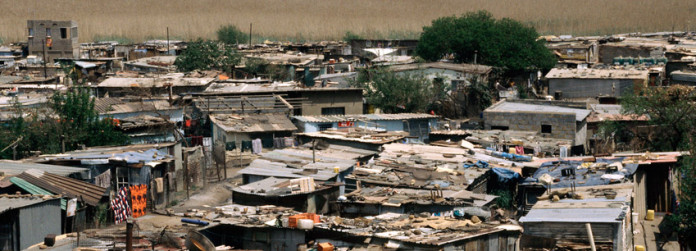
Globalization, market and poverty in South Africa


Africa’s poorest countries saw little to no progress on average in improving the quality of their policy and institutional frameworks in 2018, according to the World Bank’s annual Country Policy and Institutional Assessment (CPIA) released today.

The average CPIA score in Africa’s 38 International Development Association (IDA)-eligible countries in 2018 remained unchanged at 3.1 on a scale of 0 to 6, with some areas of social policy seeing improvements while macroeconomic management weakened.

The rule of law, accountability and transparency, and the quality of public administration remained major areas that impede the efficient use of public resources across the region.

This year’s CPIA Africa report takes a closer look at debt management, as the median government debt-to-GDP ratio reached 54.9  of GDP in 2018, an 18.5 percentage-point increase since 2013. At the same time, the share of foreign currency bonds in total external debt increased by 10 per cent while the shares of debt owed to commercial and non-Paris Club creditors rose by 5 percentage points since 2010, and sovereign bond issuances have increased rapidly.

“Some African countries are at risk of mortgaging their people’s futures in favor of today’s consumption,” said Albert Zeufack, Chief Economist for Africa at the World Bank. “When countries spend most of their revenue servicing debt, fewer resources are left for education, health, and critical services for their people. This stops progress in its tracks.”

Taken together, the increase in debt levels paired with the shift of external debt toward more market- based, more expensive, and riskier sources of finance have increased debt vulnerabilities substantially among IDA countries in Sub-Saharan Africa. The report recommends that countries improve their debt management capabilities and systems, which can enhance transparency and help stabilize the economy in the long-term.

Rwanda continues to top the CPIA ratings both in Africa and around the globe with a score of 4.0, followed in the region by Cabo Verde (3.8) and Kenya, Senegal, and Uganda (all at 3.7). South Sudan remained the lowest-scoring country on the CPIA with a score of 1.5.

Fragile countries in Sub-Saharan Africa improved slightly in the areas of gender equality, human development, and environmental stability, which bodes well for their ability to tackle the drivers of conflict and exclusion.

In fact, fragile countries in Africa saw stronger performance in social inclusion than fragile countries in other parts of the world. Non-fragile IDA countries in Africa performed on par with their global peers overall, with the notable exception of social inclusion policies, where they underperformed especially on the issue of gender equality.

“Improvements in social inclusion and service delivery have historically been crucial elements of countries’ transitions out of fragility, so even modest steps count,” said Gerard Kambou, Senior Economist and Lead Author of the CPIA report. “African countries, fragile and non-fragile, need to keep the focus on gender, education, health, climate, and governance issues alongside macroeconomic management if they want to see true and lasting progress.”

The report recommends that Africa’s IDA countries accelerate business regulatory reforms to support private sector development and improve domestic revenue mobilization in addition to strengthening their debt management. The report team plans to hold discussions on this year’s results and recommendations in several African countries in September 2019.

Stories Continues after ad

Basketball Africa League announces seven host cities for Inaugural Season

Zuku University Basketball Tournament (ZUBL) kicks off


The Basketball Africa League (BAL) has announced Cairo (Egypt), Dakar (Senegal), Lagos (Nigeria), Luanda (Angola), Rabat (Morocco) and either Tunis (Tunisia) as the host cities where the inaugural BAL regular season will take place and Kigali (Rwanda) as the host city for the first-ever BAL Final Four and BAL Final.

Additionally, the BAL announced NIKE and Jordan Brand will be the exclusive outfitter of the new professional league featuring 12 club teams from across Africa and scheduled to begin play in March 2020.

The announcements were made by BAL President Amadou Gallo Fall during a reception at the Musée des Civilisations Noires in Dakar in the presence of FIBA Secretary General Andreas Zagklis, FIBA Africa Executive Director Alphonse Bilé, NBA Commissioner Adam Silver and NBA Deputy Commissioner Mark Tatum, along with current and former NBA and WNBA players.

“Today’s announcements mark another important milestone as we head into what will be a historic first season for the Basketball Africa League,” said Fall.  “We now have seven great host cities where we will play and our first partnership with a world-class outfitter.  We thank our first partners NIKE and Jordan Brand for supporting us on this journey and ensuring our teams have the best uniforms and oncourt products.”

Beginning in March 2020, the six cities will host a regular season that will feature 12 teams divided into two conferences, with each conference playing in three cities.  The regular season will see the 12 teams play five games each for a total of 30 games, with the top three teams in each conference qualifying for the playoffs.  The six playoff teams – the “Super 6” – will play in a round-robin format to determine the four teams that will advance to the BAL Final Four and BAL Final in Kigali, Rwanda in late spring 2020.  The BAL Final Four and BAL Final will be single-elimination games.

NIKE and Jordan Brand will outfit the league’s 12 teams with official game uniforms, warmup apparel, socks and practice gear, with six teams featured in NIKE and the other six teams in Jordan Brand.  The collaboration with NIKE and Jordan Brand marks the BAL’s first partnership.

The announcement about the NBA and FIBA’s launch of the BAL, which would mark the NBA’s first collaboration to operate a league outside of North America, was made at the NBA All-Star 2019 Africa Luncheon in Charlotte, North Carolina on Saturday, Feb. 16.

The NBA and FIBA also plan to dedicate financial support and resources toward the continued development of Africa’s basketball ecosystem, including training for players, coaches and referees, and infrastructure investment.

Stories Continues after ad

 Technology as a key element of timely delivery of registration services impresses at URSB

Rejected Mr. Bemanya.


By  Bemanya Twebaze

Registrar General


In today’s changing world where clients are demanding faster, efficient and timely services, innovation in service delivery has taken center stage at Uganda Registration Services Bureau. One of the leading processes driving innovation especially for registration services is technology. The role that technology plays has enabled many of the economies in  Europe, Asia, USA and Africa score highly in the World Bank doing business annual reports matrices because it addresses the challenge of fast and timely services which URSB is continuously improving with the aid of ICT.

The ever increasing demand in business registers was also noted in the International Business Registers report of 2018 which certified that registries form the core reason for economic growth supported by technology. Many registries expand their mandate due to new legislations, information required to be shared among public authorities and also with the introduction of online services. Technology remains at the fore front as a key driver of most of the reforms in doing of business because it hastens the production processes thus enabling quick entry of businesses into the economy.

Technology & Business

Technology has become a very important part of our lives. In fact, studies show that the average smartphone user interacts with their phone for more than 145 minutes a day.  Phones, tablets, TVs, and computers that we rely on have become priority to provide us with content that we use for leisure and business purposes. URSB from the very start initiated a carefully crafted innovation scheme to give clients continuous improvement in service delivery while capitalizing on increasing non-tax revenue for government. Today, about 60 per cent of registration processes provided by the Bureau are automated, and the target is to have a 100 per cent online based system by 2020. Online systems continue to be deployed to ease registration processes for our clients. For example, the existent Business Registration System has greatly reduced the time and cost of formalizing a company.  All business processes are now fully automated, company documents are scanned and digitally saved to allow for ease of retrieval of data by all the URSB offices regardless of the location. This has greatly enhanced service delivery in terms of formalization and retrieval of documents for continuous filing purposes.

All Digital Strategy

URSB’s mantra isAll-digital all online”, which drives our activities and we have a target of ensuring all our services are fully electronic by end of the Financial Year 2019/20.  To improve client’s experience with our services, a number of systems have been developed that require less interaction with staff and more knowledge on utilizing of electronic system. Filing of companies’ annual returns can now be done from the comfort of your office or home by visiting our website and uploading the requisite documents. The same applies to filing of marriage returns/records after a marriage has been conducted in a licensed church, mosque or the office of the Chief Administrative Officer. All these functions are quite new but we are positive that they will be embraced by our clients and will improve their experience while interacting with our services.

These automation reforms plug in well with the government Vision 2040 strategy that aims at having “A Transformed Ugandan Society from a Peasant to a Modern and Prosperous Country within 30 years”. As part of the drive to attain the status, government identified technological innovation as a core driver to “promoting science, technology, innovation to enhance competitiveness”.  URSB will continue to create and roll out innovative ICT reforms and further reduce time and cost of accessing registration services.


Automation Benefits


Technology has changed every aspect of the workplace and businesses will continue to enjoy the benefits as new inventions and innovations are introduced. Safe records keeping is a crucial element of business growth. Manual record keeping causes many business registers problems due to the way records are maintained and stored, a lesson URSB learnt fast and adjusted to with ease.

Digitization of our records provides safety to clients documents while also enabling ease of reference and retrieval especially when required by clients and some of the investigative bodies within Uganda.

Property for Capital

With the enactment of the Security Interest in Movable Property Act No. 08 of 2019, URSB took on a new mandate of registration of security interests in movable property.  The new act provided for establishment of an online movable property registry that will contain details of all security interests registered by secured creditors. Movable Property in the Act refers to farm produce, machinery, motor vehicles, accounts receivables, livestock, household items etc. This will enable MSMEs access credit using their movable property and thus increase the market competition and access to credit. The registry will be fully electronic and will be accessed through our website.

Everything is faster and easier to access because of technology. The impact of technology on business is overly positive. There’s no doubt that technology will continue to be a part of the business world with every advancement made, and as URSB, we will continue to provide ICT solutions that improve on our client’s interface with our services.


Stories Continues after ad

Allan Kateregga leaves Cape Town City

Allan Kateregga of CT City during the Absa Premiership 2018/19 football match between Highlands Park and Cape Town City at Makhulong Stadium, Tembisa on 01 December 2018 ©Gavin Barker/BackpagePix


Uganda Cranes left-footed playmaker Allan Kateregga has terminated his contract with South Africa Premier Soccer League (PSL) side Cape Town City FC.

Kateregga, also known as Dancing Rasta joined Cape Town City in the 2018 summer transfer window and spent the second half of last season on loan at Maritzburg United helping them survive relegation.

Due to the foreign players’ rule in South Africa, Cape Town weren’t willing to guarantee Kateregga among the five foreign players they are registering for the new season.

“Thank you Cape Town City FC for the opportunity. I would never thank you enough. I wish the club the very best for the future.” Allan Kateregga tweeted.

Kateregga’s contract with the Citizens was set to expire in June 2021, meaning he still had two more years left on his deal.

The winger has begun the search for a new club where to ply his trade this season.

The attacking midfielder managed 18 appearances across all competitions for both City and Maritzburg United last season and found the back of the net three times.

Kateregga spent four months at KCCA FC on loan from AFC Leopards in Kenya before joining Cape Town.

The 25-year-old has also featured for Sports Club Victoria University and BUL in Uganda and also Tusker FC in Kenya.

He was part of the Uganda Cranes squad in the 2019 Africa Cup of Nations in Egypt.

Attachments area

Stories Continues after ad

Africa Oil Week and Menas Associates release Africa Oil and Gas Outlook for 2019

Workers are seen at an oil exploration site in Bulisa district approximately 244km (152 miles) North-West of Kampala January 20, 2012. Uganda said on January 27, 2012 the proposed sale of stakes by UK-based explorer Tullow Oil in its fields in the east African country to France's Total and China's CNOOC had been delayed by disagreements over protective clauses. Picture taken January 20, 2012. REUTERS/Stringer (UGANDA - Tags: POLITICS BUSINESS COMMODITIES EMPLOYMENT) - RTR2X2Y2


Diverse array of opportunities across the whole oil and gas value chain – event to offer exclusive insight into national hydrocarbon strategies and bidding rounds

A report released by Africa Oil Week and Menas Associates about what lies in store for Africa’s oil and gas industry has concluded that, on balance, the continent’s economic performance is promising, particularly as global oil markets finally recover from their 2015-2016 lows. Africa’s proven oil and gas reserves respectively account for 7.5 per cent and 7.1 per cent of global totals.

Experts predict that 2019 and beyond will see deep offshore exploration and mega gas finds, with the development of trans-continental pipelines, gas-to-power initiatives and refining potential.

The report delves into major trends for 2019, including political transitions and regional integration through the African Continental Free Trade Agreement (ACFTA) which promises to reduce barriers to intra-African trade, facilitate the movement of people and strengthening Africa’s prominence on the world stage.

A rosy picture is painted for natural gas as global consumption rises. Africa’s gas production grew by 8 per cent between 2017 and 2018 – largely out of Egypt.

In terms of opportunities, sub-Saharan Africa’s two largest producers of oil, Nigeria and Angola are expected to launch bidding rounds this year. Equatorial Guinea, Uganda, Gabon and Congo Brazzaville have ongoing rounds, Ghana launched its first licensing round at the 2018 edition of Africa Oil Week, and Madagascar is hoped to offer a number of blocks this year.

Africa Oil Week will feature two days dedicated to national showcases and bidding rounds at their upcoming event with 16 countries – including Côte d’Ivoire, Equatorial Guinea and Mozambique –presenting their national hydrocarbon sector to Africa Oil Week’s audiencer


Stories Continues after ad