Stanbic Bank
Stanbic Bank
18.1 C
Kampala
Stanbic Bank
Stanbic Bank
Home Blog Page 1320

Why it is important for schools to conduct a parents satisfaction survey

Pupils of the Bridge International Academies (BIA) in Uganda

By Mike Opio

Many factors influence a parent’s decision regarding their child’s education. These range from quality, proximity, perceived prestige and teaching style; understanding these motivations is critical to designing schools that meet the needs and expectations of parents.

For instance, every year Bridge Schools Uganda surveys its parents to understand what factors are affecting their choice of school. The recent survey conducted in December 2018 determined that their principal reason for choosing Bridge was the quality of education — 97 per cent of those surveyed who had recommended Bridge to someone else cited education quality as their motivation.

These results follow the 2018 Primary Leaving Exam (PLE) results where 95 percent of Bridge pupils passed — outperforming the nationwide average for the second consecutive year. For parents prioritising quality of education when selecting a school, Bridge is a clear frontrunner.

One Bridge Uganda parent testifies: “I have seen improvement in my child, every day he comes home and tells me what he learned at school.”

Many of the parents in the communities Bridge serves struggle to make ends meet. Education opens up the possibility of social mobility, meaning that it becomes a priority for parents trying to provide their child with the best possible future in life. A CPC survey substantiates findings that Ugandan parents ranked ‘schooling’ as the number one characteristic which determines if their child is ‘doing well’ in life. With Bridge turning out impressive results from year-to-year, it’s not surprising that parents take pride in the choice they have made — 98 per cent of those surveyed identified themselves as ‘proud Bridge parents’, up from 95 per cent the previous year.

At the centre of any parent’s ability to feel safe and secure in their choice of school for their child lies their confidence in the teacher. A Twaweza study found that almost half of Ugandan parents do not speak to anyone about problems they identify at their child’s school, so it’s encouraging to see that a contrasting 85% of parents surveyed feel that their concerns and views are listened to at Bridge, signifying that the organisation is succeeding in breaking down communication barriers between school and parent. More than nine in every ten parents said they were happy with their child’s teacher. In a country where teacher absenteeism is put at 27 percent by the World Bank, a classroom environment that sees parents happy with their teachers offers a potential step change.

Another aspect to the developing bond between school leaders, teachers and parents can be seen in the amount of participation from parents in school life. An impressive 97 per cent of parents surveyed had attended a meeting at their child’s school. Holistic collaboration is an important factor in creating powerful learning environments and the evidence of parental engagement offers a promising indication for school success.

Overall, the annual parent satisfaction survey presents an opportunity to understand parent’s choices, learn what’s working and where improvements can be made. Understanding what motivates parents, could help policymakers develop schools that work more effectively for communities more broadly. What the survey shows is that above all parents want a quality education for their children and they make choices that deliver upon that. Knowing this is also important of school heads and management communities so that they can create schools that meet parents’ needs and expectations each and every day.

Mr Opio is concerned parent

Stories Continues after ad

Gov’t to hold national dialogue on compulsory land acquisition in Uganda

Deputy Attorney General Mwesigwa Rukutana

Government is tomorrow expected to hold a national dialogue on compulsory land acquisition that is aimed at discussing proposals on the upcoming land reforms in Uganda.

In July 2017, the Deputy Attorney General, Mwesigwa Rukutana, tabled Constitution Amendment Bill No. 13 of 2017 to amend Article 26 of the Uganda Constitution. The Bill purportedly aimed at resolving the current problem of delayed implementation of Government infrastructure and investment projects due to disputes arising out of the compulsory land acquisition process.

It also aimed at enabling government, or a local government to deposit with court, compensation awarded by the Government for any property declared for compulsory acquisition of land and empower government to take possession of the declared property upon depositing the compensation awarded for the property with court, pending determination by the court of the disputed compensation awarded to the property owner or person having an interest in or right over the property.

The bill however received criticism saying the proposed amendment contravenes Article 24 of the Constitution because it seeks to deprive citizens of their survival and this should be construed as torture, cruel, inhuman and degrading treatment.

Also read:https://eagle.co.ug/2017/06/29/cabinet-endorses-compulsory-acquisition-land-infrastructure-development.html

Alluding to analysts, the amendment was also against Article 128 of the Constitution as it seeks to empower the executive to involve courts in matters that are not before it yet. It is therefore upon raising of such criticisms that the bill was withdrawn from parliament.

It wanted to force property/land owners to accept every decision of the chief government valuer (CGV) or use the CGV’s decisions on compensation as basis to deprive citizens of their property.

According to statement released by the minister of land and urban development, Betty Among, a new bill has been crafted to bring in conformity with article 26, 24 of the constitution of Uganda.

“The new bill will present a mechanism for government to access land without depriving owners, the right to prompt fair and adequate compensation. The land acquisition act needs to be reviewed,” she said in a statement adding that the dialogue will take place at Skyz hotel Naguru.

She said government is in process of developing land acquisition and resettlement and rehabilitation policy saying it this process will solve key issues related to land.

Among said during the dialogue, everyone will be availed with opportunity look at and discuss both the 2017 land amendment bill and land acquisition bill 2019, “land acquisition law will be reinforced by valuation law that is being drafted by government,” she added

Stories Continues after ad

Recognise and value domestic work -govt urged

The Speaker of Parliament, Rebecca Kadaga, chatting with Zoe Bakoko Bakoro (Right), the former Minister of Gender, and other participants in New York at the 63rd UN Conference on the Status of Women.

A civil society activist has urged government to value women’s domestic work such as cooking, cleaning, taking care of children, fetching fire wood and water as well as taking care of the elderly.

“We cannot attain gender parity when the majority of the women are engaged in the domestic sphere providing services that do not have economic benefit. We cannot talk about attaining Agenda 2030 or even SDGs when we are not addressing these issues of unpaid care and domestic work,” said Rita Aciro, the Executive Director, Uganda Women’s Network (UWONET).

Aciro said if women cannot get out of the domestic sphere to do economically gainful work and also participate in decision making, then they will always be left behind.

She said that unpaid care and domestic work is central to the attainment of all the development goals set at national level and international level and therefore, there is need to redistribute and reduce the burden of unpaid care and domestic work since it’s something that benefits the community, nation and world.

She was speaking hours ago in New York during the 63rd session of the Commission on the Status of Women.

Jane Ocaya-Irama, a Women’s Rights Advisor with OXFAM said it is important to get men and women know that the work that women do should be recongnised and valued. She said there’s need to reflect this work in terms of national statistics.

In her remarks at the event, the Speaker of Parliament, Rebecca Kadaga, said that it is important to draw attention and advocacy on the issue and have partners in the community to champion the cause.

Kadaga explained that in the mind of an African man, the duty of a woman is to fetch water, firewood and tether the goats.

“We need to have partners in the community so that we can start a conversation about unpaid care work because if you are to go to my village and ask a man, ‘does your wife work?’ he’ll say, ‘she does not work’ but she’s the first to get up and the last to sleep. So, even the concept of what is work within the community is something we need to discuss before we can lay strategies,” Kadaga said.

The Speaker undertook to work with women parliamentarians and the Minister in charge of Sustainable Development Goals, Mary Karooro Okurut, to raise consciousness about the issue until it becomes a government policy.

International and civil society organisations meeting at the sidelines of the 63rd session of the Commission on the Status of Women at the United Nations headquarters in New York, which is taking place from 11th -22nd March 2019, have proposed that government puts in place policies and programmes including legislation to address unpaid care work.

Stories Continues after ad

Ghanaian appointed as new Uganda U-17, U-20 Head Coach

Kwesi-Fabin New youth teams head-coach

Federation of Uganda Football Associations (FUFA) has confirmed the appointment of Samuel Fabin Kwesi as the head coach for the national U-17 and U-20 teams for a period of one year.

FUFA President Eng. Moses Magogo, flanked by the second vice president Darius Mugoye and CEO Edgar Watson officially introduced Kwesi before the media.

Kwesi’s immediate task at hand will be to handle the team at the 2019 Total Africa U-17 finals in Tanzania.

“As FUFA, we have a mission of becoming the number one footballing nation in Africa both on and off the pitch. We have had the position of the U17 National team head coach vacant and as FUFA, we looked for someone who has experience with the young players, a person who has contacts. Currently the market in Europe looks at young players.” Stated FUFA President, Eng. Moses Magogo

“I therefore take this moment to announce Fabin Kwesi Samuel as the new head coach of the U17 national team. He has experience with such teams having coached the Ghana U17 national team. We therefore welcome you to Uganda. We shall accord you all the necessary support.’ In his maiden submission to the media, Kwesi boldly outlined his mission at hand as regards developing the young players.”Magogo added.

“I am here for a mission. First, I want to guide the Uganda U-17 team at the AFCON U-17 finals. The time is very short but I will give it all my best shot. The youth need patience to work with and develop to their best.” Kwesi Fabin said.

The U-23 side will still be coached by national team head coach Sebastien Desabre.

The Uganda U-17 national team will enter residential training on Sunday, 24th March 2019 at the FUFA Technical center

Uganda U-17 National Team Coaching Staff:

Head coach – Samuel Fabin Kwesi

First Assistant– Jackson Magera

Second Assistant– Hamza Lutalo

Goalkeeping coach– Mubarak Kiberu

Kits Manager– Frank Bumpenje

Team Coordinator- Bashir Mutyaba

Stories Continues after ad

NSSF, BoU lock horns over remittance as legal team is barred from practice

The Bank of Uganda (BoU) is involved in another financial scandal in which officials there are accused of not paying the National Social Security Fund (NSSF) the mandatory monthly remittances of about Shs2 billion deducted from eight employees’ salaries as required by the Act establishing the NSSF.

Eagle Online understands that BoU legal team are also in trouble after the Law Council denied them practicing rights after it emerged that they helped some of the former employees at the bank to evade sending the remittances to NSSF. Some of the staff in the department are also implicated in the scam, including its head Margret Kasule.

Eagle Online understands that BoU under declared the ages of some employees even as they were of age having clocked 60 years, the mandatory retirement age in Uganda for public servants.

It is said that when NSSF continued asking for remittances of the officials whose age was under declared, BoU administrators made a u-turn and made it clear that the officials had retired, forgetting that they had lied about the ages of the officials.

However, another source at fund said when NSSF did an audit on BoU, it established that close to Shs50 billion had not been disclosed by BoU officials. This has caused exchanges between NSSF and BoU top officials. The amount is said to be part of all the money BoU has been under declaring to NSSF.

Also read:https://eagle.co.ug/2019/02/26/mps-want-top-bou-officials-prosecuted-as-they-call-for-a-ban-on-mmaks-advocates.html

“When parliament’s COSASE committee started investigations on those BoU chaps, people thought it was a witch hunt but that institution needs urgent reforms because people there are doing things with impunity”. a source at the fund said.

Eagle Online also understands that NSSF has declined to grant BoU a clearance licence as regards the affected officials which has resulted into denial by law council to grant them a practicing license. Law Council says that the due processes has to be followed before the certificate can be issued.

According to a leaked letter dated March 6, 2019, NSSF wants BoU to provide them with copies of National Identity cards for its staff so that they can verify the correct ages of the affected employees with the National Identification and Registration Authority (NIRA).

“We refer to the above subject and the emails between NSSF and Bank of Uganda on the matter. We understand the urgency of the situation , however, you will appreciate that we have to follow due process of assessing an employer’s records to ensure compliance with NSSF, before we can issue out a clearance certificate” reads the letter in part.

NSSF is said to be not satisfied as recently BoU only availed to them between August 2018 and January 2019 did not provide all information on staff below 55 years and those above 55 years.

A source said that some of BoU staff have contested dates of birth and that also exist other variances.

Other sources said NSSF demands about Shs10 billion from BoU.

The latest BoU financial scam comes a almost a month after parliament’s committee on Commissions, Statutory Authorities and State Enterprises (COSASE) pinned officials for carelessly closing seven commercial banks, without following the law. Parliament is yet to furnish the public with final recommendations of the COSASE probe that established BoU officials failed to produce some of the documents related to the sale of banks.

Stories Continues after ad

NGB closes Crown Casino Limited as it streamlines sector

Police officer effecting the closure.

In effort to streamline the gaming sector in Uganda, the National Gaming Board (NGB), has closed Crown Casino Limited for operating without a licence.

“This is part of an on-going exercise to stump out illegal players from the sector,” officials said.

The government through NGB, under section 4 of the Lotteries and Gaming Act, 2016 is mandated to issue licenses for lotteries, casinos, gaming and betting. The mandate includes licensing, supervision, enforcement and dispute resolution.

NGB is in the process of putting in place regulations for licencing and control of business to business transactions in the gaming industry. This will include control and licensing of gaming intermediaries and agents. “The objective of this initiative is to ensure accountability, effective taxation and eliminate illegal gaming operations,” NGB officials said.

Stories Continues after ad

Judith cries was shamed for leaked nudes, wanted to commit suicide

Judith Heard

Ugandan model and activist Judith Heard has come out to say that she was arrested and shamed in the local media when nude photos of hers were published without her consent last year.

Heard who was talking to the BBC said she came under attack in the local media and online after nudes emerged. The photos, she said, were downloaded from a stolen laptop.

“I have comments on Facebook attacking me about my private parts. There is no day that I am not reminded of my private parts. And when I hear them say I leaked my pictures, it really kills me,” she said.

“I was very… worried. I didn’t want to leave my house because I was scared that I might get out and maybe be killed…I might get out and maybe get stoned,” she said.

Though she says she was charged under Anti-Pornography Act, whose jail sentence carries 10 years, heard maintains her innocence.

“Whoever is doing this has the reason why they are doing it and I would never find out why,” she says. She says the nudes were leaked without her consent.

She said the nudes published in 2018 was the second time it happened to her and that the first time it happened she wanted to commit suicide.

She is now urging Ugandan women to talk openly about sexual abuse – and to show solidarity with one another.

“We are being broken every single day and we cannot come up to talk about it,” she says.

Some time on her Instagram page she urged people to face fears instead of running away from them.

“You gain strength, courage, and confidence by every experience in which you really stop to look fear in the face. You are able to say to yourself, ‘I lived through this horror. I can take the next thing that comes along,” she posted on Instagram.

Stories Continues after ad

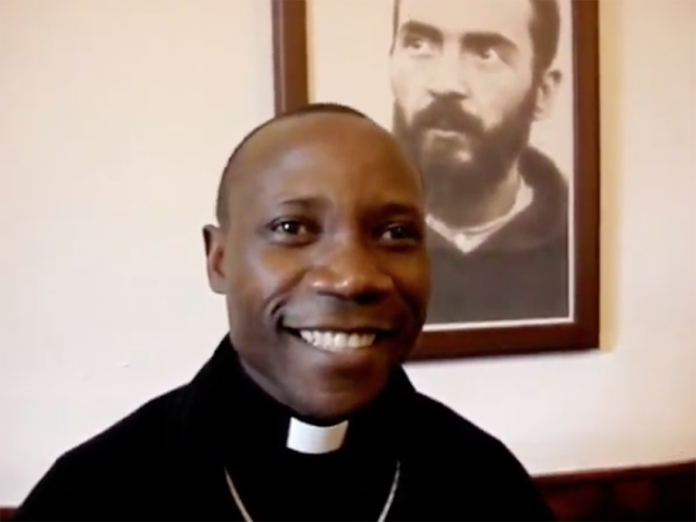
Reverend Father Joseph Oliach Eciru elected new Bishop of Soroti Catholic Diocese

Bishop Joseph Oliach Eciru

Pope Francis has appointed Reverend Father, Joseph Oliach Eciru, professor at St Mary’s National Major Seminary in Gaba as the new Bishop of Soroti Catholic Diocese.

Soroti Catholic Diocese has had no bishop since 2014 when the pope elevated Bishop Emmanuel Obbo to Archbishop of Soroti leaving the diocese without bishop for a period of five years.

Bishop elect Eciru was born on August 11th, 1970, went to Gweri Primary School and completed his ordinary level at St Peters Minor Seminary, Soroti and advanced level at St Pius X Tororo.

He did his philosophical studies at St Thomas Aquinas Major Seminary Kitigondo, Masaka and completed at theological studies at St Paul’s major seminary at Kinyamasika in Fort portal. He was ordained the pries of diocese of Soroti in 2003.

Bishop Eciru has served as a teacher at St Peters seminary and assistant St Patrick’s Parish Soroti between 2003 and 2004, Formator at St Paul’s major seminary Kinyamasika between 2004 and 2006 and professor at St Mary’s national major seminary in Gaba from 2012 till now.

He holds Licentiate in sacred scriptures from Pontifical Biblical College. He holds a doctorate in biblical theology from Pontifical University in Rome (2009-2012).

“Let’s join in fervent payer Bishop elect Eciru that he will be guided and strengthened by the wisdom and courage of the holy spirit to discharge with fidelity and joy his new mission,” reads in part of the statement that is issued by Fr Alfred Rayan D’Souza.

He lauded the most Rev Emmanuel Obbo for administration work towards the development of the Soroti diocese and overseeing all the works since he was promoted to the level of Archbishop.

Stories Continues after ad

Women make up 39% of URA employees-study finds

URA Commissioner General Doris Akol says paying taxes is painful but necessary

The Uganda Revenue Authority (URA) in 2017 undertook a study to examine the representation of women across the organisation, their performance, and the perceptions of men and women of the gender dynamics in the workplace.

The study came out with different findings. In terms of representation, in total, 39 per cent of URA employees were women at the end of 2017. Women are present in significant numbers in all departments, with the least frequent being customs at 35 percent.

According to the study, majority of the women work in junior positions, with a few in leadership, including the Commissioner General Doris Akol. There are also regional differences, with women constituting a low proportion of staff outside the central region where Kampala, Entebbe International Airport, and the URA head office are located.

In terms of their performance, the study found that on average, women receive slightly higher scores than men on their six-monthly appraisals. They also tend to remain with the revenue administration longer than men: 12.3 years on average versus 11.6 years. Finally, male employees are more than twice as likely as women to be subject to disciplinary action such as termination, suspension or dismissal.

In terms of perceptions and attitudes, women are not perceived as a novelty or a threat by their male colleagues, and both women and men seem relaxed and satisfied about working in a mixed environment.

However, more men (61 per cent) than women (23 percent) were satisfied with the URA’s current level of gender diversity. Overall, the case suggests employing women is beneficial for the effectiveness of tax administrations.

Tax administration has traditionally been a field dominated by men, but women’s participation is increasing, according to a recent study.

Stories Continues after ad

10 Key drivers that are forcing changes on business processes, people and services

Workers busy

A new initiative by the Association of Chartered Certified Accountants (ACCA) the global accountancy body, has highlighted 10 key drivers that are already changing business processes, people and services.

The report also addresses how the finance function within those businesses will need to prepare and adapt to meet transformative challenges.

Thomas Isibor, head of ACCA Nigeria said: ‘Few sectors are going to experience the impact of new tech more than Finance and Accountancy.”

‘Preparing now for the inevitability of change is even more vital for these functions, and forward-thinking should be every business’ strategic priority.

Mr Isibor continued: ‘Challenges such as digital, risk, the global economy, politics, legislation, cyber security, ethics, even climate change – are all set to impact business and the Finance department in potentially unimagined ways.’

Technology – more than just Automation and AI – is already creating the most seismic impact on the Finance, Audit and Accountancy functions. The industry is in a race for future relevance.

The ACCA has identified four broad imperatives for any CFO or partner looking to optimise how technology can add – and not detract – value from their organisation: To understand how to use the information available to them to provide strategic insight in real time; to think forwards not backwards and maximise the use of technology to do this; to ensure they have in place effective and efficient processes that satisfy the overall business requirements of finance, and to capture, measure, report and predict future performance in a much more agile manner to support better and quicker decision making.

Mr Isibor added: “Preparation and readiness now is key,’ ‘No technology has ever made an impact without first being adopted by people. The sooner we recast this challenge as one of people and processes, the sooner we’ll make progress. We have to be ready for what lies ahead.”

Stories Continues after ad