Stanbic Bank
Stanbic Bank
23 C
Kampala
Stanbic Bank
Stanbic Bank
Home Blog Page 1329

National Gaming Board ups standards as gov’t makes changes in local industry

Edgar Agaba CEO-National Gaming Board who credited for the growth of the industry.

Gaming operations have been in existence in Uganda for over 50 years with lottery being the main gaming activity carried in the 1960s when the first gaming laws were drafted.

The gaming industry was regulated by the National Lotteries Act of 1967, the Gaming and Pool Betting (Control and Taxation) Act of 1968, and an addendum of statutory guidelines introduced in 2012/13.

However, due to the expansion of the gaming industry, with new games being introduced over time, and in light of technological advancements, many facets of the law relating to lottery and gaming became outdated.

Since 2000, the gaming industry in Uganda has experienced a rapid increase in activity, with various new modes and facilities being introduced. The growth of gaming has seen the industry diversity from the early forms of gaming like; lotteries, casinos, slot machines, bingo, sports betting and pool betting.

The government of Uganda, through the National Gaming Board (NGB), under section 4 of the Lotteries and Gaming Act, 2016 is mandated to issue licenses for Lotteries, Casinos, Gaming and Betting in Uganda. The mandate includes Licensing, Supervision, Enforcement and dispute resolution.

The board has worked together with the gaming companies all over the country to ensure the proper management of the industry.

Sports betting is the most popular where applicants express their interest. Among the 27… the board has licensed so far, only 18 operators run betting retail/physical outlets while the other 9 are online operators.

The Sports betting and slot machine operators are; Kings Sports Betting with 295 branches, ForteBet with 262 branches, Premier bet has 90 branches, Sports betting Africa 95, Best holdings 10, Champion bet 61 while both Bunga Bet and Ultimate Bet have 27 branches each.

The sports betting operators only are; Fair Sports Betting with 25 branches, both Paragon Bet and WordStar Sports Betting with 6 each, Good Bet has 15 branches, Gals Sports Betting with 67, Sahara Gaming 2 and TopBet with the highest at 213.

Slot Machine operators only include; Sastoss Amusements with 26 branches, Club Win with 16 branches, Gemex Uganda 15 and Big win slots with 54 branches.

In general, a total of 1442 premises were approved and licensed by the board. 655 are located upcountry, accounting for 45 percent and 787 in the Kampala Metropolitan Area (Kampala, Mukono and Wakiso districts for 2019) accounting for 55 per cent.

In Kampala Metropolitan area, Kawempe Division has got the most number of branches with 150, Nakawa with 80 branches, Makindye with 135, Central Division having 132, Rubaga Division 105, Mukono District with 30 branches while Wakiso district has got 155 branches.

The industry has grown at unprecedented rate, with tax collections growing from Shs240 million in 2002/3, Shs11.1 billion in 2013/14 and Shs45 billion in 2017/18. Currently a projection for the financial year 2018/19 is Shs50 billion.

In accordance with Section 48 (1) of the Lotteries and Gaming Act 2016 all gaming operators are meant to remit 20 percent pf the total amount of money staked less pay outs for the period of filing returns. Section 188c of the Income Tax Act as amended 2018 a person who makes payment for winnings of betting or gaming shall withhold tax on gross amount of payment at the standard rate of 15 percent.

The sector employs 8959 (professionals and non-professionals) in various capacities like cashiers, branch managers, accountants, marketing agents/sales agents, security guards, chefs for casinos, cleaners and administration.

In the Kampala Metropolitan Area, ForteBet employs the most number of people (1282), followed by Kings sports betting employing 1100, Top bet employs 806, Goal sports betting employs 298, SBA bet 312 while others including casinos, bingo and small scale operators employ 2200.

For upcountry, Kings Sports Betting tops with 809 employees, ForteBet employs 585, Top bet 351, Goal Sports Betting 175, SBA Bet 170 while the rest including casinos, bingo and small scale operators employ 871.

Various gaming operators are sponsoring different football clubs worth billions of shillings. For example Betway, an online gaming company sponsors Express FC to a tune of Shs400 million per year, and TopBet sponsors Mbarara City to a tune of Shs200 million.

It is also a requirement that operators carry out Corporate Social Responsibility (CSR) among the communities they operate in. At the end of last financial year, a total of 800 million shillings of CSR was executed by operators ranging from medical support, school fees donations and charity drives among others.

The sector also supports other subsectors through payment of utilities like water, electricity, cable TV (DSTV), internet providers and telecom companies thus creating a positive ripple effect to the economy.

Interventions

The National Gaming Board has developed several interventions in an effort to streamline the sector and remedy emerging issues such as; Limited Ugandan involvement in the gaming sector, high nuisance value of premises and rampant advertising and signage.

Stories Continues after ad

Here is why gov’t has delayed to launch Islamic Banking

Finance Minister: Matia Kasaija.

Despite calls to government to operationalise Islamic Banking, it has not yet done do so as it sorts certain for easy transactions, according to the Minister of Finance Planning and Economic Development, Matia Kasaija.

Islamic banking, also known as non-interest banking, is a banking system that is based on the principles of Islamic, or Sharia, law and guided by Islamic economics. Two fundamental principles of Islamic banking are the sharing of profit and loss, and the prohibition of the collection and payment of interest by lenders and investors. Islamic law prohibits collecting interest or “riba.”

In Uganda, lslamic Banking is provided for under the Financial lnstitutions (Amendment) Act, 2016.

Matia says his ministry is currently reviewing the tax regime with a view to establishing parity treatment for both lslamic and conventional products for tax purposes.

More, he says, The Bank of Uganda (BoU), has undertaken to conduct Workshops before the end of this financial year, to sensitize the public on lslamic Banking and also get stakeholders’ views pertinent to informing the formulation of regulations for establishing Sharia’ah Advisory Boards in financial institutions licensed to provide lslamic finance and the Sharia’ah Advisory Council in Bank of Uganda.

“The Shari’ah Advisory Council, once constituted, shall advise Bank of Uganda on matters of regulation and supervision of lslamic banking systems, and also approve lslamic banking products, as provided under section 1158 (2)of the Financial lnstitutions (Amendment) Act, 2016,” he says.

According to the minister, BoU has received an application from one of the existing conventional banks for approval to operate an lslamic Window and that the application is under consideration by the Central Bank of Uganda.

According to sources, commercial banks like Cairo International Bank, Tropical Bank and others are interested in running Islamic Window.

While an Islamic bank is one based on, and managed with, Islamic principles, experts say an Islamic window refers to the services provided by a conventional bank but based on Islamic principles.

Meanwhile he says BoU in consultation with his ministry issued the “Financial lnstitutions (lslamic Banking) Regulations on 2no February 2018. b) Early this year and that the ministry shall continue to work closely with BoU and other stakeholders to address all outstanding gaps with respect to implementation of lslamic Banking and finance in Uganda.

How Islamic Banks Make a Profit

To earn money without the use of charging interest Islamic banks use equity participation systems. Equity participation means if a bank loans money to a business, the business will pay back the loan without interest, but instead gives the bank a share in its profits. If the business defaults or does not earn a profit, then the bank also does not benefit.

For example, in 1963, Egyptians formed an Islamic bank in Mit Ghmar. When the bank loaned money to businesses, it did so on a profit-sharing model. To reduce its risk, the bank only approved about 40 percent of its business loan applications, but the default ratio was zero.

History of Islamic Banking
The origin of Islamic banking dates back to the beginning of Islam in the seventh century. The Prophet Muhammad’s first wife, Khadija, was a merchant. He acted as an agent for her business, using many of the same principles used in contemporary Islamic banking.

In the Middle Ages, trade and business activity in the Muslim world relied on Islamic banking principles. These banking principles spread throughout Spain, the Mediterranean, and the Baltic states, arguably providing some of the basis for western banking principles. From the 1960s to the 1970s, Islamic banking resurfaced in the modern world.

Stories Continues after ad

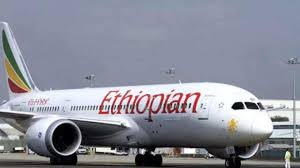
Caf commissioner among Ethiopian Airlines plane crash victims

Hussein Swaleh Mtetu

Former secretary general of the national federation and high-ranking football official, Hussein Swaleh Mtetu is among the 32 Kenyans who perished on Sunday 10th March morning on the crash of the Ethiopian Airlines Flight 302 that was on its way from Addis Ababa.

Husein Swaleh was reportedly returning home after serving as Commissioner in the CAF Champions League match between Ismaily SC (Egypt) and TP Mazembe (Democratic Republic of Congo) played on Friday in Alexandria.

The President of the Confédération Africaine de Football, Ahmad Ahmad and all the African football family sent their condolences to the dearest Hussein Swaleh Mtetu family, his relatives and to the Kenyan Football Federation.

Mr. Hussein Swaleh was appointed as CAF Match Commissioner for 2018-2020. He was the secretary general of Kenya Football Federation (KFF) when Kenya last played at the Africa Cup of Nations finals in Tunisia 2004.

The Ethiopian Airlines Boeing 737 to Nairobi crashed early on Sunday, killing 149 passengers and eight crew, the airline said having left Bole airport in Addis Ababa at 8:38am (+3GMT), before losing contact with the control tower just a few minutes later at 8:44 am.

The dead included at least 32 Kenyans; 18 Canadians; nine each from Ethiopia and France; eight each from the United States, China and Italy; and seven from Britain, according to the airline, officials and news accounts. The identities of many of the victims, have not yet been released.

Stories Continues after ad

Ethiopian Airlines: ‘No survivors’ on crashed Boeing 737

All passengers on board an Ethiopian Airlines jet that crashed shortly after take-off on Sunday have died, the airline says.

It said 149 passengers and eight crew members were believed to be on flight ET302 from Addis Ababa to Nairobi in Kenya.

The airline added that there were 33 different nationalities on board.

The crash happened at 08.44 local time, six minutes after the flight took-off from the Ethiopian capital.

It is not yet clear what caused the accident.

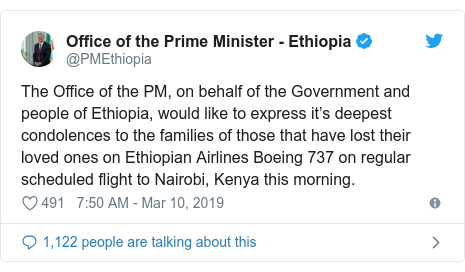
First word of the crash came when Prime Minister Abiy Ahmed expressed his “deepest condolences” on Twitter.


In an earlier statement, the airline said that search and rescue operations were under way near the crash site around the town of Bishoftu, which is 60km (37 miles) south-east of the capital.

“Ethiopian Airlines staff will be sent to the accident scene and will do everything possible to assist the emergency services,” the statement added.

Boeing, the company that built the aeroplane, said in a tweet that it was “closely monitoring the situation”.

Its 737 Max-8 aircraft is relatively new to the skies, having been launched in 2016. It was added to the Ethiopian Airlines fleet in July last year.

Another plane of the same model was involved in a crash five months ago, when a Lion Air flight crashed into the sea near Indonesia with nearly 190 people on board.

What do we know about the airline’s safety record?
Ethiopian Airlines flies to many destinations in Africa, making it a popular carrier in a continent where many airlines fly only from their home country to destinations outside Africa.

It has a good reputation for safety, although in 2010 one of the company’s aeroplanes crashed in the Mediterranean Sea shortly after leaving Beirut.

The incident killed 90 people on board.

The airline’s highest fatalities prior to this came in a November 1996 crash during a hijacking on a flight from Addis Ababa to Nairobi.

One of the aeroplane’s engines stopped when the fuel ran out and although pilots attempted an emergency water landing, they hit a coral reef in the Indian Ocean and 123 of the 175 people on board were killed.

Stories Continues after ad

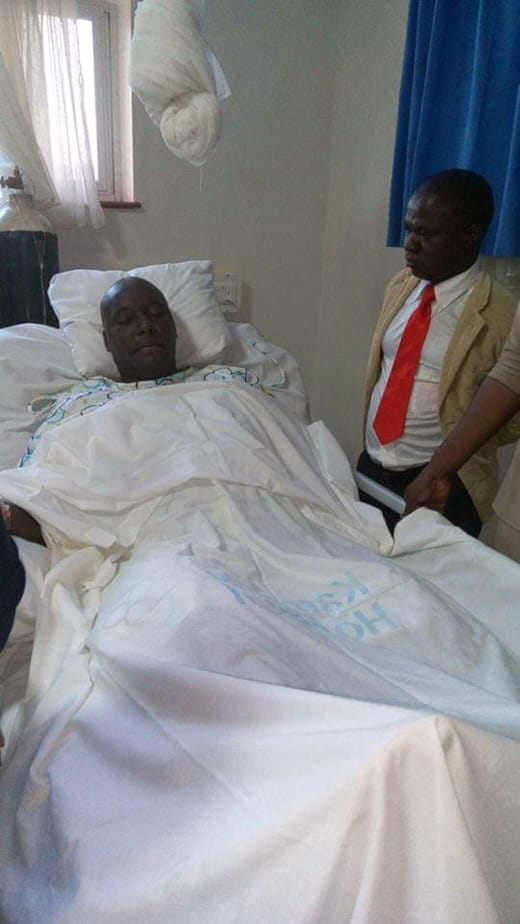
Kabaziguruka involved in road accident again

Nakawa Member of Parliament, Michael Kabaziguruka has this Sunday, March 10, 2019 been involved in a second nasty accident in less than a year.

The opposition Forum Democratic Change (FDC) legislator is currently receiving treatment at a health centre in Matugga after his car was involved in a head-on-collision along Bombo Road in Kampala.

Reports quote the MP to have said that he is now out of danger after the medics managed to control the bleeding.

“I have a head-on collision with a car belonging to a colleague (fellow) Member of parliament,” Kabaziguruka is to reported to have said from the clinic without disclosing the particulars of the colleague.

However, he is complaining of chest pain and is unable to move.

Deputy Police spokesperson, Patrick Onyango told reporters that he had not been briefed about the incident.

This comes when the MP was recovering from a previous road accident which left him with multiple fractures.

In July last year, Kabazigurika was involved in a semi fatal accident at Lugogo, while he was driving in an Ambulance to pick up patients.

The ambulance van he was driving collided with a truck near UMA show grounds, Kampala. The condition restricted him to a wheelchair for a lengthy period.

Nine months down the road, he said, his condition continued to deteriorate and doctors recommended that he flies to China for more specialized treatment, but he was unable to raise the money.

Stories Continues after ad

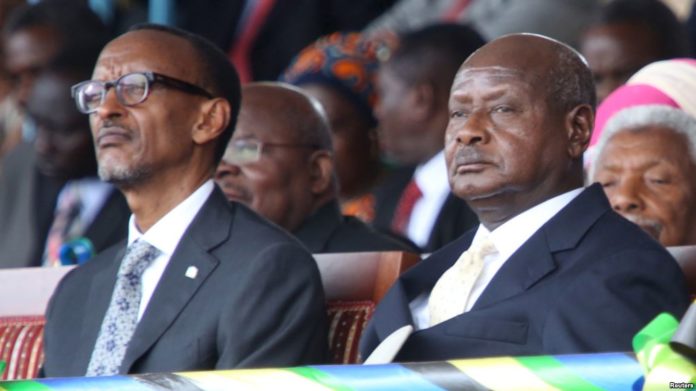
Kagame insists Uganda is destabilizing Rwanda, warns of war as Museveni hits back you can’t survive

Museveni and Kagame at a previous event.

Rwandan President Paul Kagame has insisted that Uganda is destabilizing his country even though he did not go into details how this was being done.

However, his Ugandan counterpart Yoweri Museveni has hit back warning those who plan to destabilize Uganda of the consequences.
“Those who want to destabilize our country do not know our capacity. it is a very big. Once we mobilize, you can’t survive.” Mr Museveni said today while in Mukono district during the commissioning of five factories as he assured investors of security.

Kagame made the statement on Saturday while speaking at the 16th edition of the annual National Leadership Retreat, which got underway at Rwanda Defence Force Combat Training Centre in Gabiro, Gatsibo District.

“We have been provoked, people have crossed our borders, killed our people and we have not responded. We were able to see someone wanted to drag us into this mess. When they have dragged you into this sort of problem, then you start looking the same,” he said.

“What remains to discuss with our brothers and sisters is the movement of people. We have Rwandans who go to Uganda who have been in prison, in their dozens, some of them are in military prison, others nobody knows where they are.”

He said the standoff between Rwanda and Uganda will be costly.

“All that comes costly, diverts resources, attention, we should be prepared for that. That is the price of stability and continued wellbeing. It means you have to keep doing the best you can, make progress and defend the progress you are making.”

“When I hear somebody say no one can destabilise their country, I agree. No one should actually be destabilising that country but that country should also not be destabilising others, I think it is a fair deal.”

Kagame was referring to President Yoweri Museveni’s speech yesterday where he said he won’t allow anyone to distaibilise Uganda. Museveni was Chief Guest as the country joined the rest of the country to mark International Women’s Day in Bunyangabu District.

Kagame said almost every week, there are people who are brought and dumped across the border, and when you asked some of them, they say they have been in prison for 2 years.

He said whenever he has asked Uganda about the prisoners, authorities here would say they were illegal immigrants.

“But they were in prison for two years, with no charges, until they pack them in a truck and take them across the border.”

Kagame said he had learnt lessons of the country’s struggles, of the hardships. “One of them is I am not in control of what somebody else thinks about me or plans to do against me. But I must be in control of something, and that is what happens here,” he said.

Uganda denied charges that it was collaborating with rebels and other groups to destabilise Rwanda.

Uganda also denied claims of torture and harassment of Rwandans saying whoever is arrested is handled according to the due process of the law.

President Museveni last week stopped government officials from responding to Rwanda’s claims in the media.

Stories Continues after ad

Joint AU-UN team arrives in Somalia to review AMISOM’s mandate

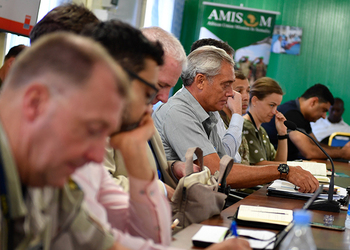
Team meeting on strategies

A joint delegation from the African Union and the United Nations is in Somalia to assess progress made in implementing the Somalia Transition Plan whose key objective is the transfer of security responsibility from the African Union Mission in Somalia (AMISOM) to Somali National Security Forces.

The delegation, which arrived in the Somali capital, on Wednesday, will evaluate steps taken by the AU Mission in implementing tasks under the transition plan as mandated by the UN Security Council Resolution 2431 (2018) and the African Union Peace and Security Council Communique 782 (2018).

“There were some mandates issued by the two councils (UN and AU) to be undertaken by this Mission. The joint review will definitely be looking at those mandates and also focus on the Somalia Transition Plan,” said Maj. Gen. Francis Okello, the Chief, Plans and Operations Unit in the AU’s Peace Operations Support Division.

UN Resolution 2431 (2018), authorized the reduction of uniformed AMISOM personnel, by 1000, by the end of February, this year. The resolution also mandated AMISOM to maintain a minimum of 1040 police personnel including five formed police units.

The Communique, on the hand, called for an assessment to be carried out on the state and effectiveness of AMISOM reconfiguration and its support to the transition process. It also sanctioned the development of a new Concept of Operations (CONOPS) aligned with the implementation of the transition plan.

Maj. Gen. Okello, who is leading the AU delegation, said the outcome of the review would inform the decisions to be made by the UN Security Council and the African Union Peace and Security Council (AUPSC) on the renewal of AMISOM’s mandate.

His remarks were echoed by the Team Leader of the UN delegates, Vincent Pasquini, who said the review would look into issues of transition planning, electoral preparations and the operating environment in Somalia.

“The objective of this meeting is really to hear the views of our partners as we set off in this review and to have as many inputs as possible,” said Mr. Pasquini, the Team Leader to Somalia in the UN Department of Political and Peacebuilding Affairs (DPPA) and the Department of Peace Operations (DPO).

The visiting delegation will also seek, among other issues, to establish challenges the AU Mission faces, the status of the implementation of the recommendations of the AMISOM Operational Readiness Assessment (ORA) and preliminary impact of the reduction of AMISOM troops.

During the week-long visit, the delegation will meet with the AMISOM senior leadership, officials from the Federal Government of Somalia, the United Nations, representatives of international partners, diplomats from AMISOM Troop Contributing Countries and the European Union.

The delegation will also hold discussions and analyze Somalia’s political and security situation as the country prepares for one-person, one-vote elections in the 2020-2021 period.

The Special Representative of the Chairperson of the African Union Commission (SRCC) for Somalia, Ambassador Francisco Madeira, welcomed the delegation to the Mission Headquarters in Mogadishu, adding that the visit demonstrates the importance of AMISOM.

“This is an important opportunity for us to share with you issues on Somalia and also listen to you and get to know your views and your concerns and most importantly your views should guide us on the way forward in our joint effort to help Somalia achieve peace and stability.”

During the joint review meeting held in May, last year, the Federal Government of Somalia reiterated its commitment to assume security responsibility as stipulated in the transition plan.

It urged the review team not to judge the country by its past but by achievements so far made in stabilizing the country.

Stories Continues after ad

NWSC promotes safe water use, hygiene and sanitation in Bunyangabo District

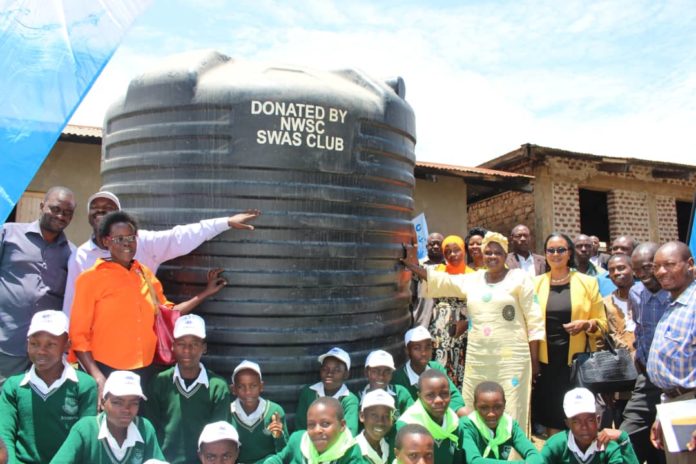
NWSC promotes safe water use, hygiene and sanitation in Bunyangabo District.

The National Water and Sewerage Corporation (NWSC) has launched the school water and sanitation clubs at St. John’s Yerya Primary School in Kibiito Town Council-Bunyangabo District through school water and sanitation clubs (SWAS) which is a Social Corporate Responsibility (SCR) initiative by NWSC aimed at inculcating values of safe water use, hygiene, sanitation and environmental protection among the school going children of the nation.

The club with over 20,000 members in more than 400 schools across the country has an aim of grooming a generation that will be responsible for our water resources and the environment in the country.

Handing over a 10,000 litres capacity water reservoir to the new school club, NWSC vice board chairperson Ruth Kanyaruju, said that the SWAS clubs are an initiative of the Board and management of NWSC.
“We want to use young people to become our ambassadors on issues of water, hygiene, sanitation and protection of the environment,” she said.

Kanyaruju said that the young people will help to spread the gospel of safe water use, sanitation, report leakages, water theft, plant trees, preach against swamp reclamation and other concerns. “The young people will be our brand ambassadors in future,” she said.

NWSC Board member Hajati Faridah Mayanja Mpiima urged the students to be responsible citizens in future

Sensitising the pupils at the school, NWSC Deputy Managing Director Board Affairs and Management services Miss Edith Kateete urged the students to protect the environment and use the water connections at the school to improve their personal hygiene and health.

Kateete said that NWSC will continue to support the education sector through the SWAS clubs.
“The government of Uganda working with the NWSC Board and management have adjusted the tariff of water to boost the education sector in the country. We have adjusted the tariff for UPE schools. This is to enable them continue educate the children who little or no school fees per term,” she said.

Kibito town Mayor Jibb Tugwezire thanked NWSC for the all-round development efforts in the country.

“NWSC is extending water, sewage services, promoting hygiene, sanitation, health and now supporting the education sector. This is commendable work by a government institution.” he said

The mayor said that the members in the club will help promote good values in their homes, at school and in the entire Bunyangabo District.

LC.1 Yerya appreciated NWSC for extending services in Kabarole district.
“We are seeing pipes in every corner of the country. Within no time, we are sure that you will achieve safe clean water for all,” he said.

The headteacher of St. John’s Yerya Primary school, Jane Kabagenyi, thanked NWSC for giving back to the education sector and its customers.

“Thank you for the SWAS clubs initiative. Through the club activities, we shall build a responsible generation that will protect our resources. With the support of NWSC, the club will provide a platform for the children to learn water and sanitation issues,” she said

Stories Continues after ad

Kadaga urges gov’t officials to support BUBU policy

The BUBU Logo

The Speaker of Parliament, Rebecca Kadaga has urged managers in government to stop fighting the BUBU Policy but rather put the interests of Ugandans first before thinking of the neighbours.

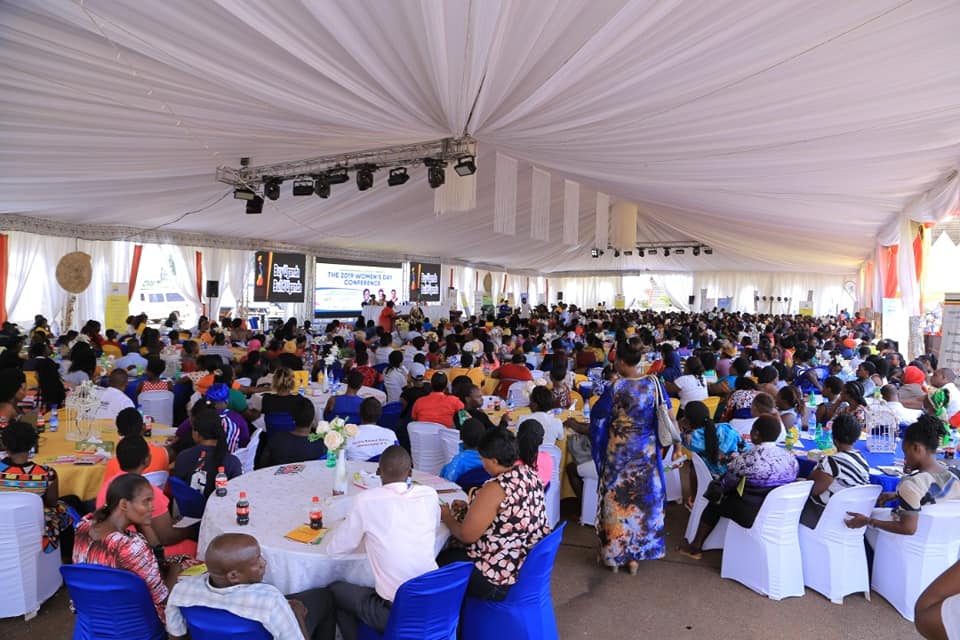
Kadaga was today opening the BUBU Expo Women in Business conference taking place at Kololo Independence Grounds. Kadaga pledged her support towards the BUBU campaign

Over 1500 women are gathered at Kololo Independence Grounds for the BUBU Expo Women in Business Conference. Kadaga, trade minister Amelia Kyambadde and Musician Mariam Ndagire are some of the Women that have been recognized for their efforts in fighting for women rights and business opportunities.

“Women need to change their attitude towards business and government need to extend more support especially in rural areas,” Kadaga said while addressing the women.

Meanwhile, an official logo for all products made in Uganda has was unveiled. The BUBU Logo was unveiled by President Yoweri Museveni during the official opening of the ongoing three-day Buy Uganda Build Uganda Expo that closes Saturday at Kololo Independence Grounds

Stories Continues after ad

Stanbic bank launches 4th Edition of National Schools Championship

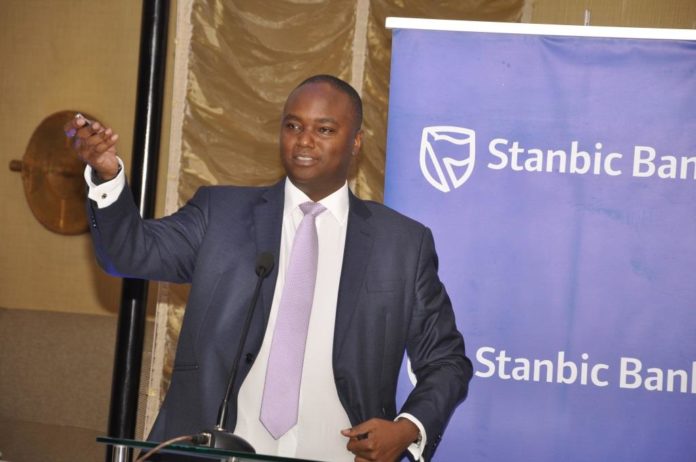
Stanbic Bank Chief Executive Patrick Mweheire

Stanbic bank has launched the 4th edition of its National Schools Championship. The annual competition seeks to equip students with business and enterprise skills in a bid to nurture entrepreneurship, creativity and long term business thinking. It targets students at the secondary schools.

The competition launched at Hotel Africana in Kampala will be held under the theme: “Empowering the job creators of tomorrow”.

Addressing guests at the Stanbic Bank Board Chairman Japheth Katto said youth unemployment was a serious problem that continues to plague many African countries including Uganda which he said has the second youngest population in the world.

“It is therefore imperative that we ensure this young population is participating productively for the good of our country’s economy. The Stanbic Bank National Schools Championship has become a powerful platform empowering students and teachers to start their own businesses and become job creators,” he said

The bank’s Head of Corporate Social Investment (CSI) Barbara Kasekende, while addressing the audience at the launch of the event urged stakeholders to pay attention to education, saying it was a critical sector for national development.

“Uganda’s Ministry of Education, in line with the National Development Plan 2020, expects at least 20 million children and young adults between the age of 3 and 24 to pass through the education system. This is informed by the fact that 80 percent of the country’s population is under the age of 30. The reality on the ground however is that school enrolment numbers continue to decline as students advance through the different education levels,” she explained.

Ms Kasekende cited the 2017 Education Monograph report released by Uganda Bureau of Statistics in partnership with UNFPA and UKAID, which said that about 11 million children went through Primary school, representing 54.7 per cent of the number of children expected to go through the education system.

About 26 per cent (5.2 million) of this same number went through secondary school while 19.2 per cent were enrolled into tertiary institutions.

She said the statistics show a clear picture of why education should be a key focus area for both the public and private sectors. “There is need to empower young people to be able to participate in the economy despite their level of education,” she said, adding that as ss a bank: We use the National Schools Championship as a platform to impart financial literacy and life skills to these students so they can become job creators rather than job seekers. We equip them with the skills that will enable them to start their own businesses.”

Through the program students and their teachers have been able to come up with business ideas and execute them into full-fledged small enterprises, she said.

Stories Continues after ad