Stanbic Bank
Stanbic Bank
18.5 C
Kampala
Stanbic Bank
Stanbic Bank
Home Blog Page 1337

Ugandans urged to seize trade opportunities with India

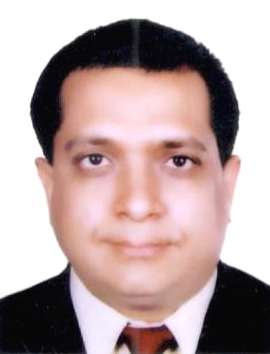
Shri Ravi Shankar

The Indian High Commissioner to Uganda Shri Ravi Shankar has advised Ugandans to exploit opportunities available in India for Uganda’s products.

Shri Ravi Shankar noted that Uganda has more comparative advantage to do business with India as compared to other countries in the region because of the favourable environment between the two states.

“In East Africa, Uganda has strong working relationship with India; let Uganda’s business community exploit such opportunities by exporting more products to India where the demand is high due to its population. This will lower the country’s trade deficit,” Shankar said.

The High Commissioner made the call to Ugandans during the awarding ceremony organized by the Indian Business Forum in Uganda which took place at the Kampala Serena Hotel on February 26.The ceremony was recognizing India’s enterprises that are excelling in doing business in Uganda.

Products with ready market

Agro related products especially fresh food and milk were cited among products that will have ready market in India.

Shri Ravi Shankar said Uganda should not only focus on reducing the volume of imports from India but on how Ugandan products can access the non-exploited markets in India.

To ensure that Uganda products have access to the India’s market, the commissioner noted that India has softened the process of applying for Visas to India, especially for the business communities. Among the interventions put in place include applying for India’s Visa on online which he said saves the applicants, time and transport cost.

Trushar Upadhyay, the general secretary of the India Business Forum in Uganda, asked government to create a conducive environment for the private sector to develop.

“Entrepreneurs in India are willing to expand their businesses to Africa, particularly East Africa but the challenge is the cost of doing business in the region being high. Governments need to ensure that the environment is conducive; that is when some countries like Uganda will attract more foreign direct Investment,” he said

The key issues which the Indian business community wants government to work on are related to taxation, poor infrastructures especially in most up country towns and the high cost of power.

The challenges notwithstanding, the Indians business community has played a big role in the growth of Uganda’s economy.

Stories Continues after ad

Why is IGG against Sudhir Ruparelia of all former owners defunct banks

Chairman Ruparelia Group of companies and former majority shareholders, Sudhir Ruparelia and other shareholders before COSASE.

Parliament’s Committee on Commissions, State Authorities and State Enterprises (COSASE) report on the controversial closure of banks by the Bank of Uganda (BoU) mentions all banks closed and makes recommendations concerning all, yet the Inspector General of Government Irene Mulyagonja has ordered the Internal Security Organisation (ISO) to investigate some of the members on the former COSASE on the allegations that they were compromised by Sudhir Ruparelia, the former majority shareholder in Crane Bank Limited (CBL).

By ordering ISO to carry out an investigation against former COSASE members, the IGG is indirectly witch-hunting the businessman given that she doesn’t not mention other former shareholders of defunct banks who want their banks compensated and reopened such those of the National Bank Of Commerce, Cooperative Bank and Greenland Bank among others.

Mulyagonja wants ISO to specifically investigate former COSASE Chairperson Abdu Katuntu, Anita Among (former Chairperson) and members Elijah Okupa and Odonga Otto on allegations of corruption and that the MPs are closer to Sudhir and his son Rajiv Ruparelia. Katuntu was further accused of receiving Shs400 million from BoU Governor Emmanuel Tumusiime-Mutebile to be used in benching the central bank with its peers and that Katuntu did not disclose the information during the probe.

Mulyagonja is believed to have ordered for an investigation against the four MPs after coming into contact with a top official from BoU. A few days ago Benedict Sekabira, BoU’s Director Financial Markets Development Coordination recently threatened Kadaga that he would go to court, saying COSASE MPs did not consider some of the documents and evidence he presented during the probe that took place from late October 2018 to late February 2019.

But as Mulyagonja wants the MPs investigated, she has failed to release a report on the alleged illicit wealth of Justine Bagyenda, the former executive director of bank supervision at BoU.

The IGG’s intervention in COSASE’s work did not go well with the Speaker of Parliament Rebecca Kadaga who said parliament will not be diverted from doing its work on mere allegations. Kadaga now wants Mulyagonja to appear before parliament to furnish the MPs with more details on the allegations against the MPs.

That aside, as a matter of concern, COSASE report which was a result of the probe, says that BoU at first agreed to sell all loan assets of Crane Bank Limited (CBL) to its rival DFCU Bank yet the bank acquired only loan book of Shs200 billion out of the Shs 500 billion, moreover the deferred payments were to be recovered from the entire loan book.

The report notes: “At the BoU Board of Directors’ sitting on 15th December 2016 it was resolved under minute no. 3754 paragraph 10, Board observations and resolutions that …the buyer of CBL would take all the assets and liabilities; and a report of a forensic audit was still awaited.”

The MPs in the report note that the board having resolved as above, it was wrong for management to agree, conclude and indeed execute a P & A that excluded some assets and liabilities, contrary to the resolutions of the board.

According to the report that has been debated in parliament BoU spent Shs478 billion as liquidity support to CBL and other intervention costs yet it could offer CBL’s assets at Shs200 billion to DFCU Bank. MPs in the report concluded that that transaction resulted in a financial loss to both BoU and CBL.

The report of the probe further notes that BoU officials later included interest on Shs200 billion on reducing balance basis, which would be recovered from the claims to be made by BoU on the CBL shareholders even as interest was never included in the P & A and the subsequent Shs200 billion liability agreement executed between BoU and DFCU Bank.

“…the Board’s resolution to charge the interest on the shareholder for money ‘lent’ to DFCU, the committee finds it inconceivable that CBL shareholders who were not party to the P & A and Shs200 billion liability agreement between DFCU and BoU would be called upon to bear the cost of negligence on the part of BoU officials,” the report continues.

The report says that by conducting the sale of CBL in a casual and informal manner, deviating from the basic principles enshrined in the Financial Institutions Act, 2004 and acting in a strange manner with the best interest of all concerned, BoU acted high handedly.

The report says BoU should bear the loss equivalent of the Shs500 billion loan book of CBL, which money should go to CBL. It adds also that BoU officials who failed to properly execute their duties in accordance with the law should be held responsible for their commissions and omissions.

The issues and recommendations above, analysts, say have angered BoU officials who were involved in the sale of CBL. The situation is worsened by the fact that BoU cannot account for some of the Shs478 billion it claims to have injected in CBL as liquidity support and other intervention costs.

Stories Continues after ad

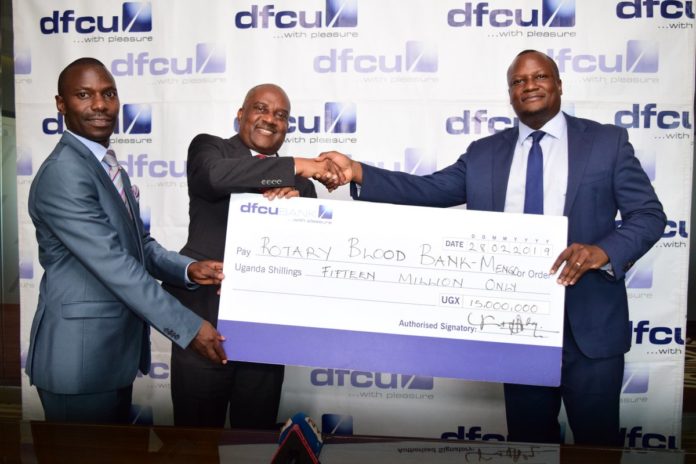
Dfcu gives Shs15m for Mengo Hospital blood bank

Picture: Dr. Emmanuel Katongole, Chairperson Rotary Blood Bank project and Mathias Katamba

DFCU bank has announced Shs15 million as contribution towards the fundraising efforts to equip Mengo Hospital with a fully-fledged Blood Bank that will test, process and pack safe blood before being distributed to other health centres.

The US $856,000 facility was in early 2017 commissioned by President Rotary international, John F. Germ and the Prime Minister of Uganda Dr. Ruhakana Rugunda.

According to Rotary, the total cost of the project was US $1,103,000 however, it is decreasing because they handle it in phases after contributions and donation for a particular cause.

The announcement was made by Chief Executive Officer of DFCU, Mathias Katamba reiterating their commitment to community empowerment and support which will be boosted with more Cooperate social responsibilities.

“Our support towards this cause is directly in line with our brand promise of Making More Possible for the diverse communities in which we operate,” he said at DFCU headquarters.

“People are at the heart of our Corporate Social Investment (CSI) agenda and the need for accessible safe blood is universal, so we are more than glad to make our contribution to this cause. We will be unveiling more community investment initiatives this year as DFCU celebrates 55 years of existence,” he noted.

The initiative intends to raise $500,000 in order to equip Mengo Hospital. Rotary fundraising efforts will be climaxed with the Transformational Leadership Forum and the Kirk Wallum Jazz concert slated for 7th March 2019.

Stories Continues after ad

WHO publishes new estimates on congenital Syphilis

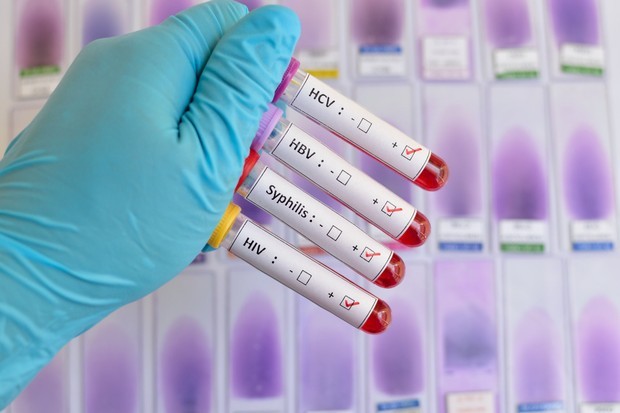
Syphilis

New estimates published Wednesday show that there were more than half a million (around 661,000) total cases of congenital syphilis in 2016, resulting in over 200,000 stillbirths and neonatal deaths. Syphilis is one of the most common sexually transmitted infections globally, with approximately 6 million new cases each year.

If a pregnant woman who is infected does not receive early and effective treatment, she can then transmit the infection to her unborn infant. This is known as ‘congenital syphilis’, which is often fatal. It can also cause low birth weight, prematurity, and other congenital deformities.

Congenital syphilis is the second leading cause of preventable stillbirth globally, preceded only by malaria.

Preventable and treatable
Congenital syphilis is easily preventable and treatable – as long as testing and treatment are provided to pregnant women early during antenatal care. The risk of adverse outcomes to the fetus is minimal if a pregnant woman, infected with syphilis, receives testing and adequate treatment with benzathine penicillin, early in pregnancy – ideally before the second trimester.

Co-authored by WHO and HRP with partners, and published in the scientific journal PLOS ONE, the new estimates show that out of the 661,000 total cases of congenital syphilis, there were 355,000 adverse birth outcomes – which represents a significant proportion of newborn death and disease.

The estimates showed that the overall global burden of congenital syphilis decreased over the 2012 to 2016 research period, although non-significantly, from around 750,000 to 660,000 cases. The research also found some improvements in screening, treatment, and surveillance of maternal syphilis. Estimated adverse birth outcomes due to congenital syphilis decreased slightly from 397,000 to 355,000.

Despite the decrease between 2012 and 2016, the numbers of affected women and infants remains unacceptably high. It is crucial that all women are provided with early syphilis screening and treatment as part of high-quality antenatal care for a positive experience of pregnancy.

In addition, health systems and programmes need to ensure that all women diagnosed with syphilis, as well as their infants, are effectively treated – and that their sexual partners are reached for testing and treatment. Countries can also work to reduce syphilis prevalence across populations, by ensuring that testing, treatment and partner referral for the infection are put into action, beyond that of antenatal care.

The importance of syphilis surveillance towards the goal of congenital syphilis elimination
WHO is working towards the goal of eliminating mother-to-child transmission of syphilis, and success has already been made in several parts of the world. In recent years 12 countries have been validated by WHO as having eliminated mother-to-child transmission of syphilis or HIV.

Monitoring the scale up of screening and treatment of pregnant women remains paramount to measure progress towards this goal. Measuring how many adults and infants are affected by syphilis with regional and national-level estimation is crucial to guide health systems’ capacity to strengthen the prevention, detection and treatment of syphilis.

Stories Continues after ad
Nigeria’s Dangote Tops a Very Short List of African Billionaires

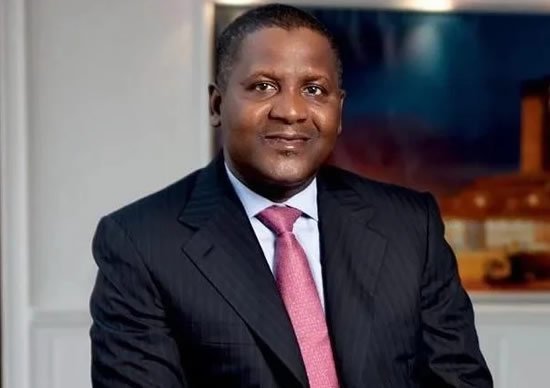
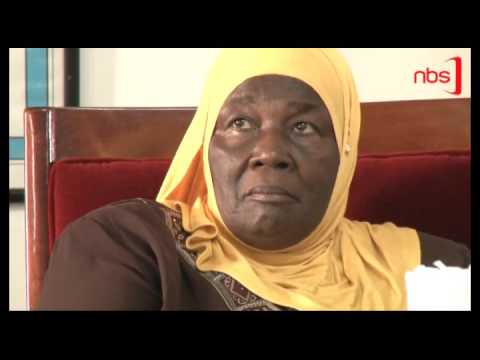
Aliko Dangote

Aliko’s US$17 billion net worth makes the Nigerian the richest person in Africa and the only member of the Bloomberg Billionaires Index from one of the 60 poorest countries.

About half of Nigeria’s 190.9 million citizens subside on less than $1.90 a day, giving it a Gini coefficient (a measure of wealth distribution) of 48.8, compared with 41.5 for the U.S. and 29.2 for Sweden.

Dangote, 61, is among just a few Nigerian billionaires, most of whom accrued their wealth by coming into possession of lucrative oil blocks or, in the case of telecom magnate Mike Adenuga , providing services to a fast-growing population. Adenuga, the nation’s second-richest person, owns mobile phone network Globacom Limited., with 45 million subscribers. He’s worth US$2.8 billion, according to the Bloomberg wealth index.

South Africa is the only other country in the sub-Saharan part of the continent with any representatives on the Bloomberg wealth ranking. Its three wealthiest citizens — De Beers heir Nicky Oppenheimer, luxury tycoon Johann Rupert and property and wholesaling mogul Natie Kirsh — are worth about $20 billion combined. All three have extensive holdings outside Africa.

There are just six Africans on the ranking of the world’s 500 richest people, including Egyptian brothers Nassef and Naguib Sawiris. By comparison, China, with a population that rivals Africa’s, has 44.

And though Dangote’s US$17 billion fortune is a startling figure in such a poor country, his wealth in proportion to the size of Nigeria’s economy is on par with or even lower than the richest citizens of more developed countries.

Stories Continues after ad
African lawyers train in negotiating deals in key economic sectors

Stephen Karangizi ALSF CEO.

The African Legal Support Facility (ALSF) has completed a two-day workshop for African lawyers and government negotiators, aimed at strengthening their capacity to negotiate complex deals involving investments in key economic sectors.

The workshop, co-organized with the African Business Law Firms Association (ABFLA) under ALSF, was held in Accra, Ghana, from February 14-15, 2019. Forty government negotiators and 30 lawyers in private practice representing public and private organizations across Africa, attended the workshop.

In his opening remarks, Stephen Karangizi, Director and Chief Executive Officer of ALSF said the topics covered were “carefully chosen to fill identified knowledge gaps between lawyers’ academic training and legal practice.”

“Participants benefited from a wide array of rich legal contributions and content on the techniques needed to successfully negotiate sustainable and equitable investment agreements for projects in the energy, mining, oil and gas sectors,” officials say.

Further, the negotiation and legal intricacies of infrastructure projects and public-private partnerships were also covered. Participants and government officials attending the workshop commended the initiative, stating that the skills acquired were relevant and vital for the effective and efficient discharge of their professional duties and official responsibilities.

Karangizi said the academy’s curriculum was co-developed by ALSF, national and regional bar associations, including the Southern African Development Community Lawyers Association (SADCLA), the East African Law Society (EALS) and the International Training Centre in Africa for Francophone Lawyers (CIFAF) based in Cotonou, Benin. The academy’s capacity building initiative is also accessible virtually via a portal with learning tools and documentation sourced from the ALSF library.

The Accra workshop was also an opportunity for the ALSF to call on Regional Member Countries to contribute to the financial resources of the ALSF – all in a bid to strengthen its capacity to support African countries with their creditor litigation and negotiations for complex commercial transactions.

Similar ALSF Academy sessions were held in Kigali, Rwanda, and Cotonou, Benin, in October and November 2018.

Stories Continues after ad
2019 Afcon Qualifiers: Match officials for Tanzania vs Uganda named

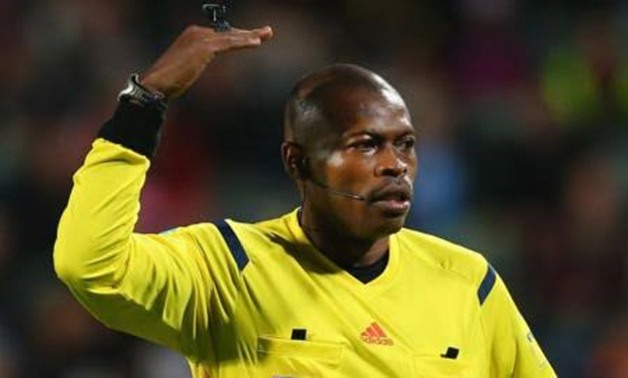
Eric Otogo Castane - Gabonese referee

Africa Soccer governing body CAF has appointed match officials for the 2019 AFCON qualifier between Tanzania Taifa Stars and Uganda Cranes on the 24th of March 2019.

Eric Otogo Castane from Gabon will be the centre referee and be assisted by fellow countrymen Moussounda Montel and Marlaise Ditsoga as his first and second assistants respectively.

Isidore Nze, also from Gabon, will be the game’s fourth official.

Mamoun Bushara from Sudan will be the Match commissioner while the Referees Assessor will be Jason Damoo from Seychelles.

The Security Officer will be David Van Vuuren from South Africa.

The match will be played on Sunday, 24 March at the Benjamin Mkapa National stadium. The reverse fixture in Kampala ended in a goalless draw.

Uganda is among the fourteen nations to have already secured a place at the 2019 Afcon while Tanzania will need to win and hope Lesotho falter against Cape Verde in the other Group L stage match.

The 24-team Africa Cup of Nations will take place in Egypt from June 21st with the final to be played on July 19th.

Stories Continues after ad

Uganda to mark International Women’s Day – Minister Jannat Mukwaya

Gender, Labour and Social Development Minister Janat Mukwaya

Minister of Gender, Labour and Social Development (MGLSD) Janat Mukwaya has said Uganda is set to mark International Women’s Day in recognition for their role and contribution to the development process of their country.

Celebrations will be held under the global theme ‘Think Equal, Build Smart, and Innovate for Change’, peddled at creating a paradigm shift for transforming mind sets to the goal of gender equality as well as identifying new ways of advancing the women’s agenda at all levels.

In a statement released by minister, the day provides an opportunity to enhance advocacy for inclusion of women’s concerns in the development agenda at all levels by calling on United Nations Member States to design and implement interventions aimed at attaining gender equality and empowerment of women.

She said National Celebrations will take place in Rwimi Primary School Playground in Bunyangabu District under the theme ‘Empowering Women through Innovative Approaches to Social Protection; a Pre-requisite for Inclusive and Sustainable Development’.

“This theme recognizes the importance of providing social protection to women with the aim of minimizing their vulnerability, building their potential through innovative approaches so that they contribute to and benefit from the development process,” she said in a statement.

Mrs. Mukwaya said gender mainstreaming in social protection is critical in the programme design, implementation and evaluation because it lays a foundation for fair distribution of outcomes and impacts on all the categories of beneficiaries.

She vowed that the ministry will continue to address gender inequalities and equity in delivering social protection services, build capacity of duty bearers to effectively implement gender responsive and equitable social protection interventions, developing and institutionalize system for delivering gender responsive and equitable social protection interventions.

She said Social Assistance Grants for Empowerment (SAGE), Uganda Women Entrepreneurship Programme (UWEP), Private Sector and Civil Society Led Initiatives have been place for empowerment and improving women’s welfare.

Stories Continues after ad

Uganda U-17 squad to Turkey named

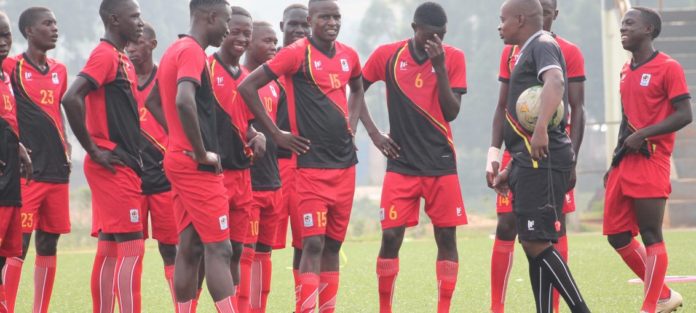
The Uganda U-17 National football team, known as ‘The Cubs’ finalised with their intensive residential training ahead of the invitational tournament in Antalya Turkey.

Throughout the ten-day camp at the FUFA Technical Centre, Njeru the team played two friendly matches to help the coaches assess players’ fitness levels.

They won 3-1 and 2-1 against Jinja SS school team and Football for Good respectively.

Cubs are among the 12 teams that will participate in the tournament and are in group 2 alongside Cameroon, Morocco and Belarus.

Uganda will open their campaign on Monday 4, March against Cameroon.

The invitational tournament is part of preparations for the upcoming 2019 U-17 Africa Cup of Nations to be hosted in Tanzania in April.

The top four teams of the U17 Afcon tournament will qualify for the 2019 FIFA U-17 World Cup in Peru in October 2019 as the CAF representatives.

The team flies out Friday morning (4am) aboard Egypt Air.

Groups

Group 1: Tanzania, Guinea, Australia, Turkey

Group 2: Cameroon, Uganda, Morocco and Belarus

Group 3: Senegal, Nigeria, Angola, Montenegro

Fixtures (Uganda Cubs)

Monday 4, March 2019 – Cameroon Vs Uganda

Wednesday 6, March 2019 – Uganda Vs Morocco

Friday 8, March 2019 – Uganda Vs Belarus

The squad of 23 players traveling to Turkey

Goalkeepers: Jack Komakech (Ndejje University FC), Oyo Delton (Kirinya Jinja SS FC), Ssemwogerere Daniel (Bright Stars FC)

Outfield players: Asaba Ivan (Vipers SC), Ekellot Ibrahim (KCCA FC), Ibrahim Juma (KCCA FC), Jarieko James (Paidha Black Angels FC), John Kokas Alou (URA FC), John Rogers (Onduparaka FC), Kakaire Thomas (Bright Stars FC), Kakande Shafic (Bright Stars FC), Kasozi Samson (Bright Stars FC), Kevin Ssekimbegga (Express FC), Kiddawalime Soul (Super Cubs), Kizito Mugweri Gavin (Vipers SC), Mugisha Rogers (Mbarara City FC), Mugulusi Isma (Kirinya Jinja SS FC), Mwaka Polycarp (Kirinya Jinja SS FC), Opaala Edwine Mukisa (Kirinya Jinja SS FC), Ssekajja Davis (Bright Stars FC), Wasswanga Shafik (Ndejje University FC), Yasin Abdu Owane (Vipers SC), Ziraba Ronnie (Express FC).

Stories Continues after ad

Victoria University to partner with Mpigi district to set up smart model village

Victoria University

The modern time challenge of education is finding its useful place in complementing Government efforts to build society.

Universities especially in the south should find new and effective ways of developing, transmitting and applying knowledge for the public good; ways that may not always look anything like received western forms of teaching or research but rather contextualized relevant teaching and learning.

Measuring a university’s success here does not mean comparing it to the failures of neighboring institutions; rather it is often precisely through active collaboration with other stakeholders such that key widespread improvements can be effected. This is not charity work; it is what universities should be for in modern time

Inspired by a common interest to work together towards the improvement of the welfare of the people they serve. Victoria University sought a partnership with Mpigi District Local Government to set up a world class smart model village that will be globally identified as success story of a sustainable rural community.

A formal letter from Victoria University was written to the District, dispatched and received in November 2018. The district then invited the University team to share this concept with a select committee of the Technical team on 20/2/2019.

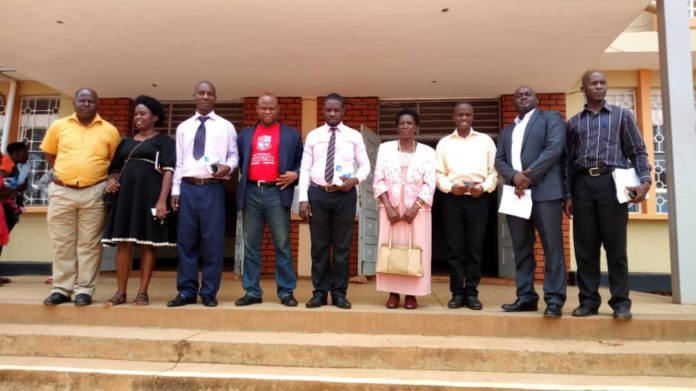
The University was represented by the Dean of Humanities and Social Sciences Mr. Fred Kasirye – Head of Delegation, Dean Business and Management Prof. Omotayo Adebujyi, Dean Science and Technology Mr. Fred Lwanga, Head of Department Humanities Mr. Mark Namayo, and Mr. Amos Turyatemba (Head of Department-Social Sciences).

They were welcomed by the District CAO Ms. Lucy Frances Amulen, the Deputy CAO – Mr. Jack Byaruhanga, and the District Community Development Officer, Mr. Mwanje Anthony. The University team made a presentation to a select committee of the District Technical Planning Committee about the model village which was well received.

Through this initiative the University shall work with the district and development partners to promote home grown development paradigms, relevant community research, effective district leadership capacity building and policy guidance.

The partnership shall see the birth of a model village with unique potential and abilities to manage its health, business, technology and societal aspects as mirrored by the four faculties of the University.

For instance students undertaking the Degree in Public Administration will make vital community level initiatives towards Good Governance, Corporate Governance and Public accountability, on the other hand their counterparts in Business shall support SMEs with strategies to grow while also supporting the District to identify additional revenue streams.

In the Health Sciences area of study aspects of public health and nutrition at both family and community levels will be a regular life testimony that students will learn, unlearn and relearn.

Students reading IT will predominantly support the demystification of IT at the grassroots to improve livelihoods through for instance simple IT enabled banking operations, communication and business management. While research will be done throughout the district the pretest, test and model interventions will be done in the selected project villages.

Under this arrangement both the University and the District will spare resources to invest in this initiative over a spread period of time, closely monitor and draw agenda that will enable each party to realize its ideals with regards to service delivery on one side and relevant higher education on the other side.

The initiative is a brain child of the University management which thought it wise to offer additional value to University students’ education by enabling students interact regularly with the real situation on the ground in modern day life while providing relevant solutions through a scholarly approach.

The discussions are still ongoing and the initiative is expected to be launched by mid this year. The University offers Diplomas, Bachelors and Masters Programs in specialized fields.

Stories Continues after ad