Stanbic Bank
Stanbic Bank
25.4 C
Kampala
Stanbic Bank
Stanbic Bank
Home Blog Page 1392

Former owners of International Credit Bank blame BoU, want licence reinstated

Former COSASE chairman, Abdu Katuntu.

The former owners of International Credit Bank (ICB), have blamed the Bank of Uganda (BoU) for shutting down their bank in September 1998 and now want its licence reinstated by the responsible authorities.

The shareholders led by former Managing Director Thomas Kato were on Tuesday appearing before parliament’s Committee on Commissions, Statutory Authorities and State Enterprises (COSASE) which has been probing BoU over the controversial closure of seven commercial banks.

Kato who was giving, ICB’s side of the story, said BoU acted without giving managers time to reconcile books of accounts. When by MPs about the closure process, Kato said they were just asked to move out of the bank by BoU officials who were in the company of policemen.

Kato said the closure of ICB resulted into losses in terms of money and lives. Without mentioning names, Kato said ICB lost three managers and its Chairman as a result of its closure. He said former owners of the bank would soon ask for financial compensation, saying they were still working on the figure to be presented for compensation.

According to the Auditor General John Muwanga’s special audit report of BoU on defunct banks, BoU closed ICB on September 18, 1998 on account of poor liquidity and insolvency which it said had put depositors’ money at risk. It appointed audit firm KPMG as the liquidation agent from September 1999-2001.

After takeover the liquidation of ICB IN 2002, BoU combined loan assets of the bank with those of Greenland Bank and Cooperative and sold them as one unit, something that ICB owners told MPs was illegal and fraudulent as it violated the Financial Institutions Act, 2004.

In the case of ICB, Greenland Bank and Cooperative Bank the total loan portfolio sold of Shs135bn included Secured loans of Shs34.5 billion which had valid, legal or equitable mortgage on the real property and were supported with legal documentation but were sold to Nile River Acquisition Company at a 93 percent discount as the company paid only Shs8.89 billion. ICB had secured loans of Shs1.1 billion.

Kato said former ICB owners the categorization of their loans such as ‘unknown loans’, ‘poorly secured’ and ‘not secured’ was suspect as such cannot apply in banking. They said BoU should give more details, saying it was wrong for BoU to lump all the loans.

COSASE Chairman Abdu Katuntu said with such confusing terms, an element of fraud could not be ruled in the commercial the bank. There is no way you can have unknown loan. Money is expended on accounts which have names of account holders,” he said.

The bank’s former owners could not also agree with BoU on liquidation costs, value of assets. BoU is officials are expected to respond to the queries raised on Friday when they will interface with the MPs. That will be the last day that BOU appears before the MPs as far as the probe is concerned.

Stories Continues after ad

No replays of incidents under review by VAR on big screens in Champions League – UEFA

Video-Assistant-Referee

Uefa will not allow stadium screens to show replays of incidents under review by the video assistant referee (VAR) when the system is used for the first time in the Champions League next week.

The potential security implications of replaying controversial incidents means that graphics will appear instead informing supporters in the stadium what type of incident is being reviewed. A Uefa official will be in the VAR control room at each match to communicate with broadcasters so that TV viewers can be told what is happening.

UEFA has met the clubs involved to explain the video assistant referee (VAR) system that will be used from the Round of 16, which starts next Tuesday.

UEFA invited representatives of the 16 clubs remaining in this season’s competition – coaches, coaching staff and club delegates – to a meeting in Frankfurt to brief them on the system, which is designed to help referees in their decision-making process.

In each stadium where matches are played, a mobile unit will provide coverage in the absence of a VAR centre and a referee, along with two video operators, will be located at each stadium to support the match official.

UEFA’s Chief Refereeing officer Roberto Rosetti explained that the VAR team will constantly check for clear and obvious errors related to the following four match-changing situations: Goals, penalty decisions, direct red card incidents and mistaken identity. The Italian expressed UEFA’s confidence that VAR will represent a crucial tool for referees in the future.

“We are convinced that VAR will be beneficial,” Rosetti continued, “as it will provide match officials with valuable help, allowing them to reduce clearly incorrect decisions – which is ultimately good for the clubs, the players, the coaches, the fans, the referees and the competition.”

VAR will also be used in the UEFA Europa League final, the Nations League final and the final of the Under-21 European Championship which will be held next June.

Round of 16 ties:

Schalke v Manchester City

Atlético Madrid v Juventus

Manchester United v Paris Saint-Germain

Tottenham Hotspur v Borussia Dortmund

Lyon v Barcelona

Roma v Porto

Ajax v Real Madrid

Liverpool v Bayern Munich

Stories Continues after ad

Opposition MPs welcomes the passing of the East African Monetary Institute Bill 2017

Odongo-George

The Opposition legislators have welcomed the passing of the East African Monetary Institute Bill 2017, peddled at pave way for a single currency in East Africa.

The East African Monetary Institute Bill sought to set up the agency to perform the role of a regional central bank and establish a single currency.

The Monetary Union, which involves a common currency and with common fiscal and monetary policies, is one of the stages of the integration of the six East Africa countries of Kenya, Tanzania, Rwanda, Burundi, South Sudan and Uganda.

During a meeting with members of the East African Legislative Assembly, Uganda Chapter, the Leader of the Opposition, Betty Aol Ocan, said Opposition MPs welcomes the idea of the regional monetary framework and currency.

“You have our support on the law and we hope to see the currency come to life in 2024,” she said adding that Opposition Cabinet has always recommended that the Uganda contributes diligently to the EAC.

The members led by Stephen George Odnongo are visiting Uganda as part of their sensitization drive to update the country on the progress of regional integration and on the critical legislations passed by the EALA.

Odongo said the passing of the Bill prepares the East Africa Community (EAC) for a single currency to foster trade in the region.

“By 2024 we shall have one monetary currency that will harmonize the exchange rates in the region and fiscal policies,” he said adding that the bill will contribute to foster regional integration.

He also said that EALA had passed the EAC Statistics Bill, which is expected to help project the region’s Gross Domestic Product and help plan and assist the transition to monetary union.

The EA Statistics Bureau Bill is expected to create a regional body similar to European Union’s Eurostat, responsible for gathering data to guide decision making within the EAC Monetary Union.

Paul Musamali, Uganda’s other representative to Arusha, raised concern over some of the funding challenges faced by the regional assembly.

“Each country contributes US $8.8 million which is 50 per cent of the budget of EALA and it is not even done on time; this leaves us in a precarious situation to scavenge for funds,” he said.

He added that, “If we are to shield ourselves against neo-colonialism we need to fund the assembly well”.

Stories Continues after ad

Post Gadafi governance problems in Libya can be solved through the building of a national army- Museveni

President Museveni

President Yoweri Museveni has said the effects of post Gadafi governance problems in Libya can be solved through the building of a national army asserting that by doing so, a lasting solution to the Libyan conflict can be found.

The President, who is the patron of the Afro-Arab Youth Council, made the comments when he received the delegation led by Mr. Abdulhadi Elhwig at State House, Nakasero.

“The African Union is more important than the tribal conflicts prevailing in Libya today. The problems in Libya can be solved through the building of a national army where they incorporate both the old and new members of the forces. I also propose that they hold elections where all the Libyans will participate fairly,” he said.

The delegation’s main purpose of meeting the Museveni was to consult him ahead of preparations for the 3rd General Assembly of the Afro-Arab Youth Council Summit that is slated to take place in Kampala in August this year. The 2nd General Assembly of the organization last took place in Kampala in 2008.

The leader of the Afro-Arab Youth, Abdulhadi Elhwig, on his part, saluted Museveni for the immense support to the group during the 2008 Summit in Kampala that was also attended by the late President Muammar Gaddafi of Libya. He observed that the event, attended by 5,000 delegates, was a big success.

He further thanked the President for accepting to host the Summit in Kampala in August this year. The event will coincide with the International Day of the Youth at which over 50 countries would be represented.

Stories Continues after ad

Express FC chairman denies sacking head coach

Kiryowa Kiwanuka - chairman Express FC.

Express FC club chairman Kiryowa Kiwanuka has refuted reports that the club has parted ways with Head coach Kefa Kisala after their 2-0 home defeat to Police FC.

The club chairman used his twitter account ‘KiryowaKk’ to reply to a tweet that claimed that Express had sacked Coach Kefa Kisala.

“This is not true!! When we make a decision we officially communicate it. Kefa Kisaala is still the head coach @ExpressFCUganda.” He tweeted.

Juma Balinya and Johnson Odong scored for the cops in a game played at Mutesa II Mutesa stadium in Wankulukuku to pile more misery to the Red Eagles.

The Red Eagles have won only 2 out of their last 11 Uganda Premier League outings and last scored a goal on January 3rd.

Express remain tenth on the 16-table log with 21 points from 17 games played, and are yet to win a league game in 2019 but are into the round of 16 of the Stanbic Uganda Cup.

There next game is a trip away to Jinja against BUL FC on Sunday 10th February at FUFA Technical Centre in Njeru.

Stories Continues after ad

Cabinet approves Anti-Money Laundering Bill, 2018

Col. Bantariza

The Ugandan Cabinet has approved the Anti-Money Laundering (Amendment) Bill, 2018, according to the Deputy Government Spokesman Rtd Col. Shaban Bantariza.

Bantariza who was briefing journalists at the Uganda Media Centre on Tuesday said the long-awaited bill was approved on Monday as Cabinet sat at State House Entebbe under the Chairmanship of President Yoweri Museveni.

He said the proposed bill would enable Uganda get international cooperation in money laundering and terrorist financing investigations but also be admitted into the Egmont Group, a united body of 155 financial intelligence units.

Government has already established the Financial Intelligence Authority (FIA) to curb money laundering and related crimes such as terrorist financing. That approval the bill means it will now be debated in parliament before it can become law.

Finally, Bantariza said, Cabinet noted the proposed transfer of the interest in Block 1, 1A, 2 and 3A by Tullow Uganda Operations PTY Limited and Tullow Uganda Limited to Total E&P Uganda B.V and CNOOC Uganda Limited.

Tullow Oil Plc sought the approval from Ugandan government some time back for the planned partial sale of its interests to Total E&P Uganda. In January 2017, the company agreed to transfer 21.57 per cent of its 33.33 per cent interests in blocs above at a total consideration of US $900 million.

In February 2017CNOOC Uganda Limited (CNOOC) notified Tullow that it has exercised its pre-emption rights under the joint operating agreements between Tullow, Total and CNOOC to acquire 50 per cent of the interests being transferred to Total on the same terms and conditions that were agreed between Tullow and Total. CNOOC, as well agreed to the amount, structure and timing of the consideration payable to Tullow. It was expected that Tullow would get all the payment by end of 2018.

The total consideration for the transaction includes US$200 million (about Shs720 billion) in cash consisting of $100 million (about Shs360 million) on completion of the transaction and US$50 million (Shs180 billion) at both final investment decision and first oil production.

The second consideration is US$700 million (Shs2.5 trillion) in deferred consideration which will be used by Tullow to fund the company’s share of the costs of the upstream development project and the associated export pipeline project.

Once the farm-down is completed, Tullow will cease to be an operator in Uganda but will retain a non-operated presence only in the country.

.

Stories Continues after ad

Museveni arrives at Banda palace to meet Kabaka over Bobi Wine

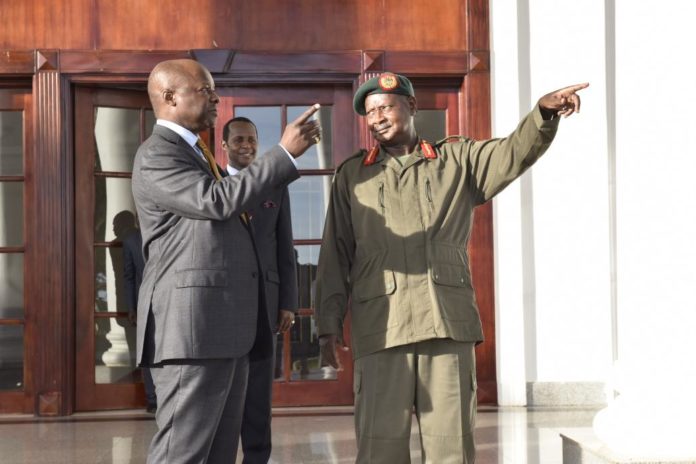
President Yoweri Museveni has this morning reached the Banda palace for a meeting with the Kabaka of Buganda, Ronald Muwenda Mutebi.

The agenda of the meeting remains secret but sources within the presidency say part of the discussion could be centred around the issue of Kyadondo East legislator Robert Kyagulanyi aka Bobi Wine. Sources say, President Museveni is angered by Mengo’s continued silent support to Mr Kyagulanyi.

This is the first time Mr Museveni is visiting the Kabaka at his official residence. The president’s convoy arrived at the palace at about 11.30 am and he was received by the Kabaka himself.

“It is true, the head of state has a scheduled meeting with the Kabaka and this meeting is special because instead of the usual way of Kabaka visiting State House, it is the president visiting the Kabaka. However, the discussion between the two is unknown to use but we suspect, the remarks made by the Katikiro over the arreats of Bobi and his colleges in Arua angered the president and the continued utterances by some people in Mengo have annoyed him and so this could be part of the reason he has opted for one on one with the king|” a sources who spoke on anonymity told Eagle Online.

In one of the press conferences at State House last year, journalists asked President Museveni on the remarks made by Katikiro Peter Mayiga concerning the arrests, and in reply, Gen. Museveni said that he would ring the Kabaka and find out what his Katikiro had said.

Sources further say that Mengo’s continued identification with the Kyadondo legislator on official functions graced by the Kabaka hasn’t been received well within the Kampala establishment because sends messages that Mengo is actually behind the singer turned politician.

Stories Continues after ad

Parliament recommends extra Shs334 billion to boost electricity use

MPs want such pupils to use power in their homes.

Members of Parliament on Natural Resources Committee has recommended an extra Shs334 billion for electricity transmission, generation and distribution projects to utilize excess power.

The committee members want government to allocate an additional Shs60 billion to the Rural Electrification Agency (REA), Shs96.1 billion to Uganda Electricity Generation Company Ltd-UEGCL and Shs178 billion to Uganda Electricity Transmission Company Ltd (UETCL) to boost electricity use among Ugandans.

The above projects are among the underfunded or unfunded priorities in the Energy Resources Directorate under the Ministry of Energy and Mineral Development in the National Budget Framework Paper for financial year 2019/2020.

There have been concerns that Isimba and Karuma hydropower dams will add 1,000 Megawatts to the national grid by the end of this year and yet there are challenges of transmitting and distributing it to users.

Also noted are the delays in compensating Project Affected Persons (PAP), which the committee says has hampered implementation of key transmission projects including Sukuru sub-station in Tororo, Mutundwe-Entebbe, Mirama-Kabale, Industrial parks, Karuma interconnection and Masaka-Mbarara.
Dr Keefa Kiwanuka, the Natural Resources Committee Chairperson, says the installed generation capacity of 1,100 Megawatts cannot be fully utilized due to poor transmission and distribution lines.

The committee is worried that adding Isimba and Karuma dams onto the national grid may not yield the desired results unless the transmission and distribution systems are expanded and upgraded.

Uganda has an excess power generation of about 200 Megawatts. Only a maximum of 750 MW can be used during peak hours between 6pm -12pm minus power from the two thermal plants that have an installed capacity of 100MW.

There are currently 36 power generating plants in the country, which include large and mini hydro dams, heat and energy, solar and thermal plants.

Stories Continues after ad

Cervical cancer one of greatest threats to women globally-WHO

WHO

Cervical cancer is one of greatest threats to women globally, killing more than 300,000 of them every year, according to World Health Organisation (WHO).

According to WHO, every minute, one woman is diagnosed. “Each death is a tragedy, and we can prevent it,” the agency says in a brief, stating that most of the women are not diagnosed early enough, and lack access to life-saving treatment much as studies have shown that prevention and early treatment of cervical cancer are also highly cost-effective.

It says nine in 10 women who die from cervical cancer are in poor countries like Uganda and that rising cervical cancer deaths is undermining health gains for women made in maternal health and HIV care. “Current disparity in survival from cervical cancer, which varies between 33-77 per cent, is unacceptable and can be minimized,” WHO says.

The agency is calling for accelerated progress especially to ensure that all girls globally are vaccinated against HPV and that every woman over 30 is screened and treated for pre-cancerous lesions. “To achieve that, we need innovative technologies and strategies. We must improve access to diagnosis and treatment of invasive cancers at their earliest stages and ensure that availability of palliative care for women who need it,” it says.

It says there must be strong health systems aimed at delivering universal health coverage, arguing that High-income countries have shown the way and that now is the time for global elimination.

Some the actions needed include vaccination against human papillomavirus, screening and treatment of pre-cancerous lesions, early detection and prompt treatment of early invasive cancers and palliative care. “This will require political commitment and greater international cooperation and support for equitable access, including strategies for resource mobilization,” WHO says.

Currently, most women diagnosed with cervical cancer are diagnosed with advanced cancers, where opportunity for cure is small. This compounded by lack of access to life-saving treatment in settings where the burden and need is highest.

Days ago Uganda’s state minister for Primary Health Care, Joyce Moriku Kaducu disclosed that over 21,000 cancer deaths were registered by the Kampala Cancer Registry in 2018.

According to current evidence, 30 per cent to 50 per cent of cancer deaths could be prevented by modifying or avoiding key risk factors such as tobacco use, excessive alcohol consumption, physical inactivity, unhealthy diets and obesity.

“The Ministry of Health has prioritized cancer control and is committed to ensuring that the communities are educated on how to prevent cancer and enabling access to cancer screening and treatment services including palliative care is available everywhere in Uganda,” Joyce Moriku Kaducu said.

Stories Continues after ad

Kadaga tours Namulonge Research Institute

Speaker Rebecca Kadaga on learning mission of smart agricultural practices intended to boost agricultural production and productivity in Busoga Sub-region.

By Our Reporter

The Speaker of Parliament Rebecca Kadaga on Monday led d a team of 30 leaders from Busoga region to the National Agricultural Research Organisation (NARO) Crop & Livestock Resources Research Institutes in Namulonge and Nakyesasa respectively on a learning mission of smart agricultural practices.

While at the Livestock Research Institute, Kadaga toured the vaccine evaluation platform where clinical trials for NARO produced (4) tick vaccines are being conducted in line with the World Health Organization procedures for release of a new drug.

“Rt. Hon. Speaker, once on the market, this vaccine will save this country over Shs3.2 trillion which is the current expenditure on imported ticks and acaracide treatment for livestock,” said Ambrose Agona, the NARO Director General.

Agona said the model is available for interested commercial farmers to adopt and replicate on their own farms. “As a Research Organization, we pride ourselves in bringing the smartest agricultural practices closer to the people for increased production and productivity,” he said.

Kadaga said, “is possible for us to move the 68% of our Ugandans into the cash economy and I implore my colleagues the elected leaders to make use of the knowledge resources available to us through the Zonal Agricultural Research Institutes to enlighten our people.”

The NARO vaccines being produced include three tick-specific vaccines and one cocktail vaccine that has the potential to protect Ugandan cattle and beyond from the three most prevalent ticks.

NARO is applying biotechnology tools in the development of potato varieties tolerant to potato blight disease, maize varieties tolerant to drought, maize stock borer and the fall army worm, banana varieties enhanced vitamin A content.

NARO has embarked on a campaign to promote research partnership and collaboration; improve research quality and increase total research funding for research by mobilising funds from farmers, industry and other sources.

Dr. Godfrey Asea, the Director of Research at the Crop Research Institute said that annually, Ugandan farmers lose an estimated Shs100 billion to major cassava virus diseases.

Stories Continues after ad