Stanbic Bank
Stanbic Bank
25.4 C
Kampala
Stanbic Bank
Stanbic Bank
Home Blog Page 1393

Cervical cancer one of greatest threats to women globally-WHO

WHO

Cervical cancer is one of greatest threats to women globally, killing more than 300,000 of them every year, according to World Health Organisation (WHO).

According to WHO, every minute, one woman is diagnosed. “Each death is a tragedy, and we can prevent it,” the agency says in a brief, stating that most of the women are not diagnosed early enough, and lack access to life-saving treatment much as studies have shown that prevention and early treatment of cervical cancer are also highly cost-effective.

It says nine in 10 women who die from cervical cancer are in poor countries like Uganda and that rising cervical cancer deaths is undermining health gains for women made in maternal health and HIV care. “Current disparity in survival from cervical cancer, which varies between 33-77 per cent, is unacceptable and can be minimized,” WHO says.

The agency is calling for accelerated progress especially to ensure that all girls globally are vaccinated against HPV and that every woman over 30 is screened and treated for pre-cancerous lesions. “To achieve that, we need innovative technologies and strategies. We must improve access to diagnosis and treatment of invasive cancers at their earliest stages and ensure that availability of palliative care for women who need it,” it says.

It says there must be strong health systems aimed at delivering universal health coverage, arguing that High-income countries have shown the way and that now is the time for global elimination.

Some the actions needed include vaccination against human papillomavirus, screening and treatment of pre-cancerous lesions, early detection and prompt treatment of early invasive cancers and palliative care. “This will require political commitment and greater international cooperation and support for equitable access, including strategies for resource mobilization,” WHO says.

Currently, most women diagnosed with cervical cancer are diagnosed with advanced cancers, where opportunity for cure is small. This compounded by lack of access to life-saving treatment in settings where the burden and need is highest.

Days ago Uganda’s state minister for Primary Health Care, Joyce Moriku Kaducu disclosed that over 21,000 cancer deaths were registered by the Kampala Cancer Registry in 2018.

According to current evidence, 30 per cent to 50 per cent of cancer deaths could be prevented by modifying or avoiding key risk factors such as tobacco use, excessive alcohol consumption, physical inactivity, unhealthy diets and obesity.

“The Ministry of Health has prioritized cancer control and is committed to ensuring that the communities are educated on how to prevent cancer and enabling access to cancer screening and treatment services including palliative care is available everywhere in Uganda,” Joyce Moriku Kaducu said.

Stories Continues after ad

Kadaga tours Namulonge Research Institute

Speaker Rebecca Kadaga on learning mission of smart agricultural practices intended to boost agricultural production and productivity in Busoga Sub-region.

By Our Reporter

The Speaker of Parliament Rebecca Kadaga on Monday led d a team of 30 leaders from Busoga region to the National Agricultural Research Organisation (NARO) Crop & Livestock Resources Research Institutes in Namulonge and Nakyesasa respectively on a learning mission of smart agricultural practices.

While at the Livestock Research Institute, Kadaga toured the vaccine evaluation platform where clinical trials for NARO produced (4) tick vaccines are being conducted in line with the World Health Organization procedures for release of a new drug.

“Rt. Hon. Speaker, once on the market, this vaccine will save this country over Shs3.2 trillion which is the current expenditure on imported ticks and acaracide treatment for livestock,” said Ambrose Agona, the NARO Director General.

Agona said the model is available for interested commercial farmers to adopt and replicate on their own farms. “As a Research Organization, we pride ourselves in bringing the smartest agricultural practices closer to the people for increased production and productivity,” he said.

Kadaga said, “is possible for us to move the 68% of our Ugandans into the cash economy and I implore my colleagues the elected leaders to make use of the knowledge resources available to us through the Zonal Agricultural Research Institutes to enlighten our people.”

The NARO vaccines being produced include three tick-specific vaccines and one cocktail vaccine that has the potential to protect Ugandan cattle and beyond from the three most prevalent ticks.

NARO is applying biotechnology tools in the development of potato varieties tolerant to potato blight disease, maize varieties tolerant to drought, maize stock borer and the fall army worm, banana varieties enhanced vitamin A content.

NARO has embarked on a campaign to promote research partnership and collaboration; improve research quality and increase total research funding for research by mobilising funds from farmers, industry and other sources.

Dr. Godfrey Asea, the Director of Research at the Crop Research Institute said that annually, Ugandan farmers lose an estimated Shs100 billion to major cassava virus diseases.

Stories Continues after ad

Polices implores parents and motorists to observe specific drop-offs procedures for safety of children

As schools opens for new term, police have called on parents and motorists to observe specific drop-offs procedures for safety of school going children.

Speaking at Central police station (CPS), Police Spokesperson, CP Fred Enanga said, parents and caretakers should ensure that children below 10 years of age do not walk themselves to school asserting that most children lose their lives to reckless motorists as they foot to school.

“School days bring about congestion on roads which requires vigilance however, making sure that all school going children remain safe throughout the term, is a top priority as police,” said Mr Enanga.

Enanga said motorcyclists have equal rights and responsibilities as drivers however, it is hard to see them respecting traffic lights signals, “This category of riders is always in a hurry and most of them do not find it important to slow down,” he added.

He noted, Children are often hit by reckless motorists when they come into the path of moving traffic and always vulnerable in the threats of kidnap and murder.

“We do encourage all motorists to always remain alert and desist from reckless conduct like, Phone usage, over speeding and double packing. Some drivers do not find it important to slow down and let children cross the road,” he said.

He implored Parents to establish contacts or other mechanism to double check the safe arrival and presence of their children at school, in a case where the student transport themselves or transported by third parties.

Stories Continues after ad

The sharing economy is changing the rules of business

Martin Zwilling

By Martin Zwilling

The pervasive ability and need to communicate constantly and globally through the Internet and smartphones is incenting everyone to get more out of their own assets and time, and capitalize on the idle resources of others. This sharing economy is rapidly becoming the new business of sharing, with major winners already including Airbnb (rooms), Uber (rides), and Chegg (books).

If you are an aspiring entrepreneur, or an existing business, and haven’t yet sized any of these opportunities, you may be already late to the game. Until I read the classic book “The Business of Sharing,” by Alex Stephany, who founded JustPark (current valuation estimated at £33M), I too had no idea of the scope of opportunities, and the 350 or more playersalready out there.

The business tenants of the sharing economy, with alternative names including collaborative consumption, peer-to-peer economy, or “we-conomy,” always imply these five basic principles and assumptions:

Sharing economy platforms create reciprocal economic value. Usually these are revenue-generating e-commerce sites, or have the potential to be revenue-generating. Even if the goods and services are changing hands as gifts, or the revenue motive exists only to make services sustainable, the economic value is evident.

There is value in the “idling capacity” of all assets. Idling capacity is a notion that was first systematically studied and measured in the context of industrial processes. The sharing economy applies the same ruthless logic of how best fully utilize our clothes, bicycles, driveways, computers, pets, and free time.

For utilization to increase, assets need to be made accessible. These days, accessible starts with being visibly listed online, in lieu of the now old-fashioned rental sites and swap-meets. It can mean selling through peer-to-peer e-commerce (eBay), renting (HomeAway), gifting (yerdle), or even swapping (Swapz).

Assets need to move in a community of engaged users. Community means more than supply and demand. Often these communities are built around special interest groups, where the members interact through social media, help each other, and trust each other, and the relationships go well beyond the transactions.

Access to assets in a community leads to a reduced need to own. One consequence of the new sharing business model is that goods become services. The Zipcar sharing service is said to take 17 other cars off the road, as opposed to Hertz car rental, which only adds more vehicles into every community.

Where and when is all this leading? I believe that we have only seen the beginning. Certainly change happens more slowly in areas encumbered by political systems, long-standing cultures, and large dominant brands. Although the sharing economy isn’t really new, here are a few of the arenas that Stephany and I believe are still ripe for disruption:

Education. With US student debt at over one trillion dollars, startups like Skillshare and Udemyprovide top-class vocational training for the price of a Harvard hoodie.

Insurance. An example is Berlin-based startup Friendsurance connecting people to create a private insurance pool for payout on household and consumer electronic claims.

Healthcare. Cohealo is now allowing hospitals to share medical equipment. Fertility can be helped by less restrictive ways for people to share their sperm and eggs.

Restaurants. In Cuba today, there are over 1,000 restaurants in people’s homes, known as paladares. Chefs are beginning to offer peer-to-peer dining platforms or cooperatives.

Financing. With crowdfunding, entrepreneurs and artists no longer need to wait for family money or venture capital. In the US, we are still waiting for equity crowdfunding, but the rewards, donation, pre-order, and debt-funding models are already working.

Yes, the sharing economy is changing the rules of business, and opening a wealth of opportunity for innovative entrepreneurs around the world. Those that recognize it early still have time to ride the wave, and those that don’t will lose out on a lucrative way of doing business. It’s time to start caring about sharing.

The writer is a veteran startup mentor, executive, blogger, author, tech professional, professor, and investor. Published on Forbes, Entrepreneur, Inc, Huffington Post.

Stories Continues after ad

Oil Palm Uganda dismisses Sh7.4 billion fraud allegations

Bidco factory in Jinja

Oil Palm Uganda has assured its stakeholders about its financial stability, dismissing reports of alleged Shs7.4 billion fraud as a smear campaign against the company.

In the latest statement, Oil Palm Uganda Managing Director and the Board, say Janadhan Naidhu, the financial controller alleged to have executed the ‘fraud’ resigned from the company to pursue other interests after serving his notice. He said allegations on some social media platforms in Uganda were false.

The statement said OPUL had not defaulted on its commercial obligations to Kalangala Oil Palm Growers Trust (KOPGT) as reported. The management revealed that it was up to date on its payments, with supplies of up to 21st January 2019 having been paid by 25th, while supplies from January 22nd to 31st will be paid by February 10, as per its practice.

The board said in 2018, Kalangala Oil Palm Growers Trust received Shs23 billion from Oil Palm Uganda for its palm fruit supplies and an additional Shs3.9 billion as dividend for its 10% shareholding in OPUL.

“OPUL notes with concern that some social media outlets seem to be unwittingly taking part in this ill-motivated smear campaign by publishing allegations against it without proper fact-checking, providing concrete or complete information to support them,” it says.

Bidco, owns 40 per cent of Oil Palm Uganda Limited and is the sole buyer of crude palm oil from OPUL. The Kalangala Oil Palm Project is part of the Ugandan Government Vegetable Oil Development Project (VODP) initiative geared towards increasing vegetable oil production in Uganda.

This joint venture spearheaded by Oil Palm Uganda Limited and Bidco Uganda Ltd is the single largest single foreign direct investment in Uganda in recent times crossing over $150 million.

Being such a massive and successful project, the board said malicious attacks targeted at OPUL would, unfortunately, jeopardize the jobs of its 1,300 employees, 1,800 contracted farmers, distributors and other suppliers who earn a living from the company.

It said the publishers of the reports had quoted nonexistent officials purporting to speak OPUL employees. “At no time were the two OPUL officers and KOPGT officer quoted in the publications contacted for attribution,” the board says. “The other source quoted in the fake news reports as an OPUL employee has never worked for OPUL.”

The board said OPUL was still committed to maintaining a fully accountable and transparent organization and zero-tolerance to corruption.

Stories Continues after ad

wreckage of a plane carrying Argentine footballer Emiliano Sala found

Emiliano Sala

The wreckage of a plane carrying Argentine footballer Emiliano Sala and his pilot has been found two weeks after it disappeared in the English Channel, one of the investigators said on Monday.

Sala, 28, was flying from France to join his new club, Premier League side Cardiff City, when the light aircraft disappeared on January 21 north of the island of Guernsey.

Shipwreck hunter David Mearns, who was hired by the striker’s family after the official rescue effort was called off, said the plane was found on Sunday morning.

“It is broken but most of it is there,” he told BBC radio.

Sala’s father Horacio spoke of his shock from his home in Progreso, Argentina, telling Cronica TV: “I can’t believe it. It’s a bad dream.”

A spokesperson for Britain’s official Air Accidents Investigation Branch (AAIB) told AFP: “I can confirm it has been found.” A further statement is expected later on Monday.

Mearns said his private company, Blue Water Recoveries, had found the wreckage before calling in the AAIB to take a closer look.

“They dove with their remotely operated vehicle, that’s a submersible with cameras and lights, and indeed confirmed that it was the plane,” he said.

“They saw the registration number and the biggest surprise to both of us was that most of the plane is there.”

Asked if the bodies of Sala and the British pilot, David Ibbotson, would be inside, he said: “That’s a possibility.”

– ‘Best we could have hoped for’ –

Sala was flying to Cardiff after transferring from French team Nantes in a 17 million euro ($19.3 million) move — a record deal for the Welsh team.

The plane, a Piper PA-46 Malibu, vanished from radar around 20 kilometres (12 miles) north of Guernsey, with pilot Ibbotson the only other person aboard.

The family hired Mearns after the official rescue team gave up their search, saying there was little chance of finding anyone alive.

“This is about the best result we could have hoped for the families,” Mearns told Sky News.

Suspected debris from the plane washed up on the Normandy coastline in France last Wednesday.

Top footballers were among more than 4,500 contributors to a crowdfunding page that raised over 300,000 euros ($343,000) to look for the wreckage.

Horacio was the only member of the Sala family to stay behind in Argentina as the others rushed to France and Guernsey to try to help with the search.

“I talk to them every day,” he said.

“They kept saying days were going by, and that there had been zero word on Emiliano, or on the plane.”

The authorities will now resume control of the investigation, Mearns said.

The AAIB hired offshore supply ship Geo Ocean III for three days, starting on Sunday, but the search will be dependent on the weather.

At Cardiff’s match against Bournemouth on Saturday, Sala’s photograph appeared on the front cover of the matchday programme.

The two captains laid floral tributes on the halfway line before what the club called a “silent reflection”.

Sala’s name, in the Argentina colours, was also spelled out behind one of the goals as supporters held cards aloft.

Cardiff manager Neil Warnock said Sala would have been “really proud” of the team after they won 2-0 in their first home match since the plane vanished.

Programme notes, penned by owner Vincent Tan and the rest of the Bluebirds’ board, said events had shaken “Cardiff City to its very core”.

Stories Continues after ad

Mobile money tax registers surplus Shs50b as OTT dwindles

URA Commissioner General, Doris Akol

Mobile money tax collections in Uganda generated a whooping Shs50 billion surplus in the first half of the financial year 2018/19, further validating the government’s decision to levy the tax Ugandans opposed.

The Uganda Revenue Authority (URA) says Shs104.75 billion was collected from mobile money tax in the period between July 2018 and December 2018 against initial target of Shs54 billion.

Vincent Seruma, the URA Assistant Commissioner for public and corporate affairs, attributed the surplus to the fact that mobile money continues to be a routine for many transactions in Uganda thus providing the “base for the proper collection of the levy”.

Initially, the mobile money levy had been implemented at 1 per cent but was in November reviewed by Parliament to 0.5 per cent. However, collections from Over the Top (OTT) tax, also known as social media tax, performed dismally with URA collecting only Shs21.12 billion in the same period against a target of Shs135.21 billion.

The poor performance of OTT, according to Mr. Seruma, was largely because of “the use of alternative means to access social media”.

Such alternatives, he said, included corporate provided Internet or hot spots which are not subjected to OTT and Virtual Private Networks (VPNs). As a result, OTT registered a deficit of Shs114.09 billion for the period running from July to December.

Stories Continues after ad

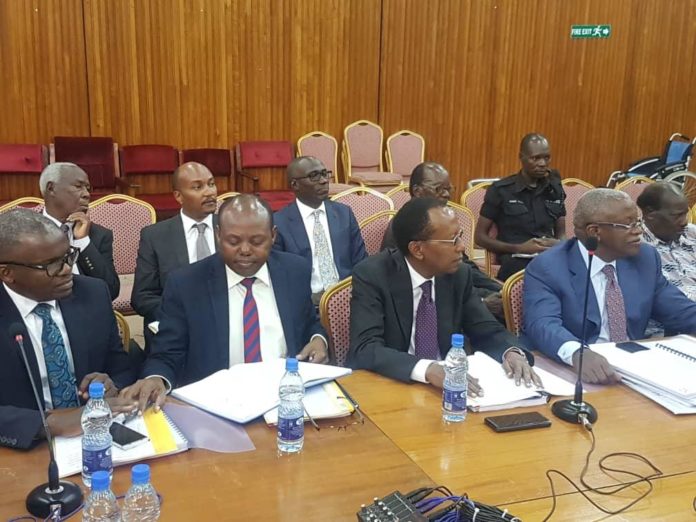
Former owners NBC demand Shs295b compensation for illegal closure

Former shareholders of National Bank of Commerce.

The former owners of National Bank of Commerce (NBC) on Monday told parliament’s Committee on Commissions, Statutory Authorities and State Enterprises (COSASE) that the Bank of Uganda (BoU) closed their bank illegally and as such demanded that they be paid compensation of
Shs295 billion for loss of business.

The former shareholders who included former Prime Minister Amama Mbabazi were meeting MPs at parliament to give their side of the story. BoU senior officers said last year they closed NBC due to undercapitalization, even though on Thursday former owners told MPs they were in the process to comply with the capital requirement when BoU officials led by Deputy Governor Dr Louise Kasekende, former Executive Director of supervision, Justine Bagyenda and Ben Sekabira,
a senior banking officer then decided to sell the bank to Crane Bank Limited (CBL).

NBC had capacity to meet the necessary capital requirements but was closed, said Matthew Rukikaire, who was presenting defence on behalf of other NBC shareholders. He said NBC was the only bank owned by indigenous people and for that, he said BoU should have taken caution
before closing it.

Rukikaire said BoU failed to play its role of supervision as it should have done. He said BoU even failed to appoint an auditor to take the inventory of NBC assets and liabilities. He also said BoU on failed to make a forensic audit on NBC.

He also wondered why BoU did not present a liquidator’s report even as they had appointed one to supervise the bank after the takeover. He said BoU closed NBC when its assets where more than customers deposits. They said at the closure of the bank, they had invested
US $1.7 billion and US $1.2 billion on the transformation of the headquarters and investment in new technology.

The shareholders in their presentation said that at the closure of NBC, it was making profits and paid dividends and that it had plans to open four more branches in Kampala and other towns in the country.
“BoU did not consider the investments above before closing the bank,” Rukikaire said, continuing that they had also raised some seven billion shillings for investment in treasury bills.

“Ms Justine Bagyenda directed that Shs7 billion be invested in treasury bills, not banking business. Which affected NBC, he said. He said Bagyenda and Sekabira were determined to take NBC out of business. NBC’s land worth Shs400 million was transferred to CBL at
Shs300 million.

NBC was closed on September 27, 2012 due to undercaprtahzation among other reasons. BoU took over the management of NBC in line with section 88(1) (a) and (b) of the Financial Institutions Act 2004 and subsequently placed NBC under liquidation pursuant to section 89 (2) (D & section 99 (1) of the Act. In line with section 95(b) of the Financial Institutions Act 2004, BoU arranged for the Purchase of Assets and Assumption of Labilities of NBC.

NBC was one the seven commercial banks closed by BoU between 1993 and October 2016. The others were Teefe Trust Bank, Greenland Bank, International Credit Bank, Global Trust Bank Uganda, Cooperative Bank and CBL.

Stories Continues after ad

MP who encouraged men to beat their wives, weds

Kakumiro County Member of Parliament who recently encouraged men to beat their wives as a form of punishment, is off the hook after wedding Ms. Kyarikunda Florence.

The wedding took place at Damasiko Parish Church of Uganda in Kyekado village, Kakumiro district superintended by the arch Archbishop of Church Uganda the Rt Rev. Stanley Ntagali. The function was graced by the Speaker of Parliament Rebecca Kadaga, State Minister of Finance David Bahati who was also the best man, Robina Nabbanja, Mwine Mpaka among other legislators.

In March last year, MP Onesmus Twinamasiko who has vowed to live with Florence, protect her said slapping women should be used as a form of punishment within a marriage. “You need to, you know, touch her a bit and you tackle her and you beat her somehow to really, you know, streamline her, he said at parliament.

Mr. Twinamasiko came few days after President Yoweri Museveni had condemned domestic violence as after the country joined the rest of the world to mark International Women’s Day.

He said the president actually, “I think, erred somehow,” Twinamasiko, who oversees Kakumiro County told the press at parliament.

His statement however drew criticisms from women activists, legislators, and civil society organisations calling (CSO) him to resign his position a member of parliament and apologize to all women in the Country.

The MP however, apologized saying, for the avoidance of doubt, may I at the onset affirm my highest respect for the dignity of women and my under wavering in the inviolability of women I actually detest all forms of violence against women.

“Kindly accept my sincere and unreserved apologies honorable members and the general public, particularly women. This apology is unconditional, I celebrate women who are the pillars of our society and the custodian of our national our national cohesion and together.” he said during the plenary.

Stories Continues after ad

UPL: KCCA FC host Onduparaka in match day 17

Allan Okello scores in the first round aganist Onduparaka

KCCA FC will host Onduparaka this Tuesday in a fixture that has always proved to be one of the best in the league but undoubtedly one of the difficult ones for the Caterpillars as they have never picked points in.

The away performance over the weekend, collecting their first point against Bright Stars at the dreaded Champions Stadium, Mwerere is something that will keenly be looked at against KCCA this Tuesday as they hope to break the Lugogo jinx.

The caterpillars find themselves 12 Points behind the league leaders KCCA and 2 behind the top four in 6th Position. A win against KCCA will reduce the point gap to 9 and push Onduparaka back to the top four as they fight hard to displace the other teams that will lay ahead of them.

KCCA hasn’t won in their last 3 games while Onduparaka has won once in the same number of games in all competitions. Both sides come into this league fixture wounded and expecting to better these recent performances.

Both teams will be without their first team coaches. KCCA’s Mike Mutebi will not be on the touchline as he continues to serve his ban while Onduparaka will rely on the services of Simeon Masaba.

Express hosts Police today at Mutesa II stadium, Wankulukuku with both sides seeking to return to winning ways.

The two teams lost their last league outing with Express falling 1-0 away to Toro United while Police were stunned by Nyamityobora with a 4-1 home defeat.

The Red Eagles will miss the services of striker Eric Kambale who is out injured and in his absence, both Brian Umony and Tony Odur could all start upfront.

Police’s Juma Balinya with 9 goals so far this season will be the main for Abdallah Mubiru side. Last season, the Cops won this fixture 1-0 courtesy of Hood Kaweesa header.

Elsewhere, on Tuesday, Maroons will host Mbarara City FC in Luzira, Tooro United will travel to Jinja to take on Kirinya Jinja SSS while Nyamityobora will host title challengers Vipers SC at Kakyeka stadium in Mbarara.

Relegation-threatened Paidha Black Angels will be at the Green Light stadium hosting BUL, Ndejje University will host the tax collectors at Arena of Visions in Bombo.

SC Villa will take on Bright Stars FC at Mandela National Stadium, Namboole on Wednesday.

KCCA still lead the table with 37 points from 16 games played so far, 3 ahead of second-placed Vipers. Nyamityobora, Ndejje University and Paidha Black Angels are in the relegation zone with 12, 10 and 8 points respectively.

There will be three live games in this round of the Uganda Premier League.

The league is expected to end on May 4th, 2019 to give ample time for the Uganda Cranes to prepare for the 2019 Africa Cup of Nations in Egypt.

Matchday 17 fixtures:

Monday 4th February

Express Fc Vs Police Fc – Muteesa Ii Stadium, Wankulukuku – Live

Tuesday 5th February

KCCA FC Vs Onduparaka FC – Startimes Stadium, Lugogo – Live

Maroons FC Vs Mbarara City FC – Luzira Prisons Grounds

Kirinya Jinja Sss FC Vs Tooro United FC – The Mighty Arena, Jinja Sss

Nyamityobora FC Vs Vipers SC – Kakyeka Stadium, Mbarara

Paidha Black Angels SC Vs Bul FC – Green Light Stadium, Arua

Ndejje University FC Vs Ura FC – Arena Of Visions, Ndejje University, Bombo

Wednesday 6th February

SC Villa Vs Bright Stars FC – Mandela National Stadium, Namboole – Live

Stories Continues after ad