Stanbic Bank
Stanbic Bank
23.9 C
Kampala
Stanbic Bank
Stanbic Bank
Home Blog Page 1425

African women must redesign the table, and not just expect to be at the table, says Graça Machel

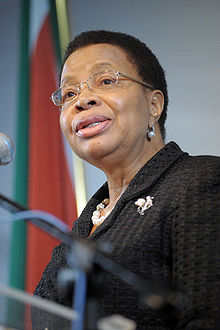
Graca Machel

Dame Graça Machel, one of Africa’s foremost advocates for the rights of women and children, has called on African women and policy makers to challenge gender inequality and inadequate female representation in the continent’s business and economic, political and policy space.

“Africa’s socio-economic transformation will only be realized once we aggressively address gender-specific challenges, prioritize gender equality and women’s participation, and firmly entrench women in leadership positions at all levels in society,” Madam Machel remarked.

“African women need to be in the driving seat of national discourse…women need to be at the centre of our economies,” Machel said. “They must also pro-actively seek to correct the status quo.”

Graça Machel spoke during the 22nd Eminent Speakers’ Lecture of the African Development Institute held at the Babacar N’diaye Auditorium in Abidjan, Cote d’Ivoire. Her address was titled: “Educating the Girl Child, Empowering Women, and Enhancing Female Entrepreneurship in Africa”.

“We have a remainder of 45 years to achieve the goals which we have set out for ourselves in Agenda 2063. Within these 45 years is a lifespan of an entire generation of young girls who will grow to become active citizens whose potential must be unlocked. To ensure that we achieve the goals for our development by 2063 we need to fully invest in and optimize of the continent’s other half which for too long has been neglected: the African female!” Machel said to a packed hall filled with development experts, Abidjan-based diplomats, members of the Southern African community in Cote d’Ivoire, students from Ivorian secondary and tertiary institutions, the media, management and staff of the African Development Bank.

The former freedom fighter who was also Mozambique’s first Education and Culture Minister, following the country’s independence in 1975, also called for increased investments in education, especially girl child education, agriculture and nutrition.

She remarked that, “Investing in education from early childhood has a lasting effect on the survival, development, protection and active participation of children in social, economic and political activities. Knowing what we know, we must demand that governments fully meet their commitments to the investment in education.”

Education transforms the lives of individuals, communities and nations and is a prerequisite for sustainable development, Machel said, emphasizing that, “Education, particularly for girls, is a catalyst for reducing child and maternal deaths and lifting people out of poverty.”

She observed that Africa as a whole has no meaningful development of an Early Child Development (ECD) system and that World Bank estimates paint a dire situation for investments in ECD in Sub Saharan Africa. “Nations in the region devote just 2 percent of education budgets to pre-primary education and early childhood development programs. This small percentage is committed in the face of overwhelming evidence that an additional dollar invested in quality early childhood programs yields a return of between $6 dollars and $17 dollars,” she said.

National spending commitments in education and Early Child Development systems in Africa vary widely, with Zambia and Central African Republic allocating just 1 percent of their GDP to education, according to Save the Children International and The Africa Policy Forum. And average spending across Africa has almost stagnated at around 4 percent of GDP over the past two decades or more.

There is therefore an urgent need for a joint coalition of the private and public sectors collaborating with civil society organisations to design and develop programs that address this scenario, Machel said, even as she sought for increased oversight of investment in human capital from Africa’s foremost development finance institution.

“While the African Development Bank is doing a good job leveraging its might, it still needs to exert pressure on governments and private sector partners to encourage investment in nutrition and ECD, as well as allocate its own resources to help build these building blocks of Africa’s human capital. What good is your power and influence as the AfDB if you are not leveraging your ability to truly impact change on the continent at the most fundamental of levels?”

Graça Machel is Chair of the Graça Machel Trust. Founded in 2010, the Trust advocates for women’s economic and financial empowerment, food security and nutrition, education for all, as well as good governance. She is the widow of the former South African President Nelson Mandela and former Mozambican President Samora Machel.

Stories Continues after ad

Mutebile,Kasekende have turned BoU into ruin -Salam Musumba

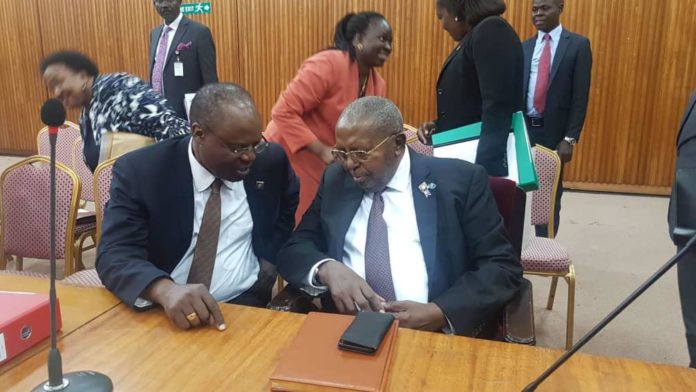
Hot seats, Kasekende consults Mutebile in the COSASE committee.

The Forum Democratic Change (FDC) diehard and former Kamuli district chairperson Salaamu Musumba has come out to castigate the Bank of Uganda (BoU) top officials, saying they have turned the central bank into a ruin due to corruption reports coming out of the country’s financial industry regulator.
Musumba who was on one of the local media channels in the country discussing the ongoing probe into BoU’s liquidation and sale of seven commercial banks blamed the Bank’s Governor Emmanuel Tumusiime-Mutebile and his deputy Dr. Louis Mutebile for the alleged financial scandals at BoU, saying that the public has no excuses to defend them.

“It is too scandalous that a central bank managed by the most celebrated economists have turned the whole thing into ruin and they have left us no excuse whatsoever to defend them. None whatsoever. You cannot sit on such dirt in air conditioned office,” she said.
She likened the officials to robbers who have stolen assets and have no time to sleep because they have to look for ways of hiding them from the public eye. “They are like robbers moving…moving lots of assets from…this. When do they ever sleep?” She asked.
She added: “I am so ashamed of the guys I am talking about. I don’t even feel comfortable speaking about them,” she said of the officials.

She said she said it was painful Tumusiime-Mutebile and Kasekende had performed as expected. “Our Governor Mutebile should have given us the best of what he has but he is going to walk out of this probe shielded to his pants. It is too painful for me,” she said.

Musumba said Kasekende is a prominent Roman Catholic who shouldn’t have involved himself in corruption. “Our own Kasekende, a celebrated Catholic…You should go to the Catholic Church when they mention Kasekende. It is like St. Somebody has returned. To be undressed like this, is sacrilegious to say the least,” she said.

Click to listen to the audio

Musumba said the country was going through hard times due to corruption. “You know I just can’t find the right English words to describe what this country is going through. The trauma of breach of trust; when you are Presiding of an empty space, a den of thieves, syndicate crime, you have ruined people’s lives, When crooks are seated in air conditioned offices, eating up people’s wealth, people’s opportunities, ruining their families. This should be allowed. Nobody has a right to ruin others this way,” she said.

But why is Musumba so bitter?
A new document reveals that Kasekende has not declared all the wealth that he owns as required by the Leadership Code whose aim is to stop public officials from embezzling public funds.
The document reveals that Dr Kasekende has eight undeclared plots of land worth billions of shillings in Buloba and Lower Naguru.

The plots Kasekende has never declared are; Plot 38 (0.157 hectares) in Lower Naguru on East road worth Shs1.280 billion, Plot 1423 on block 314 in Buloba worth Shs432 million.
Others whose value is not quoted are; Plot 1738 (0.809 hectares), Plot 3213 (0.079 hectares), plot 1427 (3.647 hectares), plot 184 (2.7 hectares), plot 1754 (1.624 hectares) and plot 6102 (0.317 hectares). The plots are all found on block 314 in Buloba.

Meanwhile Kasekende was able to declare fiver properties. They include; Plot 2A (0.142 Hectares) in Makindu worth Shs3.6 billion, Plot 2 (0.22 Hectares) on Bukoto Rise worth Shs2.7 billion, Block 314, plot 706, Plot 1475 Lubowa Estate work Shs3.6 billion and Plot 12 on Corporation Road Ntinda.

The Inspector General of Government (IGG) Irene Mulyagonja has announced that her office is the process of verifying Kasekende’s properties worth billions of shillings. The same office is investigating the former BoU director of supervision Ms Justine Bagyenda for allegedly accumulating wealth worth billions of shillings.

Stories Continues after ad

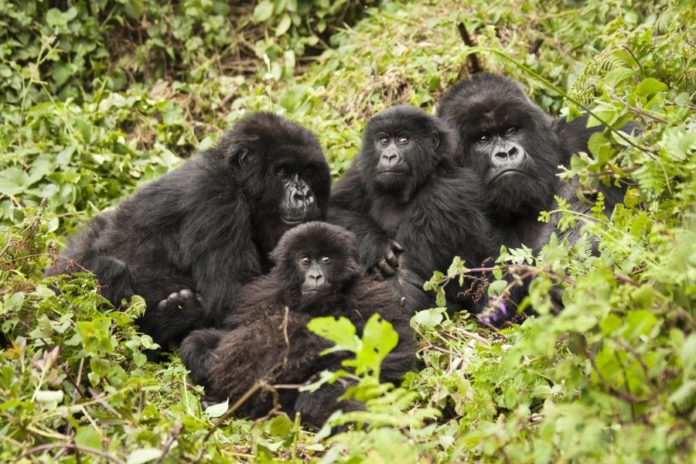
Uganda, neighbours see major growth in mountain gorilla numbers

Gorillas

Mountain gorilla population in Uganda and neighbouring Rwanda and DR Congo had achieved a significant growth as an indication of positive to efforts by conservationists to save them from total extinction, the International Union for Conservation of Nature (IUCN) has said.

Only found in Africa and listed in “Red List” of threatened species, the mountain gorilla population had grown from 680 individuals in 2008 to over 1,000 individuals, the highest figure ever recorded for the subspecies of the Eastern Gorilla, IUCN said in its latest report.

The mountain gorilla’s habitat is restricted to protected areas covering nearly 800 square kilometres in two locations made up of the Virunga Massif and Bwindi-Sarambwe, stretching across the DR Congo, Rwanda and Uganda.

The gorillas still face significant threats, including poaching amid recurring civil unrest and diseases.

“Today’s update to the IUCN Red List illustrates the power of conservation action,” Inger Andersen, IUCN Director General, said in a statement.

“These conservation successes are proof that the ambitious, collaborative efforts of governments, business and civil society could turn back the tide of species loss,” Inger said.

The updated Red List is meanwhile far from a rosy read, includes 96,951 species of animals and plants, of which 26,840 are threatened with extinction.

“Even though the rise of the mountain gorilla population is fantastic news, the species is still in danger and conservation efforts must go on,” Liz Williamson, primate specialist for IUCN said.

The IUCN classifies species according to how much under threat they are, and numbers for most high-profile ones are falling.

The fabled ‘silverback’ gorillas found roaming inside the forest-cloaked volcanoes of the Western Rift Valley where Rwanda, Congo and Uganda meet, have attracted thousands of tourists who pay hundreds of dollars to see them.

Stories Continues after ad

BoU top official moots plans to sell properties, send his family abroad in bid to evade probe

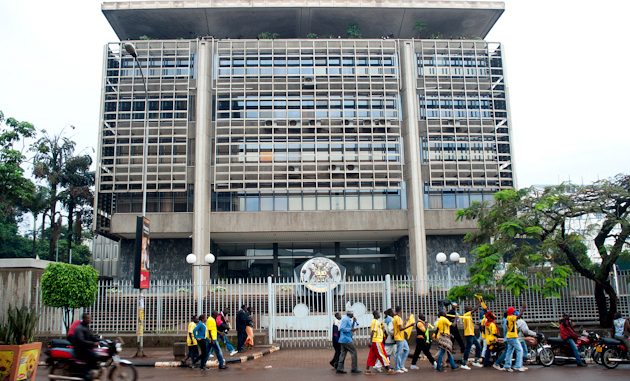
Bank of Uganda

Reports coming in indicate that a top Bank of Uganda (BoU) official who owns properties worth tens of billions of Ugandan Shillings is mooting plans to sell off some of the properties in Kampala and Wakiso districts and keep the proceeds in a foreign Bank.

The official whose name appears prominently especially in the controversial sale of National Bank of Commerce (NBC), Global Trust Bank (GTB) and Crane Bank Limited (CBL), is as well said to be mooting a plan to send his sons to Ghana where his young brother works in certain bank. Recent Leaked bank documents show one of his sons transacting huge amounts of money. It is said the son runs the account on behalf of the father, same to his wife.

The official, together with his colleague who has since retired form BoU, are said to have arranged for the purchase of assets and assumption of all or some of the liabilities of some of the banks and are said to have benefited financially from this arrangement. The colleague who retired unceremoniously is also very rich, with recent leaked documents showing she has stashed billions of shillings on her bank accounts but also multi-billion shillings properties around Kampala. She is under investigation as well.

Inside sources in BoU say the Governor, Prof. Emmanuel Tumusiime-Mutebile, is not happy that the official who tried to stop the Auditor General Mr. John Muwanga from investigating the institution over the defunct banks, kept hid vital information from him. Actually sources in the central bank say Tumusiime-Mutebile is happy that Parliament’s Commissions, Statutory Authorities and State Enterprises (Cosase) is digging into the matter though they say he is scared of the court process given that there are pending cases in court related to the matter.

Some time back when asked in the media on which BoU top official was responsible for the mess in the sale of CBL and generally the banking industry, indirectly pointed a finger to the official in question and his female colleague, now a retiree. Mutebile is of the view that the mistakes and greed of a few officials should make the rest of BoU top employees culpable.

The said official tried so much to stop the Auditor General well knowing that the investigation would pin him and not his boss Mutebile and indeed Mr. Muwanga questioned him especially as regards the sale of NBC, GTB and CBL.

Inside sources say the BoU official has sought the help of the top Roman Catholic Church hierarchy but the latter have ignored him, arguing that he should carry his own cross. Sources say the official’s efforts to reach the powers that be in this country have also been futile as the state is interested in finding out how the official who joined BoU in 2010 got his amazing wealth.

Despite complaints about his wealth, the official says he acquired some of it through research projects he has been able to do and the employment he had at a continental bank. Apart from the IGG, it is said the Internal Security Organisation (ISO) is following up the wealth of the official.

The IGG has started the process to verify the properties of the official as Cosase also prepares to quiz him on the controversial sale of some of defunct banks.

Stories Continues after ad

Safeguarding adolescents when using HCD in family planning

Teenage Girls

By Sophie Edwards

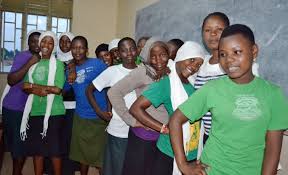
Human-centered design (HCD) has the potential to transform family planning for young people, but it comes with unique risks and challenges which mean the rights and well-being of adolescents and health workers involved need to be protected, advocates have said.

While reaching adolescents with family planning is now a priority despite political challenges in many countries, there is still a long way to go when it comes to understanding and meeting the contraceptive needs of young women aged 15-19, experts said.

According to latest data, 20 million young women in low-income countries who would like to avoid or delay becoming pregnant still do not have access to modern contraceptive methods. At the same time, complications linked to pregnancy and childbirth are the biggest killer among this age group and teenage mothers are also more likely to drop out of school — often perpetuating a cycle of poverty.

In response, some organizations, such as Population Services International and Marie Stopes International, are using HCD processes to find new ways of making birth control products and services more accessible and appealing to teenagers. This has been supported by the Bill & Melinda Gates Foundation, William and Flora Hewlett Foundation, and Children’s Investment Fund Foundation.

HCD was pioneered in 1991 by American design and innovation firm IDEO which later launched IDEO.org to apply the approach to development problems. The approach puts the user perspectives at the center of the design process by working closely with service users to co-create, rapidly test, and then adapt different approaches so they are better tailored to meet users’ needs.

However, some aspects of what makes this approach unique can also mean it brings additional risks not seen when using traditional research and design methodologies, Jessa Blades, managing director of IDEO.org’s Health program, told Devex.

“HCD in this context is about leading with conversations with girls, playing games … trying to spark a different kind of conversation … but we’re not necessarily following a script or a survey … and we are also prototyping to make ideas tangible early on and putting them out in front of people to react to and build on,” Blades said. “But because it’s a newer approach for partners, we need new co-accountability around ethics.”

To address the risks, a group of organizations launched a “commitment to action on ethics in youth-powered program design” Wednesday, during the International Conference on Family Planning held in Rwanda this week. The commitment calls on actors to adhere to 20 principles when applying HCD approaches to adolescent-focused family planning programs. Initial signatories include PSI, MSI, Family Planning 2020, Pathfinder International, Restless Development, IDEO.org, Y-Labs, AVAC, and Dalberg Design.

On the sidelines of the conference, Devex spoke with some of the groups behind the commitment to find out more about the potential and risks of using HCD to improve family planning for young people.

‘An eye-opening moment’

PSI has been applying the HCD process in some of its family planning work for the past five years. It likes the approach so much that it has developed its own spin-off, known as EIP, which stands for empathy, insight, and prototyping, Karl Hofmann, CEO of PSI told Devex.

“We’ve come to see HCD as this fantastic new tool which we can use in our social marketing toolkit to … really unpack the motivations and behaviors and the reality our consumers face,” Hofmann said.

But what really convinced the NGO was the impact HCD had on PSI’s flagship “Adolescents360” program, which aims to increase voluntary, modern contraceptive use and reduce unintended pregnancy among adolescent girls in Ethiopia, Nigeria, and Tanzania. Using HCD and other research methods, the NGO learned that it had been sending girls the wrong message about their fertility and that was preventing many from taking up contraceptive methods, Hofmann explained.

Keeping girls and health workers safe

Talking about the potential risks, Blades said HCD’s participatory approach to prototyping, if not handled carefully, can create problems for potential users of the family planning product or service, and also for the health workers delivering it.

She recounted a past instance when IDEO.org ran an information session with the local community health worker to tell girls about contraception. After the session, some of the girls said they wanted to start using birth control, upsetting their parents who became angry and confronted the health worker, she said.

“When we’re going out in the community and prototyping … we are trying to make it feel real as we want to observe actual behaviors rather than what people say … but in doing so, if we haven’t done proper community sensitization … then it’s a risk … [and] we’ve had an angry mother take her daughter back to the [health] provider,” she said.

Another risk is around “expectation setting,” Blades said, especially in the later phases of HCD when girls could be involved in testing.

“We could be testing a product or service that feels real to the group, but it’s actually still just part of the design process and so there’s no guarantee it will come to fruition … We have to be careful we are not getting young people’s hopes up,” Blades said.

The 20 principles outlined in the commitment to action are intended to help address these risks, and others. The principles call on HCD actors to show respect for the young people they are working with, treat them as equal partners in program design and delivery, and safeguard their well-being while carrying out HCD activities.

Specific commitments include creating safe and private spaces for young people taking part in HCD activities to express themselves freely, a promise that participants are “recognized and appropriately compensated for their time and work,” and that they are fully informed about what they are being asked to do, and that they can stop at any time.

“Young people have a critical role to play in every aspect of developing solutions for family planning, from designing and implementing programs to engaging in advocacy with local decision-makers,” said Nomi Fuchs-Montgomery, deputy director of family planning at the Gates Foundation.

“However, we must ensure that young people understand their rights to make their own decisions about their participation.”

Stories Continues after ad

Competition hits up as MTN joins Airtel to offer OTT data packs

mtn

The competition to keep clients has made MTN Uganda to join its rival Airtel Uganda in offering Over the Top Tax (OTT) package for its customers, underlying the efforts by service providers to make it easy for their customers to pay the tax.

The packages combine payment for data and OTT tax.

In a statement, MTN indicates that the OTT packages can be paid daily (24 hours), quarterly (4 months) and annually.

For 50MBs, one will need to pay 750 shillings, 125MB goes for Shs1, 500, 400MBs Shs3, 000 and 5,000 shillings for 1GB.

For quarterly payments, one needs to pay Shs18, 000 and Shs72, 000 for one year. Customers will dial *165*75# to access the packages.

The packages are slightly more expensive than those of Airtel Uganda. For example, at Airtel Uganda, a daily 15MB will be purchased at Shs450 and it will include Shs250 for the 15MB plus Shs200 for the daily OTT – both valid for 24hours.

The initiative by the telephone companies comes as Uganda Revenue Authority (URA) struggles to meet its targeted revenue from OTT tax since it took effect on July 1.

In the first quarter of the financial year, URA has only managed to collect Shs20 billion out of the targeted Shs24 billion.

Many Ugandans have since resorted to using VPNs as they continue to dodge the tax they say it is unfair especially to the poor.

Stories Continues after ad

UNBS closes Mbogo Quality Cuts over poor hygiene standards

The Uganda National Bureau of Standards (UNBS) has closed down the production facility belonging to Mbogo Quality Cuts Limited located in Bulenga, the processors of Alpha Special brand of sausages, due to poor hygienic conditions contrary to the Standard for good manufacturing and hygienic practices.

The closure follows a consumer complaint to UNBS that the conditions under which meet was being processed did not meet standards for good hygiene standards.

The UNBS Surveillance team inspected the premises and established that the hygienic condition at the production facility were contrary to the specifications of Code of practice for Hygiene in Food and Drink Manufacturing Industry (US 28 EAS 39: 2002) and specifications for beef sausages (US 739:2012)

The UNBS Inspection report reveals that the general hygiene of the production facility was very poor with moulds on the walls, rotten meat which was turning green was kept inside non-functioning deep freezers and fridges.

There were traces of meat all over the floor, poor drainage system with no water, dirty drums and buckets which were stained were among the production equipment used. As a result, the appalling unhygienic conditions attracted flies all over the production area and outside the factory.

UNBS inspectors did not find records of medical examination reports of workers for their fitness to handle food as per the requirements of the standard. The Team did not find evidence of a hand washing facility and foot bath to the entrance of the production area. The production facility was not demarcated into different sections to avoid cross contamination.

The company did not have records of quality monitoring undertaken during the production process and it did not have test reports from UNBS and other accredited external laboratories. There were no cleaning records for the factory and production equipment.

The general structure setup and ventilation of the factory was very poor in addition to filthy and smelly toilets. All the findings were contrary to the requirements of the standards and thus the factory was closed.

Stories Continues after ad

IGG starts auditing Kasekende’s wealth

Dr. Lious Kasekende

The Inspector General of Government (IGG) Irene Mulyagonja has started the process of verifying the assets, income and liabilities of the Bank of Uganda (BoU) deputy governor, Dr Louis Kasekende.

On October 18, 2018, the IGG wrote to Kasekende informing him of the decision to verify his assets, which she said was according to the Leadership Code Act, 2002.

“Mr. Victor Acidri, a Senior Principal Inspectorate Officer and Ms. Doreen Tusiime, an Inspectorate officer, have been authorized to conduct the verification exercise and obtain information in respect of this matter,” read part of the letter.

The IGG asked Kasekende to cooperate with the officers as they seek to establish the truth. Kasekende and other top officials at BoU are currently in the spotlight as parliament’s Commissions, Statutory Authorities and State Enterprises (Cosase) quizzing them over the controversial liquidation and sale of seven commercial banks. Some of the officials are alleged to have benefited from the deals.

However, early this month, Eagle Online ran an article showing that Kasekende possesses properties which have a market value of close to Shs21 billion.

The properties, which include building and free land are mostly located in Kampala and Wakiso districts. The two districts have the highest prices for fixed properties such as land and buildings due to high demand caused by the many social and economic activities that take place within the two districts.
The documents are set of evidence, a whistle blower is said to have given the Inspectorate of Government.

According to the leaked document, Kasekende’s properties, 20 in number, range from medium to high class residential establishments enjoying the special amenities that come with their strategic location within the proximity of the city centre.

The document shows that Kasekende owns plots of land in Lukuli Makindye (2), Makandwa, Sentema and Bira (2), each measuring below an acre.

On the other hand the document shows that Kasekende has 14 plots of land developed with residential premises, ranging from 0.168 acres to 3.68 acres. Some of the developed plots are situated in areas of Kiwatule, Munyonyo, Kisugu, Kulambiro, Lower Naguru, Najjera and Lubowa Estate.

Another leaked document revealed Kasekende has not declared all the wealth that he owns as required by the Leadership Code Act whose aim is to stop public officials from embezzling public funds.

The document reveals that Dr Kasekende has eight undeclared plots of land worth billions of shillings in Buloba and Lower Naguru. The plots Kasekende has never declared are; Plot 38 (0.157 hectares) in Lower Naguru on East road worth Shs1.280 billion, Plot 1423 on block 314 in Buloba worth Shs432 million.

Others whose value is not quoted are; Plot 1738 (0.809 hectares), Plot 3213 (0.079 hectares), plot 1427 (3.647 hectares), plot 184 (2.7 hectares), plot 1754 (1.624 hectares) and plot 6102 (0.317 hectares). The plots are all found on block 314 in Buloba.

Meanwhile Kasekende was able to declare fiver properties. They include; Plot 2A (0.142 Hectares) in Makindu worth Shs3.6 billion, Plot 2 (0.22 Hectares) on Bukoto Rise worth Shs2.7 billion, Block 314, plot 706, Plot 1475 Lubowa Estate work Shs3.6 billion and Plot 12 on Corporation Road Ntinda.

Stories Continues after ad

Enquiry into defunct Teefe Trust Bank: Mutebile, juniors fail to match Cosase in two days

Thursday and Friday were really the first two days that parliament’s Committee on Commissions, Statutory Authorities and State Enterprises (Cosase) faced off with the Bank of Uganda (BoU) Board of Directors as the legislators launched the actual enquiry into seven defunct banks, starting yesterday with Teefe Trust Bank whose date of closure seemed unclear as two dates were presented.

But first, not all members of the BoU board appeared and the Governor Prof. Emmanuel Tumusiime-Mutebile (Chairman of the board) had to apologise. “I bring apologies from the Board Members, who have not been able to join us today due to other engagements,” he said. One of the key who missed is Dr Louis Kasekende, the deputy governor and Vice Chairman of the board who was questioned by the Auditor General as he investigated BoU.

The team of BoU board members also showed signs of unpreparedness. Some members present yesterday had a conflict of interest and therefore Committee Chairman Abdu Katuntu had to politely ask them to leave. These were Dr. William Samson Kalema and former Auditor General (AG) James Kahooza who have served on its board. Kalema served on the boards of The Cooperative Bank and Dfcu Bank yet at the same time served on BoU board. One wonders why Tumusiime-Mutebile’s team undercooked this scenario. Kahooza surprised MPs when he said his role was to audit BoU of which he was once a board member.

The exit of Dr Kalema and Kahooza who were expected to answer some tricky questions was a big blow to the BoU team. That meant that the Governor Tumusiime-Mutebile and the Executive Director, Supervision, Dr.Tumubweine Twinemanzi were almost the only one left to respond to the issues raised by the Auditor General’s report.

Matters were made worse when directors of the BoU’s legal department failed to ascertain the date on which Teefe Trust Bank was closed. One of the officers would push the question to Mutebile and Dr Twinemanzi when as asked to give her legal opinion on the exact date was the bank closed. In fact the BoU legal team seems to be aloof BoU closure of banks. This was reflected as one of the legal officers, a lady said she had been ambushed with the question on the legal status of the 23 land titles of Teefe Trust Bank clients. Yesterday MP Odonga Otto called for her arrest, only that Katuntu, being the Chairperson of the committee, is holding BoU guys with a soft hand.

Mutebile insists that the resolution of banks is a complex exercise and that each bank being resolved has its own unique circumstances. “There are a number of challenges encountered during resolution. One of the main challenges is litigations by the different stakeholders. There have been several court cases against banks under resolution spanning many years,” he said Friday morning. In their submissions, the BoU staff seem to suggest there were no cases of corruption or unfairness in the closure of the banks yet the Auditor General John Muwanga says certain guidelines were not followed which caused the intervention of parliament through Cosase.

The governor appreciates the MP’s interest in resolution of defunct banks but then said: “Our hands are tied and Bank of Uganda has to operate within the law.” Yet Kasekende at first thought the bank was above the law that it could not be investigated by any other government agency. Now his boss concedes the institution is a law-abiding entity.

Like his deputy Kasekende, Tumusiime-Mutebile, if fearful of the subjudice rule, which the Mps said the investigation won’t conflict with. “Our appeal to the Committee is that as you engage us, be mindful of the ongoing court cases, which have implications on how much information we can divulge on the affected banks.” From the governors’ plea, it appears BoU will continue to hide the information that Cosase needs especially that his deputy Kasekende was against the inquiry. That means the MPs will keep on sending back BoU staff to bring more documents.

Stories Continues after ad

UPL confirms six league fixture changes

The Uganda Premier League has confirmed adjustments in the league fixtures due to involvement of the players on national duty for both the Uganda Cranes and the Kobs.

Uganda Cranes will be playing an International Friendly match against Nigeria on Tuesday 20th November 2018 and the U-23 National Team will be playing the AFCON Qualifiers return leg match on Tuesday 20th November 2018 in South Sudan.

In accordance with article 19 (26) of FUFA Competitions Rules (If a club has three (3) or more players in the national team, the fixtures involving such a club may be called off three (3) days before and three (3) days after the national team engagement if it is to be played in Uganda and may be called off three (3) days before departure and three (3) days after return from an engagement outside Uganda).

Accordingly, the fixtures for all Clubs that have three or more players on national duty have been rescheduled by UPL as indicated below;

– Match 57: URA FC Vs Police FC has been rescheduled to Saturday 24th November 2018, Mandela National Stadium-Namboole 4:00pm.

– Match 61: KCCA FC Vs Nyamityobora FC has been moved from Tuesday 20th November 2018 to Sunday 25th November 2018, StarTimes Stadium-Lugogo 4:00pm.

– Match 63: Vipers SC Vs Paidha Black Angles SC has been moved from Wednesday 21st November 2018 to Friday 23rd November 2018, St. Mary’s Stadium- Kitende 4:00pm.

In the similar development, CAF Champions League and Confederation Cup Fixtures were released on 9th November 2018 and they involve Vipers FC (27th-28th Nov & 4th-5th Dec 2018) and KCCA FC (14th-16th Dec 2018).

– Match 65: BUL FC Vs Vipers SC that was to be played on Friday 30th November 2018 has been postponed (A new date to be communicated later).

– Match 73: Vipers SC Vs Police FC has been moved from Wednesday 5th December 2018 to Sunday 9th December 2018.

– Match 96: KCCA FC Vs Paidha Black Angels SC that was to be played on Saturday 15th December 2018 has been postponed (A new date to be communicated later).

The league resumes on Tuesday, 20th November 2018.

Stories Continues after ad