Stanbic Bank
Stanbic Bank
20.1 C
Kampala
Stanbic Bank
Stanbic Bank
Home Blog Page 1428

LOP says Education Minister should resign

Leader of Opposition in Parliament, Betty Aol Ocan has asked Education Minister to resign.

The Leader of the Opposition, Betty Aol Ocan has called for the resignation of Education Minister Janet Museveni, and criticized government for failure to release reports into previous fires, making mention of the infamous 2008 Buddo fires.

Her statement followed Sunday night inferno that gutted S3 boy’s dormitory at St Bernard’s Secondary School in Manya, Rakai claiming lives of nine students.

“Colleagues, this is not the first time that this is happening. We all know we have not been able to receive investigation reports before,” she said.

“Ministry of Education, especially the Minister, is tempting us by saying we got the report of the investigations. She has to resign or be pushed to resign, the investigations report must come from 2008,” she said.

According to State Minister for Higher Education John Chrysostom Muyingo, government will meet burial expenses and foot the hospital bills of all victims of fire that gutted S3 boy’s dormitory.

“Government will do everything possible within its means to bring the perpetrators to justice, and we will also rebuild the school structures,” he said

He warned the perpetrators of their inevitable arrest, and pledged government support to the bereaved families and the injured.

Muyingo said a combination of security organs have commenced investigations, promising justice to the victims.

Speaker of Parliament, Rebecca Kadaga, has called for speedy investigations into the fire “We condole with the families of the children who perished in Manya, I hope the government will hasten efforts to find the perpetrators,” she said.

Kadaga said Parliament could not debate the matter because it would hinder the ongoing investigations. The school administration, according to the media reports, alleges that the students were expelled on various counts of indiscipline, and that they had vowed to ‘punish’ the school in return.

Stories Continues after ad

Business conditions in Uganda continue to improve, new Stanbic Bank index says

The headline Stanbic Bank Uganda Purchasing Managers’ Index (PMI) posted 56.6 in October, up from 54.2 in September and recording above the 50.0 no-change mark for the twenty-first successive month. The latest reading was above the average since the survey began in June 2016.

Four of the five monitored sectors saw business conditions improve during October, the exception being industry. New orders continued to expand at the start of the fourth quarter of 2018, extending the current sequence of growth which began in February 2017.

Panelists linked the latest rise to higher customer numbers and improving demand in the economy. Rising customer numbers also supported growth of output, which increased for the twenty-first month in succession. Each of the five monitored sectors saw activity rise.

Despite increases in new orders, backlogs of work continued to decrease. Panelists indicated that this was due to the expansion of workforce numbers. Employment has risen throughout the 29-month survey history so far.

Agriculture, construction and services all posted increases in staffing levels in the latest survey period.

Overall input prices rose again in October. Alongside higher purchase prices and staff costs, respondents also noted increases in prices for fuel, water and electricity.

The latest rise in purchase costs reflected higher prices for materials such as food, ink and stationery. The passing on of higher input prices to customers resulted in a further monthly increase in output charges. Selling prices rose in the industry, services and wholesale & retail sectors, but fell in agriculture and construction.

Ugandan companies raised their purchasing activity for the eighth successive month in October, linked to rising new orders. This contributed to another monthly increase in stocks of purchases. Meanwhile, the timely placement of orders helped suppliers to speed up their deliveries, in spite of the increase in demand for inputs.

The PMI is a composite index, calculated as a weighted average of five individual sub-components: New Orders (30 per cent), Output (25 per cent, Employment (20 per cent), Suppliers’ Delivery Times (15 per cent) and Stocks of Purchases (10 per cent). Readings above 50.0 signal an improvement in business conditions on the previous month, while readings below 50.0 show a deterioration.

Stories Continues after ad

Is BoU’s Kasekende trying to frustrate MPs as they demand for documents of defunct banks?

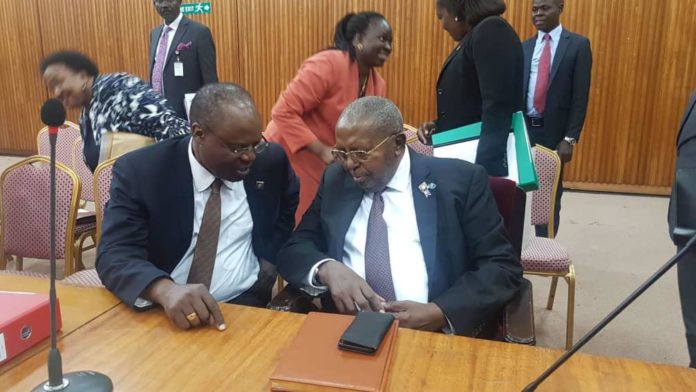
Hot seats, Kasekende consults Mutebile in the COSASE committee.

Investigations into Bank of Uganda’s (BoU) alleged irregularities in the closure of seven commercial banks have started with Parliament’s Committee on Commissions, Statutory Authorities and State Enterprises (Cosase) already finding it difficult to access all documents required to help them quiz BoU officials over irregular operations in the mysterious and controversial sale of the banks as established by a recent special audit report of BoU on defunct banks.

Auditor General John Muwanga’s special audit report established alleged corruption and suspicious activities at BoU, including unaccounted for money, missing land titles, disputed payments to external lawyers and customer loans that were inherited from closed banks and then sold at undervalued rates without justification, thereby misappropriating taxpayer’s money to the tune of Shs478 billion.

The committee has summoned various individuals including governor of BoU Emmanuel Tumusiime-Mutebile, his deputy Louis Kasekende and others including former BoU director in-charge of banks supervision Justine Bagyenda. Tumusiime-Mutebile and Kasekende appeared before the committee on Monday for the second time and were again sent back to bring all documents before MPs can begin questioning them.

For the two weeks that the committee has interfaced with BoU officials, they have had to send them back to collect all the documents used in the transactions of the banks, particularly those of Teefe Trust Bank, which BoU has failed to present on account that there law did not require them to have an inventory of the sold assets and liabilities, something that legislators on Cosase have brushed away.

It should be remembered that when Cosase on November 28, 2017 requested Mr. Muwanga to undertake a special audit on the closure of commercial banks, Kasekende worked so hard to frustrate the investigations to the extent that he approached the Solicitor General, Francis Atoke, who advised him not to cooperate with Mr. Muwanga and his team of auditors. It would take the intervention of the Speaker of Parliament, Rebecca Kadaga, for the auditors to begin investigating BoU senior staff. Kadaga argued that there is no any government institution that cannot be investigated.

However, Mr. Muwanga and his team, as cited in his report, found it difficult to get all the documents concerning the sale of the commercial banks. Dr.Kasekende and Ms Bagyenda, the two officials who spearheaded the sale of commercial banks, inside sources say, have intentionally hidden the documents to frustrate the MPs just as they frustrated the Auditor General.

The committee specifically requested the Auditor General to provide assurance on; the status of the banks at closure, cost of liquidation, status of assets and liabilities of the banks from closure to date, non-performing assets, non-recoverable assets and liquidators.

On Teefe Bank he said: “I was not availed with the inventory report, loan schedules, customer deposit schedules and statements of affairs of Teefe Trust Bank to enable me to fulfil the specific audit objectives. Due to this limitation, I could not assess the status of the assets and liabilities of Teefe Trust Bank from closure to date.”

Mr. Muwanga in his report would go on to say: “I noted that BoU did not carry out a requisite valuation of assets and liabilities of the three defunct banks (Global Trust Bank, National Bank of Commerce and Crane Bank Limited) resolved using the purchase and assumption arrangement at the time of signing the P&A. In absence of the valuation and or documented evaluation of alternatives and assumptions used, I could not establish how the terms for the transfer of assets and liabilities in the P&A were determined.”

Mr Muwanga’s dilemma as read above was caused by Kasekende who didn’t like anything to do with the investigation of BoU. In an April 19 letter to the Attorney General, he said the Auditor General had no authority to audit the Central Bank over its role in the closure of seven commercial banks, arguing that it would contradict the subjudice rule since the cases related to the collapse of CBL were before the High Court.

Dr Kasekende also believes the MPs have no powers to question him and BoU senior staff as regards the controversial sale of banks. He wants to derail the process so that the legislators lose interest or ignore certain issues related to the liquidation and sale of some of the banks. Buying time works well for him.
Sources further say Kasekende is dragging COSASE so that the lifespan of the current committee ends without a report and that would make it had for a new committee to commence investigation on BoU.

Insiders also say Kasekende is not happy that BoU’s new Executive Director of Supervision, Dr. Tumubweine Twinemanzi, who promised MPs last Monday that they would bring all required documents. It is on record that being new, Twinemanzi has little knowledge on the transactions that took place and had some owners of the banks ran to court for redress.

Unlike Tumusiime-Mutebile, Kasekende Bagyenda and Ben Sekabira are the key targets of the investigation as the two officials were the most involved in the sale of banks. Remember that Tumusiime Mutebile blamed the mess in the local banking industry on Bagyenda to the extent that he sacked her. Recent leaked documents show Kasekende and Bagyenda transacting billions of shillings on their money accounts as well as owning properties in Kampala and Wakiso worth billions of shillings.

Last year, Amos Nzeyi, one of the shareholders and former chairperson of NBC, dragged BoU to Commercial Court for allegedly wrongfully closing his bank (NBC) in 2012. The assets of the bank were later sold to Crane Bank that also collapsed last year after becoming ‘significantly undercapitalized’. Nzeyi alleges that NBC’s financial health had stabilised by the time BoU closed it and now wants court to hold BoU for alleged failure of supervising the banking sector.

Meera Investments has also dragged Dfcu Bank to the Land Division of the High Court, seeking to reclaim its 46 branches which it says were acquired illegally following the dissolution of Crane Bank. The closure of Crane Bank saw Dfcu bank become the third biggest bank after acquiring 46 branches from the financial institution.

Meera, in its law suit, claims that at the time BoU took over the management of then Crane Bank in October 2016 before its eventual sell to DFCU, it was the leaseholder of the suit properties and paying US$6,000 every beginning of the year.

Stories Continues after ad

African Development Bank launches Africa Energy Portal

Energy and Mineral Resources Minister Eng. Irene Muloni attended the launch.

“Building a Knowledge Base to De-Risk the Energy Sector in Africa,” brought together investors, policy makers and government officials for a presentation of the new initiative, the African Energy Portal (AEP) days ago in Johannesburg. The AEP portal, hosted at http://Africa-Energy-Portal.org , will consolidate, validate, and disseminate energy data and insights across Africa’s energy value chain, covering generation, transmission, distribution, regulation and policy.

The AEP is designed to address a lack of information in the sector, by providing a one-stop-shop for accurate, reliable, relevant, and up-to-date information on energy in Africa. This will include statistics on investment flows and deals, as well as the socio-economic outcomes of power projects.

“Many international and local stakeholders have experienced the data access and reliability challenges that hold back substantive participation in the numerous opportunities within Africa’s energy sector. The AEP is strategically positioned to resolve these challenges, by providing stakeholders with the requisite information to facilitate decision making, and fast track investments and initiatives that will revolutionise Africa’s energy sector,” said Amadou Hott, Vice President of Power, Energy, Climate Change and Green Growth at the African Development Bank.

In addition to being an information repository, the AEP will also provide an interactive platform for knowledge-sharing amongst Africa’s energy sector stakeholders and experts. It will serve as a virtual space for engagement, and progressive dialogue on pertinent issues affecting the development of the continent’s energy and power infrastructure.

Speaking during the launch, Wale Shonibare, Director of Energy Financial Solutions, Policy and Regulation at the African Development Bank lauded the AEP as a long-overdue, but necessary, step in “providing critical information for investment decisions, policy making, and regulatory action in Africa’s energy sector.”

Reinforcing the need for partnerships, Shonibare welcomed collaboration from external stakeholders. “We are aware that the portal’s success will depend on extensive collaboration, and we invite professionals, developers, investors, regulators, governments, financial institutions, statisticians, utility companies, think tanks, philanthropic institutions and other stakeholders to work with us in creating a robust and formidable platform for the continent,” he said.

Also attending the launch, Uganda’s Minister for Energy and Minerals Irene Muloni praised the initiative as one that would enable countries to make better, and informed policy decisions.

The AEP will leverage the bank’s energy sector and statistical expertise in order to consolidate and generate verified data and statistics on Africa’s energy sector. The bank also aims to collaborate with regional organisations, and in-country statistics agencies to develop data collection and validation procedures to improve the quality of publicly available information on the continent’s energy sector.

The Africa Investment Forum, hosted by the African Development Bank, is an unprecedented marketplace platform bringing together pension funds, sovereign wealth funds, capital markets, project sponsors, institutional and financial investors. The Forum is dedicated to advancing projects to bankable stages, raising capital, and accelerating the financial closure of deals. The inaugural edition took place from 7-9 November 2018.

The next Africa Investment Forum will take place in November 2019.

Stories Continues after ad

MPs to zero on Kasekende, Bagyenda and Ssekabira on collapsed banks

Dr. Lious Kasekende

Members of Parliament will on Thursday sit again to quiz top Bank of Uganda officials are regards the closure of commercial banks. However, according to a section of the legislators on the
Committee on Commissions, Statutory Authorities and State Enterprises (COSASE), want the grilling to be more focused on the supervision department and its former heads on how they came to arrive at the closure and sale of the banks when there was no inventory.

On November 2, 2018, Cosase kicked Tumusiime-Mutebile and his staff for failure to bring all the required documents. The MPs on the committee were surprised again on Monday that the bank officials did not again come with all the documents, more so those relating to Teefe Trust Bank.

Committee chairperson Abdu Katuntu yesterday tasked the newly recruited Executive Director for Supervision Dr. Tumubweine Twinomanzi to present the required documents by 1PM on Wednesday and ordered that the BoU team appears again on Thursday at 10 am without fail.

Rubaga North legislator Moses Kasibante told Eagle Online that failure by the BoU team on Monday meant that they have no document to show and therefore, those who were in charge of the supervision department be held responsible.

Embattled former Executive Director in charge of Supervision at Bank of Uganda Justine Bagyenda.

“We are talking about banks that were closed before they failed to adhere to the normal standards. Now we are speaking to people who are confessing that there is something wrong with supervision at BoU. When BoU explained to the AG at the time if this report, it promised to search in the archives. When we were here last time, it asked for two days and got four. Now it is confession that this bank has no reason why it closed Teefe. Was the inventory report misplaced or it was never there?”

And accordingly those to be held responsible are former Executive Directors in charge of supervision department, Justine Bagyenda and Dr. Louis Kasekende who first served in that position before being appointed Deputy Governor. Another person of interest to legislators is Ben Sekabira, director financial markets.

According to sources in the COSASE committee, legislators believe that with the necessary documents being deliberately left out, the three should take oath and narrate how the transactions where conducted. MPs believe the three have a case to answer in the matter of these banks.

Bank of Uganda has failed to provide the Auditor General (AG) details of the liquidation of Teefe Trust Bank in 1993 as it deemed the commercial bank insolvent at the time.
“I was not availed with the Inventory report, loan schedules, customer deposit schedules and Statements of affairs of Teefe Trust Bank to enable me to fulfill the specific audit objectives.

Due to this limitation, I could not assess the status of the assets and liabilities of Teefe Trust Bank from closure to date,” the AG John Muwanga says in his report he signed on August 27, 2018 and now lies before parliament for debate.

It should be remembered that in a letter ref A8:70/288101 dated November 28, 2017 the Parliamentary Committee on Commissions, Statutory Authorities and State Enterprises (COSASE); requested the AG to undertake a special audit on the closure of Teefe Trust Bank and six others commercial banks by BoU.

Kasekende tries to block investigations
On April 19, 2018, Kasekende wrote to the AG stating that an investigative audit into BoU would go against the sub-judice rule as the case between Crane Bank and BoU is court.

The Solicitor General, Atoke, on May 2, 2018 affirmed Kasekende’s letter, concurring with Kasekende that an investigation into the sale of Crane Bank would offend the subjudice rule and therefore told BoU not to cooperate with the AG or parliament.

In the letter dated May 10, 2018 and addressed to the Auditor General John F.S Muwanga, the Speaker of Parliament, Rebecca Kadaga urged that BoU had never produced any report concerning the sale of defunct banks such as Teefe Bank, Greenland Bank, International Credit Bank, Cooperative Bank, National Bank of Commerce, Global Trust Bank and Crane Bank.

“The request from the Committee on Commissions, Statutory Authorities and State Enterprises (COSASE) is premised on the finding by that committee that there has never been any report by the Bank of Uganda on the defunct banks,” Kadaga said in the letter then.

Stories Continues after ad

Creator of Black Panther dies at 95

Stan Lee

Renowned author and creator of the Marvel comic franchise, Stan lee, passed away on November 12, 2018 at Cedars Sinai Medical centre in Hollywood, California at age 95.

Mr. lee, whose real names were Stanley Martin Lieber begun his journey in 1939 when he joined Timely comics that later went on to become Marvel comics/studios. It was here that he pioneered comic writing creating some of his famous super-heroes including: Black Panther, Spiderman, hulk and the Xmen series that later went on to become Hollywood block buster movies that topped the box office and made him millions.

His work, although highly hyperbolic and entirely fictitious, still followed the traditional ‘good versus evil’ plot and was therefore able to reverberate with the lives of millions across the globe. By writing such stories, Lee gave hope to many through these different hero characters by placing them in modern day scenarios capable of finding solutions to even the most difficult of scenarios, particularly the imminent end of the world a soften depicted. Although his modern day characters gained more popularity and overshadowed their creator, he always kept a close relationship with Marvel comics, religiously appearing in cameos throughout past movie productions.

One quality that made his works a huge success amongst millions of youths was the futuristic overtones with which he told stories such as Iron man and the X-men. For Africans and Blacks living across the globe however, his greatest contribution is and will always be the introduction of first ever action super hero of African descent: Black Panther. The comic was created after Lee discovered a lack of diversity in the comic heroes that had been circulating at that time. Lee sat down with fellow author Jack Kirby and together they produced the Black Panther series that went to be the first black super hero movie to hit a billion dollars at box office.

Known as the ‘superhero of marvel’, Stan lee was the sole reason behind the marvel comic’s success in the 60s after it failed to compete with its rival company, D.C comics and threatened to close.

The news of his death left many bereft including many celebrities such as Ugandan actors Daniel kaluuya and Daina Gurira who starred in the Black Panther movie. Other actors who mourned his death also include Kenyan born star Lupita Nyongo who took to twitter to mourn the fallen legend: “Saddened to learn about the passing of Stan Lee. From watching Marvel films with friends in college to having the privilege to take on one of his characters in BlackPanther, Stan’s creative genius sparked my imagination & left me in awe. His legacy will carry on. #StanLeeForever.” The dead author is survived by two daughters, Joan and Jan lee.

Stories Continues after ad
HP partners with authorities in Uganda for double raid on counterfeit print supplies

HP cartridges

Ugandan authorities have conducted a highly successful operation to halt the trade of counterfeit HP branded print cartridges in in the Kampala area.

In August 2018, Ugandan officials carried out a massive double raid, successfully disrupting the criminal dealings of two large scale retailers of counterfeit HP print cartridges. Several premises were targeted as part of the raid, including extensive outlet stores and a hidden manufacturing site for fakes. As a result, the authorities seized over 18,000 ready-for-sale illicit print cartridges.

Counterfeiting is a crime. For users, such illegal imitations can cause a multitude of problems that can cause performance and reliability issues. Should your printer break as a result of using counterfeit printer ink or toner, you could also have issues with your manufacturer’s warranty becoming not applicable.

In contrast, original HP products are designed to meet HP’s strict quality and reliability standards, based on a long history of inventing and testing. Original HP LaserJet and HP InkJet cartridges, unlike counterfeits, benefit from superior performance and consistent results.

“HP commends the cooperation and swift action of Ugandan officials and their determination to apprehend and prosecute counterfeiters who break the law. We are proud of our continued work to bring counterfeiters to justice, not only in Africa but throughout the world,” said Glenn Jones, Global Anti-Counterfeiting Program Investigations & Enforcement Operations Manager, HP. “Through our unwavering efforts and commitment to removing counterfeit products from the market, we continue to focus on the protection of our customers through our Anti Counterfeiting and Fraud Programme.”

Across EMEA over the last five years, approximately 12 million counterfeits and components have been seized by local authorities, supported by HP. HP has conducted over 4,500 audits and inspections (CPPAs and CDIs) of partners’ stocks or suspicious deliveries for customers.

Through HP’s Anti Counterfeiting and Fraud (ACF) Programme, the company actively educates its customers and partners to be vigilant against fake printing supplies. It also cooperates closely with local and global law enforcement authorities to detect and dismantle illegal operations that produce counterfeit HP printing components.

Stories Continues after ad
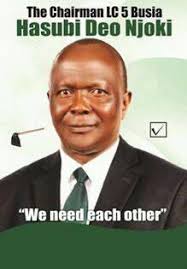
DP’s Deo Njoki hasn’t withdrawn his candidature- Mao

Deo Njoki

The Democratic Party has revealed that Deo Njoki has not withdrawn his candidature in the Busia district LC V by-election despite his nomination to the Human Rights Commission.

The Opposition sole candidate in the race, Deo Njoki Hasubi was last week nominated by the Electoral Commission (EC) and is contesting alongside Mr Paul Boniface Oguttu, the flag bearer for National Resistance Movement party (NRM), Chrispus Bwire, Tony Ojambo and Geoffrey Wandera, all independent candidates,

Speaking at DP headquarter party president general, Norbert Mao said, nomination of Deo Njoki to the Uganda Human Rights Commission is in bad faith, a dagger aimed at the heart of opposition unity.

“Top party leaders met the candidate, democracy seeking forces should resist crumbs and fight for the full loaf of emancipation,” said Mr Mao.

“High intrigue that Deo Njoki has been nominated to the Uganda Human Rights Commission, Hasubi’s appointment was seen by many as a tool to rule him out of the race. I have strongly urged him to say no, biting the bait would be extreme treachery. He will be denounced as a deserter and treated as such,” he said

In a letter to his party, Njoki said he has not yet given up contesting for the district seat and that he was merely informing his party.

He said the letter does not say that I have pulled out the race as many are speculating. “I only communicated to the party about the appointment, which came after I had been nominated. We will soon sit as the party and discuss it,”

The Busia District Chairperson seat fell vacant after Court of appeal nullified the election of Mr. Adea Ouma on grounds that he was six years ago convicted of corruption and therefore, the law bars him from holding any public office for a specified period.

Polling will take place on November 28, 2018.

Stories Continues after ad

IGAD provides training on fight against corruption

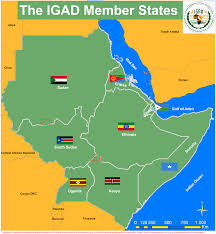
Map showing IGAD countries

The Intergovernmental Authority on Development (IGAD) on Tuesday embarked on a four-day training for Anti-corruption institutions in its Member States to further enhance the capacity of the institutions to expedite the implementation of the various regional, continental and international normative instruments on democracy and governance in order to pave way towards prevalence of peace and security in the IGAD region.

Under the Peace and Security Division (PSD), IGAD deals with issues of Democracy, Governance, Election and Human Rights (DGEHR) through the Political Affairs Program (PAP) which engages in various activities to achieve its many objectives one of which being; strengthening the capacity of member states democratic institutions.

A capacity needs assessment carried out in 2017, IGAD was asked to prioritize and focus on capacity building of IGAD Member State institutions that have a mandate on governance while maintaining a balance between the national and regional existing interventions.

During the opening remarks, Mrs. Legawork Assefa, Acting Director of Peace and Security Division at IGAD and representing the Executive Secretary of IGAD stressed the importance of strengthening capacity through training of anti-corruption institutions for them to implement and carry out the responsibilities entrusted unto them by the IGAD citizens.

“We need strong anti-corruption institutions to act as watch dogs to contribute to the current efforts by IGAD and the African Union by implementing the regional and continental efforts for Africa not to lag behind in development and to be more transparent, effective and reliable” Mrs Assefa added.

The Head of AGA Secretariat and Senior Human Rights Expert at the African Union Commission (AUC) Amb Salah S. Hammad reiterated the need to fight corruption collectively or else Africa will not improve or develop for it affects economies and the social fabric.

“The African Union supports and commends efforts by IGAD and other Regional Economic Communities to fight corruption at regional level complimented with AU instruments for successful implementation” he stated.

The Royal Danish Embassy is funding a series of training towards promotion of good governance and the fight against corruption in the IGAD region. Denmark was a host to the 2018 International Anti-Corruption Conference and is zero tolerance to corruption. The Counselor, Regional Affairs Dr. Jonas Helth LonBorg pledged continued support to IGAD and the AU towards their Member States achieving the 2018 AU theme of ‘Winning the Fight Against Corruption’ in order attain Sustainable Development Goals in Africa.

Dr. LonBorg called upon the IGAD Member States to strengthen their institutions combined with political will by the leaders and work towards changing the social norms and attitudes to fighting corruption.

The participants drawn from anti-corruption bodies and equivalent institutions in the IGAD member states will during the 4 day meeting focus on; background to corruption; familiarization of regional, continental and global conventions on anti-corruption; designing campaign strategies for anti-corruption interventions; factors that contribute to the success and failure of anti-corruption initiatives; managing corruption risks; recording and verification of declarations of assets to anti-corruption authorities(lessons learned and best practices); and reporting on anti-corruption in the Framework of African Governance Architecture (AGA).

At the conclusion of the training the participants recommit to the Declaration of the year 2018 as ‘African – Anti-Corruption year’ that was first declared at the African Union (AU) headquarters during its 30th Assembly of Heads of State and Government in January 2018 in Addis Ababa, Ethiopia where AU organs, Member States, Regional Economic Communities (RECs), civil society organisations together with citizens (women, men and young people alike) embarked on a journey to address the urgent need to curb corruption which is a major societal flaw causing setbacks in the socio-economic and political development of the continent.

Stories Continues after ad

2018 Cecafa tournament cancelled

Uganda Cecafa 2015 title

The Council for East and Central Africa Football Associations (Cecafa) confirmed that the 2018 Senior Challenge Cup, which was scheduled to start later this month, will not take place.

Cecafa struggled to find new hosts after Kenya pulled out of staging the event in August due to financial reasons.

In August the regional body was thrown into panic after the Football Kenya Federation (FKF) announced that financial challenges would not allow them to host the Championship.

Nicholas Musonye, the Cecafa Secretary General is quoted by BBC saying, “It is unfortunate we cannot have the Challenge Cup that brings together all nation teams in the region,”

“We tried to get alternatives, but the timing was also impossible because the Caf Champions League and Confederation Cup matches will this time start in November through to December from the preliminary round,” explained Musonye.

“We want to align our regional calendar of events to that adopted by Fifa therefore, Kagame Cup and Senior Challenge Cup will be played in June/July,” he added.

Kenya are the defending champions of the regional competition after beating Zanzibar 3-2 on post-match penalties in the final at Kenyatta Stadium, Machakos in December 2017.

However, it is confirmed that Uganda will host the Cecafa U-20 Championship which runs from 15-23 December.

Cecafa tournament is collaborative between the larger Eastern African countries and part of Central Africa and run by the Council of East and Central Africa Football Associations (CECAFA).

The tournament began way back in 1926 under the name Gossage Cup which then was mainly a Kenya-Uganda affair. The first ever CECAFA Senior Challenge Cup was held in Uganda in 1973 and the hosts Uganda emerged winners beating Tanzania 2-1 in the finals.

Cranes are the record holders of the regional championship with 14 titles and last won it in 2015 hosted by Ethiopia.

Stories Continues after ad