Stanbic Bank
Stanbic Bank
28 C
Kampala
Stanbic Bank
Stanbic Bank
Home Blog Page 1432

Makerere University joins KCCA, PSI in new Kampala City maternal-newborn health project

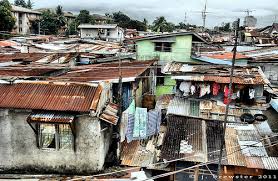
Makerere University School of Public Health has joined hands with Kampala Capital City Authority and Population Services International in a three-year implementation science project aimed at improving maternal and newborn outcomes in slum areas.

Funded by the United States Agency for International Development (USAID), the Maternal and New-born Health (MaNe) Kampala Slum project aims at generating evidence on effective approaches for improving health services for the urban poor that can be scaled up in other urban settings within Uganda and world-wide, according to a project briefing.

The project is composed of three core functions with implementation jointly led by PSI and KCCA, evaluation and learning led by Makerere University, the policy function will be by KCCA.

“The project will be implemented in the slum communities and informal settlements in the divisions of Rubaga and Makindye in Kampala city,” the MaNe briefing reads.

“The project will initiate and test innovative approaches to address the demand and supply side barriers affecting illness recognition, care seeking, effective referral and provision of quality care equitably for better MNH outcomes in urban slum settings in Kampala city,”

The Principal investigators of the project include Associate Professor Peter Waiswa, Dr. Dorothy Balaba, Dr. Okello Daniel and Dr Hirschhorn, Lisa.

Stories Continues after ad

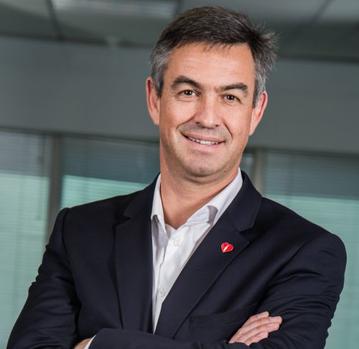
Coca-Cola appoints Jacques Vermuelen as Africa CEO

Jacques Vermuelen

Coca-Cola Beverages Africa (CCBA) has appointed Jacques Vermeulen, the current managing director of its international division, to the position of Group CEO of CCBA from December 1.

Vermeulen has served as managing director of CCBA’s International Division, which covers all of CCBA’s Africa operations outside South Africa, since July 2016.

He first joined Coca-Cola in 1995 as Head Office Financial Accountant and served in various financial roles both at Head Office and in operations before being appointed as CCS’s Chief Financial Officer in 2008.

In 2010, Jacques was appointed Chief Operating Officer (COO) for the Southern Division of CCS, and was in 2014 appointed as COO responsible for all CCS’s operations.

Stories Continues after ad

South Africa offered to host 2019 AFCON

Afcon 2019

The Confederation of African Football (CAF) have asked South Africa to step in as the hosts of the 2019 Africa Cup of Nations.

This comes after the initial hosts Cameroon were stripped of the rights to host the 2019 Africa Cup of Nations on grounds of insecurity during the body’s Executive Committee Extraordinary meeting in Accra.

South Africa hosted the competition back in 2013 and can be able to host it again, but it’s not up to the South Africa football association alone to make the commitment.

The South Africa Football Association is open to hosting the continental tournament but will have to meet the Government first before making a final decision.

The Bafana Bafana official twitter account tweeted; “SAFA President has told the SAFA AGM in Sandton on Sunday, 2 December that CAF has asked the Association to seriously consider hosting AFCON 2019. SAFA will however, meet the Government first before making a decision.”

With the stadiums built for the 2010 FIFA World Cup, South Africa is one of the countries with the facilities to host any continental competition.

CAF wants to have a new host for the competition by December 31.

Fourteen countries have already confirmed their places at the tournament and they are; Cameroon, Kenya, Senegal, Madagascar, Morocco, Mali, Algeria, Tunisia, Nigeria, Egypt, Uganda, Mauritania, Guinea and Ivory Coast.

The other ten places will be decided during the final qualifiers in March 2019.

The 2019 AFCON tournament will be the first to host 24 teams. The competition will be held in June and July moving from January and February.

Stories Continues after ad

Charcoal burning threatens sea nut oil business

charcoal

The felling of Sea Nut Trees for charcoal burning in West Nile and as well as other regions of northern Uganda, is threatening the extraction of sea nut oil which is on high demand in the country and foreign markets, according to dealers in this business.

The tree that produces both the edible product and smearing oil (butter) is among the best trees that produce charcoal which provides heat energy for preparation food in homes.

The recent engagement between the sea nut dealers and the German Corporation established that there are many challenges facing sea nut oil production and the major issue is the rampant cutting down of this trees, poor processing, branding and networking, limited scale on consumer packaging among others.

The local producers of sea nut products have now called upon local governments enact bylaws to protect sea nut tree.

Mary Orodriyo a trader in sea butter business from West Nile region said there is also no price target in the primary processing of the sea nut due to manipulation.

Charles Lagora Pader District commercial officer said the problem is the long value chain which worsened by use of fake weighing scale which is leading to adulteration of the product.

Robert Abak the resident district Commissioner Otuke appealed to the processors to use the resources that they have to support their product citing use of local media to create awareness and advertise their products.

Joyce Anguduyo another dealer said cutting of sea nut tree was making it hard for them to reap quality from the product. She urged people to be aware on the dangers of cutting down this tree species and that government should impose policy to combat the vice.

Alex Tabule the certification officer Uganda National Bureau of Standards said the farmers need to know about implementation of standards, technology, harvesting process and suitable packaging equipment should also be good enough to protect the sensitive product, quality improvement through standards and identification of gaps among others should be embraced.

Debrah Akatabi a researcher said that conservation of the tree species should be embraced by involving churches, schools and other institutions whereby they can plant more of the species in order to keep them present. They take 15 years to mature.

In 2006 President Museveni issued a warning through District Resident Commissioners to ensure that the districts of Karamoja, Lango, Acholi and West Nile protect the tree species due to their value that could boost Uganda’s exports.

Stories Continues after ad

Parliament slaps travel ban on Bagyenda, passport confiscated

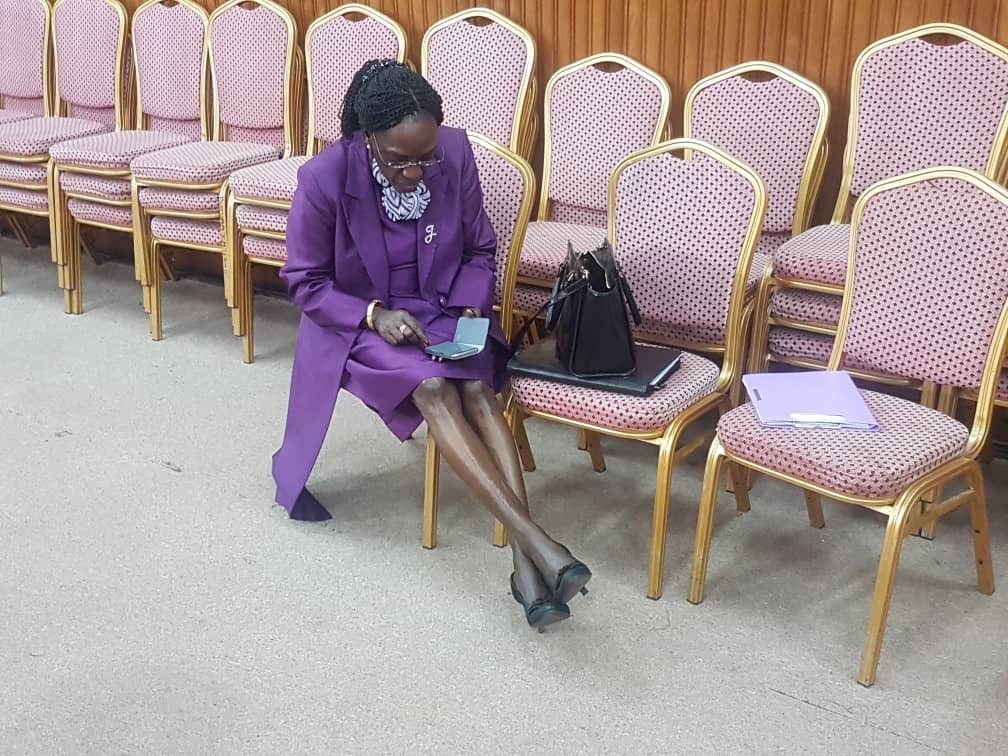
Embattled former Executive Director in charge of Supervision at Bank of Uganda Justine Bagyenda.

The former Bank of Uganda (BoU) executive director of supervision, Justine Bagyenda, was on Monday put on oath as she appeared before Committee on Commissions, Statutory Authorities and State Enterprises (Cosase) alongside the bank’s staff. The oath means should Bagyenda lie to the committee she will be arrested just like what happened to her former aides last week.

Bagyenda had earlier on apologised to the MPs for her absence in the last two weeks when they needed her to give more information on missing documents related to the liquidation of seven commercial banks. But the MPs have asked her to deposit her two passports-the International passport and the East African Passport.

The order to have Bagyenda deposit her documents came after MP Moses Kasibante (Rubaga North) warned her not to disappear again, suggesting that she deposits the passports with parliament.

MP James Waluswaka suggested that parliament confines Bagyenda even if she hands over her passports to parliament. Katuntu declined to issue any orders to do with confinement of Bagyenda, saying that she is now back in the country and will honour parliament as expected.

Bagyenda pleaded with the committee to let the police release her former bodyguard and driver who were arrested by police last week after telling lies having taken on oath. But Committee Chairman Abdu Katuntu said releasing the two persons is the duty of the police not parliament. “The law is taking its own course. Parliament has nothing to do with it,” Katuntu said.

Bagyenda lauded the committee saying it had understood her situation, even though she said social media has carried out propaganda messages about the situation. Today was the last day for a warrant of arrest to be issued against Bagyenda if she had not appeared.

On amalgamation of loans of Greenland Bank, International Credit Bank and Cooperative Bank before selling them to Nile River Acquisition Company, Bagyenda said secured loans had weaknesses such as family ownership and squatters. For this reason, she said BoU could not collect monies on secured loans. When asked about the evaluation documents/reports Bagyenda said her successor Dr. Tumubweine Twinemanzi, should look for them on archives. BoU sold the loans at Shs8.89 billion yet they had book value of over Shs34 billion. The secured loans, unsecured loans, poorly secured loans and unknown loans were sold at 93 percent.

When asked whether she did an evaluation of the loans assets before putting them on market using hired law firm JN Kirkland & Associates, Bagyenda instead asked that Director, Financial Markets Development Coordination, Benedict Sekabira shed more light on the same. The hired company is said to have done desktop evaluation of the assets of the loans of Greenland Bank, International Credit Bank and Cooperative Bank.

Representatives of JN Kirkland & Associates were sent summons to appear before the committee today but the firm’s physical address is nowhere to be traced despite having some presence on Google.

Proponents of the firm say; it is a firm of corporate lawyers and attorneys engaged in business legal practice in Uganda and many of the countries in East, Central and Southern Africa. It is our ultimate mission to become the business law firm of choice in all corners of the continent of Africa!

The MPs were concerned that BoU did not use professional valuer to evaluate the assets upon which loans were given out. No reports were availed by BoU on the same.

MPs want valuation reports that Bagyenda claims were done by Bagaine and company. Katuntu has asked that BoU come with reports tomorrow without fail.

MP Waluswaka suggested that Bagyenda be put under medical examination to establish if she has a mental problem but Katuntu ruled him out saying that the Auditor General’s report does not mention that issue since it all about audit issues.

On liquidation costs of Shs18.02 billion, BoU failed to present financial ledgers related to those costs. “I noted, that BOU did not maintain financial ledgers in relation to the liquidation costs,” Muwanga said in his report.

Deputy Governor Dr. Louis Kasekende said some documents are in the bank’s finance department. However Katuntu wondered how BoU officials could not understand what the Auditor General wanted.

Stories Continues after ad

Bagyenda turns up at Cosase probe

The embattled former Bank of Uganda executive director for supervision Justine Bagyenda is at parliament ready to appear before the Committee on Commissions, Statutory Authorities and State Enterprises (Cosase).

Bagyenda left the country on November 22, 2018 well knowing she was supposed to appear before the committee to answer queries related to the disappearance of key reports relating to the liquidation of seven commercial banks such as Teefe Bank, Greenland Bank, International Credit Bank, Global Trust Bank Uganda, National Bank of Commerce, Cooperative Bank and Crane Bank Limited.

On February 11, 2018, CCTV cameras installed at the bank captured Bagyenda’s bodyguard and driver taking out three bags containing what was suspected to be BoU’s documents. She is expected to answer queries related to the disappearance of documents, some of which the Auditor General John Muwanga complained about in his special audit report of BoU on defunct banks. Bagyenda is alleged to be a holder of three passports.

Her driver and bodyguard are under investigation by the police.

Stories Continues after ad

Africa must accelerate market reforms

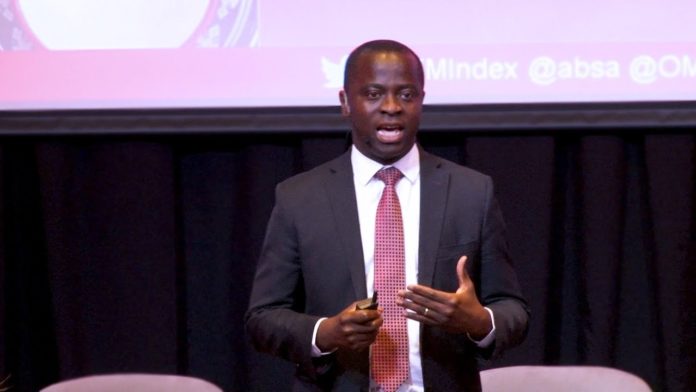
George Asante

By George Asante

African countries are making commendable progress to reform and liberalise their financial markets. This is key to financial inclusion, economic development and capital raising.

The extent of this progress was revealed in the 2018 Absa Africa Financial Markets Index, which ranks 20 countries in terms of the stage of maturity, transparency and investor friendliness of financial markets. Launched in October alongside the International Monetary Fund meetings in Bali, this is the second edition of the index, independently prepared and published by OMFIF.

It focuses on six core pillars: market depth; access to foreign exchange; market transparency; capacity of local investors; macroeconomic opportunity; and legality and enforceability of standard financial markets master agreements.

Overall, South Africa was ranked first on market depth; legality and enforceability of standard financial markets master agreements; market transparency, tax and regulatory environment; capacity of local investors and macro-economic opportunity. However, it came second to Kenya on access to foreign exchange.

The index is an important indicator of ranked countries’ progress on and commitment to financial market reforms. Without these, economic development and accessing domestic and foreign capital is difficult, if not impossible.

For Africa to grow, it needs a broad, all-inclusive financial market that facilitates investment. The index is an important tool that offers a blueprint on bolstering the continent’s financial markets, pricing investment and competing equally for the available funding needed to propel development in the region.

Peter Matlare, group chief executive officer and CEO of Rest of Africa at Absa, agrees, saying the development of well-regulated, deep and liquid financial markets should be at the top of policy-makers’ development agenda. ‘The index facilitates a meaningful debate about the maturity and accessibility of Africa’s financial markets,’ he says.

Some countries, like Botswana, Kenya, Nigeria and South Africa have made steady progress with their financial market reforms. But others, such as Ethiopia and Mozambique, lag behind, particularly in the development of stock exchanges, which are essential to raising capital through listings.

Ethiopia lacks a securities exchange, apart from one for commodities. There are no equities listed on Angola’s exchange, and both Cameroon and Mozambique have a market capitalisation of less than 5% of GDP. South Africa is the only index country where the total value of listed equities is more than $100bn, at $1.1tn.

Africa’s financial markets need accelerated reforms, principally because they can be used to raise capital to meet its significant funding needs, particularly for infrastructure projects. The continent’s transformation requires significant resources. For example, to achieve universal energy access by 2025, as much as $55bn annually must be raised in domestic and international capital. As much as $50bn is needed to fund African infrastructure projects.

While some African countries are implementing policies to bolster regional stock market integration and encourage expansion, they are hamstrung by low liquidity, limited prospects for listings and a lack of product diversity. These present significant obstacles to capital market growth. Only South Africa, Botswana and Ghana have a market capitalisation greater than 100% of GDP, while in 14 countries it is lower than 50%.

But it is not all doom and gloom, as the index illustrates. Several countries have made progress to create more transparent and well-regulated markets, supported by improving tax environments. This is vital for attracting foreign investment, encouraging domestic participation and aiding market development.

Equally impressive is increased financial inclusion through better design, implementation and regulation of savings institutions. This has widened opportunities for people in these countries to access capital markets. Additionally, countries have implemented policies that have increased the size of assets held by local investors, creating opportunities to develop financial products and enhance liquidity.

To accelerate financial market reforms, there is a need for sustained economic growth in many countries. This requires policy initiatives to attract investors by, for example, paying more attention to infrastructure and trade diversification while ensuring financial transparency. Such steps are necessary to facilitate Africa’s economic transformation.

George Asante is Head of Global Markets excluding South Africa at Absa.

Stories Continues after ad

15 war victims graduate in vocational skills

GULU: A total of 15 former war victims in Northern Uganda graduated in different vocational disciplines from Gulu War Affected Training Centre GWATC.

These former abductees By the Lord Resistance Army LRA war in the region confessed that most of them were hopeless before after returning from the bush and hardly did not know that their future can be brightened again until they started hearing about the centre on Radio and immediately opted to join despite being desperate and hopeless.

During the 8th graduation ceremony at the centre, these 15 survivors were excited upon seeing them also making another tremendous steps in lives with great hope that the decision they took will positively change their lives and thinking.

Piloya Concy, 25 years old one of the female made a revelation that she was abducted at the age of nine from Pabo village in Amuru District and by then she was in Primary Four ,she managed to come back from captivity after one year and continue with her study up to Ordinary Level but later decided to go for vocational skill training due lack of fees since both parents were unable to push her for further studies in other institutions.

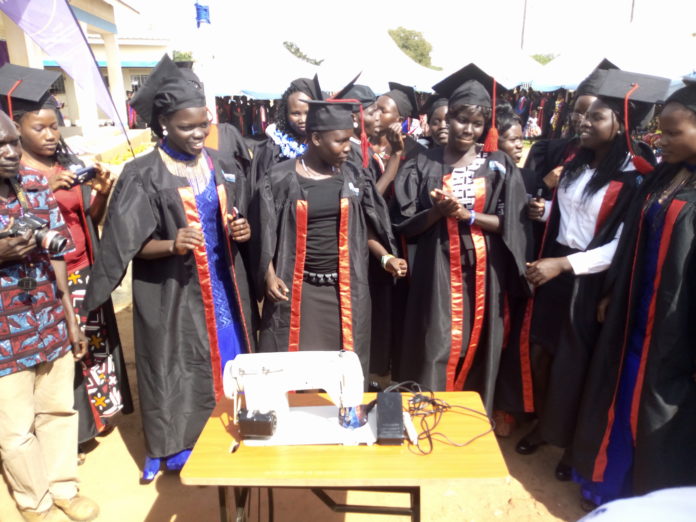
Concy did training in tailoring and garment cutting emerged the best students in the school and was awarded with an electronic sewing machine.She is hoping that the knowledge she attained and plus the equipment will help her in sustainability of her business.

Patrick Oola Lumumba the chairman LC3 Bardege Division in Gulu Municipality said in most cases parents from north were spending millions of shillings sending their children to Kampala for better education but it’s now time the parents should realise and recognize the importance of different institutions in the district in order to cut cost and burdens since they have every equipment and facilities needed to instill knowledge in their children.

He added that the grandaunts should be empowered individually by opening up their own workshops and restaurants in order to avoid exploitation from other business owners around town.

Betty Betty, director of the school revealed that she started the school because she was also affected by the war and as a returnee after studying tailoring course for three years she came back and started working with other organizations to train other returnees but later lobbied for his own training centre in 2005 were the centre has now positively impacted many lives of the returnees and other community in the region and most of them are living on their own.

Gulu War Affected Training Center has so far passed out over 400 students in hands skill disciplines including former LRA abductees and other community at large .

Stories Continues after ad
Cosase probe: Why Dfcu bank top managers are watching proceedings with anxiety

Mr. Jimmy Mugerwa, the board chairman of Dfcu bank who is accused by some shareholders for the bank's poor management.

As Parliament’s Committee on Commissions, Statutory Authorities and State Enterprises (Cosase) continue to probe top officials of Bank of Uganda (BoU) over the controversial liquidation of seven commercial banks, Dfcu bank which bought off the assets of two of the banks, is watching proceedings at parliament with anxiety.

Dfcu bank irregularly bought some of the assets of Global Trust Bank Uganda (GTBU) and Crane Bank Limited in July 2014 and July 2017 respectively, through the Purchase of assets and Assumption of liabilities agreement (P&A).

“I observed that there were no guidelines/regulations or policies in place to guide the Identification of the purchasers of GTBU. There were also no guidelines to determine the procedures to be adopted by the Central Bank in the sale of assets and transfer of assets or liabilities of the defunct banks to Dfcu,” the Auditor General John Muwanga says in a special audit report of Bank of Uganda on defunct banks.

Mr.Muwanga in his report about GTBU says he was not provided with records of the procurement process to ascertain the bid requirements, offers made, list of bidders, evaluation criteria, evaluation report and negotiation minutes leading to the P&A agreement. “In the absence of guidelines and procurement records, I could not ascertain whether BoU selected and evaluated the bids in line with the evaluation criteria,” he said.

The Auditor General pins BoU for selling assets and liabilities of the two banks to Dfcu bank without evaluating the due diligence report presented by PwC and DFCU Bank. BoU went by what the two entities presented as the best value of the assets. For instance after claiming to have injected Shs478.8 billion of taxpayers’ money into Crane Bank Limited (CBL) during its takeover, BoU would sell some of CBL’s assets at Shs200 billion, moreover paid in installments as agreed. At the time Mr. Muwanga released his report, Dfcu bank had paid Shs98 billion of the total sum.

“In a meeting with the outgoing EDS (Justine Bagyenda) on the progress of the special audit held on June 13, 2018 at BoU7r, the EDS explained that BoU did not carry out a valuation of the assets and liabilities of CBL but relied on the Inventory report and due diligence undertaken by Dfcu to arrive at the P&A,” Muwanga said.

On Crane Bank he further said: “However I was not provided with the negotiation minutes leading to the P&A agreement, In the absence of guidelines and negotiation minutes, I could not determine how BoU selected the best evaluated bidder and how the terms In the P&A were determined.”

Inside sources at Dfcu bank say not all shareholders were happy with the way the bank acquired especially assets of CBL. It lewd to divisions with some shareholders wanting to exit the shareholding for example the CDC Group.

Much as BoU says CBL was insolvent, Mr. Muwanga in his report, says there was an avenue in which the central bank would revive CBL, having spent Shs478.8 billion on it during the takeover. The MPs will have to ask BoU officials more reasons why it had to sell CBL.

Dfcu officials are scared because the ongoing probe has exposed BoU officials as being disorganized in doing business of selling off the banks. The documents don’t much, neither they were to make good reports on various transactions of the various banks. There are also counter accusations among the BoU staff on who did what.

The issue is worsened by the fact that the former executive director of BoU seems to be on the run and has failed to appear before parliament. She is suspected to have taken critical documents out of BoU on February 11, 2018, ac captured by the CCTV cameras. It will require MPs to demand that Dfcu bank avails some documents as regards especially CBL, since BoU seems to have lost some of them.

Stories Continues after ad
Burundi, Rwanda political differences could derail progress of EAC

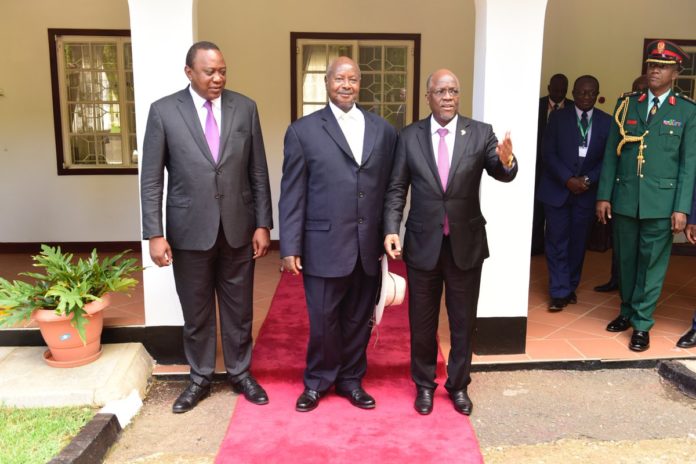
From left, Presidents Kenyatta, Museveni and Magufuli

The political differences between Burundi and Rwanda have started to derail the progress of the East African Community (EAC) whose leaders have a plan for political federation, the final stage of the integration of the six countries that the form one of Africa’s regional economic blocs.

On Friday nationals of Kenya, Uganda and Tanzania were shocked as their leaders-President Uhuru, Yoweri Museveni and Dr.John Magufuli came out of the summit hall in Arusha to announce that the 20th Ordinary Meeting of the Summit of the East African Community Heads of State has been postponed to a later date.The Summit would not take place due to a lack of quorum caused by the absence of Burundi.

“According to Rule 11 of the Rules of Procedure of the Summit of the EAC Heads of State, quorum is made of all Partner States representation which is in consonance with decision making by consensus under Article 12 of the Treaty,” said Kirunda Kivejinja, who is the Chairman of EAC Council of Ministers and Uganda’s 2nd Deputy Prime Minister and Minister of EAC Affairs.

President Paul Kagame of Rwanda and his Burundian counterpart Pierre Nkurunziza did not travel for the Summit in Arusha even though the former sent in a representative in the names of former EAC Secretary General Amb. Richard Sezibera who also is Rwanda’s Minister of Foreign Affairs. The failed Summit meeting was preceded by the 38th Meeting of the Council of Ministers which was also was not attended by the Republic of Burundi. South Sudanese president Salvar Kiir travel for the Summit but sent in a representative.

Among the items which were on the Provisional Agenda of the 20th Summit of the EAC Heads of State were: the status of ratification of various protocols; the status of resolution of long outstanding non-tariff barriers, and; the progress report on the adoption of Political Confederation as a Transitional Model to the East African Political Federation.

Other items on the Agenda were: the roadmap for the accelerated integration of the Republic of South Sudan into the EAC, and; the verification exercise for the admission of the Republic of Somalia into the Community.

The Summit was also to consider reports on modalities for the promotion of Motor Vehicle Assembly in East Africa aimed at reducing importation of used vehicles into the Community, and; the review of the textile and leather sector with a view to developing a strong and competitive domestic sector that gives consumers better choice than imported textile and footwear.

The Summit was also to review a progress report by the Council of Ministers on the Summit Directive on having two (2) Deputy Secretaries General at the Community recruited competitively on a rotational basis among the Partner States.

The Summit had been expected to assent to various Bills passed by the East Legislative Assembly, namely: the EAC Polythen Materials Control Bill, 2016; the Administration of the East African Court of Justice Bill, 2018; the EAC Monetary Institute Bill, 2018, and; the EAC Customs Management (Amendment) Bill, 2018.

All the above important issues could not be acted on just because Burundi absconded. It appears time to reconsider the EAC treaty has come.

Burundi and Rwanda are not the original members of the EAC. They were admitted upon request from the two governments respectively, having taken note of the benefits of the bloc. Same to South Sudan which was the latest to enter the bloc.

Political analysts say the original EAC countries of Kenya, Tanzania and Uganda must maintain the speed of the integration progress. They argue that the three shouldn’t be pushed back by the bickering between neighbours Rwanda and Burundi who only joined in 2007. The EAC was originally formed in 1967.

The action of Burundi, analysts say must be dealt with, by imposing punitive measures or worse still Burundi which has disrespected the EAC activities that ran almost for the whole of last week must be suspended for a while and the rest of the leaders push with programmes that benefit citizens. “We cannot wait for Burundi which has a population of 10.86 million people as of 2017, compared to bloc’s estimates of 150 million people with GDP of US$75.5 billion. Burundi has a GDP of US$3.478 billion as of 2017. That means Burundi benefits more from the bloc than what the rest of members get from Burundi,” an analyst said.

Another analyst is of the view that Burundi wants the rest of EAC Partner States to reign on Rwanda which Burundian state considers as a security threat but Rwanda has always denied the allegations. Internally, the two countries are victims of tribal tensions mainly because they comprise of two major tribes-the Hutu and Tutsi. Accusations are that the Kigali regime is not in favour of Nkurusinza being President of Burundi. Burundi accuses Rwanda of ‘recruiting’ Burundian refugees into the military as well as supporting rebels, an accusation that Rwanda denies.

After an attack on June 19 in Nyabimata Sector in Rwanda’s Southern Province, Rwanda alleged that the attack was carried out by Burundian security agencies and proxies. Rwanda says Burundi’s actions which include a blockage of the movement of goods and passenger vehicles across the border which is a violation of the EAC Common Market Protocol.

Burundi wants EAC, the African Union and the United Nations to help solve the impasse yet Rwanda says it is not ready for any dialogue based on mere allegations by Burundi.

But that aside, the latest report indicates that Burundi is the biggest defaulter in terms of budget contributions to the EAC. Burundi and South Sudan owe the EAC more than US$12 million. This also illustrates Burundi is not so much into the EAC issues. This and other reasons should force the remaining partner states to move on without Burundi, after all the country has plans to join SADC.

Stories Continues after ad