Stanbic Bank
Stanbic Bank
24.5 C
Kampala
Stanbic Bank
Stanbic Bank
Home Blog Page 1438

Ecobank introduces quick money transfer mobile application

Ecobank has said it is harnessing its digital expertise and innovation to bring efficiency and convenience to the international and intra-African remittance markets, while significantly reducing the costs of the service.

The launch of the Rapidtransfer mobile application will enable Africans around the world to easily and instantly send money to bank accounts, mobile wallets and cash collection in, and across, 33 African countries.

As well as being intuitive, easy to navigate and multi-lingual with English, French, Spanish and Portuguese variants, the application provides simple and secure digital onboarding.

Users can choose how and when funds are delivered to the intended beneficiary, with transparent foreign exchange rates prior to each transaction. Charges range from nothing to 3 percent depending on the options the customer selects.

“Historically the cost of sending cross-border remittances in Africa has been far too high. Similarly, the process to send funds has long been inefficient and burdensome, with customers forced to physically go to an agent, and yet still have little or no clarity as to when the money will reach the recipient,” said Ade Adeyemi, Ecobank’s Group CEO.

Adeyemi added, “The Rapidtransfer app remittance solution is a quick, easy and reliable digital solution that removes all of these issues. It is a game-changer for Africans with its sustainable and standout affordability.”

He further stated that the application further demonstrates Ecobank’s commitment to enhance the economic development and financial integration of the African continent. “We know that remittance flows into and across Africa from migrants working away from home has an enormously beneficial impact in powering Africa’s domestic economies,” the Group CEO noted.

“By reducing the costs to send the money, Rapidtransfer ultimately enables the beneficiary to receive more of the funds originally sent to them, which in turn will have a multiplier effect on national economies by boosting demand and driving business growth,” he pointed out.

In the first quarter of 2018, the average cost of sending US$200 was 7.1 percent and remittance services in Sub-Saharan Africa were the costliest in the world at an average cost of 9.4 percent.

A substantial proportion of migrants financially support their dependents back home and the potential size of this remittance market is illustrated by the United Nations’ estimate that the number of international migrants, including refugees, was 258 million in 2017.

Money transfers from migrant workers and others to all countries worldwide were US$613 billion in 2017 and those into Sub-Saharan Africa grew by US$4 billion to US$38 billion in 20173.

The importance of the inflow of remittances into many African countries cannot be underestimated. Remittances play a hugely important part of many national economies and their inflows represent 27 percent and 21 percent of Liberia and The Gambia’s Gross Domestic Product respectively, the Lome based group

Stories Continues after ad

Cheaper smart phones expected on Ugandan market next year

Officials display the prototype of the smart phones to be assembled here in Uganda.

The price of new brand smart mobile phones in Uganda is expected to come down next year following government’s decision to allow an American company CTI Africa to start assembling its phone products in Uganda.

The CTI Africa arm-LifeMobile- was unveiled yesterday by the Minister of State for Investment and Privatisation, Evelyn Anite, at the National Enterprises Corporation (NEC) headquarters in Bugolobi, Kampala.

“We are very excited that CTI Africa is going to start assembling mobile phones in Uganda. Ugandans are carrying so many mobile phones but none is manufactured here. So, if Ugandans buy these phones, we will diversify our economy because the dollars that would be spent on importing smart phones will be used here,” minister Anite said.

She said NEC, has already allocated LifeMobile a site on 6th Street in Industrial Area where the assembling plant will be built.

Anite said President Museveni would launch the first LifeMobile smart phones early next year.
The CTI Africa chief executive officer, Michael Landau, said during the assembling of the phones they would also help develop specialised applications to improve healthcare, mobile banking, insurance, microfinance and education services.

The company is expected to invest US$10million (about Shs40 billion) into the venture and create at least 400 jobs in the first phase of operation.
He said LifeMobile already has prospective partnerships with Jubilee Insurance for insurance services, Jumia Uganda for e-commerce, Ecobank and Microfinance Support Centre for e-banking, Medical Concierge and Uganda Protestant Medical Bureau for healthcare services.

“Our applications will be very important in improving people’s lives. We want LifeMobile to be a lifeline to all the digital services available,” he said adding that, “LifeMobile is about using a smart phone as a tool for life as it will have Apps for healthcare, insurance, e-commerce and banking”.

Landau said the firm’s first phones assembled in Uganda would be released between January and March 2019, stating that so far the firm has received orders for at least 75,000 smart phones.
He said they would introduce the hire purchase arrangement to enable Ugandans access smart phones easily.

Maj. Gen. James Mugira, the managing director of NEC, which was tasked by President Museveni to act on behalf of government in the partnership, said the LifeMobile’s presence in Uganda is a symbolic moment. He appreciated CTI for choosing to invest in Uganda.

Stories Continues after ad

African economies sustain progress in domestic resource mobilization-report

Finance minister Matia Kasaija

Africa has sustained gains in domestic resource mobilisation made since 2000, as tax revenues remained stable in 2016, according to Revenue Statistics in Africa 2018. Providing internationally comparable data for 21 participating countries including Uganda, the report finds that the average tax-to-GDP ratio was 18.2 percent in 2016, the same level as in 2015, which represents a strong improvement from 13.1 percent in 2000.

The third edition of Revenue Statistics in Africa, released in Paris during the 18th International Economic Forum on Africa, shows that tax-to-GDP ratios varied widely across African countries, ranging from 7.6 percent in the Democratic Republic of the Congo to 29.4 percent in Tunisia in 2016. Six countries -Mauritius, Morocco, Senegal, South Africa, Togo and Tunisia- had tax-to-GDP ratios greater than or equal to 20 percent in 2016. Uganda’s tax-to-GDP ratio was 13.0 percent but has slightly improved. In comparison, the average tax-to-GDP ratio for Latin America and the Caribbean was 22.7 percent and 34.3 percent for OECD countries in 2016.

Revenue Statistics in Africa is a joint initiative between the African Tax Administration Forum (ATAF), the African Union Commission (AUC) and the Organisation for Economic Co-operation and Development (OECD) and its Development Centre, with the support of the European Union.

The publication, which now covers 21 countries, shows that revenue trends are mixed. Between 2015 and 2016, the tax-to-GDP ratios of 11 countries increased while those of 10 countries in the sample decreased. Botswana registered the highest increase (1.3 percentage points) followed by Mali (1.2 percentage points). The largest decreases (of over 2.0 percentage points) occurred in the Democratic Republic of the Congo and Niger.

The changes in tax-to-GDP ratios were primarily due to economic factors. Declines in oil prices coupled with lower activity among mining and oil companies contributed to the decreases in the Democratic Republic of the Congo and Niger, while a significant increase in the sale of diamonds in Botswana has increased revenues. In contrast, the increased tax-to-GDP ratio in Mali is partly explained by improvements to tax administration.

African economies continue to rely heavily on taxes on goods and services, which accounted for 54.6 percent of total tax revenues in the Africa (21) average. Value-added taxes (VAT) alone accounted for 29.3 percentof revenues.

However, the contribution of income taxes is increasing: taxes on income and profits accounted for 34.3 percent of total revenues across the Africa (21) in 2016 and have contributed the most to growth in tax revenues since 2000, increasing by 2.6 percent of GDP to reach 6.2 percent of GDP in 2016. Corporate income tax revenue increased by 1.4 percentage points over this period to 2.8 percent of GDP, while revenue from personal income tax rose from 2.1 percent to 3.0 percent of GDP in 2016, a historic high.

The report also contains data on non-tax revenues, which continued to decline across the 21 countries on average in 2016 but remain an important source of income in certain countries. These revenues, which include income from natural resources and grants, exceeded 5 percent of GDP in nine of the 21 countries of Botsana, Burkina Faso, Cabo Verde, Cameroon, Rep. of Congo, DRC, Cote d’Voire, Egypt, Eswatini, Ghana, Kenya, Mali, Mauritius, Morocco, Niger, Rwanda, Senegal, South Africa, Togo, Tunisia and Uganda.

Authors says Revenue Statistics in Africa is an important part of the African Union’s Strategy for the Harmonization of Statistics in Africa (SHaSA) and is aligned with the African Union’s Agenda 2063 and SDG 17.1.

Stories Continues after ad

New venture scenarios that rarely attract investors

Martin Zwilling

By Martin Zwilling

If you aren’t willing to take some risk as an entrepreneur, then don’t expect any gain. Yet everyone has limits, and every investor implicitly has similar limits on what makes a startup investable, or one to avoid at all costs. If you need investors, it’s important that you understand their filters, and even if you are funding your own efforts, you need to recognize the red flags.

Of course, every risk level can be mitigated by a good plan that addresses the issue, offers a credible action plan, and will convince you, as well as investors and customers, that what looks like a risk to many is actually a sustainable competitive advantage for your startup.

Nevertheless, we can all benefit by understanding a collective view from investors on the high-risk elements that every new business has faced historically based on the team, as well as in the marketplace. Here is my perspective on the highest risk elements, from my years of working with investors and watching startups come and go:

All the co-founders are first-time entrepreneurs. A strong team has one or more executives who have run a startup before in the current business domain. Even top big-company executives are considered high-risk in a startup environment. The challenges are as different for them as a jewelry store owner now building medical devices.

Your startup is in a high-failure-rate business sector. These historically have included work-at-home, restaurants, telemarketing and social-service providers. On the Internet, I am wary of one more search engine provider, clones of existing social-media sites, and yet another new dating site. You need a big differentiator in these arenas.

Products requiring changes to government regulations. Things such as driver-less cars and new medicines are far more than a technology challenge. They require exhaustive and money-consuming tests and trial periods, followed by bureaucratic approval cycles that can take forever. If you have deep pockets, these ultimately can be very lucrative.

Huge ramp-up time and money required. For new car companies such as DeLorean and Tesla, designing and testing the product is only the beginning. Huge investments are also required to ramp up manufacturing, build a distribution network, and provide the support infrastructure. New drugs usually fall in this category, due to side-effect testing.

Niche or low growth-rate businesses opportunities. Investors are looking for large opportunities (greater than a billion dollars) with double-digit growth rates. Others may indeed make good family businesses, but are usually deemed worth investment. These are ones you need to bootstrap, crowdfund or pitch to friends and family.

Marginal legality or public image. Don’t expect investors to line up for your new online gaming site, adult entertainment or quick sources of cash. Professional investors put great value in their integrity, so they won’t risk it by making investments that some people would view as in poor taste. These may traditionally have high returns, but are still high risk.

Off-shore or foreign-country based. Every country has their own unique business requirements and customer culture. Thus investors in one country do not assume that they know what works in another country, even if it sounds good locally. If you want U.S. investors, for example, it may be worthwhile to set up an office in New York City or Silicon Valley.

No entrepreneur should consider any of these challenges as hard barriers, but they do need to be aware of higher risk perception, and include their mitigation strategy in their business plan for all to see. I encourage you to be proactive on these issues, rather than saying nothing unless questioned. Responding to a challenge will always make you look defensive, and many people will walk away without asking.

It’s also not smart to switch from a domain you know and love to a perceived lower-risk business that you know less about, or have no passion for, just because it may be more attractive to investors. Passion and commitment can overcome many risks, and these will also drive you to expand your scope of options for funding and implementation, leading to success.

If you are a true entrepreneur, you will find that a reasonable level of risk is necessary to incent you to go beyond the status quo of an existing problem. But in all cases, it pays to keep your eyes wide open, and do your homework on the pitfalls that others before you have faced. Only then can you enjoy the journey, as well as reach the destination.

The writer is a veteran startup mentor, executive, blogger, author, tech professional, and Angel investor. Published on Forbes, Entrepreneur, Inc, Huffington Post, and others.

Stories Continues after ad

EU pays tribute to journalists who lost their lives in line of duty

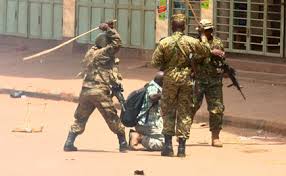
UPDF soldiers batering Reuters journalists James Akena in Kampala recently

By Federica Mogherini

Democracy cannot live without free, diverse and independent media. Journalists and media actors across the globe hold states, government officials, corporations and society at large accountable for their actions. But far too many among them face threats and attacks simply for carrying out their work, while the perpetrators of these attacks often act with total impunity.

On this day, which has been proclaimed as the International Day to End Impunity for Crimes Against Journalists, by virtue of the UN General Assembly Resolution 68/163, we pay tribute to all those journalists around the world who lost their lives and suffered attacks in the exercise of their profession. We also pay tribute to all those brave journalists who are taking up the work of their colleagues who can no longer pursue their investigations.

The assassinations of investigative journalists Daphne Caruana Galizia and Jan Kuciak in the EU, demonstrate that no region of the world is immune to this. These despicable crimes need to be thoroughly investigated and prosecute, as it is the case for the killing of Saudi journalists Jamal Khashoggi in the Saudi Consulate in Istanbul. We have asked and expect that Saudi Arabia cooperates on a thorough, credible and transparent investigation and we insist on the need for clarity on the circumstances of his death and full accountability of all those responsible for it.

There is in many countries a worrying tendency to erode and shrink the space for free journalism, often by putting indiscriminately in question the credibility of media to discredit and weaken their work. Journalists need an environment where they are able to work in safety and security, both online and offline, without fear of harassment, political pressure, censorship or persecution. A robust legal system must protect media houses and journalists all around the world so that they can fulfil their work in full independence. In a time where disinformation is on the rise, the safety of journalists must be guaranteed to allow them to promote accurate reporting for the benefit and in the interests of all our citizens.

The EU will continue to use all appropriate external policy and financial instruments to enhance the quality of journalism, access to public information and freedom of expression.

It will continue funding the European Centre for Press and Media freedom (ECPMF) and providing targeted protection through Human Rights Defenders Support programmes.

All states within and outside the European Union have a duty to fulfil their obligations to protect freedom of expression and the safety of journalists by providing an enabling legal environment, by taking threats against journalists seriously and by vigorously prosecuting actual attacks. We expect all to reinforce preventive measures, mobilising all actors and creating national safety mechanisms, in line with the UN Plan of Action on the Safety of Journalists and the Issue of Impunity.

Free journalism is the backbone of free societies: undermining it means undermining our own freedom.

This article was written by the High Representative, Federica Mogherini, on behalf of the European Union on the occasion of the International Day to end Impunity for Crimes against Journalists – NOVEMBER 2, 2018

Attachments area

Stories Continues after ad

More than 90 perform of the world’s children breathe toxic air every day-WHO report

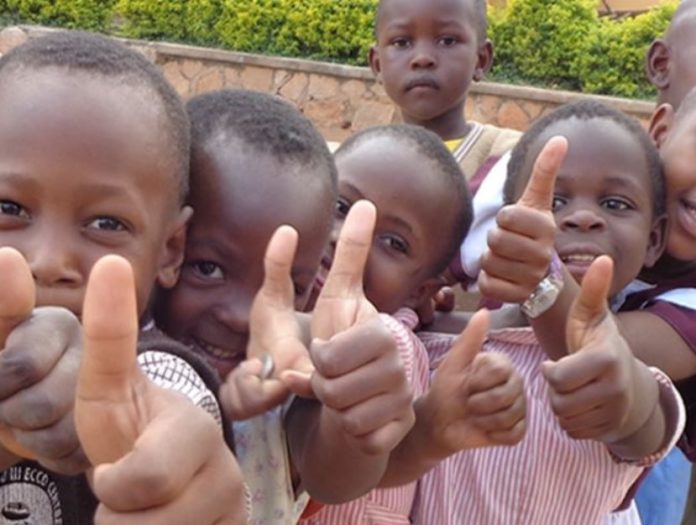
Ugandan children

Every day around 93 percent of the world’s children under the age of 15 years (1.8 billion children) breathe air that is so polluted it puts their health and development at serious risk. Tragically, many of them die: World Health Organisation (WHO) estimates that in 2016, 600,000 children died from acute lower respiratory infections caused by polluted air.

A new WHO report on Air pollution and child health: Prescribing clean air examines the heavy toll of both ambient (outside) and household air pollution on the health of the world’s children, particularly in low- and middle-income countries. The report is being launched on the eve of WHO’s first ever Global Conference on Air Pollution and Health.

It reveals that when pregnant women are exposed to polluted air, they are more likely to give birth prematurely, and have small, low birth-weight children. Air pollution also impacts neurodevelopment and cognitive ability and can trigger asthma, and childhood cancer. Children who have been exposed to high levels of air pollution may be at greater risk for chronic diseases such as cardiovascular disease later in life.

“Polluted air is poisoning millions of children and ruining their lives,” says Dr Tedros Adhanom Ghebreyesus, WHO Director-General. “This is inexcusable. Every child should be able to breathe clean air so they can grow and fulfil their full potential.”

One reason why children are particularly vulnerable to the effects of air pollution is that they breathe more rapidly than adults and so absorb more pollutants.

They also live closer to the ground, where some pollutants reach peak concentrations – at a time when their brains and bodies are still developing.

Newborns and young children are also more susceptible to household air pollution in homes that regularly use polluting fuels and technologies for cooking, heating and lighting

“Air Pollution is stunting our children’s brains, affecting their health in more ways than we suspected. But there are many straight-forward ways to reduce emissions of dangerous pollutants,” says Dr Maria Neira, Director, Department of Public Health, Environmental and Social Determinants of Health at WHO.

“WHO is supporting implementation of health-wise policy measures like accelerating the switch to clean cooking and heating fuels and technologies, promoting the use of cleaner transport, energy-efficient housing and urban planning. We are preparing the ground for low emission power generation, cleaner, safer industrial technologies and better municipal waste management,” she said.

Key findings:

Air pollution affects neurodevelopment, leading to lower cognitive test outcomes, negatively affecting mental and motor development.

Air pollution is damaging children’s lung function, even at lower levels of exposures

Globally, 93 percent of the world’s children under 15 years of age are exposed to ambient fine particulate matter (PM2.5) levels above WHO air quality guidelines, which include the 630 million of children under 5 years of age, and 1.8 billion of children under 15 years

In low- and middle-income countries around the world, 98% of all children under 5 are exposed to PM2.5 levels above WHO air quality guidelines. In comparison, in high-income countries, 52% of children under 5 are exposed to levels above WHO air quality guidelines.

More than 40% of the world’s population – which includes 1 billion children under 15 – is exposed to high levels of household air pollution from mainly cooking with polluting technologies and fuels.

About 600’000 deaths in children under 15 years of age were attributed to the joint effects of ambient and household air pollution in 2016.

Together, household air pollution from cooking and ambient (outside) air pollution cause more than 50% of acute lower respiratory infections in children under 5 years of age in low- and middle-income countries.

Air pollution is one of the leading threats to child health, accounting for almost 1 in 10 deaths in children under five years of age.

WHO’s First Global Conference on Air Pollution and Health, which opens in Geneva on Tuesday 30 October will provide the opportunity for world leaders; ministers of health, energy, and environment; mayors; heads of intergovernmental organizations; scientists and others to commit to act against this serious health threat, which shortens the lives of around 7 million people each year. Actions should include:

Action by the health sector to inform, educate, provide resources to health professionals, and engage in inter-sectoral policy making.

Implementation of policies to reduce air pollution: All countries should work towards meeting WHO global air quality guidelines to enhance the health and safety of children. To achieve this, governments should adopt such measures as reducing the over-dependence on fossil fuels in the global energy mix, investing in improvements in energy efficiency and facilitating the uptake of renewable energy sources.

Better waste management can reduce the amount of waste that is burned within communities and thereby reducing ‘community air pollution’. The exclusive use of clean technologies and fuels for household cooking, heating and lighting activities can drastically improve the air quality within homes and in the surrounding community.

Steps to minimize children’s exposure to polluted air: Schools and playgrounds should be located away from major sources of air pollution like busy roads, factories and power plants.

Attachments area

Stories Continues after ad

Uganda underperforms in 2019 Global Doing Business ranking

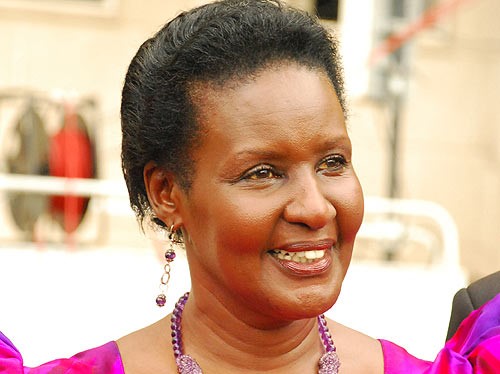
Minister of Teade Amelia-Kyambadde

Uganda is ranked 127th out of 190 economies in the global 2019 Doing Business report but Mauritius joins the group of top 20 economies this year. It is the highest ranked Sub-Saharan African economy.

The second highest ranking economies in the Sub Saharan region are Rwanda (29) and Kenya (61).South Sudan (185), Eritrea (189), and Somalia (190) are the lowest ranked economies in the region. Other large economies in the region and their rankings are Democratic Republic of Congo (184), Ethiopia (159), Nigeria (146), Tanzania (144), Sudan (162), and Uganda (127).

The region’s economies perform best in the area of Starting a Business (122). Rwanda ranks among the best globally in the Doing Business areas of Registering Property (with a rank of 2) and Getting Credit (3). In registering property, Rwanda has an efficient land registry where it takes 7 days to transfer property and costs only 0.1% of the property value, the same as in New Zealand.

Sub Saharan Africa also underperforms in the areas of Getting Electricity (145), Trading Across Borders (139) and Registering Property (131). It takes on average 112 days for a business to obtain a permanent electricity connection to the grid in Sub-Saharan Africa, compared to a global average of 86 days.

This year’s report marks the sixth year in a row that Sub-Saharan Africa leads with the highest number of business regulatory reforms captured by Doing Business.

One-third of all business regulatory reforms recorded by Doing Business 2019 were in the economies of Sub-Saharan Africa. With a total of 107 reforms, Sub-Saharan Africa has a record number for a third consecutive year.

In addition, this year also saw the highest number of economies carrying out reforms, with 40 of the region’s 48 economies implementing at least one reform, compared to the previous high of 37 economies two years ago.

The largest number of reforms implemented in the region was in the areas of Enforcing Contracts (27), followed by Starting a Business (17), and Registering Property (with 13 reforms)

17-member states of the Organization for the Harmonization of Business Law in Africa, known by its French acronym OHADA adopted a Uniform Act on Mediation in 2017 (filling a legislative void that existed in most OHADA member states) which introduced mediation as an amicable mode of dispute settlement.

Four Sub-Saharan African economies – Togo, Kenya, Côte d’Ivoire, and Rwanda made the list of global top 10 improvers this year. Over the past 12 months, collectively these economies implemented a total of 23 reforms.

Rwanda led the region in terms of the number of reforms implemented – seven in the past year, while Gabon, Guinea and Sudan were also among the notable reformers, with five reforms each.

Sub-Saharan African economies recorded eight reforms in the area of getting electricity, the highest number of any region worldwide.

Stories Continues after ad

President Museveni in South Sudan for peace day celebrations

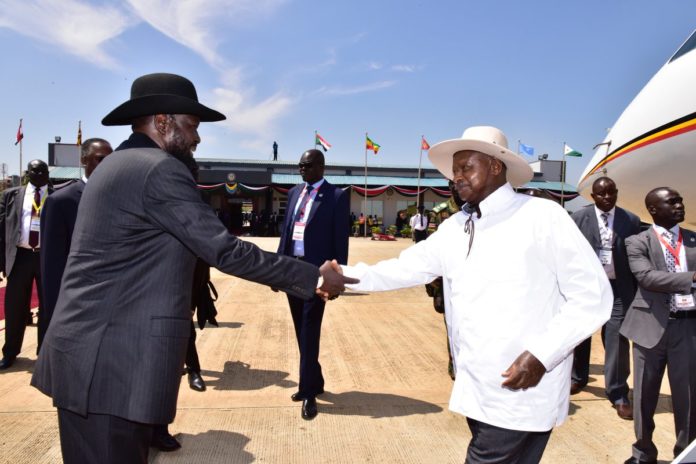
President Museveni being welcomed by his South Sudan counterpart, Salva Kiir in Juba.

President Museveni has jetted into South Sudan’s Capital, Juba ahead of the peace day celebrations proceeded by a new conclusive peace deal signed between the government of war-ravaged South Sudan and the country’s main rebel group led by Riak Machar to end conflicts.

According to the agreement, Machar will act as the first vice president, the current vice president will act as the second vice president, the third one will be a woman from opposition and the fourth will be appointed from the general public.

Rebel leader, Riek Machar returned yesterday to seal a peace deal after two years since he fled the country following the collapse of an earlier accord.

Mr. Museveni said, the long South Sudan conflict has had a huge effect on trade and people at large, for our country specifically, export revenue to South Sudan reduced by $500m, while at least a million South Sudanese sought refuge in Uganda.

“I believe with this peace process, the refugees can return home and participate in rebuilding their country,” he noted. Celebrations are scheduled to take place in john Garanga memorial stadium.

The world’s youngest nation plunged into civil war in late 2013 when troops of Kiir clashed with forces of rebel leader Machar in the country’s capital Juba, spread across the impoverished state, shutting down oil fields, forcing millions to flee and killing hundreds of thousands of people.

Machar fled to neighbouring Democratic Republic of Congo in 2016 after fierce fighting broke out again in the capital, killing hundreds. He later traveled to South Africa, where he was held under house arrest until earlier this year.

Stories Continues after ad

Sub Saharan Africa set third consecutive record of reforms to improve business climate-New report

Doing Business

Economies in Sub Saharan Africa set a new record for a third consecutive year, carrying out 107 reforms in the past year to improve the ease of doing business for domestic small and medium enterprises, says the World Bank Group’s Doing Business 2019: Training for Reform report, released Wednesday.

The latest reforms were a significant increase over the 83 reforms that were implemented in the region the previous year. In addition, this year also saw the highest number of economies carrying out reforms, with 40 of the region’s 48 economies implementing at least one reform, compared to the previous high of 37 economies two years ago.

Four of the region’s economies have earned coveted spots in this year’s global top improvers, Togo, Kenya, Côte d’Ivoire, and Rwanda. And, Mauritius regained a spot in the world’s top ranked economies, in 20th place. Five reforms were carried out in Mauritius during the past year, including the elimination of a sole gender-based barrier.

In the area of Starting a Business, Mauritius equalized the business registration process for men and women and further consolidating the registration process for all applicants. Minority investor protections were strengthened by clarifying ownership and control structures and introducing greater corporate transparency.

Reforms were also carried out in the areas of Registering Property, Trading Across Borders and Paying Taxes. Rwanda carried out the most reforms in the region in past year, with seven, and moved up to 29th rank globally. The latest improvements in Rwanda, which has carried out the most reforms since the inception of Doing Business 16 years ago, included making starting a business less costly by replacing electronic billing machines with free software for value added tax invoices.

In Registering Property, an area in which Rwanda is second only to New Zealand in the world, new land dispute resolution mechanisms made property registration easier. A new insolvency law strengthened access to credit, another area in which Rwanda excels, and made it easier to resolve insolvencies by making insolvency proceedings more accessible for creditors and granting them greater participation in the proceedings.

Other reforms in Rwanda were in the areas of Trading Across Borders and Getting Electricity. Kenya implemented five reforms, advancing to 61 st rank. One reform included the introduction of a new law which helped further strengthen access to credit. This latest reform catapulted Kenya to 8th rank in the world in the area of Getting Credit.

Kenya also made it easier for businesses to pay taxes by consolidating permits and utilizing the country’s iTax platform, while an online system helped make property registration easier. Other improvements strengthened minority investor protections and made it easier to resolve insolvencies.

Notable reforms in Côte d’Ivoire and Togo included the introduction of online systems for filing corporate income tax and value added tax returns, making it easier for businesses to pay their taxes. In Côte d’Ivoire, which carried out five reforms, access to credit and construction quality controls were also strengthened and business registration and enforcing contracts were made easier.

In Togo, which carried out six reforms, business registration was made easier with a reduction of minimum capital requirement and enforcing contracts was made easier with the adoption of a new law on mediation, among other reforms. Nigeria carried out four reforms which included making Starting a Business easier in Kano and Lagos, the two cities covered by Doing Business.

Getting Electricity and Trading Across Borders also saw reforms in the two cities. In addition, Lagos made Enforcing Contracts easier by issuing new rules of civil procedure for small claims courts, while Kano, in a negative move, made property registration less transparent by no longer publishing online the fee schedule and list of documents necessary to transfer a property.

Elsewhere in the region, Ethiopia carried out three reforms to make it easier to register a new business, enforce contracts and obtain construction permits, while two reforms in South Africa improved the monitoring and regulation of power outages and reduced the time needed to start a new business.

Regionally, much of the reform activity in the past year focused on improvements in the area of Enforcing Contracts, with the region’s 27 reforms accounting for more than half of the reforms recorded in this area globally. The uptick was the result of reforms carried out by the 17-member states of the Organization for the Harmonization of Business Law in Africa (OHADA).

The organization adopted a Uniform Act on Mediation in 2017, which introduced mediation as an amicable mode of dispute settlement. Starting a Business saw 17 reforms, which largely focused on reducing the time to obtain a business license, by streamlining existing services or introducing new online solutions.

Burundi, the region’s top-ranking economy in this area with a global rank of 17, further reduced the cost needed to register a new business. “It is a year of records for Sub-Saharan Africa. The significant acceleration in the reform effort over the past year and spanning several years is a testament to the strong impetus for change in in the region.

A more efficient business environment, in which private enterprise thrives, is a fundamental building block for job-creation and growth,” said Santiago Croci Downes, Program Manager of the Doing Business Unit. The region’s economies perform best in the areas of Getting Credit and Starting a Business, with four economies – Kenya, Malawi, Rwanda and Zambia – ranked among the world’s top 10 in Getting Credit ranking.

And, on average, it now takes 21 days and costs 39 percent of income per capita to start a new business in the region, compared with 61 days and 305 percent of income per capita in 2003, when Doing Business was first published. And the minimum capital requirement has been eliminated in a majority of economies and drastically reduced in others.

The region underperforms in the areas of Getting Electricity and Trading Across Borders. For example, it costs on average 3456.5 percent of income per capita for a business to get connected to the electrical grid, compared to 1229 percent globally. And it takes 98 hours to comply with documentation requirements to import, compared with 61 hours globally.

Stories Continues after ad

Desabre names provisional squad for decisive game against Cape Verde

Uganda Cranes head coach desabre.

Uganda Cranes Coach Sebastien Desabre is on the verge of taking the Uganda Cranes team to the 2019 AFCON tournament in Cameroon come next year.

Cranes are top of Group L with ten points and need just one point from the remaining two fixtures to make back to back appearance at the AFCON Finals.

Uganda has two matches lined up starting with the 2019 AFCON Qualifier against Cape Verde on 17th November and Super Eagles of Nigeria on 20th November in a friendly game away at Asaba Stadium.
Emmanuel Okwi will be suspended for the Cape Verde game due to accumulation of yellow cards but will be in contention to face West African giants Nigeria in the international friendly.

“The non-residential training programme will start on 9th November with 14 local based players at Lugogo. The 16 foreign based players summoned will join camp as per FIFA stipulated international break rules” FUFA Communications Manager Ahmed Hussein told the fufa website.

The 2019 AFCON tournament will be hosted in Cameroon. The competition will be held in June and July 2019 to move it from January/February for the first time. It will also be the first Africa Cup of Nations expanded from 16 to 24 teams.

Uganda Cranes Squad:
Goalkeepers: Denis Onyango (Mamelodi Sundowns), Jamal Salim (El Meriekh), Charles Lukwago (KCCA FC), Nicholas Sebwato (Onduparaka FC).
Outfield players: Isaac Isinde (Kirinya Jinja SS), Murushid Juuko (Simba SC), Timothy Awanyi (KCCA FC), Denis Iguma (Kazma FC), Nicholas Wadada (Azam FC), Godfrey Walusimbi (Kaizer Chiefs) FC, Isaac Muleme (Haras El Hodood), Bernard Muwanga (KCCA FC), Yayo Kato Lutimba (Vipers SC), Joseph Ochaya (TP Mazembe), Hassan Wasswa (El Geish), Khalid Aucho(Church Hill Brothers, India), Ibrahim Saddam Juma (KCCA FC), Tadeo Lwanga (Vipers SC), Allan Kateregga (Cape Town City), Faruku Miya (Gorica ), Ambrose Kirya (Sc Villa), Moses Waisswa (Vipers Sc), Milton Karisa (MC Oujda), Allan Kyambadde (KCCA FC), Dan Serunkuma (Vipers SC), Vianne Sekajugo (Onduparaka FC), Emma Okwi (Simba SC), Edrisa Lubega (SV Ried), Derrick Nsibambi (Smouha), Patrick Kaddu (KCCA FC).

2019 AFCON Qualifiers
Saturday, 17th November 2018
Uganda Vs Cape Verde
Mandela National Stadium, Namboole (4pm)

International friendly match
Tuesday, 20th November 2018
Nigeria Vs Uganda
Stephen Keshi Stadium, Asaba

Stories Continues after ad