Stanbic Bank
Stanbic Bank
18.4 C
Kampala
Stanbic Bank
Stanbic Bank
Home Blog Page 1443

East Africa now biggest destination for FDI, with Uganda attracting 14 projects

Uganda is attracting FDI in Energy sector.

East Africa continued to register notable GDP growth in 2017, performing stronger than all other regions across the continent, according to Ernst & Young (EY) Global’s 2018 Africa Attractiveness report.

According to the report, East Africa attracted 197 projects or 30 per cent of the continents total foreign direct investment (FDI). The region also the region recorded a 82 per cent increase in the number of FDI projects last year compared with 2016.

“This shifting investment landscape is a function of numerous factors, including multi-speed growth, investment friendly economic policies and, to some extent, regional integration initiatives, particularly in the east of the continent where the East African Community made up of Burundi, Kenya, Rwanda, South Sudan, Tanzania and Uganda has been successful in increasing economic growth since its formation,” the report says.

“This evident rise is from a rather low base in 2016, when the region’s share of FDI projects fell sharply. The FDI numbers in 2017 not only recovered from the prior year, but also made the region Africa’s major FDI hub for the first time,” the report adds.

Kenya, the region’s leading economy, reported a 68 per cent increase in inward investment projects last year, despite political uncertainty in the second half of the year following a prolonged election cycle.

Major oil discoveries also put Uganda on the investment atlas, with the country attracting 14 FDI projects in 2017, up from nine in the previous year,” the report says.

British investors were particularly active, with 10 project commitments, followed by Dutch companies.

Ethiopia, which was Africa’s second-fastest growing economy in 2017 saw its consumer products and retail (primarily textiles), real estate, hospitality and construction sectors collectively responsible the surge in FDI to the country last year.

“Looking ahead, the recent opening up of the telecoms, shipping, power generation and aviation sectors to foreign investment will prove to be a further boost to investor interest,” the reports said.

Tanzania also saw a sharp rise in FDI projects, attracting nine projects, mostly in infrastructure, as well as private investment in the development of a regional hydrocarbons sector.

The FDI projects have been tracked against the size of the economy, and its score on the annual World Bank Ease of Doing Business ranking. Through this analysis, it appears that countries with strong growth rates and that adopt more business-friendly policies tend to perform better in attracting FDI.

Rwanda is, by far, Africa’s most successful country in terms of attracting FDI. This is evidenced by the fact that Rwanda ranks as one of Africa’s most business-friendly destinations. It is also one of the continent’s most consistent rapid growth economies.

Rwanda receives 1.5 FDI projects for every US $1 billion of GDP. Measured on the same criteria, South Africa receives only 0.32 projects, attracting only 20 per cent of what Rwanda does, given its relative size.

“Major economies, such as Nigeria and Angola trail by an even larger margin, receiving only 0.16 and 0.02 projects respectively. Both countries also rank very low on the Ease of Doing Business rankings compared with their counterparts in the continent. That, coupled with their recent low growth after plunging oil prices in 2016 and the same scenario persisting in 2017, would explain their low score according to this methodology,” reads the report.

Stories Continues after ad

U.N. commends Uganda for integrating refugee pupils

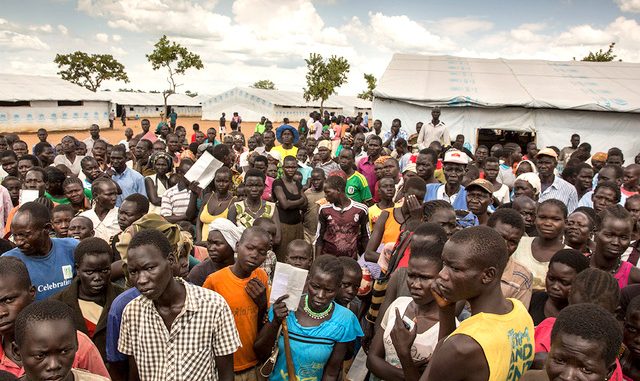
Refugees in Uganda

Other countries should educate refugees in national schools to help them integrate, the United Nations said on Tuesday, praising Uganda and Chad as poor countries setting an example.

About 4 million child refugees were out of school in 2017, the U.N.’s cultural agency, UNESCO, said, which meant they not only lost their right to education but that host nations also missed a chance to integrate people from different communities.

“Experience suggests that the inclusion processes have been very positive,” said Manos Antoninis, director of UNESCO’s annual Global Education Monitoring Report.

“The longer (refugees) stay separate, the more they feel alienated,” he told the Thomson Reuters Foundation.

Wars, persecution and other violence drove a record 68.5 million people from their homes in 2017, the majority uprooted inside their own countries while 25 million were refugees, according to the U.N. refugee agency.

World leaders agreed in New York in 2016 to ensure that all refugee and migrant children receive education within a few months of arrival in a host country.

But asylum-seeking children in Australia have limited access to education, Rohingya in Bangladesh can only attend separate, non-formal schools, and many refugees in Africa are confined to camps, making it harder to get jobs afterwards, UNESCO said.

“The hope is that in the future governments all over the world will be more reluctant to exclude refugees and put them in separate schools,” said Antoninis.

Only six in 10 refugee children were enrolled in primary school and one in four in secondary school last year, UNESCO said.

Uganda, which hosts the largest number of refugees in Africa at 1.4 million, brought humanitarian and development agencies together this year to create mixed schools for refugees and host communities, it said.

Chad, which hosts some 450,000 refugees, has developed a temporary education plan for refugees while it adapts the national system to include them, a first in Africa, UNESCO said.

The government has sent Chadian teachers to refugee camps to ease the transition, and this year converted 108 refugee schools into regular public schools that will also benefit locals, said Antoninis.

It has also trained teachers from among the refugee population to be able to teach in Chadian schools, he said.

But education remains a low priority in many places where people have fled conflict, experts said.

“During emergencies, education is not given the attention it deserves as a life-saving intervention,” said Euloge Ishimwe, a spokesman for the International Federation of Red Cross and Red Crescent Societies (IFRC) in Africa.

“Many people do not know that education in emergencies … brings about a sense of normalcy and hope that in itself can empower communities to protect themselves from harm.”

Reporting by Nellie Peyton; Editing by Katy Migiro. Please credit the Thomson Reuters Foundation, the charitable arm of Thomson Reuters, that covers humanitarian news, women’s and LGBT+ rights, human trafficking, property rights, and climate change. Visit news.trust.org

Stories Continues after ad

Seven steps to meeting your goals with your new venture

Martin Zwilling

By Martin Zwilling

Successful entrepreneurs are usually hard-driving, and highly focused on some specific goals, like being the dominant player in a given domain, or the low-priced provider of their product. Yet other entrepreneurs will talk for hours about all their ideas, and how they intend to change the world, but I don’t hear any specific goals or milestones.

Many people are very hesitant to set specific goals, due to lack of self-confidence or whatever. The result is that they don’t ever get anywhere, because they never really knew where they wanted to go. If you find yourself in this category, try the following simple steps highlighted by Brian Tracy in his classic book “No Excuses: The Power of Self-Discipline”:

Decide exactly what you want. If you want to increase your income, decide on a specific amount of money, rather than just “make more money.” Without precise goals, you can’t measure progress, and you miss the real satisfaction of knowing when to declare success.

Write it down. A goal that is not written down is like cigarette smoke; it drifts away and disappears. It is vague and insubstantial. It has no force, effect, or power. It’s too easy to forget or push aside when outside forces arise that you hadn’t anticipated – and they will. On the other hand, most people don’t hesitate to write down excuses.

Set a deadline with specific milestones. Pick a reasonable time period and write down the date when you want to achieve it. If it is a big enough goal, set intermediate milestones for measurement reference points. The rule is “There are no unrealistic goals; there are only unrealistic deadlines.” Don’t be afraid to change the deadline – for cause.

Make a list of things you need to do to achieve your goal. The biggest goal can be accomplished if you break it down into enough small steps. Make a list of obstacles and difficulties, knowledge and skills required, necessary people, and everything you will have to do to meet the goal. Add to these lists as you learn more.

Organize your list by both sequence and priority. A list organized by sequence requires that you decide what you need to do in what order. A list organized by priority enables you to determine what is more important. Then develop a business plan which embodies all of the above.

Take action on your plan immediately. Don’t delay. Move quickly. Procrastination is the thief of time, and it shortens your life. Winners in life take the first step now. They are willing to overcome their normal fear of failure and disappointment, and take a small step, and then other one, until they reach the goal.

Do something every day that moves you in the direction of your major goal. This is the key step that will guarantee your success. Do something every day that moves you at least one step closer to the goal. In this fashion, you develop momentum, which further motivates, inspires, and energizes you. Soon it becomes automatic and easier.

You can’t control the future, and that’s not the purpose of goal setting. It’s also a recipe for failure to assume that the path to your goal will require suffering and sacrifice. In fact, the whole objective of all steps above is to allow you to avoid stress and suffering, and be more fully motivated by your progress.

As you adopt a goal-setting mindset, you will find yourself setting different kinds of goals. These are lifetime goals, not just a collection of near-term objectives. It’s these really big objectives, that seem unachievable even to you right now, that will inspire you the most, and motivate you to real success and happiness.

Stories Continues after ad

UCDA recognized for competency in analysis and coffee testing

Uganda coffee for export

Uganda National Bureau of Standards has recognized Uganda Coffee Development Authority’s (UCDA) laboratories for competency in analysis and testing of coffee.

The standard recognition is awarded to laboratories that have demonstrated that their management and technical operations meet the international standard requirements.

This has made UCDA’s laboratories located at UMA show ground in Lugogo and Coffee House the first coffee laboratories in Uganda to get recognized against an international standard for laboratory quality management system to ISO 17025:2005.

The process of getting recognition involved the development of the laboratory quality manual of policies, standard operating procedures, adoption of lab quality policy, training and awareness of the staff on ISO 17025:2005 standard.

It also involved review of the procedures for sampling and analysis of coffee samples to avoid conflict of interest, Validation of analytical methods to ensure quality results and redesigning of the laboratory infrastructure to separate activities and introduction of a digital monitoring system for the laboratory operating environment.

Benefits

Laboratory operations have been standardized resulting into improved accuracy of analytical results, elimination of conflict of interest and increased operational efficiency reducing the turnaround time significantly.

The recognition has further assured our clients that results and services generated from our laboratory meet international standards for wider acceptance and trust of our quality certificate.

In addition to physical and sensory analysis the labs are also performing biochemical analysis on export coffees to guarantee food safety and quality. This has brought consumer confidence in Ugandan coffee especially for importing countries like Sudan and Europe that we hope will result into increased export volumes.

Stories Continues after ad

Cosase probe: Bagyenda in possession of documents of defunct banks

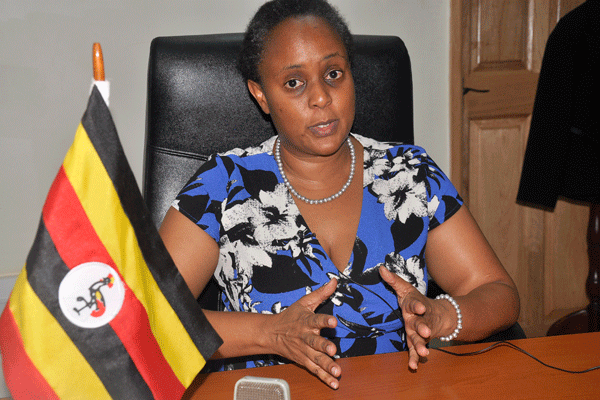
Embattled former Executive Director in charge of Supervision at Bank of Uganda Justine Bagyenda.

The former Bank of Uganda Executive Director in charge of Supervision, Ms Justine Bagyenda left office with documents of some of defunct banks after being sacked by her boss Emmanuel Tumusiime-Mutebile, a senior bank officer has said.

Ms Bagyenda was controversially sacked by Tumusiime- Mutebile in February 2018, six months before her official retirement. As executive director of supervision, her role was to ensure the stability of the banking industry but her boss sacked her after the Crane Bank scandal emerged.

Ms Bagyenda was heavily involved in the controversial closure and sale of Crane Bank Limited (CBL) to its rival Dfcu Bank in January 2017 at Shs200 billion paid in installments, the central bank, having spent Shs478 billions of taxpayers’ on CBL before it sold it to Dfcu Bank.

Sources say Ms Bagyenda went home with most of the defunct banks’ documents after her unceremonious dismissal from BoU. Her intention, inside sources say, is to teach those who were behind her exit a lesson. It is the reason why BoU officials appearing before the on-going probe by Parliament’s Committee on Commissions, Statutory Authorities and State Enterprises (Cosase), don’t have all the required documents of defunct banks.

Monday and Tuesday have been the toughest days for BoU officials as they were unable to have certain documents required by Cosase. The Governor Tumusiime-Mutebile also has said he doesn’t have all the information on defunct banks in his office, for example the 23 land titles of clients of Teefe Trust Bank. Sources say Director, Financial Markets Development Coordination Benedict Ssekabira informed a section of Cosase MPs that it is Bagyenda to blame. It is alleged that Bagyenda picked the documents at BoU on the weekend and that is why it is hard for the central bank team to present them before the committee.

It has become a habit for the BoU officials to ask for time to check their archives for documents but in reality, sources say, some of the documents are being held Ms Bagyenda. BoU’s legal department which should be in position of any document to do with BoU business is confused. But MPs on Cosase have insisted they want the documents that include minutes of meetings and others.

Sources within BoU say Ms Bagyenda worked closely with BoU’s deputy governor Dr. Louis Kasekende in the closure and liquidation of some of the banks for instance CBL whose closure caused the on-going Cosase probe that so far has not gotten satisfactory answers from the BoU. The problem has been the official’s failure to avail them with all the documents related to defunct banks.

Ms Bagyenda is expected to appear before Cosase on Thursday to explain her role in the dissolution of some of the banks that were said to be insolvent or undercapitalised. Like Dr. Kasekende Ms Bagyenda is under investigation by the Inspector General of Government (IGG) for the alleged illegal accumulation of wealth, which some analysts believe could be result of her ill-dealings while performing her duties then at BoU.

Recent leaked bank documents showed Ms Bagyenda and Dr. Kasekende as stashing billions of shillings on their accounts. The two individuals also own properties in Kampala and Wakiso districts worth billions of shillings to the extent that some were not declared to the office of the IGG as required the Leadership Code Act2002.

Both officials say they got their properties through hard work and right channels and deny they used their positions at BoU to amass wealth illegally. The public is waiting for what the on-going investigation will come out with as regards their wealth.

Stories Continues after ad

Uganda to host 3rd Community Based Rehabilitation in 2020

General Moses Ali

Uganda is set to host the 3rd Community Based Rehabilitation (CBR) World Congress in July 2020, peddled at increasing awareness on the rights and needs of persons with disabilities.

Under the theme “Empowering and Enabling”, the 2nd CBR World Congress was held in in Kuala Lumpur, Malaysia and more than 1000 delegates from 78 countries where delegates reflected on the achievements of community-based rehabilitation (CBR), its future direction and the role of CBR as an inclusive development strategy.

According to cabinet meeting chaired by first deputy Prime Minister Gen. Moses Ali, resolved that Good practices shared on CBR and Inclusive Development from different Countries, will help facilitate improved Service Delivery to persons with disabilities.

They resolved that the meeting will avail a chance for a country to draw Strategies for poverty reduction among persons with disabilities and will be adopted from experiences of other Countries, Sustainable collaboration among stakeholders and Development Partners.

The congress comes with a great potential for assisting low- and middle-income countries to achieve related SDG targets and to implement the Convention on the Rights of Persons with Disabilities.

It was noted that further research is required to continue documenting the success of CBR as a development strategy in addition an appeal was made to amplify its success by ensuring that CBR is facilitated by authorities from a broader range of sectors and institutions, including UN agencies.

Stories Continues after ad

Victoria University awards students with CGPA of 4.4 and above

Chancellor of Victoria University Dr. Krishna N. Sharma rewarding one of the students

One of Victoria University’s core values is excellence in all that they do. Over the weekend, the Vice Chancellor of Victoria University Dr. Krishna N. Sharma was very pleased to recognize twenty one students who attained a CGPA of 4.4 and above in the last semester.

These are the students who made it to the coveted Vice Chancellor’s list. The students had dinner with the Vice Chancellor and the Senior Management Team.

The occasion was crowned with a presentation of a Certificate of Achievement to each one of them. This was on Saturday 17th November 2018; a day that has gone down in the annals of our University and will always be cherished by the beneficiaries. The occasion was held at Fang Fang Chinese Restaurant-roof top of Communications House.

The Academic Registrar of Victoria University Kampala Uganda, Mrs. M. G. Katusabe -Ssemwezi said that, “The objective of the Vice Chancellor’s Dinner is to recognize Victoria University undergraduate students who excel academically with a CGPA 4.4 and above.”

Ms. Alice Akurut, a student of Bachelor of International relations and Diplomatic studies that made it to the VC Dinner list said, “Saturday was lovely and couldn’t have wished for anything better. Thank you for recognizing our efforts and we hope it will be a motivation to others in turn. Thank you Vice Chancellor, Academic Registrar, Deans plus Marketing team for making us feel at home.”

VC with some of the best students.

Victoria University, Kampala Uganda has for some years now become Uganda’s leading state-of-the-art University. The University stands out as a pivot of academic excellence, offering a fresh and intellectually thriving environment that nurtures critical and progressive thinkers.

The institution is committed to the advancement of higher education worldwide. Currently they have students from countries such as Congo, Nigeria, Ghana, Pakistan, India, South Sudan, Kenya, Tanzania, Rwanda, Burundi, Eritrea, Somalia among others by establishing exemplary education tailored to the needs of the African Market, with the courses offered strategically focused at employment-oriented education and aimed at Creating Scholars empowered to provide cutting edge solutions.

Leadership, Critical Thinking, Excellence, Leadership, Student, Centeredness, Professionalism, Innovation, Passion, Humanity and Integrity are the core values that are part of the Victoria University experience.

At Victoria University, they have international and local collaborations, so the students are assured of extensive hands on training every semester. This enables them acquire distinctive skills and knowledge of a working environment and making them competitive anywhere they will be after graduating from Victoria University.

Victoria University is a research active institution where students enjoy the benefits of working with experts who are well informed and up to date with new research and developments in their respective disciplines.

The university is centrally located in the heart of Kampala City and on the main public transportation routes coupled with ample parking space. It was opened in August 2010 and has the capacity, the facilities and determination to revitalize higher education in Uganda and the region.

The excelling students were from all the Faculties pursuing the following programmes of study which are indicated against their respective names in the table below;

NO

NAME

FACULTY

PROGRAMMES

CGPA

1 Peter Isiko

Faculty of Science and Technology

Bachelor of Computer science

4.59

2. Shalom Mwesigwa

Faculty of Science and Technology

Bachelor of Computer science

4.71

Nigisti Habtemariam Kidane

Faculty of Health sciences

Bachelor of Nursing science

4.7

2. Kahambu Kapakasi

Faculty of Health sciences

Bachelor of Nursing science

4.5

1. Mariah Peggy Nabunya

Faculty of Health sciences

Bachelor of Public Health

4.6

2. Aaron Sempa Kitratius

Faculty of Health sciences

Bachelor of Public Health

4.6

1 Hussein Ahlam Abdulhakim

Faculty of Business and Management

Bachelor of Business Administration

4.67

2 Emmanuella Bira Alika

Faculty of Business and Management

Bachelor of Procurement and Logistics

4.5

3 Patrick Wafubwa Nawinyi

Faculty of Business and Management

Bachelor of Procurement and Logistics

4.89

4 Juliet Nakasinde

Faculty of Business and Management

Bachelor of Tourism and Hotel management

4.64

1 Joyce Nakito Chukuna

Faculty of Humanities and social sciences

Foundation program

4.63

2 James Kasozi Musinguzi

Faculty of Humanities and social sciences

Bachelors In Journalism And Media Studies

4.50

3 Maureen Atukei

Faculty of Humanities and social sciences

Bachelors Of International Relations And Diplomatic Studies

4.60

4 Alice Akurut

Faculty of Humanities and social sciences

Bachelors Of International Relations And Diplomatic Studies

5.00

5 Angella Linda Aruo Akiror

Faculty of Humanities and social sciences

Bachelors Of International Relations And Diplomatic Studies

4.90

6 Aisha Asta Toure

Faculty of Humanities and social sciences

Bachelors Of International Relations And Diplomatic Studies

5.00

7 Cynthia Rutaro

Faculty of Humanities and social sciences

Bachelors Of International Relations And Diplomatic Studies

4.54

8 Johnathan Tigityabo

Faculty of Humanities and social sciences

Bachelors Of Human Resource Management

4.70

9 Allen Shayna

Faculty of Humanities and social sciences

Bachelors Of Social Work And Social Administration

5.00

10 Alberta Horlu

Faculty of Humanities and social sciences

Bachelors Of Social Work And Social Administration

4.70

11 Teddy Meliisa Nankya

Faculty of Humanities and social sciences

Bachelors Of Social Work And Social Administration

5.00

Stories Continues after ad

UNBS hosts ISO training on marketing and communication of standards for developing countries

Patricia Bageine Ejalu

The Uganda National Bureau of Standards (UNBS) is hosting the ISO Marketing and Communication training workshop on marketing and communication of standards for developing countries.

The workshop is in line with the ISO action plan for developing countries 2016-2020 which aims to support the development and/or strengthening of the national quality infrastructure (NQI) of developing countries and promote increased involvement of developing country members in international standardization.

The training workshop is expected to attract a total of 35 participants from English from Angola, Botswana, Burundi, Eritrea, Ethiopia, Gambia, Ghana, Kenya, Malawi, Mauritius, Mozambique, Namibia, Nigeria, Niger, Rwanda, Seychelles, Sierra Leone, South Africa, Sudan, Swaziland, Tanzania, Zimbabwe, Zambia.

Speaking at the opening ceremony held at Golden Tulip Kampala, the UNBS Deputy Executive Director in charge of Standards Mrs. Patricia Bageine Ejalu welcomed the international experts to Uganda and recognised the work being done by each country in the international standardisation.

Mrs. Ejalu said, “Uganda, as a member in ISO has been active since 1989 and we have been committed to participating in ISO technical committees particularly to promote the competitiveness of Ugandan products on the international market.”

Mrs. Ejalu noted that the workshop is important to close the significant communication gaps and fully exploit the value of standards.

Participation of developing countries in international standardization is also essential to ensure the global relevance of ISO standards and contribute to the access of developing countries to world markets, technical progress and sustainable development.

The workshop will take place from 20th-22nd November 2018 at Golden Tulip, Kampala.

Stories Continues after ad

Cosase quiz BoU staff on Nile River Acquisition Company as documents go missing

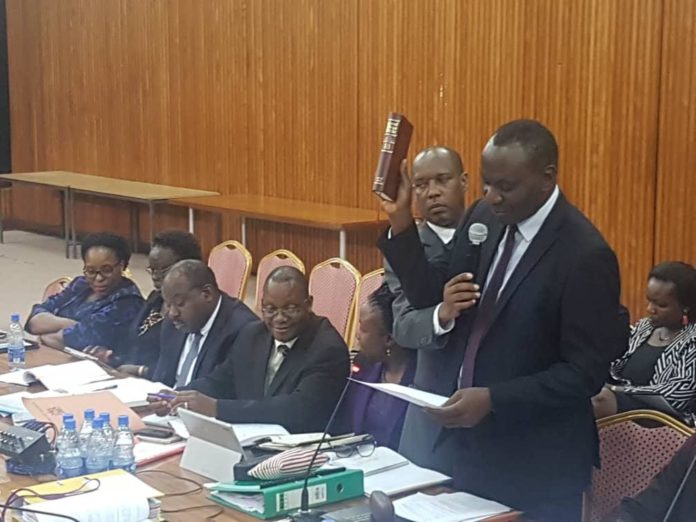
BoU executives taking Oath before MPs.

Parliament’s Committee on Commissions, Statutory Authorities and State Enterprises (Cosase) on Tuesday blasted the Bank of Uganda (BoU) top officials for engaging in business with the mysterious Nile River Acquisition Company as the company bought off secured debts of International Credit Bank (ICB), Greenland Bank and Cooperative Bank at Shs8.89 billion representing a 26 percent discount of the total secured loans.

“The loan portfolio sold included secured loans of Shs34.5 billion which had valid, legal or equitable mortgage on the real property and were supported with legal documentation. I noted that the contract price of Shs.8.898 billionn represented 26% of the total secured loan portfolio and 7 percent of the total loan portfolio implying that the loans were sold at a discount,” The Auditor General John Muwanga says in his special audit report of BoU on defunct banks.

“I was unable to determine the cafeteria used by BOU in deriving the sale value (Shs8.89 billion),” Mr. Muwanga said in his report that the MPs are using to pin BoU top gurus. When Cosase Chairman Abdu Katuntu asked the BoU officials the minutes and basis of the 26 percent discount, the BoU officials didn’t have any.

However, they explained that: “Estimating the recoverable amount of a closed bank’s loan portfolio cannot be done with precision. Because of uncertainty in the recoverable value and the costs related to recovery, is always true that any buyer will be unwilling to pay the full book value of a portfolio of bad debts. It is inevitable that these portfolios will always be sold at a discount.”

Process

The purchase of the loans stretches from 2006 when BoU designed a strategy to exit the liquidation of the three closed banks which involved; assessment/ evaluation, packaging and bulk selling of the remaining assets of the closed banks so that the proceeds can be distributed among creditors.

BoU would Subsequently, BoU carried out a competitive procurement process including public advertisement, evaluation of bidders and selection of a suitable firm to implement the strategy.

The Central Bank would later hire M/S J.N. Kirkland & Associates on January 17, 2007 to implement the exit strategy for closed banks’ liquidations and the assignments commenced on January 29, 2007.

JN Kirkland & Associates would later contract M/s American Octavian Advisors, LP which expressed interest to purchase the assets at JUST over US$10 million. The latter company would further register Nile River Acquision Company (NARC) in Mauritius in order to transact with BOU, buying the secured loans at Just over US$5 million (Shs8.89 billion).

MP Katuntu was disturbed that BoU officials, as it has become their habit, did not come with all the required documents of the transaction and tasked them to come with more left behind, if any exists. Katuntu was also bitter that the bogus transaction left government without taxing NARC, as it registered in Mauritius which is a tax haven.

It later emerged that BoU gave powers of attorney to JN Kirkland as it solicited for the buyers of the assets of the three banks, yet it went ahead to put taxpayers’ money in the process, including investing in the due diligence on M/s American Octavian Advisors, LP.

Stories Continues after ad

DFCU Bank disputes media reports on controversial transactions

Mr. Jimmy Mugerwa, the board chairman of Dfcu bank who is accused by some shareholders for the bank's poor management.

Following media reports that DFCU Bank was involved in controversial transactions as it bought off Global Trust Bank Uganda (GTBU) and Crane Bank Limited (CBL), its company Secretary Agnes Tibayeita Isharaza, has issued a media statement, saying the reports have no any truth pinning the Chief Executive Officer Juma Kisaame and Bank Chairman Jimmy D. Mugerwa.

The two officials are among those in the bank that held discussions with the Bank of Uganda (BoU) top officials as their bank bought especially Crane Bank Limited in January 2017. BoU top officials are currently being probed by Parliament’s Committee on Commissions, Statutory Authorities and State Enterprises (Cosase) over the liquidation and sale of seven commercial banks.

Sources say Mr. Kisaame and Mr. Mugerwa are lined up to appear before Cosase in regard to Global Trust Bank and CBL transactions.

The Auditor General John Muwanga’s special audit report of BoU on defunct banks, questions why BoU had to spend over Shs400 billion of taxpayers’ money on CBL during the takeover and yet sold the assets and liabilities of the bank at a paltry Shs200 billion, moreover paid in installments.

On DFCU Bank’s purchase of GTBU, the Auditor General says: “I observed that there were no guidelines /regulations or policies in place to guide the identification of the purchasers of GTBU. There were also no guidelines to determine the procedures to be adopted by the Central Bank in the sale of assets and transfer of assets or liabilities of the defunct banks to DFCU.”

He continues: “I was not provided with records of the procurement process to ascertain the bid requirements, offers made, list of bidders, evaluation criteria, evaluation report and negotiation minutes leading to the P& A agreement. In the absence of guidelines and procurement records, I could not ascertain whether BOU selected and evaluated the bids in line with the evaluation criteria.”

On CBL: However I was not provided with the negotiation minutes leading to the P&A agreement, In the absence of guidelines and negotiation minutes, I could not determine how BOU selected the best evaluated bidder and how the terms in the P&A were determined.

Despite such concerns from the Auditor General, DFCU Bank’s Company Secretary, Ms Isharaza thinks otherwise, saying the media has been reporting falsehoods.

“Over the past several weeks there has been false, misleading or fictitious information on social media and in articles disseminated on some online publications about the Bank, its Chairman Mr. Jimmy D. Mugerwa and the Chief Executive Officer Mr. Juma Kisaame,” she says.

Relatedly the news outlets months ago reported that there would be changes in the management team of DFCU Bank it this has happened with the appointment of William SSekabemba as Managing Director and Mathias Katamba as the In-coming new CEO. The changes were announced in the local media. But the changes came as a result of Kisaame seeking resignation due to the poor handling of DCFU Business in relation to CBL purchase.

In what looked like loss of confidence and interest, CDC Group, expressed interest to sell their commercial interests in DFCU Bank, information which the media published yet DFCU officials in Kampala would come up later to say it was not true.

The letter from Irina Grigorenko, CDC’s Investment Director in charge of Financial Institutions, would later silence the DFCU officials in Kampala when it indicated that indeed the Group was looking for buyers of its shares in DFCU Bank.

“It is our aspiration to exit in a manner that causes minimum disruption to the business and ensures the orderly trading of DFCU’s shares.” Grigorenko said.

The “false information” which DFCU Bank says it has been used to tarnish its name has actually come out to be true. And with then ongoing Cosase probe, more will come out to show that the deals DFCU Bank got involved in were not all clean.

Stories Continues after ad