Stanbic Bank
Stanbic Bank
21.2 C
Kampala
Stanbic Bank
Stanbic Bank
Home Blog Page 1446

Eight key skill sets required for success in your startup

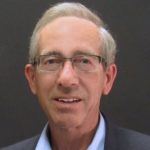
Martin Zwilling

By Martin Zwilling

In my experience in large businesses as well as years of advising startups, I see far too much focus on product skills, and too little on people and process skills. In my view, this focus on the wrong skill set is the primary reason why over half of new businesses fail in the first five years, and only one out of a hundred startups get their requested funding from professional investors.

In fact, there is much evidence that the same principles separate success from mediocrity in most of the disciplines in business. I recognized this as I was reading the classic book, ”The Only Sales Guide You’ll Ever Need,” by Anthony Iannarino, who is an international sales leader and expert on optimizing results. His focus is on sales, but I see the same skills needed for entrepreneurs.

His top eight required skill set elements for sales don’t even mention product skills, and match my view of the right skill set for successful entrepreneurs, with only a few priority changes:

Creating and sharing a vision: Storytelling and projecting a vision are foundational skills that are required from the first moment in starting a business. The old myth that “if we build it, they will come” has not worked for a long time. The best visions begin in the future, describe how to get there together, touch on emotions, and work in your values.

Diagnosing and understanding the customer problem: This means all business people, especially entrepreneurs, need to get beyond the presentations and the experts, to actively listen to real customers. They need to ask customers the difficult questions, and really understand costs versus benefits, as well as competitive alternatives.

Opening relationships and creating opportunities: Whereas providers used to control information, the Internet has given customers access to more information and more choices than ever. They demand interactive relationships with you, and depend on the relationships you have with their friends. Relationships are the new keys to opportunities.

Producing results with and through others. You can’t build a business or sell alone. You have to lead and motivate many others with the right skill set to make it happen. To do this, you call upon your storytelling, negotiating, and change-management skills, all the while demonstrating your unswerving accountability. It’s up to you to clear the way.

Asking for and obtaining commitments: Building a company and selling are all about gaining commitments. While it’s true that you can go too far too fast when asking for funding or asking for an order, all too often fear and timidity keeps entrepreneurs from going far enough fast enough. Offering more value is the key to a quicker close.

Negotiating and creating win-win deals: When dealing with customers or partners, only win-win deals make sense. It’s all about value for both parties, and good negotiation is highlighting value. Great entrepreneurs are able to think on their feet, and are always prepared. Highlight the points of agreement, rather than hammer on the differences.

Understanding business essentials and creating value. Product leadership alone might have been enough in the past, but today people are looking at a bigger picture. They want a business that is ethical, understands sustainability, and provides leadership that goes beyond profitability for shareholders. Value is far more than cost versus price.

Building consensus and helping others change:Consensus and change are hard. These require building a team that can work together, identify the obstacles to change, deal with conflicting interests, and overcome the challenges to change. Great entrepreneurs create and sell a compelling case for change, and lead that change.

Put simply, your personal and people skills are the difference that makes the difference, more so than the product or service you bring to the table. It takes discipline, initiative, a positive attitude, and the ability to communicate and be accountable to set your business apart from the million others that have equal access to your customers. Make them remember you and appreciate the added value.

The writer is a veteran startup mentor, executive, blogger, author, tech professional, and Angel investor. Published on Forbes, Entrepreneur, Inc, Huffington Post, and others.

Stories Continues after ad

Trump says Saudis staged ‘worst cover-up ever’ on Khashoggi; U.S. revokes visas of some Saudis

Saudi Crown Prince Mohammed bin Salman meeting with Jamal Khashoggi's sons Salah and Sahel.

President Donald Trump said on Tuesday Saudi authorities staged the “worst cover-up ever” in the killing of prominent journalist Jamal Khashoggi this month, as the United States vowed to revoke the visas of some of those believed to be responsible.

Trump spoke hours after Turkey’s president, Tayyip Erdogan, dismissed Saudi efforts to blame Khashoggi’s death on rogue operatives. Erdogan urged Riyadh to search “from top to bottom” to uncover those behind Khashoggi’s death in the Saudi consulate in Istanbul on Oct. 2, an incident that has sparked global outrage and strained relations between Riyadh and Washington.

For Saudi Arabia’s allies, the question will be whether they believe that Crown Prince Mohammed bin Salman, who has painted himself as a reformer, has any culpability.

Trump said the killing and subsequent cover-up by Saudi Arabia were “a total fiasco.”
“There should have never been an execution or a cover-up, because it should have never happened,” Trump told reporters. He said he had spoken on Monday with the crown prince who denied having anything to do with Khashoggi’s killing.

Earlier, Trump said the Khashoggi matter was handled badly by Saudi officials.
“Bad deal, should have never been thought of. Somebody really messed up. And they had the worst cover-up ever,” Trump told reporters at the White House.
Khashoggi, a critic of the crown prince, was a U.S. resident and Washington Post columnist.
Trump’s comments in recent days have ranged from threatening Saudi Arabia with “very severe” consequences and mentioning possible economic sanctions, to more conciliatory remarks highlighting the country’s role as a U.S. ally against Iran and Islamist militants, as well as a major purchaser of U.S. arms.

Trump did not give his views on who was ultimately responsible. But Secretary of State Mike Pompeo said the United States had identified some of the Saudi government and security officials it believed were involved in Khashoggi’s murder and would take appropriate actions including revoking U.S. visas.
The U.S. State Department said 21 Saudis would have their visas revoked or be made ineligible for U.S. visas. Another official said the vast majority of the group had U.S. visas.
“As we continue to develop our understanding of the individuals that were responsible for this, not only those who executed it but those who were connected to it, the world should know that we intend to hold those individuals accountable when we develop this fact set,” Pompeo told reporters.

Pompeo also said the State Department was looking into whether sanctions could be applicable for those found to be involved.
“These penalties will not be the last word on this matter from the United States,” Pompeo said, although he emphasized as have other senior U.S. officials, the importance of the U.S.-Saudi relationship. “Neither the president nor I are happy with this situation.”

As the crisis unfolded over the past three weeks, Saudi Arabia changed its tune on Khashoggi. Riyadh initially denied knowledge of Khashoggi’s fate before saying on Saturday he was killed in a fight in the consulate, an account met with skepticism from several Western governments, straining their relations with the world’s biggest oil exporter.

Saudi Arabia has detained 18 people and dismissed five senior government officials as part of an investigation into Khashoggi’s death. One of those fired includes Saud al-Qahtani, a top aide who ran social media for Prince Mohammed. According to two intelligence sources, Qahtani ran Khashoggi’s killing by giving orders over Skype.
Turkish security sources say that when Khashoggi entered the consulate, he was seized by 15 Saudi intelligence operatives who had flown in on two jets just hours before.

ERDOGAN VOW

Erdogan on Tuesday stopped short of mentioning the crown prince who some U.S. lawmakers suspect ordered the killing.
“The Saudi administration has taken an important step by admitting to the murder. From now on, we expect them to uncover all those responsible for this matter from top to bottom and make them face the necessary punishments,” Erdogan said in a speech in parliament.
“From the person who gave the order, to the person who carried it out, they must all be brought to account,” Turkey’s president said.

Turkish sources have said that authorities have an audio recording purportedly documenting the killing. Erdogan made no reference to any audio recording.
A Saudi Cabinet meeting chaired by King Salman said Riyadh would hold to account those responsible for the killing and those who failed in their duties, whoever they were.
Turkish investigators searched a Saudi consulate vehicle in Istanbul that contained two suitcases and other items, according to broadcaster CNN Turk. It was not clear what was in the suitcases.

‘BRUTAL MURDER’

Trump said he would work with the U.S. Congress to determine the U.S. response to the Khashoggi matter.
In terms of what we ultimately do, I’m going to leave it very much – in conjunction with me – up to Congress,” Trump said, adding he would like a bipartisan recommendation.
CIA Director Gina Haspel, in Turkey to investigate the death of Khashoggi, has sought to hear the purported audio recording of his torture and murder, four sources familiar with her mission told Reuters on Tuesday.

A host of Western executives and governments have pulled out of a high-profile Saudi investment summit that started on Tuesday because of the Khashoggi affair.
Erdogan said the killing was planned from when Khashoggi, 59, first went to the Saudi consulate in Istanbul on Sept. 28 to obtain documents necessary for his marriage. He was told he would need to return later to collect the documents.

A day before Khashoggi’s death, agents arrived from overseas and began to scout locations, including the Belgrad Forest near Istanbul and the city of Yalova to its south, Erdogan said. Police have searched both areas for evidence of Khashoggi’s remains, Reuters has reported.
On the day Khashoggi arrived for his appointment and was later killed, the hard disk in the consulate’s camera system was removed, Erdogan said.

“Covering up a savage murder like this will only hurt the human conscience. We expect the same sensitivity from all parties, primarily the Saudi Arabian leadership,” he said.
“We have strong signs that the murder was the result of a planned operation, not a spontaneous development.”

Stories Continues after ad

Museveni expected to grace first ever ‘National Dialogue’

President Museveni

President Yoweri Museveni will on November 21, 2018 launch the Uganda National Dialogue that seeks to provide all Ugandan citizens with the opportunity to proactively address root causes of conflict, instability and injustices that have afflicted the nation since independence.

The dialogue process is premised on the fundamental belief that national diversity is an asset rather than a problem.
Representation must reflect gender, ethnic, regional, religious, demographic and other forms of diversity that characterize the Ugandan society.

According to the statement released by the chairman for Inter Religious Council of Uganda, Sheikh Shaban Mubajje, and the chairman of Elders Forum rtd Justice James Ogoola, The process of national dialogue emphasizes opportunities for all citizens-men and women, young and old- to participate through a variety of modalities. Citizens will participate through a series of formal and informal discussions, focus group meetings, debates, memoranda, traditional and social media and newspaper articles,” reads in part.

“Representation will be based on regions and districts recognized at independence in 1962, registered political party organizations, institutionalized religious leaders, recognized traditional and cultural institutions, Parliament of Uganda, government officials professional bodies, academia, media business community, informal business associations, children, youth and students and people with disabilities,” reads in part of the statement.

Others are: veterans, senior citizens, Uganda local government association, Uganda urban authorities association, Ugandans in the diaspora, performing artistes and entertainers, sports fraternity, workers organizations, charity organizations, and observers from the diplomatic missions, development partners and East African Community, African Union, Commonwealth, United Nations, and international community.

They noted that, the dialogue will be guided by identified thematic consensus on values of land and natural resources, economy that works for everybody, service delivery, political commitment, Constitutionalism and rule of law and Implementation modalities.
The Convening Organizations which include Inter- Religious Council of Uganda (IRCU), Elders Forum of Uganda (TEFU), Inter-Party Organization for Democracy (IPOD), National Consultative Forum (NCF), Citizens Coalition for Electoral Democracy in Uganda, Uganda Women’s Network (UWONET) will determine the number of delegates to be invited to the dialogue at both regional and national levels.

Representation will be based on a pre-determined base number plus, an additional number of delegates allocated to the respective segment at both regional and national levels.
The dialogue is expected to unite the country into peaceful and prosperous nation where all Ugandans live in harmony and work towards enhancing the country’s wellbeing.

Stories Continues after ad

Think exponentially, not incrementally: How the rules of the game are changing in Africa’s banking sector

Sunil Kaushal

By Sunil Kaushal

We are fortunate to witness a period of monumental progress in Africa. The changes are visible across all sectors. African start-ups have raised a record breaking $560 million in 2017, an increase of 53 per cent from the previous year. African governments have welcomed technology into the continent, hoping to inspire a revolution across all industries and sectors.
And some of the brightest minds are determined to rewrite the rules of the game by harnessing technology to tackle some of the continents greatest challenges – with one of them being the distinct lack of access to banking services for large parts of the population. Only four years ago, an astounding 66 per cent of Sub-Saharan Africans did not have a bank account. Now, Africa has been described as a “leapfrogger” with the application of a technology driven economic model to reach the unbanked.

FinTech remains to be the most appealing industry for investors as African start-ups look to bridge the financial gap. Several of the largest deals in 2018 involved African FinTech companies: Kenyan-based Cellulant raised close to $50 million from investors this year, while microfinance company Branch received another $20 million investment to continue funding their mission to bring digital financial services to the Sub-Saharan continent.

While some banks may feel threatened, an abundance of opportunities are hidden within this transformation, most of which come down to partnering with the disruptors. There is a clear chance to leverage existing customer relationships and a deep understanding of the sector in the form of a forward-looking collaboration, which can fundamentally improve ways of doing business on both sides.

Think exponentially, not incrementally

It is a reality that the financial industry is experiencing disruptions on all fronts. As banks, we have a choice as to how we approach and address this change. One of the most important principles to master this evolution is to move from managing people and processes to managing purposes and principles with an entrepreneurial mindset.

US-based Singularity University, one of the world’s leading incubators and think-tanks in the field of technology, stresses that the greatest challenge for established institutions is to reinvent themselves using a digital mindset by thinking exponentially and not incrementally. This doesn’t mean the core of what companies do today has to be discarded, rather it is about innovating to foster sustainable growth.

Driven by unhindered obsession

An impressively large number of companies as well as individuals are investing in research, innovation and ideas for execution to keep up with the ever-changing demands of African consumers. Just in the first half of 2018, nearly 120 deals between investors and start-ups were signed. The time when start-ups were considered small, insignificant companies is long over: in fact, with their entrepreneurial spirit and unconventional approaches, they have the power and ability to shape the future of the continent. It can even be said that the people leading these small enterprises hold the key to growth by prioritising the greater good over personal goals. This is perfectly aligned with our bank’s mantra ‘Good enough will never change the world’.

During a recent trip to San Francisco, I had the opportunity to meet Patrick Collision, co-founder of Stripe (think PayPal). Started only seven years ago, Stripe displaces the need to have a merchant capability and enables sellers and buyers in e-commerce to invoice and collect payments. He believes it can be a large company, but it would have to have the mindset where people prioritise the greater good over personal goals. I thought this insight was fascinating, as for this kind of culture to grow, there must be unhindered obsession about doing better every single day.

Africa’s Bright Digital Future

Halfway through 2018, total funding for start-ups in Africa has increased by nearly four-fold compared to the first half of last year. Digital entrepreneurs are changing the Sub-Saharan continent, and we have an opportunity be part of this monumental transformation. However, it requires all of us to embrace both exponential thinking and the latest technology to the fullest. The banking sector has taken promising first steps in the right direction with a rage to think differently to support client needs in Africa. Our ‘Women-In-Technology’ incubator program in Kenya and the launch of our first truly digital Bank in Ivory Coast give me confidence we are on the right path. I am proud to see unhindered obsession and exponential thinking come to life despite the challenging hurdles of a global banking operation.

We must do everything we can to harness technology and champion the next generation of entrepreneurs in Africa. We must put our faith in people who are on a mission to accelerate the continent’s development. In the words of renowned African entrepreneur and philanthropist Tony Elumelu, we have a responsibility to ‘collectively invest in our young people, and if they succeed, we all succeed’. I am inclined to agree.
Sunil Kaushal is CEO, Africa & Middle East at Standard Chartered Bank

Stories Continues after ad

Moving beyond GDP: Government launches program to establish value of natural resources

Keith Muhakanizi (R) at the launch of the programme

Uganda has an opportunity to grow economically stronger and improve its policy making, for long-term sustainable growth and prosperity by taking into account the value of existing stock of natural assets, such as forests, wetlands and land

This was the key message on Tuesday from the joint launch of the Natural Capital Accounting (NCA) Program in Uganda led by the World Bank in partnership with the Government of Uganda through the Ministry of Finance, Planning and Economic Development, with financial support from the Global Partnership for Wealth Accounting and the Valuation of Ecosystem Services (WAVES), hosted by the World Bank.
Currently, close to one third of wealth in low income countries like Uganda comes from natural capital, according to the “Changing Wealth of Nations: Building a Sustainable Future” Report published by the World Bank in 2018, which assesses the performance of 141 countries in building wealth.

The Permanent Secretary and Secretary to the Treasury, Ministry of Finance, Keith Muhakanizi, who officiated at the launch held at the ministry’s headquarters, welcomed the WAVES program which aims to support government in its ongoing efforts to quantify the value of its natural capital as a measure and indicator of future growth and progress.

“Government recognizes the importance of building statistical systems that support better management of our natural resources. The future of growth of Uganda will depend on sound management of our natural capital and we need to establish a credible set of natural accounts if we are to do that,” he said.

Several government ministries, departments and agencies as well as think tanks, NGOs and academia – most them present at the launch – are engaged in producing data as part of their day-to-day work programmes, but Muhakanizi said this needs to be harmonized and integrated more systematically into national development planning processes, including the process of preparing the Third National Development Plan.

He added: “Such a system will be of immense value to the country and will help us to produce more credible natural capital accounts and analyze results to inform policy planning and implementation”.

Tony Thompson, World Bank Country Manager welcomed Government’s commitment to go beyond the conventional macroeconomic indicators like Gross Domestic Product, and look at both natural and human capital investments as critical.

“For a country like Uganda, most of its wealth is made up of its natural capital. But you need to invest in human capital while protecting natural capital so that you are passing on a richer legacy for the next generation,” he said in a speech read by World Bank Senior Operations Officer, Franklin Mutahakana.

The WAVES Uganda program, led by the Ministry of Finance, jointly with the National Planning Authority, Uganda Bureau of Statistics, and Ministry of Water and Environment. To support the process, it will also build capacity; promote learning and support analysis and valuation of natural assets and ecosystem services.

Ross Hughes, Senior Natural Resources Specialist and the Team Leader for this work at the World Bank said “Natural Capital Accounting is a tool that is useful for enabling government to transition towards inclusive and green growth. Lessons and experience from other countries will help Uganda in this journey”.

Uganda has one of the fastest rates of forest loss in the world. A 2016 Joint Water and Environment Sector Review Report shows Uganda’s forest cover is down to 11 per cent (2015) to 24 per cent (1990). Degradation of forests and wetlands has been attributed to the rising population (currently at 3 per cent annually); climate change, and huge demand for land for agriculture and wood fuel.

Participants called for a mapping of already existing initiatives including data to avoid duplication, the need to build greater staff capacity, and standardizing data and accounting protocols. They urged the Ministry of Finance to streamline institutional arrangements to implement the program and ensure all key agencies engaged in natural resource management as well as those that are directly affected such as the ministry of energy (charcoal economy).

WAVES, launched in 2010, is a World Bank-led global partnership that brings together UN agencies, governments, international institutes, nongovernmental organisations and academics to mainstream natural capital accounting into development planning processes and economic accounts of government based on internationally agreed standards. A total of 10 countries, including Uganda, are currently participating in the program. In Africa, the program is active in Botswana, Zambia, Rwanda and Madagascar, with Uganda being the most recent addition.

The program is funded by the European Commission, Denmark, France, Germany, Japan, The Netherlands, Norway, Switzerland and the United Kingdom.

Stories Continues after ad

MPs begin to quiz BoU top managers over defunct banks

Former COSASE chairman, Abdu Katuntu.

The legislators on Parliament’s Committee on Commissions, Statutory Authorities and State Enterprises (Cosase) are expected to begin probing the Bank of Uganda (BoU) top managers over the controversial closure and sale of seven commercial banks, key among them Crane Bank Limited (CBL).

The Committee will quiz the BoU officials using the forensic report by the Auditor General John Muwanga which revealed the rot ranging from unaccounted for money, missing land titles, disputed payments to external lawyers and customer loans that were inherited from closed banks and sold at an undervalued rate without justification.

The report now in parliament raises key issues regarding the closure of Teefe Bank (1993), International Credit Bank Ltd (1998), Greenland Bank (1999), The Co-operative Bank (1999), National Bank of Commerce (2012), Global Trust Bank (2014) and the sale of Crane Bank Limited (CBL).

The report says assets worth Shs23 billion formerly owned by Global Trust Bank (GTB) Uganda were not transferred to Dfcu in the purchase and assumption agreements when the bank was closed in July 2014. Some of the assets were: cash balances (Shs6.6 billion), amounts due from other banking institutions(Shs2.3 billion), other assets (Shs5.1 billion),amounts due from group companies (Shs9 million), property and equipment (Shs5.6 billion),intangible assets(Shs758 million) and deferred tax (Shs2.4 billion).

Auditors in the report say they could not trace Shs9 billion which was taken from other banks as the inventory report highlighted then. The money was not reflected on the recovery account. The Committee chairperson, Abdu Katuntu yesterday said that Cosase would a preparatory meeting today.

The committee is expected to summon a number of individuals such as; BoU Governor Prof. Emmanuel Tumusiime-Mutebile and his deputy Louis Kasekende; former BoU director in-charge of banks supervision, Justine Bagyenda; the Dfcu managing director, Mr. Juma Kisaame, as well as the former owners of the seven defunct banks.

Finance minister Matia Kasaija could be summoned over the sale of closed banks.
Mr. Muwanga has also faulted BoU officials for selling CBL assets and some liabilities to Dfcu bank without valuation as they depended on Dfcu’s inventory report to sale CBL at only Shs200 billion paid in installments.

The auditors wonder why BoU sold 79 per cent of the loans it inherited from International Credit Bank, Cooperative Bank and Greenland Bank in 2007 despite having closed the banks in 1998 and 1999.

Stories Continues after ad

UCC gives MTN one month provisional licence to operate

MTN LOGO

Local telecoms regulator -Uganda Communication Commission (UCC) has granted a 30 days provisional licence to MTN Uganda, its 20 -year licence having expired on October 20, 2018.

Eng. Godfrey Mutabazi, the Executive Director of UCC said MTN Uganda was not ready to renew its old licence as it expired last Saturday.

“We are still working out some modalities. We have given them a 30 days provisional licence,” he said, emphasizing that the telecom company will get a 10-year licence when the provisional one expires.

The process for licence of renewal started a year ago when Mutabazi revealed that UCC had received application from MTN Uganda.

Cabinet last month cleared to renew MTN’s licence though it comes with tough terms as laid out in the new national broadband policy. Some of the conditions include; listing on the Uganda Securities Exchange (USE) and covering entire geographical area of Uganda, national roaming, among others.

CEO Wim Vanhelleputte months ago hinted the top managers would in the near future start the process of listing on the local bourse to allow Ugandans own shares in the company.

Stories Continues after ad

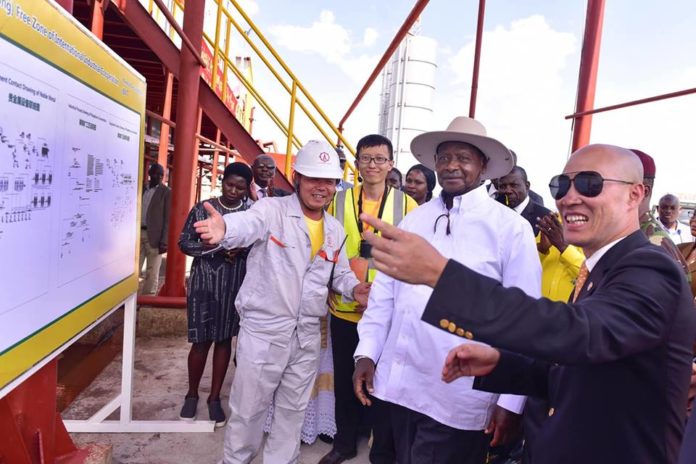
Museveni launches Sukuru Phosphate Project

President Yoweri Museveni has commissioned the First Phase of Tororo Free Zone Industrial Park and the Sukulu Project in Tororo district on the border with Kenya and appreciated Chinese investors for the work well done.

The first phase of the project launched Tuesday comprises of the living base, quarry, mineral dressing plant, phosphate fertilizer plant, in-backed block plant and red brick plant for tailing comprehensive utilization, machine repair and laboratory center.

The US$620 million Sukulu project is set to produce organic fertilizers and is expected to employ over 2500 people.

The plan for the Sukulu Project also includes a mineral dressing plant with an annual exploitation amount of 200 tons, a phosphate fertilizer plant (annual production of 100,000 tons), an iron and steel plant (annual production of 400,000 tons), a hydro metallurgical plant and cosmetics plant.

The fertilizer production plant will begin with producing 50,000 tons of purely organic fertilizers on the local market and will grow to 100,000 tons as demand grows beyond borders across the region.

This fertilizer will improve water retention of soils besides the soil’s ability to absorb nutrients.

According to CEO Dongsong Energy Group Uganda Ltd, Jane Guo, the second phase of the project will employ about 3000 to 4000 local workers. It will comprise of the steel, glass, ferroalloy and tin smelting plant, Shea processing factory, humid acid fertilizer, cement fiberboard plant and wood factory will be completed and begin operation at the end of July 2019.

He lauded Museveni and h government officials that played “a major role to ensure this project is a success from back when it was in the exploration phase to now when production is going to kick off.”

The third phase to include the phosphorus chemical plant, iron foundry, and medical glove factory will be completed and begin operation at the end of 2020.

The project will benefit neighboring countries like Rwanda, DRC, South Sudan, Tanzania and Kenya.

Museveni said that the project in Tororo will make Uganda competitive especially when the planned building of the Standard Gauge Railway (SGR) is completed.

The president also used the function to warn of the rampant corruption in the country. Museveni said public officials who ask for bribes from investors discourage investment in such projects.

Stories Continues after ad

Erdogan says Khashoggi was victim of ‘ferocious’ pre-planned murder

ANKARA, TURKEY - OCTOBER 23: Turkish President and leader of Turkey's ruling Justice and Development (AK) Party Recep Tayyip Erdogan attends his party's parliamentary group meeting at the Grand National Assembly of Turkey in Ankara, Turkey on October 23, 2018. (Photo by Ercin Top/Anadolu Agency/Getty Images)

Jamal Khashoggi died as a result of a brutal premeditated murder, Turkey’s President Recep Tayyip Erdogan said on Tuesday, in a highly anticipated speech in which he rejected Saudi Arabia’s claim that the journalist was killed accidentally.

Erdogan called on the perpetrators to be brought to justice in Istanbul and questioned whether the Vienna Conventions, which give immunity to diplomatic staff, applied in this case.
It was the first time that any official in Turkey has publicly outlined the Turkish contention that Khashoggi was killed by a hit squad sent from Saudi Arabia. But while Erdogan had promised the “naked truth,” he offered few details beyond those revealed by Turkish officials speaking privately.

The main thrust of his speech amounted to a comprehensive rejection of Saudi Arabia’s case that Khashoggi died by accident as a result of a brawl. “The information obtained so far and the evidence found shows that Khashoggi was murdered in a ferocious manner,” Erdogan told lawmakers in Ankara.

Among the new details revealed by Erdogan was an allegation that, on the day before Khashoggi was killed, a team of consular staff carried out a reconnaissance mission at two separate locations in Belgrad Forest, on the outskirts of Istanbul, and at Yalova, a city about a 55-mile (90-kilometer) drive south of Istanbul.
As part of the probe, police on Tuesday morning raided a villa in Yalova’s Termal district believed to belong to one of the Saudi suspects, Turkish newspaper Hurriyet reported, citing local media. Khashoggi’s body has yet to be found.

Erdogan also put into the public domain allegations that a 15-strong hit squad arrived in Istanbul, saying that a team of three arrived on a private jet the day before Khashoggi died, and that two teams of nine and three — the larger team including “generals” — arrived on the day of his appointment at the consulate.
Hours before Khashoggi arrived to obtain paperwork to marry his fiancée, security cameras were disconnected, Erdogan said.

“We stated that we would not remain silent and that we would take every step necessary for justice to be done,” Erdogan said to members of his ruling Justice and Development Party (AKP).
But there were some glaring omissions and few new details in the speech. Much of what Erdogan said in the parliamentary address has already appeared in media reports and he made no reference to a previously reported audio recording from inside the consulate, said to have captured his alleged torture and killing. Nor did he mention Saudi Crown Prince Mohammed bin Salman, the Kingdom’s de facto ruler, by name.

Bin Salman, in public comments the day after Khashoggi disappeared, professed to know nothing about any malfeasance, insisting Khashoggi had left the Istanbul consulate alive.
Erdogan called on Saudi King Salman for the 18 Saudi suspects linked to Khashoggi’s death to be tried in Istanbul.
After weeks of denying any knowledge of Khashoggi’s whereabouts, the Saudi government said on Friday that the journalist had indeed died in the kingdom’s diplomatic compound in Istanbul. The Saudi story has shifted drastically since Khashoggi was last seen entering the consulate on October 2; the official line is now that he was accidentally killed when a discussion with officials turned into a brawl.

Erdogan presented a very different version of events on Tuesday, speaking in Ankara as Saudi Arabia’s flagship investment conference got underway in Riyadh, the Saudi capital. Dozens of top business leaders from around the world have pulled out of the Crown Prince’s showcase event, known as “Davos in the desert,” as questions mount over the Saudi government’s role in the death of the Washington Post columnist and US resident.

State television in Saudi Arabia flashed urgent banners on Tuesday from the Council of Ministers, stating that the kingdom would hold to account those responsible for Khashoggi’s murder.
“The procedures taken by the Kingdom regarding the incident of citizen Khashoggi indicates the leadership’s keenness to hold accountable those ‘who failed in their duties,'” the banner read.
But, during his speech, Erdogan rejected the idea that blaming “rogue elements” of the Saudi intelligence and security services would satisfy Turkey or the international community.
Turkish police stand guard in front of parking lot in Istanbul, where an abandoned car belonging to the Saudi consulate was found.

“It will be satisfactory only when everyone who is responsible for this is penalized appropriately,” he said. “I don’t doubt the sincerity of the King. At the same time it is very important for the inquiry to be carried out by an impartial team.”
Turkish officials have maintained from the start that Khashoggi’s death was “violently planned”ahead of time, carried out by a team of Saudi operatives dispatched to Istanbul, and subsequently covered up.

In the intervening weeks, Turkish officials have released a drip-feed of information related to their investigation into Khashoggi’s murder, including surveillance footage shared exclusively with CNN that showed what a Turkish source described as a “body double” leaving the Saudi consulate in Istanbul on the day Khashoggi died. The Saudi operative, said by the Turkish source to be one of a 15-man team sent from Saudi Arabia to kill Khashoggi, was wearing the journalist’s clothes and was picked up on surveillance footage at locations around Istanbul.
Erdogan confirmed the body double in CNN’s exclusive.

Turkish Foreign Minister Mevlut Cavusoglu said Tuesday that evidence uncovered during the investigation has yet to be shared with any country, according to Turkey’s state-run Anadolu News, but that Turkey was “ready to cooperate in a possible probe into Khashoggi case at UN, international courts.”

“Jamal Khashoggi’s killing is a violently planned and a very complicated murder, which was being covered up,” Omer Celik, AKP spokesman, said at the party’s headquarters in Ankara on Monday. “I hope those responsible for Khashoggi’s killing are punished and no one ever thinks of repeating this.”
Speaking to reporters on Monday, Erdogan’s spokesman Ibrahim Kalin said: “The line our President put since the beginning of this case is very clear. The investigation will continue until the end.”

Stories Continues after ad

Continental legislators are in Rwanda for the fifth Pan African Parliament sitting

Rwanda President Paul Kagame.Photo credit/reuters

African legislators have convened in Kigali, Rwanda to discuss among others contemporary issues affecting the continent such as natural resources management and corruption, labour migration and the need to develop model laws.

The First Ordinary Session of the Fifth Pan African Parliament sitting, is premised on the African Union theme of the year 2018: “Winning the fight against corruption: a sustainable path to Africa’s transformation”, is taking place at the Kigali Convention Centre, Rwanda from October 22 to November 2, 2018.

In his remarks the guest of honour, Rwanda’s President Paul Kagame who doubles as the Chairperson of the African Union, commended the PAP for the breadth of their agenda for the session, which includes developing a model law on disability in Africa; conference on women’s rights as well as discussion and debate of reports on nutrition, corruption and election observation.

“The impact of your work is multiplied by your dual role as MPs for your respective legislatures. We count on you as advocates for Africa’s integration. I ask for your support for speedy ratification of the continental free trade agreement and the protocol on free movement of persons,” Kagame told the MPs.
The responsibility for Africa’s security and prosperity should and must be in our hands. We should innovate and get solutions from Africa’s rich experiences and cultures even as we are open to the best global insights,” he said.

He called on the PAP to play a big role in monitoring political progress in the continent and holding institutions to account for commitments that have been made to Africa’s citizens.
PAP President, Roger Nkodo Dang said, Africa should be a space of solidarity and dialogue. He said the continent possesses potential, which should be tapped and that it should cease to be a market for raw materials.

Nkodo said, there is still a challenge of ratification by African countries of some of the Protocols of the African Union, in particular the Malabo Protocol, and hoped that with President Kagame at the helm of the AU, he would give added push to rally nations to ratify the Protocol.
“It’s our wish that you be the spokesperson of the PAP and the Bureau has decided to appoint you as the champion of the Malabo Protocol,” Nkodo said.
Currently, the Pan African Parliament is only a consultative and advisory organ, but the Malabo Protocol seeks to give it full legislative authority to make laws for the continent. The Protocol provides for the election of MPs to the continental assembly from outside the membership of national parliaments. It also provides for representation of two women out of five designated members per country.

The Protocol to the Constitutive Act of the African Union on the PAP was adopted by the Assembly of the AU in June 2014 in Malabo, Equatorial Guinea. Since its adoption, there have been only five out of 28 ratifications needed for the Protocol to come into force.
The Pan African Parliament draws membership from 55 AU member states with five members elected or designated from each country’s legislature.

Several speakers attended the official opening of the Session among which included Speakers from DR Congo, Djibouti, Gabon, Mozambique, Tanzania and the East African Legislative Assembly. The PAP also administered oaths to 40 new MPs.

Stories Continues after ad