Stanbic Bank
Stanbic Bank
24.7 C
Kampala
Stanbic Bank
Stanbic Bank
Home Blog Page 1456

31 confirmed dead in Bududa as River Suume bursts its banks

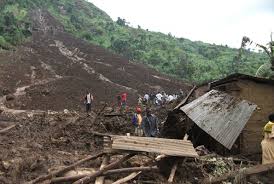
Two market centres on the slopes of Mt. Elgon were competently decimated when river Suume in Bukalasi subcountry in the landslide prone District of Bududa burst its banks carrying whatever it found in its way into the larger River Manafa, killing at least 31 residents.

According to Martin Owor, Commissioner for Disaster Preparedness and Management, about 31 bodies were confirmed dead by yesterday, but many more are feared dead. Recovery efforts had been restricted due limited accessibility and navigation in the area as the river ripped off all brigades linking the remote villages to the rest of the district and creating a huge sludge rift separating either sides if the river.

“Most of the people were caught at the trading centre, the landslide pushed huge boulders into a river which burst its banks and the water swept away the people,” Owor said.

The incident took place during the afternoon down pour and most of the victims were those who were operating in the two centres, of Nalutungu and Anchenor, those who were enjoying the afternoon local brew or those who had taken shelter from the rain on their way to their destinations but it was not a market day in any of the two centre. Animals too were not spared.

Others were those whose homes were in close vicinity to the river banks or those who were found on the roads in the way of the river where it passed including boda boda riders who were braving the afternoon rain. Two of them lost their bikes one was carried away while the third one lost both of the passengers but survived with injuries from the rolling rocks.

The catastrophe was a surprise to the residents who were going about with their usual chores un aware of the heavy rains within the Mt. Elgon Nation Park that had triggered heavy flooding and mudslides that gained momentum carrying trees and rocks as rolled down the mountain slopes.

Relief teams are now combing the area to search and rescue survivors, Owor said.

“There are people who were displaced and they need shelter, food and all other support and we’re moving that relief to the area,” he said.

The disaster occurred just a few kilomenters from the 2010 disaster of the next village of Nametsi in which over 30 homesteads were completely buried and unknown number of lives lost. Similar disasters are common in this area but residents have taken low response to Government efforts to leave the mountainous areas.

Stories Continues after ad

World’s largest sleep study shows too much sleep as bad as too little

Couple in bed with relationship difficulties

What’s being billed as the world’s largest sleep study suggests that getting too much sleep might be just as bad as not getting enough of it.

The study, led by Western University in London, Ont., was launched in June 2017 and involved more than 40,000 people from around the world.

According to researchers, the data suggests that consistently sleeping more or less than the recommended seven to eight hours per night can have a major impact on brain functions.

“The key thing here is that that’s on a regular basis,” said Dr. Conor Wild, the study’s lead author and a research associate at the university’s Owen Lab.

“So if you’re sleeping 11 hours every single day over a month, that could have an effect on your brain much like sleeping too little every day for a month.”

Western’s Brain and Mind Institute collected data from more than 40,000 people around the world for the study, with participants filling out an extensive questionnaire before moving on to a series of online cognitive tests.

“These are tests we’ve used for decades to understand specific functions in the brain and we’ve adapted them to turn them into little games to play on your iPad, phone, or your PC and that gave us information about how their brains were functioning.”

Speaking on London Live on 980 CFPL, Wild added that researchers were most surprised at the number of people reporting less sleep than recommended. Roughly half of the 40,000 participants reported typically sleeping less than 6.3 hours per night.

“A lot of people were sleeping four hours a night on average, and that had an effect of being 10 years older in terms of their performance on some of these tests.”

The research found that reasoning and verbal abilities were most strongly impacted by too much or too little sleep, while short-term memory performance was relatively unaffected

Wild noted that there’s no one-size-fits-all approach to sleep.

“However, on average, across all the people we were looking at, this seems to be the trend,” he explained.

“One of the things we really want to dig in a bit more with this data and some more studies is really kind of examining this individual variability and how much does this result hold for individuals or are there some things that, maybe if you do this a lot or it’s part of your occupation, maybe it doesn’t have an effect. There are still some lingering questions.”

Stories Continues after ad

Uganda to mark world food day in Karamoja

Nabuin ZonalAgricultural Research and Development Institute.

Uganda is set to celebrate world food day that is aimed at Heightening awareness on hunger, food security and promotion of yield enhancing technologies to increase productivity in agricultural sector.

According to Food and Agriculture Organization (FAO) statistics, more than 1 billion people suffer from hunger as 36 million lose their lives. This means that one in every six people on Earth don’t get enough food to live a healthy life. Every five seconds a child under five years dies because of hunger, or of directly related causes.

The climax of activities will take place on October 6,at the Nabuin Zonal Agricultural Research and Development Institute in Karamoja sub-region. Under that theme ‘A Zero Hunger World by 2030 is Possible’, celebrations will focus on hunger, under nutrition, malnutrition and how these variables impact on development.

In the intervention to promote food and nutrition security, Ministry of agriculture has developed a number of policies which include the Food and Nutrition Policy (2003), the National Agricultural Policy (2013) and the National Action Plan for Nutrition (2015) and the National Agricultural Extension Policy (2015).

The Agriculture Sector Strategic Plan (2015/16-2019/20) which pushes for dietary diversification to ensure food security and promotes 15 priority commodity interventions for maize, bean, rice, cassava , banana, fruits (citrus, pineapples, mangoes), vegetables, coffee, tea, potato and dairy, beef, fisheries, poultry and apiary commodities products.

FAO indicates that Zero tolerance to hunger can help build a safer and prosperous world for everyone. FAO notes that, a dollar invested in hunger prevention could return between $15 and $139 in benefits and Zero hunger could save the lives of 3.1 million children a year.
“Ending child under nutrition could increase a developing country’s GDP by 16.5 percent and ending nutrition-related child mortality could increase a workforce by 9.4 percent,”

Stories Continues after ad

SA ratifies FTA, joins Uganda and two others

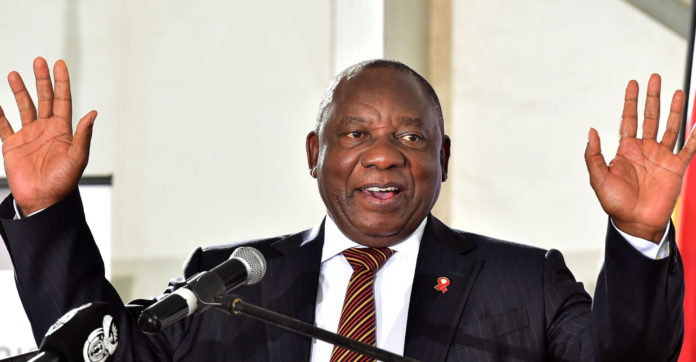
Cyril-Ramaphosa

South Africa has ratified the Tripartite Free Trade Agreement (FTA)becoming the fourth country to do so after Egypt, Uganda and Kenya. This is according to a notification sent by the South African Government to the Chair of the Tripartite Task Force, Ms. Chileshe Kapwepwe, who is the Secretary General of COMESA.

“This is excellent news,” said the Secretary General. “This development moves the tripartite process to near operationalization.”

The process of ratification has been set in motion in a number of member states and it is expected that this target will be reached by end of April 2019, which is the deadline that the Tripartite member states set for themselves. With this latest development, 10 more ratifications are now needed for the Agreement to enter into force.

“This development adds to the aura of expectations around the Tripartite Free Trade Area Agreement which groups 29 of the 55 countries negotiating the African continental Free Trade Area,” the COMESA Director of Trade and Customs, Dr Francis Mangeni, who is also a member of the technical negotiating team, said in Lusaka today, adding that all the Annexes to the TFTA Agreement have been concluded.

Transitional arrangements

On the basis of the provisions on transitional arrangements, he explained, once the threshold for minimum number of ratifications is achieved, then implementation of the Agreement commences immediately, on the basis of the principle of variable geometry. This is aided further, by the fact that exchange of tariff offers is near complete.

All the member states, save for Southern Africa Customs Union (SACU) countries, EAC countries and Egypt chose to offer their respective Regional Economic Communities’ preferential arrangements and were therefore not negotiating tariff offers.

“The negotiations between EAC and Egypt are complete,” Dr Mangeni said. “Those between SACU/Egypt and SACU/EAC are nearing completion. In the latter case, divergence has narrowed down to just one product line. All the negotiating parties have agreed to a deadline of December 2018.”

Rules of Origin

Negotiations on the Tripartite rules of origin are highly advanced. From the total of 5,387 tariff lines, Rules of Origin have now been developed for 3,267 tariff lines (At 6-digit HS 12 version), representing 60.8 per cent of all the tariff lines. In addition, a draft manual on application of the Rules of Origin has been developed and is ready for use. Trade can therefore commence on all the aforesaid tariff lines.

A number of tripartite instruments have also been developed and are now ready for use. The tripartite guidelines on implementation of Trade Remedies are ready for use and so are certificates of origin, export declaration and import declaration forms among others.

In addition, the Tripartite Agreement on the Movement of Business Persons has also been finalized and will be ready for use once it undergoes legal scrubbing.

“This latest ratification, moves the Tripartite process one step closer to the implementation stage, and it is likely to present more scope for early harvest and by extension, prospects for fast tracking the continental integration agenda,” Dr Mangeni said.

Stories Continues after ad

Kyangwali locals want OPM officials investigated over torture

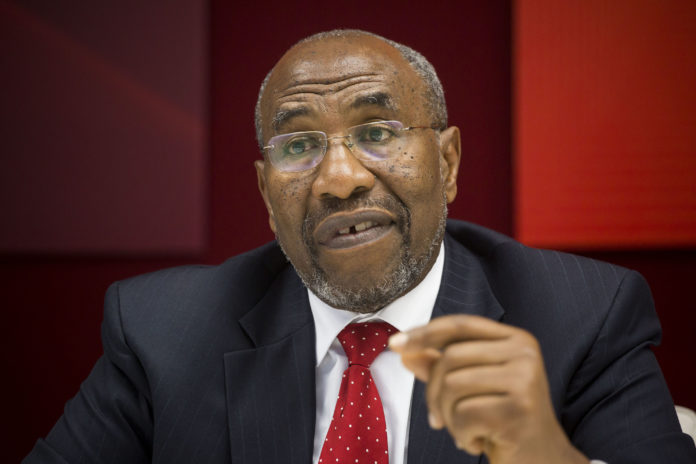
Ruhakana Rugunda, Uganda's Prime Minister.

The indigenous people of the contested Kyangwali refugee settlement have demanded for an independent investigation into their eviction, crimes against humanity and torture allegedly by officials from the Office of the Prime Minister.

The residents made the demand while meeting the Committee on Presidential Affairs during a fact-finding visit to the contested land in Hoima district. The MPs were in the area between October 5-7, 2018.

“Government efforts to better the lives of refugees has rendered us landless in our own country,” Said Issayana Peter, a father of six, who claims he owned 10 acres of land in the area on which he had a banana plantation, fruit trees and other food crops.

During the public hearing held at Kyangwali refugee camp headquarters, witnesses narrated gruesome acts of torture by the army and police allegedly aided by the Principal Settlement Officer, Bafaki Charles, who works with the Office of the Prime Minister (OPM) and Lutaaya Vianey from Ministry of Lands.

“By the 1950s, I was not born when this refugee settlement was established; I also rely on documents available,” Bafaki responded while making his presentation to the Committee.

The locals rubbished the 2013 Oketta Report which recommended forceful eviction.

On 20 August 2013, over 60,000 residents were evicted by the army and police in Bukinda Parish to secure land for hosting Congolese refugees. The families later sued government, claiming to have lived with refugees since the 1960s when the refugee resettlement was started.

On 27 April 2015, Justice Simon Byabakama, who was the then Masindi Resident Judge, ordered the boundaries of the contested land to be resurveyed to ascertain whether the land claimed by the evicted families is within the resettlement scheme.

A joint survey report was submitted to court, which is yet to rule on the matter.

During the hearing of the case, some families were allowed back on the land.
“Currently we are being squeezed in one acre per family, forced to relocate and given no compensation for the development on our land. We pray that we follow the 1998 survey and life continues,” said the representative of Bukinda residents, Nestori Tumwesigye.

Sunday Matia, a resident of Bukinda village says the refugee settlement camp officials and the police came to his home one afternoon and directed him to leave in three days as his land had been allocated to a refugee family. Sunday, who is 39 years, blames government for reportedly grabbing his ancestral land.

Hon. Daniel Muheirwe (Buhaguzi County) who presented the petition to Parliament on 19 September 2018, said the land hosting Kyangwali refugee settlement was donated by the Bunyoro kingdom in 1950 to host Rwandan refugees.
“In 1998, government demarcated boundaries for the 91 square-km piece of land and the boundaries have been respected by the local communities. I wonder why government plans to extend the boundaries of Kyangwali refugee settlement by annexing 28 villages in Kasonga Parish,” said Muheirwe in his petition.
As a result, on 20 September 2018, Parliament directed the Office of the Prime Minister to immediately halt the proposed expansion of Kyangwali refugee settlement until the contested issues are resolved.
Parliament has tasked the Committee to assess the problem and report back to the House.

The Committee will also visit Bunyoro Kingdom authorities to ascertain the size and boundaries of the land, which was allocated to host Rwandese refugees in the 1950s.
Communities neighboring the refugee settlement are living in fear of eviction and have appealed to their leaders to intervene since some families have already been relocated.

The evicted people are from 31 villages in Kasonga parish.

Stories Continues after ad

MP Zaake to gov’t: We are just seeking for transfer of power

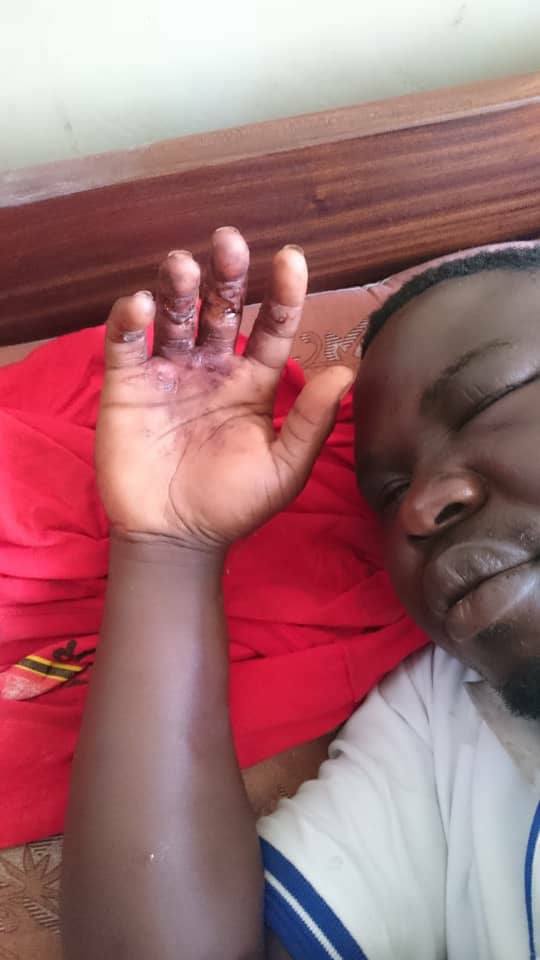
Mityana Municipality MP, Francis Zaake in pain after he was tortured by Special Forces in Gulu.

Controversial Mityana Municipality Member of Parliament, Francis Zaake Butebi, is tomorrow expected to jet back after spending one month in India where he had gone for medical treatment.

The MP is among the 36 suspects grappling with treason charges that were leveled against them. The group is allegedly to have smashed one of the president’s vehicle windscreen in the procession from holding their conclusive rallies a head of Arua municipality by-election that was won by Independent and FDC leaning candidate Kassiano Wadri.

In his statement Zaake said, security agencies of Special Forces Command (SFC) and police excessively battered him during and after his arrest to the extent that he could no longer feel the pain. “I think that after failing to kill me during the ‘Togikwatako’ Saga, they thought that another opportunity had presented itself to them to completely eliminate me,” he added

As his life continued deteriorating in the Gulu Police cells, the MP was later dumped at Rubaga hospital by unknown people. After spending two weeks on life supporting machines, Zaake was charged with treason and cleared to leave the country.

The Independent legislator noted that, in the struggle to oust president Museveni out of power, God will erect many youths reading from the same script as himself, “trust me when the late Cerinah Nebanda was brutally murdered, many of us joined the struggle and here we are exactly reading from the same script as her,” he added.

He contended that, Health workers that attended to him in Rubaga Hospital were intimidated during and after his admission by the state, he however, applauded them for braving the storm. Narrating the ordeal, he said in Mannipal Hospital, through Ugandan Embassy, the state of Uganda attempted to conspire and obtain his medical documents but due to professional ethics exhibited by medical workers, their efforts didn’t not yield.

Zaake said, there has been propaganda orchestrated by the state to justify their wrong doing that People Power is a violent group. “That is not true, we are non-violent, and we associate ourselves with the principle of Mahatma Gandhi which states that an eye for an eye leaves the whole world blind. We can never be violent and never shall we ever be, two wrongs can’t make a right,”

“We are just seeking for transfer of power to a generation that will address the current constitutional crisis that befalls us as a Country and we intend to do this with utmost tranquility unless otherwise the state plants a bad group among us,”

Stories Continues after ad

S.4 girl drags father to police over school fees

Jinja – 17-year-old Jovia Nakisige, a S. 4 candidate at Magogo Secondary School in Jinja district has run to police asking them to arrest her father, Godfrey Basalirwa to compel him pay her school fees such that she doesn’t miss the final exams.

Nakisige has in her statement at Buwenge Police station alleged that her father left the responsibility of footing her school fees only to her mother which mother the mother has failed to raise.

“When I reached S.4, he (Basalirwa) told me that he has stopped paying for me fees and directed me to now start asking for everything from my mother,” she said.

Asked how much is the school fees balance, Nakisige said she is supposed to pay shillings 300,000 or else she will miss the UNEB exams.

“This term we (S.4 candidates at her school) are all in boarding so we are paying 300,000. But I am the only student who has not deposited anything and I was yesterday warned by the head teacher that I am most likely not to sit my papers,” she added.

She told the police that her father earns money and had a lot of valuables including animals but he only sees no value in educating a girl child.

Efforts to get a comment from Basalirwa were futile because his contact was off by the time of filing this story but police said he must be arrested and advised to cater for the daughter’s school fees.

Lydia Namugeere, the officer in charge of child and family protection at Buwenge Police station confirmed entering the girl’s case and said the officers would have Basalirwa in their hands any time.

She however condemned the act of fathers who abandon their children especially girls

Stories Continues after ad

Museveni offers chartered plane to take Uganda Cranes to Lesotho

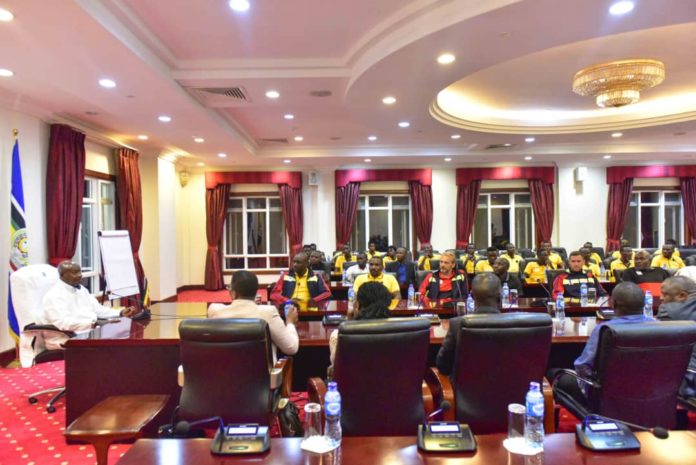
President Yoweri Kaguta Museveni in a deep discussion with the Uganda Cranes and FUFA Contingent to State House on Tuesday in Entebbe.

President Museveni has come to the rescue of the Uganda Cranes by chartering a private jet to fly the players to Maseru for their reverse fixture against Lesotho to be played on Tuesday 16th October, 2018.

Uganda will host Lesotho in a doubleheader, with the first leg of the 2019 Afcon qualifiers at Mandela National Stadium this Saturday on 13th October while the second leg to be played in Setsoto Stadium, Lesotho on Tuesday, 16th October, three days after the first leg.

Uganda Cranes and FUFA top executives were hosted by President Yoweri Kaguta Museveni at State House Entebbe at a function he organized to celebrate the 56th Independence Day with the team and football fraternity ahead of Saturday’s AFCON Qualifier.

The delegation to State House was led by FUFA 1st VP Justus Mugisha, accompanied by 2nd Vice President Darius Mugoye, FUFA CEO Edgar Watson and the FUFA Finance Director Decolas Kiiza.
President Museveni congratulated the team for posting results that have kept the Cranes on top of the group in the campaign but urged them to work harder against Lesotho on Saturday.

On top of the chartered plane, the President also offered the Uganda Cranes contingent to State House a financial boost of UGX 200M (Two Hundred Million Shillings).
“I have been following you of recent and I thank you for the performance but we need to work harder for better results. I have offered you a chartered plane to Lesotho and UGX 200M to help you get good results” said President Museveni.

Speaking on behalf of the players, team captain Denis Onyango appreciated the President and the First Lady Janet Museveni (Minister of Education and Sports) for the recent support towards the Cranes and football.

Cranes still sit top of Group L with 4 points from two matches played. Lesotho are second with two points, on level with Tanzania while Cape Verde are bottom with no point. Two teams from each group will qualify for the tournament.

The 2019 AFCON tournament will be hosted in Cameroon. The competition will be held in June and July 2019 to move it from January/February for the first time. It will also be the first Africa Cup of Nations expanded from 16 to 24 teams.
Meanwhile, all the players that were summoned are present in the camp as preparations continue at Mandela National stadium.

AFCON 2019 Qualifier
Uganda Vs Lesotho
Saturday, 13th October 2018
Mandela National Stadium (4pm)
Return Leg
Lesotho Vs Uganda
Setsoto Stadium, Maseru

Stories Continues after ad

AMISOM hands over refurbished police station to Somali Police authorities

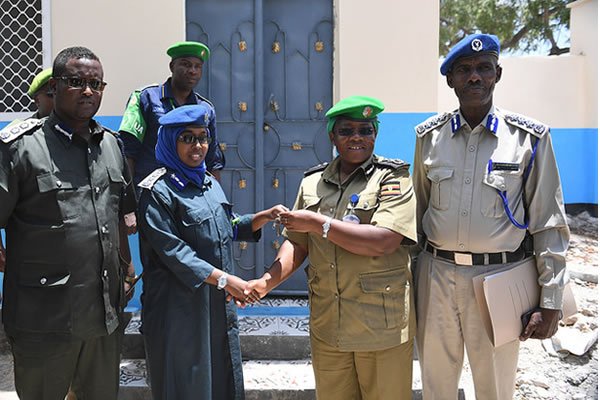
AMISOM Police hands over refurbished police station to Somali Police authorities

Residents of Dayniile district in Somalia’s capital of Mogadishu, can now enjoy better policing services closer to their homes, following the renovation of a hitherto derelict district police headquarters.

The fully refurbished police building, rehabilitated with the support of the Japanese government, through AMISOM Police and the Civil Affairs Unit, was formally handed over to the Somali police authorities today.

“We must exit (Somalia), when we have uplifted the Somali Police to a certain level of independence – in terms of capacity building and in terms of infrastructure and logistics,” said AMISOM acting Police Commissioner Ms. Christine Alalo, during the handover ceremony.

She reiterated AMISOM’s commitment to training and equipping the police force with necessary skills, to enable them improve their services across the country.

Dayniile Police Station was identified for renovation by Individual Police Officers from AMISOM, who collocate with their Somali counterparts, in various police stations across the capital, to carry out a mentorship programme.

Before its renovation, the station lacked decent sanitary facilities and office space. The refurbishment has created a humane working environment for police officers stationed at the facility.

The deputy chief of the Somali Police Force Ms. Zakia Hussein, expressed gratitude to AMISOM for going beyond its primary duty, to help the Somali Police Force.

“Thank you our partners AMISOM Police, not only for the help you have accorded to us, but also in every aspect of our policing and the way you are assisting us; and the way we are working together,” said the deputy police chief.

The police station has also been fitted with solar panels to provide electricity. Additionally, Ms. Alalo donated 3,000 notebooks to the police officers to help in keeping records of incidents while in the field. The notebooks will be shared across police stations in the capital.

Other than training and mentoring police officers, AMISOM has supported the construction, renovation and upgrade of various police stations across the country, with the aim of enhancing the standards of policing.

Stories Continues after ad

Stakeholders push for ratification of the arms treaty

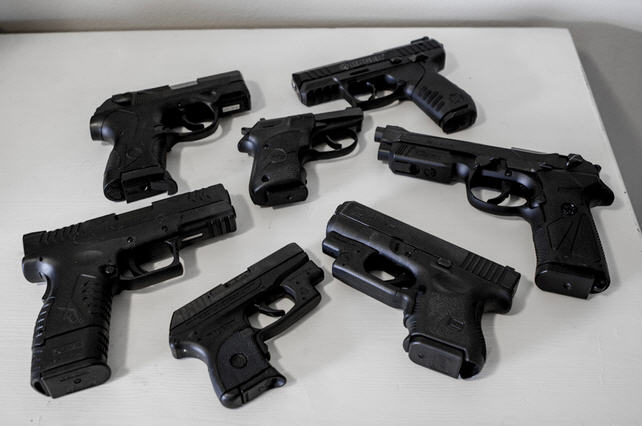
Guns

Stakeholders keen to reduce the proliferation of Small and Light Weapons (SALW) now want EAC Partner States to ratify the Arms Trade Treaty (ATT) to mop out illegal arms.

A seminar on Arms Trade Treaty and its Complementarity to the Regional Arms Control Instruments for Partner States organised by the East African Legislative Assembly (EALA) and the International Committee of the Red Cross (ICRC) took place in Arusha days ago.

EALA Member,Pierre Celestin Rwigema, speaking on behalf of the Speaker, Martin Ngoga Karoli, said it was vital for the region to seriously tackle the matter of illegal arms saying the security challenges were beyond inter-state issues but a concern for intrastate initiatives.

Rwigema said insecurity played a role in hindering development, destabilizing leadership and resulted in poor economic development among others. The legislator added that violent crimes as well as arms trafficking, transnational criminality, which were many times related to presence of illegal arms would threaten the continent if not checked.

“In addition, with the EAC now implementing the Common Market Protocol that envisages free movement, there is imminent fear of increase in cross-border crime. Unfortunately, free movement of persons does not only involve those in search of opportunities, but it inevitably also involves free movement of criminals. This can be destabilizing and calls for closer co-operation by the agencies. Articles 123,124 and 125 of the EAC Treaty explicitly underscores security as a critical component in supporting; consolidating and protecting regional integration”, Rwigema said.

The legislator remarked that the African continent was repositioning itself to be a significant player in global trade. He therefore called for all effort to be inculcated to ensure regional and continental peace and security. Hon Rwigema said it was necessary for all Partner States to ratify the Treaty. At the moment, all Partner States have signed the Treaty but none of them has ratified the same. The EAC Partner States are among the 38 countries that have signed but not ratified the Treaty according to the Head of the Arms Trade Treaty Secretariat, Mr Dumisani Dladla.

Dr Philip Mwanika, ICRC Focal Point in Charge of Multilateral Affairs and Humanitarian Diplomacy, remarked that the Assembly was a critical stakeholder in so far as reducing armed violence and conflict mitigation is concerned.We have particularly been made aware of the work of the Committee on Regional Affairs and Conflict Resolution towards conducting fact finding mission and advancing conflict transformative dialogue sessions with civil society and governments pertaining to some still protracted social contexts in the region”, Dr Mwanika said.

The ICRC, he said, was keen to continue in its mandate of supporting citizens in the armed conflict areas. Mwanika lamented over the bulk of civilian suffering occasioned by presence of conventional weapons and cited the indiscriminate and direct attacks against civilians, hospitals and even humanitarian workers.

He called for responsible arms transfers and enforcement of rules and norms connected to international arms trading as a means to preventing the risks of weapons they provide from being used to commit, or facilitate serious violations of human rights.

Mwanika said over the thirty-plus years of work in South Sudan and Somalia, the ICRC could attest to a slow-motion effect of conventional weaponry in displacement and more indirect suffering due to cumulative deterioration of basic services, life chances and livelihoods.

Mwanika also informed the seminar of positive developments and dynamics citing conscious action towards armed violence reduction as a means to realizing peace and security. The multilateral expert enumerated the Nairobi Protocol, Kinshasa Convention, the EAPCCO Protocol and the Mifugo Protocol as key resources in dealing with the scourge of small arms and light weapons.

The Head of the Arms Trade Treaty Secretariat, Dumisani Dladla, said whereas importation and related issues of buy and sale of arms is a sovereign right of nations, states must work together to assess the risk of proposed transfers. He said that nations need to take measures to regulate arms imports where necessary and which may include looking at the import systems as well as requesting information from an exporting state regarding a pending or actual authorization of shipment.

The objectives of the seminar were to demystify certain provisions of the ATT which have raised concerns for Member States in the region, to provide a platform towards listening to perspectives of other states and regional organization on ratification of the ATT; to understand other similarities and differences between the Nairobi Protocol and the ATT (UNPOA) and to take a pragmatic approach to understand the ATT reporting obligations and identify ways to harmonise transparency obligations under the Nairobi Protocol.

According to the ICRC, more must be done to revert what can be a crisis of small arms in future.

“East Africa is one of the regions in the world that is gravely affected by small arms and light weapons and yet no single East African state is a party to the Arms Trade Treaty,” said Eve Massingham, Regional Legal Advisor for the ICRC.

She said that the failure of any East Africa state to ratify the treaty seems to be holding others back, arguing that there is need to speak collectively about the Arms Trade Treaty and what roadblocks countries face to ratifying it.

The ATT which entered in to force in Dec 2014 is part of the International response to the tremendous human suffering caused by the widespread and poorly regulated availability of conventional weapons in establishing for the first time a global norm for responsible arms transfers, the ATT represents a historic achievement.

Analysts contend that the ATT as contrasted with other control laws provides a blueprint for action to reduce human suffering by all States in the arms supply chains. By adopting the ATT, States have recognized that arms and ammunition can no longer be regarded as just another form of commercial goods.

At the very core of the Treaty is the need to subject the transfer of conventional arms, their ammunition, and parts and components to strict criteria, with the aim of ensuring that weapons do not end up in the hands of those who would use them to commit serious violations of international human rights law or other serious crimes.

Mr Oluwafisan Bankale,Representative of the Economic Community of West African States (ECOWAS) said illicit rampant of SALW was rampant in the region due to a culture fueled by several conflicts including civil wars in Sierra Leone, Liberia, Cote d’Ivoire and Guinea Bissau. At the same time Tuareg rebellions in Niger and Mali and the terrorism activities in Mali and Nigeria had led to the leak of stock in to the hands of terrorists.

EALA Member, George Odongo reiterated that the Treaty been specific to the Partner States means we need to interrogate the issues at the Partner States levels and EALA is capable of holding the conversation with the national parliamentary committees. The Assembly is interested in peace and security and the prevalence of arms hampersthe aspect.

“ATT looks at the demand and supply side and it is therefore vital to look at the entire trajectory including matters of stockpile management. EALA RACR wants to continue in the engagement with ICRC”, he said. “We are keen to look at the ratification issue and to aggregate the regional and international commitments,” Odongo said.

Stories Continues after ad