Stanbic Bank
Stanbic Bank
25.4 C
Kampala
Stanbic Bank
Stanbic Bank
Home Blog Page 1460

Strategies to create your own market and win bigger

Martin Zwilling

By Martin Zwilling

New technology markets and paradigm shifts have traditionally been bad bets when seeking investors, since these were known to take decades to develop, and cost lots of money. For example, consider how many years it took for the market to move from radio to television, or fully accept personal computers on every desktop. The leading edge was too often the bleeding edge.

Yet now I believe the evidence is clear that the world has changed. Many customers now actively seek out new technologies, rather than wait for many others to try it first. Technology is changing faster than ever, and new things usually work when they are released. Steve Jobs proved it with the iPhone, and Elon Musk can’t produce his electric cars fast enough to keep up with demand.

Bold entrepreneurs now can credibly talk about entirely new markets, such as the Internet of Things (IoT), genetic modifications, and privatized space travel. However, such changes don’t yet happen automatically, so it still takes proactive strategies and key actions to create new demand where none exists. Here are the specifics that I recommend to improve your odds of success:

Sell the market concept before building a product. Today, with instant and pervasive Internet communication, you can sell your vision via blogging, crowdfunding, and videos before you spend big money building prototypes and pivoting as you learn. This will prep and size the market, and greatly increase your chances of getting it right the first time.

Highlight positive social and environmental impacts. For example, if your new product reduces pollution or world hunger, this adds immediate value and confirms a positive long-term strategy for customers today. Too many founders still focus their product design and selling efforts only on direct paybacks to the customer.

Incent your team to continually think “outside-the-box.” You set the limits and the culture for your team, based on how you reward creative thinking, or penalize people for failed experiments. It starts with hiring the right people, and building relationships with the right experts, analysts, and investors. Then you really listen to what they have to say.

Work to build a compelling story around your new idea. Customers need to see personal and social benefits around a new solution, not just a new technology. The change must also include long-term benefits, as well as short-term. A compelling story can make or break your ability to differentiate your solution from dozens of others.

Use social media and the media to build demand for change. New markets don’t just happen, or create themselves. People need to be influenced and educated to change consumption habits, expectations, and buying patterns. Product messaging and branding need to follow later, after the initial demand has been built. Concept marketing is critical.

Build momentum with an integrated marketing campaign. All the elements of change required for the new market must be addressed consistently, not just the product elements. A successful campaign must not only capture people’s imagination but must have the right integration to move people to a new frame of reference and new thinking.

Acknowledge and position competitors around you. It may sound counterintuitive, but when you are creating a new market, competition helps legitimize it and increases the size of the pie. Position competitors positively around you, and continue to find ways to keep yourself ahead of the crowd, with both product offerings and thought leadership.

Elon Musk, for example, opened all his battery patents to competitors, with the expectation that this would expand the market as well as build the support infrastructure for his Tesla electric car market. He highlighted the positive environmental aspects, as well as the high performance remote maintenance elements of his new technology. New markets don’t have to be disruptive.

Thus new entrepreneurs have a new alternative to the tried and true approach of linear thinking, cost reduction, and more new features. Maybe it’s time for you to step out of your comfort zone, think more broadly, and pursue a new market legacy for maximum fun and profit.

The writer is a veteran startup mentor, executive, blogger, author, tech professional, and Angel investor. Published on Forbes, Entrepreneur, Inc, Huffington Post, and others.

Stories Continues after ad

Uganda Police stakes Shs20m in hunt for bad man in city

The unidentified suspect wanted by police.

The Uganda Police Force has staked Shs20 million as a reward to any individual who can identify a mischievous man whose image was recently captured by CCTV cameras.

The man is alleged to be behind the circulation of threatening letters and other messages to the business community in Kampala Metropolitan Areas. He said to be using the bad language as a means to get money from his targets.

According deputy police spokesman Patrick Onyango, letters or messages were allegedly written and circulated by a group calling themselves ‘People’s agency’.

He said the investigations into the matter were still on ongoing. “We would like to appeal to the general public to positively identify for us the criminal in this photograph as he is the man behind the threatening letters to the business community,” he said.

According to Onyango, the unidentified man and his criminal gang are demanding money in foreign currencies ranging from US$ 30,000 to US $ 45,000 which they say must be given to them within three months.

Police has appealed to whoever has any information that may lead to his arrest and prosecution to the nearest police station or ring telephone numbers 0712827702, 0702436325, 0702415982, 0715411689.

Stories Continues after ad

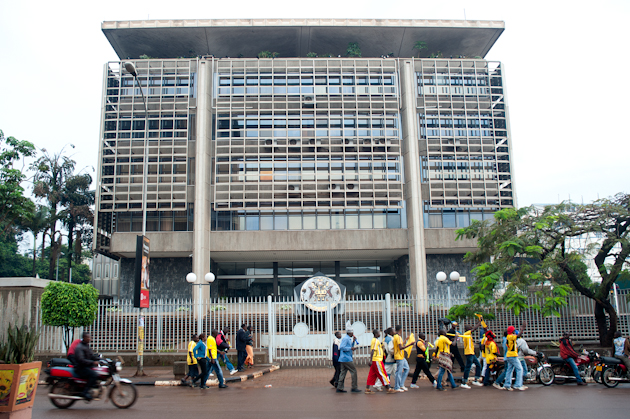
BoU top official moots resignation

Bank of Uganda

The Bank of Uganda (BoU) still continues to make news headlines and Eagle Online understands that a top manager who we cannot mention for now is writing his resignation letter and is likely to hand in the script to President Yoweri Museveni mid this week.

The official who was first appointed on January 1, 2001, re-appointed for a second five-year term on January 1, 2006 and re-appointed for a fourth five-year term, effective January 12, 2016 intends to get out of that institution at the time when its image is at its worst owing to the selfish dealings of his senior staffers.

The official in his 18 years of service at that institution has been credited for stabilizing Uganda’s macro-economy as well as the financial sector. He is credit for controlling over the years keeping it at single digits, apart from 2011-2012 when it hit high of about 30 percent when he allowed Museveni to use the money kept in the Bank for campaigns.

But his planned resignation comes at the time when BoU is embroiled in legal battles especially with former owners of Crane Bank Limited (CBL), led by Sudhir Ruparelia who accuses BoU of selling their bank without following the right processes.
The official also is likely to leave at the time when parliament has lined up him and others to answer questions relating to the closure and sale of seven commercial banks now defunct-Teefe Trust Bank, International Credit Bank Limited, Greenland Bank, The Cooperative Bank, National Bank of Commerce, Global Trust Bank and CBL.

The official at one time clashed with Members of Parliament over the Shs142 billion BoU compensated Kampala businessman Hassan Basajjabalaba for loss of city markets. The MPs had wanted him out of office but Museveni intervened to save him, but the president blamed him for paying Basajjabalaba without consulting him. He would later refer to the Mps as ignorant and that only God would remove him from his job at BoU.

The official would in February 2018 later sack the director of supervision Justine Bagyenda without giving any reasons though in a statement he said it was a normal exercise given that other officials were moved from one position to another. Bagyenda would run to IGG Irene Mulyagonja to save her but she was unable. The official said then that he had independence to make changes at BoU and as such clashed with the IGG. Museveni would intervene to settle the differences between the official and the IGG.

But as he goes, the official will live to regret the decision in which BoU sold CBL to Dfcu Bank at Shs200 billion, having invested over Shs400 billions of taxpayers’ money in the bank before the sale. The sale of CBL caused an investigation into BoU by the Auditor General John Muwanga who has handed the report to parliament. Everyone is waiting what the official will say when he appears before parliament, alongside others.

Stories Continues after ad

Kenya to host the 9th East African petroleum conference and exhibition

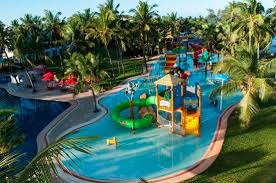
Pride Inn Paradise

The 9th East African Petroleum Conference and Exhibition 2019 (EAPCE’19) is scheduled to be held at the Pride Inn Paradise Beach Resort, Convention Center and Spa in Mombasa, Kenya.

The conference organized by the East African Community (EAC) Secretariat and the EAC Partner States is expected to attract more than 1,000 participants taking place on 8th to 10th May, 2019.
Under the theme East African Region: The Destination of Choice for Oil and Gas Investment Opportunities to Enhance Socioeconomic Transformation, aims at promoting the region’s petroleum potential and investment opportunities.

The last eight Petroleum Conferences have proven a valuable forum for governments and petroleum industry players from around the world to dialogue.

According to the EAC Secretary General, Ambassador Liberat Mfumukeko, as the conference provides a forum for dialogue for all players in the Petroleum industry regionally and internationally, the 2019 edition of the Conference is also in line with the EAC Vision 2050 that aims to transform the region into an upper-middle income region by the year 2050.

“Energy is one of the vital infrastructure ‘enablers’ of EAC Vision 2050 and the level and intensity of commercial energy use in the region is a key indicator of the degree of economic growth and development,” added the Secretary General.

Held since 2003, the East African Petroleum Conferences have provided increasing awareness of the potential for petroleum production in the region and other important issues in the petroleum sector, including technological advancements in exploration, development and production.

Delegates can expect high quality technical presentations, exhibitions from a wide spectrum of players from the petroleum sector. The conference Programme integrates field excursions to selected sites in each Partner State for delegates to see the rich geological variety that the region possesses as well as the tourist attractions that the region is well known for.

EAPCE’19 will take place at a time when the EAC has embarked on a journey to implement the Vision 2050. The objective of the energy sector development under the EAC Vision 2050 is to ensure sustainable, adequate, affordable, competitive, secure and reliable supply of energy to meet regional needs at the least cost.

By 2050, the region’s target is to transform the energy landscape to be characterized by efficient distribution of petroleum products with sufficient strategic reserves.

Stories Continues after ad

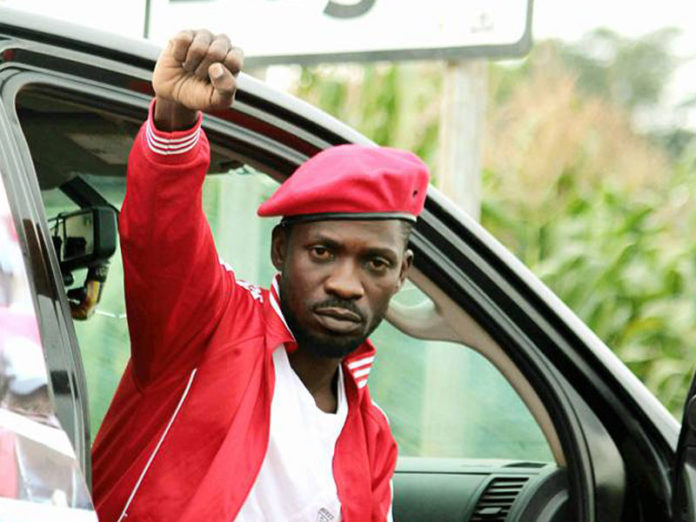
Bobi Wine takes Kyarenga concert to Busabala

Bobi Wine

Kyadondo East legislator,Robert Kyagulanyi alias Bobi Wine has moved his new album launch known as Kyarenga to One Love Beech-Busabala, saying preparations are ongoing.

The show is scheduled to take place on November 10, 2018 starting from morning at 6:00 am until late at a fee of Shs10, 000.
Wine said that the move has been made after a countrywide consultation and frustrations by the management of Namboole stadium. He said his crew; Fire Base has asked police for provision of security at the album launch.

“Upon coming into an agreement with the Namboole management, we were twice frustrated, tossed from one police officer to another, we this time round hope, police will avail us security,” he said.
He further said “We know the management of Namboole and FUFA were used to frustrate our concert but that can’t stop us from moving forward. I know they didn’t want to do what they did, but they managed to do it,” he said at Fire Base offices in Kamwokya.

He said One Love beech accommodates a bigger number of people compared to Namboole stadium, “ That is our home, come camp for three or four days on top of helping police on the issue of security. Please be vigilant at the venue and report any suspicious person as early as possible,” He added.

Responding to President Museveni’s guidelines to security organs, Kyagulanyi said, “this is not the right time to debate that letter, but I always take his actions more than what he says”.

Stories Continues after ad

Gideon Moi hints at 2022 pact with Raila

Baringo Senator Gideon Moi.

Kanu national chairman Gideon Moi has hinted at forging a political pact with Opposition leader Raila Odinga in 2022. The two have, however, kept the country guessing on what the deal could be between them.

A push by leaders from Rift Valley and Nyanza to have the two partner in the next General Election heightened at the weekend with Mr Moi camping in one of Mr Odinga’s strongholds — Homa Bay County — for two consecutive days.

FUNDRAISER
The Baringo Senator attended a church service at Wikondiek SDA Church in Karachuonyo on Saturday and a fundraiser for small-scale traders from 80 market centres in Homa Bay County on Sunday. During these two days, leaders from both the Orange Democratic Movement (ODM) and Kenya African National Union (Kanu) pushed for Mr Odinga and Mr Moi to forge a team in 2022.
Present during the fundraiser were Homa Bay Woman Representative Gladys Wanga, MPs Dr Lillian Gogo (Rangwe), Adipo Kuome (Karachuonyo), Anthony Oluoch (Mathare), Charles Were (Kasipul), Gladwel Cheruiyot (Baringo Woman Rep) and Nominated Senator Abshiro Halake.

INDICATION
Mr Moi, who is also the Baringo Senator, gave the clearest indication yet of a planned partnership with Mr Odinga, saying residents of Nyanza should give them time to plan on how to complete the journey to Canaan.

He made the statement at the home of fallen veteran politician and family friend Elisha Aketch Chieng’ in Ndhiwa. Mr Chieng’ was laid to rest a week ago.
“Baada ya handshake, Raila na mimi tuko njia moja, ile urafiki ulikuwa na Baba utaendelea, tunapanga njia yenye tutapeleka wananchi ile Canaan Raila alisema. (After the handshake, Raila and I are one thing, the friendship between him and my father will continue. We will walk together and lay a road map to Canaan),” said Mr Moi amid cheers from the crowd.

REFERENDUM
He added that Kenya will see the fruits of economic development after the handshake, and took a swipe at those already campaigning for 2022. “Let those going around continue doing so; we have a well-laid plan,” said Mr Moi.

The Senator praised President Uhuru Kenyatta’s fight on corruption, saying no one should use a community as a shield when found culpable. “No matter who you are, if you are corrupt, you will not escape the dragnet,” he said. Earlier at the fundraiser, speaker after speaker asked Mr Moi to work with Mr Odinga and to back calls for a national referendum.

Stories Continues after ad

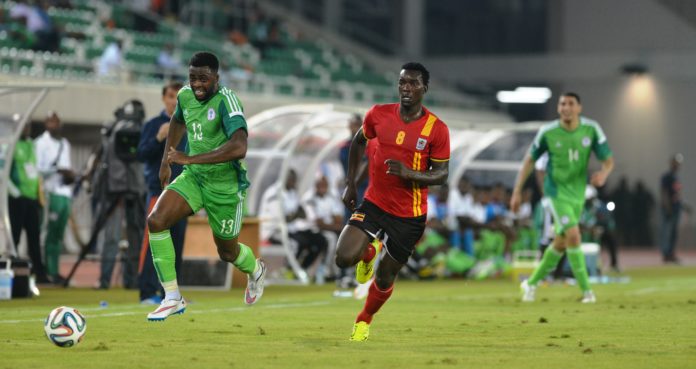
Uganda lineup International friendly with Nigeria Super Eagles

Aucho Khalid in action against Nigeria in 2015

FUFA has confirmed that an international friendly has been lined up for Uganda Cranes to play Nigeria Super Eagles at Asaba Stadium on Tuesday, 20th November 2018.

The proposed game between the Super Eagles and the Cranes of Uganda will take place after both sides are through with their AFCON qualification matches against South Africa and Cape Verde respectively.

The development has been confirmed by the FUFA Communications Manager Ahmed Hussein.
“The Uganda Cranes technical team will make use of the FIFA International break that runs from 12th-20th November by playing a high profile friendly with the former African Champions. Matches between these two soccer giants have always been so close since time immemorial” said Hussein.

“A 30 man contingent will depart on 18th November 2018 for the trip to Nigeria. The foreign based players in the contingent will then connect to their respective clubs after the friendly” added Hussein.
Uganda are top of the group L AFCON qualification group with 10 points and only need a point to secure a place in the final tournament in Cameroon next year.
The Super Eagles of Nigeria top group E and need a win against South Africa at the FNB stadium to secure qualification.

The two teams last met in 2015 when Uganda Cranes edged the Super Eagles 1-0 at Ibo Akwa Stadium, courtesy of a Miya Farouk goal in the 81st minute.

International Friendly
Tuesday 20th November 2018
Nigeria vs Uganda – Asaba Stadium

Stories Continues after ad

Foreign domestic investment into Africa rises-EY

Dollars

South Africa shares the title of largest African FDI hub with Morocco; Southern, West, East and North Africa all receiving more or less equal FDI; the USA remains the single biggest country investing in Africa, while Western Europe is by far the biggest regional investor.

According to Ernest & Young (EY)’s latest Africa Attractiveness report, FDI was up across the continent last year, although South Africa experienced a fall in project numbers, on the back of continued weak domestic growth.

The EY 2018 report, ‘Turning tides’, provides an analysis of FDI investment into Africa over the past ten years. The 2017 data shows that Africa attracted 718 FDI projects which is up 6 percent from the previous year. This was in line with a recovery in the continent’s economic growth, following a difficult preceding year.

The higher project numbers were driven by interest in ‘next generation’ sectors, namely manufacturing, infrastructure and power generation. Despite the rise in FDI, project numbers remain below the 10-year average of 784 projects (per annum).

The report also highlights the countries with the strongest FDI gains, with Ethiopia, Kenya and Zimbabwe experiencing a major uptick in FDI during the 2017 year. By contrast, South Africa, Egypt, Mozambique and Cote d’Ivoire experienced declines in FDI projects in the same year.

Ajen Sita, EY Africa CEO, says, “2017 was in many respects a key year for the continent. We saw multiple changes in leadership across a number of countries, including South Africa, Zimbabwe and Angola. In addition, Kenya’s election was drawn out which created uncertainty at the time. Changes in leadership have in turn led to a renewed urgency to implement fresh policies as new administrations move to address slow economic growth.”

Emerging market investment into Africa slows

2017 saw a noticeable decline in emerging market investment flows into Africa. This is a major turnaround from the previous year when Asia-Pacific investors strongly increased inbound investments. Last year, investments from this region fell 16% while intra-African FDI also fell by 14 percent. The weaker intra-African flows were largely driven by a weaker appetite by both Moroccan and Kenyan investors into neighbouring countries. South Africa’s outward investment project numbers held steady as weak domestic growth saw companies continue the search for external growth opportunities across the continent.

North American (primarily the USA), and Western European FDI flows to the continent remain strong

After the USA, which remains the single largest country investing into Africa, three of the remaining top five investors are European, namely the UK, France and Germany. Of the ten largest investing countries in Africa, six are Western European.

The report found that South Africa, Morocco, Kenya, Nigeria and Ethiopia were the dominant anchor economies within their respective regions, collectively accounting for 40 percent of the continent’s total FDI projects. Overall these four major sub-regions each attract similar FDI when measured by project numbers. For the first time ever, East Africa became the single largest beneficiary of FDI with 197 projects (27 percent of total projects). Southern Africa, by contrast, fared lowest of the four major regions, at 162 projects (23 percent).

“Whilst South Africa remains the continent’s leading FDI destination when measured by project numbers, for the first time ever the country’s lead is under threat with Morocco increasing its FDI projects by a sizeable 19 per cent to share the top spot with South Africa. “Over time and as Africa’s growth accelerates, we anticipate that South Africa’s share of inbound FDI will continue to decline, relative to the rest of the continent. This will be driven by sustained strong growth, particularly in the Eastern-hub economies, and revived growth in the West hub. It illustrates the need for South Africa to ensure its leading economic role across the continent is sustained”, says Sita.

Next steps to increasing Africa’s FDI

”There are major opportunities that the continent can benefit from after the recent leadership changes we have witnessed. These opportunities require emboldened leadership to drive renewed policy reforms and implement new initiatives which encourage inbound investment flows. There are some outstanding examples of how this has already worked in some countries, not least Rwanda, which is able to attract FDI well ahead of other economies of similar size, and indeed, ahead of much larger economies,” Sita says.

By focusing on improving public sector efficiencies and finances, minimizing bureaucratic processes and partnering with the private sector on major projects, more countries can stimulate much needed FDI. In addition, they should continue to focus attention on increasing their scores on the ease of doing business and global competitiveness rankings, he says.

Stories Continues after ad

Chief Justice Katureebe attacks Bamugemereire over land grabbing allegation

CJ. Bart Katureebe

The Chief Justice Bart Katureebe has attacked Justice Catherine Bamugemereire’s land commission for the recent press release regarding the handling of land issues in courts of judicature, arguing that the Commission should have presented an interim report on the matter to president Museveni instead of running to the media.

“We would have expected the commission to communicate findings of such a serious nature in form of an Interim Report to the president not a Press Release,” Justice Katureebe says in a press release for Monday.

The Commission on October 26, published a press release accusing the judiciary of corruption tendencies in land adjudication.

He says had the Commission presented the report to the president, the judiciary as well as the government, would have studied that report and taken appropriate action, “including giving the officers mentioned in there …an opportunity to defend themselves”.

Nonetheless, we will further study the Press Release and try to work on it appropriately. Any judicial officer found to have acted outside the law, will be dealt with accordingly,” he says.

The judiciary has on occasions acted interacted with the Commission including on 25 September 2017 when it formally presented a detailed memorandum with recommendations regarding land administration and adjudication in Uganda, the Press Release notes.

The Principal Judge, Yorakamu Bamwine also blasted the Commission, saying that: “Actions of a few judicial officers should not be used to brand the entire judiciary a culprit.” Lately, we are encouraging judicial officers to conduct judicial processes in a more transparent manner so as to enhance public trust and confidence in the judiciary,” he says.

Stories Continues after ad

African governance progress lagging behind needs and expectations of growing population, finds 2018 IIAG

Mo Ibrahim

The 2018 Ibrahim Index of African Governance (IIAG), launched Monday by the Mo Ibrahim Foundation, highlights that public governance progress in Africa is lagging behind the needs and expectations of a growing population, composed mainly of young people.

Over the last decade, Overall Governance has on average maintained a moderate upward trajectory, with three out of four of Africa’s citizens (71.6 per cent) living in a country where governance has improved, says the Index.

African governments have struggled to translate economic growth into improved Sustainable Economic Opportunity for their citizens

According to the Index, since 2008 the African average score for Sustainable Economic Opportunity has increased by 0.1 point, or 0.2 per cent, despite a continental increase in GDP of nearly 40 per cent over the same period. There has been virtually no progress in creating Sustainable Economic Opportunity, meaning it remains the IIAG’s worst performing and slowest improving category. Defined as the extent to which governments enable their citizens to pursue economic goals and prosper, the almost stagnant Sustainable Economic Opportunity trend strikes a concerning contrast with demographic growth and youth expectations. Africa’s population has increased by 26.0 per cent over the last ten years and 60 per cent of the continent’s 1.25 billion people are now under the age of 25.

A diverging picture across Africa

African countries show increasing divergence in Overall Governance performance. Continental progress is mainly driven by 15 countries that have managed to accelerate their pace of improvement over the last five years. Progress is most striking in Côte d’Ivoire, Morocco and Kenya. Divergence is also reflected in Sustainable Economic Opportunity trends. While 27 of Africa’s countries have shown some improvement, in 25 countries, accounting for 43.2 per cent of Africa’s citizens, Sustainable Economic Opportunity performance has declined over the last ten years.

There is no strong relationship between the size of a country’s economy and its performance in Sustainable Economic Opportunity. In 2017, four of the ten countries with the highest GDP on the continent score below the African average score for Sustainable Economic Opportunity and sit in the lower half of the rankings, namely: Algeria, Angola, Nigeria, and Sudan. Meanwhile two of the smallest economies on the continent, Seychelles and Cabo Verde, reach the 5th and 6th highest scores in providing Sustainable Economic Opportunity for their citizens.

Declining Business Environment runs counter to the growing working age population

Calling for attention is the trajectory of the African average score for Business Environment. Deteriorating by almost -5.0 points over the last ten years, this is a worrying trend given that the number of working age Africans (15-64 years old) is expected to grow by almost another 30 per cent over the next ten years.

This will increase demand for jobs in an environment where on average progress in Sustainable Economic Opportunity is almost non-existent. Such demographic figures create a further striking contrast with the drop of -3.1 points in Satisfaction with Employment Creation since 2008.

Additionally, the indicator measuring Promotion of Socio-economic Integration of Youth registers an average continental decline of -2.3 over the last decade.

Education outcomes are worsening

Further cause for concern is Education. While Human Development is one of the bigger success stories of the 2018 IIAG, driven by improvements in Health, the stalling progress in Education seen in last year’s IIAG has now turned to decline.

For 27 countries, Education scores registered deterioration in the last five years, meaning that for more than half (52.8 per cent) of Africa’s youth population, education outcomes are worsening. This drop is driven by a fall in the indicators measuring whether Education is meeting the needs of the economy, education quality, and citizens’ expectations of education provision.

Civil society space is shrinking

Progress in Participation & Human Rights has been made on average. Almost four out of five of Africa’s citizens (79.6 per cent) live in countries that have progressed in this dimension over the last decade. However, ‘free and fair’ executive elections do not always translate into a better participatory environment. Alarmingly, citizens’ political and civic space in Africa is shrinking, with worsening trends in indicators measuring Civil Society Participation, Civil Rights & Liberties, Freedom of Expression and Freedom of Association & Assembly.

Welcome progress in Rule of Law and Transparency & Accountability, which are key to sound governance performance

Although Personal Safety and National Security continue to show average decline over the last decade, Rule of Law and Transparency & Accountability have begun to register welcome progress. Rule of Law is the most improved sub-category in the IIAG over the last five years. African average performance in Transparency & Accountability has also improved, though more needs to be done as it remains the worst performing sub-category.

The IIAG highlights that citizens’ rights and welfare are key to progress in public governance. Overall Governance scores are strongly correlated with citizen-centred measures, including property rights, civil rights & liberties, government accountability and social welfare policies.

The IIAG results also confirm that Rule of Law and Transparency & Accountability are key pillars of good governance. These two sub-categories show the strongest relationships with Overall Governance scores in Africa, with strong performance in these areas being the most common components of countries that perform well. Transparency & Accountability is also strongly related to the Sustainable Economic Opportunity categoryand Business Environment sub-category, indicating that improvements in these areas will support progress and economic opportunity in Africa.

Mo Ibrahim, Chair of the Mo Ibrahim Foundation, said:

“We welcome progress in Overall Governance, but the lost opportunity of the past decade is deeply concerning. Africa has a huge challenge ahead. Its large and youthful potential workforce could transform the continent for the better, but this opportunity is close to being squandered. The evidence is clear – young citizens of Africa need hope, prospects and opportunities. Its leaders need to speed up job creation to sustain progress and stave off deterioration. The time to act is now.”

Stories Continues after ad