Stanbic Bank
Stanbic Bank
24.6 C
Kampala
Stanbic Bank
Stanbic Bank
Home Blog Page 1462

Gov’t makes shortfall of Shs10b tax revenue in September

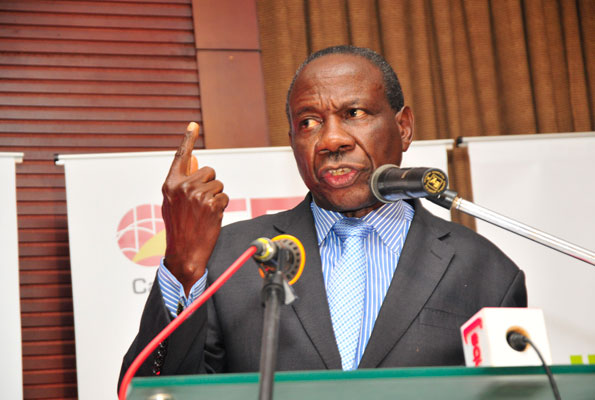
Finance Minister, Matia Kasaija who is worried of the sinking economy.

Government’s tax revenues in September 2018 totaled just over Shs1.2 trillion, registering, a shortfall of Shs9.9 billion and thereby offsetting the surplus recorded in non-tax revenues, according to the Performance of the Economy Report published by the Ministry of Finance Planning and Economic Development (MFPED).

According to the report, tax revenue collections were affected by international trade taxes whose collections were Shs51.6 billion lower than the projected target of Shs578.5 billion for the month of September. “This was due to lower than projected taxable imports during the period that affected both import duty and VAT on imports,” the report reads in part.

The report which tracks the performance of the Ugandan economy monthly, notes that shortfalls of Shs37.7 billion and Shs 21.7 billion were registered in VAT on imports and import duty respectively.

Meanwhile the report indicates that direct and indirect taxes amounted to Shs64.6 billion and Shs335.1 billion, performing above their respective targets by 2 per cent and 10 per cent respectively. “The performance in direct taxes mainly resulted from surpluses received in Pay As You Earn (PAYE) and earnings from withholding tax on treasury bills while indirect taxes benefited from surpluses on the mobile money levy and phone talk time,” says the report.

However, revenue and grants in September 2018 amounted to about Shs1.3 trillion performing at 94.3 per cent against the target. “This performance was mainly attributed to lower than anticipated grants received which performed at only 48.5 per cent against the target of Shs143.7 billion,” the report says.

Government Expenditure
Preliminary data indicates that Government expenditure during the month totaled to about Shs1.4 trillion, which translates into a performance of 65.0 per cent against the programmed expenditure, the report says. This, the report says, mainly resulted from lower than planned external project disbursements.

Current expenditures in the month of September 2018 were Shs906.1 billion against the program of about Shs1.1 trillion. “This mainly resulted from frontloading of the quarter one expenditure in the first two months of the Quarter coupled with the downward revision of domestic interest payable in the period,” the report says.

Meanwhile development expenditures in the month performed at only 43 per cent of the program or about Shs1 trillion. “This was on account of lower than anticipated external project disbursements and absorption of monies in the external project accounts,” the report says.

Backwards, the total budget value is Shs32.7 trillion for the current financial year (FY) which is 13 per cent up on FY17/18. Domestic revenue will fund 64 percent of the total outgoings, down from 67 per cent budgeted in the prior year. The planned deficit is Shs7, 428 billion (6.6 percent of projected GDP), which will be funded by increased domestic borrowing of Shs1, 785 billion along with external borrowing.

The Uganda Revenue Authority (URA), which is a national tax collector, has been given a tax collection target of Shs16.4 trillion in the current financial year.

Stories Continues after ad

EC resolves to renew its relationship with CCEDU

Electoral Commission and CCEDU officials

The electoral commission has resolved to renew its partnership with citizen’s coalition for electoral democracy in Uganda (CCEDU) months after the latter was suspended from observing any elections.

CCEDU was on July 4th 2018 suspended from conducting election-related activities over allegations that the organisation has been partisan in the way it has been conducting its activities, breaching electoral observation guidelines for benefits of stake holder in the electoral process.
EC, chairman Justice Simon Byabakama said, the commission and the nation wants credible, honest and impartial partners to access electoral process and make pertinent recommendations, it is upon that background that EC suspends your relationship until further notice,” the statement said.
The suspension followed CCEDU position of opposing voting by lining up behind candidates, “therefore we will not observer LC1 elections,” they wrote.

However, in a meeting held at Electoral Commission headquarters, the two bodies agreed to form a joint committee comprising of three officials from each organisation to expeditiously harmonize the parameters of their working relationship and communication strategy while engaging in election related activities.

The committees will be mandated with presenting mutually binding positions on both sides and pave way for lifting the suspension of CCEDU.

According to Crispin Kaheru, the chairperson of CCEDU, the allegations are baseless since they have done reports before, “so it’s not true that we are just on the other side,” he added.
“While performing our election observation duties, we have to work with the EC because it is them that are directly mandated to manage elections, that is one fact that was clear in the meeting we had,” he said.

Stories Continues after ad

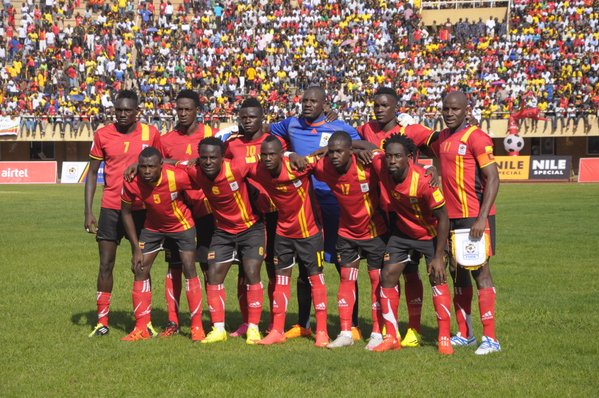
Uganda climb four places in October 2018 FIFA rankings

Cranes

After back-to-back victories over the Lesotho national football team in the group L 2019 Africa Cup of Nations qualifiers, Uganda Cranes has climbed four places in the October Fifa rankings released today.

The Cranes are now in 79th position with a total of 1291 points, and are placed at 16th in Africa.

Uganda Cranes beat Lesotho 3-0 and 2-0, in the home and away matches respectively, to move one point closer to the Afcon tournament in Cameroon 2019.

A brace from Emmanuel Okwi and a Farouk Miya penalty were on target in the Namboole game while Miya netted both goals in the return leg in Maseru.

Cranes next opponent on 17th November 2018 at the Mandela National Stadium, Cape Verde, dropped by one slot to 68th.

East African neighbours Kenya are at 105, Tanzania at 136, Burundi (142) while Rwanda at 138.

The top five countries in Africa are; Tunisia (22), Senegal (25), Nigeria (44), Congo DR (46) and Morocco (47).

Last month, Belgium joined France in becoming the FIFA/Coca-Cola World Ranking’s first-ever joint leaders. Now the Red Devils are in sole possession of top spot, by the narrowest possible margin, 1733 to France’s 1732.

Brazil comes in third, World Cup finalists Croatia in fourth and England complete the best five countries.

Gibraltar was the best mover, moving up by 8 places to 190, while Mozambique fell hardest, dropping by 9 places to 122.

The format used by FIFA is named “SUM” as it relies on adding/subtracting points won or lost for a game to/from the previous point totals rather than averaging game points over a given time period as in the previous version of the World Ranking.

The points which are added or subtracted are partially determined by the relative strength of the two opponents, including the logical expectation that teams higher in the ranking should fare better against teams lower in the ranking.

The next FIFA/Coca-Cola World Ranking will be released on 29 November 2018.

Stories Continues after ad

Uganda and EU reconfirm partnership at Article 8 Political Dialogue

The EU Ambassador to Uganda Attilio Pacifici shares a light moment with Prime Minister, Dr. Ruhakana Rugunda as other officials look on

Uganda and the European Union (EU) have reconfirmed their close partnership in a Political Dialogue meeting held on October 24, 2018, hosted by President Yoweri Museveni at State House in Entebbe.

The meeting was held in accordance with Article 8 of the Cotonou Partnership Agreement and forms part of regular political dialogue between Uganda and the EU on global, regional and national issues of mutual interest.

The discussion was held in an open, cordial and constructive atmosphere. The EU delegation was led by the European Union Ambassador to Uganda, H.E. Attilio Pacifici, who was joined by the Heads of Mission of Austria, Belgium, the Czech Republic, Denmark, France, Germany, Ireland, Italy, the Netherlands, Poland, Sweden, and the United Kingdom.

Also in attendance in the meeting above were the Prime Minister, Dr. Ruhakana Rugunda, Foreign Affairs Minister Sam Kutesa, Minister of Finance, Matia Kasaija the Minister for Security, Attorney General and Secretary General of the National Resistance Movement, Justine Lumumba, as well as other senior government officials.

The topics for the political dialogue ranged from business climate, trade and investment to matters of rule of law as well as regional issues, with the EU thanking Uganda for its positive role in promoting regional peace and security. The EU also expressed its gratitude to Museveni and his ministers for; “regularly being available for a constructive political dialogue.”

Stories Continues after ad

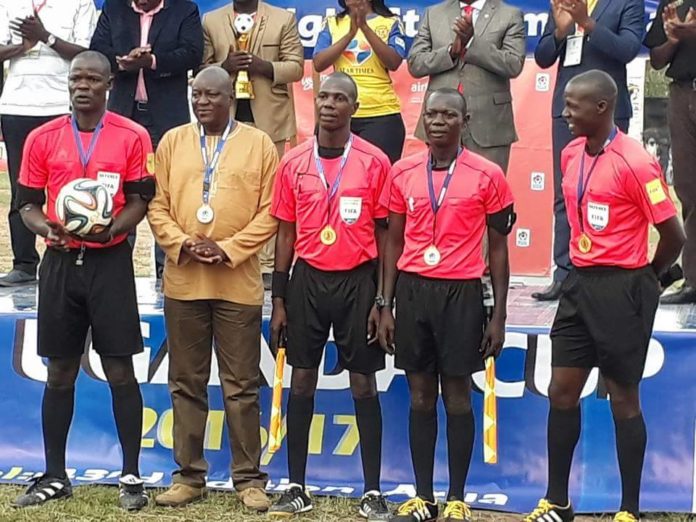
FUFA submits 23 names for 2019 FIFA badges

Ugandan referees during the Uganda cup final

Twenty-three referees have been shortlisted by FUFA to take charge of selected FIFA assignments for the 2019 season and they are to be confirmed by the world football governing body.

FUFA submitted the list to FIFA yesterday for the referees to be considered for the 2019 FIFA Badges. The development has been confirmed by the Chairman Uganda Football Referees Association Ronnie Kalema.

The list consists of five male referees, six assistant male referees, 3 female referees, five female assistant referees and four beach soccer referees.

Florence Ayaro, Eunice Tiwuwe and Keneddy Bazirio Kawagga are the new faces that have been added to the list by FUFA.

“The list was reached on after the mandatory fitness tests then presented to the FUFA Executive Committee for approval” said Chairman Uganda Football Referees Association Ronnie Kalema to the FUFA website.

Uganda currently has 21 International referees but FIFA decides on the allocation of referees to each Member Association.

FIFA will confirm the referees suitable for the 2019 FIFA badges before the end of this year.

The proposed list:

Referees (Men): Miiro Brian Nsubuga, Ssali Mashood, Muhabi Alex, Sabilla Ali Chelangat and Oloya William

Assistant referees (Men); Ssonko Mark, Okello Dick, Katenya Ronald, Okello Lee, Balikoowa Musa Ngobi and Masembe Issa.

Referees (Women): Nabadda Shamirah, Murungi Diana, Ayaro Florence

Assistant referees (Women); Nantabo Lydia Wanyama, Nagaddya Catherine Cynthia, Nakitto Marex Nkumbi, Mutonyi Jane and Tiwuwe Eunice.

Beach Soccer: Kintu Ivan Bayige, Mugerwa Shafic, Ssenteza Muhammad and Kawagga Bazirio Keneddy

Stories Continues after ad

Private sector credit hits 13.6 trn in August 2018 –report

Real estate had the largest share of 20 per cent of private sector credit

The total stock of outstanding private sector credit (PSC) in Uganda increased by 1.3 per cent to about Shs13.6 trillion in August 2018 from about Shs13.4 trillion in the previous month, according to the Performance of the Economy Report for the month of September 2018.

According to the report published by the Ministry of Finance Planning and Economic Development (MFPED), most of the expansion was recorded in the stock of foreign currency denominated credit which grew by 2.7 to Shs5.04 trillion in August 2018 percent from Shs4.9 trillion in July 2018.

The stock of shilling denominated credit also expanded by 0.5 percent to Shs8.5 trillion in August 2018 from about Shs8.5 trillion in July 2018.

Lending institutions disbursed credit worth about Shs1.045 trillion to the private sector in August 2018 which partly accounts for the growth in the stock of outstanding private sector credit.
“There was increased demand for credit by the private sector when compared with the previous month as value of loans applied for increased by 50.9 per cent although only 56.1 per cent of this was approved,” says the report.

The report says manufacturing, trade and the real estate sectors registered declining credit extension on a monthly basis yet they account for the biggest share of credit extensions. “They are the reason the total credit extension in the month declined,” the report says.

In terms of sectoral shares, trade and the real estate sectors hold the biggest share of the stock outstanding private sector credit at 20 per cent each, followed by personal and household loans at 18 percent, Manufacturing, Agriculture follow at 12 per cent each, respectively.

Other sectors’ share follows as; Transport and Communication (5 per cent) Electricity and Water (5 per cent), Community, Social & Other Services (4 per cent) and Business Services (4 per cent) while mining and quarrying as well as other services share 0 per cent each.

Meanwhile the report says the average interest rate for shilling denominated credit during the month of August 2018 reduced to 19.03 per cent down from 19.17 per cent recorded for the previous month. “Unlike for the shilling denominated credit, average lending rates for foreign currency denominated credit went up from 7.62 per cent in July 2018 to 7.78 per cent in August 2018,” the report reads in part.

Stories Continues after ad

Vivo Energy profit dips after supply disruptions in Q3

Vivo Energy

Shell African licensee Vivo Energy has reported a slim tumble in third-quarter gross cash profit tagged to a slowdown in retail volume caused by short-term supply disruptions in Uganda, Kenya and Ivory Coast.

Vivo, which is listed on the London Stock Exchange and distributes and markets Shell-branded fuels and lubricants across 15 African markets, said gross cash profit dropped to US $167 million in the quarter ended September 30, from US $171 million a year before.

The company gave no detail on the nature of the supply disruptions, saying only that they were largely resolved.

It said total retail volumes grew just 1 percent in the quarter. Overall Q3 volumes grew to 2,323 million litres, which was a 2 up percent rise from last year. The company said it expected growth of 4 per cent for the full year.

Established in 2011 via a partnership between energy trader Vitol Group and UK-based private equity firm Helios Investment, Vivo has been looking to expand and develop its network of 1,800 filling stations.

Recently it purchased a network of service stations from Engen Holdings and expects to use them to allow it expand into extra eight African markets. Vivo also expects to exceed its earlier target of opening 80 retail stations this year.

Stories Continues after ad

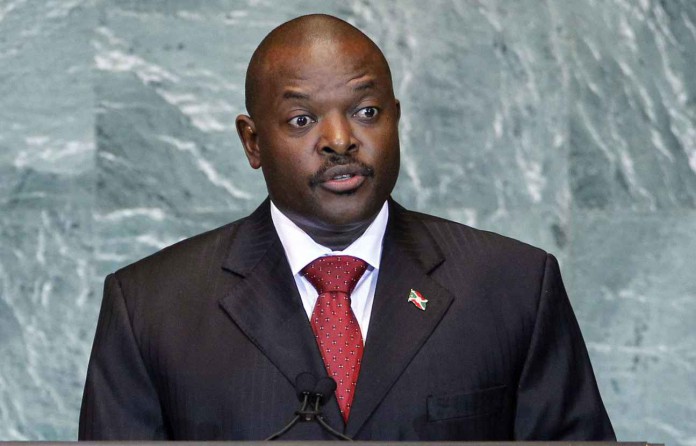
Burundi yet to confirm its participation in Dialogue to resolve conflicts

FOURTH TERM? Burundi President, Nkurunzia.

Government of Burundi is yet to confirm its participation in the 5th and final round of the Inter-Burundian Dialogue that is aimed resolving conflicts in the country.

Since April 2015, protests have taken shape against the president’s decision to run for a contested third consecutive term. Since then, the security situation has deteriorated, with more than 400 people killed and 200,000 fleeing to neighboring countries of Uganda and Tanzania.
Although much of the violence has subsided in recent years, extreme poverty, lack of law and order and ongoing human right violations, as well as the difficulty of integrating former rebels into state institutions, continue to be major barriers to stability and sustainable peace in the country.

According to Ambassador David Kapya who remarked on behalf of the Facilitator, retired Tanzanian President Benjamin William Mkapa, there is no confirmation from the government of Burundi on whether they will attend the talks or not.

The talks that are being held at the Ngurdoto Mountain Lodge near Arusha, Tanzania have the goal of arriving at consensual roadmap towards the 2020 general election in Burundi.
The 5th and Final Round of the Burundi Dialogue, which will go up to October 29, 2018, will involve the Facilitator engaging political parties and political actors in arriving at the roadmap.

Amb. Kapya, a Senior Adviser to the Facilitator, said that retired President Mkapa had so far engaged with international actors to seek their assistance in bringing all the parties to the negotiation table.

Earlier in June, Burundi’s long-serving President Pierre Nkurunziza announced that he would not run for another term, easing fears of new violence in the impoverished country after a referendum on term limits. He was expected to take advantage of the constitutional amendment to participate in the next two presidential elections of 2020 and 2027.

Stories Continues after ad

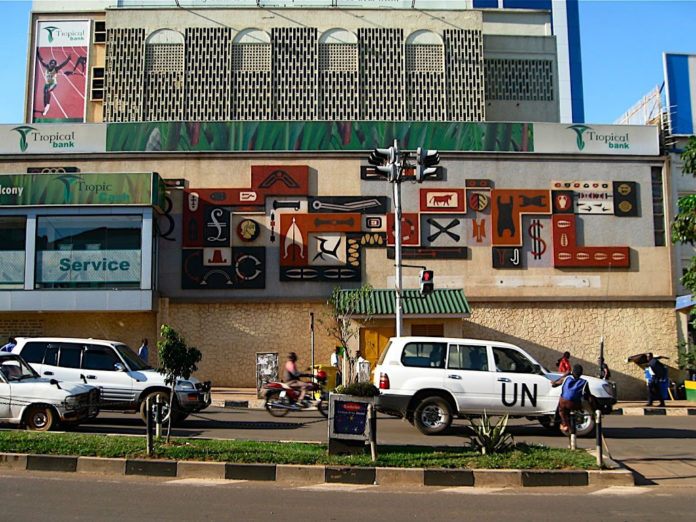
BREAKING: Tropical bank MD sacked

Tropical-bank

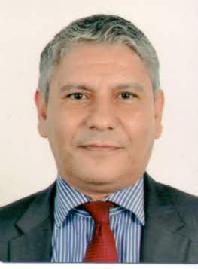
The latest news in the local banking industry is that The Managing Director of Tropical bank Kreshi Sameh Mahmud has had his contract terminated and asked to handover office immediately.

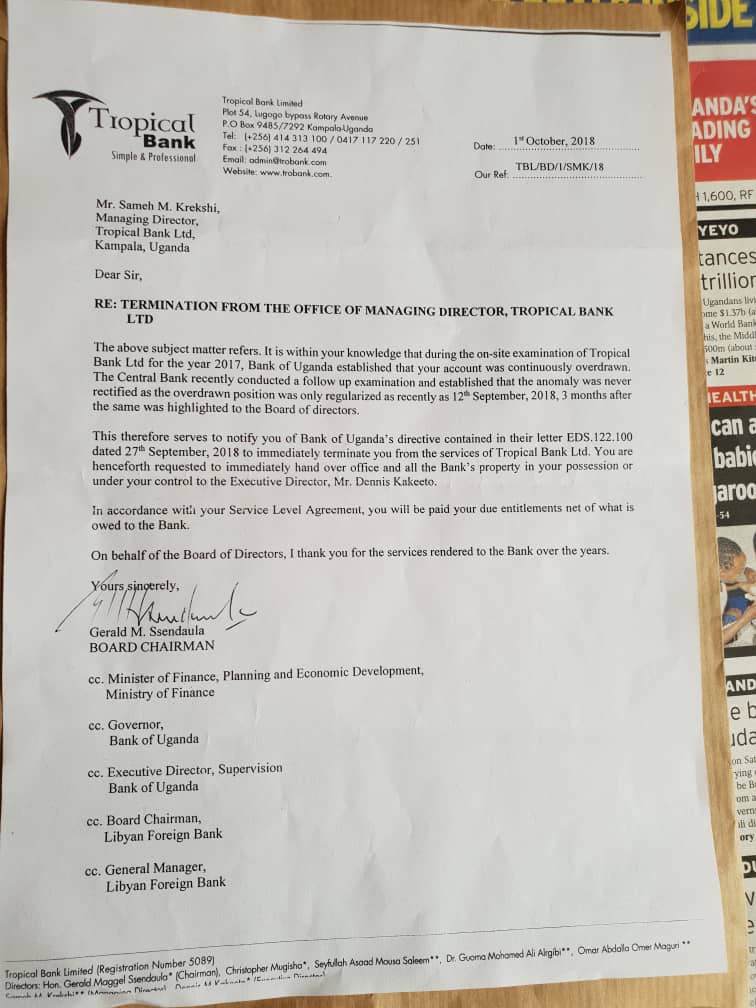
The termination letter was written by the Bank’s board chairman Gerald Ssendaula on October 1, 2018, stating that Mahmud’s bank account was continuously being overdrawn which goes against Bank of Uganda regulations.


“It is within your knowledge that during the on-site examination of Tropical Bank Ltd for the year 2017, Bank of Uganda established that your account was continuously overdrawn. The Central Bank recently conducted a follow up examination and established that the anomaly was never rectified as the overdrawn position was only regularized as recently as 12th September 2018, 3 months after the same was highlighted to the Board of directors,” Ssendaula wrote.

Denis Kakeeto, the Executive Director for now replaces Muhmud in acting position.

Sacking letter.

However, other sources say there is a clique of mafias in the bank eying US$ 7 million lying on one of the accounts for Libyan shareholders and would want to withdraw and shared it. “That’s the reason the termination of the MD is very urgent. That once he is out of the country, it will be easy for them to withdraw this money,” a source says.

Mr. Muhmud has been Managing Director of Tropical Bank Limited since August 17, 2016. Mr. Mahmud served as General Manager of Tropical Bank Limited since 2015 to August 17, 2016. He is a visionary, action oriented and hands-on Leader, with over 20 years’ experience in Treasury Operations, Trade Finance, Investment and Portfolio Management, International relations and Marketing; General bank Operations among others. He has been a Director of Tropical Bank …

Stories Continues after ad

NWSC,two ministries sign Tri-partite MoU to skill technicians in water sector

Eng. Silver Mugisha, NWSC Managing Director who is credited with the latest innovations.

The Ministry of Water and Environment, Ministry of Education and Sports and National Water and Sewerage Corporation (NWSC) have signed a tri-partite Memorandum of Understanding (MoU) aimed at skilling Engineers, plumbers and other technicians in the sector.

The above follows the July 2012, tri–partite MOU) between NWSC, Directorate of Water Development (DWD), and the Directorate of Industrial Training (DIT), under the auspices of Ministry of Education and Sports was signed. The duration of this MOU was five (5) years, and expired at the end (July 2017).

The latest MoU to run for another five years (2018-2023) was signed to benefit more technicians in the water sector, the previous one having been implemented successfully.
Representing the Ministry of Water and Environment, NWSC Board member and Director, directorate of water development in the Ministry of Water and Environment Eng. Aaron M. Kabirizi said that all technicians and plumbers will be required to be certified. “We want to know the different skills they attained from training institutions,”” he said.
Speaking at the signing ceremony, NWSC MD Dr. Eng. Silver Mugisha said a number of NWSC plumbers and technicians have learnt on the job and, therefore, there is need to test the skills.
He said that the programme is in line with the ongoing staff development plans and the corporation has made good strides towards developing training materials and vocational infrastructure/training centres at Gaba and Kachung Vocational Skills Development Facility coming on board very soon. “We have plumbers who have worked with NWSC for over 20 years and we need to certify them,” he said.

Aggrey Kibenge, the education ministry undersecretary, said certification would enable local technicians and plumbers to compete for opportunities even at regional level.
While Dr Martin Kalibala, the manager training and capacity building at NWSC, said since 2016, NWSC is been assessing engineers and technicians from DIT. “It is good for this programme to be rolled out. It has improved service delivery and reduced on costs of monitoring workers, since they are now competent,” he said.

Kalibala said that upon completion of the training and assessment, NWSC technicians will be given certificates known as Worker’s Practically Acquired Skills (Worker’sPAS).
The primary objectives of the MOU are to: develop a highly skilled national technicians’ workforce in the water sector, which shall competently run and maintain water supply, sewerage, and sanitation systems, within and outside the jurisdiction of DWD and other Water Authorities.

The trained personnel will; enhance the schemes’ operational efficiencies; ensure better asset management; and reduction in non–revenue and create synergies with stakeholders and develop capacity at various vocational skills levels, qualification standards, assess/examine candidates and award certificates/qualifications.

Benefits of the MoU to NWSC
NWSC will achieve the following benefits from implementing the MOU:
• Enhance vocational hands–on skills for technicians (plumbers, electro–mechanical technicians, electricians, customer service advisors, welders, water quality experts) for the small towns under DWD jurisdiction.

• Earn additional income from training DWD technicians – through External Services (ES) – since the financing mechanisms of the MOU training activities will come from DWD budgets.
• Strengthen our collaboration with DIT and DWD.
• Enhanced our corporate image, corporate social responsibility (CSR), and visibility by enhancing skills within the water sector.

Last year, over 232 NWSC graduated from the Gaba skills development facility [VSDF].
This year, a total of 284 graduands will graduate at the centre come November 9, 2018.

Stories Continues after ad