Stanbic Bank
Stanbic Bank
21.4 C
Kampala
Stanbic Bank
Stanbic Bank
Home Blog Page 1465

NWSC annual turnover improves by 20.9%

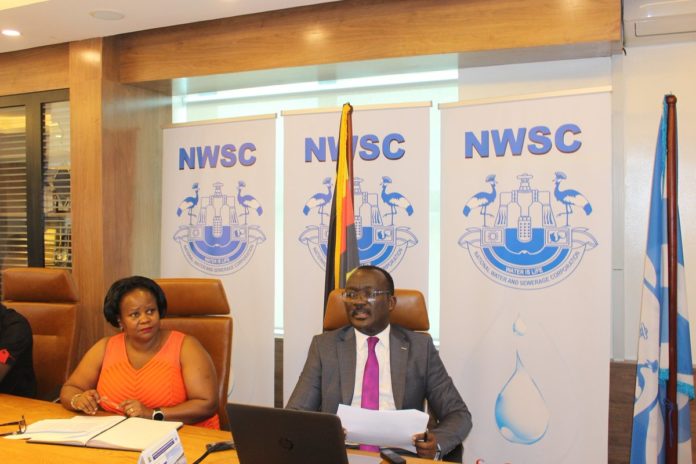
NWSC MD Dr. Silver Mugisha and a colleague during the presser.

National Water and Sewerage Corporation have today shared the company’s performance overview to the public at their Head Office in Nakasero.

Dr. Silver Mugisha, the NWSC Managing Director, presented performance for the past five years and mainly 2017/2018 in particular as one of the requirements of public corporations.

He says in 2013/14, they extended 470kms of water mains, 910kms of water mains extensions in 2016/17 and 2021kms of water mains extension in 2017/18, indicating a percentage increment of 122 per cent.

“Water service coverage has increased from 77 per cent (2013/14), 78.2 (2016/17), 83.7 (2017/18). This a 5.5 per cent increment in service coverage. We have extended clean safe water to serve more people. We had 66 towns in 2013/14. 218 towns in 2016/17 and 236 towns 2017/18. This an 8.3 per cent increment in water mains extensions across the country,” explains Dr. Mugisha.

“We had a total water network length of 6,994kms in 2013/14. We have increased the network length from; 12,113kms of water mains in 2016/17 to 14,166kms of water mains in 2017/18.” He added.

According to Mugisha, they have increased the number of new connections (People served). From 28,068 new connections in 2013/14, to 40,712 in 2016/17 and now 50,341 towns in 2017/18. This is an increment of 23.7 per cent. Total water connections have increased from 366,330 in 2013/14 to; 529,709 Water connections in 2016/17, 587,873 Water connections in 2017/2018. This is an improvement of 11 per cent.

Total Sewer connections have increased from 18,810 in 2013/14 to 21,072 sewer connections in 2016/17, 21,616 sewer connections in 2017/2018. This is an improvement of 2.6 per cent.
“The annual turnover has increased from 184.5 billion in 2013/14 to; 321 billion in 2016/17, 388 billion in 2017/2018. This is an improvement of 20.9 per cent annual turnover & capacity to extend services to more people.” He explains
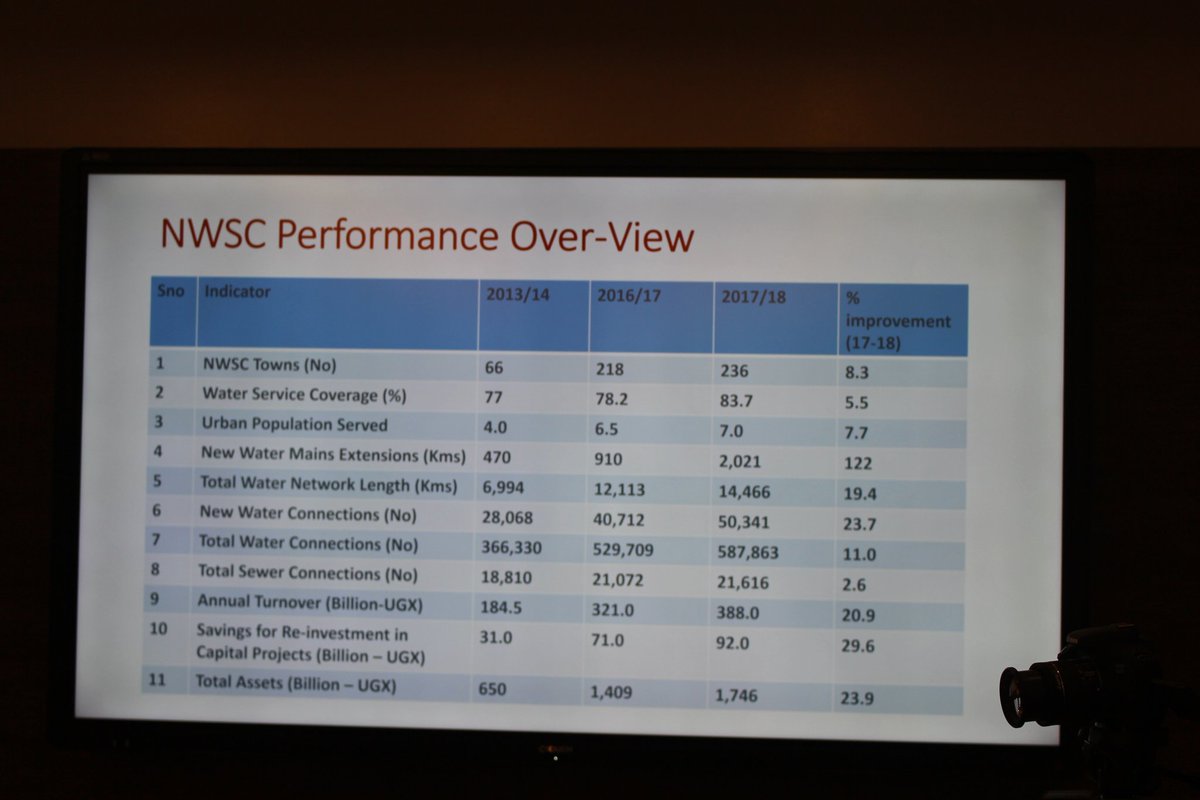
NWSC performace overview.

Savings for re-investment in Capital Projects increased from 31 billion in 2013/14 to 71 billion in 2016/17, 92 billion in 2017/18. This is an increment of 29.6 per cent. Dr. Mugisha appreciated the customers who pay their bills promptly.

The total assets of NWSC have increased from 650 billion in 2013/14 to 1,409 billions in 2016/17, 1,746 billions in 2017/18 which is an improvement of 23.9 per cent.

Dr. Mugisha added that it is risky to put sewerage services where there is no water. They are aggressively extending their water mains to serve more people with clean safe water. They’re also working on sewage master plan that will be launched very soon.

“At NWSC, we don’t make profits! We reinvest all the surplus income we get. Our commitment to achieve 100 per cent water coverage in all corners of Uganda is total.” He concluded
National Water and Sewerage Corporation is a water supply and sanitation company in Uganda which is wholly owned by the government of Uganda.

Stories Continues after ad

World Bank to investigate Bujagaali and Isimba power projects

Contested Land: A group nine has taken the Isimba contractor and government to court demanding compensation for the land where the damn is being constructed.

The board of directors at World Bank is set to investigate allegations of harm and related potential non-compliance plausibly linked to the Bujagaali and Isimba power generation projects.

In June 20, 2016, the monetary body received a complaint related to the Bank-financed Uganda Private Power Generation (Bujagali) Project, the Water Management and Development Project (WMDP) and the Energy for Rural Transformation Phase III Project (ERT-III).

Complainants raised concerns about potential social and environmental harm caused by the construction of the Isimba Dam reservoir and the consequent flooding of the Kalagala Offset area (KOA).
While the World Bank is not financing the dam, the complainants averred that, the flooding will undermine the management of protected natural resources in the KOA, which is a requirement of an indemnity agreement between the International Development Association and the government of Uganda as part of the Bujagaali project.

The inspection Panel noted the importance of investigating the timing and adequacy of management’s actions in response to the government of Uganda’s decision to build the Isimba Dam, which threatens the integrity of the KOA in potential non-compliance with the Kalagala Offset Sustainable Management Plan under the WMDP.

It also noted that the timing, sequencing and adequacy of the ESIA addendum, financed under the ERT-III with analysis of alternatives limited to Isimba Dam’s differing heights, reservoir levels and water level regimes, could constitute potential non-compliance with Bank Policies on Environmental Assessment and Natural Habitats, among others.

The two Request for Inspection were lounged in on June 20, 2016 (case no. 110), and on September 19, 2016, the Panel received a second Request for Inspection, case no. 113, related to the same projects.

Stories Continues after ad

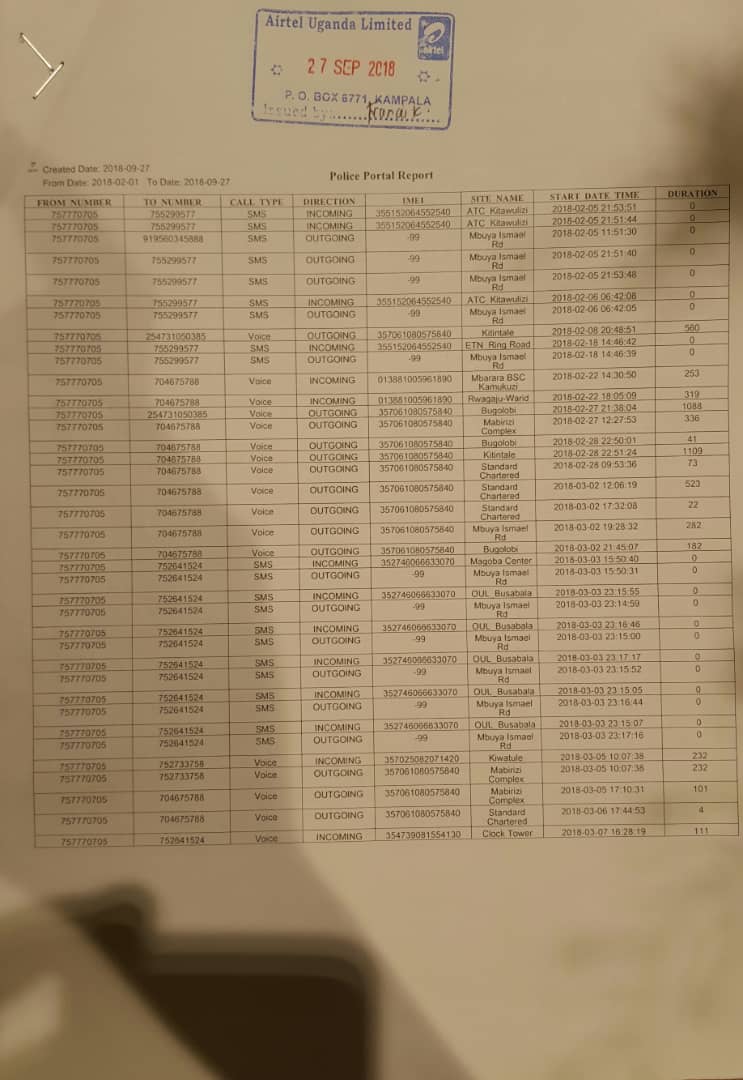
Parliament summons: Justine Bagyenda lied, never travelled as revealed by phone printout

Embattled former Executive Director in charge of Supervision at Bank of Uganda Justine Bagyenda.

It has emerged that former Executive Director in charge of Supervision at Bank of Uganda, Justine Bagyenda lied to parliament that she had traveled out the country.

In a detailed telephone printout that has since leaked, Bagyenda was at Mbuya as shown by the leaks and on that same day, she received several calls.

Bagyenda snubbed appearing before the appointments committee of parliament which is chaired by the Speaker Rebecca Kadaga to defend herself in order to be reappointed on the board of Financial Intelligence Authority (FIA). Bagyenda and other board members were supposed to appear before the committee for vetting after they were reappointed by Finance Minister, Matia Kasaija.

However, Bagyenda wrote to the committee indicating she had travelled out of the country. She decided not to make a show after it emerged that several people had petitioned the committee over her past record at both BoU and at FIA.

Bagyenda is being investigated for illicit accumulation of wealth and property by both Inspectorate of Government and same FIA, a body she is supposed to superintend.

Stories Continues after ad

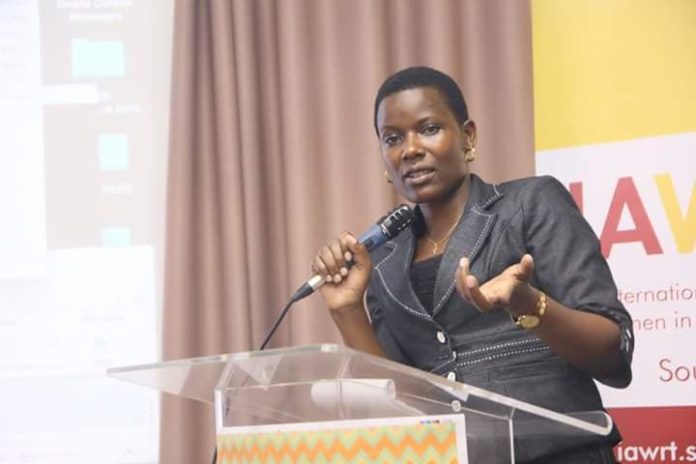
Journalist Eunice Nankwanga elected president of IAWR-Uganda chapter

Ms Eunice Nankwanga

Journalist Eunice Nankwanga has been elected the President of International Association of Women in Radio and Television (IAWRT) Uganda chapter.

Nankwanga who worked with NBS TV, Kingdom Television and other organisations, is currently the spokesperson for Interreligious Council of Uganda (IRCU).

Remarking after the voting exercise, the outspoken and experienced journalist vowed to contribute on gender mainstreaming in media and mentorship saying mediocrity is not a choice. “It is time for a woman to reshape own position without being clustered into vulnerabilities,” she said at organisations headquarters in Nansana.

Since the platforms works for elevation of women in media, Nankwanga pledged to avails opportunities, share strategies and contribute towards the development of women in broadcasting and exchanging professional and technical knowledge and experiences.

IAWRT-Uganda chapter is a network of professional media practitioners working for gender equality in the media and a fairer treatment for women working in broadcasting journalism in Uganda.

It also provides a rich resource of knowledge and professional experience through its information exchange forums and professional media support to various organizations and individuals.

She will be working along six members to achievement her goals. The other members are:
1. Stella Teta -Vice President
2. Agnes Nantambi-Secretary
3. Rose Namale-Treasurer
4. Linda Kibombo- Board Member
5. Fleria Nalwanga – Board Member
6. Irene Birungi – Board Member
Outgoing members
1. Sarah Nakibuuka – President (now serves as Secretary to IAWRT international Board)
2. Eunice Nankwanga – Vice President
3. Joyce Bagala- Secretary
3. Irene Birungi- Treasurer
4. Rose Namale – Board Member
5. Agnes Nantambi- Board Member
6. Stella Teta- Board Member
7 – Prossy Nandudu- Board member

Stories Continues after ad

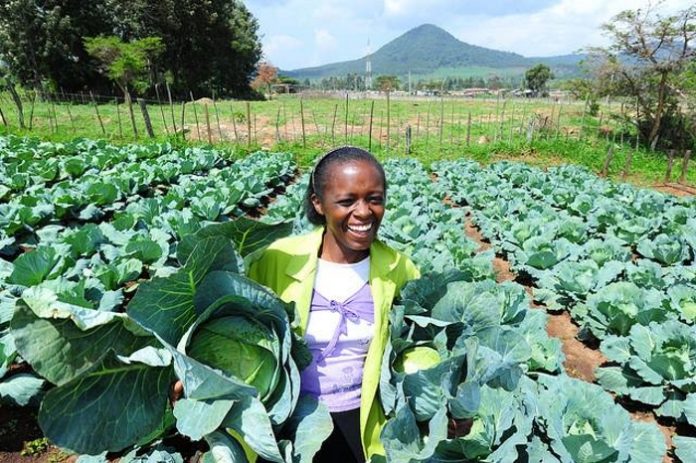
Gender gaps in African agriculture are holding back progress

Lady in her garden

Gender gaps in agriculture in Africa are holding back progress towards ending hunger and must be urgently addressed, the UN Food and Agriculture Organization’s Director-General José Graziano da Silva said at a joint event with the African Union (AU) on the margins of the UN General Assembly.

“We need to better recognize and harness the fundamental contribution of women to food security and nutrition. For that, we must close persisting gender gaps in agriculture in Africa,” Graziano da Silva said.

The Director-General called for better representation of women in governance mechanisms and decision-making processes, as well as adequate and equal access to land, financial resources, social protection programmes, services and opportunities for women in rural areas.

Addressing gender gaps

The findings and recommendations of the AU-FAO study The Regional Outlook on Gender and Agrifood Systems were presented at the event. The Outlook is based on an extensive review of existing statistics, gender audits of 38 National Agricultural Investment Plans and in-depth country gender assessments carried out in 40 countries.

The study’s recommendations call for a “gender data revolution” in the agri-food sector to inform sound policies and programmes, and elevating the gender benchmarks in planning, monitoring and accountability.

“We need to put in place gender targeted programmes that address women’s specific vulnerabilities but also their key role in household nutrition and resilience,” Graziano da Silva said.

“Evidence shows that when women are empowered, farms are more productive, natural resources are better managed, nutrition is improved, and livelihoods are more secure,” he added.

The backbone of rural production

In some African countries, women account for up to 60 per cent of the labour force in family farming. They are largely responsible for agricultural activities such as growing vegetables, preserving harvests and raising small ruminants such as sheep and goats. Women are also responsible for family nutrition through the preparation of meals.

Closing productivity gaps could increase food production and consumption by up to 10 per cent and reduce poverty by up to 13 per cent.

If women have the same access to skills, resources and opportunities as men, they can be powerful drivers in the fight against hunger, malnutrition and poverty. Empowering women in agriculture, value chains and trade will accelerate the achievement of the Malabo Commitments and the Sustainable Development Goals

FAO and UN Women: building momentum on gender equality

On the sidelines of the event, FAO Deputy Director-General Maria Helena Semedo met with UN Women’s Deputy Executive Director Asa Regner.

UN Women recently commended FAO for its achievements so far in gender equality. In 2017, FAO met or exceeded 93 per cent of all performance indicators under the UN System-wide Action Plan on Gender Equality and the Empowerment of Women.

“FAO recognizes the importance of gender equality and women’s empowerment – both within the Organization and in our work where gender is a major priority. We know that when women have decision-making power, all of society benefits,” Semedo said.

“The partnership between UN Women and FAO has proven especially fruitful in turning words into concrete action. I look forward to continued, strengthened cooperation between the two agencies to unlock the potential of rural women and girls as agents of change,” Regner said.

Equality in action

FAO and partners are providing technical support to many African countries in order to empower rural women. One example is the Joint Programme on Accelerating Progress towards the Economic Empowerment of Women in Ethiopia, Liberia, Niger and Rwanda, implemented with the World Food Programme, the International Fund for Agricultural Development and UN Women. The Programme has already enabled more than 40,000 women to receive training on improved agricultural technologies, and aims to enhance their access to financial services and markets.

Stories Continues after ad

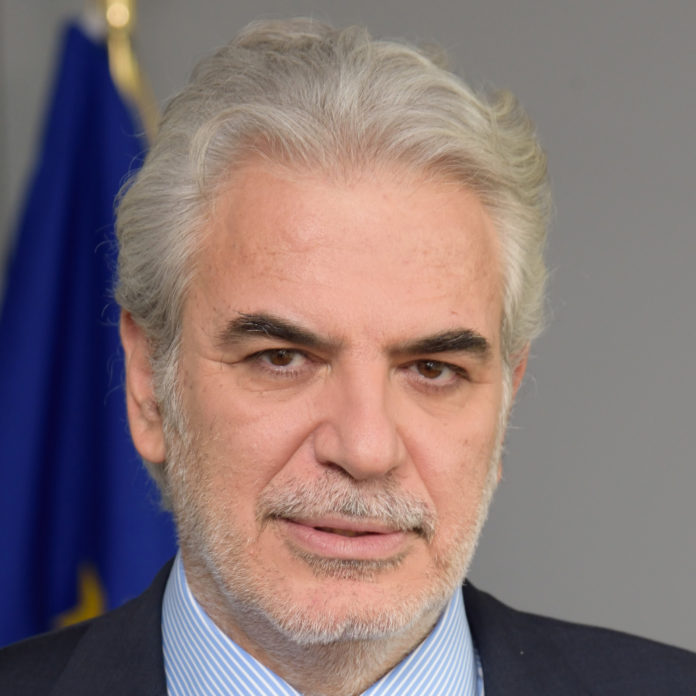
EU donates Shs270m for Ebola preparedness in Uganda

Christos Stylianides

In response to the 10th outbreak of Ebola virus disease in the Democratic Republic of Congo,the European Union is reinforcing preparedness in Uganda with a donation of Shs270 million (€60 000) in humanitarian funding to reinforce interventions aimed at detecting cases and preventing transmission.

“We have to be extremely vigilant and never let our guard down when dealing with health threats such as Ebola. The European Union has been at the forefront of efforts to help people affected by the virus and contain outbreaks,” said Commissioner of Humanitarian Aid and Crisis Management Christos Stylianides.

The official said they have mobilised the EU emergency response mechanisms and provided logistical support for the recent and current outbreaks in DRC, and also contributed to vaccine development. “Our support to the Uganda Red Cross will help to take much needed action to help the country prepare better,” he said.

Health experts have warned there is a real risk of Ebola spreading to Uganda due to intense cross-border movements between the two neighbouring countries. Should Ebola hit Uganda, it will not be the first time. The deadly disease has hit the country in the past on more than one occasion.

The EU funds will allow the Uganda Red Cross to reinforce preparedness and prevention in 7 of the most at risk districts bordering DRC (Ntoroko, Bundibugyo, Kasese, Kisoro, Kanungu, Kabarole, Bunangabo) and 18 points of entry. Staff and volunteers will be trained in contact tracing, informing and engaging with communities, and carrying out safe and dignified burials.

Others will be taught how to take infection, prevention and control measures and provide psychosocial support to affected people. The activities will reach 149 000 people over the next 3 months. They are in line with Uganda’s preparedness plan and complementary to actions of other partners on the ground.

The funding is part of the EU’s overall contribution to the Disaster Relief Emergency Fund (DREF) of the International Federation of Red Cross and Red Crescent Societies (IFRC).

The Uganda-DRC border sees daily movements of displaced populations, traders and miners. Insecurity and community resistance in eastern DRC are hindering efforts to contain the disease. 244 000 Congolese refugees have arrived in Uganda in the first half of 2018 as a direct consequence of inter-communal violence in North Kivu and Ituri provinces. Since this outbreak was declared on 1 August 2018, 151 cases of Ebola have been reported in eastern DRC.

The EU and its Member States are the world’s leading donor of humanitarian aid. Relief assistance is an expression of European solidarity with people in need all around the world. It aims to save lives, prevent and alleviate human suffering, and safeguard the integrity and human dignity of populations affected by natural disasters and man-made crises.

Through its Civil Protection and Humanitarian aid Operations department (ECHO), the European Union helps millions of victims of conflict and disasters every year. With headquarters in Brussels and a global network of field offices, the EU provides assistance to the most vulnerable people on the basis of humanitarian needs.

Meanwhile, the European Commission has signed a €3 million humanitarian delegation agreement with the International Federation of Red Cross and Red Crescent Societies (IFRC) to support the Federation’s Disaster Relief Emergency Fund (DREF). Funds from the DREF are mainly allocated to “small-scale” disasters – those that do not give rise to a formal international appeal.

The Disaster Relief Emergency Fund (DREF) was established in 1985 and is supported by contributions from donors. Each time a National Red Cross or Red Crescent Society needs immediate financial support to respond to a disaster, it can request funds from the DREF.

For small-scale disasters, the IFRC allocates grants from the Fund, which can then be replenished by the donors. The delegation agreement between the IFRC and ECHO enables the latter to replenish the DREF for agreed operations (that fit in with its humanitarian mandate) up to a total of €3 million.

Stories Continues after ad

Gov’t to set up cancer treatment centres in Arua and Mbale

Minister Sarah Opendi

Government will set up cancer treatment centres in Arua and Mbale referral hospitals for treatment of various types of the catastrophic disease in the country.

According to the Minister of State for Health Sarah Opendi, the move is in line with the World Health Organization recommendation to adopt a planned response to the cancer crisis by initiating a Comprehensive National Cancer Control Programme.

Arua and Mbale caters will supplement the already operational cancer treatment center in Mbarara Regional Referral Hospital and Uganda cancer institute in Mulago.
“These facilities aim to help in decentralizing cancer treatment services as well as decongest the Uganda Cancer Institute,” said Opendi.
Wamanga Wamai (Mbale Municipality) asked the Minister to explain what the government was doing to mitigate the rampant increase of cancer cases in the country.

“When a person is screened and found to have cancer, they are usually told that it is at an advanced stage. That is why very many of our people are dying of cancer,”
She noted that government is set to have a Comprehensive National Cancer Control Programme that will include care delivery with a National Cancer Centre of Excellence at the centre, cancer service network, cancer research, and a national policy on cancer.

Acknowledges the burden, threat of cancer and other noncommunicable diseases, Opendi said Ugandans had ignored advice from the ministry and partner health programmes to go for early cancer screening, but instead some of them had resorted to traditional methods to try treat the disease.
“We have trained midwives across the country to detect cancer [of the cervix], such that one does not need to move to the cancer institute or a regional referral hospital to carry out cancer screening,” Opendi said.

She implored parents to take their children for vaccination against Hepatitis B, which she said poses a risk of cancer of the liver and Human Papillomavirus

Stories Continues after ad

World Bank commits US$1 billion for battery storage to upgrade renewable energy

Solar power

The World Bank Group has committed $1 billion for a new global program to accelerate investments in battery storage for energy systems in developing and middle-income countries. The program is expected to help these countries upgrade their use of renewables – particularly wind and solar power – improve energy security, increase grid stability and expand access to electricity.

The $1 billion financing is expected to mobilize another $4 billion in concessional climate financing and public and private investments. The program aims to finance 17.5 gigawatt hours (GWh) of battery storage by 2025 – more than triple the 4-5 GWh currently installed in all developing countries.

“For developing countries, this can be a game changer,” said World Bank Group President Jim Yong Kim. “Battery storage can help countries leapfrog to the next generation of power generation technology, expand energy access, and set the stage for much cleaner, more stable, energy systems.”

Currently, batteries used in energy generation systems are expensive, and most projects are concentrated in developed countries. The “Accelerating Battery Storage for Development” program, in response to demand from countries, will finance and de-risk investments such as utility-scale solar parks with battery storage, off-grid systems – including mini-grids – and stand-alone batteries that can help stabilize and strengthen grids.

The program will also support large-scale demonstration projects for new storage technologies suitable for developing countries’ needs – such as batteries that are long-lasting, resilient to harsh conditions and high temperatures, and that present minimal environmental risks.

“Batteries are critical to decarbonizing the world’s power systems. They allow us to store wind and solar energy and deploy it when it’s needed most to provide people with clean, affordable, round-the-clock power.” Dr. Kim said. “We call on our partners to join us and match the investments we’re making today. We can create new markets for battery storage in countries with high wind and solar potential, growing energy demand, and populations that still live without reliable electricity.”

The World Bank Group is putting $1 billion of its own funds towards this new program and will fundraise another $1 billion in concessional climate funds through channels such as the Climate Investment Funds’ Clean Technology Fund (CTF). The program is expected to raise an additional $3 billion from public and private funds and investors.

The new program will also convene a global think tank on battery storage, bringing together national laboratories, research institutions, development agencies and philanthropies to foster international technological cooperation and training that can develop and adapt new storage solutions tailored for the needs and conditions of developing countries.

The World Bank Group has been working with countries to support the deployment of batteries together with solar and wind power for several years, with projects currently underway in Africa, South Asia, and the Pacific. The Bank Group has financed roughly 15 percent of the stationary battery storage capacity already deployed or currently under development in developing countries, mostly through mini-grid projects and in island states to improve resilience.

Stories Continues after ad

54% of Ugandans blame laziness as cause of poverty

laziness

The latest research findings released by Twaweza, a regional NGO, indicate that 54 per cent of Ugandans interviewed in the survey say that people are poor because of laziness or lack of personal effort.

In the findings, external factors such as social injustice (29 per cent), luck (16 per cent) and unemployment (11 per cent) are mentioned by fewer people.

But three times more people (62 per cent) say that hard work is the route to getting ahead in life or improving one’s status as compared to education (20 per cent). Most citizens (80 per cent) also believe that hard work makes it easy to acquire wealth.

The findings are the latest to be released by Twaweza in a research brief titled: The haves and the have nots: Ugandans’ opinions on poverty, fairness, and inequality. The brief is based on data from Sauti za Wananchi, Africa’s first nationally representative high-frequency mobile phone survey. The findings are based on data collected from 1,925 respondents across Uganda in May 2018.
Click to read report
SzW-UG-2018-Inequality-FINAL-print
According to the research findings, many Ugandans also have an unclear sense of relative poverty and where they might rank. This is especially true in urban areas where 8 out of 10 urban residents (78 per cent) are considered to be in the richest 40 per cent of the population while only 1 out of 20 urban citizens (4 per cent) consider themselves to be in this wealth group.

Similarly, in rural areas, 1 out of 10 (8 per cent) see themselves in the richest 40 per cent of the population while in reality 3 out of 10 (29 per cent) are.

Nonetheless, 95 percent of the Ugandans interviewed think that the gap between rich and poor is too wide, with a large majority (81 percent) saying the government is responsible for reducing this gap.

Further, 7 out of 10 citizens think inequality is an urgent problem. They call on government to provide free quality social services (41 per cent), lower taxes and less regulations on small businesses (37 per cent), and increased funding for social safety nets (37 per cent). But only 3 out of 10 (28 per cent) feel the government is showing sufficient urgency in addressing the problem.

Further, 60 percent of those interviewed agree that inequality motivates people to work hard while 4 out of 10 think that social benefits make people lazy (44 percent) and that it is shameful to receive them (benefits) without working (37 percent).

Attitudes to women’s roles are worrying: 3 out of 10 think boys’ education should be prioritised over girls’ (32 per cent), 4 out of 10 think that men should be given preferential access to jobs, sources of income and resources in times of shortage (38 per cent) and 5 out of 10 (51 per cent) think that it is better for the family when the woman is primary custodian of the household.

But, encouragingly, Ugandans have deep faith in the justice system: 9 out of 10 citizens agree that ordinary people (91 per cent) and wealthy people (85 per cent) will both be punished according to the law if they commit crimes.

Marie Nanyanzi of Sauti za Wananchi at Twaweza, said: “Ugandans’ attitudes towards women’s access to resources and opportunities are slightly disappointing. But their strong faith in the justice system to handle cases objectively is positive. Although citizens seem to place a lot of the responsibility for poverty at their own and their peers’ doors, they are unequivocal in calling for strong systems of government support and lower obstacles for small businesses; they want their government to provide an environment in which they and their businesses can thrive.”

Stories Continues after ad

I have no issues with Dr. Besigye- Gen Muntu

Gen. Muntu

Former Forum for Democratic Change party president rtd Major General Mugisha Muntu said he has no issues with former presidential candidate Dr. Kiiza Besigye despite believing in different political ideologies.

Gen. Muntu and others quit the Najjanakumbi based party, over what he says different party ideologies. Muntu is said to be front building of party structures as opposed to defiance fronted by by Besigye and Najjanakumbi faction.

Muntu who believes in building party structures noted that, they had two options of leaving the party or staying and remain locked to Amuriat’s agenda of defiance, and keeping at the party to initiate their motives.
“I have no issue with Dr. Kizza Besigye and we shall meet because we are all actors in the political environment. I don’t mix things. We don’t become enemies after we compete,” he noted at Africana Hotel.

Gen Muntu says their decision to leave was reached after countrywide consultations which saw them interact with Ugandans across all sub regions. He contends that the consultations showed that the party was divided basing on two ideologies of defiance and building party structures to favorably compete in the election.

“I was also called a mole when I was in the bush. We do things differently, that’s why people misunderstand us,” said Muntu.
Muntu emphasized that those that allege that he has been meeting President Museveni seem not to understand him I last met face to face with President Museveni in 2004 after the PAFO meeting in Mbale. I say this and I know no one can challenge it. Integrity is one of the most central values of my existence as a human being,” Gen. Muntu said.

Muntu who quit amid criticisms, revealed that their departure is in good faith believing that it is consequential to both the party and could mark the beginning of cooperation between opposition parties and leaders.

The group is however, set to have a participatory process of defining their agenda, core values and motives for the yet to be formed political party.
“We must be willing to recognize that One Uganda One People cannot be achieved without truth and justice. That peace, unity and transformation cannot happen without People’s Power being our power,” he added

Stories Continues after ad