National Resistance Movement party supporters in Nakasongola district and in Buruuli county in particular are said to be divided on whom to front for next elections due to the passing on of former Attorney General Peter Nyombi.
It is said the Nyombi family is as well divided on who to front given that three people have shown signs of carrying on the programme of late Nyombi. The three are Ambassador Henry Mayega, Nyombi’s young brother and Uganda’s Deputy Head of Mission in China, Andrew Nyombi, the son to the late Nyombi and Ms Julian Nyombi, the wife to late Nyombi.
Sources say that although by the time of his death Nyombi was out of parliament, he had continued with his programmes of development, rural electrification, and extension of clean water among others. During his sendoff, he was credited with helping the needy and offering free legal services especially in land matters to the poor.
Majority of the voters in the area consider the constituency of being politically orphanage given that the sitting Member of Parliament is new in parliament and hasn’t grasped issues.
Nyombi died of heart attack and was buried last Thursday in Nakasongola town council.
Uganda has signed an agreement with Russia to collaborate in the field of Information Communication Technology.
The two countries will cooperate in parcel transportation, radio telecommunications, conduct joint research and trainiing and support each other in enforcing open government data and openness of state bodies, network security, issuance of electronic IDs of citizens and information systems in healthcare and ICT regulation.
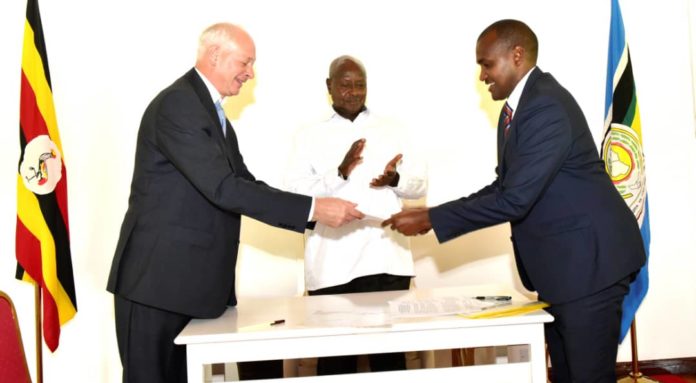
The signing ceremony saw ICT Minister Frank Tumwebaze committing on Uganda’s behalf and Alexey Volin, Russia’s Deputy Minister for Digital Development and Mass Communication, ratified for his country.
Mr Volin, who doubles as the co-chair of the Russian-Uganda Inter-Governmental Commission on Economic, Technical and Scientific Cooperation, delivered a condolence message from President Vladimir Putin to President Museveni following the Bududa landslides tragedy. The tragedy led to death of over 40 people dead.
Mr Volin said Russia through its embassy had set up a one-stop centre where Russian companies seeking to invest in Uganda would be supported.
He lauded Kampala Capital City Authority for agreeing to name a street after Yuri Gagarin, the first person to fly in space. His flight in April 1961, aboard the Vostok spacecraft, lasted 108 minutes.
Museveni in in turn encouraged Russia to invest in Uganda saying that government will support them in terms of land and tax waivers for large-scale investments.
In the meeting, International Affairs State Minister Okello Oryem, revealed that the joint ministers’ commission had set up a time frame to ensure all agreements between Russia and Uganda are implemented.
Members Parliament meeting in Geneva have voted to ban debate on the subject of Lesbian, Gay, Bisexual, and Transgender (LGBT) at the Inter Parliamentary Union.
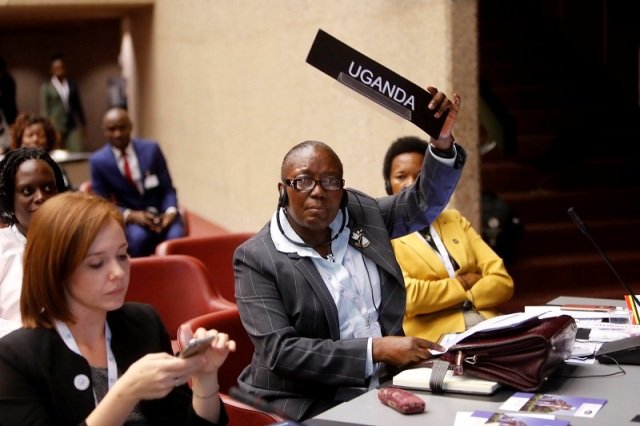
The Ugandan delegation led by Speaker Rebecca Kadaga steered the move against what they termed as a well-orchestrated machination led by Canada and Belgium who had lobbied many delegates to vote in favor of the motion. They were supported by representatives from China, Russia, African and Arab parliaments.
The LGBT agenda had been presented to the Assembly to be debated as an emergency item for the next 140th IPU Assembly. This, IPU President, Gabriela Cuevas Barron subjected the matter to a vote by member states.
The question put was on whether the standing Committee on Democracy and Human Rights should hold a panel debate that will lead to a resolution entitled, “The role of parliaments in ending discrimination based on sexual orientation and gender identity and ensuring respect for the human rights of LGBT persons,”
Speaking against the motion, Busiki County MP, Paul Akamba reminded the General Assembly of the IPU statute and reasons why it was formed in 1889 calling on all delegates to vote in respect of that statute.
“Article 1(2) of the IPU statute states that the Inter-Parliamentary Union shall work for peace and cooperation among peoples and for the solid establishment of representative institution and also contribute to the defense and promotion of human rights, which are universal in scope. The agenda presented here has been widely rejected by many member states hence lacking universality in scope,” he said. 689 MPs voted against the proposal while 499 legislators voted for the proposal.
“I am so happy that this battle has finally been won. It started in St. Petersburg in Russia when they attempted to smuggle this same item but today we have made a final vote that will prohibit the issue of LGBT from appearing on the IPU agenda,” said Kadaga.
Kawempe North MP, Latif Ssebaggala applauded all nations that joined the Ugandan team to vote against the debate and promised that the same strength is being brought to Uganda to awaken the Anti-Homosexuality Bill in the Parliament of Uganda.
“The decision taken today has made me so strong and as I return from Geneva, I am prepared to awaken our gay law that was nullified by court,” he said.
Uganda has over the years continued to oppose the LGBT agenda at the different international meetings that are held around the world.
Kasekende is alleged to be loaded and just last year alone, he is said to have transacted over Shs35 billion on his mobile money account.
Click to view Kasekende’s explanation Document 5
The Inspector General of Government has zeroed on unexplained wealth of top Bank of Uganda officials in the latest inquiry.
In the newest inquiry, the IG is said to be looking into the assets and liabilities of over 100 employees but more emphasis is being put on employees in supervision and banking departments.
Although Inspectorate downplayed the inquiry to annual declaration of income, asserts and liabilities of officials, however, sources say the inquiry was triggered off by the reports of Auditor General that among others fault BoU officials especially in supervision for failure to explain how properties of defunct banks has been sold or taken over by officials at the central bank.
“The AG in his report was clear on these properties because whenever a bank is closed, such banks have properties like house and land but in most cases, these properties are silent and basically that is why we want to establish who takes over these properties and could these top bosses taking over them?” a sources said.
One of the declarations of income, assets and liabilities forms filled by Dr Kasekende shows that he owns property worth about Shs8 billion in upscale areas of Kampala, Wakiso and other areas. He is also a shareholder of Green Hill schools, a farm in Bukasa valued at Shs500 million and several commercial buildings which fetch millions of shillings in rent per year. In the declaration form, Dr Kasekende says he picked loans from commercial banks and used his statutory salary, savings from research, gratuity payments and travel allowances to build rentals and acquire the assets.
Kasekende is alleged to be loaded and just last year alone, he is said to have transacted over Shs35 billion on his mobile money account.
The Leadership Code Act 2002 requires all specified leaders to declare their Incomes, Assets and Liabilities to the Inspector General of Government. The Code prohibits conduct that is likely to compromise the honesty, impartiality and integrity of leaders or conduct that leads to corruption in public affairs and it imposes penalties on leaders who breach the Code.
Early this year, it is said President Yoweri Museveni ordered Bank of Uganda Governor, Emmanuel Tumusiime Mutebile to ‘sort’ out ‘thieves’ at Bank of Uganda.
Museveni who met the Inspector General of Government and a team from BoU at State House after cabinet lectured the two sides to sort out bickering that could easily hurt the economy but also warned of thieves at BoU.
A tough talking Museveni told me Mutebile that BoU had performed well but the emerging reports that individuals at the central bank had amused wealth were disturbing and such individuals should be fished out.
According to sources at the said meeting, Museveni who seem to have equipped himself well with the current literature on the central bank argued that corruption at the bank could easily manipulate staff not to perform their duties as they are compromised by the sector the supervise.
Eagle Online couldn’t verify whether the president’s call to Mutebile to sort out thieves was triggered by the revelation by leaked bank account details that revealed that former Executive Director in charge of Supervision at BoU, Justine Bagyenda had huge sums of money in several banks accounts. Bagyenda is now being investigated by Financial Intelligence Authority, Inspectorate of Government and Uganda Revenue Authority for allegations of money laundering and tax evasion from income on her properties.
Recently, the IGG faced with the conundrum as to whether the Bank of Uganda Governor acted within his powers to make administrative changes at the Central Bank, one of which involved the retirement of Justine Bagyenda, the erstwhile Director of Bank Supervision.
‘This is to direct the Board of Directors of BoU not to ratify any actions or decisions taken by the Governor on or around February 7, 2018 in relation to the impugned appointments and transfers until such time as the investigation by the Inspectorate has been concluded or until this office directs otherwise’, the IGG’s March 12 letter states in part.
But in his five-page strongly-worded letter which he copied to among others President Yoweri Museveni, Speaker Rebecca Kadaga and Prime Minister Dr. Ruhakana Rugunda and Finance Minister Matia Kasaija,. Mutebile draws the attention of the IGG to Article 162 (2) of the Constitution that guarantees the independence of the BoU from direction of any authority in the country. Others copied in include the Attorney General, the Auditor General and members of the BoU Board of Directors. ‘In performing its functions, the Bank of Uganda shall conform to this Constitution but shall not be subject to the direction or control of any person or authority,’ the Article states in part.
Mutebile adds: ‘The Article in question is clear, unequivocal and unambigious on the Independence of the Bank of Uganda and the fact that Bank of Uganda is not subject to the direction or control of any person or authority and therefore no outsider, including your office can interfere with the decisions of the Bank of Uganda’.
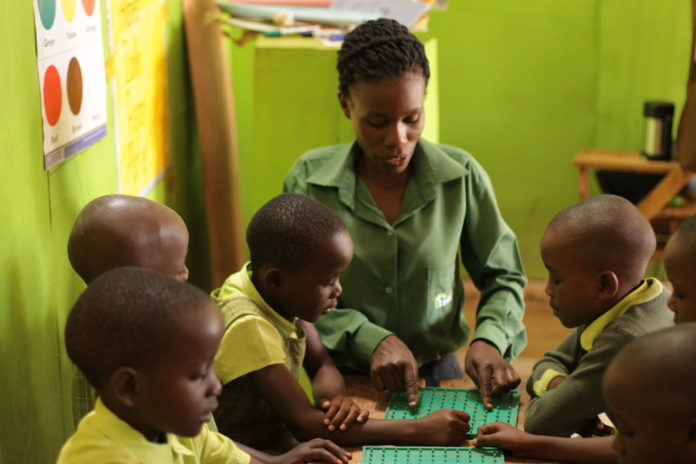
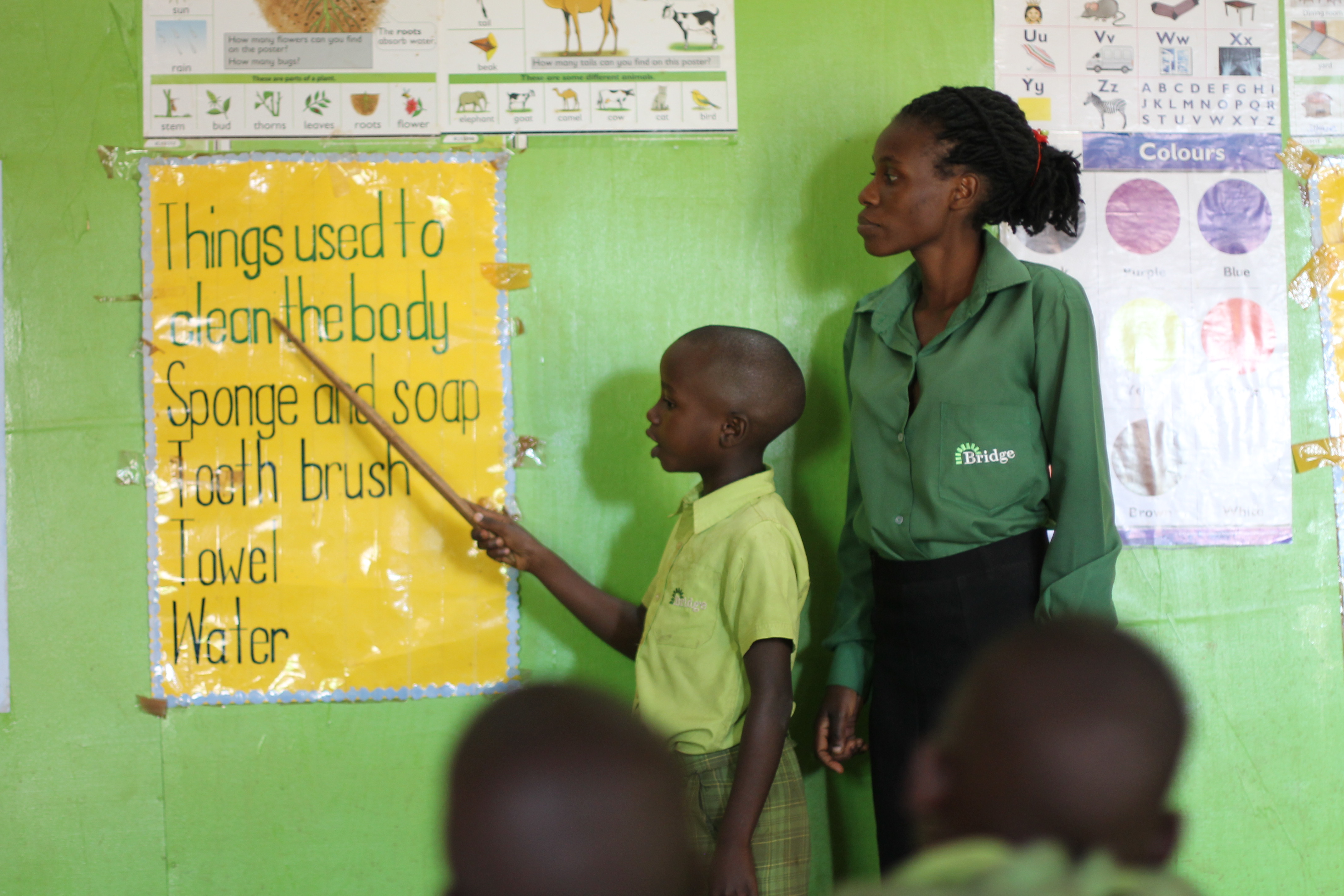
The UK Department for International Development (DFID) has published a groundbreaking report in Nigeria which shows full equality of learning in Bridge schools’ classrooms, regardless of a child’s socio-economic background.
It is a strong endorsement of DFID’s commitment to innovative private sector roles in improving service and opportunity for these families. Even though the report was based on Bridge schools in Nigeria, the findings clearly have relevance in a Ugandan context where the social enterprise operates 63 schools educating thousands of children in some of the country’s poorest communities.
The DFID findings build on the preponderance of evidence demonstrating that the methods used and support provided by Bridge to teachers and pupils leads to higher learning than the alternative.
This was seen in Uganda last year when Bridge pupils sat the Primary Leaving Exam (PLE) for the first time and 100 per cent of pupils passed. In addition, over 93 per cent scored in Division 1 and 2 compared to just 56 per cent nationally. Bridge pupils went on to take up places at some of the most prestigious secondary schools in Uganda.
The DFID report makes clear that at Bridge schools, parents’ income and education was not correlated to children’s learning outcomes. This is a landmark finding – demonstrating that children from even the poorest families attain the same learning as those that are better off if the child attends Bridge.
This is what we should always find at every school – that the school itself is ensuring that each child, regardless of family background, can achieve their full potential. The DFID findings contradict decades of global education research trends that demonstrate family background matters more than the school a child attends, in relation to levels of learning. At Bridge, this is not true.
A spokesperson for DFID Nigeria said DFID “welcomed the findings of the independent study that show the need to build the regulatory capacity of government to support school management systems and processes that are necessary for improved learning outcomes in both public and private schools.” they added “this study will contribute to the growing body of evidence on the role of private sector provision of education in sub-Saharan Africa”
One of the report authors, Alina Lipcan, from Oxford Policy Management, said: “Good management matters, we find a strong correlation with better learning outcomes. We would recommend more programmes focused on better management, so that more schools and pupils can benefit.”
The report also highlights that Bridge pupils know more than their peers in other schools; the majority of children in Bridge schools are from poor families; Bridge teachers have the best relationships with their pupils and that Bridge schools are managed more effectively than other types of schools.
Bridge Uganda Country Director Morrison Rwakakamba welcomed the findings of the report saying, “There is no learning gap at Bridge schools. This is a big deal. This study validates our methods, which ensure that all teachers have high expectations for every pupil, irrespective of their families’ income, prior educational attainment, or which language they speak at home. Bridge schools are places of equal opportunity and equal learning benefits for all types of children, and especially for the poor.”
Rwakakamba also adds that the “independent DFID report shows that Bridge is helping children from poor families to learn, improving access to quality education, and enabling the best overall learning attainment in the local communities we serve. We can now say with total confidence that Bridge makes a significant and important overall contribution to education opportunities.”
The report was researched and conducted by Oxford Policy Management and the University of Sussex.The findings come as both the UK DFID Secretary of State, Penny Mourdant;
“We have tackled the dogma and culture that still exists in some parts of the aid sector, which not only sees organisations failing to put the beneficiaries first but also preventing the private sector from helping deliver those global goals”; and the CEO of the IFC Philippe Le Houérou; “We need to be imaginative and find new and more creative public-private solutions and, in many countries the governments are seeing the potential of working with the private sector.” are advocating the use of the private sector to achieve the SDG’s.
Matchday three of the 2018/19 StarTimes Uganda Premier League season continues tomorrow with two fixtures to be played.
KCCA FC will travel away to Arua to play against Onduparaka FC at the Greenlight Stadium, with both teams still unbeaten this season.
New signing Nicholas Kasozi returned in time for the game against the Caterpillars, the club confirmed. Kasozi is yet to play a competitive game for KCCA FC since his switch from SC Villa. He has been involved in team training and is part of the travelling squad to Arua.
Goal keeper Tom Ikara also returns from injury while Julius Poloto is expected to be back for the game against Bright Stars FC next week on Tuesday.
Onduparaka will be seeking to extend their winning streak to 3 wins in a row after defeating Nyamityobora 2-0 and SC Villa 1-0 while KCCA will be looking forward to an improved performance after a goalless draw with Kirinya Jinja SSS in their previous fixture.
KCCA has never won a game at GreenLight against Onduparaka while the hosts have never registered a clean sheet against the Kasasiro boys.
The Caterpillars go into this game with 3 former KCCA players in Okot Denis, Okwalinga Solomon who were both signed in the recently concluded transfer market and Veteran Okhuti Ceaser who will be making his return from Suspension because of the Red Card he received at the end of Last Season.
In the other fixture of the day, URA will host newcomers Ndejje University at Mandela National stadium, Namboole.
Meanwhile, Express picked their first win of the season with a 3-1 victory away at Police at the StarTimes Stadium on Tuesday.
Tony Odur, Ibrahim Kayiwa and Michael Birungi were on target for the Red Eagles while an own goal from Arthur Kiggundu was a consolation for the Cops.
At Kavumba youngster Joel Madondo’s brace took him top of the goal scorers charts with four as Kirinya-Jinja went fifth following a 2-1 victory over Tooro United.
Bul also recorded their second win of the season with a comprehensive 3-0 thrashing of league newcomers Paidha Black Angels in Jinja.
Daniel Shabena, Timothy Douglas Owori and Hamisi Tibita were on target for the hosts as they went second on six points.
Friday, 19 October fixtures
Onduparaka vs KCCA, Live on Sanyuka TV
URA vs Ndejje University
Saturday, 20 October fixtures
SC Vipers vs Nyamityobora
Mbarara City vs Maroons
Bright Stars vs SC Villa Jogoo
Tuesday, 16th October results:
Police 1-3 Express
BUL FC 3-0 Paidha Black Angels
Tooro United FC 1-2 Kirinya Jinja SSS
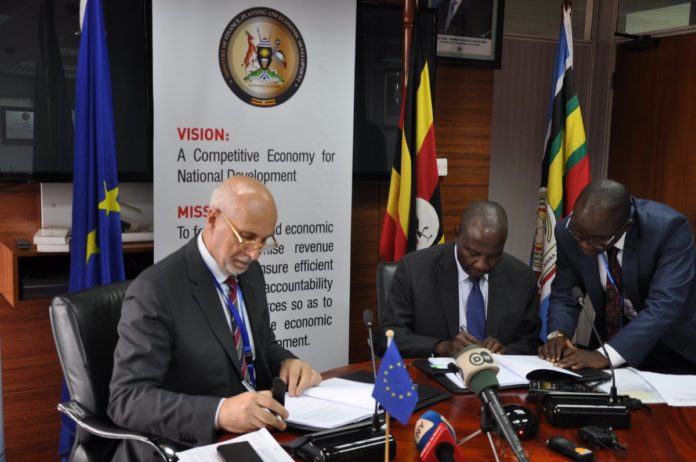
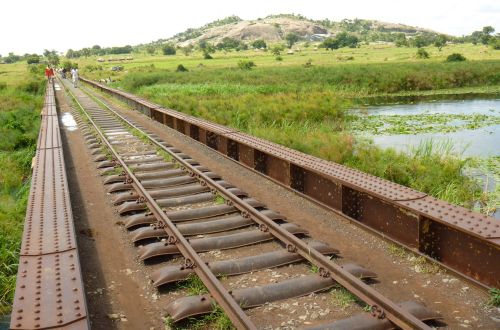
The government of Uganda through the Ministry of Finance Planning and Economic Planning have signed a financing agreement where the European Union (EU) is to provide a grant of more than Shs90 billion for the rehabilitation of the Tororo-Gulu railway to support the Development Initiative for Northern Uganda (DINU).
The Finance Minister Matia Kasaija signed on Behalf of the government of Uganda while Amb. Attilio PACIFIC, Head of Delegation of the EU Delegation signed on behalf of the Europeans.
The agreement signed at the Ministry of Finance headquarters in Kampala will also see the Ugandan government inject in the rehabilitation project Shs57 billion.
The money will fund the physical rehabilitation of the line, supervision of the works, capacity building of the Uganda Railway Corporation (URC) and the compensation of about 4000 people for loss of mainly their crops and a few developments on the land.
Finance Minister Kasaija said the rehabilitation of the Tororo-Gulu railway is part of government’s efforts to modernize the railway system in the country especially after it terminated the operations of the Rift Valley Railways for failure to meet concessional terms.
“Due to the continued failure by RVR to meet their obligations under the concession, Government decided to terminate the Rift Valley Railways (RVR) freight concession for Uganda Railways in 2017. Government via Uganda Railways Corporation (URC) took over the operations of Uganda Railways and all assets of the railway formerly managed by RVR such as the permanent way, locomotives, workshops … reverted back to URC,” he said.
Minister Kasaija said the project to begin by year end is part of a deliberate move to rejuvenate the railways subsector and with the objective to relieve the heavy burden on the country’s road infrastructure. The grant will be used to repair Uganda’s 375km Tororo – Gulu Line.
“The Tororo- Gulu Metre Gauge Rehabilitation Project is very important for trade facilitation for Uganda as it will open up the northern parts of Uganda and parts of Congo and South Sudan in terms of freight,” he said, adding that the project is also linked to the bigger DINU programme and the Gulu Inland Container Depot, a logistics hub consisting of intermodal road-rail transhipment platform and distribution facilities, also funded by the EU.
He said that because of its proximity to the Albertine region, the railway project will benefit from transportation of equipment and inputs for the construction and operations of the oilfields given the bulky nature of oil equipment, which he said normally exceeds the standard size for road transport and therefore require special transport arrangements, making them natural customers for the railway.
The project shall be implemented by Uganda Railways Corporation under the supervision of Ministry of Works and Transport.
According to Amb. PACIFIC: “This project is part of EU’s efforts to help government develop northern Uganda. It also complements well the EU humanitarian assistance to refugees and support to host communities provided under the EU Emergency Trust Fund.”
He said the rehabilitation of the railway and the Gulu Logistic Hub will have a major impact on the facilitation of trade by reducing import and export transportation costs. The two projects, he said will be a key import/export platform not just for northern Uganda but also for South Sudan and eastern Democratic Republic of Congo (DRC.)
The official said: “The project will have a spill-over impact on private sector growth and on investment promotion. It will also add value to the key value chains of Northern Uganda including agriculture products, cement, oil and gas, mining as well as industrial products in general.”
The Tororo-Gulu railway line used to be a pivotal economic artery along the East African Northern Corridor linking the port of Mombasa and Eastern Uganda to Northern Uganda, as well as the neighbouring countries of South Sudan and Democratic Republic of Congo. The line has been out of service since 1993 notably due to actions of war by the Lord’s Resistance Army and the unfair competition of overloaded trucks.
The 375km old metre gauge railway line from Tororo through the districts of Mbale, Kumi, Soroti, Lira and Gulu.
Top Dfcu bosses are reported to have agreed on Mr Mathias Katamba as incoming Managing Director replacing Juma Kisaame who id due for retirement early next year.
According to insider sources, Mr Katamba is said to have agreed to a deal, however, what is shocking is that the Chief of Business and Executive Director, William Sekabembe who rejected a job at Kenya Commercial Bank (KCB) of Managing Director and opted to remain with Dfcu hoping to be given the top slot replacing Kisaame has been left out.
Sekabembe declined a job offer at KCB Uganda as Managing Director. Sekabembe declined the job offer in a letter dated September 5, 2018.
In July reports came out indicating Sekabembe had resigned from Dfcu, with many sources predicting he was to join KCB Uganda, even though the resignation from Dfcu didn’t take immediate effect as he has to wait for three months to elapse.
KCB Uganda had in a letter dated July 24, approached Sekabembe to become its Managing Director, following changes at Dfcu Bank.
But in reply to KCB Uganda’s Head of Human Resources Department, Sekabembe said: “I would like to give my appreciation for the recent Managing Director job offer with KCB…Limited, however, after careful evaluation, I regrettably decline the position.”
It is said that in process of luring him to remain at Dfcu, the board and top management increased his salary from Shs38 million to Shs56 million on top of a promise that he would replace Kisaame.
Sources say Sekabembe was supposed to assume the position of MD at early last year, but current MD Kisaame was given more time to manage Dfcu’s acquisition of Crane Bank.
Meanwhile there have been shareholder and individual staff exits at Dfcu in the past few months leaving industry analysts and the public wondering what was happening at the bank.
Mid-June, British government owned development firm CDC indicated that they are leaving Dfcu, which they have partnered with for over 50 years.
After CDC’s announcement, Deepak Malik, the CEO of Arise B.V; Dfcu’s majority shareholder also resigned from the board without giving reasons, though Board Chairman Elly Karuhanga would letter come out to explain Malik’s decision to resign. Karuhanga also confirmed to the media a month ago that indeed the bank was having liquidity problems.
Insider sources indicate that there two camps created among the shareholders, one led by board chairman Elly Karuhanga and Dfcu bank board chairman, Jimmy Mugerwa insisting on current MD Juma Kisaame and the other camp-mainly led by 58.71 majority shareholder Arise BV and Britain’s CDC Group in favouring William Ssekabembe who they think can turn around the fortunes of the bank whose current problems seem to have emerged from the controversial purchase of Crane Bank in January 2017.
DFCU Shareholding percentages
Arise BV 58.71 per cent
CDC Group of the United Kingdom 9.97 per cent
National Social Security Fund (Uganda) 7.69 per cent
Kimberlite Frontier Africa Naster Fund 6.15 per cent
2 undisclosed Institutional Investors 3.22 per cent
SSB-Conrad N. Hilton Foundation 0.98 per cent
Vanderbilt University 0.87 per cent
Blakeney Management 0.63 per cent
Retail investors 11.19 per cent
BoU staff retirement benefit scheme is 0.59 per cent
Uganda joined the international community to celebrate World Food Day on the 16th October 2018, with the National celebrations held at Nabuin, Nakapiripiriti district in the Karamoja region. The theme for this year was: “A Zero Hunger World by 2030 is Possible.”
As the country joined the World to celebrate, Twaweza, an independent initiative, had a few facts that can be used to back up stories on the same day from the Uganda citizen perceptive.
In their report, it shows that one out of two citizens (49 per cent) have, in the three months before the survey, gone a whole day without eating due to a lack of money or other resources.
And one out of eight citizens mention hunger/drought (15 per cent) as one of the most serious problem facing their household.
There is considerable variation in experiences of food security across Uganda, although the number of people going without food for a whole day remains high across groups.
In both urban (45 per cent) and rural (51 per cent) areas, and in wealthier households (39 per cent) as well as poorer ones (60 per cent), Ugandans often go hungry. Five out of six residents of some sub-regions go a whole day without food, compared to just one out of ten in other sub-regions.
The sharpest variations come when considering specific sub-regions. In Karamoja, five out of six residents (85 per cent) have gone a whole day without food in the three months before the survey, and the numbers are also very high in Central (75 per cent), and Teso (73 per cent).
In comparison, one out ten residents of Lango (9 per cent) and three out of ten in Bunyoro (30 per cent) and West Nile (30 per cent) have experienced this problem.
Food insecurity and poverty tend to go hand in hand. This brief explores the financial health and security of Ugandan households. How many households lack the income to cover their basic daily needs? What action do they take when their income leaves them short?
Even larger numbers have experienced difficulties with food security over the same period. Five out of six (85 per cent) have been worried that they would run out of food, and three out of four (75 per cent) had to skip a meal.
The analysis and geographical breakdowns were made by Twaweza, which is an independent East African initiative that was established in 2009. Twaweza means “we can make it happen” in Swahili.
Twaweza works on enabling children to learn, citizens to exercise agency and governments to be more open and responsive in Tanzania, Kenya and Uganda.
Food and Agriculture Organization celebrates World Food Day each year on 16th October to commemorate the founding of the Organization in 1945. Events are organized in over 130 countries across the world, making it one of the most celebrated days of the UN calendar.
The principal reason to celebrate the day is to increase awareness of the crucial need for effective agriculture and food policies to be implemented by governments across the world to ensure there is sufficient food available for everyone worldwide.
Gor Mahia CEO Lordvick Aduda (right) presenting Shafik Shafik Batambuze with Jersey after penning down 2 year contract at Gor Mahia head office - Nairobi.
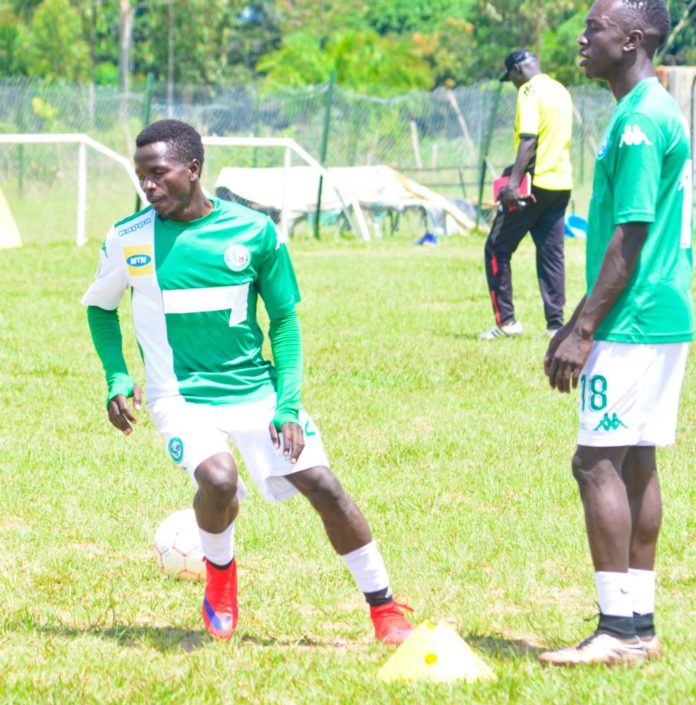
Reigning Kenya Premier League champions Gor Mahia have completed the signing of defender Shafik Batambuze from Tanzanian side Singida United FC.
The Kenyan club confirmed, “Ugandan defender Shafik Batambuze has penned a two year contract with the reigning champions Gor mahia FC in readiness for the forthcoming CAF CL and the 2019 Kenya Premier League.”
Gor Mahia continue rejuvenating their squad ahead of a busy football calendar next season beginning December 2018 as they seek to defend their title and compete in the CAF Champions League.
“The Ugandan full left back and former Singida United of Tanzania’s player will fill the gap left by Godfrey Walusimbi.” they added.
Godfrey Walusimbi moved to South Africa’s Kaizer Chiefs on a three-year-deal in August this year.
Shafik’s deal is reportedly to be worth between Ksh 1 and 3 million shillings (approximately 75 million Ugandan shillings).
Batambuze has played for Tanzanian giants Simba SC, Singida United as well as SC Villa Jogoo.
He has previously also featured for Tusker, Sofapaka, Muhoroni Youth and Western Stima in the KPL.