Stanbic Bank
Stanbic Bank
16.9 C
Kampala
Stanbic Bank
Stanbic Bank
Home Blog Page 1487

Commercial lending rates slightly rise in July-report

Finance Minister Matia Kasaija

Commercial banks’ Shilling denominated monthly lending rates slightly edged upwards to 19.2 per cent in July from an average of 17.7 per cent in June 2018, according to the Performance of the month of August Economy Report published by the Ministry of Finance Planning and Economic Development.

Foreign currency denominated lending rates however, declined from a weighted average of 8.4 per cent to 7.6 per cent over the same period.
During the month of August 2018, the Central Bank maintained its policy rate at 9.0 per cent, which has been the status quo since February 2018.

The Central Bank Rate (CBR) has been kept at single digit since October 2017, with the expectation that inflation will remain with in the 5 per cent target both in the medium and long run.
The total value of loans approved in July increased by 8.2 per cent to Shs1, 383.3 million from Shs1, 278.3 million in June 2018.

However, the stock of outstanding private sector credit amounted to UShs13, 379.1 billion in July 2018 down from Shs13, 404.7 billion in June 2018, registering a decline of 0.2 per cent. “This could be explained by higher payback during the month that offset the extensions,” the report says.

According to the report, the pick-up in credit is majorly attributed to the supportive monetary policy stance, as well as eased credit standards resulting from lower risk of default which is reflected by a reduction in the ratio of non-performing loans to total gross loans. This reduces from 5.3 in March 2018 to 4.4 in June 2018.

By Sector, manufacturing received the largest share of credit extended in July 2018, at 28.8 per cent. Other notable recipients of credit were; Trade (18.1 per cent), Transport and Communication (17.7 per cent) and Building, Construction and Real Estate (10.9 per cent).

Government Securities
According to the report, during the month of August 2018, there were three Treasury bill auctions and one bond auction in the primary market. And Shs650.46 billion was raised, of which Shs453.23 billion was from treasury Bills and Shs197.23 billion was from T-bonds.

“Shs571.17 billion was used for the Refinancing of maturing debt whilst Shs79.29 billion went towards financing other activities in the government budget,” says the report.

However, according to the report, treasury bill rates for the month of August 2018 were largely stable following the rejection of some bids in July 2018. The average rates for August 2018 were 10.6 per cent, 12 per cent, 14.1 per cent for the 91, 182 and 364 day tenors respectively compared to 10.5 per cent, 12 per cent, and 14.5 per cent in July 2018. All auctions were oversubscribed with an average bid to cover ratio 6 of 2.5 an improvement from 1.2 recorded the previous month.


Stories Continues after ad

Bobi Wine to Museveni: How do you feel when people are beaten, killed in the hands of security agencies?

Bobi Wine

Kyadondo East Member of Parliament Robert Kyagulanyi aka Bobi Wine has taken on President Museveni asking him how he feels when people are being battered and killed by security agencies.

The legislator asked during a media briefing held at his home in Magere, in Kasangati Town Council where he said many people have breathed their last after being beaten and roughed up by security agencies.

Bobi Wine has clashed often times with police and army during the processions of opposition leaders.

“I expected the president to call on the errant soldiers to order, however, I was disappointed when President Museveni decided to pat them on the back for a job well done,”
“Mr President, just like there was a time when you were not in power, there will be a time when you will not be in power so treat people the way you would want to be treated, It is not too late to regain and save your legacy so please do what is right, ” he said.

He stressed that as a fountain of honor has always referred to them as his grandsons and daughters, he acts contrary to the norm by subjecting them to torture, arrests.

Grandparents are known to treat their grandchildren with love and care and so grandparents shouldn’t brutalize their grandchildren every time they have a different opinion,” he added.
Bobi Wine who reminded security operatives of brutalizing Ugandans said, they are not fighting against them rather fighting for them too. He encouraged them to join the campaign saying People Power is not about Bobi Wine or anybody. It is an idea premised on the fact that power belongs to the people.

He said as Ugandans, they are going through a tough time, “We must stand together to end the disturbing videos of security operatives brutalizing people they are supposed to protect.”

Stories Continues after ad

New technology firm launches in Uganda

Josh Sandler

Lori Systems, a tech-enabled trucking logistics platform has launched into Uganda, Rwanda and South Sudan after winning multiple bids associated with the newly built US $4 billion railroad system in East Africa, with the joint goal of driving down the costs of goods in the region and unlocking the region’s growth potential.

“We’ve opened new locations in Uganda, South Sudan and Rwanda. Over the past year, we have grown rapidly – both in terms of throughput on the system as well as the team. Our team has grown from 15 to 70 since February and adds experience from organizations such as McKinsey, DHL, and NASA. Lori is focused on hiring the best talent in order to execute on bringing down the costs of goods across the continent,” the CEO Josh Sandler said.
The firm has also partnered Kenya’s Standard Gauge Railway to help reduce the costs involved by truckers in moving bulk imports and exports.

“We’re so excited to announce our working partnership with the Standard Gauge Rail in Kenya. In our continued efforts to bring down the costs of goods, we have been rapidly ramping up our operations to tackle massive transportation issues. We’ve already had success in bringing down direct costs of moving bulk grains, achieving a 17 per cent reduction in Uganda,” said Sandler.
The firm also recently partnered with Kuehne + Nagel, DHL and Cargill to allow them to extract greater insight from their logistics data and drive informed action through improved technology, analytics, and operations.

To further reduce transportation costs and respond to increased demand, Lori has recently brought on top talent from across Africa. Jean-Claude Homawoo, Harvard Business School alum, joins Lori as Chief Product Officer from Google where he was a Product Lead. Prior to that, he was iROKO’s VP of Strategy.

Andrew Musoke, Head of Commercial, is a former Vice President at JP Morgan and Harvard Business School alum from Uganda. Lori also recently brought on Mehul Bhatt to run the East African region as it focuses on pan-Africa expansion. Bhatt is the former CEO of Maersk Tankers India and ran one of biggest clearing and forwarding agencies in East Africa.

Stories Continues after ad

DRC confirms Ebola case at Ugandan border

Democratic Republic of Congo has confirmed a case of Ebola on its border with Uganda, a country so far clear of the deadly virus, authorities in Congo said over the weekend.

The new infection is almost 200 km (125 miles) away from the nearest other known case in Congo’s current Ebola outbreak, which is believed to have killed 97 people since July and infected another 46 in North Kivu and Ituri provinces.

The new infection is almost 200 km (125 miles) away from the nearest other known case in Congo’s current Ebola outbreak, which is believed to have killed 97 people since July and infected another 46 in North Kivu and Ituri provinces.

Ituri province’s Vice Governor Keta Upar said in a statement that the latest Ebola case had been reported in Tchomia on the shores of Lake Albert. It is the closest the disease has come to Uganda, Congo’s eastern neighbour.
Uganda’s health ministry said on Thursday it was preparing to deploy vaccinations against the virus should it spread to its territory.

Congo has experienced 10 outbreaks of Ebola since it was discovered in the country’s forested north in 1976. The disease causes haemmorhagic fever, vomiting and diarrhea and kills about half of the people it infects.

Health officials have made progress slowing the spread of the virus with experimental vaccines and treatments. But violence and turmoil in eastern Congo has made some areas difficult to access.
Dozens have been killed in ethnic clashes between groups in Djugu territory where Tchomia is located, with thousands crossing into Uganda to escape the violence.

Stories Continues after ad

Seven attributes of people with an entrepreneur mindset

Martin Zwilling

By Martin Zwilling
As an angel investor and a mentor to aspiring entrepreneurs, I’m always disappointed to see founders who seem stressed out most of the time, and more annoyed than energized by the abundance of challenges they see in building their startup. The entrepreneurial lifestyle is a tough one under the best of circumstances, and it’s one you have to love in order to succeed.

Obviously, it’s not that simple, but making the right first impression is critical for an entrepreneur, not just with investors, but also with partners, customers, and even yourself. Even though I’ve been working with entrepreneurs for many years, I’m sure I’m not the only person who can quickly spot the ones whose mentality for the role is suspect.

We would all prefer that aspiring entrepreneurs take a hard look in the mirror early, before they assume they can step easily into the role of a Mark Zuckerberg, Richard Branson, or Bill Gates. Here are some key mindset attributes to look for, which I believe are essential for every entrepreneur to see in themselves:
You relish the role of leading the charge. Being a visionary or an idea person is not enough; you have to be anxious to jump in and get your hands dirty. Most success stories in business are not about envisioning the next big thing, but about making that change happen. Investors and strategic partners look for entrepreneurs who can execute.

Able to balance right-brain and left-brain activities. Most technical entrepreneurs are left-brain logical thinkers, even perfectionists. Yet every business today needs a focus on visualization, creativity, relationships, and collaboration, which are normally in the domain of right-brainers. Successful and happy entrepreneurs have that rare whole-brain focus.

Enjoy being outside your comfort zone. New businesses are an adventure into the unknown. You need to be mentally prepared to enjoy the roller coaster ride, rather than face it holding your breath with your teeth gritted at every turn. Only then can you enjoy the thrill of victory when you survive a major turn, and be energized for the next one.

Proactively seek input, but make your own decisions. Great entrepreneurs seek out critical customers and industry experts, and actively listen, but are not afraid to trust their own judgment as well. Ultimately they accept the responsibility of “the buck stops here,” meaning they live by their own decisions, and never make excuses.

Willing and able to do a little bit of everything. Technology experts tend to have a very deep level of knowledge, but not very wide. If your real interests are not very broad, then building a business will likely be frustrating and expensive. Startups have limited resources, so the founders have to enjoy trying things, and learning from their mistakes.

Viewed by others as a successful problem solver. The best ideas for a new business are solutions to a real customer problem, rather than great ideas looking for a market. Creating a new business means tackling one difficult problem after another, until success suddenly appears. Entrepreneurs see problems as milestones to success, not barriers.

Don’t demand or expect immediate gratification. Seth Godin once said “The average overnight success in business takes six years,” and he is an optimist. For some entrepreneurs that success is financial, and for others it is a legacy of good deeds. Because it takes so long to get there, it is important to be happy with the journey.

I’m not suggesting that you need to fit every aspect of my view of an entrepreneur’s mentality for success. Certainly there are winning businesses run by people from every background and personal style. But if you are looking for investors, team members, and demanding customers, it helps to understand what their biases might be in committing to and helping the ideal partner.

I do believe that if every aspiring entrepreneur spent at least as much effort looking inward, understanding their own drivers and preparing, as they do in working outward by building solutions, seeking investors, and writing business plans, the startup success rate would go up.
Overall, the entrepreneur mentality is a state of mind that enjoys the activities and requirements of starting a business. Happiness is more likely to lead to success, than success leads to happiness. Are you certain that your desire and expectations of being an entrepreneur are being driven by the right perceptions?

The writer is a veteran startup mentor, executive, blogger, author, tech professional, and Angel investor. Published on Forbes, Entrepreneur, Inc.

Stories Continues after ad

Continental bank, university to hold conference on successful technologies for African farmers

Ugandan farmers at the show will be trained on growing pasture for cattle

The African Development Bank and Purdue University are organizing the Scale Up Conference on Agricultural Innovations from September 25-27, 2018, to address how to shift agricultural innovations from research institutions into the developing world, particularly Africa.

The conference will bring together hundreds of individuals and organizations engaged in the introduction, diffusion, and adoption of agricultural innovations that have the potential to reach millions.

Bank President Akinwumi Adesina will be the keynote speaker at the conference. Together with Bank Vice President for Agriculture, Human and Social Development Jennifer Blanke, Adesina will meet with university management and other stakeholders on partnership opportunities, including the Technologies for African Agricultural Transformation (TAAT) initiative, being steered by the Bank. TAAT is a knowledge- and innovation-based response to the recognized need for scaling up proven technologies across Africa.

“This will be the first multi-day conference on this topic that includes presentations, panel discussions, case studies, and breakout group discussions to help conference participants develop a thorough understanding of how to scale up agricultural innovations to reach millions,” said Indrajeet Chaubey, Associate Dean and Director of International Programs for the College of Agriculture at Purdue University.
Dozens of speakers who have implemented scale up processes in agricultural landscapes will participate.

“In the College of Agriculture we work to develop solutions to real world problems while also finding methods to realistically deliver and grow these technologies,” said Karen Plaut, the Dean of the College of Agriculture. “The Scale Up Conference is about taking those technologies and applying them in the developing world.”

Participants are expected to gain an understanding of successful, sustainable large-scale implementation. Researchers, implementing organizations, the business community, governments, policymakers and the donor community will come together to discuss best practices for scaling up agricultural technologies.

For more than 60 years, Purdue University’s College of Agriculture has led and managed large agricultural research and development projects. In addition to a long history of significant agricultural innovations, the university has produced three World Food Prize laureates.

Stories Continues after ad

Dfcu bank director finally resigns as restructuring intensifies

dfcu bank

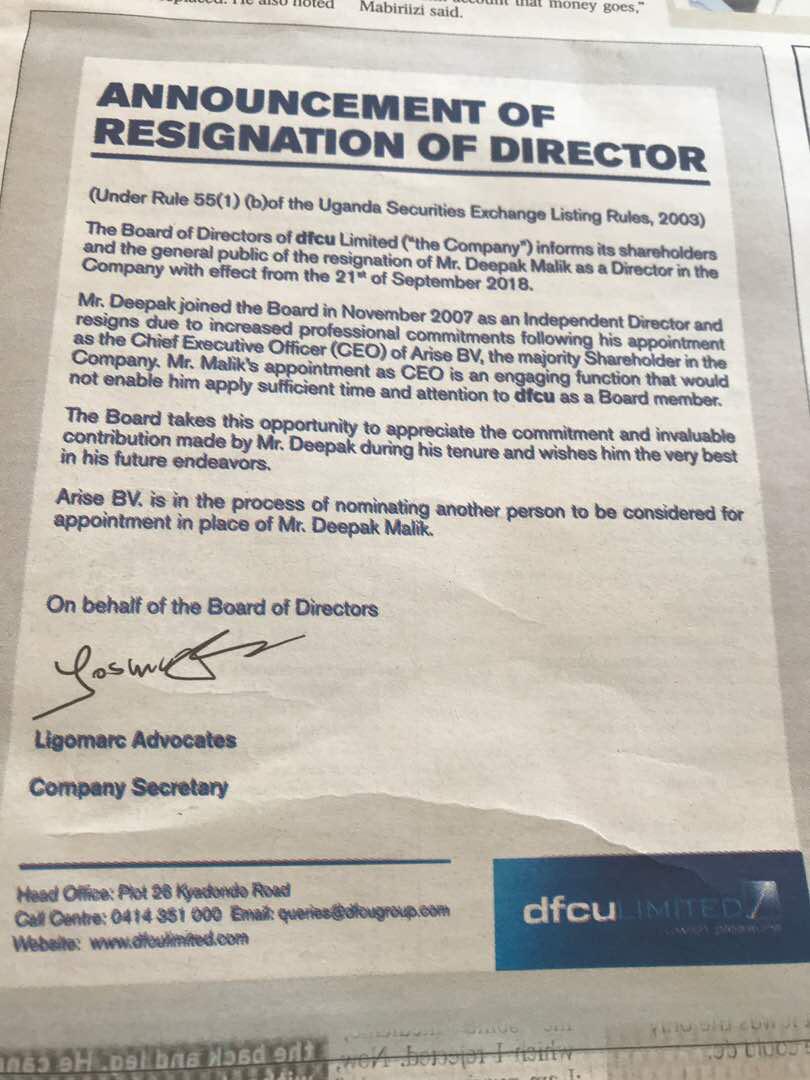
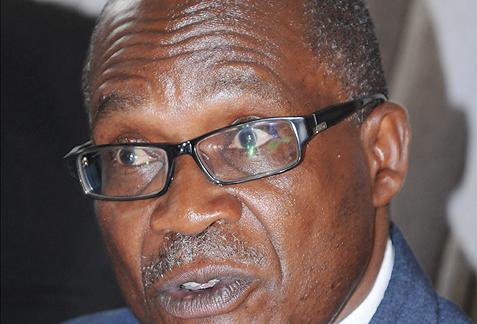
Deepak Malik who has been a director on the board of Dfcu bank has finally resigned and left the board of the bank.
According to an internal memo, Malik ceased being a member of the board on September 21, 2018. The board had early hinted on his resignation as being normal.

“The board of directors of Dfcu (the company) informs its shareholders and general public of the resignation of Mr Malik as a directorin the company with effect from the 21th of September 2018. Mr Malik joined the board in November 2007 as an independent director and resigns due to increased professional commitments following his appointment as the Chief Executive Officer of AriseBV, the majority shareholder in the company”

Eagle Online has reliably learnt most mid managers have resigned at the bank since a Kenyan human resource consultant was brought in the restructuring process.
He also serves as the Head of Department – Financial Institutions and part of the management team at Norfund.

Arise B.V. first acquired a majority stake of over 50 per cent in Dfcu Limited, the holding company of Dfcu Bank after lending US $50 million in February 2017. The money was to help DFCU Bank meet its short-term capitalisation needs after it controversially took over Crane Bank in January 2017.
Arise B.V. acquired the stake in DFCU Bank from two previous largest shareholders of Dfcu Bank-Rabo Development B.V and Norfinance AS (Norfund) which had a 27.54 per cent stake each to become the largest majority shareholder in Dfcu Bank.

The South Africa-based company was to support Dfcu Limited via long-term investment in the bank’s growth ambitions, especially to enable the bank to improve its market position and efficiencies especially after acquiring Crane Bank Limited in a deal many analysts believe had financial flaws.

Malik’s resignation as a non executive director means the Dfcu board is now left with five other non-executive directors led by All Elly Karuhanga as Chairman. Others directors are; Albert Jonkergouw, Winifred Tarinyeba- Kiryabwire, Frederick Kironde Lule and Michael Alan Turner.
Analysts say the Malik’s decision to resign confirms reports that Arise B.V. intends to leave especially that Britain’s Commonwealth Development Corporation (CDC) Group intends to exit, following Dfcu Bank’s controversial acquisition of Crane Bank Limited in January last year at only Shs200 billion yet Crane Bank had assets worth over Shs1 trillion.

Reports indicate that CDC is leaving for various reasons which include poor economy but some sources say CDC wants to dodge paying taxes on its dividends. Other sources intimated to Eagle Online that top executives at Arise B.V. decided to plan exiting Dfcu Bank in fear that CDC was leaving them trouble, they being new and majority shareholders of Dfcu Bank.

Financial analysts say with the revelation by Auditor General that Dfcu acquired Crane Bank Limited and yet it was the valuer and at the same time a buyer could land top Bank of Uganda executives in trouble as big shareholders of Dfcu are spending sleepless nights. The situation is made worse as the case is also in court.

Internal Memo announcing Malik’s exist.

Back to Malik
Mr. Malik joined Norfund as an Investment Director in 2003 where his efforts were spent in promoting Norwegian investments in Southern Africa and the region.
He was previously the Regional Director of South Africa at Norfund. He has started his career at SIEMENS (India) in 1982, after which he opened a private consultancy in 1984, specialising in financial services. He was then appointed as audit manager for KPMG in 1988, following which he became Financial Director for ZAL HOLDINGS (Ltd) – a subsidiary of Zambia Consolidated Copper Mines Limited.

In 1993 he became the Financial Controller for Mulungushi Investments and in 1994 was appointed as the Manager Operations Accounting. In 1995 he was appointed General Manager for Group Procurement. Mr. Malik was responsible for the regional office for Africa. He served as an Acting Head of Department Financial institutions and SME at Norfund.

He also served as the Regional Representative at The Industrialization Fund for Developing Countries, of Denmark. Previously, Mr. Malik’s vast experience included his roles as a Managing Director and Chief Executive Officer at the Development Bank of Zambia, as a General Manager at Zambia Consolidated Copper Mines and as an Audit Manager at KPMG. He serves as the Chairman of AfriCap Microfinance Investment Company. He is on the Board of Directors of various companies, including financial institutions and private equity funds.

He is a Non-Executive Director of Real People (Pty) Ltd. since July 20, 2011. He serves as a Non-Executive Director at Equity Group Holdings Limited. He is a Non-Executive Director of Equity Group Holdings Limited since April 29, 2015. He had served as a Non-Executive Director of Real People Investment Holdings Limited since May 28, 2015. He served as a Board Member of Norwegian Microfinance Initiative.

He served as a Director of NMBZ Holdings Limited and NMB Bank Limited from January 31, 2014 to October 22, 2014. He is also the Head of Financial Institutions Department of Norfund, covering Africa, South Asia and Central America.
He is also part of the Executive Management team of Norfund. He has over 35 years’ experience and has a diverse experience in general management, development banking, banking, private equity, audit, microfinance, corporate and public finance, project financing, financial restructuring and privatization in emerging markets, mining, procurement and financial management.

His specialization is working with multilateral/bilateral financial institutions and he also has an extensive knowledge of developing countries. He is a qualified Chartered Accountant. He holds a Bachelor of Commerce (Honors) from the University of Delhi, India.

DFCU Shareholding percentages
Arise BV 58.71 per cent
CDC Group of the United Kingdom 9.97 per cent
National Social Security Fund (Uganda) 7.69 per cent
Kimberlite Frontier Africa Naster Fund 6.15 per cent
2 undisclosed Institutional Investors 3.22 per cent
SSB-Conrad N. Hilton Foundation 0.98 per cent
Vanderbilt University 0.87 per cent
Blakeney Management 0.63 per cent
Retail investors 11.19 per cent
BoU staff retirement benefit scheme is 0.59 per cent

Stories Continues after ad

Lack of money forces gov’t to omit additional recruitment in FY2019/20

Public Service Minister Wilson Mukasa Muruli

Those who were expecting to be employed by government will have to wait much longer as there will be no money for additional recruitment of staff within public service in the financial year 2019/20, senior official of the Ministry of Public Service has said.

Speaking at a Local Government Budget Consultative meeting in Jinja last week, Simon Bwire, Principal Human Resource Officer at Ministry of public service said that in light of the unavailable resources that “Recruitment will be based on replacement of positions that have become vacant within the running financial year 2017/18”.

wire said that requests for recruitment should be made for positions that exist in the approved structure of the entity. He told the accounting officers present to attach a clear letter when submitting requests for recruitment.

“The deadline for submitting recruitment plans for FY2019/20 is 30th September 2018,” he said. He also said that positions which missed out on salary enhancement in the first phase of financial year 2018/19 will receive enhancement in the second phase.
Speaking on behalf of the Ministry of Finance, Planning and Economic Development (MoFPED), Commissioner John Wanjala said that this year’s Local Government Budget Consultative meetings (LGBC) serve to kick start the budget preparation process for financial year 2019/20.

The Commissioner said that the meetings seek to present and discuss the proposed budget strategy for financial year 2019/20, incorporate the proposals of the leaders at local government level and generate consensus on government proposals for financial year 2019/20.

“The FY2019/20 Budget Strategy will focus on harnessing key growth sectors, enhancing private sector growth and development, boosting human capital development, strengthening public sector management and developing a financing mechanism,” he said.
Presenting a position paper on behalf of the Civil society, Eli Wanyama of Vision Care Organisation highlighted the poor state of health, education and sanitation infrastructure, pupil and teacher absenteeism especially in the hard to reach district of Namayingo in Sigulu Islands, where teachers and pupils alike engage in fishing instead of school. He also raised the issue of poor garbage management in the municipalities of Busia and Jinja.

Meanwhile, at the LGBC meetings in Masaka district, Godfrey Ssebugoobwa, the Acting director, financial services at the ministry warned district workers and leaders to deliver services as planned. Ssebugwao was bitter, saying that in the financial year 2017/18 Shs35.4 billion from local gov’ts accounts was sent to the consolidated fund after officials failed to spend it.

As a recommendation, he said that Secretary to the Treasury Keith Muhakanizi, has been instructed to institute disciplinary action on the accounting officers who fail to utilize the funds or fail to provide convincing evidence as to why the funds were returned. He urged local governments to improve their performance in order to positively impact service delivery.

Another LGBC meeting was held at Acholi Inn in Gulu, where Emma Ogwang, an Economist in the ministry attached to the Budget Office, said the Program Based Budgeting (PBB) reforms by the ministry is to link performance to results. The Gulu LGBC meeting was attended by different district local government officials, other government agencies, media and civil society members.

Stories Continues after ad

Implement peace deal, S. Sudan’s warring parties told

South Sudan Refugees in Uganda.

September 23, 2018 (GULU) – A group of South Sudanese refugees living in Uganda have appealed to the warring parties to ensure that the recently signed peace agreement is fully implemented.

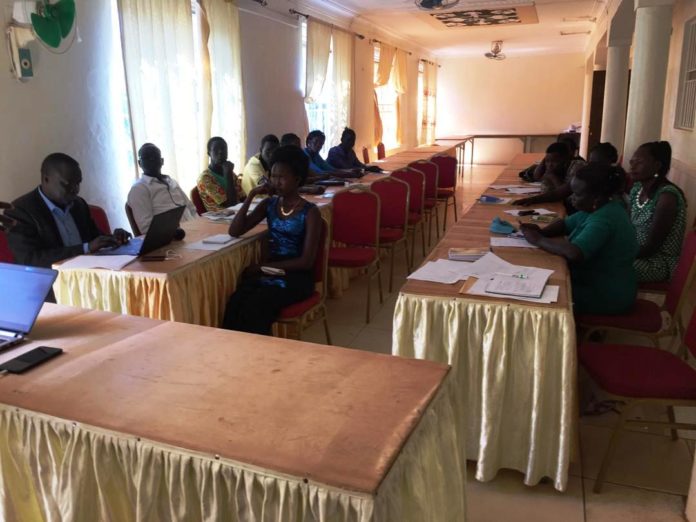
The group, which comprised of 20 youth, was deliberating at a one-day workshop organized by Remembering Ones We Lost (ROWL) on the theme: ‘Youth dialogue on sustainable peace in South Sudan’.

A public memorial aimed at remembering all the victims of the conflict and armed violence in South Sudan, ROWL currently compiles names of all the people who either died in armed struggles or generalized forms of violence in the East African nation since 1955.

Speaking at a workshop held in Uganda’s town of Gulu, ROWL’s Executive Director, Gideon Daud, said the youth, who constitute the majority of the South Sudanese population, can play fundamental roles in ensuring peace and stability in the country.

“The youth, being the majority of the population, have a role to ensure stability and peace or they can also be used to spoil the peace gained since they are the ones fighting on the front lines, both on the government and the armed opposition sides,” he said.

The one-day dialogue, Daud stressed, aimed at ascertaining the roles youth can play in the implementation of the recently signed peace and what is they need for sustainable peace in the country.

More than a million South Sudanese currently live in Uganda as refugees in camps, while other live as urban refugees in major towns.

Patrick Otorit, a participant at the dialogue, said youth of South Sudan should avoid being used as the perpetrators of violence.

He, however, appealed to the warring factions who signed the September 12, 2018 peace deal to ensure those who did not take part in the process are incorporated in the coalition government.

“How shall we handle issues of aggrieved parties like Thomas Cirillo and his National Salvation Front [NAS]? What will the new government do to bring such warring factions together?” he asked.

Mary Keji, on the other hand, appealed to the citizens in the country to forgive each other and that all aggrieved people be reconciled.

Meanwhile, Joseph Amanya, a co-founder of ROWL said the peace agreement is the best opportunity for restoring peace and stability.

In an overview of the recently signed peace deal, Amanya said the government structure of power sharing within the peace agreement offers women and youth fair representation in the new government.

“When you look at the new peace agreement, women have been allocated 35 per cent representation in the new government, with six allocated to the Juba government, three will come from the armed opposition and one will be nominated by the opposition coalition,” he told the gender-balanced participants attending the dialogue.

The accord, according to Amanya, also addressed some key issues such as the need to establish a truth, healing and reconciliation commission, a hybrid court and a repatriation authority.

South Sudan became an independent country on 9 July 2011 after decades of war, lengthy negotiations and a referendum to secede from neighboring Sudan. Two and a half years later, in December 2013 armed conflict broke out between forces loyal to President Salva Kiir and those allied to his then deputy Riek Machar.

However, in August 2015, the two main parties in the conflict agreed a peace deal and later formed a transitional unity government with President Kiir at the helm and Machar as one of his two deputies.

Renewed again fighting broke out in July 2016 with heavy clashes in the capital Juba and other parts of the nation forcing Machar to flee.

On September 12, the South Sudan rebel leader signed a peace agreement with the government aimed at ending a civil war, which has killed tens of thousands of people and displaced millions.

Stories Continues after ad

EAC Speakers meet for peace and cooperation

Speaker Rebecca Kadaga

Speakers of Parliament from the East African Community (EAC) have met in Juba, South Sudan to strengthen cooperation and promotion of peace in the region.
The legislators from South Sudan, Uganda, Burundi, Rwanda, Tanzania and Kenya met under the auspices of the Bureau of EAC Speakers.
The Speaker of the Uganda Parliament, Rebecca Kadaga, stressed the significance of supporting each other, saying they have cultural and economic ties.
“Uganda bears a big brunt when there is instability in South Sudan because of the resultant influx of refugees who then put pressure on schools, hospitals and general infrastructure. I have had discussions with the United Nations High Commission for Refugees to give additional support to the host districts,” Kadaga said.

She advocated for the actualization of the provision of EAC Customs Management Act in regard to free movement of labour, skills and capital. She said this will provide employment for the large population of the youth in the EAC.
“I note that there is still a number of non-tariff barriers to trade and free movement of labour and capital amongst EAC partners,” said Kadaga.
Further, she called on South Sudan to grant security for Ugandan traders, saying reports indicate that Ugandan traders are facing hostility from Sudanese.

“During a meeting with Ugandan traders in Juba, I was informed that they required extra protection because they are being threatened with eviction by the locals yet they have invested a lot in the market,” Kadaga said.

The President of the Senate of Rwanda, Bernard Makuza, underscored the importance of cooperation in trade and infrastructure development as key in translating aspirations into practical results for the region.
“Today more than ever, cooperation is not a choice but rather an imperative in real terms,” said Makuza.
The Speaker of Burundi National Assembly Pascal Nyabenda called on EALA to support Burundi in its efforts to lift what he termed “illegal sanctions” by the EU on Burundi.
“EU has imposed unjust economic and budgetary sanctions on Burundi which is counter-productive. In such conditions, it will not be easy for Burundi to sign an economic partnership agreement with EU,” said Nyabenda.

The Speaker of the Kenyan Senate, Kenneth. M Lusaka, challenged the EAC Speakers to provide proper legal frameworks that will promote peaceful coexistence in the region and beyond.
“Our Parliament is committed to ensuring that all Bills related with business from EALA are prioritized and considered within the stipulated timeline,” Lusaka said. Adding that, “I wish to urge you fellow Speakers to similarly ensure that all business related to the integration process is prioritized and given due attention.”
Anthony Lino Makana, Speaker of the Transitional Legislative Assembly of the Republic of South Sudan pledged full support of the EALA activities.

“In the third week of October, the plenary of EALA will be held here in Juba and we are looking forward to hosting the Inter Parliamentary Games in December,” said Makana.
He however reminded fellow Speakers of their role in modeling the EAC through review and development of policies and structures that facilitate the region’s aspirations.

“There is need to strengthen EALA so that all the legislative parameters of integration are given due attention. States should benefit from joint infrastructural development, networking, cooperation in social and welfare projects and a unified voice in international community,” said Makana.

The Outgoing Chairperson of the Bureau of EAC Speakers who is also the Speaker of EALA, Martin K Ngoga, said EALA has earmarked some additional activities for South Sudan as part of a contribution to the road map for full integration.
“EALA has already received its nine elected members who are not only resourceful, but knowledgeable and committed to see integration work,” said Ngoga.

Stories Continues after ad