Stanbic Bank
Stanbic Bank
27.3 C
Kampala
Stanbic Bank
Stanbic Bank
Home Blog Page 1488

Pan African University launches research policy

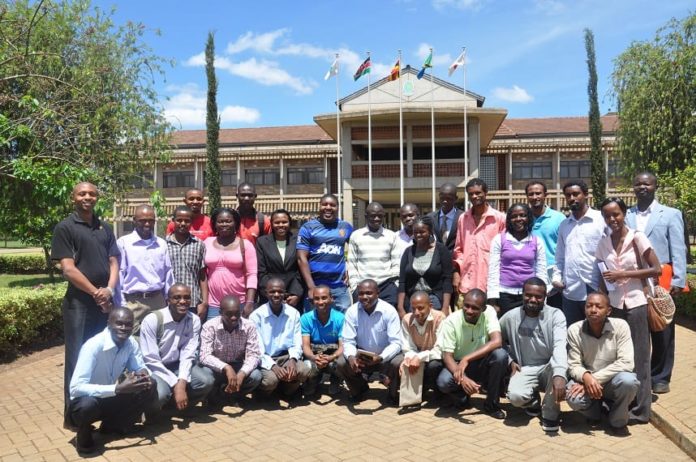
Pioneering-students-of-the-PAUSTI-in-a-group-photo-outside-AICAD

The Pan African University (PAU) has published its first Research and Publication Policy, a document that, once approved by its governing council, will guide how the university will conduct and publish research which is a critical component of its function as a postgraduate training and research network of African universities.

According to the statement released by the university, the 17-point draft document will be officially adopted by the institution’s governing council in the near future. The document is a product of a lengthy process that commenced in 2016 when the African Union summit of heads of state adopted a revised PAU statute, which, among other things, provided that the PAU develop its own research policy.

Following the provisions of the law, the university commissioned a consultant to develop the document in conjunction with the four PAU institutes. The draft was presented to and validated at a workshop held from 3-4 September and chaired by Kassa Belay, PAU deputy rector.

“This workshop aimed to, among other things, provide a platform for deliberations and to critically review and validate the draft policy, provide inputs and enrich it for the guide and management of research and publication within the university,” he said.

The draft was presented to the university senate the following day and is now being fine-tuned before being taken before the council for approval, according to Belay.

Relevance and impact

Once the policy is in place, important research areas will be prioritised on the basis of relevance and potential impact.

It will help to ensure that quality and relevant research is conducted in a responsible and efficient manner and, more importantly, ensure that research funds are efficiently managed, he said.

Belay said the document seeks to provide strategic direction and a conducive environment for the advancement of innovative research; it also highlights principles of good research practice, including academic freedom, accountability, integrity, transparency, openness, adherence to ethical standards, and safety issues, among others.

“Research is carried out to answer specific questions or issues, to solve problems, to widen understanding or to add to the body of knowledge. Publication is one of the dissemination tools to inform the research community and the wider readership about the output or evidence of research. A policy framework, a course or principle of action adopted or proposed, provides direction to these activities,” he said.

No new programmes

At its September meeting, the university’s senate also resolved that PAU will not add any new programmes to the ones currently being offered over the next five years.

“The decision to limit the launch of new programmes was intended to help the university consolidate and focus on enhancing the quality of its teaching, research and outreach activities,” the university said in a press statement.

The university currently offers studies in 57 disciplines, including 29 masters and 16 PhD programmes.

In addition the organisation has agreed that all branches of PAU should start operating according to a harmonised annual academic calendar for smooth implementation of learning programmes.

The university became functional in 2012, graduating three cohorts of masters’ students and one cohort of PhD students. It operates four thematic institutes in Kenya, Nigeria, Algeria and Cameroon. A fifth and final institute devoted to space sciences will be set up in South Africa.


Stories Continues after ad

Birthday bliss

Happy Birthday Ms Miranda Kyewankola Kingsholic and thanks for being an ardent reader of Eagle Online.From www.eagle.co.ug team.Enjoy your day.

Stories Continues after ad

Security operatives should stop Impunity – Bobi Wine

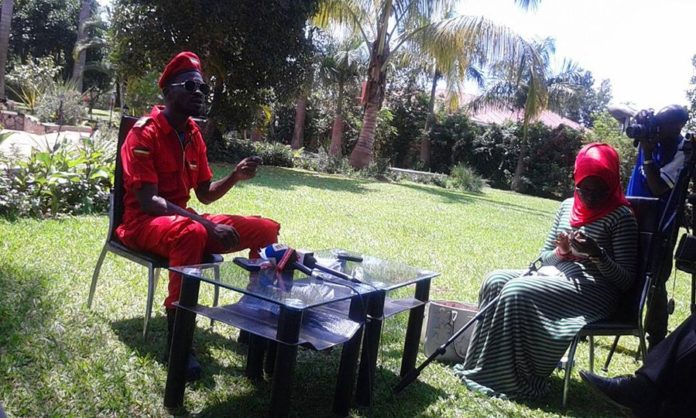
Kyadondo East MP Robert Kyagulanyi aka Bobi Wine talks to the media at his home.

Controversial Kyadondo East legislator Robert Kyagulanyi has applauded his supporters for always standing with him since he was brutally nabbed and incarcerated after Arua mayhem.

Narrating the ordeal of what transpired when he arrived from US where he had traveled for medical attention, Kyagulanyi says, there is no way he can express his gratitude to towards individual’ supporters who have stood with him for his safety.

Kyagulanyi who says, is irked by impunity of security agencies who have devoted themselves to violating people’s rights day in day out. “I was arrested by people in police uniform and others in civilian attire moments after the plane had just landed at Entebbe airport,”

”I am very bothered by the gruesome pictures and videos which I just saw. Why would security agencies dehumanize Ugandans so much? I saw people, most of who were going about their business along Entebbe road and Kasangati town, being beaten and manhandled by some security personnel. This impunity must stop,” he said.

“They grabbed me from the tarmac, took away my walking stick and grabbed my red beret off my head. I was forced into a waiting police vehicle. I insisted that I did not want to get into an unknown car with complete strangers and that I had my own car waiting for me at the arrivals but my plea fell on deaf ears,” he narrated.

He says they searched for his passport and it was taken from him, “I still don’t know where it is, “I got sandwiched between two counter terrorism policemen in a vehicle that had other police officers. I was then driven off towards the UN airbase with a string of police patrol cars and military trucks. They drove me at breakneck speed and after a long ride; we got to Kira then headed to Gayaza road until I was eventually dropped at my home in Magere,”

He decried gross violation of his rights, but most importantly the rights of his friends, family and lawyers who endured gross harassment throughout the day.
Several legislators including Medard Ssegona, Makindye East MP Allan Ssewanyana, and Kampala Lord Mayor Erias Lukwago were blocked from leaving their respective homes over allegations that they will cause commotion in town and incite violence. Ssegona was later picked and dropped at parliament.

On August 31, Bobi Wine left Uganda for the United States seeking better treatment after being tortured by presidential guards of Special Forces command (SFC) during the Arua Municipality by-election mayhem which the then jailed candidate Kassiano Wadri emerged winner to replace late Ibrahim Abiriga as MP of that constituency.

Before flying to the US, Bobi Wine was produced before the General Military Court Martial and charged with illegal possession of fire arms which were later dropped and leveled with treason charges in Gulu Magistrate’s Court. He is scheduled to reappear before the magistrate on October 1.His counterpart representing Mityana Municipality constituency still remains in India fighting for his life, having been bartered together with Bobi Wine by security agents, alongside several others, including civilians.

Stories Continues after ad

Extreme poverty declines to 8.6%

World Bank’s preliminary forecast shows that extreme poverty has declined to 8.6 per cent in 2018.
Fewer people are living in extreme poverty around the world, but the decline in poverty rates has slowed, raising concerns about achieving the goal of ending poverty by 2030 and pointing to the need for increased pro-poor investments, the World Bank finds.

The international poverty line is currently valued at $1.90 in terms of 2011 purchasing power parity, which equalizes its purchasing power across all countries and currencies.
About half of the world’s countries now have poverty rates below three percent, but the report finds that the world as a whole is not on track to achieve the target of less than three percent of the world living in extreme poverty by 2030. In the 25 years from 1990 to 2015, the extreme poverty rate dropped an average of a percentage point per year – from nearly 36 per cent to 10 per cent. But the rate dropped only one percentage point in the two years from 2013 to 2015.

World Bank found that, two regions, East Asia and Pacific and Europe and Central Asia, have reduced extreme poverty to below 3 per cent. The Middle East and North Africa region had previously been below 3 per cent in 2013, but conflict in Syria and Yemen raised its poverty rate in 2015.
“Over the last 25 years, more than a billion people have lifted themselves out of extreme poverty, and the global poverty rate is now lower than it has ever been in recorded history.

This is one of the greatest human achievements of our time,” World Bank Group President Jim Yong Kim said. “But if we are going to end poverty by 2030, we need much more investment, particularly in building human capital, to help promote the inclusive growth it will take to reach the remaining poor. For their sake, we cannot fail.”

Despite the tremendous progress in reducing extreme poverty, rates remain stubbornly high in low-income countries and those affected by conflict and political upheaval.

The deceleration in global numbers stems mainly from an increasing concentration of extreme poverty in regions where poverty reduction has lagged. A case in point is Sub-Saharan Africa, where, under all but the most optimistic scenarios, poverty will remain in double digits by 2030, absent significant shifts in policy. Slowing declines in poverty also reflect falling commodity prices, conflict, and other economic challenges for developing countries.

Stories Continues after ad

Court grants Kassiano Wadri permission to visit Arua

Kassiano Wadri

Gulu high Court judge, Justice Mubiru Stephen has revoked a travel ban that was early put on MP elect for Arua municipality Kassiano Wadri.

Kassiano Wadri was arrested on Augusts 13, hours after holding their conclusive rallies head of the Arua by-election. He was nabbed along with Robert Kyagulanyi, Ntungamo Municipality MP Gerald Karuhanga, Jinja East MP Paul Mwiru, former MP Michael Mabikke, and 28 other, the group is battling with charges of treason and malicious damage of president’s vehicle.

And through their lawyers led by Busiro East legislator Medard Lubega Ssegona and Bugiri Municipality MP Asuman Basalirwa, 33 were on August 27 granted bail by Gulu high Court judge, Justice Mubiru Stephen.

However, Wadri was given stringent conditions which included staying away from his constituency in a period of three months for the community to recover from the chaotic scenes they witnessed unless Court authorizes him.

Through his lawyers, Wadri appealed against Court decision, contending that his people’s views are not represented in the August House since he can’t access them. He argued that the area is politically calm and worst worry he has never met his for voter to thank them when they made decisions and elected him to parliament.

Appearing Justice Mubiru , his plea was heard and cleared him to access Arua Municipality.

Despite standing on an independent ticket, Wadri is a member of Forum for Democratic Change (FDC), the main opposition party in Uganda. He served in the 7TH , 8th and 9th Parliaments of Uganda.

Stories Continues after ad

Report pins BoU for selling defunct banks’ loans at 93% discount

GTBank

As Bank of Uganda liquidated and sold International Credit Bank (ICB), Greenland Bank and Cooperative Bank, it would also go ahead to sell loans worth Shs135 billion, including secured loans worth Shs34.5 billion, at a discount of an amazing 93 per cent.

That transaction was revealed by the Auditor General’s (AG) recent confidential report of BOU on seven defunct commercial banks.

“In the case of ICB, Greenland Bank and Cooperative Bank the total loan portfolio sold of Shs135 billion included Secured loans of Shs34.5 billion which had valid, legal or equitable mortgage on the real property and were supported with legal documentation but were sold to Nile River Acquisition Company at a 93 per cent discount,” the AG John Muwanga said in the report he did at the request of parliament.

Members of Parliament requested the audit of BoU in the sale of defunct banks following public outcry against BoU’s sale of banks without proper due process and the Auditor’s finding in the report will form part of grounds MPs will stand on to further question BoU top managers who spearheaded the sale of the banks.

Refund of contributions made towards settling customer claims

According to the report, a sum of Shs96.431 billion was contributed by the Deposit Protection Fund (DPF), Government of Uganda and BOU towards settling the insured and uninsured depositors of Cooperative bank, ICB and Greenland bank and was to be refunded following the sale of assets of the closed banks. However, the report by the AG noted that only Shs28. 055 billion was refunded by the liquidator (BoU) leaving a balance of Shs68.376 billion.

Government is unlikely to recover the outstanding balance since only Shs19.7 billion has been set aside to clear the outstanding claim pending conclusion of the liquidation exercise. This, according to sources, is a loss to the taxpayers if no recoveries are made.

Further the report accuses BoU of misstating liabilities of Greenland Bank, Cooperative Bank and International Credit Bank (ICB), saying the three banks owe DPF even BOU included the figures in the financial statements. “I further noted that although the Statements of affairs of the three (…) closed banks as at 30th June 2015 indicated that the banks owed Shs.14.89 billion to the DPF …, the DPF financial statements for the financial years ended 31st December 2009, 2010, 2012 and 30th June 2017 indicated that the three (…) closed banks did not owe the DPF hence the liabilities are misstated.,” the report says.

Liquidation costs not clear

The report says the recovery account provided by BoU did not have a clear description of transactions relating to liquidation costs reported in the Statements of affairs as at 30th June 2016.

According to the statement ICB has an outstanding liquidation costs of about Shs70.3 million while Cooperative Bank has Shs115.3 million. On the other hand Greenland had no outstanding liquidation costs, having paid about Shs8.2 billion.

Global Trust Bank

Global Trust Bank (GTBU) was closed on 25th July 2014 due to undercapitalization and Corporate Governance weaknesses among other reasons. BoU and Dfcu would later arrange the purchase of assets and assumption of all or some of the liabilities of GTBU, with Dfcu taking 65 percent and BoU withholding 35 percent of the liabilities. Total assets and liabilities transferred from GTBU s were about Shs71 billion.

However, the AG’s report notes that the transaction was messy as guidelines were not followed. I observed that there were no guidelines/regulations or policies in place to guide the identification of the purchasers of GTBU. There were also no guidelines to determine the procedures to be adopted by the Central Bank in the sale of assets and transfer of assets or liabilities of the defunct banks to Dfcu.

The AG Muwanga furthers says in the report that he was not provided with records of the procurement process to ascertain the bid requirements, offers made, list of bidders, evaluation criteria, evaluation report and negotiation minutes leading to the P&A agreement.

“In the absence of guidelines and procurement records, I could not ascertain whether BoU selected and evaluated the bids in line with the evaluation criteria,” he says.

Stories Continues after ad

Over 86 bodies recovered after a passenger ferry capsized in Tanzania

MV Nyerere 2

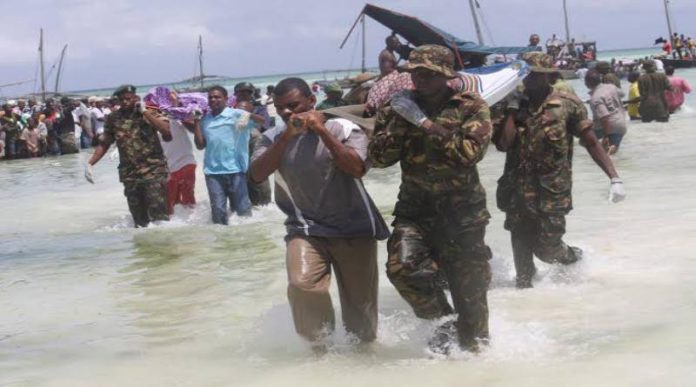
Over 86 bodies have reportedly been recovered after a passenger ferry capsized in Tanzania off the coast of lake Victoria.

Hundreds more are feared drowned after the MV Nyerere ferry overturned off the island of Ukerewe. By yesterday, only 40 bodies had been recovered however, this morning rescuers resumed searching for survivors at first light where more bodies were found.

A government official says more than 200 are feared to have drowned in the disaster just a few meters from a dock as locals watched helplessly from the shore when the vessel got into difficulty just a few yards from the banks of Ukerewe, the lake’s biggest island.
Some nearby fisherman were able to save roughly 30 people from the water.

Local reports indicate the ferry was overloaded with up to 400 people on board however the maximum capacity is thought to be around 105.
Officials have found it hard to establish the precise number of passengers on board since the person dispensing tickets had also drowned with the machine recording the data lost.
Regional governor John Mongella said last night the toll had reached 44 while 37 others had been rescued, though some were in “a very bad condition”.

The death toll doubled on Friday as more bodies were pulled from the water. Lake Victoria is the largest lake in Africa and the third largest, by area, in the world after Lake Superior and the Caspian Sea. It is approximately 26,590 square miles.

“We pray to God to give us hope in such an accident,” Regional Commissioner Adam Malima told reporters.
“We pray to God to give us hope that there has not been a high death toll. “It is not known what caused the ferry to get into difficulty. Locals joined with emergency teams in rescue efforts before the rescue mission was halted until dawn on Friday,”

Stories Continues after ad

KCCA take on SC Vipers in FUFA Super Cup

KCCA FC manager Mike Mutebi

With only a week left to the start of the 2018/19 Uganda Premier League season, KCCA FC and Sports Club Vipers will battle for the FUFA Uganda Super Cup tomorrow.

The Uganda Super Cup is a match played before a new season, between the Uganda Premier League champions and Stanbic Uganda Cup champions of last season.
SC Vipers won the Uganda Premier League last season while KCCA won the Stanbic Uganda Cup, beating The Venoms 1-0 in the final.

KCCA are the Super Cup holders, having beaten Paidha Black Angels 3-0 last year. Patrick Kaddu and Tito Okello each bagged a goal while Allan Okello made sure of the victory.
Brian Nsubuga Miiro will be the centre referee and be assisted by Dick Okello and Isa Masembe while Ali Waiswa is the fourth official.

The match acts as season curtain raiser for the upcoming 2018/19 Uganda Premier League campaign that gets underway on Friday, September 28, 2018.
The match will be played at Mutesa II Stadium in Wankulukuku at 4pm.

September 22nd, 2018
FUFA SUPER CUP
KCCA FC Vs SC Vipers
Wankulukuku Stadium, 4:00 pm

Stories Continues after ad

Seven keys to selecting a startup idea that works for you

Martin Zwilling

By Martin Zwilling

In big business, as well as startups, I have found that your effectiveness can be highly correlated to your ability to build and maintain people relationships, often more so than hard work, or how many hours you give. But all relationships are not the same, and your ability to distinguish between positive and negative, or casual versus committed, can make or break your future.

I find that the most successful entrepreneurs have mastered the art and skill of building and managing relationships. For example, we all know people who really believe that everyone in the world is their supporter, when in fact many are actively working against them. The reasons may be emotional or fact based, but the key is understanding and dealing with relationship realities.

In my role as a mentor to business professionals and entrepreneurs over the years, I have found that it’s important to take a hard look at the relationships around you on a regular basis. If you have very few, or the wrong relationships, or your assessment abilities need tuning, your impact and your career may be limited. But, like most other skills, you can learn from these priorities:

Everyone benefits from active mentoring. The most productive business relationships involve mentoring, or active sharing of knowledge and experience, with the intent to improve communication, cooperation, and impact. This is a powerful and positive relationship that benefits both careers, as well as the business.

It works at all levels inside an organization, as well as outside the company. Most successful entrepreneurs and business executives admit to having mentor relationships, including Bill Gates with Warren Buffett, and Mark Zuckerberg with Steve Jobs. We all have our strengths and weaknesses, and can benefit from an external perspective.

Provide and seek coach and advocate relationships. The best coaches are people who care about you as a person, without any ulterior motives, and intend to inspire you to be the best that you can be. With their advocacy and guidance, your morale, skills, and thus productivity will go up, benefiting both the company and your career.

A good coach is not a critic. Beware of relationships with people who constantly put you down, highlight your flaws, or discuss your shortcomings with other team members.

Establish relationships with people in the know. Some peers are always researching the big picture and latest details, and can keep you in the loop on what’s happening in the organization and why. I’m not talking about gossip or negative information, but positive insights that will help you spend your time to the best advantage in your career.

These people are easy to recognize if you keep your eyes and ears open. They typically share insights early that prove to be productive, and have good relationships themselves with executives and other leaders.

Actively court relationships with people you aspire to be. If your friends are all people in lesser experience, it’s unlikely that you can learn new things from them. Supplement the scope of your relationships with trailblazers you respect, to be inspired by their results, and motivated to follow in their footsteps. Keep your ego in check.

Expand work relationships into personal friendships. Personal friendships between peers is always good for business, even between managers and team members. Personal friendships will improve communications and trust, and will definitely improve your personal satisfaction and life balance, between work and play. .

Make it a point to get to know other teams and customers. Just knowing more people both inside and outside your organization, if only as acquaintances, is still a good thing. It keeps you from becoming isolated in your views, improves trust all around, and generally leads to more cooperation and sharing. Even with all our technology, business is still people-to-people.

Above all else, don’t create enemy relationships. Things change rapidly in business, and enemies have a way of resurfacing in a position to damage your career or your project. Don’t burn your bridges with anyone on the team, and use your initiative to engage people directly to improve communications, rather than cutting them off or instigating a personal battle.

In my experience, even the best technology and business model can’t succeed without positive relationships all around on the team. As an angel investor, I learned this the hard way, and now I’m a believer that smart investors invest in people with the right relationships, not just ideas and skills. Work to make your ability to manage relationships your sustainable competitive advantage.

The writer is a veteran startup mentor, executive, blogger, author, tech professional, and Angel investor. Published on Forbes, Entrepreneur, Inc.

Stories Continues after ad

New report calls for equity in unpaid care work in Ugandan households

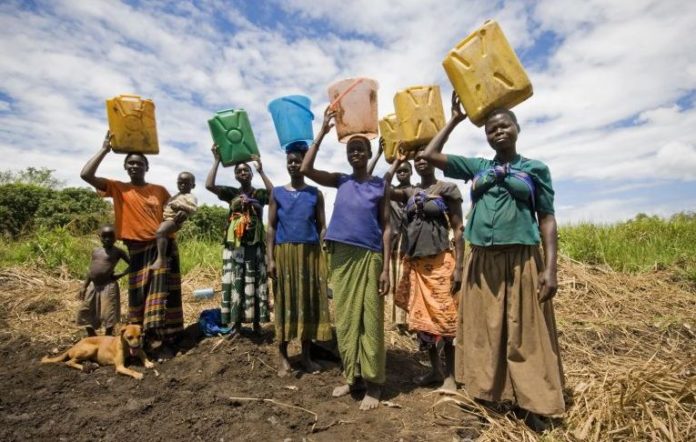
Women-carrying-water

A new report of the research done by the Economic Policy Research Centre (EPRC), Uganda Women’s Network (UWONET) and Makerere University School of Gender and Women Studies, say there is need to balance the unpaid care work between men and women in the country.

Dubbed “Gender Roles and the Care Economy in Ugandan Households, the case of Kaabong, Kabale and Kampala Districts”, the report highlights how unpaid care and domestic work is distributed in Uganda’s households.

It warns that if care work is not distributed properly across women and men within and outside the household, heavy care work can negatively affect employment and earnings, leisure time, participation in development initiatives, sleep among others for women and girls.

The report defines unpaid care and domestic work (UCDW) as work done in services of others entirely by women and girls, motivated by reasons other than financial compensation. “Women income earnings are still low averaging Shs50, 000-200,000 per month,” it notes. But Specific policies designed to reduce women’s UCDW are non-existent in Uganda.

The report says that unpaid care work is primarily carried out by women and girls and states that more men than women spend most of their time in atypical 24-hour day on paid work (24 per cent for men compared to 13.8 per cent for women)

According to the report majority of the women said they would spend the time doing more income generating work in case of less care work (Kampala 61.6 per cent) Kaabong 46.6 per cent and Kabale 34 per cent.

The report also cites acceptability of violence against women for perceived care failings for example failing to care well for the children. This is higher in Kaboong than in other districts.

The report calls on government to adopt “triple R” approach of Recognizing care at policy, community and household levels, Reducing difficult care work through labour saving technology, and Redistributing the care work costs and responsibilities from men to women.

Since childcare is considered the most problematic care activities, the report also advises that women and men decide on the number of children to have given that fewer children reduce care workload.

According United Nations Development Programme (UNDP), one of the significant structural barriers to women’s economic empowerment is women’s disproportionate burden of unpaid work at home that restricts women from taking up paid jobs, undertaking advanced education and skills training, and most importantly participation in public life.

Stories Continues after ad