Stanbic Bank
Stanbic Bank
18.2 C
Kampala
Stanbic Bank
Stanbic Bank
Home Blog Page 1503

Mbabazi invites Museveni for ‘daughter’s traditional marriage as Ramaphosa jets in

President Museveni and Mr Mbabazi at a past event.

President Yoweri Museveni has been invited for the traditional marriage for Ms Bridget Rwakairu Birungi and Andile Ramaphosa.

Andile Ramaphosa is son to South Africa President Cyril Ramaphosa while Ms Birungi is a niece to Mr Amama Mbabazi, the former Ugandan Prime Minister and presidential candidate in the 2016 general elections.

Mr Mbabazi has also invited his political nemesis, Justice and Constitutional Affairs Minister, Maj. Gen. Kahinda Otafiire.
South African President Cyril Ramaphosa is expected to jet in this evening ahead of sons’ traditional marriage tomorrow.

Following the arrival his wife Hope Ramaphosa on Wednesday, Ramaphosa is today expected to jet into Uganda ahead of their son Andile Ramaphosa’s traditional marriage.

In his fatherly duties, the South Africa Head of State is expected to lead a delegation of dozens of family members and close friends from Johannesburg to Kampala.
Preparations in high gear at Mbabazi’s Kololo, residence for tomorrow’s Kuhingira where the two presidents will witness the vows.

In accordance with culture, the marriage is preceded by a traditional ceremony known as ‘Okhusaba’ that was held on May 19 where Andile Ramaphosa delivered a marriage proposal to Ms Birungi.
Mr Mbabazi took over the upbringing of the girl after her father’s death Shadrack Rwakairu of Kabale and Peace Ruhindi, a sister to Jacquieline, Mbabazi’s wife.

The ceremony shall be held at plot 10 Nyonyi Gardens Kololo, at former prime ministers Amama Mbabazi’s residence.

Stories Continues after ad

Premier Rugunda calls for peaceful resolution in war torn countries

Called for peace: Uganda PM Ruhakana Rugunda

The Prime Minister of Uganda Dr. Ruhakana Rugunda has called for peaceful resolution in war torn countries so that citizens to settle and engage in meaningful development of their lives and their countries.

Rugunda was speakiing at the launch of development response to displacement impact project (DRDIP) in Kamwenge district where he Commissioned Combined outpatient department (OPD), maternity with a latrine, placenta pit, supply, delivery, and installation of a lightening protection 10,000ltr capacity stainless steel rain water harvesting tank and solar power unit in Kyarugaju HC II.

Dating way back to the 1950s, the premier said Uganda has been hosting. At end of June 2018, statistics indicts that Uganda is hosting 1.45 million refugees, the largest refugee population hosted in Africa and 3rd largest in the world.

“We shall assure asylum space for refugees in Uganda and at the same time we are protecting national and community interests, I call upon whoever is involved in conflicts that is destabilizing our regional to stop these embarrassing and costly conflicts, We are all losers whether directly involved in the conflicts or not,” he said.

He noted that the office of the Prime Minister (OPM) is striving to ensure that hosting of refugees becomes a blessing not a burden to the country generally and the host communities in particular.

“I would like to extend government appreciation to host communities and the district leadership for all the support rendered in ensuring that refugees are hosted in a peaceful environment,” said the prime minister.

He pointed out that the above attributes to Uganda regarding hospitality, refugees have come at a cost to country’s environment, infrastructure deterioration and social economic pressure on host communities.

Government and majority of Humanitarian actors for a long time concentrated on humanitarian service delivery to refugees and very little was done for host communities, he said infrastructural development in terms of roads, and schools must be addressed for service delivery.

Stories Continues after ad

Very few Ugandans have health insurance-survey

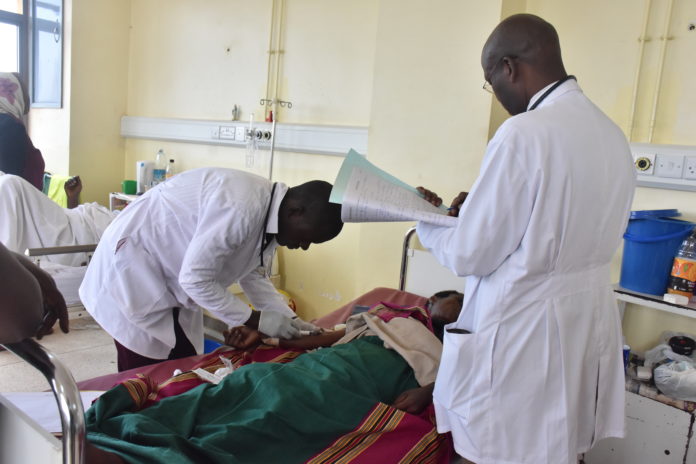
Capt Dr Gideon Nuwagira (r) and Pte Dr Oboth Ronald treating a patient at Kiruddu hospital

A baseline survey that covered 2000 respondents in Uganda reveals that six in 10 citizens (59 per cent) cite poor health services as one of the top three problems facing Uganda today, more than for any other issue.

The survey done by Sauti za Wanainchi, a flagship of Twaweza East Africa also indicates that 38 per cent of the respondents cite inflation and the high cost of living as the other problem facing Uganda. 33 per cent or one in three cites a lack of jobs as another big problem.

When it comes to their own households, six in ten citizens (58 per cent) name inflation and the high cost of living as one of the top three problems they face. This is more than for any other issue, though the poor quality of health facilities follows close behind, named by just over half the population (55 per cent) and hunger / drought, also mentioned by half (49 per cent).

The survey also reveals established that 98 per cent have no health or medical insurance.
It further shows that 51 per cent of the respondents/household members went to a government health facility for treatment against disease or injury.

Meanwhile 24 per cent, 12 per cent and 4 per cent of the respondents said they went to a private/NGO facility for treatment, pharmacy and grocery, respectively. 1 per cent of the respondents said they did not visit any health facility while 0.4 per cent said they visited traditional/ faith healer.

A further 2 per cent and 3 per cent of the respondents said they visited church facilities and used medicines at home respectively.

The survey was meant to draw citizen experiences of public service delivery, specifically looking at health facts. It followed the Health Monitoring Unit’s recent preliminary findings on the state of health in Uganda, which showed that a big number of local government public health facilities are infested with quack health workers who find their way on the government pay roll.

Stories Continues after ad

Student jailed for stalking MP out on bail

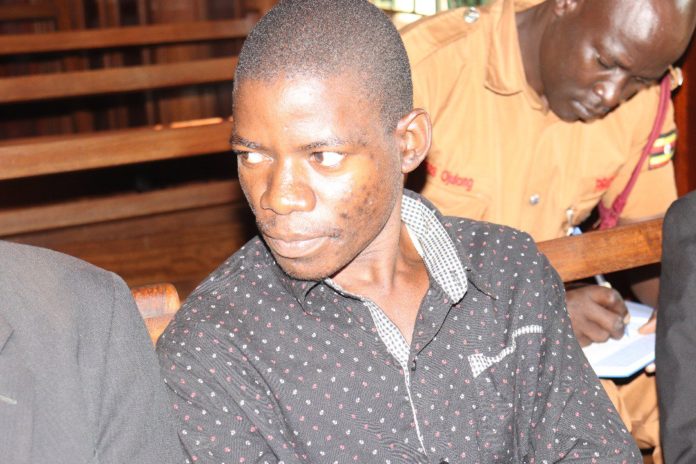
Isiko at Court during the hearing of his case

High Court Judge Jane Francis Abodo has this morning released YMCA student, Brian Isiko after he was convicted of Cyber Harassment and Offensive Communication.

Isiko was in July sentenced to two years in prison for incessantly love texting and stalking Kabarole Woman MP Sylvia Rwabwogo.

Ms Rwabwogo told court that Isiko was being used by some selfish individuals in a mission to lure her with love and later kill her, “What most of you regard as mere love messages should know that this was not just love messages,”

Through his lawyer Ramadhan Waiswa, Isiko appealed against Buganda road magistrate Gladys Kamasanyu’s decision on among others that the legislator once appeared in the press saying she is single and searching.

Presenting Grace Regan Muganza a retired UPDF officer and current coordinator of the Reserve force; as well as Wako Godfrey, the Assistant Academic Registrar of Kyambogo University, who is also his paternal uncle as his sureties, Isiko was granted shs500, 000 cash bail as his sureties were ordered to pay Shs 5million non cash.

Justice Jane Francis Abodo ordered him to report to high court deputy registrar every third Friday of the month starting with August 17.

Court also ordered him not to contact MP Sylvia Rwabwogo, failure to comply with court ordered, his bail will be cancelled.

Stories Continues after ad

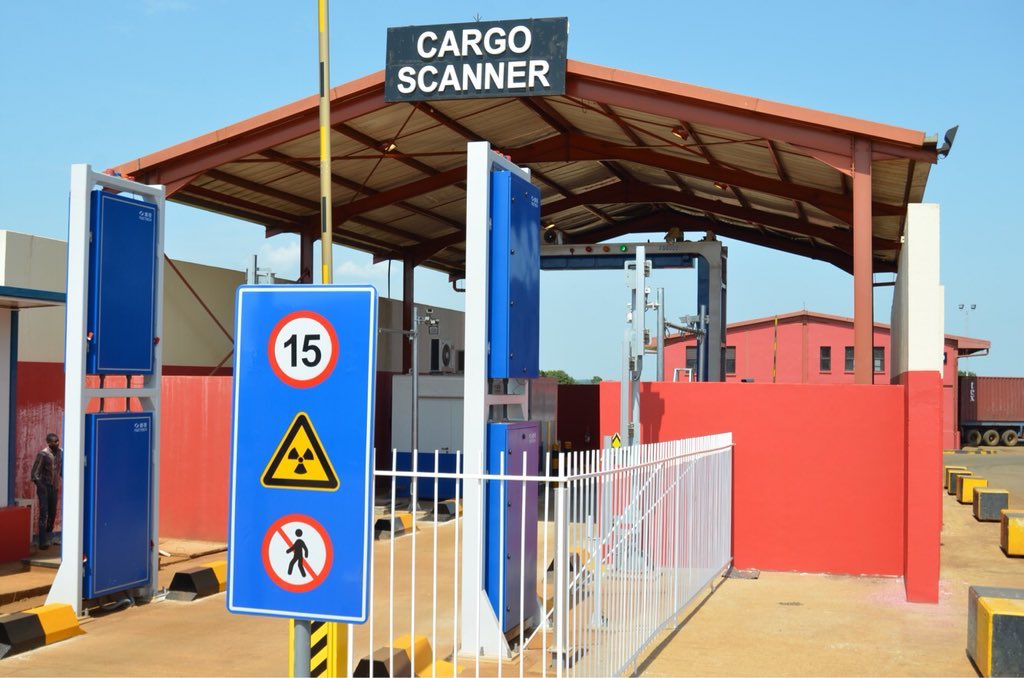
Kasaija launches two non-intrusive cargo inspection scanners at Busia and Malaba

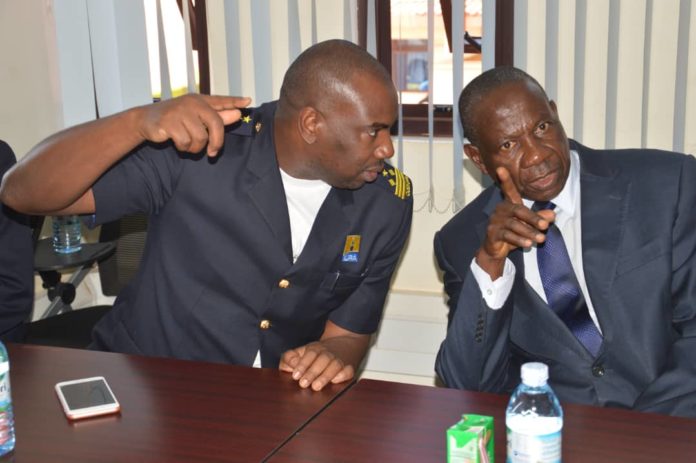
URA Commissioner in-charge of Customs Kateshumbwa and Minister Kasaija during the launch.

Finance Minister Matia Kasaija has launched two FS 6000 Non-intrusive Cargo Inspection Scanners at Busia and Malaba One Stop Border Posts (OSBP).

Speaking at the launch, Kasaijja said cargo scanners were acquired from NUCTECH, a China based company by Uganda Revenue Authority customs’ department to streamline and improve cargo in transit thus boosting international trade.

Kasaija said in a marketplace where illicit cross border trade and smuggling is still thriving, supply chain security is very crucial. Customs therefore, the need to prevent illegal transport of unauthorized or undeclared goods and migrants alike.
“When combined with effective profiling methods, non-intrusive scanners can greatly improve the customs and security functions,” said Kasaijja.

With support from Trade Mark East Africa and Department for International Development (DFID) finance minister said, the newly launched scanners will be linked with the ones at Mombasa Port thus create a digital trade corridor.
As part of the digital revolution, it is important that all efforts are put in place to ensure faster and more effective technology is used in trade. Electronic cargo scanning and clearing is thus a great step forward.

Scanners allow for archiving to be set to allow the system to free up space from old images. The server supplied with the system, has a provision for inserting USB drives and USB DVD RW drive to allow for burning of the images in standard format.

URA Commissioner for customs Dicksons Collins Kateshumbwa commended the authority on the milestone of having the first non-intrusive inspection scanner in the region.
He said they (Scanners) can inspect close to 200 trucks per hour Implying that trader can spend between one to three minutes.

Stories Continues after ad

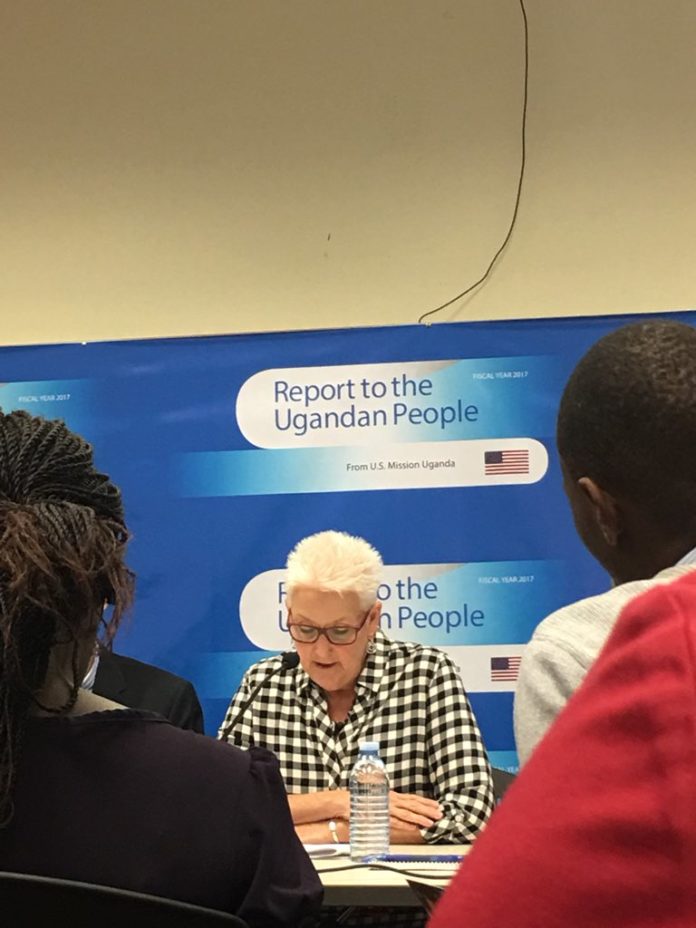
$640,850 recovered out of corruption- US Ambassador

Amb. Malac

US Ambassador to Uganda Deborah Malac says $640,850 was last year recovered following publication of investigative reporting series that exposed corruption cases in the country’s local governments.

Speaking at the launch of US 2017 Report to the Ugandan People, Malac says the sum of money was recovered in 28 local government following procurement audits in eight districts. The process resulted into conveyance of public hearings involving parliament’s local government public accounts, public procurement and disposal of public assets authority, office of the Attorney General and civil society.

Corruption is considered as one of the greatest barriers to Uganda’s economic development. Alluding to statistics, in 2017, Uganda was ranked 151 out of 176 countries in the Global Corruption Perceptions Index.
“Much work remains, however, Uganda faces major challenges that will continue for the foreseeable future. Ultimately, Uganda’s people and government will chart their own destiny. We are here to support their dreams and their efforts for a better future,” she said.

The report covers agricultural sector, health, prosperity, security, democracy, and strong education.

It indicts that U.S. government is collaborating with local authorities, the media, and civil society to help Ugandans in the fight against corruption, improve government transparency, strengthen the quality of public services, and increase dialogue between government and the public.

“US through United States Agency for International Development (USAID) is committed to improving the accountability and responsiveness of Uganda’s systems to ensure sustainable development,” states in part of the report.

Stories Continues after ad

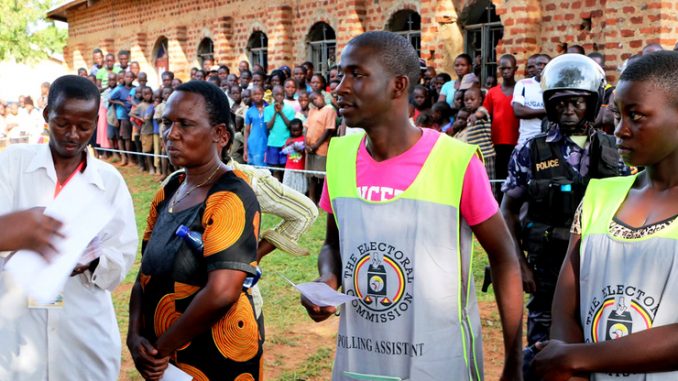
Ugandan citizens trust LCI Chairmen than president-research

Ugandan lining up in the just concluded LC1 elections. Research shows that Ugandan prefer trusting village chairman than a president.

The election of the Village Council (LC1) elections took place on July 10, 17 years after the country last conducted such elections in 2001 under the Movement System where candidates were elected on individual merit since multi-party democracy was not in existence like it is today.

Before the latest elections that had candidates of different political parties and independents participate were held, a new study whose findings were released in November last year, revealed that Ugandan citizens trust information provided by village council Chairmen than the president and any other political leader in the country.

The survey was done by Twaweza East Africa, a nongovernmental organisation working in Uganda, Kenya and Tanzania on effective public and policy engagement, through powerful media partnerships and global leadership of initiatives such as the Open Government Partnership.

The research referred to as Sauti za Wananchi (representative mobile phone survey) interviewed 1,980 people, with 45 per cent saying they would trust their LC1 Chairmen than the president at 34 per cent, the same with an LCV Councilor.

The percentage of citizens interviewed who said they would trust information obtained from any government official, the Prime Minister, an MP from NRM, ruling party member/supporter, an MP from opposition party and opposition party member/supporter comprised 31 per cent, 28 per cent, 26 per cent, 25 per cent, 22 percent and 21 per cent respectively.

The question probing how free citizens are to criticize information and statements provided by leaders, 68 per cent, 64 per cent, 59 per cent, 56 per cent, 50 per cent, 48 per cent, 47 per cent, 46 per cent, 45 per cent and per cent said they were free to criticize village/street chairmen, LCIII Chairperson, LCV Chairperson, government institution, Chief Administrative Officer, Minister, Prime Minister Vice President and president respectively.

Further the 67 per cent of the citizens contacted believed they would get information from the office of the LCIII on birth certificates while only 41 per cent believed they would get information on development plans and budgets from local authority. A further 50 per cent believed that they would get information from a local school on how much of the capitalization fund has been received.

The findings shows that 96 per cent of the people interviewed prefer going physically to a government office or authority to seek for information while 29 per cent said they would use a phone instead. A few respondents opted personal connections, social media, email, fax and others respectively.

However, the findings showed 27 per cent, 27 per cent, 26 per cent and 25 per cent were not free to criticize information and statements from the president, Vice President, Prime Minister and Minister.
This Sauti za Wananchi data is premised on public access to information and freedom of expression as cornerstones of good governance and democracy.

Stories Continues after ad

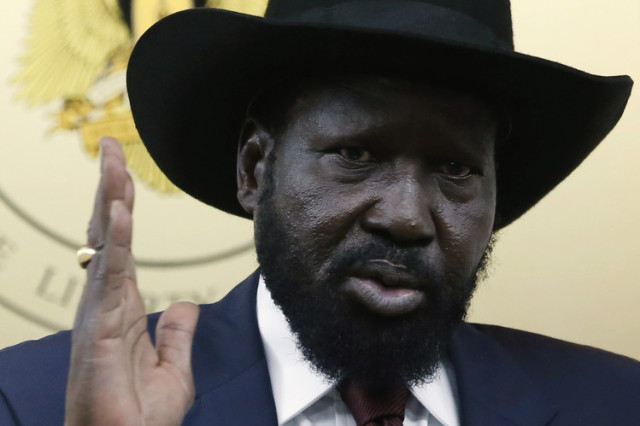
South Sudan Opposition Alliance choses the downtrodden over elite in peace talks

Wanted Out: South Sudan President Salva Kiir Mayardit

By Maria Nassiwa

The South Sudan Opposition alliance have chosen to push the line that favors the common man and not the blue collared elite at the ongoing peace talks in Khartoum in Sudan.

The move is seen by many as one which will separate politicians who care about people’s welfare from those who do not.

“The Khartoum peace talks provided many South Sudanese with an opportunity of knowing whether their political leaders meant what they propagate and preach.

“It might not be possible to gauge the magnitude of the widespread support that some SSOA members harvested by standing firm behind popular demands like federalism, the abolition of the illegal 32 States, and accountability,” Dr Lako Jada Kwajok one of the opposition politicians said in a press release.

Khartoum may seem far away from the small towns and villages of South Sudan, but modern technology made communications and the flow of news easy.

SSOA want President Kiir to leave power. They accuse him of failing to run government and dragging it down to ruins.

Stories Continues after ad

CiplaQCIL ready to list on USE after CMA approval

CiplaQCIL headquarters in Kampala

Ugandan drug maker Cipla Quality Chemical Industries Ltd (CiplaQCIL) said on Thursday in a statement that it plans an initial public offering and a listing on the Uganda African Securities Exchange (USE).

The company said each of its shareholders would be selling a minority of their stakes in the Initial Public Offer (IPO) and that the transaction and potential listing had received approval of the Capital Markets Authority (CMA) which regulates the USE.

“The listing has received the relevant approvals required, and the Company will provide further details shortly. Renaissance Capital is acting as the lead transaction advisor and book runner, and Crested Capital (Uganda) is the lead sponsoring stockbroker to the listing,” the statement said.

The company largely owned by India’s pharmaceutical giant Cipla, has a manufacturing plant in the capital city Kampala and will be the 19th security on the USE.

CiplaQCIL manufactures nine branded generic drugs, six of which are antiretroviral (ARV) drugs, one artemisinin-based combination therapy (ACT) drug and hepatitis B and C drugs which it sells mostly in sub-Saharan African countries.

The firm said as part of its growth strategy it, has been evaluating an initial public offering and listing of its issued share capital on Uganda Securities Exchange.

Cipla, according to a statement, will still maintain a majority stake even after the IPO but the firm did not state how much equity would be offered for sale on the USE.

In April last year the company announced it would list 31.1 percent of its stock on the USE in its IPO, having sent documents to CMA for approval.

In November it announced it had appointed a book runner, Kenya’s Renaissance Capital to manage the listing process.

A report in the media said then that the company’s largest stakeholder, Cipla Limited of India, would reduce its shareholding to 51% from the current 62.3% in the IPO.

“Each of the shareholders will be selling a minority of their stakes to enable sufficient free float and liquidity. Cipla Group, represented through a subsidiary, will retain a majority stake,” the Thursday statement said.

Capital Works Investment Management, an institutional investor in the pharma company with a 14.4 percent shareholding, would sell off its stake in the IPO, the report said at the time.

Ugandan shareholders, on the other hand, the report said, would halve their shareholding to 1.8 percent. They include Frederick Mutebi Kitaka, George W Baguma – both executive directors at the company – and Emmanuel Katongole, the executive chairman.

The three were among the six founding investors of the compnay when it started operations in 1997. In 2005 Cipla Limited bought into the company.

Another investor, the private equity firm TLG Capital which has a 12.5 percent stake and is expected to retain its shareholding.

“It is an exciting time for the Uganda capital markets that last had an IPO in 2012 and we applaud CiplaQCIL for taking this important step in its growth story,” said USE’s CEO Paul Bwiso said of the new member that is to give other details in the due course.

Stories Continues after ad

World Bank appoints new chief for Uganda

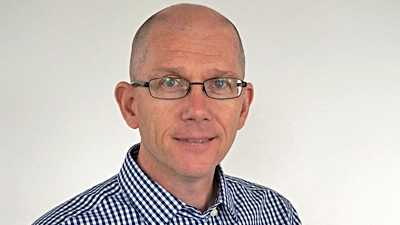
Antony Thompson

A dual Irish and British national, Antony Thompson is the new World Bank (WB) Group Country Manager for Uganda. He succeeds Swedish Christina Malmberg Calvo who had been holding that office since 2015.

Under his leadership, the World Bank will continue supporting inclusive growth and poverty reduction through a wide array of financial products and technical assistance. The World Bank Group (WBG) Country Partnership Framework (CPF) for the period 2015/16 to 2020/21 supports the Government of Uganda’s vision of a transformed, modern and prosperous country by 2040.

The program is focusing on raising rural incomes by increasing agricultural productivity and commercialization and reducing vulnerability to shocks; investing in better service delivery, particularly in health and education, improving the business environment and access to infrastructure services, all of which are underpinned by strengthening governance and accountability.

Thompson will be overseeing a portfolio of 26 projects totaling close to US $3 billion. The Bank’s portfolio in Uganda is primarily financed from the International Development Association (IDA), which provides grants and credits.

The credits are on concessional terms (interest free) and only attract an administrative service charge of 0.75 percent on the disbursed amount. Credit repayments are stretched over 38 years, including a six-year grace period.

This is complemented by trust fund resources that support technical assistance and analytical work to help the country share and apply innovative knowledge and solutions to the challenges it faces.

Thompson was the Country Manager for Bulgaria, the Czech Republic and Slovakia, since August 2014. He also served as the Manager for Strategy and Operations at the Human Development Network, based at the World Bank Group (WBG) Headquarters in Washington, DC.

Thompson joined the WBG in 1992 as part of the Young Professional Program, working on Human Development for the Middle East and North Africa region’s country Operations Department. He has worked in several different capacities, including Operations Officer, Lead Financial Sector Specialist, Operations Advisory, and Sector Manager. Throughout his career in the World Bank, he has worked extensively in Financial Sector, Private Sector Development, and Tax Administration.

In addition to human development, Thompson’s areas of expertise include health, HIV/AIDS prevention, and financial sector reforms.

Thompson holds a Bachelor of Arts (Honors) from the University of Ulster and a Masters of Business Administration (Honors) with a specialization in Finance from the University of Chicago.

Stories Continues after ad