Stanbic Bank
Stanbic Bank
24.5 C
Kampala
Stanbic Bank
Stanbic Bank
Home Blog Page 1513

Minister Kibanzanga applauds Dairy Development Authority or empowering local investors

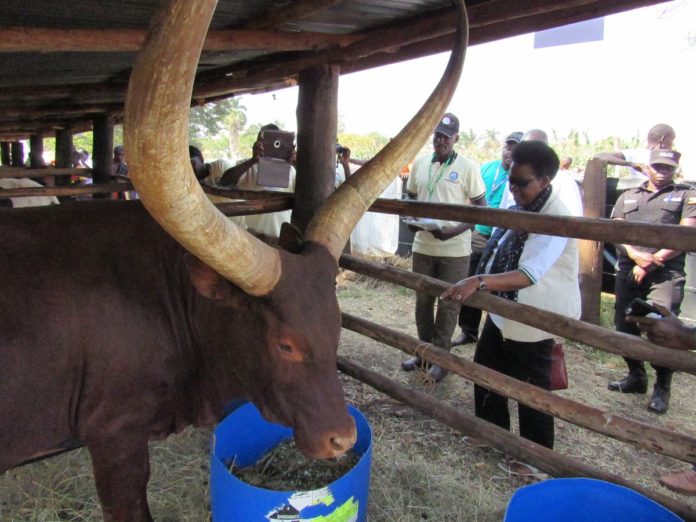
State Minister for agriculture Christopher Kibanzanga has applauded Dairy Development Authority (DDA) for empowering local investors to produce packaged and highly-competitive milk products on local and international market.

Speaking in Jinja agricultural show Kibanzanga said, as a result of strategic interventions in the dairy value chain, milk production has increased from 2.08 billion liters in 2015/16 to 2.23 billion liters in 2016/17 hence representing 6 per cent growth rate.

Agricultural show kicked off on Monday with a motive of empowering sector players with knowledge marketing opportunities, value addition and boosting of production.

“DDA has played a significant role in regulating and developing the dairy, thank you for delivering,” he said.

State Minister for Animal Industry Joy Kabatsi, said the mission of the DDA is to provide efficient development and regulatory services for increased production, processing and marketing of quality milk and dairy products for improved incomes and food security for dairy farmers in Uganda.

She said, last year, two milk collection centers with total collection capacity of 8,200 liters of milk were rehabilitated and equipped in Kayunga and Masindi. Over 1000 dairy farmers are already utilizing them.

“Soroti milk collection center and Entebbe Dairy Training School were also rehabilitated with the aim of skilling dairy stakeholders in Value addition and quality assurance,” she said.

And yesterday, Vice President Edward Kiwanuka Sekandi has appreciated innovations and projects exhibited in the Show including Vegetable Oil Development Project which is implemented in partnership with international fund for agriculture (IFA).

Stories Continues after ad

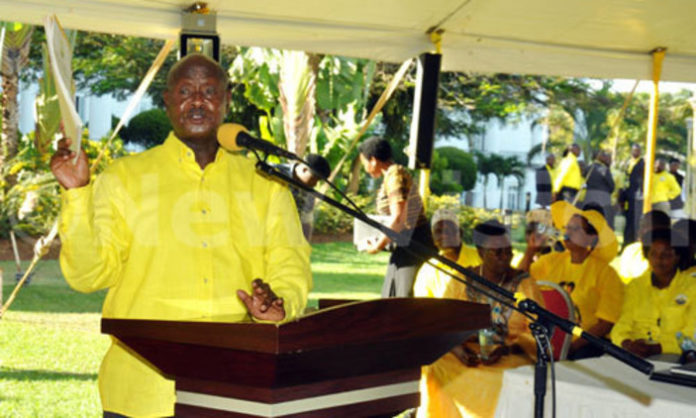
Museveni in Nebbi to drum up support for NRM flag bearers

PLEASE RETIRE: NRM party National chairman, Yoweri Kaguta. Museveni.

By Nassiwa Maria

The NRM chairperson president Yoweri Kaguta Museveni is in Nebbi municipality today in support of the NRM flag bearers in the forth coming lections slatted for July 27 2018.

Residents of Nebbi are jubilating as they wait for their party chairperson who is expected to hold a rally as he shows support for the NRM flag bearers in Nebbi municipality.

This rally is expected to be held at Nebbi primary school where residents of this region will gather to be addressed by their party chairperson president Yoweri Museveni.

These elections are for the newly created municipalities and the president is expected to address the residents of there places to drum up support for the NRM flag bearers

According to the spokesperson of NRM Rogers Mulindwa, he said the president is conducting these travels to different places to fetch up support for NRM candidate.

“The president is in Nebbi today, he is going to be in Apak tomorrow and on Sunday he will be in Mityana and this is majorly to fetch up support for the NRM flag bearers,” said mulindwa.

These elections are scheduled to usher in leaders of different posts of councilors, mayors and members of parliament. Two councilors will be voted to represent at the district level and two others that is to say the male and female councilor.

Earlier on in June 2018, the apathy of voters in Nebbi was severely affecting the NRM primary elections to choose party flag bearers for Nebbi municipality elections, as a number of voters preferred to continue with their usual gardening work.

The created municipals include Njeru in the central region, Bugiri eastern region, Kotido in Karamoja, Shema and Ibanda in Western region, Apak in Acholi and Nebbi in west Nile.

Nebbi was created and became operational in July 2016, without technical and political positions.

Stories Continues after ad

Umeme incurs Shs600m loss as Mukono vandals raid transformers for oil

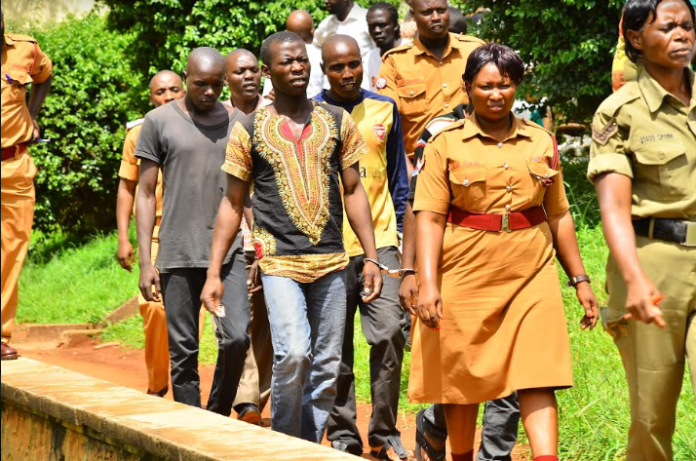
Some of the vandals arrested recently being led by police and prisons officers.

Dr. Mark Mutebi (not real name), runs a clinic in Mukono Municipality. He offers diversified laboratory services to the communities in and around that city.
All the laboratory services and other clinical records done using computers are dependent on reliable electricity supply.

Of late however, Dr. Mutebi, like many other residents in the municipality, is not a happy man after transformer vandals hit the municipality, leaving up to 18 transformers, estimated at over Sh600 million damaged.
“We are stuck. We cannot do anything, yet there are so many patients in need of our services. In business terms, we have lost so much money because of the effects of vandalism,” Dr. Mutebi said.

The rampant vandalism of transformers in that town has forced Umeme to organise a second stakeholders’ engagement workshop with the residents of the area in a move to find solutions to the vice.
The meeting held on July 20, is a follow-up of a similar one conducted in March last year. It is targeting local and political leadership and all the key security personnel.

The thieves vandalise transformers to draw out the oil for sale. The oil is said to be used in cooking and production of cosmetics, which poses danger to victims the oil is toxic. Some are vandalized for copper cables.

Sources said the appetite for fast foods and beauty products and the booming scrap business is also not helping matters.

Abbey Gwaivu, the Umeme customer service engineer for greater Kampala, said the vandals targeted copper cables in the 18 damaged transformers.
“The rest of Kampala is still safe. We are engaging the communities to take ownership of the network infrastructure by protecting the transformers,” Gwaivu said.

Umeme currently incurs costs running up to billions of shillings annually in the replacement of vandalized infrastructure.

Vandalism has also been reported by the telecommunication companies, electricity transmission company (UETCL), roads authority (UNLA) and other agencies.
In the past, a number of vital distribution transformers for the Bweyogerere Industrial Park, Namanve and Mukono have been vandalized.
Consequently, supply to Seeta, Mukono, Kalagi, Mbalala, Katosi, Nagalama, Nakifuma and surrounding areas was interrupted for long hours, while Umeme teams replaced and repaired the damage caused by the vandals.

“This is frustrating and bogging down our efforts to refurbish the network for reliable supply. The money we are spending in repairing and replacing vandalized equipment would have created a greater customer experience if it is injected in network refurbishment,” Kalist Okello, the Umeme integrity manager, said.

He appealed to the public to report those involved in power theft and vandalism to the nearest Police station or local authorities.
“We need all the public support in fighting against this vice. More often than not, most of the unplanned outages experienced by our customers are a result of acts of vandalism. Vandalism causes frustration to our legitimate customers through prolonged power outages,” he said.

Top Umeme officials have continuously said vandalism was pulling down progress in infrastructure improvement.
“Vandalism and power thefts are a national problem, which amounts to an economic crime. It causes frustration to our customers through prolonged power outages, caused by the criminals,” Selestino Babungi, the Umeme managing director, said recently, urging the government to address the underlying problem across the affected sectors through deterrent legislation.

Babungi noted that the continued theft and vandalism of the electricity infrastructure was heavily costing the sector.

On average, Umeme loses an estimated Shs100 billion annually in power theft and vandalism.
A 1 percent energy loss reduction translates into about Sh10 billion in saving.
Despite the huge loss to the economy, the current Electricity Act, 1999, is not deterrent enough to curb the vice.

Okello said that the penalties for power theft and illegal connections in Uganda range from caution, community service, to maximum of Sh2 million fine or a three-year jail sentence.
He says it is time to speak out and watch over your neighbour’s activities since they can directly impact on your electricity supply reliability, the tariffs and more importantly your safety.

“Truth is you cannot have a reliable and safe power supply or lower tariffs when your neighbours are stealing power and vandalizing the distribution infrastructure,” he says.
Vandalism is also affecting the Uganda Electricity Transmission Company, Uganda National Roads Authority, telecoms and local government councils billions of shillings.

He said that vandalism of transformers affects Umeme’s bottom-line by increasing operations costs.
“Vandalism not only increases the cost of operating the network, it frustrates our dear customers through prolonged outages. Economically, customers may not run their businesses or light their homes,” he said, adding that the bulk of transformers are imported and their vandalism negates the company’s network expansion drive as it has to replace the vandalised equipment.

Experts said Umeme currently loses close to US $2 million per annum, in vandalized network equipment.

Solutions to the problem

The company has an anti – vandalism strategy that includes use of State security services to detect and investigate the root causes of the menace. Culprits arrested in the act are brought to book.

“We are engaging the legislators to amend the laws for stiffer penalties to the culprits. We also engage the community to safeguard these assets,” Okello said.

Gwaivu disclosed that the giant utility was in the testing process for dry transformers, without copper or oil, which is a target for the vandals.
“We are also doing network modification to relocate transfers from isolated to visible public places,” he said.

Stories Continues after ad

Uganda take on Samoa in 2018 Rugby Sevens World Cup

Rugby cranes train in USA ahead of Samoa match.

Uganda Rugby Cranes will lock horns with Samoa in the Rugby sevens World Cup pre-round of 16 tie at AT&T Park in San Francisco, United States.

The global tournament is set to kick off today with Kenya facing Tonga in the first game of the preliminary round. Uganda’s game will be the fifth.

The Rugby Cranes will face England if they win. However, they will drop to the Bowl Cup if they lose to the Oceanian country. The game will be played at 12:29am Ugandan time.

Uganda lost to Samoa 27-19 in the group stages and 29-5 in the knockout of the Bowl Cup in December 2016.

Rugby Cranes qualified for the 7s World Cup in October last year during the Africa 7s championship played in Kampala. They defeated Zimbabwe in the final to retain the African title.

Eight countries; South Africa, Fiji, New Zealand, Scotland, England, Argentina, USA and Australia get a bye into the round of 16 because of their good rankings.

The tournament is in its seventh edition and will take place from 20 to 22 July.
Over 95,000 fans are expected through the turnstiles over the three days of action. New Zealand are the reigning champions.
The Uganda Rugby Cranes Squad in USA:

Coach: Tolbert Onyango
Team: Desire Ayera, Adrian Kasiito, Michael Okorach, James Odong, Solomon Okia, Justin Kimono, Phillip Wokorach, Timothy Kisiga, Aaron Ofoyrwoth, Pius Agena, Byron Oketayot and Ivan Magomu.

Pre-round of 16 fixtures:
Kenya v Tonga
Canada v Papua New Guinea
France v Jamaica
Wales v Zimbabwe
Samoa v Uganda
Russia v Hong Kong
Japan v Uruguay
Ireland v Chile

Stories Continues after ad

Bemanya, Hamilton Telecom dealt blow, Anite triumphs in deal to award Mauritius Telecom stake in UTL

Twebaze Bemanya

Ministry of Finance has presented to Cabinet two bidders from which one must be selected to invest in the liquidated Uganda Telecom (UTL), but it has turned out that the Minister Kasaija favours Mauritius Telecom over Hamilton Telecom which has been complaining of alleged unfairness in the bidding process.

The government of Uganda and UCom hold 31 per cent and 69 per cent shares respectively in UTL, which is currently administered by Twebaze Bemanya, Uganda’s Registrar General and Chief Executive Officer of the Uganda Registration Services Bureau (URSB).

A document to Cabinet has urged Bemanya to finalise the contract with Mauritius Telecom, seen to be the only credible potential partner with Government as recommended by the Financial Intelligence Authority (FIA) Executive Director Sydney Asubo.

President Museveni directed the FIA to carry out due diligence on the number of potential investors and the agency in its report, cleared Mauritius Telecom as the most credible and financially stable company to co-invest with government in UTL, much as it did not give the highest offer.

State Minister for Investment Evelyn Anite now on a study leave in the US had also held that Mauritius Telecom was the best bidder following the clearance by the FIA which analyzed the operational and financial records of all bidders.

But that decision did not go well with Hamilton Telecom and Bemanya as they accused the FIA of incompetence, bringing about the current scandal in UTL that brought about sharp differences between Bemanya and Minister Anite as the former fought to have Hamilton Telecom ahead of Mauritius Telecom.

the FIA had cautioned Cabinet against dealing with Hamilton Telecom, reporting that the company employs only 20 people and indicated an expected monthly turnover of Shs200 million, which was worsened by the fact that the company’s funds were originating from a one John Kamya but also that the company’ financial statement as well as that of Kamya were absent at the time of scrutiny.

Hamilton Telecom Limited, was incorporated in Uganda on August, 2016, with objectives of providing communication services, satellite services and cellular internet, among others
“It is therefore our opinion that it is risky for government to engage this company as a strategic investor,” read part of the FIA report, adding that the company lacks the financial capacity to be a meaningful strategic partner to government of Uganda.

However, in case Mauritius Telecom opts out, the ministry said it would consider Hamilton Telecom on grounds that it acquires UTL in a short period of time.

The company would have to make a non-refundable deposit of 10 percent of the offer within seven days of the date of the offer and a requirement to sign the agreement and to pay the balance of the proposed amount within further seven days. The company had made an offer of US $70 million (about Shs25.9 billion) in assets with capital investment of US$285 million (about Shs1.055 trillion) in three years.

Mauritius Telecom’s asset consideration is US$45 million (about Shs166.5 billion) and plans to invest $100 million (about Shs370 billion) in three years.
As it sources for the new investor, government plans to extend UTL’s license for 20 years, expand its frequency bandwidth to cover the whole country and give tax waivers on import duty for equipment, Corporate Tax, VAT and Excise duty on services for the initial of four years.

Government also wants UTL to become the sole provider of ICT services to Government and have access and use of the National Backbone Infrastructure.

That would be boosted by a starting customer base of 400,000 government employees who have been directed to install UTL lines.
Kenya’s giant telecom-Safaricom, which had shown interest in partnering with Afrinet Communications Limited, withdrew its interest.

As a result Afrinet Communications Ltd which had offered the second best purchase price of US$ $67 million (about 247.9 billion) has confirmed their withdraw, leaving Mauritius Telecom and Mauritius Telecom in the battle to the up the majority stake in UTL.
Government needs an investor who pays off UTL’s creditors. But no investor has offered US $80 (about Shs296 billion) required to take over majority shares.

Bemanya meanwhile proposes that government selects the best three potential partners and entice them to increase their offers. However given FIA’s recommendation that Hamilton Telecom is not financial vibrant, it would be difficult for the company to raise the offer and be accepted.

But the ministry stresses that for any agreement concluded in view of government incentives, the Attorney General approve it; and the Administrator must obtain proof of availability of funds from a reputable bank before making an offer to any partner.
Other firms.

Telecel Global, a company incorporated in Lebanon but with other offices in South Africa, United Kingdom and the Dominican Republic, the FIA reported that it had not seen financial records to facilitate assessment of its financial strength much as there were no reports of involvement in money laundering and terrorism.

Afrinet Kenya Limited, Bayliss Consortium, and Neubacher Montage LLP were also bypassed by the FIA after failing to access information on their operations including audited financial statements.
FIA’s investigations revealed that Teleology Holdings Limited is a private equity firm incorporated in Gibraltar with 12 international and eight Nigerian shareholders.

But the the company was disqualified because it was in the process of acquiring 9mobile, one of the major telecommunications companies in Nigeria, which is also has to repay a loan of US $1.2 billion that it obtained from 13 different banks.

Stories Continues after ad

Secrets that forests have been keeping from you

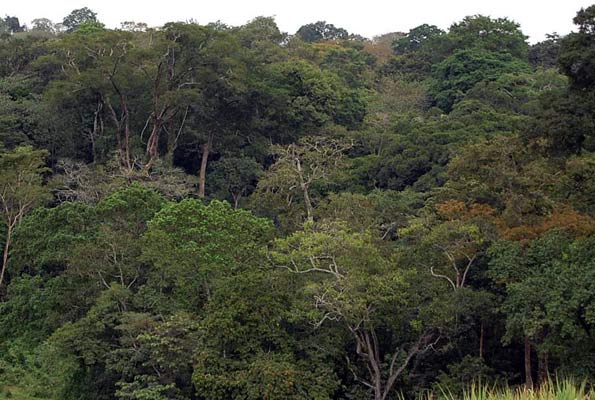
Mabira Forest

The world’s forests have secrets that you may not be aware of. They are to be found in supermarkets, water fountain. Discover as you read on. That’s the thing about forests. They keep secrets.

For too long we have seen trees as purely functional or ornamental, objects in the backdrop or on the sideline. They decorate city streets. They give us shady spots for resting and relief from the sun. They provide us with paper and fuel, fruit and nuts. These benefits are fairly obvious.

However, some of their other benefits are almost invisible to the naked eye. Forests are quietly working in the background, secretly cleaning our water, filtering our air and protecting us from climate change. They are guardian angels for more than a billion people, providing food, medicine and fuel to those who might not have access to these resources from anywhere else. They house more than three-quarters of the world’s terrestrial biodiversity and are homes to many of the world’s poorest people.

Forests play a key role in our lives that we don’t even recognize. Here are 7 ways how and some of their best kept secrets:

Supermarkets – More than the occasional apple or orange that we pluck from a tree, forests are veritable food markets. Almost 50 per cent of the fruit we eat comes from trees, not to mention the nuts and spices that we also get from these food baskets.

Life insurance – Some communities rely almost exclusively on forests for their food sources. Around 40 per cent of the extreme rural poor – around 250 million people – live in forest and savannah areas. For these communities, vibrant forests and trees are their lifeline and insurance against hunger.

Water Fountain- Forests provide a large part of the drinking water for over 1/3 of the world’s largest cities including New York and Mumbai. Many rivers and streams have their sources in forests. Trees act as filters and provide us with the clean water that is vital for life.

Energy – Around one-third of the world’s population use wood as their source of energy for necessities such as cooking, boiling water and heating. Wood from forests supply about 40 per cent of global renewable energy – as much as solar, hydroelectric and wind power combined. Trees grow back, but we need to place more emphasis on using these resources sustainably to protect our forests from degradation.

Superhero- Forests and trees may look inconspicuous like Clark Kent, but they are like Superman in many ways. They are our heroes in the fight against climate change. They make our cities more sustainable by naturally cooling the air and removing pollutants. They safeguard our health by giving us places to retreat to and relax in. They tackle land degradation and stand up against biodiversity loss by providing plant and animal life with habitats.

Carbon sinks – As a force for good, our forest superheroes act as carbon sinks, absorbing the equivalent of roughly 2 billion tonnes of carbon dioxide each year. Like any superhero though, they have a flaw. Deforestation is their kryptonite. When trees are cut down, they release this carbon dioxide back into the air. Deforestation is, in fact, the second-leading cause of climate change after burning fossil fuels. It accounts for nearly 20 per cent of all greenhouse gas emissions — more than the world’s entire transport sector.

Recreation – Trees are stress relievers. Nature-based tourism is growing three times faster than the tourism industry as a whole and now accounts for approximately 20 per cent of the global market. Studies even link green spaces and tree cover in cities to reduced levels of obesity and crime. As one example, the obesity rate of children living in areas with good access to green spaces is lower than in those who have limited or no access at all.

Forests have been our quiet helpers. They have been secretly playing a bigger role in our day-to-day lives than we realize. We cannot lead the healthy, productive lives that we would otherwise without them and we cannot hope to have a ZeroHunger world without enlisting their help, the help of the governments, agencies and bodies that protect them and your help in respecting them.

Share these messages with friends and think about the part they play in your life. Forests and trees should get some recognition too. It is time to spill their secrets

Stories Continues after ad

Gov’t to carry out country wide vaccination against cholera

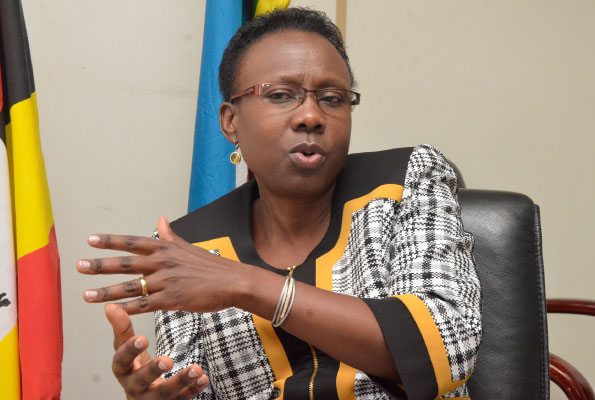
Health Minister, Dr.Ruth Aceng making a point during a past. presentation. She is reported to be against the idea by government to have companies process Marijuana here.

The Minister of Health, Dr. Jane Ruth Acheng says government will carry out country wide vaccination against cholera a disease that is brought about by poor sanitation.

The development of oral cholera vaccination come in awake of sporadic cholera outbreak in areas of Kyotera and Bulambuli districts.

The minister who was reacting to concerns that were raised by legislator said, that the exercise will start from eight districts of Bulambuli, Kampala, Wakiso, and Jinja among others. She said that the vaccines will soon be availed and distributed to the rest of the districts in the country.

She noted that cholera vaccine has already been administered to refugees because over allegations that were affected by the disease at the time they entered the country. She implored residents in cholera prone districts to maintain good hygiene for curbing of the disease.

Earlier Kyotera district MP Robinah Ssentongo remarked that the outbreak of the epidemic has been worsened by absence of health services in the district. She revealed that most affected area is Nongoma village where residents have to cross to Tanzania for health services.

“I have received reports that two children have died of cholera related symptoms and several others are suffering. Unfortunately, the Health Centre II has no medication,” said Ssentongo.

Bulambuli County MP Alex Burundo said one person died of cholera and 20 people have been affected in Bulambuli district, “We need government to increase the water sources in Bulambuli district and ensure the water is disinfected,” he added.

Stories Continues after ad
Job scam: Man remanded for conning Shs 212million

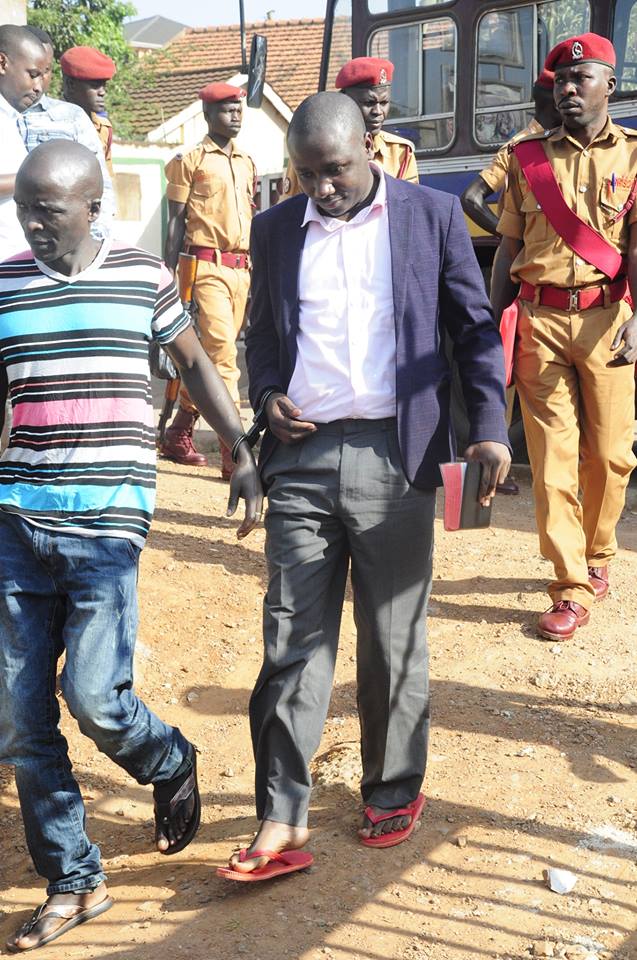
The proprietor of Miracle Recruitment Services International Limited, Ayebazibwe Everest(in suit) being escorted to a waiting prison bus

The proprietor of Miracle Recruitment Services International Limited, Ayebazibwe Everest has been remanded to Luzira prison over allegations of conning Shs212million from people promising jobs abroad.

Appearing before Law Development Centre (LDC) magistrates Court, Everest was charged with obtaining money by false pretense C/s 305 of Penal Code Act and operating a recruitment agency without a license C/s 38(1) of Employment Act of 2006, Regulation of 4 & 85(a) of Employment (Recruitment of Uganda Migrant Workers Abroad) Regulations 2005.

The suspect was first charged on 6th July 2018 of 25 counts, convicted and sentenced to three years imprisonment.

The investigating officer told the magistrate that several complainants have come forward and that the police are taking their statements with a view of laying additional charges.

Amendment of the file comes after 70 reports of obtaining money by false pretenses were registered at Old Kampala Police Station vide CRB.628/2018The suspect recruited several people, claiming that he could link them to the in charge of a Canadian employment Programme

Victims told court that the suspect has set standard charges basing on the country where you want to work from. Witness said in one was required to pay Ushs10 million to work in Canada, Qatar Shs4.5m, Dubai Shs5m and Sharjah, United Arab Emirates Shs5m.

Stories Continues after ad
Ugandan appointed Comesa director of human resources

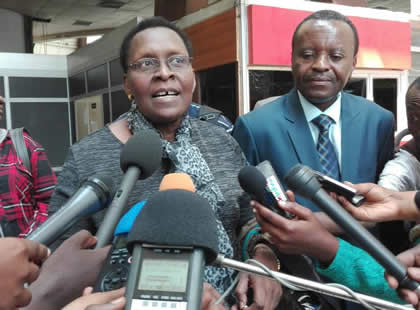
Internet Photo: Marth Elimu speaking to the press at a past function.

Ugandan Ms Martha Elimu is the new Director Human Resource and Administration at the Common Market for Eastern and Southern Africa (COMESA) Secretariat in Lusaka Zambia.

Ms Elimu was formally Chief of Human Resources and Management Services at the same institution.Before Ms Elimu joined COMESA, she head of HR at Monitor Publications Limited/Nation Media Group (NMG), Uganda.

Ms Elimu was appointed as Comesa heads of state summit 2018 on Wednesday elected its first woman secretary-general, Zambian Chileshe Kapwepwe, a former alternate director at the IMF, She replaces Sindiso Ngwenya, who worked at the regional body for 34 years in various capacities.

At the time of her appointment, Ms Kapwepwe was serving as chairperson of the Zambia Revenue Authority (ZRA).

The new changes come at the time when membership of Comesa has risen to 20 following the admission of Tunisia as a member of the regional bloc at the ongoing Summit of the COMESA Heads of State and Government. Tunisia was admitted after having fulfilled the COMESA terms and conditions of accession to the COMESA Treaty.

Tunisia first applied for observer status in COMESA in 2005 but the matter was not concluded. In February 2016, the country formally wrote to the Secretary General making enquiries on joining.

Meanwhile Comesa has adopted internship programme whereby graduates from tertiary institutions in the COMESA region are now expected to be absorbed into employment much faster following the adoption of a Youth Internship Volunteer Programme.

The Programme, which was adopted by the 38th meeting of Council of Ministers held from 14 -15 July 2018 in Lusaka, Zambia, seeks to increase youth employment, particularly for young women and men graduates who join the labour market every year. It was developed in collaboration with the United Nations Volunteers.

The Council meeting was attended by Ministers and their representatives from Congo DR; Egypt; Eritrea; Ethiopia; Eswatini; Kenya; Libya; Madagascar; Malawi; Mauritius; Rwanda; Seychelles; Sudan; Uganda; Zambia; and, Zimbabwe.

The Youth Internship and Volunteers program is expected to raise youth employability through practical skills. It is also expected to provide job opportunities (in key economic sectors) through the provision of information and facilitation of networks and resolve the mismatch between labour market demands and the supply of qualified personnel from institutions of higher education.

According to the United Nations, 226 million youth aged 15-24 lived in Africa in 2015 representing almost 20 per cent of the continent’s population. This represents one-fifth of the world’s youth population. It presents a huge opportunity for the program to empower the continent’s youthful population and enhance their contribution towards economic development.

In its decision, the Council urged Member States, through Ministries responsible for youth, to facilitate the implementation of the Youth Internship and Volunteer Program. In line with chapter 25 of the COMESA Treaty, which focuses on development and utilisation of human resources, the newly adopted program will include among other aspects, training and skills development of the youth.

The Programme will be piloted in four countries: Comoros, Egypt, Ethiopia, and Zambia, before replication to other member States and secretariat has been directed to engage more development partners to support the program to enable coverage of more Member States.

Stories Continues after ad
What next for distressed banks like DFCU now that BoU won’t give them loans?

dfcu bank

The Bank of Uganda Governor Prof. Emmanuel Tumusiime-Mutebile while addressing delegates at the Annual Uganda Bankers’ Conference on July 17 in Kampala, categorically stated that his bank will not give loans to distressed commercial banks in the country.

“The BoU has no obligation to bail out a distressed bank by providing it with liquidity support, in the hope that it will somehow be restored to financial health. Such an option would be extremely dangerous,” he said. That warning did not go well with some bankers who were hoping to rush to the central bank for rescue. They will now have to look elsewhere for bailout.

As Mutebile was delivering his speech, Uganda’s Prime Minister Dr Ruhakana Rugunda and the Minister of Finance Matia Kasaija were so attentive because government wants commercial banks that are financially stable. This is so because stable banks boost the economy by lending to the private sector and government. On the other hand, distressed banks can end up costing government and impacting negatively on the economy as they have no ready cash to lend to borrowers.

Before Mutebile gave his address, Patrick Mweheire, the CEO of Stanbic Bank and Chairman of Uganda Bankers Association (UBA), had in his earlier speech hinted that about six commercial banks of the 24 under the supervision of BoU were loss making, something he said was of a great concern. That means such banks are distressed as their debtors are not making payments on their debts; hence the banks are losing money for future business.

Mweheire also cried out that commercial banks in Uganda are not being helped by courts of law as they take a long time than to dispose of the civil suits. And that this impacts negatively on their investments such as limiting on their liquidity and growth of their loan portfolio.

In Uganda, most of the court cases involving banks arise of debtors failing to pay back the loans as agreed. However some banks are careless when giving out loans especially to tricky borrowers who exploit the loopholes. Other losses are a result of syndicates between borrowers and the staff in the banks.

But the governor in his statement pointed out that mismanagement of the money leads to the situation of distressed banks. And he sees no value in giving a mismanaged bank a bailout which could create losses at the taxpayers’ expense.

Question is whether Mutebile is watching such distressed banks and whether he intends to close them to save depositors money which he said s one of the major considerations for the closure of any bank. He mentioned he closed five such banks at different periods. Those included National Bank of Commerce, Greenland Bank and recently Crane Bank among others.

But as that happens, DFCU, a major commercial bank that acquired the other in January 2017 is in a liquidity crisis even as it earned in excess of Shs20 billion as net profit that year. Insiders say that bank was recently denied a loan request from BoU, a proof that the local banking industry is weak. That could explain why that bank failed to reach out to fellow banks but instead wanted BoU to loan it taxpayers’ money at a cheap rate.

That bank is in the situation where major shareholders want to exit and top managers resigning as well as high deposit withdrawals. It appears shareholders want to share the profit and go instead of ploughing back some of the proceeds. It would be illogical therefore for BoU to give such a bank a loan which comes with a low interest rate compared to that obtained from a fellow commercial bank. That bank was aware of that difference before tempting BoU.

We are now waiting to see if BoU will act to wipe out distressed banks in the industry like it has done in the past. A distressed bank is as good a failed bank and one of the measures to arrest the situation is to sell them, merge them or sell its assets, transfer its liabilities or liquidate them.

This is what some of the defunct banks went through as BoU erased them from the local banking industry. However, on the recommendation of parliament, BoU is being investigated by the Auditor General for selling and liquidating some of the banks without writing any report.

Stories Continues after ad