Stanbic Bank
Stanbic Bank
20.2 C
Kampala
Stanbic Bank
Stanbic Bank
Home Blog Page 1538

Ugandan Kabeho hands over leadership of regional business body

Ugandan Jim Kabeho who has been Chairman of the East African Business Council (EABC) has handed over the office to his successor, Kenyan Nicholas Nesbitt for the period 2018/19.

Kabeho handed over the office during the 19th Annual General Meeting (AGM). Mr. Nesbitt is also the Chairman of Kenya Private Sector Alliance (KEPSA) and General Manager Eastern Africa, IBM East Africa Limited.

In his remarks, Kabeho lauded the EABC Secretariat for the good work that has been done in the year under review and congratulated the incoming board of directors, urging them to continue the ongoing initiatives of the EAC Integration process.

Kabeho pledged to support his successor and the new team as they seek solutions to the challenges that face the private sector in the region.
In his acceptance speech, Nesbitt reiterated the need to increase competitiveness of East African companies and SMEs to compete at continental as well as international level.

“Let’s focus on competitiveness of our businesses to sell our goods at regional, continental, and international scale,” he said.
He urged for close collaboration with the governments of the EAC Partners States and called for the government to improve the business environment support the operations of the Private Sector to thrive.

The new chair also called for improvement of technological infrastructure to fast track free movement of goods and services in the region.
He further appreciated efforts by the former chair Mr. Jim Kabeho in steering the work done in the year 2017 together with the Executive Committee.

He urged private sector players in the region to use technology in service delivery. “Adopt technology such as block chain to solve regional challenges like counterfeits and contrabands,” he said.
“Adopt technology such as block chain to solve regional challenges like counterfeits and contrabands” said Mr. Nicholas Nesbitt, new EABC Chairperson.

Dr. Manu Chandaria, EABC Founding Chairperson in his remarks during the meeting urged the Private Sector to be committed in the EAC Integration and spearhead for full inclusion of EABC in the EAC as a constituent member of the EAC Integration process.

“As the Private Sector our interest should be one East Africa and not our country,” he said, calling for the strengthened private sector advocacy efforts at regional level.

The event also saw the appointment of vice Chairs and Members of the EABC Executive Committee who strategically guide EABC’s mission to promote sustainable Private Sector driven growth.

The (AGM is the supreme policy making organ of the EABC. The AGM meets once a year to elect the Executive Committee headed by the Chairperson, receive annual report on the initiatives undertaken by the Secretariat and give overall direction to the Secretariat in line with the Strategic Plan and interests of the business community in East Africa.

The EABC Board of Directors consists of 22 members, headed by a Chairperson, elected from the Partner States on an annual rotational basis. Each country nominates four Members to the Executive Committee.
During the 19th EABC Annual General Meeting, EABC also honored outgoing board directors for their distinguished service to the council.

Stories Continues after ad

Kampala businessman sues Standard Chartered Bank’s top officials for ‘inflated loan’

Kampala businessman Habib Kagimu has sued the Chief Executive Officer of Standard Chartered Bank Chief Executive Officer, Albert Saltson and other two top officials Winnie Ojambo and Julius Baluku who heads collections department at the bank.

The Buganda Road Magistrate has issued summons asking the three bank officials to appear at the court on July 5, 2018 without fail to defend themselves against the allegations of inflating a loan and denying the businessman information regarding his company’s dollar account. Kagimu and his company Habib Oil Ltd are represented by Muwema and Company Advocates.

The three are accused under case No.2668 of 2018. The trio is also accused of insisting to sell off Kagimu prime properties for allegedly failing to pay back a loan the businessman says it is inflated.

Habib Oil Limited. is challenging the bank’s claims in the High Court, accusing the bank of inflating the loan figures. The case is HCCNo.662/2016. Kagimu operates a US dollar account No.870401296700 with the bank at Speke Road Branch for the last seven years.

The company is also disputing unexplained debt entries that were made on August 2016 of US $3.8 million and on October 31, 2016 of US $ 394,651.57. The complainant wants the actual interest rate applicable to the loan for the whole facility period be disclosed. It also wants the bank to give it bank statements from January 2013 to June 2016.

Kagimu’s lawyers argue that the trio have used their influence at the bank to deny their auditors access to information so that they audit all the transactions on the company’s dollar account held in the bank. On May 29, 2018, Habib Oil Limited., through its lawyers and auditors asked for information and clarification regarding the inflated amount the bank said it was outstanding on the company’s balance sheet.

Kagimu says that the bank’s refusal to grant information to him and his auditors has caused ‘substantial damage and injury’ to him.
Kagimu is also suspicious of the transaction that took place on the company’s account three years preceding 2016. That was worsened when he read in the media recently that Standard Chartered Bank was advertising his assets he offered as security to obtain the said loan.

“…it been a month now and the Bank has denied the Complainant access to its financial data…as sought above and yet is seeking to sell the complainants’ securities for alleged non-payment of loan amounts, it has concealed on its computer system.,” the company’s lawyers say in a letter dated June 28, 2018.

Stories Continues after ad

UK gives heavy machinery to Amisom

UK Ambassador to Somalia, David Concar (in suit) with Amisom top military officer

The United Kingdom has donated heavy equipment worth 5.6 million pounds to the African Union Mission in Somalia (AMISOM) to help in clearing main supply routes as the force steps up the condition-based transition process.

The equipment which includes tractor trucks, bulldozers, backhoe and front end loaders, forklifts and module dump tipper among others will be used in sectors one, two and five together with the Mission Enabling Unit based in Mogadishu.

While handing over the equipment, on Saturday, the United Kingdom Ambassador to Somalia, David Concar, said his government was proud to be associated with AMISOM in its efforts to stabilize Somalia and help secure lasting peace and security.

“What we are doing today, transferring 5.6m pounds worth of equipment is, we hope, going to make a real difference to the ability of AMISOM to clear roads, supply routes and to press ahead with stabilizing Somalia and working in partnership with Somalia’s own forces as they get stronger,” United Kingdom Ambassador to Somalia said.

Mr. Concar thanked the peacekeeping force together with the troop contributing countries for the sacrifice they have made to ensure stability in Somalia.

“We thank you AMISOM for everything you have done and the troop contributing countries and above all the troops who are out there in these dangerous environments often paying for the stability and progress we have seen with the ultimate sacrifice,” the UK Ambassador added.

Receiving the 49 heavy machinery equipment, AMISOM Force Commander, Lt Gen Jim Beesigye Owoyesigire, said the equipment will come in handy in the current period when the force is determined to kick out Al-Shabaab from the key areas they still occupy.

“We thank the government of UK for supporting us with these force enablers,” Lt. Gen. Owoyesigire said.

Sector One Commander, Brigadier Paul Lokech, who received 14 of the machines donated pledged to use the equipment wisely to make the transition process a success.

“We know with this equipment, we can improve our operations capability and also it will help us, jointly with the Somalis, meet the requirement of phase one of our transition,” Brigadier Lokech said.

Besides sector one, 12 machines will be donated to Sector two, Sector five (12) and Mission Enabling Unit (11).

Last year, the UN Security Council approved the gradual reduction of AMISOM troops and transfer of security responsibilities to Somali national security forces.

Stories Continues after ad

Five principles for driving revenue, not just user count

Martin Zwilling

By Martin Zwiling

Some analysts argue that revenue drives growth, while others say user growth drives revenue. Both have worked. Google reached $1B in revenue within five years of incorporation, and now has a market capitalization of over U$800b. Twitter showed no focus on revenue in the first five years, but was able to parlay 500M users into a US$25b public company, now growing revenue.

Every startup dreams of achieving that milestone, when they can focus more on scaling the business and enjoying their earnings, rather than fighting for another investment infusion. Most are still confused about the right priority. Should they focus on increasing revenues and profitability, or entice more and more users with “free” services, to increase their valuation.

Traditionally, it was simple. A business only achieved critical mass by becoming cash-flow positive. Revenue growth (top line) then had to be converted into profit growth (bottom line), before a business was deemed to be self-sustaining and worthy of public investment.

It’s only been in the last decade or two, that social media companies, like Facebook and Twitter, have achieved market valuations in billions of dollars (unicorn status), while clearly sacrificing revenue to gain users. In my view, the pendulum is swinging back, with investors looking more for the traditional indications of business integrity, stability, and growth:

Some element of organic growth is a good thing. The purest form of capitalism has always meant charging a fair price and making a fair profit. Re-investing profits to grow the business is organic growth. The concept of free goods and services to get you hooked, financed by deep pockets, or advertising, seems marginally ethical to many.

Long-term stability requires revenue growth and profit. Most modern investors still look for a business model that embodies a gross margin over 50%, and a net margin in the 20% range. A healthy business, ready to scale, has been doing this for a year or more, with an existing customer set generating a non-trivial and growing revenue stream.

High customer loyalty and high team passion. Startup productivity is embodied in key ratios, including low cost of customer acquisition, high retention, and high revenue per employee. High customer churn and lackluster team members are still indicators of a high-risk investment opportunity, to be avoided by both public and private investors.

Growing appreciation for the value of the solution provided. These days, you need customer evangelists who see the value and will pull in their friends through viral actions to keep the business growing. Too many of the high user growth startups have been fads, and numbers can go down as fast as they go up, as per Friendster and MySpace.

Understanding competitive early mover requirements. First movers in a new space need users more than revenue to maintain market share, so investment pitches need to highlight this priority in requests for funding resources. More complex and defensible businesses should highlight their organic drive to profitability and brand leadership.

Unfortunately, the Internet and heavily funded startups have nurtured a customer expectation of free web services and free smartphone apps. In these domains, it is now difficult to monetize at all until you have a large critical mass of users. In these cases, growth scaling is important, both before and after revenue flow begins. The business plan must reflect both growth phases.

Thus even after a startup has achieved a critical mass of users, the expectation of long-term revenue growth and profitability does not go away. Twitter is facing this challenge right now, as the large majority of public investors expect a near-term financial return on their investment, every quarter of every year.

So a higher focus on user growth may be necessary early, but is never sufficient. If you are in it for the long run, don’t forget the basic business principle that if you lose money on every customer, you can’t make it up in volume.

The Writer is a veteran startup mentor, executive, blogger, author, tech professional, and Angel investor. Published on Forbes, Entrepreneur, Inc.

Stories Continues after ad

Africa fashion designers meet to strategize for prosperity

Fashion designers in a group discussion

The third Fashionomics Africa Masterclass for textile, apparel and accessories entrepreneurs, tomorrow’s designers and startups over the weekend met in South Africa in a workshop organised by the African Development Bank (ADB) in partnership with Google Digital Skills for Africa, Nesta, Parsons School of Fashion and African Fashion International.

The class provided the tools and know-how to build a fashion brand from an idea to its execution. Nearly two-thirds of the 170 participants were women. Experts and industry insiders gave presentations and took questions on how to run a business, digital marketing, branding, online commerce, high-quality manufacturing and networking.

Presenters included South Africa’s Department of Trade and Industry; South Africa’s Department of Small Business Development; the UK-based global innovation foundation, Nesta; Google Digital Skills for Africa; Parsons School of Fashion and SiMODiSA, a Johannesburg-based industry association whose mission is to accelerate entrepreneurship by collaborating with policy makers.

Organizers carried out a needs assessment survey for sector entrepreneurs and promoted and enhanced content for the online platform. Stronger public and private stakeholder strategic partnerships included a new collaboration on knowledge sharing between New York-based Parsons School of Fashion and the African Development Bank

“With Fashionomics Africa, the Bank and its partners are looking at this sector through a value chain approach from cotton production to retail stores to see how a “Made in Africa” brand, can contribute to our economies,” said Vanessa Moungar, Director of the Bank’s Gender Women and Civil Society Department. She added, “Given the right investment and access to training and resources, African textile, apparel and accessories entrepreneurs can compete on the regional and global stage, we believe.”

Stefan Muller, the Bank’s Lead Country Coordinator in South Africa pointed out, “Our institution has been undertaking initiatives to create an enabling environment for youth employment and entrepreneurship, including the Jobs for Youth in Africa Strategy, which is designed to create 25 million jobs and positively impact about 50 million youth over the next decade. We know that manufacturing, services and agriculture hold the greatest potential to create these much-needed jobs. But we also need to look at emerging sectors and opportunities arising from new activities and economies.”

Director Moungar concluded, saying, “This is the right time to support these fashion and textile sectors that yield not only economic benefits but also contribute to the development of our shared cultural identities. We must showcase positive perceptions of African traditions internationally. Together we will demonstrate that Africa is not just a source for labor, it is a source of creativity and innovation. It is time to scale up Africa’s creative entrepreneurial talent, ensuring equal access to opportunities for women and men.”

Fashionomics Africa supports African textiles and fashion by building the capacities of micro, small and medium-sized enterprises in the textile and clothing sector, especially women and youth. It is aligned with the Bank’s High 5 strategic priorities, especially Industrialize Africa, Improve the lives of African people, and the Jobs for Youth in Africa strategy.

Stories Continues after ad

We are investigating Justine Bagyenda- IGG insists

Embattled former Executive Director in charge of Supervision at Bank of Uganda Justine Bagyenda.

The Inspectorate of Government has in the press release confirmed that it is investigating the former director of supervision at the Bank of Uganda, Justine Bagyenda who is alleged to have accumulated too much wealth through corruption.

Ms Bagyenda was sacked by her former boss, the BOU Governor Prof. Emmanuel Tumusiime Mutebile in February even as her official retirement was due this month of June. Mutebile has never given reasons as to why he sacked Ms Bagyenda.

Regarding investigation of Ms Bagyenda’s wealth, the office of the Inspector General of Government (IGG) says in a press release of June 29, 2018: “This is to inform you that the inspectorate is conducting investigations on allegation of wealth of Justine Bagyenda, and when we complete these investigations, the report will be shared with relevant authorities only.”

Meanwhile, the same office says it is investigating recruitment at the Uganda Investment Authority (UIA) whose Executive Director. Jolly Kaguhangire was days ago sacked by the board on allegations of nepotism, corruption and incompetence.

The press release says the report of the investigations at UIA will also be shared with relevant authorities, adding that the IGG Irene Mulyagonja has not met Ms Kaguhangire in person since her sacking that has turned controversial.

Stories Continues after ad

NRM SG Lumumba congratulates Butebo’s LCV chairman Keddi

The National Resistance Movement party flag bearer in the Butebo initial district LCV chairman elections, Samuel Keddi has casting his vote

The ruling National Resistance Movement Secretary General Justine Kasule Lumumba has congratulated her party’s flag bearer, Samuel Keddi upon his victory as chairman elect for the new district of Butebo.

Curved from the traditional Pallisa district, Butebo went to polls yesterday to have their first district LC V chairman. The race had two candidates; winner, Keddi and an NRM leaning independent candidate James Okurut.

Keddi polled 17,554 (64.2 per cent) votes against Okurut’s 9765 (35.7 per cent).

“I congratulate the people of Butebo for the ‘peaceful and focused electoral exercise,” the NRM communications officer, Rogers Mulindwa quotes Lumumba as saying.

Lumumba also applauded the party national chairman, Yoweri Museveni for his support to the NRM flag bearer.

Museveni was on Monday in Butebo district where he taught voters at a rally the benefits of voting for NRM.

“Thumbs up for the party chairman, Central Executive Committee members and the local leaders for the combined efforts that have yielded results,” she said.

Butebo becomes the 10th LCV seat of newly created districts NRM has won since July 2016. The other nine include Kakumiro, Kagadi, Rukiga, Rubanda, Bunyangabo, Pakwach, Namisindwa, Kalungu and Kyotera. The ruling party only lost in Omoro but to an NRM leaning independent candidate.

Stories Continues after ad

Freed terrorism suspects to sue DPP for wrongful detention

DPP Justice Mike Chibita

The Director of Public Prosecutions (DPP), Mike Chibita, could soon be aligned in court to defend himself against four former terrorism and murder suspects who intend to sue him personally for wrongful detention.

The four suspects have written to Chibita, claiming they were wrongly arrested and detained on terrorism, murder and other charges without evidence pinning them to the crimes including the killing of Muslim sheikhs Mustafa Babiga and Hassan Kirya.

They are represented by their lawyer Fred Muwema of Muwema and Company Advocates who wrote to the DDP on June 29, 2018 of the intention to sue the official personally in courts of law. The four are; Yusuf Sentamu Kasibante, Muhamadi Kalodo Kasibante, Ismail Sentongo and Musa Isa Mubiru.

Yusuf Sentamu Kasibante, Muhamadi Kalodo Kasibante were arrested in Deira Dubai by Dubai police officers on allegations of terrorism, crimes against humanity, two murder cases, attempted murder and aiding support to ADF rebels and associates in Nalukolongo, central, eastern and northern parts of Uganda between February 2014 and January 2015.

The two are accused of murdering Sheikh Mustafa Bahiga on December 28 3, 2014 and Sheikh Hassan Kirya on June 30, 2015, respectively. Sheikh Bahiga was gunned in Bwebajja in Wakiso district while Sheikh Kirya was gunned in Bweyogerere also in Wakiso district.

The duo is also accused of attempting to kill Sheikh Dr. Haruna Kirya on January 3, 2015 at Wattuba Mutugga in Wakiso district.
On the other hand Musa Isa Mubiru was arrested at Dubai International Airport on January 3, 2016 while on a business trip whereas Ismail Sentongo, who was a resident in Dubai, was arrested on December 6, 2015. The victims claim no evidence was availed to the Chief Prosecutor of Dubai Court Ismail Al-madan by the Uganda police operatives who were following up the matter in Dubai.

According to their lawyer Muwema: “The quadruplet was held in confinement in Dubai and subsequently charged in Uganda for the above alleged crimes.”

The former suspects claim they were abducted from Dubai by unknown persons who flew them to Abdu Dhabi where they were confronted by Uganda police officers namely; SSP Nickson Agasirwe Karuhanga and ASP Fred Tumuhairwe who “advised them to cooperate if they cared about their lives and freedom.”

Their lawyer Muwema has given the DPP seven days to respond or else the case will end up in court. Muwema claims his clients want the DPP to be held personally liable for what they say untold pain, suffering, loss and damage they have encountered during and after their illegal arrest, detention and sham trials.

Muwema has copied the letter of intention to sue to the Ambassador of UAE to Uganda, president of Uganda Law Society and the Chairman of Uganda Human Rights Commission.

Stories Continues after ad

NRM wins initial Butebo district LC V election

NRM Secretary General Justin Kasule Lumumba

National Resistance Movement (NRM) candidate, Samuel Keddi has this monring been declared a winner in the new Butebo district LC V chairman elections held on Thursday.

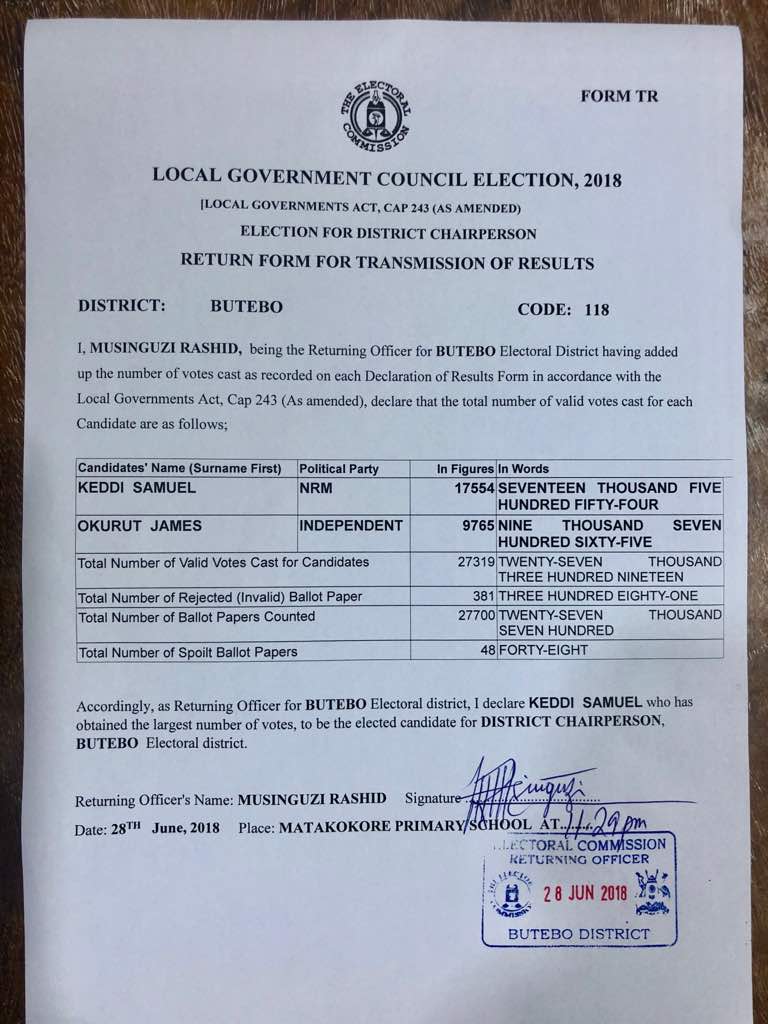
The district returning officer, Rashid Musinguzi declared Keddi with 17,555 votes beating his only opponent; the NRM leaning independent candidate, James Okurut who got 9765 votes.

By midnight when the declaration was made hundreds of Keddi’s supporters had already gathered at his home in celebrations and others held similar celebrations in differents trading centres of the new district.

The NRM national Deputy Treasurer, Dr Kenneth Omona accompanied by the NRM communication officer, Mr Rogers Mulindwa, and other party members expressed joy and most of their candidates standing on different levels won the elections

Omona applauded the people of Butebo district for entrusting NRM with that opportunity to serve them.

He said with voting NRM flager bearers, voters are assured of benefiting government program as there will be no friction between the implementers and the centre.

“Butebo being a young district, needs leaders who are determined to unify and promote development and as well promote NRM activities to make it more popular,” he said.

The Electoral Commission declaration form for Butebo

The Electoral Commission officer in charge Eastern Region, James Peter Emoru, applauded the voters and the candidates who participated in the election exercise for being calm and cooperative unlike in other previous elections.

“The elections were entirely peaceful with no major incidences and this would be attributed to the efforts done by the police. The security agencies did us a tremendous job to respond quickly to any emerging chaos,” Emoru said.

Addresing his voters at his home this morning, Keddi, pledged to unite the people of Butebo because a divided district cannot make us prosper in terms of service delivery.

“It is very important for us to be united. I therefore call upon my colleague Mr Okurut to come on board and we steer the district to a greater height because operating on divided ground will not take us anywhere,” he said.

Kedi pledged to ensure improved service delivery and more on the poor state of the road.

“Our roads have become impassable but since people have entrusted and elected me into that office definitely I will not disappoint them. What they want is better service,” he said.

Butebo was curved from the traditional Pallisa district.

Stories Continues after ad

Seven steps to building a highly engaged new venture team

Martin Zwilling

By Martin Zwilling

Entrepreneurs need to be effective team leaders, since no one can transform an idea into a product and a business without some help. Unfortunately many founders I work with as a mentor are experts on the technical side, but have no insight into leading a team. But fortunately, team building is a skill that can be learned and practiced, for those willing to put in some effort.

The only real alternative is to find a co-founder who can build and lead the team, while you focus on the product. Otherwise, in my experience, the startup will fail. The importance and the specifics of practical team leadership were re-confirmed to me recently in the classic book, “Unlocked,” by Robert S. Murray, who is a recognized expert in the field of business leadership.

I recommend his checklist as a starting point for developing team connections and building engaged team members as a key step in becoming an effective team leader, even if your team is spread all over the country:

Consciously reduce time spent on outside activities. You won’t be viewed as the team leader if you spend most of your time on activities that are not relevant to your team. Being visible and engaged on a random part-time basis, due to other jobs, won’t do it. If your team has trouble finding you, you won’t make productive connections.

Be compulsive about scheduling time for your team. Even busy entrepreneurs need to schedule regular and predictable times which will be devoted only to working and interacting with the team. Possibly an hour in the morning and an hour in the afternoon may be enough, if you make it happen consistently.

Maintain a weekly “huddle meeting” with the entire team. This can even be done remotely via Skype, but it’s important that every team member attends. You need to listen as each summarizes their accomplishments for the last week, and their plan for the week ahead. Leadership is making sure they have resources and understand the strategy.

Have monthly reviews with each team member. Team members need and crave feedback, much more frequently and informally than the annual performance review. I recommend scheduled monthly 30-minute informal checkpoints, as well as quarterly updates on objectives and performance. Ask what you can do for them in every review.

Practice leadership by walking around (LBWA). I personally have found this to be one of the most effective ways to find out what is going on, as well as an opportunity to provide feedback on strategy and direction. Go for walks every day and stop at people’s desks. Ask them what is going on, both in the team and outside of work. Listen.

Recognize team members for individual efforts. Communicate individual results as well as team results to everyone. Most leaders don’t say “thank you” enough. Recognition in front of peers is often more motivating those monetary awards. This is the time to talk about wins with customers and what is coming on the horizon, and the team role in each.

Be real and authentic in every interaction. If you are not, your team will see right through it and you will be worse off than if you stayed locked up in your office. Make sure you’re treating all team members as you would want to be treated. Be genuinely interested in learning something new every day from your team, and they will follow you.

The value of startup teams with the founder as an effective leader is many times the value of many strong individuals working independently. It’s not only your connection with the team, but their connection with each other that is critical. Only a dedicated leader can spot those special powers in each member and then build a well-oiled team which can win the startup war for you.

The result is not only more productivity, but also a startup where everyone loves to contribute, and the whole team feels the energy and satisfaction of accomplishing your dream. Now your personal leadership becomes business leadership, which can actually change the world.

The Writer is a Veteran startup mentor, executive, blogger, author, tech professional, and Angel investor. Published on Forbes, Entrepreneur, Inc.

Stories Continues after ad