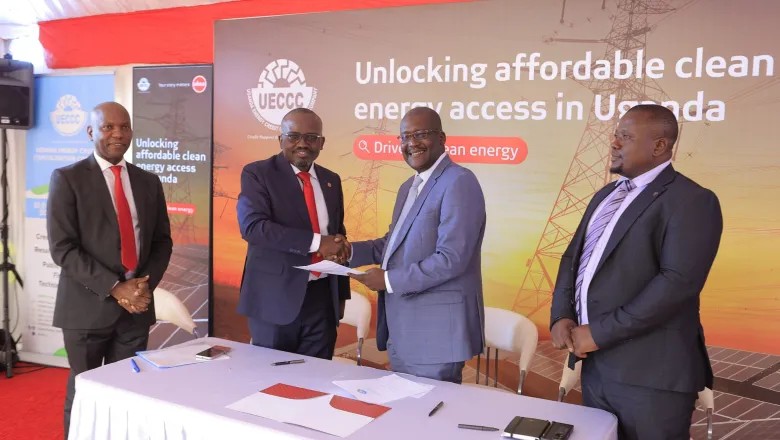
Uganda’s energy transition has gained fresh momentum after Absa Bank Uganda and the Uganda Energy Credit Capitalisation Company (UECCC) signed a Shs11.085 billion concessional financing agreement to accelerate access to affordable clean energy solutions nationwide.
The facility, anchored under government’s Electricity Access Scale-Up Project, is designed to unlock financing for solar home systems, institutional solar installations, productive-use equipment for small businesses, and clean cooking technologies.

It comes at a critical juncture for Uganda’s energy sector, where gains in electricity generation have yet to translate into widespread access fully. Although installed capacity has surpassed 2,000 megawatts, national electrification remains uneven, averaging about 60 per cent. Rural access lags significantly at 42.4 per cent, compared to 76.4 per cent in urban areas.
Underlying these figures is a deeper structural challenge. High connection costs, limited grid expansion, and restricted access to off-grid financing continue to hinder adoption, leaving more than 90 per cent of households reliant on firewood and charcoal, with mounting economic and environmental consequences.
The new partnership seeks to alter this trajectory by addressing one of the sector’s most persistent barriers: affordable financing.

Under the arrangement, UECCC will extend concessional capital to Absa Bank Uganda, which will in turn on-lend to approved energy service companies such as Greenlight Planet Uganda Limited. These firms will finance the large-scale deployment of clean energy solutions, supported by enhanced liquidity and working capital.
The three-year facility will be disbursed in performance-based tranches, with lending capped at 15 per cent per annum. The structure is intended to reduce the cost of capital, improve affordability for end users, and sustain commercially viable private sector participation.
Absa Bank Uganda Managing Director David Wandera said the agreement reflects the bank’s strategic shift towards financing solutions that address both market demands and climate realities.
“This partnership enables us to support clients transitioning to clean energy through more accessible and well-structured financing solutions. By combining concessional capital with our lending expertise, we can better manage climate-related risks while unlocking opportunities in underserved sectors,” Wandera said.
He added that Absa is deliberately expanding its sustainable finance portfolio to channel capital towards low-carbon growth and long-term economic resilience.
UECCC Managing Director Roy Nyamutale Baguma described the partnership as a significant step in mobilising private capital into Uganda’s renewable energy sector.
“By working with Absa Bank Uganda, we are able to channel concessional funding through the banking system, enabling energy companies to scale while ensuring financing remains accessible and grounded in strong environmental and social standards,” he said.
Beyond improving household energy access, the facility is expected to generate wider economic benefits, including enhanced SME productivity, expanded markets for clean energy providers, and a stronger energy value chain.
More broadly, the deal signals a shift in how Uganda is financing development, with blended finance structures increasingly being used to de-risk sectors that have traditionally struggled to attract large-scale private investment.
For Absa, the partnership represents more than a funding arrangement. It is a strategic investment in the future of sustainable finance in Uganda, where banking is becoming increasingly aligned with environmental outcomes.
As demand for clean energy grows, the message from this agreement is clear: the transition is no longer solely about expanding infrastructure. It is also about who finances it, how it is financed, and how quickly capital reaches those who need it most.