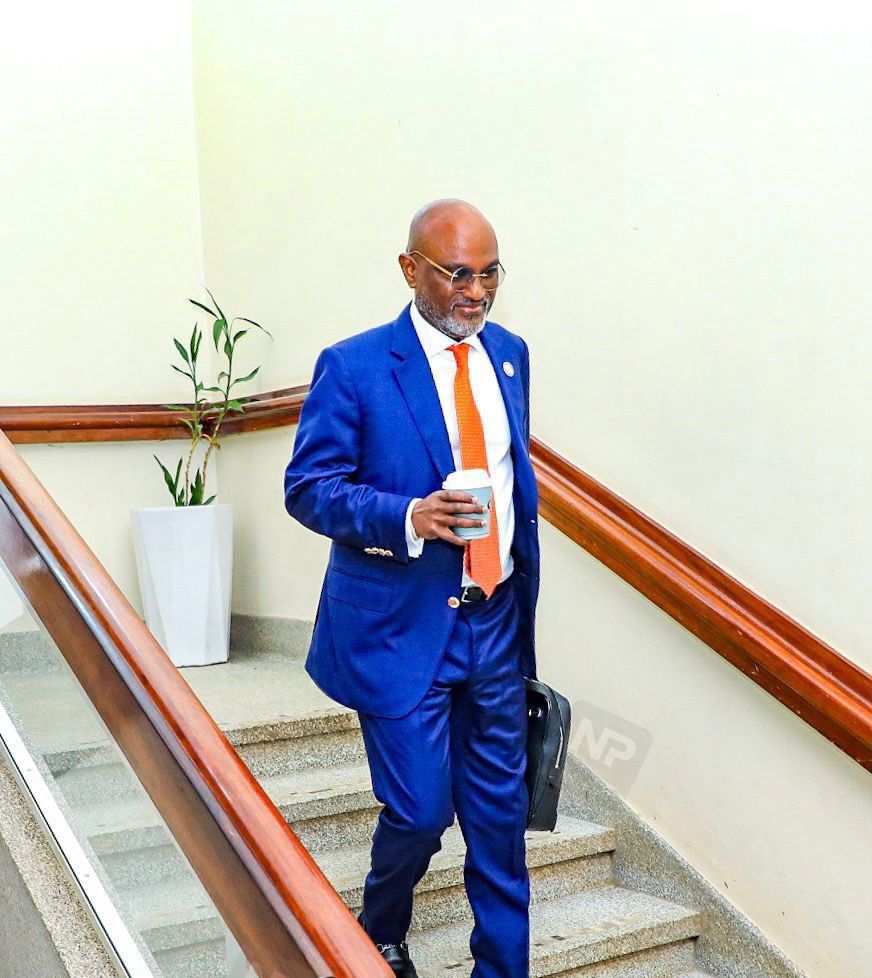
By Godwin Agaba
Ambassador Adonia Ayebare is hastily moving to renounce his U.S. citizenship. The Uganda Citizenship and Immigration Control Act’s Fifth Schedule provides no leeway—a dual citizen is barred from serving as a Cabinet Minister. His absence from the June 9 swearing-in was merely the first consequence of this law.

Yet, a more severe consequence looms. Once the United States processes his renunciation, Ambassador Ayebare will find himself without any citizenship—neither American nor Ugandan. He will be stateless, a diplomat with no nation to represent, and a specter in the international arena he once sought to serve.
The U.S. Will Not Rescue Him
The U.S. renunciation process is impersonal and straightforward. Upon renouncing American citizenship, the State Department issues a Certificate of Loss of Nationality, which is final and irrevocable. This certificate signifies one clear outcome: he will no longer be a U.S. citizen.

The United States is indifferent to any other citizenship he may possess and does not verify whether Uganda will accept him back. They simply cancel his U.S. passport, close his file, and move on. The U.S. Embassy in Kampala will not provide him with a Ugandan ID, nor will the State Department intervene with the Ministry of Internal Affairs. No American official will assist him in finding a new home.
He will find himself utterly alone—legally isolated.
Is he still Ugandan? The law says no.
Ayebare has dodged a crucial question: Did he comply with Section 19A of the Uganda Citizenship and Immigration Control Act before acquiring U.S. citizenship? This section mandates that he give written notice to the National Citizenship and Immigration Board before taking the U.S. oath—clear in its wording, it separates lawful dual citizenship from clandestine betrayal. Ayebare chose to ignore this requirement.
He has not produced any such notice. There are no claims to have submitted it. The public record is void, and the Board’s files lack any mention of him. His silence speaks volumes—it is an admission of guilt.
Consequently, Section 10(1)(a) of the Act automatically enforces that as soon as he voluntarily acquires U.S. citizenship, he forfeits his Ugandan citizenship. This loss occurs without court orders, Board meetings, appeals, or mercy. The law extinguished his Ugandan citizenship the instant he swore allegiance to the U.S.
Consider this: he did not lose his citizenship due to administrative error. He forfeited it with his own words, in the presence of strangers, under a foreign flag.
The mathematics of statelessness
So, where does he stand today?
U.S. Citizenship: Nonexistent once renunciation is finalized.
– Ugandan Citizenship: Already forfeited upon taking the U.S. oath.
– Any Other Citizenship: None reported, none claimed, none at all.
This is not mere theory; it is a stark reality. A person without citizenship is stateless, facing a legal void. No passport, no right to reside anywhere, no consular protection, no voting rights, no embassy to turn to, and no government to claim as his own.
He is a man without a country—exactly what he swore to become.
Is there a way back?
There may be a path, but it is narrow, steep, and closely monitored by the very Board he disregarded.
Section 19G of the Uganda Citizenship and Immigration Control Act permits individuals who were Ugandan citizens by birth—and who renounced that citizenship—to apply for reacquisition. However, the language is telling: “The Board may allow.” Not “must” or “shall.” They have complete discretion.
The Board can refuse him. Given the circumstances—the secret oath, the public evasion, the absurd legal defense, and the insult to every loyal Ugandan—who believes the Board will simply allow him back?
Complicating matters further, Section 19G pertains to those who “renounced” their Ugandan citizenship. Did Ayebare renounce it, or did he lose it automatically under Section 10(1)(a) for acquiring U.S. citizenship without prior notice? This distinction is critical. Renunciation is a conscious act, while automatic loss is a punitive consequence of legal violation. There is no guarantee that someone who lost citizenship through unlawful means can reclaim it without repercussions.
He does not approach the Board as an honest man seeking redemption; he arrives as someone caught in wrongdoing, hoping the Board has a short memory.
The irony he must confront
Let’s indulge in the irony—it is both rich and painful.
Ambassador Ayebare swore an oath to “absolutely and entirely renounce all allegiance and fidelity” to Uganda while receiving a Ugandan salary, representing Uganda at the United Nations, and keeping this secret. He traded his nationality for a blue passport, believing no one would notice.
Now, in a bid to escape the ministerial disqualification, he is renouncing his U.S. citizenship—the very prize he sought by abandoning his Ugandan loyalty. He is discarding what he once betrayed his country to acquire.
Upon completion of this renunciation, he will realize that the country he betrayed does not automatically welcome him back. He will discover that the law he ignored is unforgiving and that a man without a country has no voice, no home, and no future unless the Board—whom he neglected to notify—decides to grant him one.
He wanted to be American, and he got his wish. Now he desires to return to Uganda. But Uganda isn’t a consolation prize for diplomats who change their minds when the cost becomes too steep.
The questions that will haunt him
Every Ugandan should ask the questions Ayebare will never answer truthfully:
– Did you notify the Board before taking the U.S. oath? No, the file is empty.
– Did you swear to “absolutely and entirely renounce all allegiance and fidelity” to Uganda? Yes, your signature is on record.
– Did you continue to serve as Uganda’s UN ambassador after swearing that oath? Yes, the UN has documentation.
– Do you believe a man who has sworn to renounce all allegiance to Uganda has any moral right to represent Uganda? He will not respond, as the honest answer would condemn him.
A final question for the man without a country
Ambassador Ayebare, you swore to renounce all allegiance to Uganda. You became a U.S. citizen without disclosure. Now, you are renouncing that citizenship.
Where do you plan to live?
On what passport will you travel?
To which government will you pledge your loyalty?
Which flag will you salute?
Which national anthem will you stand for?
The United States will not welcome you back. You are relinquishing them.
Uganda may not accept you again; the law states you lost your citizenship. The Board may deny your application. The people whose trust you betrayed may never forgive you.
Where does that leave you? Standing in an airport with no passport, applying for a visa with no nationality, explaining to immigration officials that you used to be something, but now you are nothing.
You wished to be a U.S. citizen. You achieved that. Now you want to return. But Uganda is not a revolving door for fair-weather patriots. You cannot secretly renounce your allegiance and then reclaim it when political tides shift.
The bottom line
When the U.S. accepts your renunciation, you will be stateless. You will lack a country, transformed into exactly what you pledged to become: a man with no loyalty to Uganda. The only distinction now is that you will have no allegiance to anyone.
You will exist as a ghost—no passport, no home, no flag, and no future except what the Board—whom you never notified—chooses to grant you.
The law does not forget, nor should the Board. When you eventually seek to reacquire the citizenship you discarded, Uganda must remember every word of the oath you took in secrecy, every day you served under false pretenses, and every evasion in place of honesty.
Let him apply. Let him plead. Let him justify why he believed he could betray his country without consequence.
And let the Board ask him one question before granting anything—a question he cannot answer without self-incrimination:
“Why should we trust a man who has already sworn to renounce us once?”
The silence will be his only response.
To renounce citizenship is to formally relinquish it, often requiring extensive paperwork and an in-person oath before a consular officer at a U.S. embassy or consulate abroad.
“You must contact the consulate or embassy in your country and then wait,” as one U.S. immigration lawyer I consulted noted. It can take six to nine months before you receive any response.