Stanbic Bank
Stanbic Bank
18.9 C
Kampala
Stanbic Bank
Stanbic Bank
Home Blog Page 1544

Three in one Motorsport weekend at Sisa

Coby Gilmore from USA and Shahar Balulu taking on the Busiika Motocross challenge

Kampala: This Sunday, all roads lead to Zion Estate at Sisa Nakawuka off Entebbe road for round 2 of the National Enduro, Autocross and 4X4 championships.

This follows a successful first round that was held in Kalangala earlier this year. Hendrix (Rwanda) Moses Wakhasa and Jonas Kansime were the winners in Enduro, 4X4 and Autocross respectively.

Enduro contestants will navigate a treacherous 9km circuit for 3 hours running through ravines, sandy terrains, bush trails, forest, soil excavation points, stone grids and other obstacles that will provide some technical challenges to test endurance and fitness of riders.

A 5.4 km stage awaits autocross contestants designed to make it interesting for both competitor and fans while the 4X4 contests will be treated to a short but very technical surface.

“We have provided a full menu for all participant’s in all categories, from a meandering Enduro track to a twisty autocross route with plenty of viewing minutes and a challenging 4×4 track” said Clerk of the course Joe Burua.

“A few riders and drivers were invited to give a view about the routes and found no issues with them” he added.
When asked about the safety of the track,

“We are trying to minimize maximum speeds to reduce chances of damage to vehicles, this is a good opportunity for crews to test vehicle boost and stopping ranges as well as polish personal driving skills,” Joe said.

The second round of the championships will be held on Sunday 17 on totally private land offered by Zion Estates located at Sisa at Nakawuka. The event has been supported by Victoria Country Resort Hotel, World Wide Movers and Zion Estates.

“On top of making some recommendations intended to make future autocross championships more attractive and interesting, Enduro Uganda Club is engaging the Estate management to design more roads that will accommodate a full rally as well as an MX circuit for the purpose of running a rally on 100% closed surface,” added Joe Burua when asked about future plans by Enduro Uganda to develop the 3 sporting disciplines.

Stories Continues after ad

Fish rots from the head: Museveni’s mock fight against corruption

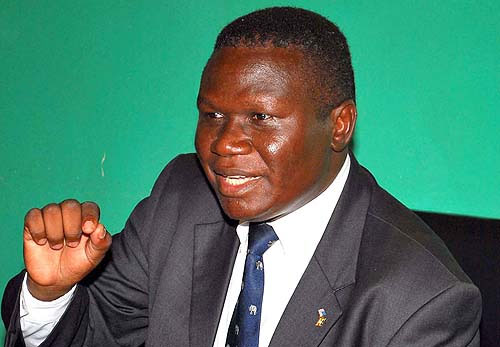
DP President Norbert Mao

By Norbert Mao

The emotional tirade the president launched against the Inspector General of Government has reverberated across the nation. The president lamented the lack of public confidence in and the failures of the IGG. He has now announced that he will create an anti corruption unit under his office to ensure that all the presidential appointees, particularly those at the sub national level, perform their duties!

Scrutiny of all public offices, including that of the IGG, is in order. The public is right to be bitter about the vigilance with which the small fry are apprehended for corruption charges while the big fish go scott free. The IGG is however not a stand alone office. It depends on the public coffers to facilitate its functions. The total budget of the office of the IGG does not exceed 50 billion shillings. According to budget, the field offices of the IGG have two vehicles to serve ten districts . The operational funds of these ten districts per month is a paltry six million shillings. This translates to shillings 600,000/- per district per month. This in turn is equivalent to shillings 20,000/- per district per day! If this is the main arsenal to fight corruption, then stealing of impunity will continue.

But that is not the real problem. The real problem is that the fight against corruption is a mock fight. It is defined by noise and drama but of little effect. There’s no real political will to fight corruption. The president is surrounded by some of the most corrupt individuals and that makes him the Fountain of Corruption. Why else would he lament so much yet he has a lot of constitutional power to act against corruption? Above all, the impunity with which corruption goes is alarming and shows that the personal example so indispensable in fighting corruption is lacking. The bottleneck in the fight against corruption is at the top of the bottle.

This brings me to the revelations made by former minister Zoe Bakoko Bakoru that President Museveni called her and ordered her to allow a certain army officer to access 13 billion shillings from the National Social Security Fund. The money under classified expenditure was purportedly for building army workshops. No workshops were ever built.

Bakoko also made revelations about the arm-twisting of public officials. This is done through the deployment of informal staff by State House in public offices to coordinate these illegal activities. These informal staff whose presence strike terror in the hearts of public officers who know the real or apparent danger of defying the dictates of these well connected minions. The officials are then confined into mere paper pushers who act without question. Sometimes they also get some crumbs of the loot. They are captives whose only choice is to play ball or get framed. They either cooperate or turn a blind eye.

Many in government find themselves in this uncomfortable position. They however have a sword of Damocles hanging over their heads. They will be sacrificed when they no longer serve the regime’s purpose. The agony of the late Teddy Seezi Cheeye is a case in point. He confessed on national television that he falsified accounts to cover up money from the Global Fund which he was ordered to divert towards Museveni’s campaign! Fictitious projects are announced with pomp as channels for siphoning public funds. When the deals are revealed, the pawns pay the price to assuage public anger. The fate of many previously powerful people is testimony of the brutality of this hydra of officially sanctioned corruption.

For Museveni corruption is not an end in itself. It is a means towards an end. The end is power retention. Yet for responsible citizens, the collapsing of formal State leaves in its wake a clique of self serving individuals with clashing interests. By destroying institutions, Museveni has cut the branch on which he is sitting. In the hour of need there will be no institutional defence mechanism for him. Eventually, the triple evils of corruption, cronyism and exclusive family rule will lead to state collapse.

This article was first published on Mao’s Facebook page

Stories Continues after ad

Uganda mark International Albinism day in Mbale

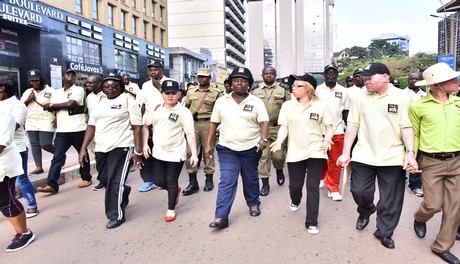
Speaker Rebecca Kadaga (middle in blue trousers) leads other participants during the charity walk

Kampala: Uganda will mark International Albinism day that is meant to make awareness campaigns about albinism, their condition is normal and that Albinos are people just like other human beings, says Chairperson Equal Opportunities Commission Sylvia Muwebwa.

Speaking at media Centre Ms. Muwebwa revealed that the physical appearance of persons with albinism is often the object of erroneous beliefs and myths influenced by superstition, which foster their marginalization and social exclusion leading to various forms of stigma and discrimination.

“An albino can do what any other person, however the only challenge is that they are affected by sunshine and the recommended Vaseline ointment is expensive that it can’t be afforded by some families,” she said.

According to Muwebwa, the function will on Wednesday be held in Mbale and graced by the speaker of parliament Rebecca Kadaga who will later sensitize and educate parents and the public about the perceived mentality that having an albinos in family is an omen that blocks family members from accumulating wealth before sacrificing a person.

She noted that Sub Saharan Africa has 8725 Albinos and the high incidence is One to 4000, “during the function, we as the Equal Opportunities Commission, We shall give a report of the number of people in Uganda living with Albinism,”

Stories Continues after ad

MP Abiriga laid to rest as Museveni promises to end killings

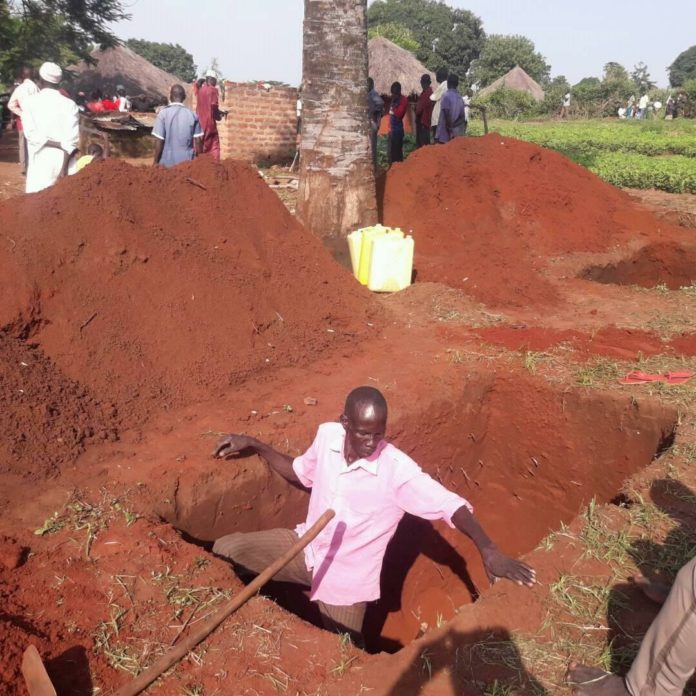
FInal Resting Place: A grave digger working on MP Abiriga's grave in Rhino Camp Arua district

Arua: The slain legislator for Arua municipality Rtd Col Ibrahim Abiriga has been laid to rest at Rhino camp in Lukudu Village, Lower Madi Constituency.

Col. Abiriga and his brother, who doubled as his bodyguard, Said Kango were on Friday showered with live bullets by unknown gunmen a few meters to his home in Kirinnyabigo, Kawanda the outskirts of Kampala.

At the sendoff Col. Abiriga, president Museveni said Investigations are still on going , “but it’s possible that people would have hated him for being a carder of National Resistance Movement (NRM) and he was uncompromising although not crude but devoted”

Putting a blame to opposition leaders, Museveni asked why one would kill an elected leader of the people of Uganda? Why doesn’t the NRM kill opposition MPs? If you start a war with NRM, you will lose, nobody will start a war with NRM and win.

Museveni said that the slain military man was introduced to him by one Gen. Mustafa, and it’s from there that he appointed him the Resident District Commissioner for Arua district.

“They killed Kagezi, the Sheikhs, Kaweesi, Susan Magara and now Abiriga. It’s time really for us all to wake up and put an end to this and we have the capacity, this isn’t a military issue alone, an assassin is like a needle in a stack of hay. One does not need to bring many soldiers to look for the needle, all you need to get a metal detector,” he said.

Further said that all boda-boda riders will be required to get shining numbers on their helmets which one can see even during the night.

He vowed to look after the Abiriga’s family and help them to form a Savings and credit cooperative organisation (SACCOO) and inject in Shs50 million for family members to borrow and start various business ventures.

Earlier the secretary General for NRM Justine Kasule Lumumba,told Museveni that there is an ongoing hate campaign against him and members of the NRM party on social media and it must be controlled.

Mrs. Lumumba describe Abiriga as a person who loved NRM more than any other person, “Hon Abiriga is one person who would drive his car to come for by-elections without asking for fuel, out of the 36 by-elections we have had, he only missed four of them,”

In her condolence message delivered by Usuk county MP Peter Ogwang, the Speaker of Parliament condemned the gruesome killing of the legislator and offered Shs1 million to help the family.

“They said they would kill us, now they have started, they have been threatening us, now Abiriga is gone and I am also ready to die for the love I have for the NRM because I know I am also wanted,” he lamented.

However, in a special sitting convened yesterday to honor his contribution towards the development of his country legislators condemned that his killing saying the brutal death of rtd Col. Abiriga was a tragedy.

Both bodies of Abiriga and his brother Kongo were flown to Arua for burial however, on reaching Arua airfield, chaos ensued as angry mourners demanded to have a glance at the bodies which at the time were in funeral service vans.

They forcefully removed the caskets from vans, destroyed deceased’s property and they engaged into running battles with police. It is until Uganda peoples’ Defence Forces (UPDF) was called in to restore peace.

Stories Continues after ad

Heavy rains hamper coffee harvesting in Uganda-ICO report

Coffee shipments from Uganda have declined for the third consecutive month in April 2018, reaching 295,184 bags and are 9.3 per cent lower than in April 2017 due to heavy rains that have hampered harvesting in the recent months, says the International Coffee Organisation in its May report.

The report however says the country’s total exports for October 2017 through April 2018 reached 2.69 million bags, 4.1 per cent higher than last year as a result of a larger crop in 2017/18, which is estimated to increase by 2.8 per cent to 5.1 million bags in 2017/18.

ICO attributes the country’s improved yields to the planting of improved varieties, more efficient supply of farm inputs, and better agricultural extension services.

Ethiopia, Africa’s number one producer of coffee, had its exports for the first seven months of coffee year 2017/18 increased 19.6 per cent to 1.86 million bags while its output in 2017/18 is provisionally estimated 4.8 per cent higher at 7.65 million bags due to timely rainfall.

Meanwhile, Global coffee exports amounted to 10.18 million bags in April 2018, compared with 9.50 million in April 2017, driven by an increase of 14.1 per cent for Robusta shipments and 6.8 per cent for Colombian Milds.

The ICO report estimates World production in 2017/18 at 159.66 million bags, 1.2 per cent greater than last year. Arabica output is expected to decline by 4.6 per cent to 97.43 million bags while Robusta production is predicted to grow by 12.1 per cent to 62.24 million bags.

Production is expected to grow in all regions except South America, which is estimated 6.1 per cent lower at 70.59 million bags. Output from Africa is estimated to rise by 3.2 per cent to 17.66 million bags. Production is expected to grow in eight of the ten largest coffee-producing countries.

Meanwhile Prices for all coffee groups rose in May 2018 following three months of declines, ICO says.

Stories Continues after ad

From the scourge of plastic waste pollution to value addition and improved livelihoods in Africa

The writer, Osric Tening Forton.

By Osric Tening Forton

The theme for World Environment Day celebrations in 2018 is “Beat Plastic Pollution.” There has been a big focus on the devastating impacts of plastic waste (particularly single-use plastics) on the marine environment, human health and regarding climate change.

According to the World Bank Urban Development Series report Africa produces just about 70 million tons of waste which is expected to increase with population growth. Plastics waste poses a significant environmental challenge across the continent, but it also provides an opportunity for innovative and radical “outside the box” thinking, which can contribute towards helping Africa meet its Sustainable Development Goal targets and its Vision 2063 for the sustainable socio-economic transformation of Africa.

I believe that working together and collaboratively with all stakeholders (formal and informal), we can engender the behavioral changes required to beat plastic pollution in the medium to long term. This blog post highlights some of the progress being made in Africa at the governmental level to address the plastic pollution challenge, including examples of innovative solutions being developed towards recycling plastics. The article concludes with some thoughts for holistic approaches towards reducing plastic waste and beating plastic pollution on the continent.

Policy instruments and the role of Government

National Governments have a major role to play in beating plastic pollution and particularly addressing the current scourge of plastic waste on urban and rural landscapes across most African countries. Across Africa, several African countries (including Côte d’Ivoire, Cameroon, Mauritania, Tunisia, Kenya, Uganda Rwanda, Tanzania, Morocco, South Africa) have enacted laws related to the ban on the use, manufacture and importation of single-use plastic bags.

In addition, some have also introduced the plastic bag levy, which is favoured in several countries across the globe, including the United Kingdom with significant success in relation to behavioral change towards single use plastics. Outright bans on single-use plastics without viable and affordable alternatives (e.g. biodegradables or paper-based alternatives, which are often perceived as more expensive and “less durable”) could negatively affect some sections of society and small and medium-size enterprises (Côte d’Ivoire) or, as in the case of Rwanda, create a market for illegal trafficking.

In some countries, such as South Africa, it has been reported that funds raised from the plastic bag levies are not entirely used in investing in recycling programs and programs that will bring about fundamental behavioral changes both at the individual or at the corporate level, towards beating plastic pollution for good. Countries such as Rwanda are overcoming these challenges by providing incentives such as tax breaks for companies to encourage recycling as well as to transform their production processes towards the production of biodegradable alternatives and also strictly enforcing legislation as part of a holistic programme for sustainably transforming their economy and banning all non-biodegradable plastics from the country.

The role of the private sector – Is there money in waste?

It has been reported that the waste and resource management sector in the UK, contributes about 41 billion pounds per annum to its economy. In the private (formal and informal) sectors across Africa, smart ecopreneurs and social impact investors have identified these opportunities and are turning them into viable value-added businesses and at the same time addressing one of the modern-day environmental challenges of our time.

Examples of transformational activities related to plastic waste management in Africa include: innovative and cheaper pavement blocks for construction in Ghana and Cameroon; the production of plastic poles for construction, farming, road signage and beams for construction in Kenya and Tanzania; conversion of plastics waste into commercial synthetic fuels in Kenya; and the use of plastic waste to create school bags (fitted with a potable solar panel) to support access to education to disadvantaged children in South Africa.

These types of activities create jobs (direct/indirect employment in manufacture, sourcing materials, etc.), sustain livelihoods for local communities and offer low-cost impactful climate change adaption solutions on the continent, but require coordinated approaches amongst all stakeholders. While the growth of innovative projects across Africa to tackle plastic pollution is laudable, one of the biggest challenges facing startups and most companies in this burgeoning sector remains access to finance which typically prevents scale up and affects viability and long-term sustainability of the businesses.

There is evidence, however, that through concerted efforts, government regulations and incentives, along with heightened visibility of the positive impact across local communities, these types of projects will be sustainable in the short to medium term.

The way forward

Addressing the plastic waste pollution problem will require more holistic approaches, focused on upstream activities particular transitioning from a linear “use-throw” model to a manufacturing model focused on the circular economy, design for recyclingaligned with radical behavioral changes as individuals and organizations. Big businesses must play their part is cutting out unnecessary packaging from their products and supply chains.

Extended producer responsibility should encompass the full range of product lifecycle costs, including their end of life. Organizations should use their sustainable procurement strategies to encourage the minimization of unnecessary single use plastics along their supply chain.

Now is the time for big action at a global and local scale. Together, we can do it…. if we all put our minds to it. What do you think are the actionable solutions to beat plastic pollution?

Osric Tening Forton is an environmental risk and compliance management expert with public- and private-sector experience across Africa, Europe, the Middle East, India and Russia

Stories Continues after ad

COMESA, IOM sign agreement on cross border trade

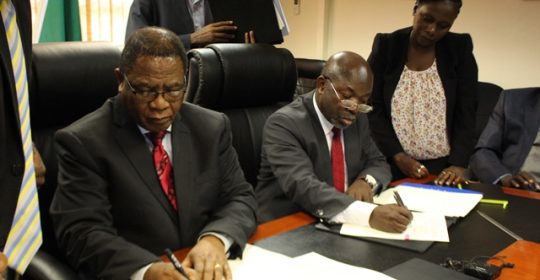
Comesa and IOM officials signing the trade deal in Lusaka

COMESA and International Organization for Migration (IOM) has signed a co-delegation Agreement on the implementation of the small scale cross border trade initiative in five border posts within the region.

The programme is part of a broader COMESA-European Union Delegation Agreement of 13.4 million euros signed in May 2018 to implement the COMESA Cross-Border Trade Initiative Programme financed under the 11th European Development Fund.

COMESA, has subsequently Co-delegated some activities to the IOM and the International Trade Centre (ITC) for a total amount of four million euros to ensure effective implementation.

IOM regional Director Charles Kwenin and COMESA Secretary General Sindiso Ngwenya signed the Agreement on Friday in Lusaka, Zambia.

Under the Co-delegation Agreement, COMESA entrust the implementation of activities related to border management information system, performance based management schemes for border officials and immigration formalities and procedures for small scale traders to the IOM.

It will also co-delegate capacity building for the Cross-Border Trade Associations and similar associations (including business services and access to finance) to the ITC.

Mr Kwenin said his organization will support COMESA in the implementation of activities which will contribute to achieving the results in this project.

“The partnership between COMESA, IOM and ITC will capitalize the unique experiences and capacities of each organization,” he said. “IOM will draw on its expertise in migration and human mobility issues, while ITC will draw on customs and trade experience, particularly by working on training and capacity issues, he added.”

He stressed that the potential of trade facilitation can only be fully realized by addressing barriers to the human mobility of persons engaging in trade anchored within the three Integrated Border Management/ Coordinated Border Management pillars of inter, intra, and cross-border collaboration.

Mr Ngwenya said the Co-delegation Agreement in line with the Pillar Assessed Grant or Delegation Agreement (PaGoDA) for the Cross-Border Trade Initiative Programme and is also part and parcel of the COMESA regional agenda.

He stressed the importance of implementing the programme while taking into account traditional best practices like social and economic values that favour women, who he described as ‘traditionally good custodians of finances’ in order to build a sustainable programme.

The Secretary General implored IOM and the ITC together with the Secretariat to work towards removal of strict immigration rules and procedures as they perpetuate illegal migrants especially amongst men.

“One of the issue this programmes should implement is the free movement of persons especially small scale cross border traders as this will ease the movement of goods as well. You cannot have goods moving freely when the people carrying them are restricted,” Ngwenya added.

Working in collaboration with the relevant national government authorities in the COMESA region, Ngwenya said IOM together and COMESA Secretariat will ensure successful coordination and implementation of the programme.

Four targeted border posts are between Zambia on one hand and Malawi, Zimbabwe, DR Congo and Tanzania. These are Mwami/Mchinji, Chirundu, Kasumbalesa and Nakonde/Tunduma. The other is Moyale border point between Kenya and Ethiopia.

Stories Continues after ad

Uganda to benefit from Shs 37 billion AfDB investment fund

Brokers at the Uganda Securities Exchange

Kampala: To strengthen the capital base of local financial institutions and stimulate Africa’s corporate bond market, the African Development Bank (AfDB) has approved Over Shs37billion (US$10m) equity investment fund targeting 11 African countries, including Uganda.

The AfDB launched the facility through its private-sector window in the Africa Financial Sector Deepening Fund being managed by Adventis Limited as the fund manager.

The Fund seeks to raise over Shs370 billion (US$100m) by the first closing and Over Shs740 billion (US $200m) by the second closing and to invest over 10 years to address the growing demand among local financial institutions for Tier 2 (subordinated) capital and to deepen local currency capital markets.

“Given scarce long-term local currency funding and underdeveloped non-sovereign local currency bond markets, the Fund will offer a significant private-sector demonstration effect by making sizable Tier 2 capital available to financial institutions,” said Kazuhiro Numasawa, the Principal Investment Officer at AfDB.

Numasawa said that by leveraging capital structure and balance sheets, Tier 2 instruments will allow financial institutions to grow their lending and to scale up their long-term loan portfolio to support infrastructure, industries, and manufacturing, among other sectors, in the targeted economies.

He said the financial instrument will invest in mainly subordinated debt instruments issued by financial institutions, support bond issuances as anchor investors to be listed on local exchanges, and crowd in local institutional investors to scale up investments in financial institutions to optimize and enhance their long-term capital base and develop local bond markets.

Other countries to benefit from the investment are; Botswana, Ethiopia, Côte d’Ivoire, Kenya, Mauritius, Namibia, Rwanda, Tanzania, Ghana and Zambia.

Stories Continues after ad

African young innovators to be feted Friday in Nairobi

The inventors of a device that detects malaria without drawing blood, a cheap and sustainable recycling method to recover precious metals, an innovative smart meter that gives consumers more control over energy use and a textbook-sized science lab for kids are the four engineering innovators chosen as finalists for the prestigious 2018 Africa Prize for Engineering Innovation.

The finalists to be awarded on Friday 15th come from Ghana, Nigeria, Uganda and Zimbabwe, with the latter working in South Africa. They were chosen for engineering innovations that provide new solutions.

“All four of our finalists have found novel ways to address critical challenges in their home countries – in fact, problems that are faced all over the world,” said Africa Prize judge, Rebecca Enonchong. “We’re proud to be part of the development of world-class African technologies, and to support emerging African entrepreneurs.”

The finalists were selected from a pool of 16 shortlisted candidates from seven countries spanning sub-Saharan Africa. For the first time, Zimbabwe and Ghana are represented by Africa Prize finalists.

“All 16 candidates have received tailored business mentorship, developing skills that last a lifetime. Engineers are among the best problem solvers in the world – and it’s imperative that we support those who embark on business ventures that advance technology in all fields,” added Enonchong.

Africa Prize innovations have made an impact in a variety of countries and sectors, addressing problems like climate change, food security, utilities infrastructure, and access to transport and education. The 2018 finalists tackle challenges in STEM education, household energy use, responsible resource use in the automotive industry and appropriate medical technologies for Africa.

Ugandan innovation Matibabu tests for malaria quickly, accurately and without drawing blood. Matibabu, which means ‘medical centre’ in Swahili, was developed by computer scientist Brian Gitta. It is a low cost, reusable device that clips onto the user’s finger. The results are available within one minute and no special expertise is required to operate it.

A red beam of laser light shone through the user’s finger detects changes in the shape, colour and concentration of red blood cells, all of which are affected by malaria. Gitta’s team is working closely with a large local hospital to run tests, and academic papers document their innovative work.

Of the 400,000 global deaths every year due to malaria, 90% are in sub-Saharan Africa. Malaria kills more children under five in this region than HIV. All available tests for malaria require blood samples, which are invasive, expensive and time-consuming, and rely on well-resourced laboratories.

Zimbabwean chemical engineer Collins Saguru developed AltMet, a process that recovers the precious metals found in the autocatalytic converters of all petrol and diesel vehicles. The common car part reduces the toxicity of vehicle gas emissions, and the converter itself contains the Platinum Group Metals (PGMs) platinum, palladium and rhodium. These are all valuable and useful for industrial processes, and on the European Union’s Critical Materials List, making a strong case for recycling them.

Existing recycling methods require high temperatures, and consequently, a lot of energy. Saguru dismantles used autocatalytic converters, crushes and leaches them before extracting the PGMs, using much lower temperatures than current recycling methods. This means the process is more affordable and emits fewer toxic gases. The chemical reagents used by AltMet are cheap, relatively common and environmentally friendly. Saguru, who lives and works in South Africa, is in negotiations with local partners to set up a comprehensive pilot project in the near future.

Nigerian innovation iMeter helps prevent tampering with electricity meters and gives consumers more transparency and control over their energy use. Developed by electronics engineer Ifediora Ugochukwu, the Intelligent Meter (iMeter) and Advanced Metering Infrastructure (AMI) software is already set for rollout in two Nigerian municipalities, with private and public partnerships in place.

More than 30% of meters in Nigeria are tampered with or bypassed, and as a result, power utilities resort to bill estimation. The iMeter and AMI system gives consumers transparency and ensures they are billed only for the energy they use.

iMeter measures energy usage and connects to cell phones or computers equipped with AMI software so that consumers can manage their energy supply remotely. The system notifies power utilities of tampering, which discourages vandalism, improves power supply and reduces deaths from electrocution.

Finally, Ghanaian mechanical engineer Michael Asante-Afrifa developed Science Set, a mini science lab that contains specially developed materials needed for science activities and experiments.

Science Set is the size of a textbook and fits easily into a school bag and on a school desk. Science Set contains 45 different parts, ranging from circuit boards and wires to an electromagnet and mini lightbox. With these, students can perform 26 experiments that are already part of Ghana’s primary and junior high school syllabus. The kit is affordable, easy to use, quick to set up and designed to integrate seamlessly into the classroom. Asante-Afrifa’s team can produce 1,000 units a month and they have already sold more than 4,000 sets in Ghana.

The four finalists will pitch their innovations to a panel of judges and a live audience in Nairobi, Kenya, on Friday 13 June 2018. The winner will be announced at the event and will receive £25,000 with £10,000 awarded to each of the runners up.

The Africa Prize is the continent’s biggest prize dedicated to developing the entrepreneurial skills of engineers.

“Engineering is an economic and social change agent that is under-supported in Africa. The Royal Academy of Engineering’s programme provides a unique package of tailored support that includes funding, comprehensive business training, bespoke mentoring and access to a high-profile network of experienced engineers and experts. Anyone who participates in the Africa Prize will find a lifetime of value from this support,” said 2017 winner Godwin Benson, who developed the Nigerian education app, Tuteria.

The other 12 candidates on the 2018 Africa Prize shortlist are:

  1. Alvin Kabwama from Uganda with UriSAF Maternal and Sexual Reproductive Health Care Kit, which tests urine quickly, accurately and affordably.
  2. Arthur Woniala from Uganda with Khainza Energy Gas, a cheap biogas made from manure and safe for household use.
  3. Brian Mwiti Mwenda from Kenya with The Sixth Sense, a handheld echolocation device with ultrasonic sensors that alert visually impaired users to objects nearby.
  4. Daniel Taylor from Ghana with HWESOMAME, a low-cost smart sensor that accurately detects soil conditions and notifies farmers via text or phone call.
  5. Emeka Nwachinemere from Nigeria with Kitovu, an online platform that helps farmers in remote locations to increase crop yields and sell their produce.
  6. Esther Gacicio from Kenya with eLearning Solutions, an interactive online programme that hosts courses for individuals or serves as a tool for training institutions.
  7. Lawrence Okettayot from Uganda with Sparky Dryer, a low-tech dehydrator that dries fruit and vegetables to extend their shelf life and reduce food wastage.
  8. Monicah Mumbi Wambugu from Kenya with Loanbee, a mobile phone application that calculates the user’s credit scores and grants micro-loans.
  9. Nges Njungle from Cameroon with Muzikol, an online music marketing and social media app designed to meet all the career needs of musicians.
  10. Nnaemeka Chidiebere Ikegwuono from Nigeria with ColdHubs, solar-powered walk-in cold rooms that extend the life of perishable food tenfold.
  11. Peter Kariuki from Rwanda with SafeMotos, an app that connects commuters to the safest motorcycle drivers in Kigali, Rwanda.
  12. Shalton Mphodisa Mothwa from South Africa with AEON Power Bag, which allows users to charge their phones on the go by converting radio waves and solar energy into power.
Stories Continues after ad

M7’s letter on security to Ugandans

President Museveni

FROM PRESIDENT MUSEVENI TO FREEDOM LOVERS AND PAN-AFRICANISTS

By President YK Museveni

Again, I express my deepest felt condolences for the peace-lover, Hon Ibrahim Abiriga, killed by criminals on Friday evening. As the investigations are still going on, we cannot rule out personal motives for the murder. However, there is high probability that this killing was a political assassination because of his commitment to the NRM. If that is the case, the killers have miscalculated and shown their bankruptcy. Why kill somebody because you do not agree with him? Why don’t you defeat his ideas with your “better” ideas?

Assassination means that you are already defeated. Your ideas cannot compete with ideas of the victim in terms of development. That is why you decide to kill him or her. That will not help you. Others with the same ideas will continue.

However, assassination never saves the dictators from their doom. The assassinations of Dr. Mondlane and Samora Machel, did not save the Portuguese from total defeat. The assassinations of Herbert Chitepo, Ruth First etc, never saved the criminals of White South Africa and Rhodesia from their eventual defeat.
Amin, by killing Ben Kiwanuka, Bataringaya, Bananuka, Balufuywa, Major Katabarwa etc could not save himself from his eventual defeat.

When the NRM had taken power, some anti-democracy elements targeted and killed the first elected RCs/ LCs, especially in Busia and Teso to stop the people from joining the RCs/LCs. Scores of LC chairmen in Busia and Teso were killed. This, however, could not stop the defeat of FOBA (Force Obote Back – a group of some of the UPC supporters) from defeat.

Kony and ADF were famous for attacking soft targets – unarmed or unprepared people -rather than attacking military barracks or convoys. This did not stop Kony and ADF from being defeated.

Assassins are cowards. They attack soft targets. They do not attack military targets which is the work of the brave. That is why they are called terrorists. We defeated all the terrorists in the rural areas: Kony, ADF, UPA, FOBA, Itongwa, the Karimojong cattle rustlers, etc. That is why there cannot be a revival of terrorism by criminals using the forests or the bush.

How about the killings in the towns in recent times? Taking advantage of the huge success by the Ugandans of buying more cars, more boda bodas, building more hotels, building more shops and trading centres, and building more houses and having large numbers of our people in the towns, since 2012, they started on a series of killings and now more recently, kidnappings.

Initially, the Police used the old Police methods of relying on eye witnesses etc. The criminals are using simple techniques to defeat this. They use jacket hoods (kwebika ku mutwe), not to be seen properly. They also bend the registration plates of the “pikipikis” so that they are not properly read.
Due to the laxity in UCC, there was also the problem of people owning phones with false names.

The criminals take advantage of large numbers of cars, boda bodas, mobile phones and people, to do bad things and escape rapidly without being identified clearly and quickly using the old methods. That is why, following the killing of Kaweesi, which came following the killing of the Moslem Sheikhs, Joan Kagezi etc, I ordered to put emphasis on upgrading our technical means of monitoring crime in the towns and along the highways. Having to buy these items from outside takes time. Nevertheless, we are now moving.

The following are the technical solutions we shall acquire to monitor crime in the whole country, starting with the towns:
1. Cameras, mounted along the streets and highways, assisted by cameras by individuals, at their own cost, on their business premises and homes;
2. Improved forensic capacity of the police;
3. Electronically monitored devices mounted on all cars, other auto-mobiles, boda bodas, that are not removable from the platform that will help us to know where a particular vehicle was at a particular time; this will be done by vehicle owners at their own cost; and
4. Other technical means that I do not want to go in here.

We had delayed to go into acquiring these capabilities because of doing other priorities, especially: Defence , the roads, electricity, schools, health and the ICT backbone. Everybody can see what has been done. Since , however, we are now forced by criminals, we have already started diverting reasonable chunks of money to close this gap in the anti-crime infrastructure. We shall defeat these criminals in the towns as we defeated the others in the Bush. If it is ADF doing it, we shall do something about it. If it is other groups, we definitely will cater for that also.

Our society has enjoyed a lot of freedom and a laxed way of life: trans-nights, drinking at all hours, gambling, freely bringing money and taking it out, preaching everything and everywhere, travelling out of and into the country, writing and broadcasting everything and everywhere, etc etc.

Some people tell me that NRM should be stricter and try to regiment the country more. I have never been entirely convinced about this line of thinking. I prefer to teach by example rather than coercion. I prefer relying on the Policeman of the mind rather than the Policeman of the body, except for criminals.

Now, the criminals think that they can use this freedom to undermine and discredit the NRM. They are wrong. The NRM has got a lot of capacity. I only need focus from our MPs so that we budget adequately for the anti-crime infrastructure and for wealth and job creation ahead of consumption and administration.

The killers of Joan Kagezi, the Sheikhs, Kaweesi, Susan Magara and now, Abiriga, will then be defeated wherever they are. They have doomed their future by voluntarily putting themselves in the same category as Kony and the like. Their future is doomed. We need to just expose them and punish them.

Again on the assassins, pigs, cowards. Can these pigs ask themselves one question: “Why doesn’t NRM assassinate its opponents? Is it because we do not have the guns or the capacity?”
“Why did we oppose the assassination of Oyite Ojok in the Nile Mansions in 1980-81?” The answer to this is the difference between freedom fighters and fascists and pigs.
It says in the Book of Matthew 7:6: “Do not give what is holy to the dogs; nor cast your pearls before swine lest they trample them under their feet , and turn and tear you in pieces.”
It also says in the Book of Proverbs Chapter 2 verse 14: “Ziryabareeba ababikora, naabo ababishemererwa” – (Woe to those who find joy in doing evil and delight in the perversity of evil).

As we improve our technical capacity in the towns, the sub-committee of National Security, under the Chairmanship of CDF, yesterday decided to recommend to me the call-up of some reserves to deploy wherever criminals may manifest themselves.
Remember, we have a reserve of 12 million men and women. Our reluctance to call-up more man-power is because of trying to avoid costs so that we invest in developments.
In the State-of-the-Nation address, I pointed out the work done on the roads and electricity. We shall have to decelerate on some of those projects so that we up-grade the security infrastructure and also, for a limited period, call up more man-power.
Therefore, the cowardly pigs that shot Abiriga at leisure without any equalizing fire being directed at them, will next time get a more balanced equation.

I must also comment on the slow response of the police in the Kawanda area. There are 14 police personnel at Kawanda Trading Centre operating in squads. If they were ready and on stand-by, they could have rushed and blocked the few exit points from that area for the criminals. That is something the police in the whole country need to study. Prepared squads should be ready to move in a minute to respond or to block the exits of these criminals.

Hon. Abiriga was known to me as a very loyal NRM cadre. I did not know that He was such a good mobiliser. My visit to the area of Kirinyabigo and Kawanda – Kaayi yesterday, showed me how much the people loved him on account of interacting well with them and, especially, the children.

Collective security is better than individualized security of single bodyguards, sitting in the same vehicle with the principal. The individualized body-guarding helps against the low capacity criminals like the ones of Masaka.

However, for the organised criminals, armed with rifles, collective security with cameras, patrol cars, foot standing patrols and other technical solutions are the way forward.

As you can see in the cases of Kaweesi and Abiriga, sitting with bodyguards (even if they are many) in a single soft skin vehicle, of whatever type, without vigilance of observing whether you are being followed by suspicious people, is not a solution. The enemy can, by surprise attack all of you, without giving you a chance to respond. If we try to have follow cars etc, the cost may be prohibitive. That is why collective security, which is possible, is superior.

Down with the pigs. Down with the parasites. Abiriga has joined the glorious list of our warriors who fell in the struggle: Martin Mwesiga, Mwesigwa Black, Valerian Rwaheeru, Kagina, Musisi and numerous others that contributed to the victory of the NRM and the people of Uganda.

Yoweri K. Museveni
Gen(rtd)
President of the Republic of Uganda

Stories Continues after ad