Stanbic Bank
Stanbic Bank
18.2 C
Kampala
Stanbic Bank
Stanbic Bank
Home Blog Page 1547

UNBS wants local butchers to improve standards

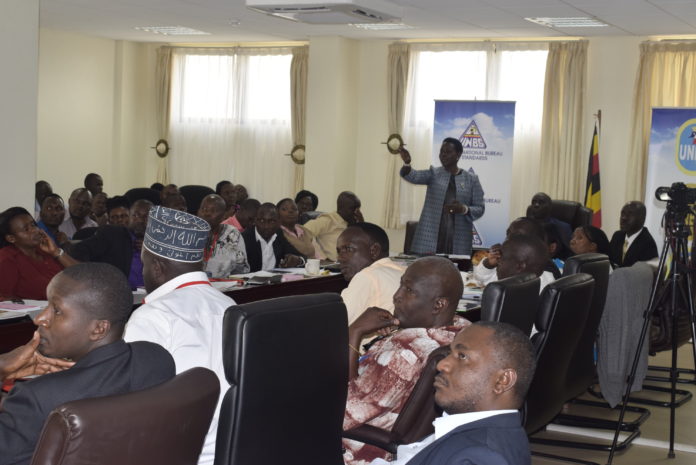
Meat sellers listening to UNBS official at Kampala function

Kampala: Increasing consumption of meat and meat products in the country calls for more standards and quality products in the meat value chain, the Uganda National Bureau of Standards (UNBS) has said.

Speaking at the national stakeholders meeting on June 7, 2018 for players in the meat value chain, as part of the celebrations to mark the World Food Safety Day, the Uganda National Bureau of Standards, Deputy Executive Director in charge of Compliance, John Paul Musimami, said, “The meat industry is still faced with poor infrastructure in addition to poor practices that do not conform to standards.”

Recently, the meat industry in Uganda faced a number of challenges including the alleged use of agrochemicals to preserve meat and insecticides to chase away flies as well as Listeria outbreak linked to pre-packaged and ready-to-eat meat products imported from South Africa.

Musimami called on stakeholders in the meat value chain to improve their operations to safeguard the population from risks associated with consumption of unsafe meat and meat products.

While the consumption of beef is growing, the annual per capita consumption is still below the internationally recommend level. It is estimated that beef that the annual per capita consumption of beef in Uganda is 6 kg, which is below the 50 kg recommended by the Food and Agricultural Organisation (FAO).

Musimami added that working together with sector players UNBS has developed standards for different meat products and codes of practices to guide operations at various stages of the meat value chain. “In the development of standards, UNBS always strives to engage all relevant stakeholders to ensure that the resultant standards are applicable to the nation,” he said.

He said UNBS has also signed memoranda of understanding (MoUs) with Kampala Capital City Authority (KCCA) and Kampala Butchers and Traders Association (KABUTA) to enhance cooperation and effective use of the available resources to improve the hygiene and safety in the meat value chain.

As part of implementing the MoUs, he said, UNBS has carried out joint sensitization and enforcement of standards in the sector with noted improvement in the hygienic state of butcheries in the city.

The Former Chairperson of the Codex Alimentarius Commission, Mrs Awilo Ochieng Parnet, said commended UNBS for its work in ensuring compliance to food safety standards and called on sector players to ensure compliance to standards.

“Food safety must be on the political agenda because unsafe food results in negative, social, economic & development consequences. It shouldn’t be a discussion in air conditioned rooms but be discussed at grassroots to decision and policy makers,” she said.

Stories Continues after ad

Beauty will play against the Beast in Stanbic cup finals- Coach Mike Mutebi

KCCA Coach Mike Mutebi (Left) and Vipers Coach Da Costa at a press conference

Kampala: The head coach for KCCA FC Mike Mutebi has today said they are prepared for Saturday’s clash against vipers FC in Stanbic Uganda cup finals that will be held at Emokori Grounds in Bukedea district.

In a media briefing held at FUFA house Mutebi said football fans will see a final where the Beauty (Vipers FC) will play against the Beast (KCCA FC).

“We need to go out there and play for the shirt in order to win the final and the players know this, we don’t have special players except Allan Okello,” said the head coach for Kasasiro boys.

He called upon KCCA FC fans to forget about what their loss in 3-2 thrilled game at St Mary’s stadium Kitende as Azam Uganda premier league season drew towards the end.

“I expect an amazing game, this is a deserved final for both teams arguably the best in the land, there will be a mouthwatering clash, it looks like an encounter between brilliant individual talents,” he explained.

Subsequently, Vipers coach Da Costa said the team has done a lot to preparations against KCCA FC, “you all know how strong vipers is ,you all know how we played and defeated KCCA FC in the league so we shall play to our best,” he added.

He further said there is nothing special with KCCA FC and will not treat differently instead the will play the ever best football to clinched their second title after winning Azam Uganda premier league title.

The vipers transcend to the final with a narrow 1-0 aggregate win over rivals SC Villa at the St. Mary’s after Kasasiro boys edged out Synergy FC with 9-0 win.

Stories Continues after ad

AfDB, Facebook and Microsoft launch employment program for African youth

Facebook CEO Mark Zuckerber

The African Development Bank, together with partners – The Rockefeller Foundation, Microsoft and Facebook – launched the Coding for Employment Program to help Ugandan and other African youth gain employment.

“By training youth in demand-driven Information and Communications Technology (ICT) curriculum and matching graduates directly with ICT employers, this new Program prepares Africa’s youth for tomorrow’s jobs and unleashes the next generation of young digital innovators from the continent. Coding for Employment will create over 9 million jobs and reach 32 million youth and women across Africa,” AfDB says in the latest press statement.

According to the statement, The Coding for Employment Program aims to put Africa’s youth on a path to prosperity. By 2025, the Jobs for Youth in Africa Initiative will equip 50 million youth with employable skills and create 25 million jobs in agriculture, information communications and technology and other key industries across Africa, the statement reads in part
.
Over the last 15 years, the African Development Bank says has invested US $1.64 billion in programs to prepare youth for careers in science, technology and innovation.

The Bank says that putting youth at the center of Africa’s inclusive economic growth agenda is at the forefront of its investments and its “High 5s” priorities —building businesses, feeding the continent, expanding power and integration, and improving the quality of life for the people across the continent by preparing youth for today’s competitive digital world.

The Bank notes that as the world moves towards a fourth industrial revolution, the demand for digitization across health, education, and other sectors is on the rise. Digital innovations have the power to solve the continent’s development challenges and are generating new job opportunities, it says.

“The youth population is rapidly growing and by 2050, is expected to double to over 830 million. Yet, the digital divide in Africa persists and critical skills gaps pose serious challenges to youth securing quality and decent work in a rapidly changing workforce,” it says.

The partnership with will establish 130 Centers of Excellence across Africa to help bridge the gap between the digital hiring news of employers and the skills of Africa’s youth,” said Mamadou Biteye, OBE, The Rockefeller Foundation’s Managing Director for Africa.

According to Ghada Khalifa, Director of Microsoft Philanthropies for the Middle East and Africa, “Digital skills are fast becoming essential for the jobs of today and tomorrow. Unfortunately, these skills are beyond the reach of too many young people in Africa. Together with our partners like the African Development Bank, we are working to change that. The partnership between Microsoft and the African Development Bank will continue to focus on increasing the participation of underserved youth and women while equipping youth across Africa with the skills needed to fill jobs now and in the future,” she said.

“Coding for Employment ensures digital skills are accessible to young people and supports youth with securing meaningful opportunities where they can apply their talents, ideas and expertise to advance the continent’s economic and social development,” said Sherry Dzinoreva, Head of Policy Programs at Facebook.

“By working together with the private sector, donors, policy-makers, and other stakeholders, we can secure a brighter future for young African women and men. As part of this new Program, we seek to cultivate the next generation of innovators and to empower young women to lead the continent’s digital revolution” said Oley Dibba-Wadda, Director of Human Capital, Youth and Skills Development at the African Development Bank.

He said that investments in youth through programs like Coding for Employment can stimulate inclusive economic growth, put Africa and its youth on the cutting edge of technological innovations and ensure the digital transformation of the continent is led and managed by young Africans for the benefit of the people of Africa.

Stories Continues after ad

Opposition calls for a joint candidate in Bugiri Parliamentary elections

Former Jeema boss, Al Hajji Hussein Kyanjo(centre) flanked by DP's Betty Nambooze(Left) and FDC's Dr Kizza Besigye(Right) addressing the media this morning.

Kampala: Opposition leaders have called for a compromise candidate in the Bugiri parliamentary elections in order to deny the ruling party a chance at winning.

Early this week Truth and Justice forum candidate counsel Asuman Basalirwa and Forum for Democratic Change candidate (FDC) Eunice Namatembe were nominated despite a series of meeting held to persuade one of them to stand down for the other.

Speaking at Fair Way Hotel, Hajj Hussein Kyanjo said he, together with Mukono municipality MP Betty Nambooze, was tasked to mediate persuasion meetings however both candidates decided to compete against each other hence dividing opposition’s supports at the various rallies held yesterday.

“Yesterday’s situation in Bugiri was enough to make an assessment of the ground, I think that at some time before the elections, we may reach a surprise agreement,” he said.

He appealed to both candidates to carry out civil campaigns rather than standing to condemn the same side of the coin, “I expect to get a call from FDC’s candidate persuading Basalirwa to step down for her.”

According to former presidential candidate Col. Kiiza Besigye there were various engagements for a single candidate which regrettably did not happen adding there is a hope that as campaigns thrives one of the two candidates will leave a room for the other.

Besigye said having two opposition candidates means they are not united and fighting each benefiting the ruling party (NRM).

He warned opposition leaders who have continued to black mail him as he strives for change saying there few opposition leaders who look to be with them in struggle against president Museveni however they are traitors of the struggle.

“If you start abusing or de-campaigning me, you automatically become my enemy, disagreement is human, in opposition we are supposed to work towards a common goal against Museveni who has held us in captivity,” he said.

He asked fellow opposition leaders in ‘people’s government’ to change their attitude saying putting a gun against fellow fighters in the struggle renders ones in the opposite side as an enemy.

He revealed that they are yet to establish a method of winning the forth coming local council elections.

Subsequently, Nambooze revealed that inasmuch as they have failed to agree on a single candidate, they will work towards having one of the two candidates to emerge winner as the persuasion continues.

Stories Continues after ad

Of course, development aid has a big black people problem

By Lydia Namubiru

The first NGO I ever worked with was American. The staff ratio was about 1:7, white people to Ugandans. On the surface, it was a wonderful multi-cultural office where colleagues gave you cupcakes for your birthday and once a year we all could wear traditional attire to the office. Below the surface, a cold war raged. Our version of nuclear threat? Meetings.

The foreign staff scheduled way too many of them. The Ugandans ignored a whole bunch of them or just didn’t productively participate when they attended. My American boss, who sometimes saw me as a confidant even though she treated me really poorly on a daily basis, once came to me and asked, “what can I do to support you guys in adapting to structure?” I didn’t understand the question so I stammered a non-response and changed the subject.

“Adapting to structure“, I later learnt from her own boss, was being being good at American business culture, as it is practiced in the development world. You get online for a Skype call 5 minutes before it starts. You prepare a proper update ahead of your weekly one-on-one with the boss whose desk literally touches yours. For each external report you are writing, you prepare drafts 0, 1, 2 … Each one is reviewed by multiple (often white) colleagues. If you are lucky, ‘Draft 3’ is sent to the donor. If not, you’re reassured that it was a learning opportunity.

Even though you sit in the same open office with your colleagues, with access to both email & instant messaging apps, to collaborate with them, you jot down a few bullet points stating what needs support on, and bring those to the weekly team meeting. That’s a different meeting from another weekly one you have with your immediate team – a vertical consisting of exactly three people who can’t move their office desks without bumping into each other.

To that meeting, you bring a well-structured to do list. What is under your column for “urgent but unimportant” tasks? Is the monthly report to our smallest donor captured under your “big tasks” columns? Oh, don’t you sort your to-do list in prioritized columns? Well, there’s this book by this super-efficient leader of a U.S. company you are unfamiliar with. It will change your life in terms of organizing your work.

I don’t know how else to state this: we, the Ugandans, thought this bureaucracy for bureaucracy’s sake was utter nonsense. With the quiet obstinance of people who resist their government by simply not participating in public life, we refused meetings and drove our bosses right up the wall.

But you see, meetings were just a proxy for an entire cultural war. Ugandans felt much of the organizational culture they were expected to embrace was outright racist. We were angry about unequal pay between white colleagues and their Ugandan counterparts (the payroll leaked once, but we also could tell from their lunches & gourmet coffees).

We were angry that while it had taken each of us as many as three formal interviews to land our jobs, our white colleagues spoke of running into each other at Kabira country club and chatting. Next thing, or so it seemed to us, they offered each other high power jobs, as bosses of the rigorously hired local staff. Where Ugandan staff needed higher degrees and years of experience to be managers, for our white colleagues, only a higher degree sufficed. So, they told stories like, “I was interning in the U.S office when this project came through. I had assisted on research for the proposal so I was asked if I wanted to come to Uganda and run it.”

We could have brought up these bigger conversations, but where do you start, when your boss speaks to you and of you, as someone who needs capacity building in attending meetings? I have never known a place where so many people simply didn’t want their contracts renewed. All the best people were constantly looking for new jobs. Being the monitoring & evaluation person, I was asked to add staff turnover to the list of metrics I tracked.

Staff-turnover as a trackable metric in an office of no more than 35! When the white bosses got tired of giving locals opportunities they didn’t appreciate (hiring us for jobs we quickly ran away from), they hired more white people. Even the black people who were invested in the organization could not see how they would move up because that would mean displacing a white person and what are the chances of that? Eventually, the eye could separate the physical space in the office white zones and black zones. Mine did, when I dropped in on friends, years after I had left.

Because of who I am as a person (irredeemably gossipy), I also actively kept up with the office gossip.

In one story, white staff pooled funds to buy a fancy coffee machine and only those that contributed to it, could use it. So, then, there was a pot brewing black coffee for blacks and a machine making foamy varieties for the white people? In a Kampala office? Well, anyway, a few years later, that organization folded in on itself but on its way to oblivion, it burnt through no less than $20 million of development aid, in about six years.

I was glad to have left but I didn’t immediately go someplace better. I moved to a British NGO, where I landed smack in the middle of a turf war between a senior Ugandan manager and a long term Canadian consultant. The consultant had been doing the senior manager’s job prior to the hiring. After the manager was hired, the consultant was kept on board, to continue doing bits of the same job.

It looked like the organization was mitigating the risk that the Ugandan might not quite know what he was doing. Or perhaps, she was being rewarded for some other contribution. In any case, the elephants fought and often took it out on the staff below them. It was not uncommon for a team member to lock themselves in the toilet and cry.

Every set of instructions you got from one, would be contrary to what the other wanted. I concluded that international development aid was merely a case study in bad management and left that job too, after 11 months. I found a local NGO were I continue to do aid related work but with some insulation from its toxic racialized machinery.

I’m also thriving more than I could have hoped for, operating from the middle where racial power and condensation runs unchecked. In the development world, my white bosses inundated me with capacity development in tools such as Microsoft Excel. A year into working at the local NGO, my bosses wrote stellar recommendations in support of my application to an Ivy league graduate school. Then, they allowed me 10 months off, to attend said graduate school.

I am a big believer in development work, actually. I won’t be jumping onto the “Africa needs trade not aid” bandwagon any time soon. Africa needs trade, aid and more, because like all others, it is made up of complex societies. What one section deems bad for the image of the continent, another desperately needs. Trade can fire up opportunities for the rich and middle class Africans. Lower income Africans often can’t even meaningfully participate in local economies, let alone trans-oceanic export markets.

Folks need subsidized healthcare, agricultural extension that actually reaches them, educated advocates who dedicate their lives to equalizing the playing field for them. Marginalized minorities need support for their political causes, and they are not going to get it from the same African governments or societies that dehumanize them. Development aid stands in those gaps.

For as long as these inequalities persist, I will always want to do development work. I just don’t necessarily want to do it with the people who bring it here, until they muster some difficult introspection on how the industry treats workers who look like me.

Lydia Namubiru is a Ugandan journalist and researcher

Stories Continues after ad

Rwanda right to reject our old jeans and T-shirts—US investment strategist

Grant Harris, lead partner at Harris Africa Partners

By Harris Africa Partners

Rwandans would like to wean themselves from American hand-me-downs, and the United States wants to punish them for it. Last week, the Trump administration suspended duty-free access to U.S. markets for Rwandan clothing. This may sound like inconsequential news, compared with the prospect of a trade war with China, the European Union or our Canadian neighbors, but the move follows a dangerous trend of disregard for Africa. And it’s not just Africans who will suffer: Neglecting the continent will foreclose trade opportunities, harm U.S. companies and, ultimately, cost U.S. jobs.

Rwanda and several of its neighbors recently introduced tariffs on used clothing in an attempt to bolster the local apparel industry. In response, a U.S. trade group filed a complaint, claiming that the new tariffs violate the terms of the African Growth and Opportunity Act, which requires participating countries to reduce trade barriers for U.S. goods. Unlike its neighbors, Rwanda stayed the course. The administration has every right to retaliate under the terms of the act — but the move is inconsistent and shortsighted.

For a start, the administration can hardly claim to be acting on principle. More than 100 countries benefit from U.S. trade preference programs without returning the favor. Florie Liser, former assistant U.S. trade representative for Africa, notes that countries like India and Brazil, which are major exporters to the United States under the program known as the Generalized System of Preferences, “ship a lot more to us than Rwanda, yet have significant barriers to U.S. trade.”

The selective decision to retaliate against Rwanda not only adds to the general trade turmoil damaging U.S. standing overseas but also is seen as a particular snub of Africa, where President Trump’s derogatory comments about its countries have not been forgotten.

The administration can’t claim to be protecting a vital American industry, either. The complaints of the used-clothing association — that Rwandan tariffs would have a negative impact on up to 40,000 U.S. jobs — are unsubstantiated. Rwanda, a country of approximately 12.5 million people, imported $17 million in used clothing in 2016, according to the U.S. Agency for International Development.

The clothes are primarily donations to organizations like the Salvation Army and Goodwill, bought by members of the trade group that lodged the complaint, the Secondary Materials and Recycled Textiles Association, and resold in Africa. Rwandan vendors sell them in market stalls.

Rwanda’s motivations are as much about dignity as they are about economics. Just as China recently banned imports of “foreign garbage” that it used to buy and recycle, Rwanda is taking a stand against the perceived indignity of buying clothes that others have worn and discarded. It would be a different story if Rwandans were rejecting icons of American ingenuity and enterprise, like cutting-edge medical devices or mobile technologies.

But they’re not; they’re rejecting our hand-me-downs. The White House fails to grasp that, as well as the bigger picture for the United States. It’s not just Rwanda — the president is picking fights with trading partners old and new over relatively small amounts of U.S. imports and exports and with little regard for the long-term consequences. As relationships fray — even longtime allies feel under duress — the price to the United States rises; the country will pay not just in self-inflicted economic harm but also in diminished global leadership and reduced support for its national security priorities.

Banning used clothes is not enough to build Rwanda’s domestic textile and apparel industry, especially given competition from cheap Chinese imports of ready-made clothing. But there is a certain irony in Trump punishing Rwanda for protecting domestic manufacturing in what really is a Rwandan version of “America First.” More to the point, the United States ought to be supporting countries that pursue economic growth and development plans — not just because it is the right thing to do but also because the vitality of the U.S. economy depends on whether we have markets for our goods and services.

Until recently, supporting African economic growth was a key piece of U.S.-Africa policy. For instance, building on the African Growth and Opportunity Act’s strong legacy of bipartisan support, President Barack Obama launched the Trade Africa initiative to support regional economic integration and work toward a more reciprocal trade relationship. But the suspension of access for Rwandan apparel reinforces the sad truth that the Trump administration has no vision for trade with Africa.

And there is no question that U.S. businesses will suffer as a result. Africa represents the last frontier for America’s export-driven economy, with consumer and business spending predicted to reach $6.7 trillion by 2030. A U.S. government report released last week cited motor vehicles, poultry and refined petroleum products among various sectors, as well as a range of services, with the potential for greater American exports to sub-Saharan Africa.

The United States misses a larger opportunity by engaging in petty trade squabbles and generally neglecting the continent. While it is true that the Trump administration maintains that it supports more reciprocal trade relationships with African states and has been studying trade and investment potential in certain African markets, advancing a strategic economic partnership with Africa requires more than talk. Actions — like threatening the funding of government agencies that support U.S. companies investing in Africa, leaving key ambassadorships vacant and deprioritizing trade programs — speak louder than words.

Meanwhile, other economies are making aggressive commercial plays in Africa. China has been Africa’s leading trade partner for the last nine years; trade scuffles like this one with Rwanda can only further drive African states into China’s open arms. Nor is it just China — the European Union has been actively traveling the region, signing two-way trade agreements that will disadvantage American companies far more than any tariffs on secondhand clothing.

It would be misguided to dismiss this row with Rwanda as a small issue with a small country. The larger economic picture is much more worrying.

Harris Africa Partners is an American company that advises companies and organizations on strategy, policy, and mitigating risk with respect to doing business in Africa.

Stories Continues after ad

Skilling Ugandans: KCCA, Standard Chartered Bank train over 200

Standard Chartered Bank Uganda CEO Alber Saltson

Kampala: About 200 young graduates have undergone a special training aimed at empowering them with employable skills.

The training has been conducted by Kampala Capital City Authority (KCCA) in partnership with Standard Chartered Bank.

According to KCCA’s Director of Gender, Community Services and Production, Harriet Mudondo, the Director Gender Community and Production, the training was meant to update the young people with the requirements of the job market.

She called for more youth who have completed their studies to register with KCCA Employment Services Bureau in order so that they benefit from the services that the bureau offers.

“Young people who have been here have had their lives turn around,” she said adding that some have been employed as a result of attending the special training offered by experts in the different sectors of the job market.

In some circumstance, she said, KCCA has been able to link young people to employers even though she warned that their role as regards the program is to give young people skills needed in the job market.

She challenged the young people to always exhibit a positive attitude in what they do. “The issue of mindset change and positive attitude is very important,” he said.

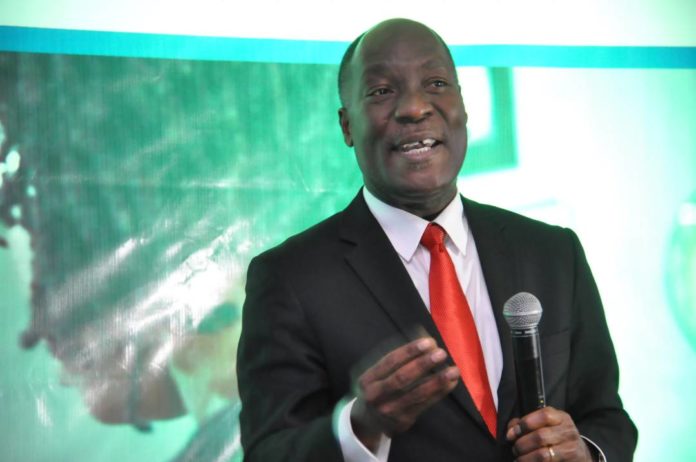
Speaking to the trainees, Standard Chartered Bank’s Chief Executive Officer, Albert Saltson, said his bank would continue to support them to acquire employable skills but challenged to have good work ethics and do their work to the best of their abilities.

“Try as much as to excel in what you do and you will be able to climb the career ladder,” he said, urging the youth to be focused so as to overcome challenges that may come their way.

Saltson advised the youth to develop their careers further, saying that having the first degree or diploma was not enough given the current competition in the job market where those with more skills and knowledge are preferred. “Learning never stops. Add more qualifications to your name,” he said.

He urged the youth to identify mentors who can help them achieve their career goals. “Look at what made that person achieve what he achieved. Take that person as your mentor or role model,” he said.

Sylvia Mulomi – Country Head Human Resources at Standard Chartered Bank, urged the youth to engage in activities that make them be ready for employment.

“Be employment ready. Know what you want to do and find out what it takes to do what you want to do,” she said.

Mulomi however advised the female youth to resist sex demands from employers, challenging them instead to be flexible and begin with the opportunities that come their way.

She said it was important for the youth learn about the organisations they want to work with before even applying for the job.

Human resource consultant Paul Olweny who spoke to the male dominated group of trainees said they were trained in CV writing, cover letter writing, interview techniques.

He urged the youth to review the job specifications before applying. “Your qualifications, skills, knowledge and experience should match the job specifications,” he said.

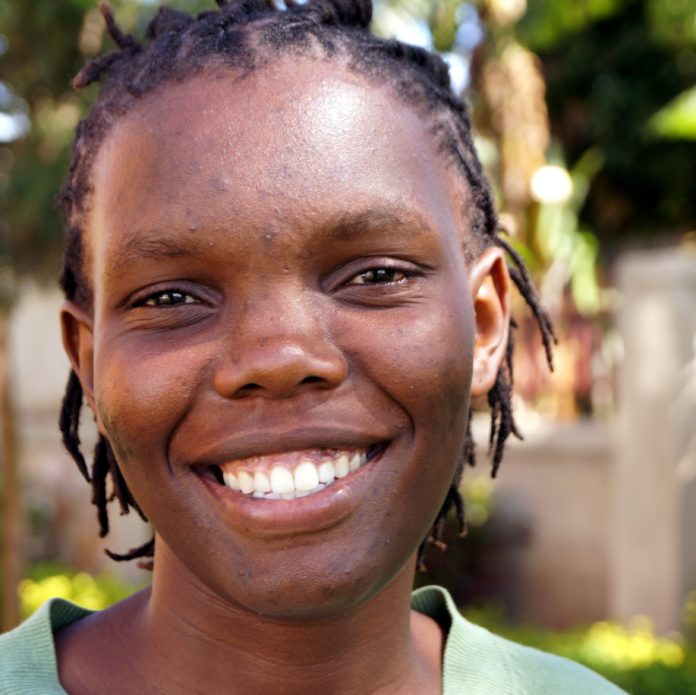
One of the trainees who preferred her first name Allen, appreciated KCCA and Standard Chartered Bank for availing them with the training opportunity. “I have been jobless for two years now since I graduated but I am hope full that the training will increase my chances of passing interviews,” she said.

Stories Continues after ad

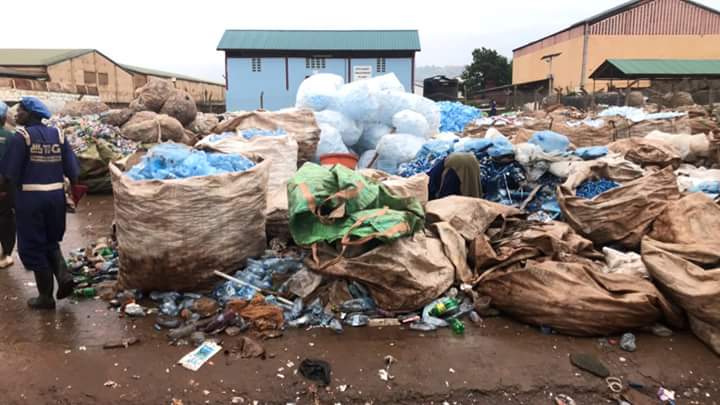
US Ambassador tips Ugandans on fight against plastics pollution

The US Ambassador to Uganda, Deborah Malac has urged Ugandans to wage war on plastics pollution.

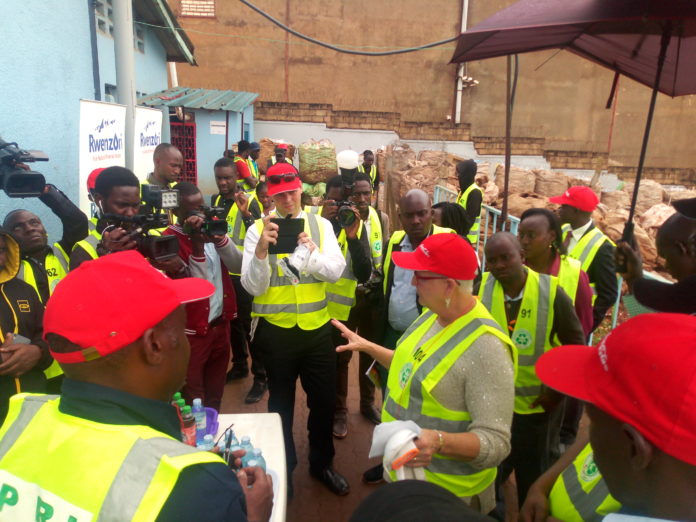
In her World Environmental Day message at the Plastic Recycling Industries (PRI) plant in Nakawa, a subsidiary of Coca-Cola Beverages Africa, Malac stressed the importance of Ugandans pledging themselves as individuals, citizens and members of the global community in ensuring a clean environment through proper disposal of plastics.

She used the event to applaud PRI on environmental stewardship exhibited and the clear tracking of their targets monthly.

“Being able to collect 34 per cent of the plastic you produce as CCBA is a step in the right direction,” she lauded the partnership route and agreed that the plastic problem requires collective effort.

“I would like to thank Coca-Cola Uganda for what they are doing to make a difference. They are picking plastic from the streets, sewage and water ways.”

In January 2018, the Company launched a global goal to fundamentally reshape its approach to packaging through its World Without Waste initiative.

This initiative aims to collect and recycle the equivalent of 100 per cent of its packaging by 2030.

“In Uganda, we know we have a waste problem. Two years ago in 2016, Plastic Recycling Industries (PRI), the largest plastic recycling business in Uganda became a subsidiary of Coca-Cola Beverages Africa on July 1, 2016 when The Coca-Cola Company, SABMiller plc and the Gutsche Family Investments (GFI, majority shareholders in Coca-Cola SABCO) announced the combination of their bottling operations of non-alcoholic ready-to-drink beverages businesses in Southern and East Africa.

“PRI collects about 10 tons of plastic daily, ridding the environment of close to 400 tons of plastic per month. It employs 45 people directly, 80 casuals and empowers 1,500 plastic collectors to earn a living, 80 per cent of whom are previously unemployed women,” explains Conrad van Niekerk, Managing Director of Coca-Cola Beverages Africa Uganda.

This year, the UN is calling on people across the globe to help “Beat Plastic Pollution” a theme that is very relevant to us as Coca-Cola Beverages Africa (CCBA).

A series of activities have been organized to commemorate theme throughout the month and can be followed on; #BeatPlasticPollution
#worldwithoutwaste

Stories Continues after ad

Bobi Wine: Why am I endorsing Counsel Asuman Basalirwa?

Bobi Wine and Asuman Basalirwa in Bugiri during nomination.

Dear friends,

A few people have been asking me why I decided to endorse Counsel Asuman Basalirwa in the upcoming Bugiri Municipality MP elections. Let me use this opportunity to explain why.

First of all, let me remind you all of the nature of struggle we are involved in. I have at all times said that we need a united force to fight and defeat dictatorship in Uganda. The struggle we are involved in is not a struggle of political parties, religions or tribes.

It is a struggle to liberate our motherland from the chains of corruption, bad governance and dictatorship. It is not a personal war and none of us should lay claim on it. It is a battle between the people of Uganda and a small clique of people who continue to impose themselves and oppress our people.

Therefore, in this struggle, we need to try as much as possible to unite all the forces of change to fight a common enemy. Not a personal enemy- but the enemy of the progress of our nation!

And so, just like we did in the recent elections in Jinja and Rukungiri, I had hoped that we would all unite behind one candidate in Bugiri Municipality because we have seen it work elsewhere. This is because my belief is that the very first step towards emancipating our nation is UNITY.

Surprisingly citizens seem to be ahead of us, leaders, in understanding this simple fact. Wherever I have gone, people have been clear that they want to see a united team fighting for them. Therefore, that was our initial prayer and effort with regard to the Bugiri election. Unfortunately for some reason it failed.

Although it is never too late, as it stands we have two candidates on the opposition side- Counsel Asuman Basalirwa and Ms. Eunice Namatembe. Having come to the cross-roads, we needed to make a decision. The question was, what is the right thing to do? If our overall objective is to liberate our country from dictatorship as soon as possible, on which side must we stand?

I must confess that it was a tough decision because Eunice Namatembe is a freedom fighter like the rest of us. She is also on the side of liberation and I would support her at any point if the circumstances did not raise the kind of conflict they have raised.

However, I felt more compelled to stand with Counsel Asuman Basalirwa and I fully endorse him without reservation. Looking at all factors, I am persuaded that a win for Basalirwa would be a great addition to our overall objective of emancipating Uganda.

My conscience is very clear that we need Counsel Basalirwa to win this election. We must stop looking at these elections as mere events, or simply as opportunities for people to get jobs. These elections symbolize resilience. They must be viewed as the fire that reignites the liberation struggle. For we have seen that our problem today is not just that we have many bad leaders. No. In fact, the bigger problem is that we have many leaders who know what is right and what is wrong, but they choose not to say it or stop the wrong because they are afraid of the consequences.

To break that, we need tested men and women on the frontline. We need people who will stand and be counted. Asuman Basalirwa is such a man.

Some people will be shocked to learn that I did not know Asuman closely before. But anyone who has been following the politics of our country knows what counsel Basalirwa’s contribution has been to this struggle and what he is capable of. Right from the time he was Guild President at Makerere, Basalirwa has been on the side of Uganda. He has been arrested and jailed countless times fighting against injustice. We have seen him crisscross courts of law- from the lowest to the highest, defending opposition leaders, representing activists and arguing the case for good governance and human rights for all. In 2016, we saw him aggressively argue the presidential election petition.

He has been a regular visitor at different police stations all over the country to secure bond for political prisoners and to protest against illegal detentions. He has done these things countless times without even charging legal fees. We have seen him campaign zealously for progressive candidates so many times.
He has stood with our comrades in the struggle regardless of their political affiliations! Asuman has been there for FDC, for UPC, for DP, for JEEMA, for CP, for Go-Forward and yes for Uganda. He has been there for us and my conscience tells me that we should be there for him.

Basalirwa believes that young leaders have a role to play in shaping our nation. In 2010, he was elected youngest Party President in Uganda’s history at 33. I feel very proud to identify with such a man! We must desist from being petty. When necessity calls, we must be willing to put aside personal ambitions and party or other differences and work for the greater good of our country. If our aim is indeed to change Uganda for the better, let us walk this talk for the sake of our people and our nation.

And that is why I pledge that when duty calls I will answer, guided by one principle- whoever is for Uganda is an ally. Whoever is against Uganda is a foe. Period!
I therefore, request the people of Bugiri to support Asuman Basalirwa in every way so that we quicken our mission to free Uganda. I will be there personally to campaign for this great son of the soil.

Finally, I leave you with two quotes. Martin Luther King Jr said, “There comes a time when one must take a stand that is neither safe, nor politic, nor popular, but he must take it because conscience tells him it is right.” Nelson Mandela said, “Any man who changes his principles according to whom he is dealing with- that is not a man who can lead a nation.” May these timelines words always inspire us to be true to good conscience and loyal to our principles at all times. God bless Uganda.

Robert Kyagulanyi aka Bobi Wine is the MP for Kyadondo East

Stories Continues after ad

Lionel Messi ahead of Cristiano Ronaldo on Forbes rich list

Lionel Messi with wife Antonella Roccuzzo

By Agencies

As the World Cup tourney nears in Russia, Barcelona star Lionel Messi has moved above Real Madrid rival Cristiano Ronaldo in the rankings in the annual Forbes list of the world’s 100 highest-paid athletes but football lost top spot to boxing’s Floyd Mayweather.

Messi, with earnings of £82.9 million, occupies second spot behind Mayweather, with Ronaldo in third on £80.6m.

His move above Ronaldo comes after he signed a new contract at the Camp Nou, with Brazil star Neymar (£67.2m) now in fifth place following his world-record move from Barcelona to Paris Saint-Germain last summer.

Forbes said Messi’s annual salary and bonus was more than £59m before tax, making him the year’s highest-paid player, with endorsement deals with companies including Adidas and Pepsi adding to his fortune.

Ronaldo has a place in the list’s top three for a sixth successive year, while Neymar has risen 13 places to fifth after putting pen to paper on a lucrative five-year contract with PSG.

Stories Continues after ad