Stanbic Bank
Stanbic Bank
24.7 C
Kampala
Stanbic Bank
Stanbic Bank
Home Blog Page 1551

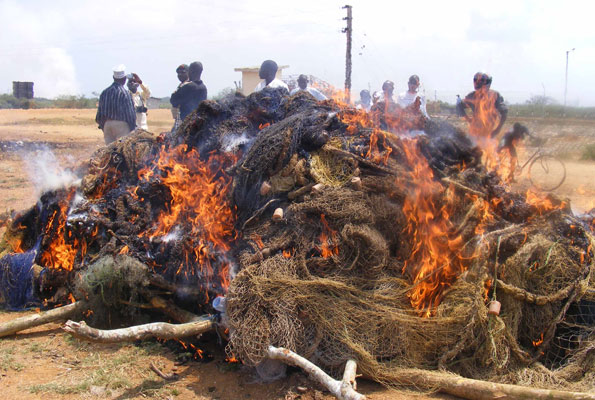
International Day for the fight against illegal fishing set for June 5

Fisheries law enforcement officers burn illegal fishing nets

As the international community’s efforts to ensure sustainability of fisheries are serious compromised by illegal fishing activities, the United Nations says as the world prepares to observe the International Day for the Fight against Illegal, Unreported and Unregulated Fishing on June 5, 2018.

Experts note that fisheries provide a vital source of food, employment, recreation, trade and economic well-being for people throughout the world.

“In a world of growing population and persistent hunger, fish has emerged as an important commodity for the achievement of food security. However, efforts by the international community to ensure the sustainability of fisheries are being seriously compromised by illegal, unreported and unregulated fishing activities,” they say.

According to the UN Food and Agriculture Organization (FAO) illegal, unreported and unregulated fishing activities are responsible for the loss of 11–26 million tonnes of fish each year, which is estimated to have an economic value of US $10–23 billion.

To curtail this impact, UN notes, Target 4 of Goal 14 of the Sustainable Development Agenda adopted in 2015 by the UN General Assembly, specifically urges the international community to “effectively regulate harvesting and end overfishing, illegal, unreported and unregulated fishing and destructive fishing practices” by 2020.
“Meeting this ambitious target requires strong awareness-raising efforts to draw the attention of the general public to the negative impacts of illegal, unreported and unregulated fishing activities, an activity in which FAO has been actively engaged,” it says.

To promote long-term conservation and sustainable use of fisheries resources the 1995 FAO Conference adopted the FAO Code of Conduct for Responsible Fisheries. The Code is voluntary and sets out principles and international standards of behavior for responsible practices with a view to ensuring the effective conservation, management and development of living aquatic resources, with due respect for the ecosystem and biodiversity.

In 2009 the FAO Conference adopted the Agreement on Port State Measures to Prevent, Deter and Eliminate Illegal, Unreported and Unregulated Fishing. The Agreement is binding and stipulates minimum port State measures to prevent deter and eliminate illegal, unreported and unregulated fishing. It entered into force on 5 June 2016.
In Uganda, illegal fishing methods have pushed back foreign earning, according to the The Minister of Agriculture Animal industry and Fisheries, Mr Vincent Ssempijja.

He said then that: “Currently Uganda earns about $150m (Shs542 billion) in exports annually but some time back when all factories were operational, we were earning US $400m (Shs1.4 trillion), which I believe if all regulations were in place we could earn double that figure to a tune of US $800m (about Shs2.8 trillion) annually.”

The minister Ssempijja made the statement while addressing journalists during the pass out ceremony of the UPDF officers of the Fisheries Protection Force (FPU) at the Fisheries Training Institute in Entebbe.

He said there was need to protect the fisheries sub-sector which contributes 3 per cent to the national GDP and 26 per cent to the agriculture sector GDP.

Stories Continues after ad

Martyrs day: Police is stuck with 23 children, 28 suspected criminals

Luke Owoyesigire

Kampala: Police is still stuck with 23 children who got lost as the country celebrated martyrs day at both the Catholic and Anglican shrines.

Speaking at the press conference held central police station (CPS) Kampala Metropolitan Police Spokesperson, Luke Owoyesigyire said they had over 30 children many of whom were separated from their parents at the time of drawing ‘holy water’.

Owoyesigyire revealed that they are still holding 28 people suspected to have indulged themselves in crime and they are currently being held at Kira Division police station.

“As we garner information about them, they will be presented in courts of law and those with minor cases will be released on police bond,”

He further said that whoever lost property should not to lose hope because police recently launched an application called lost and found that can be down loaded on smart phones to trace your property.

“If you lost your property, documents go to that application and insert in your name, phone numbers and the property you lost. When we discover them, we shall publish them and tell you a particular police station where you can get them,” he said.

He applauded pilgrims for observe peace and law as the celebrations went down.

Stories Continues after ad

NWSC commissions water supply system

Workers of NWSC

The National Water and Sewerage Corporation has commissioned the new Ssisa Water Supply system along Entebbe Road.
The new project will boost water supply to Ssisa, Lutaba, Gayaza, ICT, parts of Sekiwunga, Zziru villages and the surrounding areas.

Major works of booster station construction, 4.5 kilometers of distribution mains and installation of a 162,000 litres capacity water reservoir.

The system works include: Construction of a booster station, laying 4.5 kilometers of Entebbe area

Engineer Anthony Ojok said the area office has completed other interventions to boost water supply along Kasenyi Road and Lyamutundwe, Kawuku-Wamala, Ziiru, Ssisa, Lutaba, Sekiwunga , Akright, Kabulamuliro, Bwebajja, Nganjo, Dewe, Kajjansi-Lumuli, Makandwa, Nakigalala, Kitovu, Mazzi, Bweya, Kitende, Kawoto and the surrounding areas.
The Director Engineering services Eng. Alex Gisagara said that the corporation has embarked on extension and intensification of the network to extend services and serve more people in all corners of Uganda.
According to NWSC Managing Director, Eng. Silver Mugisha, the corporation has stepped up works under the Service Coverage Acceleration Programme (SCAP100).

“The programme is aimed at improving lives of the people of Uganda with clean safe water in over 12,000 villages in Uganda by 2020.” he said.

Other projects that have been completed include: Upgrade of the booster station in Nsamizi- Entebbe to deliver more water to Kawuku and Kajjansi from the Entebbe network to cater for the growing demand for services.

And Upgrade of Namulanda booster station to double the current volumes of water being lifted to Akright reservoir for distribution to consumers and Installation of a new pump at Kitende booster station.

Stories Continues after ad

Sudhir expands empire by opening of another building in Kampala

City Mogul, Sudhir Ruparelia is at it again just few months after opening another building in Nakasero area.

On the weekend, Rajiv Ruparelia, the Managing Director of Crane Management Service, opened up a building on 5th street industrial area.

Rajiv being briefed by constructors.

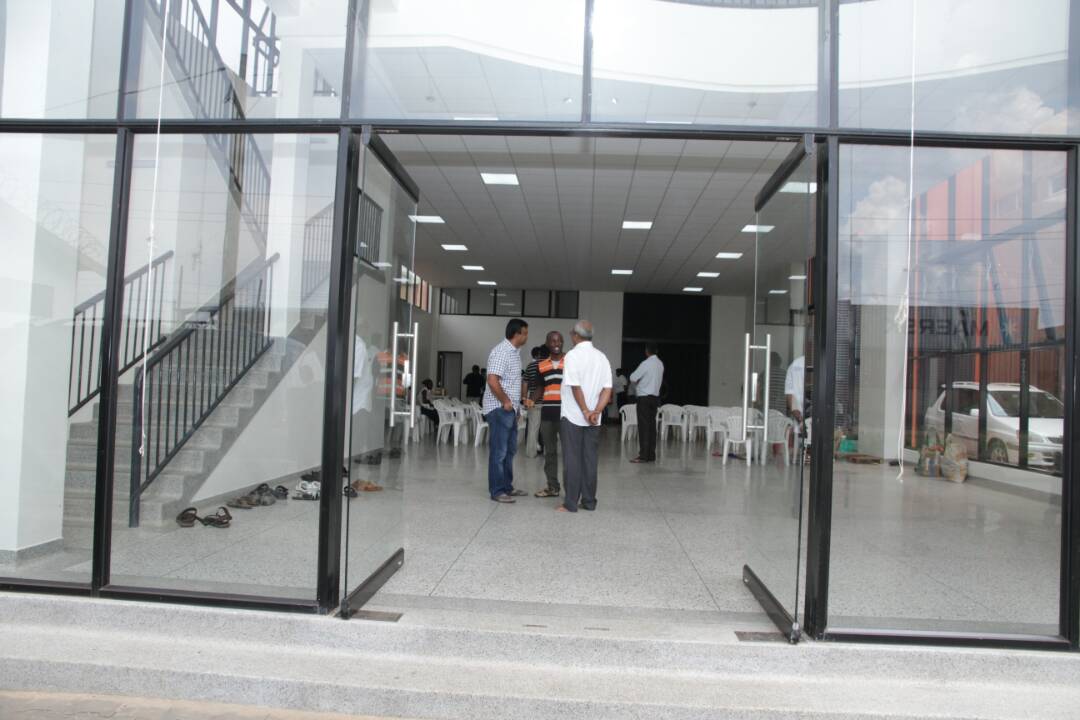
According to Rajiv, the building is to cater for a combination of ware house, office and showrooms.

“It is three in one and it will cater for those that want to shift away from the congested city centre but who would want work in such an environment. However, the structure has got space for showrooms as well as enough parking” Rajiv said.

The has building is 1600 meters of the total area. Sudhir will in July unveil another state of art building that is under construction at Shimon grounds. Crane Management Service is the largest property service in Kampala.

Stories Continues after ad

Parliament asks Museveni to intervene in Apaa eviction

Justice and Constitutional Minister, Ephraim Kamuntu.

Parliament has asked President Yoweri Museveni to intervene into the planned process of evicting people from and around Zooka forest and game reserve an area that is situated in Apaa Parish, Paboo Sub County in Amuru district.

The request by parliament chaired by Deputy Speaker Jacob Oulanyah came after the Leader of Opposition in Parliament Winnie Kiiza asked government to explain the continuous land conflicts between the Madi and the Acholi as government resolved that both encroached on game reserve’s land.

“Given that the president has taken the initiative to have a permanent solution to this problem, any activities on the remaining land should cease until the he gets on the ground. The earlier the president goes there, the better for all of us,” said Oulanyah.

According to a report presented by the Minister of Tourism, Wildlife and Antiquities, Prof. Ephraim Kamuntu, out of the 827 square miles of the land in question, locals have been evicted from 400 square Miles.

“There is no conflict among the people; the conflict is instigated by some leaders who instead of going to courts of law want to incite violence. Despite the demarcation, locals from Gulu, Adjumani and Amuru districts continue to encroach on the forest reserve,” he said in parliament.

He regretted the incident of March 23, 2018 where one of the locals was shot dead by the patrol team, “It is unfortunate that a group of 20 youths suspected to have been poachers, and armed with bows and arrows, attacked a patrol team, the team had tried to avoid confrontation with the hostile group and retreated from the attackers who continued to pursue them,” said Kamuntu.

The First Deputy Prime Minister, Gen. Moses Ali also appealed to MPs to allow the president to resolve the issue, “President Museveni has already committed to solving the Apaa land conflicts and he should be given the opportunity to do so,” he added.

“Even if the president is going to de-gazette the land, he will have to follow the procedure and consult the people of Adjumani,” said Gen Moses Ali.

However, Kilak South MP Gilbert Olanya accused government of evicting the locals to clear the land for an investor from South Africa.

“The investor is already advertising that he has acquired about 42 square kilometers of land in Apaa. Government should instead de-gazette the land for the locals and find better ways of getting land for investors,” said Olanya.

The land conflicts between the Madi and the Acholi in the northern Uganda date way back to 2015 when members of the two tribes attacked each other, following with claims that the Madi had settled on Acholi land in an area stretching from Zooka Bridge to Aliwala.

Stories Continues after ad

Must the gods and dead chiefs, Kings return to preserve us?

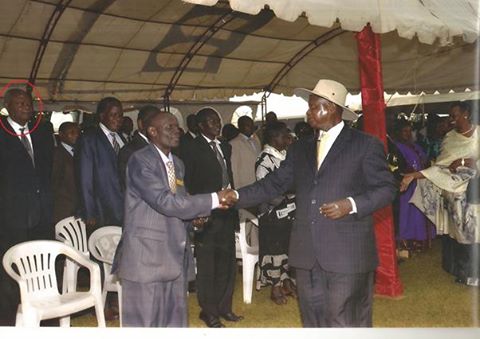
HULLO: President Yoweri Museveni greets the author Mr Nabende Wamoto.

BY NABENDEH WAMOTO

Are the dotcom proponents worst enemies of our generation than our primitive, ancient forefathers who did wonders to practice sustainable land management such as pooling of labor, contours, fertility enhancement with homemade manure e.t.c?

Conservation is internationally described as the protection of flora and fauna, an area placed under public control for the protection and preservation of wild vegetation and animal life for the benefit, advantage and enjoyment of the general public whose boundaries cannot be altered either by presidential or royal decree except by competent legislative authority i.e. the August house (Parliament) of Uganda.

Therefore issues of hunting of fauna and collection of flora is prohibited except again with permission of the conservation authorities like Uganda wildlife Authority.

BAMASABA KAMPALA CHAPTER BRIEF.final

It must be recalled that conservation of game for example started with rulers (Kings) who used to go hunting in the wild. However as people learnt how to develop and use sophisticated weapons (firepower), they threatened the Kings interests by reducing the number of game so in order to protect their interests, the rulers put regulations on the hunting activities which protected game.

The Roan Antelope in South Africa for example exclusively belonged to the Kings and in the same way Ivory in Toro belonged to the Omukama (Toro King) and no other person was allowed to own the trophy. Conservation or park creation in the United States of America was first initiated in 1872 with YELLOWSTONE conservation area i.e. National Park and from hence the idea of conservation spread to other areas albeit with different themes.

In Africa, the first practical move of a conservation area was the Sabi game reserve established in the Transvaal in 1898 which later became known as Kruger national park from 1926.

Before Kruger was named a park, Virunga national park (then Albert national park) was declared in 1925 in the then Belgian Congo, later called Congo Kinshasa, Zaire and now Democratic Republic of Congo to protect mainly the mountain gorillas (scientifically known as Gorilla gorilla berengei).

Uganda joined in the fray and at the moment there are 10 national parks Viz: Murchison falls, Queen Elizabeth, Kidepo valley and Lake Mburo national parks which are which are dominantly grasslands, mount Rwenzori and Mgahinga gorilla national parks which are dominated by tropical montane forests, Bwindi impenetrable forest national park which is dominantly low land tropical rain forest, Kibaale forest, Semuliki and Mt. Elgon national parks.

If the ancient leaders would conserve how then can the dotcom ones destroy like what is happening on Mt. Elgon parks?

NABENDEH WAMOTO S.P (0776-658433)
Kenya Utali College Alumni
Email: simonwamoto@yahoo.co.uk

Stories Continues after ad

Minister Mukwaya calls for protection of women at work

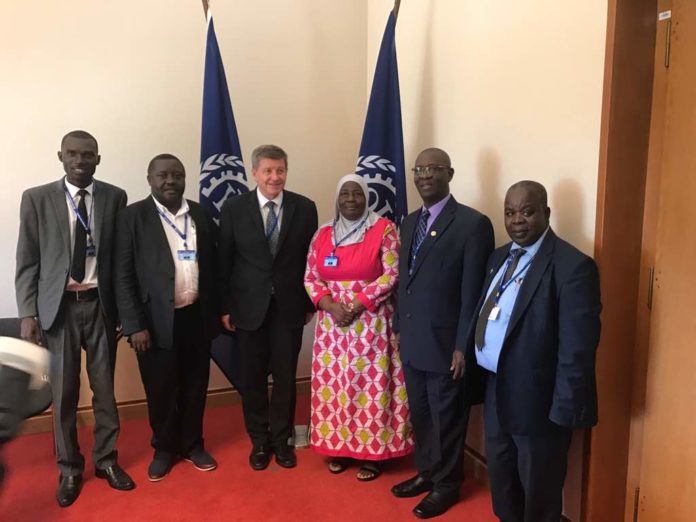
Gender Minister Janat Mukwaya (3rd R), Permanent Secretary Pius Bigirimana (2nd R) and other members on the Ugandan team with the Director General of ILO, Guy Ryder at the ongoing Labour Conference in Geneva

The Minister of Gender, Labour and Social Development Janat Mukwaya has called on labour actors at the international scene to ensure that more efforts are put into protecting women against violence and harassment at work.

Mukwaya observed that women are subjected to violence and harassment at work than men but unfortunately, although violence against women is widely acknowledged, few people raise a voice against the vice.

“For others, the violence and harassment is seen as conservative stereotypes, but it is the reality that has to be tolerated as part of life. I am therefore, pleased that the International Labour Organisation is working on an international labour standard on ending violence and harassment at work,” she noted.

The Minister was speaking at the 107th Session of the International Labour Conference that’s underway in Geneva, Switzerland. The conference runs from 28 May –8 June 2018.

Mukwaya is leading the Government of Uganda delegation which also includes Mr. Pius Bigirimana, the Permanent Secretary, Ministry of Gender, Labour and Social Development, Mr. Peter Werikhe, Secretary General National Organisation of Trade Unions and Mr. Douglas Opio, the Executive Director of the Federation of Uganda Employers.

The International Labour Conference is the ILO’s highest decision-making body.

It meets annually, bringing together the tripartite delegations from the Organization’s 187 member States and a number of observers from other international actors to consider a series of topics related to the world of work, placed on its agenda by the Governing Body of the ILO.

.

Among the committees is the Standard Setting Committee on violence and harassment in the world of work, where Uganda and
She appealed that the standard setting should be followed by domestication in the various countries and establishment of well-resourced and functioning institutions against violence at work.

“Furthermore we must enable women to take their destiny into their hands through education, employment creation and enterprise development.”

“Similarly, imbalances in asset ownership especially land should also addressed. This is because where males own and control land, access to finance will also be skewed in favour of men yet capital is crucial for improvement of livelihoods of women through enterprise development,” the Minister noted.

She cited that of the 192 million unemployed people in the world, 114 million of them are in developing countries.

“Gender gaps are also a matter of concern. A woman is associated globally with 30 per cent less chance of being in the labour force and often being at the bottom of the economic ladder. Women continue to be paid approximately 20 per cent less than men per month across the world, even when they are engaged in the same or work of equal value,” she said.

She added that Uganda welcomes the ILO-initiated women at work centenary initiative which aims to better understand and deliver decent work for women in the 21st Century.

Stories Continues after ad

Trade war continues as Kenya gives Uganda ultimatum to lift ban on sweets

Uganda imposed tax on Kenya-made sweets

Kenya has given its neighbours Uganda and Tanzania one more month to lift an embargo on duty-free entry of Kenya-made sweets or face retaliatory action from July 1, when new the financial year 2018/19 begins in the East African Community (EAC) bloc.

Uganda and Tanzania in March this year imposed a 25 percent import duty on Kenyan confectionery, juice, ice cream and chewing gum earlier in the year on grounds that makers were using zero-rated industrial sugar imports.
The two countries rejected certificates of origin issued by the Kenya Revenue Authority (KRA) and opted to levy the import duty on the confectioneries.
Acceptance of the certificate, a document showing where a good has originated so as to determine the import duty chargeable — guarantees goods to enter tax-free into partner states of the EAC as outlined in EAC Common Market Protocol.
Sources say revenue and standards bodies from both countries will separately visit Kenyan factories from June 11 for verification in a bid to resolve the embargo.

Sources say Kenya will make a decision by June 30 and communication will be made by the EAC secretariat on the findings of that verification.

The verification process, to be supervised by the EAC’s secretariat, will extend to factories making other products such as cement, lubricants, cosmetics and wooden pallets which have also had difficulties gaining free access into Tanzania.
Uganda and Tanzania revenue authorities accuse the Kenyan manufacturers of tilting competition in their favour by using industrial sugar imported under a 10 percent duty remission scheme.
The region does not produce industrial sugar. In April, Kenyan firms accused Uganda and Tanzania of using the customs taxes to restrict trade in the EAC.
The two countries have lists of Kenyan products they suspect do not meet the rules of origin, which forms the basis for qualification for duty-free market access within EAC under the common market protocol of July 2010.

Official statistics show Kenya’s exports to Uganda fell 9.52 per cent to Sh12.92 billion in the first three months of the year 2018 compared to last year, while Tanzania’s rose 20.37 percent to nearly Sh6.01 billion.

According to sources, officials will investigate availability of stocks of duty-free raw sugar shipped into the country under the one-year zero-rate duty remission scheme that Kenya sought from the EAC secretariat last July.

Reduced sugar production in the region as a result of a recent prolonged drought, allowed importation of raw sugar at zero tax.

Stories Continues after ad

Keys to recharging passion and purpose in business

By Martin Zwilling

New entrepreneurs routinely jump into a startup with a full charge of passion and energy, but often find themselves drained of both after a few months by the workload and challenges. As a result, burnout and loss of passion are consistently listed among the top causes of startup failure, according to many experts. The challenge is find ways to continually recharge along the way.

Of course, this same challenge extends well beyond the entrepreneur, into all walks of life and work. I found some great insights in the classic book, “Are You Fully Charged?” by human relations expert and bestselling author, Tom Rath, which explains well the three keys to energizing all your life pursuits. These keys are meaning, interactions, and energy.

Based on my experience working with early-stage startups, I agree with Guy Kawasaki, that those entrepreneurs who set out to make meaning in the world (a positive change) create the companies that will most likely be successful. I have paraphrased Rath’s eight recommendations on making meaning as key focus principles that every new entrepreneur should take to heart:

Create meaning with small wins. Celebrate small wins by asking yourself what can you do today to make a difference? Real meaning is made up of many small differences, such as a design breakthrough, new business model, a truly satisfied customer, or an excited team member. Take a moment to enjoy each of these and get recharged.

Pursue life and meaning, as well as a solution. Finding meaning is driven from within, through new learning and overcoming challenges. Every startup has a wealth of these opportunities. Successful entrepreneurs often admit that they enjoyed the journey more than the destination. Meaning does not happen to you – you create it. Don’t wait.
Make your startup a purpose, not just a business. Strive to see the work you do to build a business as the way to make a difference in the world. Make sure your team understands your shared mission, meaning, and purpose. Making meaning is making your life, and the lives of others, stronger as a product of your efforts.

Find a higher calling than cash. Happiness does not scale up with income. Studies show that doubling your income might increase happiness by 10 percent. In addition, focusing first on money will kill meaning. The more you focus your efforts on others, the easier it is to do great work without being dependent on money, power, or fame.
Ask what the world needs. You create meaning when your strengths and interests meet the needs of the world. One of the rightful critiques of all the “follow your passion” advice is that it presumes you are the center of universe. A better way is to explore the most pressing needs in your social circles, organization, and the worldwide community.

Don’t fall into the dreams of others. If you walk only in the path of others, your own image disappears. Be sure you create your own shadow, spending some time each day engaging in activities that energize and recharge you. Also plan to spend more time around specific people who energize your work and less around those who don’t.
Take the initiative to shape the future. If you want to make meaning in the world, your ability to do so will be almost directly proportional to the amount of time you spend initiating instead of responding. Being busy is often the antithesis of working on what matters most. Usually you have to focus on less to do more.

Work in bursts, paired with time to recharge. This can mean focus for 45 minutes, followed by a break for 15 minutes. Short breaks allow you to refresh yourself and work with purpose. Try to remind yourself daily why you do what you do, and if you don’t like what you hear, it’s time to change to something that has more meaning for you.

In an author survey of 10,000 people, only 20 percent admitted to spending much time doing meaningful work yesterday. Only 11 percent reported having a great deal of energy at work. Clearly, most entrepreneurs are operating well below their capacity, and could be more effective in building their business or making new meaning in the world. If you are one of these, then it’s time for you to change before you burnout and disappoint everyone, including yourself.

Stories Continues after ad

BoU in financial crisis after making loss of Shs494b

Bank of Uganda

The Central Bank –Bank of Uganda currently under probe by the Auditor General (AG) over the mismanagement of properties of closed banks is under a financial crisis after making a loss of Shs494 billion now is seeking capitalization from central government, sources say.

Following instructions from Parliament’s Committee on Commissions, Statutory Authorities and State Enterprises (Cosase), the office of the Auditor General is carrying out a broad forensic audit into the operations of Bank of Uganda and is demanding accountability for Shs200 billion taxpayers’ money that was injected into Crane Bank before it was sold to Dfcu Bank.

Interestingly, despite injecting Shs200 billion of the taxpayers’ money into Crane Bank capitalisaiton, BOU sold the bank to its competitor- dfcu at the same amount. Leaked documents show that dfcu will pay the money in installments.

However, Jinja Municipality East MP Paul Mwiru who was the Vice Chairman of the Public Accounts Committee in the last Parliament, earlier said that BOU top managers must account for Shs600 billion not Shs200 billion, claiming that before the release of Shs200 billion to Crane Bank under the guise of capitalization, Parliament had already capitalized BoU with Shs400 billion.

Having acquired Crane Bank in January 2017, Dfcu reported Shs127 billion net profit as of December 2017, up from just Shs46 billion in 2016.

The Auditor General John Muwanga was also instructed by Cosase to look into Crane Bank sales agreement that was signed in January 2017 between BoU and Dfcu Bank. Former Crane Bank shareholders are seeking legal redress because of the way the bank was sold, without putting their interests into consideration.

Cosase is in possession of a Crane Bank shareholders’ document disputing the sale and summing up the sales agreement as fraudulent and it has also been passed to the Auditor General’s office, which will carry out the forensic audit.

Some of the issues Cosase wants the auditor general to look into are; the cost of Crane Bank liquidation, assets management, hiring of external lawyers, liabilities and also the status of all the banks closed by the central bank.

The Auditor General’s office has confirmed that the forensic audit into BoU is ongoing and that they will leave no stone unturned.

.

Stories Continues after ad