Stanbic Bank
Stanbic Bank
24.7 C
Kampala
Stanbic Bank
Stanbic Bank
Home Blog Page 1552

Museveni assures Anglicans on Church House project

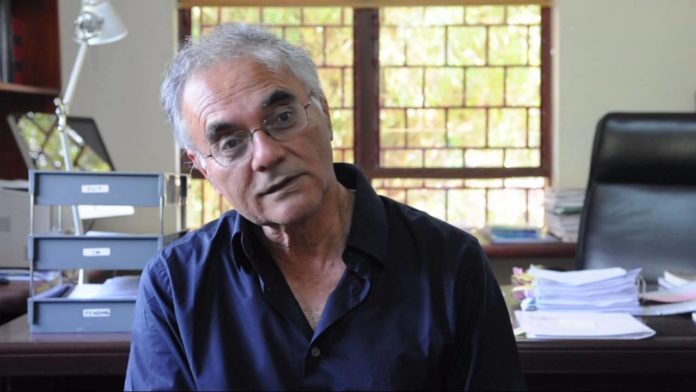
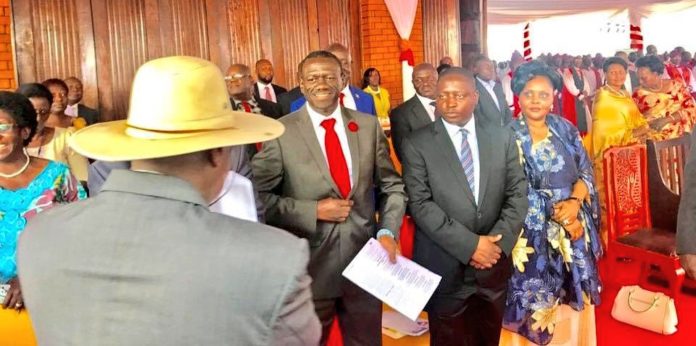
President Museveni greeting Dr. Kizza Besigye

President Yoweri Museveni has given assurances to the Church of Uganda that no one will take away Church House from the Church as long as he is still alive.

The President was speaking at the Anglican Shrine in Namugongo, Wakiso District during the annual Uganda Martyrs’ celebrations. Kigezi Diocese led the celebrations for this year’s Martyrs’ Day celebrations.

President Museveni said he had seen media reports to the effect that the Anglican Church risked losing the multi-billion Church House building located in Kampala City Centre to businessmen.

“I saw in the news today that you have issues with the Church House. They want to steal it from you. Archbishop Orombi and I worked very hard to get that house. As long as the Lord has put me here, I will not allow it to happen. I will meet and discuss with the leaders,” he said.

Church of Uganda owes Equity Bank debt of Shs2.6 billion in interest. The bank in a February 9, letter, had given the Church of Uganda only three weeks to pay, or the house would be advertised for sale.

Meanwhile, the President was happy that the numbers of Church of Uganda pilgrims attending the annual pilgrimage at Namugongo had increased. He promised to help the Church of Uganda so that Anglicans further develop their site at Namugongo to a higher level like their Catholic neighbours have done to theirs.
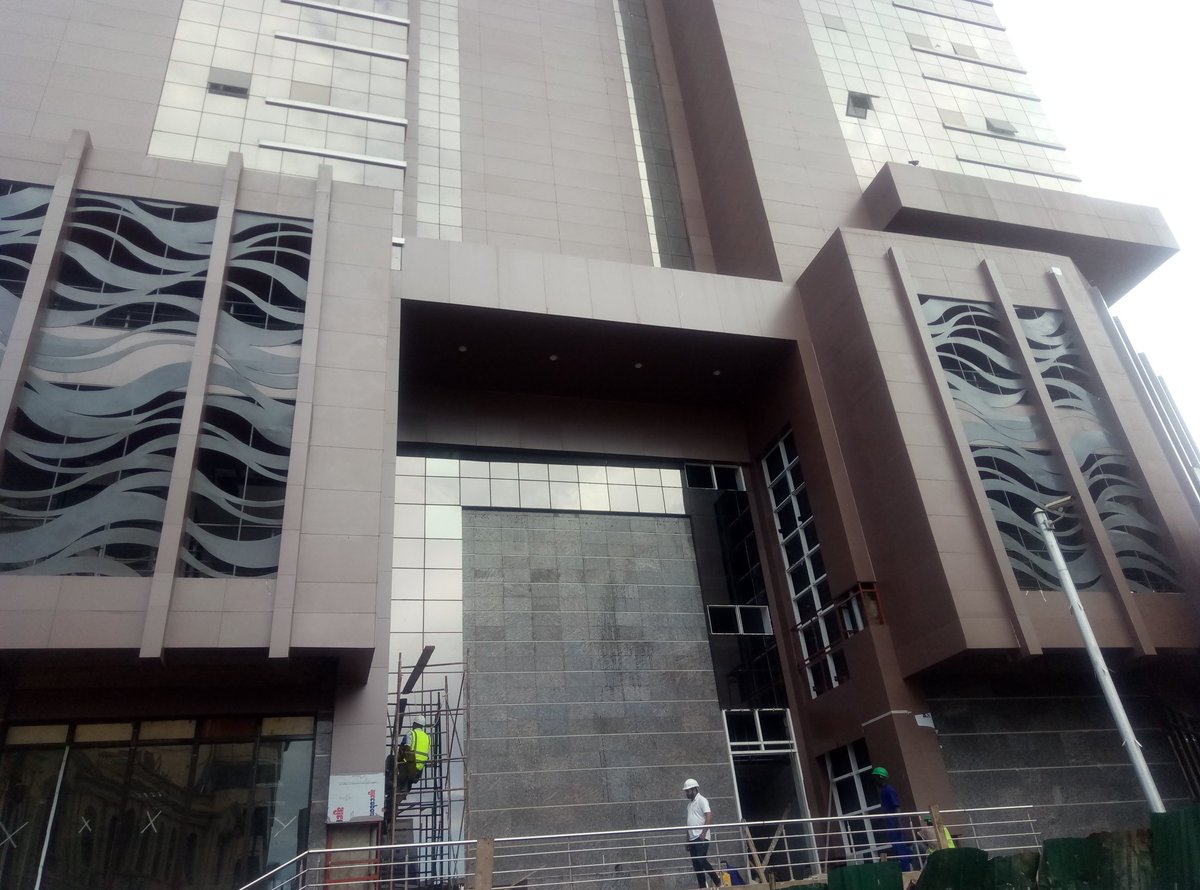
Church House in final touches.

“Some of you do not know that the majority of the Martyrs were Protestants. You used not to pay so much attention to this day but now you are awake. I congratulate you. We are going to develop this place like that of your brothers because I have noticed that the gradient here is too steep,” he remarked.

The President used the occasion to encourage the pilgrims to work hard for the transformation of their homes and chase away poverty. He called for efforts to live exemplary lives like that of the disciplined Puritans who played a crucial role in the building of the United States of America.

“There is a saying that in this world, we are visitors and we are passing through. So some people do not care to develop their lives. The Bible says that the body is the temple of God, but if it is full of prostitution and drunkenness and poverty, how can it be the temple of God?” he remarked.

In his sermon based on the Scriptures from the Book of Revelation, Bishop David Grants Williams of Basingstoke in the United Kingdom encouraged the pilgrims to be ready to sacrifice their lives for Christ, even to the point of death, just like the Uganda Martyrs. He thanked the President for the stability in Uganda adding it has enabled the country celebrate major events in peace.

Stories Continues after ad

Cancer: Cobalt 60 Radiotherapy machine still functional-Ministry of Health

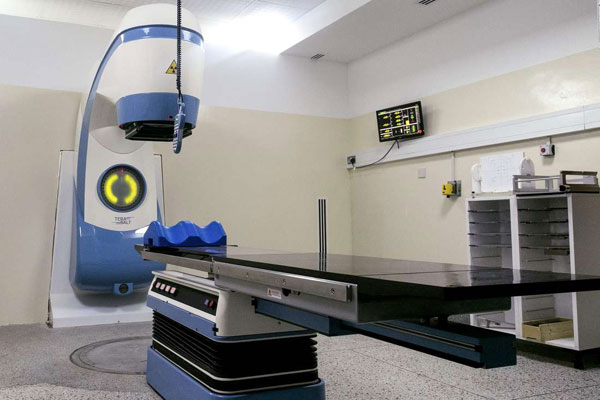
Cobalt 60 Radiotherapy machine

The Ministry of Health has come out to refute media reports that the Cobalt 60 Radiotherapy machine at the Uganda Cancer Institute (UCI) is no longer functional.

“We would like to inform the public that the Cobalt-60 Radiotherapy machine has not broken down and is fully functional,” the Acting Director of Health Services, Dr. Henry G. Mwebesa said in a June 3, media statement.
The machine was imported into the country in August last year at a cost of over Shs3.015 billion ($815,000) and installed at Mulago Hospital in January this year.

Mwebesa said the operations of the machine have been scaled down in preparation for its first periodic servicing which is scheduled for this week, adding that the machine was still under warranty, meaning servicing is to be done for free by the manufacturer.

“The designated technician from the machine manufacturer (UJP-Praha), Mr Bednar Andrej has been contacted and is expected to arrive in the country on Thursday 7th June 2018to undertake the servicing of the machine which will commence on Friday 8th and run through the weekend of 9th -10th June 2018. Normal full capacity operation of radiotherapy services is expected to resume on Monday 11th June 2018,” he said.

He said: “Due to the big number of patients that required the services, the number of patients treated per day drastically increased from about 10 patients upon re-establishment of the service in November and December 2017 to 150 patients per day by the end of March 2018. This has remained the current average number treated per day, with the exception of the emergency cases.”

He said since the installation of the machine, the number of treatment sessions rose from about 20 to over 300 per day and that about 1000 patients have been treated since the restoration of radiotherapy services at UCI last November. “About 15,000 treatment sessions had been done by the end of May 2018,” he said.

Meanwhile he said government has funded the training of three Radiotherapy technicians, who are currently training in Zambia and are expected to back in the country in March next year.

“The construction of additional modern bunkers with six chambers -which will house four linear accelerator radiotherapy machines- has also reached a level of 95 per cent progress and this is intended to fast track the next phase of modernization and expansion of radiotherapy services,” he said.

He said the new machine is; “a high-level and ultra-modern machine and was accepted by both the International Atomic Energy Agency (IAEA) and the Institute for Clinical Use in October 2017.”

Stories Continues after ad

Mamdani returns to UCT centre as honorary professor

Mamhood Mamdani

Ugandan academic Professor Mahmood Mamdani returned to the University of Cape Town’s Centre for African Studies (CAS) as an honorary professor, almost 20 years after he left owing to a disagreement with his faculty.
His return to UCT has been hailed as “institutionally historic” and marking a significant step on the university’s path towards decolonising the institution.

In a statement last week, Professor Lungisile Ntsebeza, CAS director, said: “This appointment is particularly exciting and profoundly significant in light of the pressure from the student movements since March 2015 for the University of Cape Town (UCT) to be decolonised and to fundamentally transform its curricula, with numerous references by student leaders to the relevant scholarship of Mamdani.”

Mamdani was appointed as the AC Jordan chair of African Studies at the University of Cape Town in 1996 and became director of CAS in early 1997. However, he left the institution in 1998 following a fall-out with his faculty over its rejection of a faculty-wide foundation course on Africa that he was asked to develop.

His departure and the events leading up to it became known as the “Mamdani Affair” and still serve as a critical reference point in South African debates about institutional transformation.

In what is described in the CAS statement as a “profoundly historic occasion for both CAS and UCT”, Mamdani returned to UCT to deliver the TB Davie Memorial Lecture on August 22, 2017.

“His lecture – titled ‘Decolonising the Post-Colonial University’ and delivered to a much inspired, excited and indeed provocative and engaged audience of hundreds of students, staff and workers – brought to the public space the vital debates that are currently intensely reverberating across South Africa’s higher education institutions,” the statement said.

Ntsebeza said Mamdani’s course titled ‘Problematising the Study of Africa’ had been rejected by a “white-dominated faculty”. This had led to Mamdani’s public critique that UCT was promoting “Bantu Studies” and “South African exceptionalism” as “African Studies”.

“The appointment of Mamdani as honorary professor in CAS is therefore nothing less than institutionally historic,” he said.

In 1998 Mamdani accused his faculty of presenting a colonial view of Africa from both a spatial and social perspective; drawing on a limited set of disciplinary perspectives; reinforcing a racial reading of Africa by not incorporating African intelligentsia in core readings and relying instead on the American academy’s perspectives on African studies; and presenting a racial periodisation of African history leading to the concluding logic: “disintegration following the departure of the white man”.

However, according to Ntsebeza, almost two decades later, “the core African Studies course he argued for … was successfully implemented as a core course at postgraduate level in African Studies, and much of the themes within his scholarship have been introduced in the highly successful foundational African Studies major first rolled out in 2017.”

Once voted the world’s ninth most important public intellectual by the US’s Foreign Policy and the UK’s Prospect magazines, Mamdani is currently director and professor of the Makerere Institute of Social Research at Makerere University and Herbert Lehman Professor of Government in the departments of Anthropology, Middle Eastern, South Asian, and African Studies (MESAAS), Political Science and School of International and Public Affairs at Columbia University, New York, where he was also director of the Institute of African Studies from 1999 to 2004.

His texts have been core readings for undergraduate and postgraduate studies at UCT and far beyond on the major debates on the study of African history and politics, exploring the intersection between politics and culture, comparative studies of colonialism, civil wars and the state, and genocide in Africa.

Stories Continues after ad

Sisters-In-law suck!- Don Zella gives excuse for failed marriage

AT EASE WITH SELF: Don Zella

Kampala: UK-based Ugandan socialite Sheila Patience Nadege aka Sheila Don Zella’s marriage collapsed close to two years ago but she is yet to get over it.

In a social media rant video released two days ago, she puts the blame squarely on in-laws especially the husband’s sisters.

In fact, she hates her in-laws so much that she says she can never attend burial or funeral rites of her in-laws, saying she hates them so much.

She has a message to young couples back in Uganda: “Keep away from them(sisters-in-law).They are specialized in wrecking marriages of young couples just like in-laws did to her.”

Don Zella separated from Musician Ibrahim Mayanja alias Prof. Big Eye a few years ago.

However, in a characteristic rant on her Facebook page, she advises young wives not to entertain in-laws.

“Sisters in-law should look for their own husbands instead of staying at their brothers’ homes,” the rant starts before going into how her ex husband’s sisters had a special love for food and in heaps let alone loving attention from their brother.

“If you want to eat Matooke, please look for your own husbands. The food the husband buys is for his wife and children,” she went on accusing her in laws of being haters

The dark-cum-brown self baptized don also advises young ladies to look for rich men.

Don Zella says she believes she has been cursed by her in-laws who she alleges didn’t want her to continue being Big Eye’s wife. She says she used to have many men running her but now she has only one- a muzungu (a white man).

Housewives, she says, should mistreat their in-laws to the extent of leaving while cursing.
“In-laws should only visit their son and brother for three days and then leave. When relatives over stay, the husband, wife and children should start eating at the restaurants and leave the relatives hungry at home,” she rants on.

She urges housewives to make their own money so that they can have voice in the house. “Look for money, be rich and you will be listened to, she says.

Right now, she says, she is fasting while praying to Allah to bring her more than one man who can meet her different demands like food, car and hair care, among others.

“With my beauty I can not only attract one man. How can a beautiful lady have only one man?”she said.

Don Zella recently was on social media-Facebook, urging Ugandan girls to look for rich money who can give them a good life, including buying posh cars and renting or building them big houses. She urged the girls to use their southern hemispheres to earn money from rich men because God meant it that way.

Some of her followers however think the socialite needs psychiatric help otherwise she might rant her way to madness.

Stories Continues after ad

Speaker plants 5,000 trees to restore Mt Moroto forest reserve

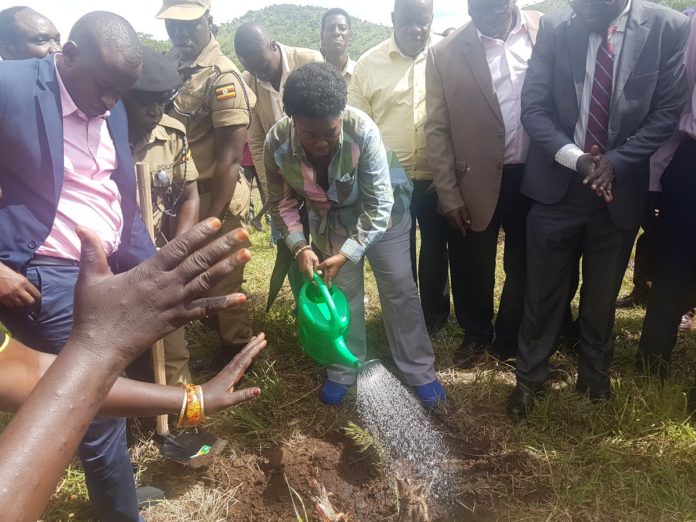
Speaker Kadaga officiating at a ceremony to kick start the planting of trees for the restoration of Mt Moroto

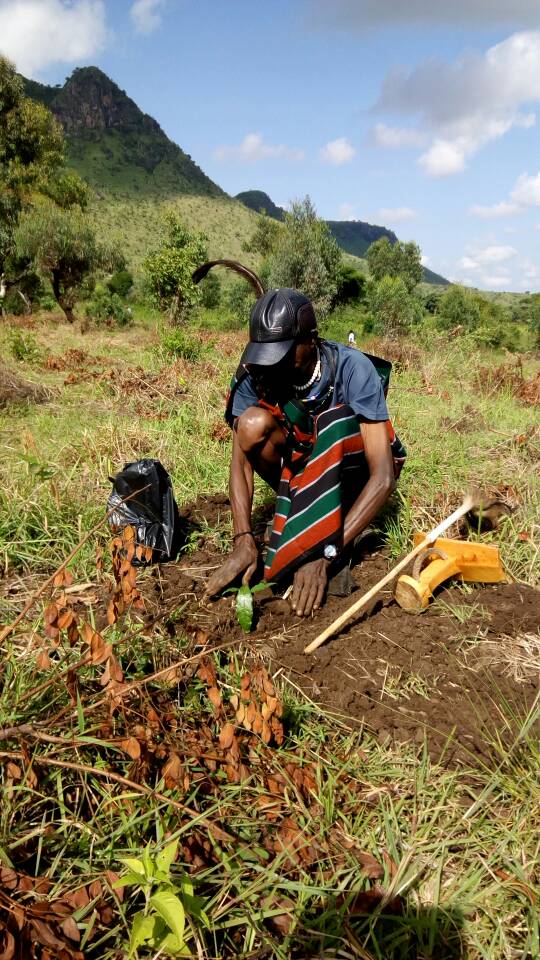
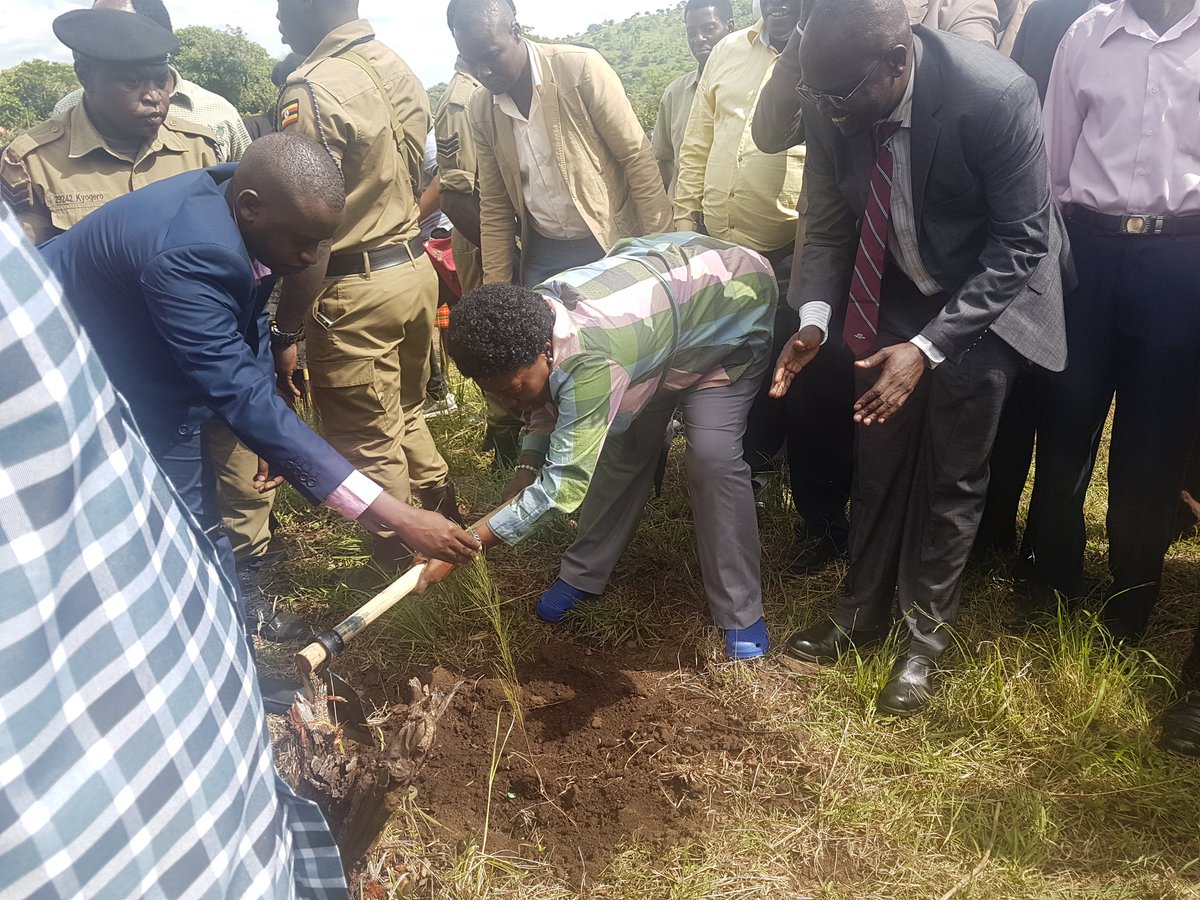
Moroto: Speaker Kadaga led Parliament in planting 5,000 trees as part of a campaign aimed at restoring Mountain Moroto forest reserve that was deforested for various human activities.

Speaking at Katikekile Sub-county Moroto district, Ms. Kadaga said the campaign was launched in January during parliamentary week where they urged the general public to contribute Shs 20,000 to buy trees that will be planted 10 hectares of land

She vowed to push the ministry of finance to start a ‘Tree Fund’ in the budget for reforestation and conservation of the environment as government continue to enforce laws against illegal deforestation and mining.

“I thank the Tepeth elders for the initiative to own and protect the forest. Parliament has adopted Mt. Moroto as our project. We shall be here every year for three years to ensure trees are planted,” she said.

Make Moroto Green: A local participating in tree planting in Moroto district.

She however said it is a responsibility of every citizen to play a role in environmental conservation adding that the effects of destruction of vegetation cover in Karamoja have already been felt across the region.

Earlier Tepeth leaders expressed concerned that they are witch hunted by notorious pastoralist tribes in the Karamoja region telling them to vacate the mountainous areas so as to graze their cattle.

In reaction the speaker said on rights of indigenous people in Uganda, parliament will do is part to ensure the Tepeth and other communities don’t get extinct, “everyone is entitle to a right to live, own property and liberty so no one should intimidate you,” she added.

Like This: Speaker of Parliament Alitwala Kadaga planting a tree at a function in Moroto

Parliament’s involvement in the restoration and conservation of environment follows similar activities that have been carried out by various government entities and organisations such as Uganda national roads authority (UNRA), UMEME, National water and sewerage corporation (NWSC) and sundry.

Stories Continues after ad

EALA legislators call for absorption of planned assembly budget

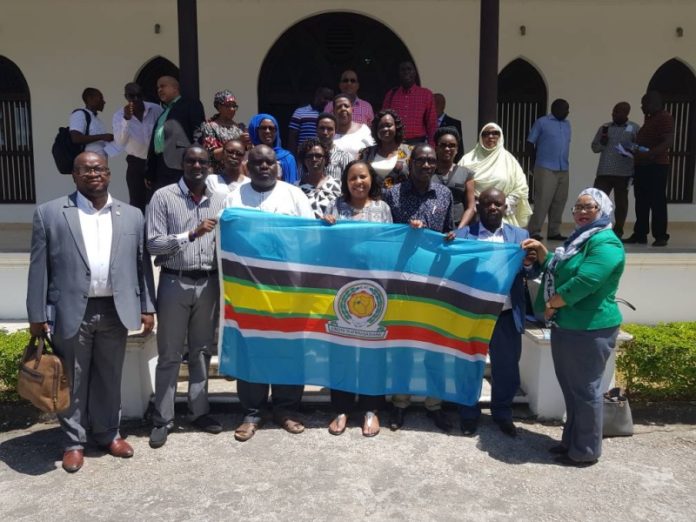
EALA legislators pose for a group photo

Kampala: The Committee on Accounts in the East African legislative assembly (EALA) has called for proper, coherent and consistent budgetary planning saying the assembly has always failed to absorb its planned budget.

According to EAC Audited Financial Statements for the Year ended 30th June 2016 that was presented to EALA, the community had a budget of US $ 112,233,039 however the actual expenditure totalled to US $59,664,208 hence an overall budget performance of 65 per cent.

Speaking to EALA yesterday, the Chairman of the Committee on Accounts, Dr. Jumanne Ngwaru Maghembe said EAC Institutions, projects and programmes across board have a challenge of budget absorption, this therefore calls for proper budgetary planning, coherency and consistency in the budgeting process.

“The committee recommends Council of Ministers to direct the Audit Commission to follow up and report on annual basis to the Assembly through EALA Committee on Accounts on the status of the Assembly’s recommendations’ implementation’” He said during the session in Kenya.

He said the Committee observed a weak Audit function at the EAC adding that inadequate staffing is affecting the audit function on all the Organs and Institutions of EAC.

“In the regard, an immediate upgrade of the Audit function in to a fully-fledged department to ensure effectiveness is therefore necessary…” read in part of the 149 page report.

“On non-implementation of the previous audit recommendations, the Committee wants a proper mechanism to enable the Assembly to get periodical report(s) on the status on implementation of its recommendations from the Council of Ministers,” he said.

The Report further called for timely remittances of contributions by Partner States saying delays make implementation of EAC programs difficult.

“When funds are remitted towards the end of the financial year, they are not sent to the specific institution to which the money was budget for, but deposited to the reserve account,” the reads in part.

Other challenges include inadequate and weak regulatory framework governing the financial and procurement regimes at the EAC, weak compliance and verification systems of goods and services procured and weak disciplinary mechanisms to reprimand staff at the EAC among others.

The 4th Assembly that is running until June 15th, 2018 in the Kenyan capital, legislators are expected to debate various bills including the EAC Community Supplementary Appropriation Bill, 2018, the East African Community Appropriation Bill, 2018 and the Administration of the EALA (Amendment) Bill, 2018.

Stories Continues after ad

Is there connivance between FIA Board and top BoU official to frustrate Bagyenda Investigations?

Embattled former Executive Director in charge of Supervision at Bank of Uganda Justine Bagyenda.

By Peter Musisi

Following a recent letter that a Kampala youth group wrote to the Prime Minister Ruhakana Rugunda, demanding that government explains why the Financial Intelligence Authority (FIA) has not come out with any report concerning money laundering allegations slapped on the former director of supervision at Bank of Uganda, Ms Justine Bagyenda, the Authority’s executive director Mr Sydney Asubo, on Thursday came out, claiming unconvincingly that the investigations were ongoing.

Instead a report in Sunday Vision indicated that FIA would investigate city socialites like Bryan White, Jack Pemba among others but the question is of what is importance are these socialites to the Ugandan when top government official swindling tax payers’ money aren’t investigated? We want FIA to investigate the source of the wealth of top BoU officials.
Mr.Asubo claimed in the media that two months were a short time to conclude investigations on money laundering. Investigation into such a case, he said, cannot be rushed as concerned people want.

However, there is a problem at FIA as regards investigating Ms Bagyenda, who according to recent leaked documents had billions of shillings on her bank accounts. A whistleblower said then that the money is not in tandem with the salaries she earned in six years at BOU. Extra leaks revealed that Ms Bagyenda owns real estate properties around Kampala, though some sources say some belonged to her late husband.

Ms Bagyenda up to now is a member of the FIA Board, headed by Leo Kibirango who once served at BOU as governor. Kibirango, Dr Louis Kasekende, the BOU Deputy Governor and Ms Bagyenda share a long banking experience. The fact is that the FIA cannot investigate Ms Bagyenda since she sits on its board.

Reports indicate that Mr Kibirango as the Board Chair of the FIA is not interested in the agency investigating Bagyenda over illicit accumulation of wealth. He sees her as one of his own. That is the only reason why Mr Asubo has not done what he is supposed to do on Ms Bagyenda.

Meanwhile the public is also waiting to hear when the FIA board will drop Ms Bagyenda before serious investigations into her financial dealings commence. In the circumstances it only fair that FIA announces officially that Ms Bagyenda is n longer member of the board to pave way for a serious investigation into her wealth.

FIA seems to have even ignored calls from MPs to investigate Ms Bagyenda. For instance Budadiri West MP Nathan Nandala Mafabi wants Ms Bagyenda behind bars in Luzira over money laundering.

Nandala who is the former head of Parliament’s Public Accounts committee says it is ironic that Bagyenda who has been heading the Anti-Money Laundering committee at BOU was involved in acts akin to money laundering.

“That lady Bagyenda has been the head of Anti-Money Laundering committee and the law we passed, stated that whoever participates in money laundering has to be imprisoned for 20 years. That is why Bagyenda should have been in Luzira by now, and the law stipulates that the money she stole should be returned,” Nandala said at Parliament in March as he addressed the media.

However, much as Kibirango and others are determined to shield Ms Bagyenda, they should understand that she on the Inspector General of Government’s tracker on cases of abusing the leadership code that requires politicians and senior government officials to declare their wealth. Sources say she has in the past appeared at the IGG offices for questioning. This is worsened further by the Uganda Revenue Authority (URA), which is demanding that she pays taxes she allegedly evaded. There are documents to this effect.

Kibirango and company stand to be isolated on this matter if they cannot act. Many are watching and continue asking questions.
For a young group to come up demanding that the FIA gives the latest on the investigation into Ms Bagyenda’s alleged illicit wealth, it speaks volumes even as Mr Asubo seems to say he depends on President Museveni to carry out his mandate.

Peter Musisi is a Concerned Uganda

Stories Continues after ad

I did not stop BoU audit-Deputy Speaker Oulanyah

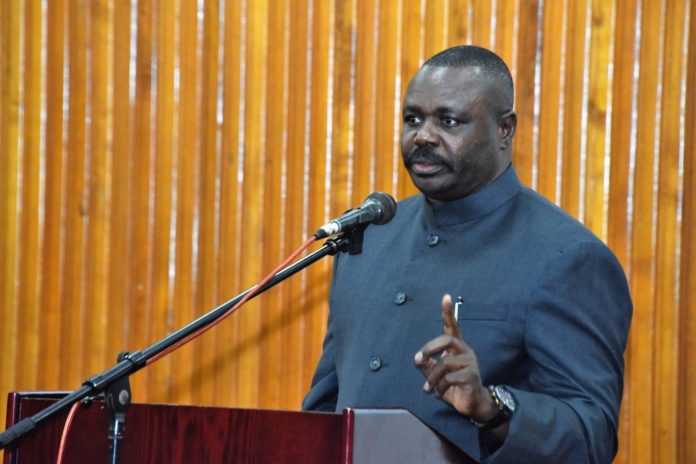
Speaker Jacob Oulanyah

The Deputy Speaker of Parliament, Jacob Oulanyah, has come out to clear his name, saying his ruling on the recent motion to investigate Bank of Uganda by parliament was not did not mean the central bank free.

“There was notice that a motion be moved to investigate BOU and I allowed it. But during debate, it was raised that the issue of BOU and Crane Bank was before court,” Oulanyah said as he clarified his ruling on the matter during the plenary sitting last week.

He said that parliament received a letter from lawyers stating that there were five cases filed in court on the same facts contained in the motion.

“My ruling on the motion was clear that parliament could not continue debating the issue because it would tantamount to subjudice,” said Oulanyah.
He said his ruling forced the Auditor General (AG) to seek guidance from the Speaker of Parliament Rebecca Kadaga after BOU top managers refused to cooperate with the AG’s investigators. The BOU top executives had been advised by the Solicit General not to cooperate based on Oulanyah ruling then.

Backwards, on May 10, 2018 Kadaga in a letter, instructed the Auditor General to continue with the audit of BOU, saying her deputy’s ruling had nothing to do with the investigations into the central bank that has had its share of criticisms of recent for mismanagement of the sale defunct banks like Crane Bank, Teefe Bank, Greenland Bank, International Credit Bank, Cooperative Bank, Bank of Commerce and Global Trust Bank.

Oulanyah emphasised that the ruling he made stopping debate on the matter did not stop the AG from carrying out the audit on BOU yet. Deputy Governor Dr Louis Kasekende was using Oulanyah’s ruling to help the Bank invade an audit as demanded by parliament. Parliament was shocked that BOU had never produced any report concerning the liquidation and sale of the banks yet government some of the taxpayers’ money was used in the processes.

Parliament’s Committee on Commissions, Statutory Authorities and State Enterprises (COSASE) had instructed the Auditor General to do a broad forensic audit into the operations of Bank of Uganda and demand accountability of Shs200b, which BO injected into the Crane Bank before it was sold off to rival dfcu Bank.

Following Kadaga’s instructions, the AG is conducting of BOU. In the letter Kadaga said any government institution established by law cannot invade investigation if need arises.

Stories Continues after ad

Citizens to hold first ever World Bicycle Day

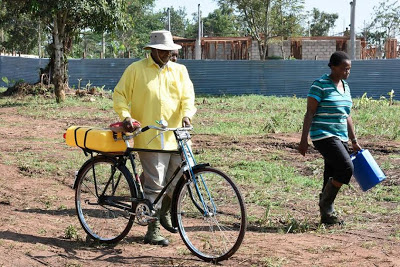
President Yoweri Museveni surprised Ugandans by fetching water on a bicycle in a demonstration to irrigate their crops during dry seasons.

Citizens of Uganda and others across the world will on June 3, 2018, celebrate the first ever official World Bicycle Day, according to the United Nations (UN).

The UN glorifies the bicycle as a simple, affordable, reliable, clean and environmentally fit sustainable means of transportation. It is a symbol of sustainable transportation and conveys a positive message to foster sustainable consumption, UN says in a brief statement.

“World Bicycle Day encourages countries to adopt best practices and means to promote the bicycle among all members of society, and welcomes initiatives to organize bicycle rides at the national and local levels as a means of strengthening physical and mental health and well-being and developing a culture of cycling in society,” it adds.

According to the UN, the World Bicycle Day encourages Member States to devote particular attention to the bicycle in cross-cutting development strategies and to include the bicycle in international, regional, national and subnational development policies and programmes;

Further it encourages Member States to improve road safety and integrate it into sustainable mobility and transport infrastructure planning and design, in particular through policies and measures to actively protect and promote pedestrian safety and cycling mobility, with a view to broader health outcomes, particularly the prevention of injuries and non-communicable diseases;

It also encourages stakeholders to emphasize and advance the use of the bicycle as a means of fostering sustainable development, strengthening education, including physical education, for children and young people, promoting health, preventing disease, promoting tolerance, mutual understanding and respect and facilitating social inclusion and a culture of peace;

The Day encourages Member States to adopt best practices and means to promote the bicycle among all members of society, and in this regard welcomes initiatives to organize bicycle rides at the national and local levels as a means of strengthening physical and mental health and well-being and developing a culture of cycling in society.

In Uganda the bicycle is a major means of transport especially in the rural areas where people use it for transportation of goods to and from the market as well as transporting themselves to different destinations.
In Eastern Uganda especially in Busoga sub region in eastern Uganda, it is common observing women and girls riding bicycles loaded with water cans and other goods.

“We grew up riding bicycles alongside our brothers as we went to fetch water,” says Esther Babirye from Namutumba. She says during her school days, she would ride the bicycle to school. This she says, helped her attend classes in time.
In Uganda the bicycle is used by health groups such as village health teams (VHTs) to reach their clients or the sick. “Government gave us these bicycles and they have eased our transportation and work,” says Isaac Mulokwa, a VHT member Bududa District.

The bicycle is also a source of income in Uganda as some citizens, especially the youth use it transport people and goods as well as knife grinding at a price. “Every day I make an average of Shs10, 000 as I carry passengers between Wandegeya and Bwaise,” says Abdul Kiryowa. Wandegeya and Bwaise are one of Kampala’s popular suburbs where some businesses operate 24/7.

Other people use the
In Uganda the bicycle is a sports item as citizens both in towns and rural areas use it to compete in races where winners are awarded. Uganda Cycling Fedartion is the Umbrella organisation with the purpose of promoting and managing the cycling sport in the country.

Stories Continues after ad

Uganda sends food aid to flood-affected families in Somalia

Sultan Warsame Aliyow Ibrow, speaks during a handover ceremony of food donated by the UPDF soldiers serving under the African Union Mission in Somalia (AMISOM), to the residents of the Lower Shabelle region that recently hit by the floods in Somalia, on 1 June 2018. AMISOM Photo / Omar Abdisalan.

Uganda yet again extended its humanitarian hand as government on June 1, 2018 donated foodstuff to flood-affected families in Golwayn, in Somalia’s Lower Shabelle region.

The lorry-loads of assorted food consisting of rice, wheat flour, sugar, cooking oil and milk, were delivered through the Ugandan AMISOM contingent.

Uganda’s Deputy Ambassador to Somalia, Maj. Gen. Nathan Mugisha flagged off the food convoy.

“Uganda is not only here to do the security part only. We feel sympathetic with the people and we join the wider international community in bringing rescue to especially the displaced communities of Golwayn who have been displaced by the enemy into IDPs (camps); but now have been displaced again by the flooding River Shabelle,” Maj. Gen. Mugisha said, while handing over the donation to Golwayn elders.

The food will benefit needy families who have borne the brunt of the heavy downpour.

According to the UN Office for the Coordination of Humanitarian Assistance, the flooding has affected more than 750,000 people with more than 229,000 displaced. Communities most affected by the flooding live along the Shabelle and Jubba rivers. The flooding, caused by the unusually heavy rains, has also led to fatalities and damage to infrastructure.
Ambassador Mugisha called for more support from other well-wishers, to the flood-affected families.
Brig. Paul Lokech, the Uganda contingent commander noted that the flooding had also adversely impacted on agriculture and movement of persons. He said some of the displaced families had sought shelter and safety near the AMISOM military defences.
“The areas where the people should be farming is all flooded. There is no productive activity taking place,” said Brig. Lokech.
He added, “That therefore means the next season is going to be very difficult for our people. Because if our people cannot produce this year because of the flooding, then that means next year there is going to be problems regarding food. So, we anticipate this flooding is going to have a negative impact on the agricultural production in Lower Shabelle”.

Sultan Warsame Alio Ibrow, a elder and chief of Golwayn who received the food donation expressed gratitude to the Ugandan government and AMISOM for the assistance and called for more humanitarian interventions to assist affected families.

“There is no area that has not been affected by the floods in areas with close proximity to River Jubba and River Shabelle. Some people who have fled from villages in Lower Shabelle including Gaburow, Bulla Sheikh, Madulow up to Janaale areas, are now squatting in Golwayn, as internally displaced,” Sultan said.

The elder estimated that at least 750 displaced families from other regions, had moved to Golwayn in search of food and shelter.

Stories Continues after ad