Stanbic Bank
Stanbic Bank
24.8 C
Kampala
Stanbic Bank
Stanbic Bank
Home Blog Page 1567

Speaker Kadaga urges Busoga leaders to skill communities

Speaker of Parliament of Uganda, Rebecca Kadaga.

The Speaker of Parliament, Rebecca Kadaga, has urged leaders in Busoga to support their communities to embrace government skilling programmes that are aimed at fighting poverty.

Kadaga made these remarks at the Skills Development Facility Workshop organised by Private Sector Foundation Uganda (PSFU) on May 28, 2018 at Hotel Africana, Kampala.

The Speaker was reacting to a presentation by the Executive Director of Private Sector Foundation (PSFU), Gideon Bagadawa who cited low levels of adoption of the Skills Development Facility (SDF) in Busoga region.
SDF is part of the Uganda Skills Development Project funded by the World Bank, which aims at promoting employer-led short term training in order to address prevailing skills imbalances and shortages in Uganda.

Kadaga said that the SDF project would help fight the high unemployment rates in Busoga region.
“Have you taken time to look at the structure of your population and how many people idle around because they have nothing to do?” She asked. She urged people in the region to grow Matooke instead of travelling to western Uganda looking for the same.

She urged national legislators from the region to help train communities in entrepreneurial and financial management. “We are going to keep being overwhelmed as leaders if we do not energize these people to work hard to emancipate themselves financially,” she said.

Mr Badagawa said that only One billion Shillings had been granted to businesses and groups in Busoga out of US $21 million (about Shs77.7 billion) disbursed throughout the country.

He urged communities and groups in the region to get organised so that they benefit more from the project. “They need to form unions, register and establish themselves as formalised entities,” he said.

Ms Ruth Musoke, the Project Manager SDF said that the programme aims at skilling people across all sectors in the economy.

Stories Continues after ad

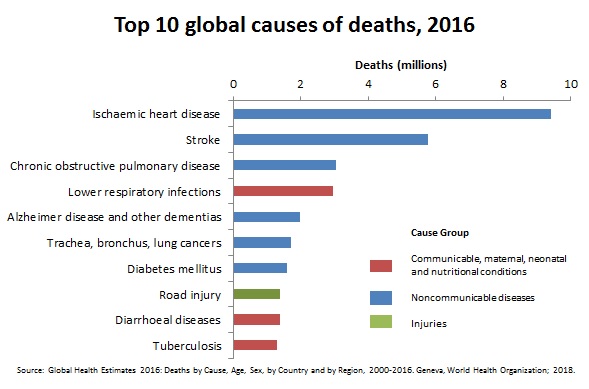
Top 10 causes of death revealed, HIV/AIDS not on list

Of the 56.9 million deaths worldwide in 2016, more than half (54 per cent) were due to the top 10 causes, the World Health Organisation says. Ischaemic heart disease and stroke are the world’s biggest killers, accounting for a combined 15.2 million deaths in 2016.

These diseases have remained the leading causes of death globally in the last 15 years.
Chronic obstructive pulmonary disease claimed 3.0 million lives in 2016, while lung cancer (along with trachea and bronchus cancers) caused 1.7 million deaths. Diabetes killed 1.6 million people in 2016, up from less than 1 million in 2000. Deaths due to dementias more than doubled between 2000 and 2016, making it the 5th leading cause of global deaths in 2016 compared to 14th in 2000.

Lower respiratory infections remained the most deadly communicable disease, causing 3.0 million deaths worldwide in 2016. The death rate from diarrhoeal diseases decreased by almost 1 million between 2000 and 2016, but still caused 1.4 million deaths in 2016. Similarly, the number of tuberculosis deaths decreased during the same period, but is still among the top 10 causes with a death toll of 1.3 million.

HIV/AIDS is no longer among the world’s top 10 causes of death, having killed 1.0 million people in 2016 compared with 1.5 million in 2000.

Road injuries killed 1.4 million people in 2016, about three-quarters (74 per cent) of whom were men and boys.
More than half of all deaths in low-income countries in 2016 were caused by the so-called “Group I” conditions, which include communicable diseases, maternal causes, conditions arising during pregnancy and childbirth, and nutritional deficiencies. By contrast, less than 7 per cent of deaths in high-income countries were due to such causes. Lower respiratory infections were among the leading causes of death across all income groups.

Non communicable diseases (NCDs) caused 71 per cent of deaths globally, ranging from 37 per cent in low-income countries to 88 per cent in high-income countries. All but one of the 10 leading causes of death in high-income countries were NCDs. In terms of absolute number of deaths, however, 78 per cent of global NCD deaths occurred in low- and middle-income countries.

Injuries claimed 4.9 million lives in 2016. More than quarters (29 per cent) of these deaths were due to road traffic injuries. Low-income countries had the highest mortality rate due to road traffic injuries with 29.4 deaths per 100 000 population – the global rate was 18.8. Road traffic injuries were also among the leading 10 causes of death in low, lower-middle- and upper-middle-income countries.
Why you need to know the reasons people die

Measuring how many people die each year and why they died is one of the most important means – along with gauging how diseases and injuries are affecting people – for assessing the effectiveness of a country’s health system.

According to WHO, Cause-of-death statistics help health authorities determine the focus of their public health actions. A country in which deaths from heart disease and diabetes rise rapidly over a period of a few years, for example, has a strong interest in starting a vigorous programme to encourage lifestyles to help prevent these illnesses. Similarly, if a country recognizes that many children are dying of pneumonia, but only a small portion of the budget is dedicated to providing effective treatment, it can increase spending in this area.

High-income countries have systems in place for collecting information on causes of death. Many low- and middle-income countries do not have such systems, and the numbers of deaths from specific causes have to be estimated from incomplete data. Improvements in producing high quality cause-of-death data are crucial for improving health and reducing preventable deaths in these countries.

Stories Continues after ad

Global tea production set to rise next decade

Uganda is a major tea producer in Africa.

Global tea consumption and production are projected to keep rising over the next decade, driven by robust demand in developing and emerging countries.

This will create new rural income opportunities and improve food security in tea-producing countries, according to a new report released Monday.

According to the report, tea consumption has grown particularly rapidly in China, India and other emerging economies, driven by a combination of higher incomes and efforts to diversify production to include specialty items such as herbal teas, fruit fusions and flavoured gourmet teas.

The report, which was discussed by the FAO Intergovernmental Group (IGG) on Tea, at its biennial meeting in Hangzhou, China, suggests that tea consumption has also benefited from increased awareness about the beverage’s anti-inflammatory, antioxidant and weight loss effects. Such health and wellbeing benefits are seen as the key drivers of future consumption growth.

Tea production set to increase
World production of black tea is projected to rise annually by 2.2 per cent over the next decade to reach 4.4 million tonnes in 2027, reflecting major output increases in China, Kenya and Sri Lanka – with this China would reach the output levels of Kenya, the largest black tea exporter in the world.

Meanwhile, global output of green tea is foreseen to increase at an even faster rate of 7.5 percent annually to reach 3.6 million tonnes in 2027, largely driven by China, where the production of green tea is expected to more than double from 1.5 million tonnes in 2015-2017 to 3.3 million tonnes in 2027.
Climate change impacts
The IGG report also warns that tea production is highly sensitive to changes in growing conditions. Tea can only be produced in narrowly defined agro-ecological conditions and, hence, in a very limited number of countries, many of which will be heavily impacted by climate change.

Changes in temperature and rainfall patterns, with more floods and droughts, are already affecting yields, tea product quality and prices, lowering incomes and threatening rural livelihoods. These climate changes are expected to intensify, calling for urgent adaptation measures. In parallel, there is a growing recognition of the need to contribute to climate change mitigation, by reducing carbon emissions from tea production and processing.
The report, therefore, urges tea-producing countries to integrate climate change challenges, both on the adaptation and mitigation front, into their national tea development strategies.

Trendy product for young people
Global demand for tea is also benefiting from a new clientele. Young urban consumers in large producing countries like China and India have emerged as the fastest growing segment, eager not only to pay a premium for specialty teas but also curious to know more about the product they consume – its quality, origin and contribution to sustainable development.

Young, upper-middle class consumers are looking for fashionable products to be integrated into their lifestyles, which now also include gourmet quality tea, and consuming them in the sophisticated environments of specialty teashops and exclusive restaurants, hotels and cafés.

Promoting health benefits to boost demand
While world tea consumption has increased over the last decade, traditional importing European countries, with the exception of Germany, have seen a decline in consumption levels. Overall, the European tea market is largely saturated. Per capita consumption has been declining for more than a decade, facing competition from other beverages, particularly bottled water.

Over the next decade, Western countries in general are expected to see lower consumption growth. In the UK, for instance, tea consumption is projected to decrease as black tea struggles to maintain consumers’ interest amid increased competition from other beverages, including coffee.

The report argues that the decline in tea consumption in the traditional European markets could be stalled or even reversed by diversifying into other segments, such as organic and specialty teas, and by promoting their health and wellbeing benefits.

The strategy of promoting the health benefits of tea has also proved effective for other markets. For example, loose-leaf tea is seeing new growth in the United States, not least as a result of increased public health consciousness.

The analysis in the IGG document was based on data received from member countries, supplemented by data from FAOSTAT and the International Tea Committee (ITC) as well as other sources.

Stories Continues after ad

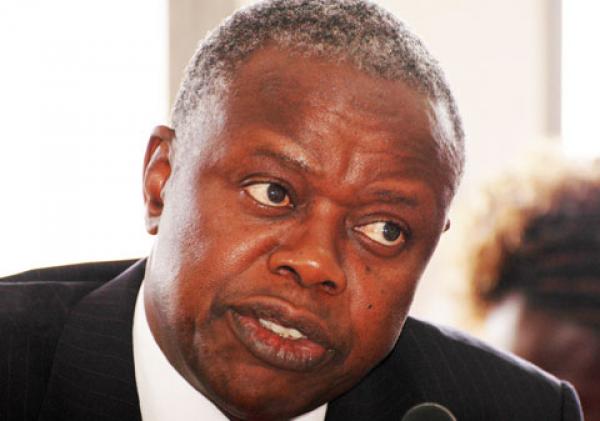
Police should investigate Bagyenda’s wealth and not the journalists

Mr. Kyamutetera

By Muhereza Kyamutetera

For months now, Justine Bagyenda, the sacked Executive Director, Supervision at Bank of Uganda has been in the headlines over her unexplainable wealth.

Although both the Inspectorate of Government (IGG) and the Financial Intelligence Authority (FIA) have both formally admitted to placing Bagyenda under formal investigation a couple of months ago, the two institutions are tight-lipped about their findings thus far.

The police who have since been silent in this debacle, through their Director of Cyber and Financial Crimes, a one Mr. Kototyo William, instead decided to issue criminal summonses against editors of seven online news publishers that have fiercely reported about this case.

Apparently the summonses stem from a complaint filed by Bagyenda at police in which she claims that the stories published about her are “false, defamatory and extremely damaging” and have caused “untold mental and psychological distress” not only to her, but also family members.

However, the media houses which published Bagyenda’s vast wealth have since stood by their story and have challenged the police not to shoot the messenger but rather go on to investigate the said claims.

The journalists’ firm stand could now be vindicated by a 23rd March 2018 draft report by the Auditor General; unearthing rot at the Central Bank- particularly in Bagyenda’s Department, over the way they handled or rather mishandled the closure of several banks.

The report is a result of an audit ordered by the Parliamentary Committee on Commissions, Statutory Authorities & State Enterprises (COSASE) on 28th November 2017; pursuant to section 13 (3) of The National Audit Act 2008. The audit that sought to examine the circumstances surrounding the closures of Teefe Trust Bank, Greenland Bank, International Credit Bank, Cooperative Bank, National Bank of Commerce, Global Trust and Crane Bank. The audit itself was sparked off by an outcry from the public and Crane Bank’s shareholders over the takeover and rushed sale of Crane Bank, over what they believe was a giveaway price to dfcu Bank.

Bank of Uganda refused to cooperate especially over the closure of National Bank of Commerce and Crane Bank, pleading the sub judice rule, since the two closures are subject to court suits- although they have since been compelled to cooperate by the Speaker of Parliament.

The preliminary report that largely covers the closure of International Credit Bank Limited, Greenland Bank and Global Trust Bank shows that loans worth Shs135 billion from the three banks were sold to M/S Nile River Acquisition Company in 2007 at $5.25m (Shs8.9 billion), a price that was a mere 26 per cent of the total secured loan portfolio and 7= per cent of the total loan portfoli0- leading to a loss of Shs126billion.

This discrepancy needs to be investigated as it could provide clues to who could have benefitted from this deal.
The audit further notes that BoU failed to recoup money worth Shs6.6 billion that the three banks held in foreign banks and went on to write off the funds from six foreign accounts, despite failing to prove through any correspondences with the said banks, that they tried to collect the money, raising fears that the said money could have been recouped but it went into private pockets.

The draft report also shows that BoU failed to prove that GTB assets worth Shs23 billion were transferred to dfcu, when dfcu took over the bank in July 2014. Additionally, 25 certified land titles that had been taken over by GTB as collateral by the time it was closed in 2014 were not transferred by BoU to dfcu.
“BoU did not transfer these titles to the purchaser (dfcu) contrary to the agreement. Management (of BoU) should place caveats on all the lost titles to protect the property and ensure that the titles are recovered and handed over to dfcu,” the audit recommends.

It is interesting to note that the period after 2007, when the recoveries of the said defunct loans started, also coincides with the period in which Bagyenda, under whose docket the recoveries fell, went on a property acquisition spree.

Between 2007 and 2016 Bagyenda either single-handedly, jointly with her children or using her children as proxies acquired and or registered 14 properties- in prime locations in Kampala, Mbarara and Ntungamo Municipalities.
Rather than intimidate journalists, the police should instead use their resources to investigate the link between Bagyenda’s wealth and the findings of the Auditor General.

Whereas the Auditor General is investigating BoU, the Police should instead be looking into the sources of her wealth.

Available leaked records show that Bagyenda in 2014, held bank balances equivalent of Shs1.6 billion in her shilling and dollar accounts at DTB Bank. Between 20th January 2014 and 15th May 2017 she made additional cash and wire deposits to her dollar account totaling to $295,000 (Shs880 million).

Most of these moneys were briefly fixed and then either sent to her DTB shilling account or her other account at Barclays Bank. From her Barclays account, she wired a total of Shs693 million in 47 weekly wire (RTGS) transactions of between Shs10 million- Shs30 million to a Kenny Muwonge’s account No. 2120011273 in Centenary Bank. On reaching Muwonge’s account, the money would be immediately withdrawn in cash and or via mobile money.

From the DTB shilling account, between 1st of March 2017 and 8th September 2017, she wired a total of Shs950 million- in 4 tranches of Shs350 million, 150 million, 100 million to Tibeingana & Co Advocates a law firm owned by city lawyer and property developer Deox Tibeingana.

Leaked mobile money transactions from MTN show, Bagyenda made mobile money transactions to the tune of Shs499,428,906 million in just a period of three years, to a phone number linked to her biological son- a one Robert Muhumuza.

But more importantly, these transactions were not reported to the authorities by either the banks, or the mobile phone companies as required by Section 6 (2) b of The Anti-Money Laundering Act (2013).

The act mandates all financial institutions, law firms real estate agents, casinos, brokerage firms, investment bankers, registrar of companies, registrars of land, Uganda Investment Authority, NGOs and all Licensing Authorities to report to the Uganda Financial Intelligence Authority (FIA), all transactions equal to, or above the amount of 1,000 currency points (Shs20,000,000). This was later upgraded to 5,000 currency points (Shs100, 000,000) as per the amended anti-money laundering act that commenced on 26th May 2017.

Instead of the journalists, it should be Bagyenda, the banks and the various beneficiaries of her transactions that should be recording statements.

Let me conclude by quoting Nicholas Opiyo, a human rights lawyer, who opined on twitter that: “In a serious criminal justice system, a public official suspected of illicit wealth accumulation – who hasn’t denied the same but only claims invasion of privacy – would be under police investigation-not courageous online journalists who have exposed these claims.”

But maybe, again in the words of Opiyo: “when a thief starts chasing after the people who caught him/her, you know he/she is no ordinary thief.”

Stories Continues after ad

Uganda’s coffee exports drop 9.3 percent in April

Uganda’s coffee exports in the month of April 2018 dropped 9.3 per cent to 295,194 60-kilo bags, according to the latest report released by the Uganda Coffee Development Authority (UCDA).

The coffee exports which underperformed in April compared to March fetched the country the much needed foreign exchange of US $32.73 million which also showed a decline of 16.66 per cent when compared to March earnings.

UCDA attributes the decrease in both quantity and value to an end of the main season in the central and eastern regions.
The report shows that the country’s full year coffee exports (May 2017 to April 2018) totaled 4.66 million bags worth US $521 million.

Uganda, Africa’s number one exporter of coffee, grows both Arabica and Robusta types. Arabica, known for its sweet aroma is grown on the slopes of Mount Elgon in Eastern Uganda and fetches a high price on the world market compared to Robusta which is grown in the lowlands, even though the country exports the latter in bigger quantities than the former.

Ethiopia, Africa’s number one producer of coffee, consumes most of the crop domestically, leaving less for export.
Uganda’s coffee exports during the month of April went to EU countries (183,987 bags lower than 233,958 bags exported in the previous month). Sudan imported 37,714 bags (12.78 per cent) compared to 45,175 bags (13.55 pervcent) the previous month.

The USA imported 25,133 bags (8.51 per cent) compared to 12,283 bags (3.68 per cent). Morocco imported 12,797 bags (4.34 per cent) compared to 9,060 bags (2.72 percent) and India 12,598 bags (Coffee exports to Africa amounted to 55,621 bags, a market share of 18.84 per cent compared to 69,638 (20.89 per cent) bags the previous month.

Globally, coffee exports for March 2018 were 10.81m bags, which was 0.9 per cent lower compared to March 2017. Total exports for the first six months of coffee year 2017/18 were 59.96 million bags, which was a decrease of 0.6 per cent.

The 2017/18 global production is still estimated at 159.66m bags compared to 157.69 million bags, an increase of 1.2 per cent from last year.

Arabica production is estimated to reduce by 4.6 per cent to 97.42 million bags while Robusta is projected to increase by 12.1 per cent to 62.24m bags. Africa’s production is expected to increase by 3.2 per cent from last year with an output of 17.63 million bags.

Global consumption is projected to increase by 1.3 per cent at 159.92 million bags with major increases noted in Asia and Oceania countries and South America.

Stories Continues after ad

Confusion as Museveni orders First Lady to reappoint Prof Balunywa as MUBS Principal

Prof. Wasswa-Balunywa

President Yoweri Museveni in a letter dated April 28,2018 has directed the First Lady Janet Museveni who is also the Minister of Education and Sports to reappoint Prof. Waswa Balunywa as the Principal of Makerere University Business School (MUBS).

“I am directing to reappoint Professor Waswa Balunywa as Principal of Makerere University Business School ( MUBS) for another term on the expiry of this one. One of the obstacles that have wasted our time is a disoriented, pro-imperialism academia,” Museveni wrote in a letter he copied to the Vice President, Prime Minister, Attorney General and Chairperson, Education Service Commission.

Museveni in his letter says Prof. Balunya is an active administrator who has steered MUBS off strikes. “Professor Balunywa has always been on the liberation side ideology in addition to being an active administrator. His institution has been free of strikes. I have never found him averse to advice the times I have interacted with him. Such a person is good to work with,” Museveni wrote.

Museveni’s letter ordering for the extension of Balunywa’s term has dealt a blow to Mubs Council which a day ago appointed Associate Prof Moses Muhwezi as the institution’s acting principal. Prof Muhwezi has been Prof Balunywa’s deputy for the past four years. Mubs Council is headed by Prof Venansius Baryamureeba.

Museveni’s unexpected letter epitomizes weeks of confusion in the education ministry, the highlight of it characterised by counter accusations between Baryamureeba and Balunywa and divisions among senior government officials on whether or not to renew the incumbent’s contract.

Baryamureeba in March recommended Balunywa for re-appointment, but revised his position to say his letter to Education Minister Janet Museveni was a reminder about imminent lapse of the principal’s tenure. The Council chairman was then accused of eyeing to succeed the principal, an allegation he denied.

Baryamureeba’s letter prompted the minister to direct the Education Service Commission chairperson, Mr Waggwa Lubega, to advertise the job.

Museveni’s letter has meanwhile left a section of Busoga politicians having the last laugh as they have been out there playing both the tribal and political card to ensure that 63 year old Balunywa, who is beyond the statutory retirement age is kept on as the Chancellor of the only high end government owned business school.

However, it remains to be seen whether Baryamureeba and Balunywa will work together, following their hot exchanges in both traditional media and social media platforms.

Stories Continues after ad

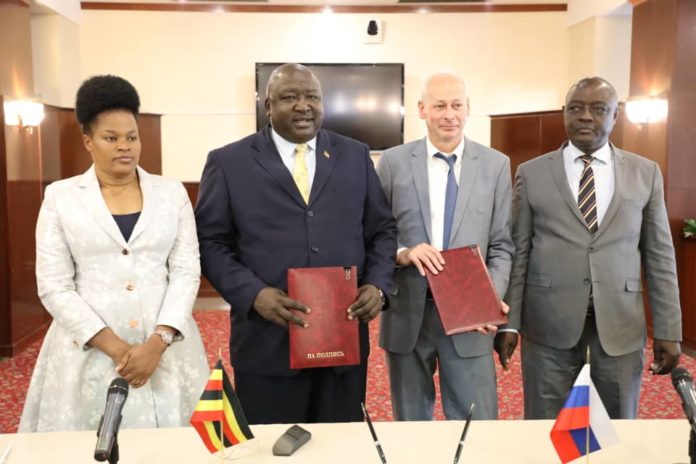
Russia promises equipment to protect Uganda’s intelligence

KAMPALA: The Russian government has promised to give high end- to- end encryption equipment to help security agencies protect the transmission of intelligence.

Security equipment will also be installed at strategic facilities like airports and power plants.

According to the statement issued by Foreign Affairs, the Russians also promised during a meeting in Moscow Wednesday between the Ugandan delegation led by Foreign Affairs State Minister Okello Oryem and Russian officials says that Russia agreed to supply Uganda anti-drone systems.

“Peacemaker international security center is ready to supply Russian-made autonomous voice notification kits for alerting the population in emergency situation and during mass events within up to two kilometers range as well as providing Russia ant-drone system equipment for the protection of civilian objects of critical infrastructure from unmanned aerial vehicles,” the statement reads.

The Russians also promised to give Uganda encryption technology to ensure Uganda’s security information is safe.
The statement also said there is a need to introduce video conference communication platform for Uganda People’s Defence Forces and cameras for police.

During the session, both parties welcomed an agreement between the Russian developers and PROTEI, a leading Russian IT company, Uganda Telecom [UTL] and K2 telecom to start working on Wi-Fi offload.

They also discussed the Memorandum of Understating that was ratified by the Russian state-owned nuclear energy State Atomic Energy Corporation [Rosatom] and the ministry of Energy and Mineral Development of Uganda on the use of atomic energy for peaceful purpose that was signed in Moscow June last year.

They commended the beginning of practical cooperation regarding the possible supply of the Russian civil equipment to Uganda.
In education sector, the Russian government promised to create favorable conditions for learning Russian language in Uganda and modern telecommunications technology.

Stories Continues after ad

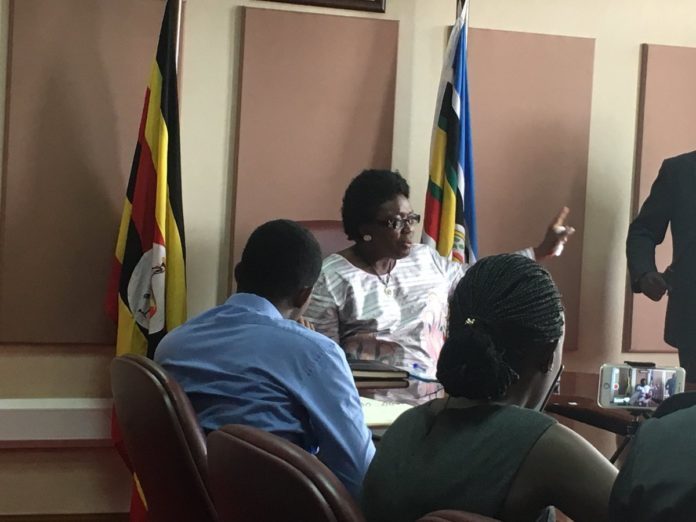
There is no attempt to increase pay of MPs- Kadaga

Kadaga answering some of the questions.

The Speaker of Parliament, Rebecca Kadaga has refuted reports that Members of Parliament were to receive a salary increment.
In a live Twitter chat held at Parliament today May 28, Kadaga was answering some of the questions from the Journalists and public.
“There is no attempt or strategy to increase the pay of MPs in any way so it is a lie. Our budget was read in March so you would have seen it in the budget framework paper.” Kadaga said.

Last week, there were various reports in the media that there was a proposed double increment of monthly salaries for MPs from Shs11 million currently to Shs24 million.

In the related development, the Speaker was asked about the continued absenteeism of the MPs in parliament sittings.
She replied, “I was working on the list of absentees over the weekend for those members who don’t attend committees and plenary. They will be notified and the list is coming out by next week so they are put to shame.”

Also, records show that 107 legislators have not said a word on the floor of parliament and 65 of them only spoke once in the first 35 sittings of the second session of parliament. Kadaga said that she cannot force any member to speak.

“Those who want to speak, stand up in order to be chosen and contribute. In parliament you have to stand up to indicate that you have to speak. So if you do not stand up, I leave you.”

The Speaker was then asked about her decision of not appearing before the Constitutional Court sitting in Mbale to explain her role in the passing of the Age limit bill. She said that the Speaker and the President do not appear in Court and the law must be respected.

The Speaker said she’s immune from prosecution, citing Section 25 of the Parliament Act and the ones who sued her just didn’t know.

In addition, the speaker said that Parliament has handled 6 Bills and she is hopeful that by the end of this session in June, more 7 Bills will have been handled including Succession Bill, Sexual Offense Bill and Marriage and Divorce Bill.

Kadaga added that two Bills such as the Anti-Counterfeit Bill and PWDs Bill have been an issue of frustration. The Anti-Counterfeit Bill was first introduced in the 9th Parliament and withdrawn. It was reintroduced in the 10th Parliament and again withdrawn in January this year.

The speaker also admitted that Parliament has been a bit slow on a number of Bills such as the Civil Aviation Bill, Data Protection Bill, Mental Health Bill among others which are all still in process.

Stories Continues after ad

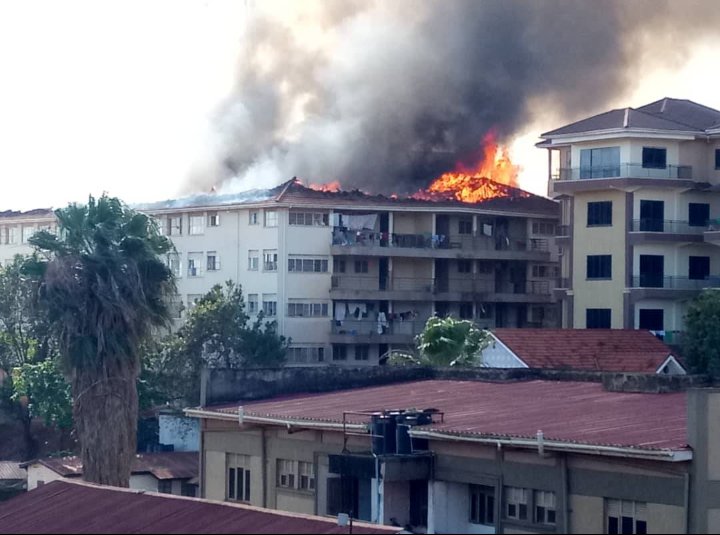
Fire guts Bahesi Hostel in Bugolobi

Fire has gutted Bahesi Hostel located near an Airtel service center in Bugolobi today afternoon and destroyed students’ property.

The cause of the fire is not yet known but according to eye witnesses, it started from the top floor of the hostel at around 4pm.

The Fire Brigade reached the scene early to help control the fire from spreading.
The hostel is mainly occupied by Makerere University Business Students (MUBS) and no injuries have been reported yet.
Bahesi Hostel is one of the biggest hostels around MUBS accommodating both males and females.

This is the second fire outbreak in a university in a space of three days after Mary Stuart Hall of Makerere University on Saturday morning which affected three students sustaining minor injuries as they were escaping.

Stories Continues after ad

Qute Kaye: Dembe FM’s Eddy Sendi in verbal fight with Toolman

Eddie Sendi

There is a raging war between self-styled music critic, Edward Sendi and renowned musician, Freddrick Kibalama popularly known as Toolman.

The verbal war sparked off by the current situation singer has been ongoing for two days now.

It all began when Dembe Fm’s presenter Sendi blamed Qute Kaye’s woes on drug addiction and failure to plan for his earnings when he was still on top, something that never went down well with the now German based artist, who advised that all that Kaye needs now is help and not being judged.

” Iam surprised Eddy Sendi is blaming Qute Kaye. I was at the peak of my time between 2007 to 2008 together with Qute Kaye, Fina (Mugerwa), Dr Hilderman, Henry Tigan and more. And I remember very well I was charging Shs1.5 million upcountry. At the time, Eddy Sendi was working for a telecom company. He called me one time to perform in Tororo and Mbale on company promotion shows and at each show, he was offering Shs150, 000 because we would travel in a company coaster” he said

Adding “I might have been smart with my money and I had good bargaining power than Qute Kaye, but there was a lot of exploitation from such guys like Eddy Ssendi,” the ‘Kisulumuzo’ hitmaker revealed

The revelation didn’t go down well with Sendi, who hit back by calling Toolman a failed artiste.

“Tune into Dembe FM on Saturday June 2 as I answer back to Uganda’s poor version of Shaba Ranks. Thank God none of my sisters had to marry a man, they are all married to men and not the other way round,” he took a swipe at Toolman, remarks that have heavily been criticized by the public.

Nevertheless, Toolman has responded, advising send to Ssendi to act in a way that befits his age.

“Edward Sendi I believe you above 40. I don’t usually respond to people but I had to because at your age, you worked everywhere you worked and later came to the entertainment industry as a refugee of work. The music industry is not an agriculture industry of sort that now we can’t because there is no rain. The music industry is for musicians and if you decided to be a critic, I expected some sense of professionalism in you.

“You don’t have to talk only good things but talk responsibly about people. It’s not written anywhere that whoever is in the music industry will end up as a winner; some will fall and some will raise. Just know Qute Kaye is our own and behind your ngalabi you should hold to that.”

Stories Continues after ad