Stanbic Bank
Stanbic Bank
21.9 C
Kampala
Stanbic Bank
Stanbic Bank
Home Blog Page 1608

Museveni urges Ruhaama residents to protect wetlands

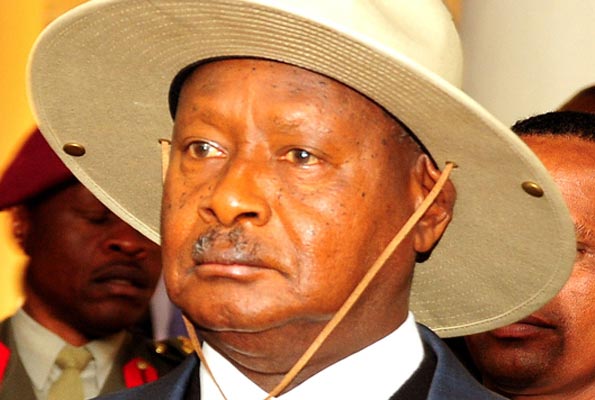
President Yoweri Museveni

President Yoweri Museveni has urged the people of Ruhaama Constituency in Ntungamo district to conserve the natural environment especially the wetlands, which he said are of great economic importance to the country.

Museveni made the call at Kahiija Primary School playground in Kabingo Parish in Nyakyera Sub-County as hundreds of area residents were celebrating Moses Kahima Mugabe’s victory as the new area MP.

Mugabe, who is  affiliated to the National Resistance Movement Organisation (NRM-O) headed by Museveni as Chairman, won the by-election after former MP William Zinkuratiire died.

“In creation, God separated swamps from the dry uplands. To provoke God’s power is dangerous. Conserve the wetlands and you will realize that they are more economically productive,” Museveni said, emphasising the uses of swamps as sources of water for irrigation, grass for mulching, fish farming in ponds and papyrus for paper manufacturing, among others.

The President added: “I congratulate you and thank you for supporting the NRM. To choose an active and constructive leader in politics, means promoting development. When Ruhaama County was being led by the opposition, there was no development not until Maama Janet Museveni came to represent you as an MP that you started receiving government services – electricity, tarmac roads, schools and health facilities.”

Museveni was accompanied by the First Lady and Minister of Education and Sports, Janet Museveni, who is the Ntungamo District NRM Chairperson.

The president urged residents to fight poverty, be patriotic, support women emancipation and avoid tribalism. He said. “Looking at the development perspective, what is the religion of poverty?  What is the religion of tribalism or being unpatriotic or fighting against women emancipation?” He said, commending the residents for voting the new MP.

On health, Museveni urged parents to guide the youth about the disadvantages of leading risky life styles that may lead to catching diseases like HIV/AIDS. He also urged parents to feed their children on nutritious food for better growth. He pledged 400 corrugated roofing iron sheets and other building materials for Kahiija Primary School.

First Lady Janet Museveni thanked the residents in the area for their overwhelming support to the NRM, while the MP, Kahima Moses Mugabe pledged loyalty to the ruling party.

He said so far development projects in the areas have taken place, citing the tarmacking of Mirama Hills Road. He said that plans are underway to build the Eriya Kategaya Memorial School, the construction of Maama Janet Museveni Girls’ School and the extension of electricity deeper into rural areas, among others.

Ntungamo District Woman MP, Beatrice Rwakimari, commended government’s infrastructure programmes and services’ delivery in the area, saying they have created support for the NRM.

 

Stories Continues after ad

AMISOM reviews its ICT capabilities after Al-Shabaab attack

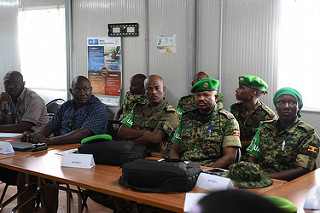
A section of AMISOM officers at the review workshop

A team of Information, Communications and Technology Services executives from the African Union Mission in Somalia (AMISOM), are undertaking a technical and asset review exercise for the Mission’s ICT infrastructure, with the aim to make it more effective.

The three-day review workshop, which opened Monday, aims to improve communication systems and secure networks in the Force.

The AU Mission’s Deputy Force Commander in-charge of Operations and Planning Maj. Gen. Charles Tai Gituai, told the group of 39 mission personnel, that the review must ensure a ‘collated projection of the Force’.

“For any peace support operations to function effectively, or any other operation, military command and control depends on a complex communication network of equipment, personnel and communication protocols to relay information among forces,” he said in his opening remarks.

While highlighting the importance of information and communication technology, in the success of any peacekeeping mission, he called for more robust methods of communications that adequately addresses the needs of the Force and strengthens its effectiveness.

“And this calls for well established communication systems that enhances cohesive, flexible and secure communication networks,” emphasized the Deputy Force Commander.

Other than deliberating on information sharing and the Mission’s communications needs, the three-day workshop, which is supported by the United Nations Support Office in Somalia (UNSOS), will evaluate and identify gaps that may impede the AU Mission’s work.

UNSOS’ support to AMISOM includes the provision of, and management of Information Communication Technology facilities and equipment. The equipment provided by UNSOS range from secure email facilities, radio communication equipment, internet connectivity, satellite phones, asset management and maintenance of the communication infrastructure.

The training came a day later after Al-Shabab militants attacked African Union troops at their base-mostly Ugandan soldiers on Sunday. AMISOM said its soldiers killed at least 30 al-Shabab fighters as they repulsed an attack by the armed group. Four Ugandan troops are reported to have died in the attack, even as Al-Shabaab says it killed over 59 AMISOM soldiers.


Stories Continues after ad

Kavule, Salaama, Kibuye punters win Fortebet Easter goodies

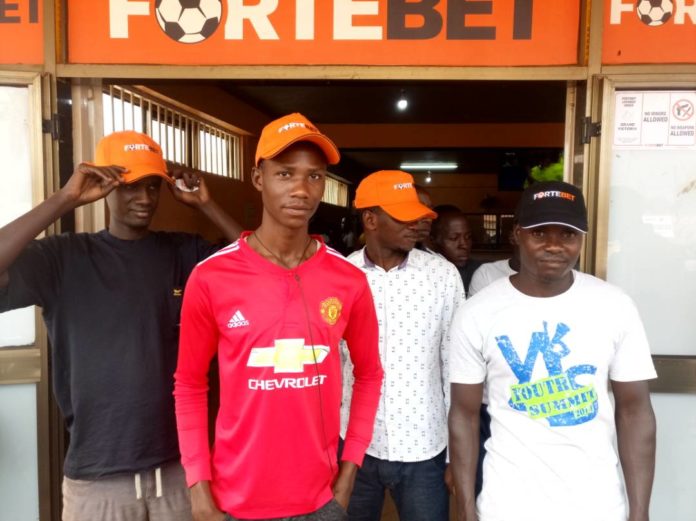
Some of the people who won themselves caps

Bettors at Fortebet centres of Kavule-Salaama road and Kibuye landed themselves lots of goodies given out over the weekend. The gifts, like it has been at most of Fortebet branches, were in a way of thanking the clients for having chosen this betting company over the others.

The handover was conducted by the company media manager John Nanyumba, at the two centres located just a stone-throw from Kibuye Kobil fuel station.

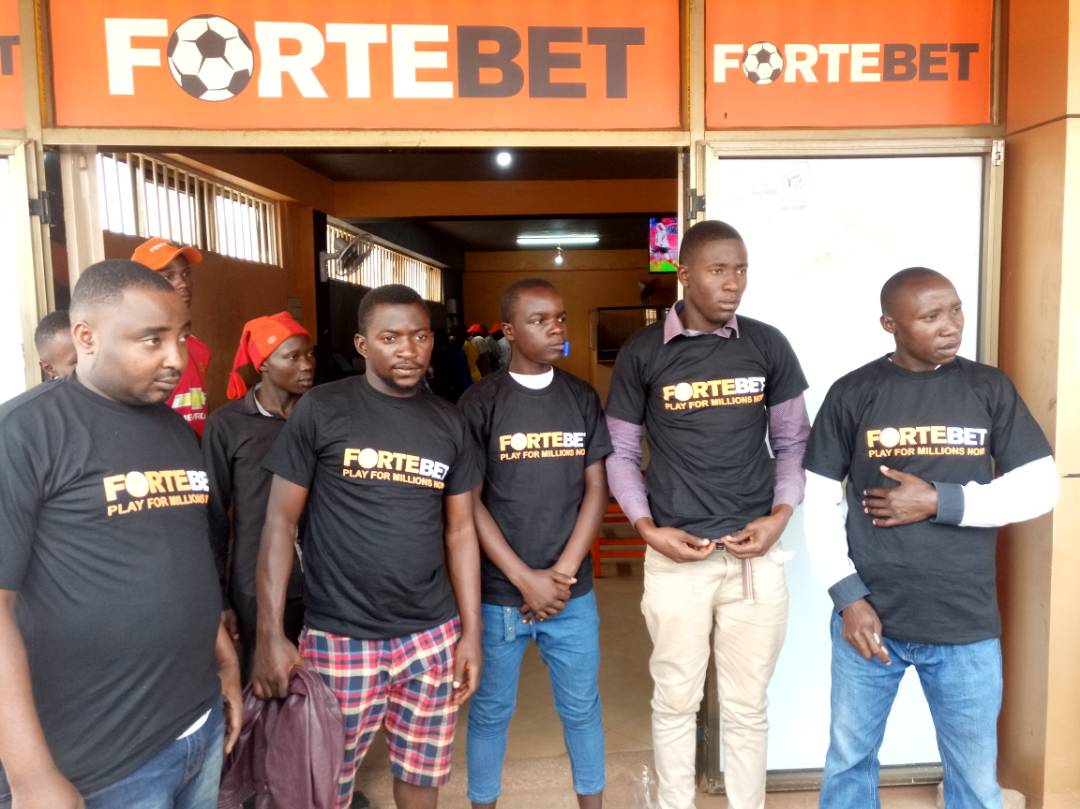
Customers that won Fortebet T-shirts

Many customers were found at the centre and tens of them walked home with a number of gifts like original team jerseys for top European teams, caps, T-shirts, pens, wristbands-all branded with Fortebet.

“Today we are here to demonstrate that we are not only Uganda’s best betting company that offers the highest odds but also the only one that gives back to its customers and Ugandans at large,” said Nanyumba, while addressing the customers at Kavule-Salaama road just before the gifts were handed over to the respective recipients.

He added, “All of you are winners today, as long as you placed a bet, especially of 2000/= and above. Just sow us your receipt-whether hard copy or online and we give you your gift instantly.”

Six customers won themselves original jerseys for clubs; Manchester United, Manchester City, Chelsea, Real Madrid and Tottenham Hotspurs after placing bets of 50.000/= and above, in addition to wristbands and pens. Six other customers scooped a T-shirt each while five more customers got a cap each and other gifts. All the other customers, as long as they had placed bets with 2000/= and above, took different prizes as mentioned above.

“We are moving from branch to branch. For those that have already won, congratulations and for the branches we haven’t reached, just stay alert by constantly checking our Facebook page to know which branch shall get the gifts in the following weekend,” Nanyumba promised.

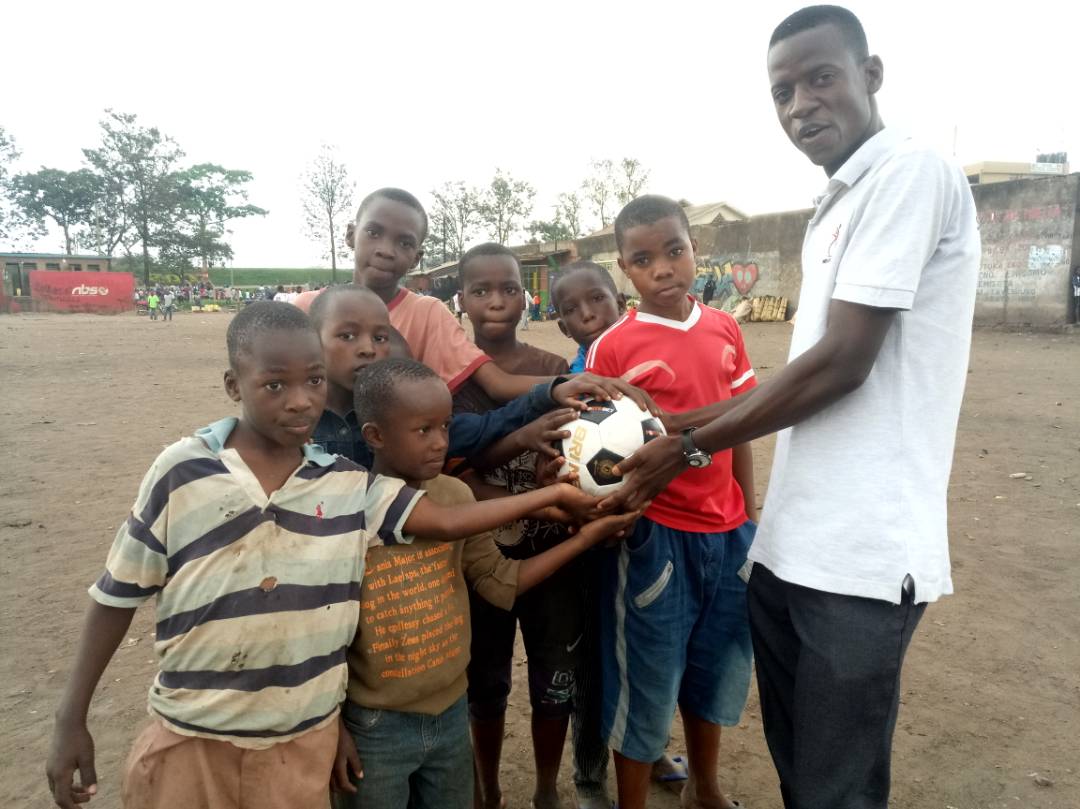
John Nanyumba handing over the ball to the kids

At the same time, Fortebet also donated balls to kids that play football near Kibuye market. “We do this because one of our goals here is to promote the growth and development of sports talents. We have given out many and still giving out more,” noted Nanyumba.

This weekend, Fortebet gifting team shall visit Mbarara town. So, all Mbarara punters be there and win!

Stories Continues after ad

Daring thieves steal from journo, demand ransom brazenly

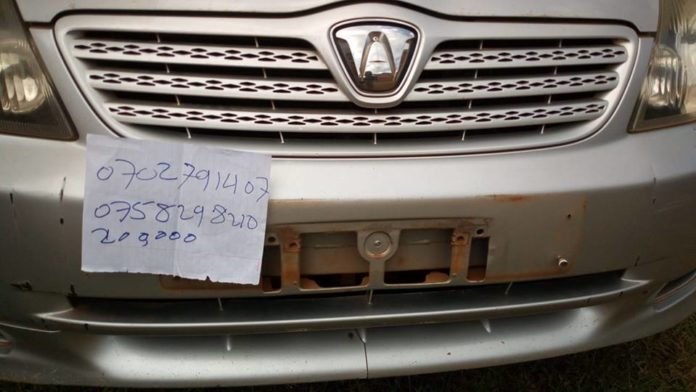
The car that thugs stripped of a number plate and later brazenly demanded a ransom

Daring thieves have stolen the front number plate of a car belonging to vetran journalist David Gusongoirye, and left their contacts for him to pay a ransom.

According to Gusongoirye, the thieves struck last night and left a piece of paper inscribed with the numbers 0702791407 and 0758298210, for him to conact them and pay Shs200, 000 to enable him recover the number plate.

The type of theft exhibited by these daring thugs is a challenge to law enforcement and comes in the wake of the Uganda Communication Commission (UCC) directing that all Simcards be registered in order to curb rising crime.

Just over a month ago kidnappers held Susan Magara for 20 days and killed her after the relatives paid part of the US$1 million ransom demanded.

Also last week, another woman was killed after her relatives had paid a ransom.

Stories Continues after ad

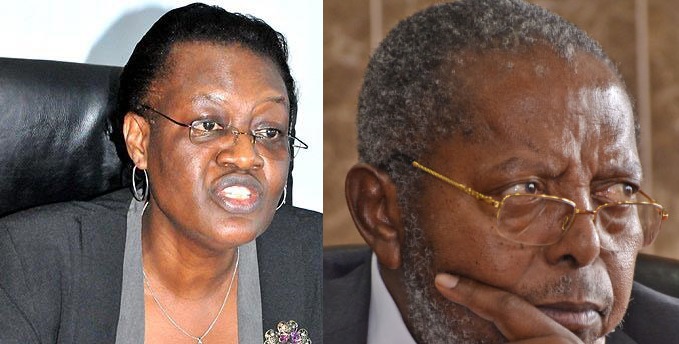
Don’t cause economic crisis over Mutebile-Museveni warns IGG as AG confirms investigation into BoU over Crane Bank

IGG-Irene-Mulyagonja and Governor, Emmanuel Tumusiime Mutebile.

President Yoweri Museveni has reportedly warned the Inspector General of Government, Justice Irene Mulyagonya over her probe into the actions of BoU governor.
In a stormy meeting before the Easter holiday, Mr Museveni is reported to have cautioned Ms Mulyagonya to go slow on Governor Emmanuel Tumusiime Mutebile or the country risked an economic crisis as a result of the investigations into actions of the BoU top executive of making changes at the central bank.
“Please, don’t cause me trouble with the economy. However, much you hate Mutebile, stop these investigations and this shouldn’t be a personal issue between Mutebile and you.” Mr Museveni is quoted by sources at the meeting.
According to sources, the president is reported to have suggested no more bickering shouldn’t be displayed in the public between the two sides because of the potentiality of hurting the economy and could easily lead the shilling to further slide against other currencies.
Meanwhile Auditor General has kicked started forensic audit into the activities of BoU and most importantly how Crane Bank owned by Kampala tycoon Sudhir Ruparelia and a host of other directors. The AG John Muwanga is reportedly interested in how a decision was reached by BoU to give Crane Bank to DFCU bank at a mere Shs200 billion which was supposed to be for Liabilities. Crane Bank was given away without name the price.
The forensic audit into BoU activities was sanctioned by Parliament and is supposed to guide the August House on the next cause on the debate on BoU.

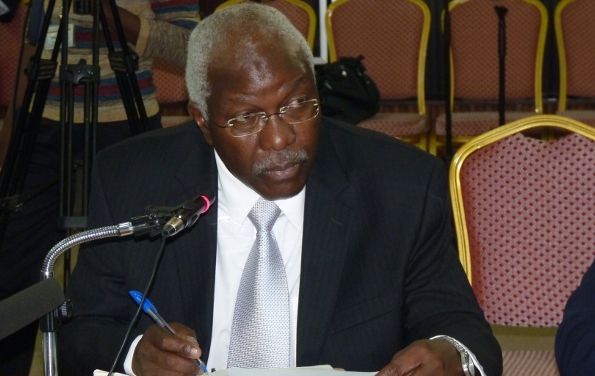
Auditor-General-John-Muwanga, who is carrying out a forensic audit into BoU.

Recently, the IGG faced with the conundrum as to whether the Bank of Uganda Governor acted within his powers to make administrative changes at the Central Bank, one of which involved the retirement of Justine Bagyenda, the erstwhile Director of Bank Supervision. Ms. Bagyenda has since sought the protection of the IGG, who in turn has reportedly blocked the changes made by Mutebile.
‘This is to direct the Board of Directors of BoU not to ratify any actions or decisions taken by the Governor on or around February 7, 2018 in relation to the impugned appointments and transfers until such time as the investigation by the Inspectorate has been concluded or until this office directs otherwise’, the IGG’s March 12 letter states in part.
But in his five-page strongly-worded letter which he copied to among others President Yoweri Museveni, Speaker Rebecca Kadaga and Prime Minister Dr. Ruhakana Rugunda and finance minister Matia Kasaija, Prof. Mutebile draws the attention of the IGG to Article 162 (2) of the Constitution that guarantees the independence of the BoU from direction of any authority in the country. Others copied in include the Attorney General, the Auditor General and members of the BoU Board of Directors.
‘In performing its functions, the Bank of Uganda shall conform to this Constitution but shall not be subject to the direction or control of any person or authority,’ the Article states in part.

Stories Continues after ad

Netanyahu cancels plan to send migrants back to Uganda

Benjamin Netanyahu

Israel scrapped its plan to deport tens of thousands of migrants back to Africa, after mass demonstrations against the policy in the streets of Tel Aviv and criticism from abroad.
Prime Minister Benjamin Netanyahu, who spearheaded the program to deport about 38,000 migrants to an African nation that wasn’t identified, said Monday that the deal had fallen through and that his government had instead reached an agreement with the United Nations refugee agency to send at least 16,250 to Western countries. The others will be given temporary residency permits, he said at a press conference in Jerusalem.
“We’re doing the best thing possible through an unprecedented agreement” with the United Nations High Commissioner for Refugees, Netanyahu said. Among the countries that may accept the Africans are Italy, Germany and Canada, he said.
As many as 60,000 people, most fleeing Sudan, Eritrea and other countries with wretched human rights records, crossed illegally into Israel through the porous border with Egypt as asylum-seekers between 2005 and 2012. Many settled in poor sections of Tel Aviv, to the chagrin of residents who appealed to the government to send them away.
Barrier Erected
Netanyahu and other politicians who objected to their presence insisted they didn’t flee persecution but came as economic migrants seeking a better life. They called them a “cancer” and a “scourge” and warned that they would over time dilute Israel’s Jewish majority. The government erected a barrier along the border with Egypt that stopped the migration.
Supporters of the original deportation plan attacked Netanyahu for buckling to political pressure and allowing more than half the Africans to stay. Education Minister Naftali Bennett, a cabinet member who leads the Jewish Home party, said the deal with the UN agency “will turn Israel into a Garden of Eden for infiltrators.”
Diplomats from Germany and Italy said they weren’t aware that agreements had been signed to accept the asylum seekers, according to Israel’s Haaretz newspaper and the Italian Ansa agency, which didn’t name the officials.
The migrants’ champions in Israel defended them as genuine asylum-seekers and argued that the Jewish state, born in part on the ashes of the Holocaust, shouldn’t expel people who said they faced persecution if returned to Africa.
Unlike countries in Europe that recognized thousands of Eritreans and Sudanese as political refugees, Israel granted refugee status to very small numbers. Many others were sent to detention centers, where they were pressured to accept payments to leave Israel. Over the years, about 22,000 were sent to African countries including South Sudan, Rwanda and Uganda.
After Netanyahu and Interior Minister Aryeh Deri in September unveiled their plan to deport the migrants, rights organizations sought to help them apply for refugee status and held demonstrations that brought out thousands of Israelis from around the country. Major international Jewish organizations and members of the U.S. Congress called on Netanyahu to cancel the deportations.
The new plan to send the asylum-seekers to the West and give residency status to the rest will be phased in over five years, Netanyahu said. The government also pledged to allocate money to rehabilitate Tel Aviv neighborhoods where the Africans are concentrated and encourage many of them to move to other parts of the country.

Stories Continues after ad

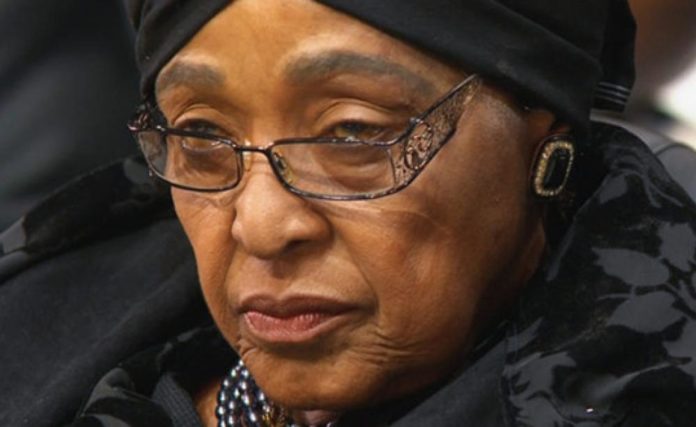
Winnie Madikizela-Mandela dies at 81

Winnie Mandela

South African anti-apartheid campaigner Winnie Madikizela-Mandela has died aged 81, her personal assistant says.
Winnie Madikizela-Mandela was the former wife of South Africa’s first black president, Nelson Mandela.
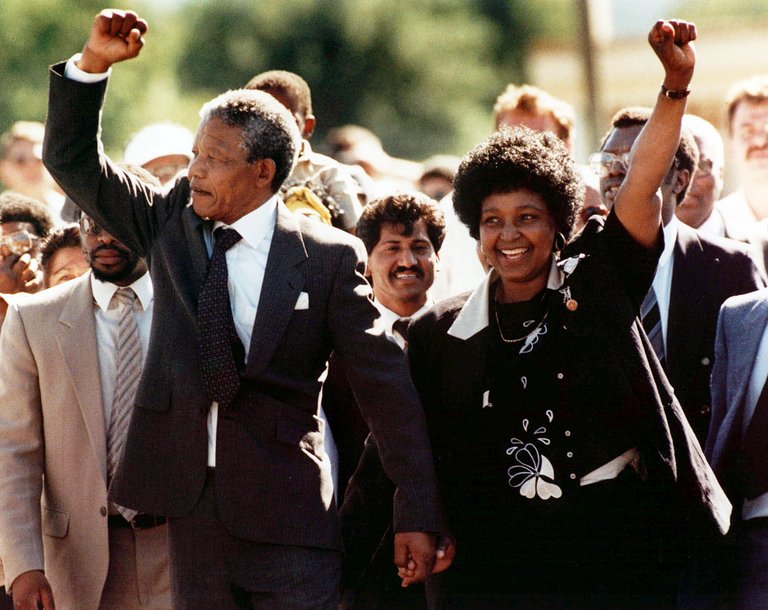
The couple – famously pictured hand-in-hand as Mr Mandela walked free from prison after 27 years – were a symbol of the anti-apartheid struggle for nearly three decades.
However, in later years her reputation became tainted legally and politically.
Family spokesman Victor Dlamini said Mrs Mandela “succumbed peacefully in the early hours of Monday afternoon surrounded by her family and loved ones” following a long illness, which had seen her go in and out of hospital since the start of the year.
Retired archbishop and Nobel laureate Desmond Tutu praised her as a “defining symbol of the struggle against apartheid”.
“Her courageous defiance was deeply inspirational to me, and to generations of activists,” he added.
President Cyril Ramaphosa – who Mrs Madikizela-Mandela praised earlier this year – is expected to visit the family home this evening, African National Congress (ANC) Chairperson Gwede Mantashe said.
He added: “With the departure of Mama Winnie, [we have lost] one of the very few who are left of our stalwarts and icons. She was one of those who would tell us exactly what is wrong and right, and we are going to be missing that guidance.”
Energy Minister Jeff Radebe, reading out a statement on behalf of the family, paid tribute to “a colossus who strode the Southern African political landscape”.
“As the ANC we dip our revolutionary banner in salute of this great icon of our liberation struggle,” he said.
“The Mandela family are deeply grateful for the gift of her life and even as our hearts break at her passing we urge all those who loved her to celebrate this most remarkable South African woman.”

The Mandelas after being freed.

South Africa’s pride and joy – and my neighbour
Analysis by Milton Nkosi, BBC News, Johannesburg
I knew Winnie Madikizela-Mandela personally. We come from the same neighbourhood in Soweto.
To many, she was the pride and joy of the nation, an icon in her own right – never mind the fact she was Nelson Mandela’s wife.
Mrs Madikizela-Mandela was also the first black social worker in the country. Her love and desire to help those in need was always burning from deep inside.
But she was not nothing but sweet talk. She met the brutality of racial segregation with fire. Each time the police came to arrest her at her home in Orlando West, she held her own.
She never gave in. Not one inch – and sometimes, this landed her in trouble. As anti-apartheid activists Mosioua Lekota noted in her defence: “Those who did nothing under apartheid never made mistakes.”
She will be remembered for her fight against an inhumane system, rather than for the mistakes she made in that fight.

Mrs Madikizela-Mandela was born in 1936 in the Eastern Cape – then known as Transkei.
She was a trained social worker when she met her future husband in the 1950s. They were married for a total of 38 years, although for almost three decades of that time they were separated due to Mr Mandela’s imprisonment.
 Nelson Mandela: The women who loved him
It was Mrs Madikizela-Mandela who took his baton after he was jailed for life, becoming an international symbol of resistance to apartheid. She too was jailed for her role in the fight for justice and equality.

But Mrs Madikizela-Mandela also found herself mired in controversy.
She was heard backing the practice of “necklacing” – putting burning tyres around suspected informants’ necks – and was accused of conducting a virtual reign of terror in parts of Soweto by other members of the ANC in the late 1980s.
She was also found guilty of kidnapping and sentenced to six years’ imprisonment for her involvement in the death of 14-year-old township militant Stompie Seipei. She always denied the allegation, and the sentence was reduced to a fine.
Mr Mandela, who stood by her throughout the accusations, was finally released from prison in February 1990.
But two years later, their marriage crumbled. The couple divorced in 1996, but she kept his surname and maintained ties with him.

Stories Continues after ad

US dealers cheer as Uganda backtracks on ‘Mivumba’ ban

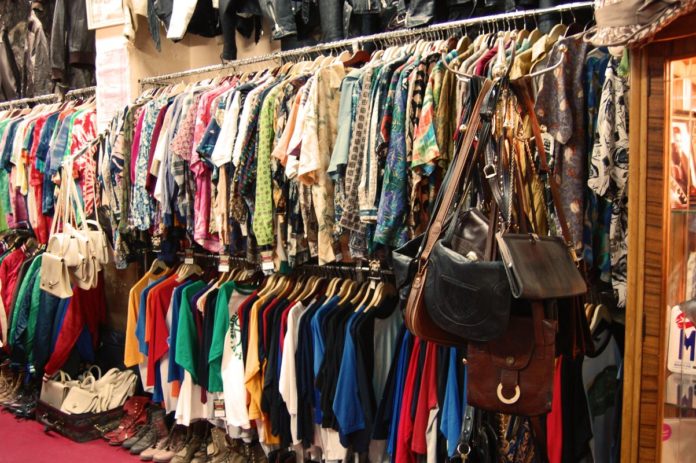
Secondhand clothing on sale

Members of the Secondary Materials and Recycled Textiles Association (SMART) in the US are rejoicing after they were told that a proposed ban on secondhand clothing (Mivumba) imports from the U.S. by Uganda and other four members of the East African Community (EAC) will not be implemented as originally planned.
Uganda, Tanzania, Uganda and Burundi have now officially announced their decision to roll back the ban. Kenya announced their decision to back off from the ban in 2017, following protests from SMART. The decision by the EAC states means the Americans will continue to earn dollars from the region, a big percentage of the population depends on secondhand clothing.
SMART, trade associations, acts on behalf of its numerous small and medium-sized member companies who use, convert and recycle pre-and post-consumer textiles, including used clothing.
In March 2017, SMART filed a petition and delivered testimony during a related hearing asking the U.S. government to conduct an out-of-cycle review of the African Growth and Opportunity Act (AGOA) beneficiary status of Kenya, Tanzania, Rwanda and Uganda and request the suspension of duty-free status for all currently eligible apparel imports from the EAC countries.
The countries at the time argued that they would do so as a measure to boost their own local industries that would later on create jobs for the fast-growing population, especially the youth who are the majority. Uganda would do so via her Buy Uganda Build Uganda (BUBU) Policy which encourages Ugandans to consume locally-made products.
The decision forced SMART to file a petition to the US government. The U.S. government officials are said to have worked hard behind-the-scenes to convince the EAC countries to drop off the proposed ban, paving the way for the secondhand textiles industry worldwide.
The proposed ban sparked international controversy regarding the textile industry’s role in Africa, as no ban or increased duties were slated to occur on imports from China, the region’s largest source of clothing imports. Whereas EAC heads of state were initially concerned U.S. secondhand textiles would disrupt their countries’ own textile industries, SMART representatives argued new and secondhand apparel industries coexist independently in numerous developed and developing countries, including the United States’ own thrift store and new retail establishments.
The decision not to effect the ban means more than 190,000 jobs within the United States alone being preserved, as the total exports to the EAC represents roughly 22 percent of the U.S. industry’s total exports. The EAC members have announced they will focus on other measures to develop their textile and apparel industry.
Meanwhile, The U.S. government has suspended duty-free treatment for all AGOA-eligible apparel products from Rwanda in 60 days, a decision welcomed by SMART representatives, who lauded President Donald Trump to suspend the benefits, instead of termination of Rwanda’s status as an AGOA beneficiary. They said this would allow for continued engagement with the aim of restoring market access and thereby bringing Rwanda into compliance with the AGOA eligibility requirements.

Stories Continues after ad

Norway, Dutch cited in fraudulent takeover of Crane Bank

Latest information reveals that governments of Norway and Dutch could have exerted pressure on some individuals at Bank of Uganda to give Crane Bank Limited to DFCU group.
The two countries whose companies own majority shares in DFCU are said to have used a top executive at the central bank to seal the deal that saw Shs200 billion paid for CBL. The Shs200 billion is said to have been for liabilities. Interestingly, no price was named for CBL and this could mean that the CBL was given out for free.
Last week DFCU bank announced Shs127.6 billion as profits for financial year 2017-2017. However, what is shocking is no substantial of that money will remain in Uganda to develop the economy as most of it will siphoned out of the country for foreigners to share it.
The Shs127.6 billion can tarmac 150 kilometers of a road at a cost of Shs800 million per kilometer or can build over 1000 modern primary schools.
But the revelation that majority shareholders of DFCU are foreigners leaves Uganda questioning why it risky to have major investments in the hands of foreigners who at the end of the day, pocket almost all profits exiting them to their countries.

Uganda is known for being kind to investors but shouldn’t the country have a seal on how much percentage they should give to foreign companies like Rwanda does? Some shares should be left for locals and these could check on the siphoning of all cash to foreign lands like it is the case with DFCU.
DFCU is partly owned by the Commonwealth Development Corporation (CDC) a British government-owned company, together with other foreign multinationals like Rabo Development from the Netherlands and NorFinance from Norway who are shareholders in Arise B.V together with Norfund, a Norwegian government owned Private Equity firm and FMO, the Dutch Development Bank.
Last year, a company called Arise BV was formed after the companies, Norfund, Norfinance FMO, and Rabobank, all of which had shares in different commercial banks in Sub Saharan Africa, transferred their shares to form one company, Arise BV.
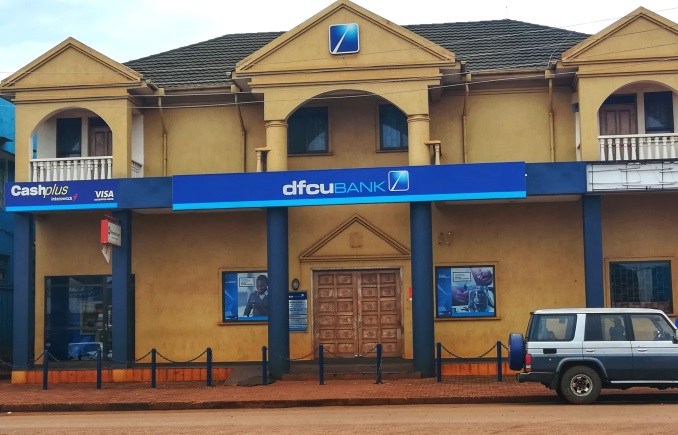
Arise B.V is now the majority owner of DFCU Bank, which on January 27, 2016, acquired Crane Bank Limited from Bank of Uganda where it had been under receivership.
Arise BV, which has its headquarters in the Netherlands became majority shareholder in DFCU, (owns 57.81 per cent of shares), just three months after the latter acquired Crane Bank’s assets.
Arise BV claims to aspire to “build strong locally owned financial service providers (FSPs),” and to help “people in Sub Saharan Africa to empower themselves by getting bank accounts and take loans and hence build a better life for their families.”

In April last year, four firms wholly and partially owned by the governments of Norway and Netherlands pooled resources and formed a giant, and named it Arise B.V.
After taking CBL, DFCU had an increase of nearly Shs100 billion in interest income largely from loans and advances taken over from CBL. Interestingly, this is the very year when the prime lending rates were being reduced by all banks in line with reduction in CBR. Although CBL had been declared by BoU at its takeover, as none performing, but an astonishing increase of Shs118 billion by DFCU from CBL customer base means that this must have been from the write back of the purported Non-Performing Assets (NPA) taken over from CBL.
According to extracts of the DFCU bank published statement, there was a windfall increase in income of Shs216 billion. This increment comes after DFCU acquired the Shs200 billion CBL from BoU payable over a period of five years and this has been referred as Bargain Purchase. This profit means that DFCU made Shs92 billion mainly from increased number of branches and staff taken over from CBL.
CBL had loans and advances to a tune of Shs1.1 trillion but some of these loans are being approved as NPA. However, this could be some of the reasons DFCU is make abnormal profits because of the securities.

The bank’s credit to customers rose to Shs1.3 trillion in 2017, up from Shs834.8 billion in 2016.More, customer deposits rose to Shs1.98 trillion from Shs1.13 trillion received a year earlier. That was attributed partly to the acquision of Crane Bank.
BoU transferred the liabilities (including deposits) of Crane Bank to DFCU Bank in 2017.
The leaked agreement between Bank of Uganda and DFCU indicated that the external owned bank got Crane Bank with assets valued at Shs1.3 trillion for just Shs200 billion (payment for liabilities).
The Agreement did not state the amounts of money paid by DFCU as a net purchase price; or the payment terms for monies, or the assets (outside branches) that DFCU was taking over.
DFCU Shareholding percentages
Arise BV 58.71 per cent
CDC Group of the United Kingdom 9.97 per cent
National Social Security Fund (Uganda) 7.69 per cent
Kimberlite Frontier Africa Naster Fund 6.15 per cent
2 undisclosed Institutional Investors 3.22 per cent
SSB-Conrad N. Hilton Foundation 0.98 per cent
Vanderbilt University 0.87 per cent
Blakeney Management 0.63 per cent

Retail investors 11.19 per cent
BoU staff retirement benefit scheme is 0.59 per cent

Stories Continues after ad

UPDF kills 30 Al-shabaabs on Easter

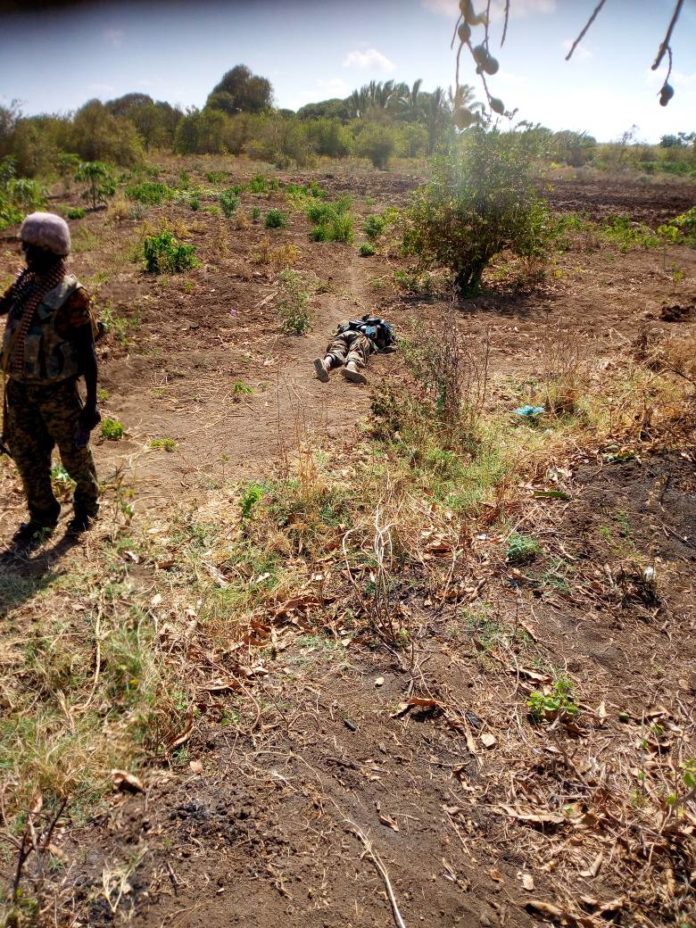
AMISION soldier walks past killed Al-shabaab fighter.

Uganda People’s Defence Forces has killed 22 fighters of the Al-shabaab terrorist group in Somalia.
UPDF under AMISIOM killed the 22 terrorists that attempted to Forward Operating Bases at Quoroyole, Buulo Mareer and Golwen in Lower Shabelle Region of Somalia.
AMISIOM also destroyed eihjt of their vehicles that included two born improvised explosives.
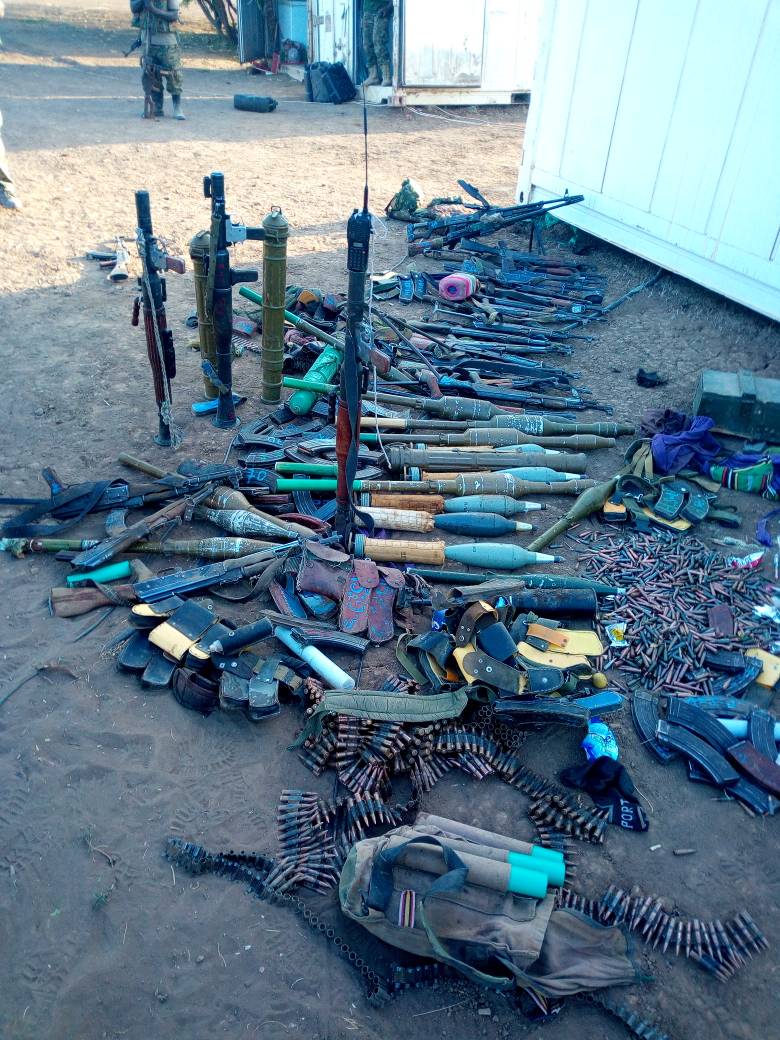
“The following equipment were captured from terrorists four PK Rifless, two rocket propelled guns, two recoiless guns, one walkie talkie and 18 submachine gun rifles.”

Al-shbaab also killed four UPDF soldiers and six sustained minor injuries. Previously Al-shabaab has used days like Christmas and Easter to attack AMISIOM bases

Stories Continues after ad