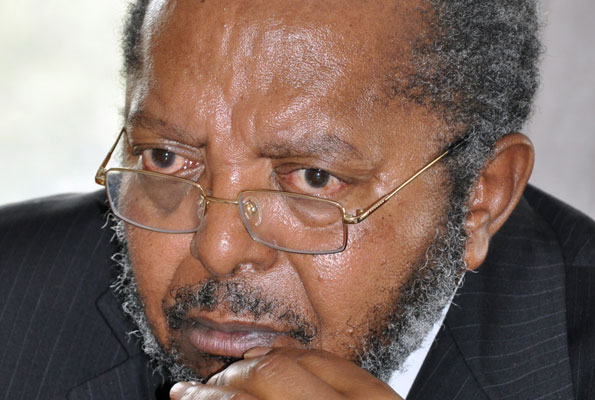
Senior Presidential Advisor on Political Affairs, Martin Aliker told the Institute of Commonwealth Studies at University of London in an interview that he doesn’t go to President Yoweri Museveni begging but if he does so, he goes there to tell him hard stuff and that in front of the president, he is known as bearer of bad news. Below is the interview.
Interview: Dr Martin Aliker explains why Milton Obote loved the Commonwealth but hated Great Britain. He also reveals how he helped late Gadaffi in Lockerbie bombings case
Dr Martin Aliker (MA) is no stranger to Ugandan politics since colonial times, through independence, and has seen the country evolve through political upheavals to the present status. In May 22, 2013 the Institute of Commonwealth Studies at University of London hosted him for an interview by Dr Sue Onslow (SO). We re-publish it for our readers.
SO: Dr Aliker, thank you very much indeed for agreeing to take part in this interview project.
MA: You’re most welcome.
SO: I wonder if we could begin, please, at the point of independence, [when] you had been working for the Ugandan government. What was your view of the Commonwealth and of Britain at that particular time?
MA: In 1962, the Commonwealth had not yet developed to the level it has developed now, because most of the African countries were still not yet independent. So, our sense of belonging to the Commonwealth was not really that strong. Our tie was mostly to the United Kingdom – because of obvious reasons, the most important being education. Many of us came to this country for university education.
SO: Your first president, Milton Obote, was identified as being a very strong supporter of the Commonwealth. At the time of the transformation of the Commonwealth in the mid-1960s – with the expansion of newly independent African states and the creation of the Secretariat – it’s very evident, looking at the files, that President Obote took a particularly impassioned and engaged stand on Commonwealth issues.
MA: Well, Obote could have appeared to be interested in the Commonwealth, but, basically, he was not that for Britain, as a politician.
SO: Yes.
MA: Because he was brought up as anti-British. His politics started in Kenya, and it tended to be pro-east, Russian-orientated, communist; although, in Uganda to itself, the Ugandans were not pro-Russia. So, in order for Obote to rule the country, he had to show interest in the Commonwealth.
SO: This was, then, a question of Obote using international issues to strengthen his domestic standing?
MA: That’s right. That is correct.
SO: As you recall, how much of a challenge was Rhodesia’s illegal declaration of independence in 1965 to the cohesion of the Commonwealth? Is this something that was discussed in Ugandan politics and Ugandan newspapers at this particular time?
MA: The Rhodesian issue was very much discussed in Uganda. But Ugandans could not really identify themselves with Rhodesia because, distance-wise, Rhodesia is quite geographically far removed from Uganda. You have Tanganyika in between, you have Zambia in between. So, Ugandans didn’t really know much about Rhodesia. They were sympathetic, but they could not demonstrate their feelings about Rhodesia in any meaningful way.
SO: So, how politically active were you at this particular point in the mid- to late-1960s?
MA: Well… [Laughter] I was never really involved in politics. I have to make a confession. I was one of those people who did not see the need for independence in Uganda, because life was very comfortable under the British. We didn’t really see what more we wanted. We had everything: there was never any segregation in Uganda, the salary scales were the same, the facilities were all available. So, the agitation for independence was only amongst a few people. At that time, we talked about how those who were failures in life were the ones who went into politics.
[Laughter]
SO: I’m sorry! [Laughter] How interesting!
MA: Well, I can tell you the names of the people who went into politics. Milton Obote: Obote did not get a degree. He had no degree, but he left Makerere because they were not offering law. He wanted to study law and there was no law faculty, so he left. He left of his own accord. So, he didn’t have a degree. I can go through the names: George Magezi, Cuthbert Obwangor, Matthias Ngobi, Gaspari Oda, Alex Latim – all these fellows had no degree. There wasn’t, I don’t think, in the first government…Oh yes, in the first cabinet there were four people with degrees. There was William Kalema, Grace Ibingira, Joe Zake and Dr Emmanuel Lumu. Those are the ones I can think of who had degrees.
SO: What you’re suggesting to me here, then, is that politics was seen very much as a second-class profession?
MA: Very much so. Definitely, it was for those who were failures in life: people who had no definite careers or good prospects for the future.
SO: So, rather than it being intellectual leadership at independence and the energy and dynamism of first-class political minds, you’re suggesting in Uganda that this was not the case?
MA: At the beginning it was not; even up to now it is not. Today, it is a means of a livelihood.
SO: Ah, so, they seek to resolve ‘the problems of the bus queue’ through political office?
MA: No, they seek to become members of parliament so they can get paid.
SO: That’s what I mean: that, if you have problems in the bus queue, you become an official or member of parliament, so you can automatically jump ahead and get a Mercedes-Benz!
MA: That’s right. Yes, this is how we view them.
SO: So, in the 1960s, there was a remarkable disconnect between the intellectual elite, such as yourself – the professional elite – and the political elite, which was not engaged with grassroots activism?
MA: There was no connection at all. I don’t remember anybody, say, from Makerere University joining politics.
SO: That is an extraordinary debasement of your country’s intellectual capability and the resource pool in politics.
MA: No…We did not view politicians very positively.
SO: As you said on Monday, there was remarkable disdain for the idea of the country being ruled by commoners and people of ‘common intellect’.
MA: Well, for the landed gentry – especially in Buganda – and the so-called ‘Whose son are you?’ These are people who had property, people who had money, people who had status, and they could not see themselves being ruled by the sons of ‘Who is he?’ – commoners, so to speak. In Buganda, the problem persists to this day. They say that…The Baganda still expect a special position for themselves, which means a special position for the elite in Buganda, not for every Muganda. And, when they talk about what Buganda wants in the special status, they are really talking about going back to the time when the Kabaka was the absolute ruler and he dished out jobs as he saw fit. Well, that’s not going to happen anymore.
SO: No, that system of patronage is not. So, by the latter part of the 1960s, had you become more politically active if you were criticising these second-class politicians?
MA: Well…I didn’t, because I got more involved in business. So, that even put me further away from politics, and one of the reasons Amin took over government was that we never expected it to happen. We just could not see a coup in Uganda. A coup for what? Everybody was content. And Amin took over the government and we were all so helpless. We were not prepared for it. We couldn’t counter Amin in any way. Today it would be different: I don’t think Amin would have survived as long as he did – 8 years – in today’s Uganda. 4
SO: For the outside world there was the conundrum that Milton Obote was at a Commonwealth Heads of Government Meeting in Singapore when the coup happened…
MA: Yes.
SO: You yourself left Uganda in 1972 to go to Kenya.
MA: Yes.
SO: Do you recall that there was much of a desire among the business elite – the exiled business elite of Uganda – and the exiled politicians, a desire for the Commonwealth to take a more prominent stance on what was going on inside Uganda in the 1970s?
MA: Yes, there was. In fact, we felt very much let down by the outside world – especially the Commonwealth and the United Kingdom, which did nothing to try to get rid of Amin. Afterwards, the UK became interested – when Amin’s excesses became public knowledge – but, at the early stages, Amin showed a pro-British attitude and the High Commission at that time in Kampala thought the man was a good person. He fooled the High Commission.
SO: But were you involved in any particular moves to try to encourage external international criticism, or criticism from within the Commonwealth?
MA: From about ‘76, I not only encouraged but I actively participated in raising funds to topple Amin.
SO: Did you have contacts with the Secretariat or the Commonwealth Secretary General to try to encourage declaratory statements that said…
MA: No, no contact at all with the Secretariat.
SO: I know that from talking to Sir Sonny Ramphal that he felt passionately that the Commonwealth was being extremely vocal in opposition to the white minority government of southern Rhodesia and, of course, apartheid South Africa, but it was not looking into its own internal abuses of human rights.
MA: No. We, in Uganda, felt very much let down by the Commonwealth and particularly the UK, because the UK could have taken a lead which would have encouraged the other Commonwealth countries to be more critical of Idi Amin.
SO: You said that you were involved in extending financial support for Amin’s removal. Had you also made any representations to the British government of James Callaghan?
MA: No, I never did that.
SO: Were you aware of others who might have done?
MA: I don’t know who actually made the representations, because Ugandans were spread out all over the world and some people who were living in the United Kingdom could have had access to some government officials. But I personally don’t know of anybody, and I personally never made any representation to the British government.
SO: Dr Aliker, how important was the exiled Ugandan community in Nairobi at this point as a focal point of agitation for Amin’s overthrow?
MA: Kenya was a conduit through which people passed. Some of us stayed in Kenya; many of us just passed through Kenya to go elsewhere. But the group that remained in Kenya was very, very active, because of [the] proximity with Uganda, and people would come and go and they would take messages and sometimes armaments.
SO: Did you have discreet lines of contact with the Kenyan government? Or with Kenyan security forces, or people in State House?
MA: With the Kenya government, yes. I personally had direct contact with the President. President Kenyatta was very sympathetic to Ugandans, and the Head of the Civil Service – Geoffrey Kariithi – was an ex-Makerere. In fact, almost all the Permanent Secretaries were ex-Makerere, and they were very, very sympathetic to us. When Kenyatta died and President Moi took power, he replaced most of Kenyatta’s appointees with his own appointees. Now, these are people who did not go to Makerere, and they had no sympathy for Ugandans. In fact, some of them thought we were savages because they had never been to Uganda.
SO: They had no idea of the standard of Makerere University?
MA: They had no idea that in education [and] socially, Uganda was far superior to Kenya. Our problems in Kenya as refugees started with President Moi’s rule.
SO: So, your lines of access were good while President Kenyatta was alive, because of your contacts with him and his sympathies. In your description of the removal of Amin, the Commonwealth doesn’t appear to come out very well.
MA: No. The Commonwealth didn’t do anything.
SO: Well, the Commonwealth likes to present itself, of course, as sending the Commonwealth Observer Mission in December of 1980 to observe the elections between the four political parties – after Amin had been overthrown and then after General Lule had come in.
MA: I came in with Lule.
SO: Were you involved in any of the discussions about bringing in the Commonwealth Observer Mission?
MA: Well, let’s go back to Moshi [and] the [1979] Conference. At the Moshi Conference, General Tito Okello was the head of the Ugandan fighters – alongside the Tanzanians – against Amin. He came to Moshi and called me and said to me, “When we reach home, we – the fighters – want you to be the President of Uganda.” And I knew that if it was announced on the radio in Uganda that I was going to be the President, by the time I got there my parents would be dead. And, at that time, the lives of my parents were far more important than my ambition of becoming President of Uganda. So, I persuaded Tito Okello to allow Lule to become the President, and it took me two days trying to convince Lule to become the President because he was not sure whether my tribesmen – the Acholi, who were fighting – would accept him. So, I am the one who made Lule the President. Otherwise, if I had been ambitious enough, I would have taken over.
SO: Sir, in your role as ‘king-maker’ – because that’s what you were for Lule – or ‘president-maker’, I should say, did you maintain your authority and influence afterwards?
MA: When we got back to Kampala, Lule asked me, “What do you want to be?” And I said, “I just want to help you.” And so I stayed with him in State House, in Entebbe, as his advisor.
SO: Were you involved in inviting the Commonwealth Observer Mission to come in for that election?
MA: No, Lule was already toppled.
SO: He was; I’m sorry. It was quite a tumultuous time in Uganda!
MA: [Laughter] Yeah, Lule was already toppled; Binaisa had also been toppled. So, it was the military commission, which included this present President – he was the deputy to Paulo Muwanga. Muwanga was the Chairman of the military commission; in fact, the President of Uganda at the time.
SO: So, in your short time as Lule’s advisor, was foreign policy in any way one of your preoccupations? I appreciate that, given the tumult in the country and the need to re-establish the state and its legitimacy, this might not have been your top priority.
MA: Foreign policy was the least of our problems. In fact, when Lule was toppled, I was in London. He had sent me here to come and meet with government officials to seek assistance. Another colleague, called Semei Nayanzi, who was also his advisor…We were both in London. He had come for a different reason. I was sent specifically by Lule to come and see government officials in the United Kingdom, because he knew that I have contacts.
SO: Do you recall, sir, whom you came to see?
MA: Edward du Cann. Yes, he was then the Chairman of the 1922 Committee.
SO: My father was his successor.
MA: Ah!
SO: Why did you contact him?
MA: Sir Edward du Cann was the Chairman of Lonrho, and I was Chairman of Lonrho in Uganda. So, I knew him.
SO: So did Tiny Rowland have any particular role in assisting the…
MA: Not at that time. Tiny Rowland came in much later to assist the current President.
SO: Okay. I was just thinking of what Tiny Rowland was doing to promote Joshua Nkomo’s cause via Lusaka and the whole Zambian connection. So, this was a role Tiny Rowland played in 1985-1987 to support Museveni?
MA: Yes.
SO: Did you come to see du Cann in his capacity as chairman of the Conservative backbench committee – i.e. for his political connections – or in his capacity as Chairman of Lonrho?
MA: For both reasons – because, as chairman of the 1922 Committee, he had influence in the Conservative government.
SO: Yes. Did you make any time or effort to go to Marlborough House to talk to the Commonwealth Secretariat?
MA: No, I came specifically to see du Cann.
SO: And how much help was he?
MA: Well, he was helpful, but not immediately. It was afterwards, when he put me in touch with Prime Minister Thatcher, that his assistance became obvious. Because, there came a time when we had nothing – no money in the Treasury, nothing at all…
SO: It had all been looted?
MA: Yes. And so Binaisa, as President, said, “Look, you know the people in England. Please go and ask for help.” [This was] the second time. And I, again, went to du Cann and he said to me, “Look, this is my secretary. You tell her everything” – which I did. She typed it all and gave it to me to read and I signed it. And du Cann then said, “Fine. I will try to get this to government.” The following day he rang me up and said, “I have two business people from Portugal coming to dinner at my house. Could you please come?” And he had a flat in Westminster. I had met his wife, Sally, and so I bought some flowers and took a taxi. When I got there, there was the Prime Minister of the United Kingdom, Mrs Thatcher – whom I had met in Lusaka – and du Cann said to me, “Oh, I’m sure the two of you have something to talk about. Why don’t you come into my study?” Mrs Thatcher was having a sherry and I was given a sherry and she had my letter – the paper I had dictated to du Cann’s secretary. And she said, “This I can do, this I can do, this I have to ask my colleagues, this will take time, this I can do.” And, in five minutes, she had taken a decision. And then she said to me, “I’m sorry I can’t join you for dinner; I have another commitment.” And she got up and left with one person following her and outside there was not a single marked car.
SO: That’s impressive. That’s very impressive.
MA: So, that was my experience with Mrs Thatcher.
SO: What you’re explaining here, then, is the effect of extraordinary personal networks as well as good fortune. Business networks, political networks, dinner diplomacy, a quiet word with the Prime Minister…all combining to achieve important diplomatic results.
MA: That’s right.
SO: So, in a way, that is the Commonwealth at its best: a filigree of networks.
MA: That is true. I have to make a personal confession: that, in this country, if I really must see somebody – and if I have a song to sing – then I can see somebody who knows somebody who knows somebody who will get me to see that person. But, I have to have a reason for seeing that person.
SO: Yes.
MA: So, in terms of connections…Yes, I have connections in this country.
SO: Sir, is it the ‘old Commonwealth’ network? Not the ‘old boy network’, but the ‘old Commonwealth’ network.
MA: [Laughter] Well, it’s a combination of both. For example, in any other country, one of the people could not have become a friend – because he was a District Officer, he would have been a ruler. But, in Uganda, and in my district, he was sort of a supervisor. And I met him when he came to my father’s court to have a look at the cases that had been decided – to make sure that justice was done – and we became friends. And through him, in his job, I got to meet a lot of people. So, whether it is Commonwealth, or the ‘old boy’ network, it is difficult. But let’s give the credit to the Commonwealth!
[Laughter]
SO: Okay, if we must! It’s interesting that you had a meeting with Mrs Thatcher and not her Foreign Secretary.
MA: No. I had met Lord Carrington in Lusaka…
SO: Yes, you’d met him in Lusaka, as you’d gone down for the CHOGM meeting?
MA: Yes. Now, it was very interesting. For the purpose of seating at the plenary session, [the name used] was ‘Britain’. For the purpose of accommodation, it was ‘United Kingdom’, which is right next to Uganda. And Mrs Thatcher – of her own free will – twice walked across the lawn by herself and came to see us in our house – we were with Binaisa – to talk to us. She was very sympathetic to us.
SO: When you say she was ‘sympathetic’, you mean she was then prepared to listen to your need for state capacity building, for security sector reform?
MA: Yes. She had just been elected. She was still very enthusiastic. 9
SO: So, you felt that she was a committed Commonwealth person, or a person committed to the reconstruction of Uganda?
MA: She was, I think, both. And, of course, she had Lord Carrington as the Foreign Secretary. And he has remained a friend of mine to this day and he was, again, very sympathetic.
SO: So, going down to the Lusaka CHOGM, your deliberate intention was to solicit Commonwealth support for the reconstruction of Uganda?
MA: Yes. I was taken by Binaisa for that purpose: to meet as many people as possible.
SO: And how receptive was the Commonwealth to that?
MA: Well, Lee Kuan Yew of Singapore, for example, was very sympathetic, but he was also trying to build up Singapore and he was in the middle. He did not have the resources to give us. But he was very sympathetic; I remember him being very pro-Uganda.
SO: I’m just wondering because, in the literature, the Lusaka conference is taken as one of the triumphs on the path towards the ultimate Rhodesia settlement. But do you think that, in fact, meant that Uganda’s issues and needs were eclipsed because the political focus was elsewhere?
MA: Yes. We were right next door to Rhodesia and the Rhodesian issue was very, very strong at that particular meeting. Mrs Thatcher tackled the Rhodesian issue head on. She did not support Ian Smith. This act totally disarmed those Heads of State who had come to Lusaka to oppose Britain, thinking Mrs Thatcher was going to support UDI under Smith. It was a dramatic triumph for Mrs Thatcher and saved the Commonwealth.
SO: Besides Lee Kuan Yew, was the Secretary General giving Uganda any attention regarding its developmental needs, its needs for expert assistance…?
MA: No, we were not given any particular recognition. We were given a chance to speak and Binaisa spoke as the leader of the Uganda delegation. But, nothing…No resolution was passed because Amin had already gone, so Uganda was no longer a burning issue – the reconstruction was no longer a burning issue – at that time.
SO: Do you feel, then, that no political kudos could be gained by helping Uganda at that particular point? Or was it just that Southern Rhodesia seemed to be top of most people’s priorities?
MA: Well, at that time, Southern Rhodesia was the burning issue. Uganda was on the back burner.
SO: After Lusaka, the Commonwealth Observer Mission came to Uganda in December of 1980 to supervise elections. Were you involved in…?
MA: I was very much involved. In fact, I stood on the Democratic Party ticket in Gulu South. The BBC sent a crew and they were told, “If you want to film a winner go to Gulu South.” And they came to one of my rallies. When the 10
children saw this van, they took off because they saw white people! By that time, there were children in Uganda who had never seen white people. They actually ran away from the BBC crew!
SO: These ‘aliens’!
[Laughter]
MA: They had never seen white people. Amin had expelled most whites; the few remaining ones were in and around Kampala.
That election was fair. Free and fair. And I want to stress this: there was no rigging. Absolutely no rigging. I went to one of my polling stations and the box was overflowing with votes for me. What happened was [that] after the elections and the result were sent to Kampala, Muwanga changed the names of the winner from the Democratic Party to the Ugandan People’s Congress. He just switched names: he never changed the votes. There was no rigging. People voted freely.
SO: So, the election process – in terms of delivering a universal secret ballot – that process was free and fair. But it was the outcome that was manipulated?
MA: Yes. I left Gulu because my results were declared in Gulu. I left Gulu to go to Kampala as a winner. I was about 50 miles from Kampala when I heard on the radio that my opponent had won. Now, I had polled 45,000 votes to his 4,000 votes.
SO: So, how much of this ‘electoral theft’ went on? I mean, in those elections, the Uganda People’s Congress got 73, the Democratic Party got 52.
MA: First of all, in the West Nile, there was no voting because the UPC declared that it was a disturbed area. So, all the votes were given to the UPC. In Lango – Obote’s district – Democratic Party candidates were stopped from going to register. So, that gave the UPC about 22 votes already. When they announced Buganda votes it was 35 out of 35 in favour of DP, which wiped out the UPC lead completely and put the Democratic Party ahead. That’s when Muwanga said, “Nobody will announce the results except me.” And that’s when he changed the results.
SO: That’s when he flipped it?
MA: Yes. There are two very good examples – one in Kabale, involving the current minister, Ruhakana Rugunda. He lost to a fellow called Kitariko of the Democratic Party, and Rugunda actually signed that he lost. Two days later, he was told, “You have won.”
SO: So, in which case, the Commonwealth Observer Mission…
MA: They had left! The next day, after the results were announced by Muwanga, they left. Because Uganda was pretty raw at the time.
SO: Yes, that’s very evident from looking at the files of the Secretariat.
MA: Yes.
SO: And the violence in the Luwera triangle and the…
MA: That had not yet started. It started soon after, but Uganda was raw with the Tanzanians in charge.
SO: So, the process of the election was free and fair…
MA: Yes.
SO: …but the outcome was stolen.
MA: Yes. They just switched the names. The other [example] was in Tororo. A fellow called Okwenje was a UPC candidate who lost, and he signed that he lost. Two days later, he was told, “You have won.” He said, “How could I win?” “You must accept that you won,” he was told by the government.
SO: So, if there was any hope that the Commonwealth – riding high after contributing to the Zimbabwe election monitoring process and endorsing it as free and fair – could replicate [this accomplishment] in Uganda, in fact, it was not a success? I mean, it was a success from observing the process of electoral voting…
MA: Yes. They were there to make sure that people were free to vote, they were not there to confirm the results.
SO: To validate the outcome?
MA: No. And their report was correct [in saying] that it was free and fair. I was there, I was a participant, and I cannot say that my votes were stolen from the box. No, no. My votes were not stolen. They were counted properly in the District Commissioner’s office and I won by a wide majority.
SO: Did you make representations to the Commonwealth? I mean, you must have tried to fight this.
MA: No. It was not worth it, because Muwanga had already exhibited his extra-judicial killings. I was a target because I had denied him the Presidency in Moshi. Because he was being fronted as a candidate that would eventually give the job to Obote – which he did, anyway, in the end.
SO: So, how quickly did you go back into exile?
MA: Almost immediately, because Muwanga was looking for me. I booked my ticket to fly out of Entebbe. The people in the airport knew what Muwanga wanted, because they had been instructed to report on my travels. So, I was booked three times by the people at the airport and they told me, “You come in the first booking.” And I flew out before Muwanga knew I had left.
SO: Before the security forces were sufficiently organised?
MA: Yes. And I didn’t come back while Muwanga was in power. In fact, I didn’t come back while Obote was in power, until he called for me in 1984. 12
SO: So, were you involved in exile politics between your…
MA: During Obote’s time?
SO: Yes.
MA: No. I just assisted. Not directly.
SO: How were you [assisting] ‘indirectly’?
MA: In the sense that one of my friends, Chris Mboijana, was a key individual helping the Museveni group and I would help him financially when he was short of money. These people came, ate and slept in his house, and he had to buy food [and] buy drinks for them, and so I would contribute.
SO: So, were you part of another network, back in Nairobi, supporting political opposition?
MA: Not in the same way [that] I was during Amin’s time, no.
SO: Okay. So, did the Commonwealth play any part, again, from what you are saying…?
MA: I wouldn’t know, because I was not in Uganda.
SO: I just wondered if you had maintained any connections back in London. du Cann, obviously, was no longer Chairman of the 1922 after 1984…
MA: Well, I maintained contact with my private friends. [Laughter]
SO: Okay. ‘Useful business contacts and private friends’. [Laughter] So, Museveni then achieved power through the National Resistance Movement in 1986. Were you involved in that final successful push towards Kampala?
MA: No, because that was against my people – against Tito Okello. When Tito Okello took over power, two days later he rang me. I was in Nairobi and I flew to Kampala, and I was in Kampala for three days…and I left; I didn’t see him. Then he rang me again and I went…I was there for two days, and did not see him, and I didn’t go back. When he was toppled and he came to live in Nairobi in exile, I went to see him and he told me that he had wanted me to be the Minister of Finance but that Olara Otunnu did not want me anywhere near the government.
SO: Why?
MA: He was afraid of my being in government [because he thought] that I would overshadow him.
SO: So, it wasn’t because you would necessary affect his [Okello’s] standing within the government, or affect Otunnu’s access to possible sources of patronage and disbursement?
MA: Well, he just didn’t want my influence. 13
SO: Would you have accepted the position, had it been offered?
MA: I don’t know. Because Obote, in his final days, sent for me. He wrote a letter – an official letter – asking me to go and see him. When I saw him, he said to me, “I have three jobs. I am the President, I am the Minister of Foreign Affairs, and I am Minister of Finance. I can’t give you [the] Presidency because I want to be the President, but the other two you can have.” So, I didn’t know how to get out of it. I said, “But Mr President, I stood as a member of the Democratic Party, and if I now join your government, my supporters will think I have let them down.” And, I added, “Besides, there are people in your cabinet who would not want me anywhere near you.” I was thinking in particular of Sam Odaka and Luwuliza Kirunda, who absolutely hated me. And Obote’s reply was, “I can deal with them.” With his ministers. So, I said to him, “Mr President. I know you are going to have elections next year. When you have won your elections, I will not stand this time, and if you appoint me, I will be happy to come into your government.”
SO: So, this was 1984-85?
MA: Yes, and then he was toppled in ‘85 by Tito Okello, and then a year later Museveni took over.
SO: So, is it fair to say, sir, that by this particular time Uganda had developed ‘politicised ethnicities’?
MA: Yes.
SO: Which helps to explain Museveni’s emphasis on the ‘no party’ state – ‘no party democracy’, as it were?
MA: Yes. Museveni took advantage of the fact that the army was predominately northern-controlled. The Acholi and the Langi were in the majority. We had got rid of Amin’s people. Before the Amin coup, we – the Acholi – were dominant with the Langi and the West Nilers as part of the army. We were the leaders.
SO: When you say that you managed to ‘de-politicise’ the Ugandan army and remove Amin’s people, did the Commonwealth help in any way? I know that Mrs Thatcher and Carrington were intent on providing support for security sector reform in Zimbabwe at this particular time. Did they also provide it to Uganda?
MA: I don’t think so. I think there was assistance through the British High Commission during Obote’s time. During Obote’s time there was some assistance, but I don’t know how many people were involved and what their role was, exactly. [What] I mean about getting rid of Amin’s people [is this]: when Amin came to power, we, the Acholi, bore the immediate brunt of his killings. He got rid of most of the Acholi officers. When Amin was toppled, our people – alongside the Tanzanians – actually retaliated against the people in the West Nile. And it would have been worse if the Tanzanians were not there. The Tanzanians [provided some] restraint.
SO: So, they acted as a peace-keeping force?
MA: Yes, to a degree.
SO: Did you have contacts – in a political capacity – with Tanzania, with the Tanzanian leadership, with Nyerere’s people?
MA: During Amin’s time?
SO: Yes.
MA: Yes. With Nyerere, directly.
SO: Although, as you said, the 1979 developments sabotaged your own autonomous intention to remove…
MA: Nyerere wanted to get rid of Obote from Tanzania. So, he was in favour of restoring Obote as President [of Uganda].
SO: So, in this complicated political story of contestation for power, when Museveni achieved power in 1986, how soon did he start sending out lines of contact to you, to invite you to come back to act as his special adviser?
MA: Museveni sent for me in 1986. And I went to see him in State House in Entebbe, and he gave me two hours of his time and I left with two thoughts in my mind: that this man is either very sincere, or a superb actor.
SO: And could you make up your mind which?
MA: I said to myself, “I will give him the benefit of the doubt and I will help him.” And he exploited my contacts overseas.
SO: In what way?
MA: By sending me on missions which he could not send his ministers to. Which continues to this day.
SO: Am I allowed to ask, what sort of missions?
MA: [Laughter] Well…To meet people.
SO: Sir, if I could just unpick this slightly…Where is foreign policy made in the presidency of Yoweri Museveni? Each political culture has its own focus of decision-making, of foreign policy activity. This can be both formal and informal. The President maintains control over foreign policy?
MA: Yes, he does.
SO: So, he would have a group of advisors?
MA: I don’t know whether he has a group of advisors. I know what he and I do together.
SO: This, then, implies a remarkable political friendship, and a reliance on key designated emissaries?
MA: I don’t know who the other emissaries are. I only know myself and I will give you one specific example. In 1995, Uganda and the Sudan had broken diplomatic relations, [and] so he brought me in as minister in ‘96. And my first job was to go to Sudan to mend fences. Between ’96 and 2002, I visited Khartoum eight times – talking with Bashir. My conversations with Bashir were not less than two hours – mostly three to four hours. So, Bashir and I know one another quite well.
SO: Sir, I’d like to explore this further, but just to go back for one moment… For Museveni and yourself to establish an effective political alliance – because it seems to me that’s what it is – this may circumvent more formal channels within the Ugandan government, but is definitely to the benefit of Ugandan national interests.
MA: Yes. Museveni never asked me to do anything really personal. It was personal in the sense that it involved him and individuals.
SO: Is that his style of presidency?
MA: I would imagine so.
SO: In that he does not wish to see talent languishing on the opposition benches; the way the President recruits and involves all possible talent.
MA: I was…to the last of his days, the go-between. I went to visit Gaddafi several times – on behalf of my government and some other foreign governments as well.
SO: So, were you a spokesperson for the African Union?
MA: No, I was only the personal emissary of Museveni.
SO: And other foreign governments, too?
MA: [Laughter]
SO: Something tells me you may know Sir Mark Allen.
[Laughter]
MA: Well, we were in…[the Monitor Group]. I was involved in the Lockerbie issue.
SO: Okay…Governments have formal bureaucratic lines of communication and all effective governments have informal lines of communications, because this is how governments work. In what way were you involved in the Lockerbie issue?
MA: As far as Lockerbie was concerned, Gaddafi was desperate to get his two arrested countrymen freed. So, he lobbied many governments, including the Israeli government. And he went to Museveni as Chairman of the OAU and asked him if he could talk to the Americans. Museveni had no connection with the Americans, so he called me and he asked me to go and plead with the Americans to allow the case to be transferred to the UK. I remember telling him, I said, “Sir, I have succeeded in doing many things for you, but this one is going to be difficult because American public opinion is very much against the Libyans.” And he said, “Oh, well, you just go and add your little voice.” So, I called a friend in Washington who organised for me to meet with people from the CIA, and I was shocked – I made the request and they said, “We have no objection transferring the case to the UK, because British law is the same as ours.” And they said, “We will allow this case to be transferred to the UK.” And as I got up to leave, they said to me, “This time we are not going to shoot the messenger. We would have liked to shoot the sender.”
[Laughter]
SO: That was a vital piece of diplomacy, sir.
MA: Anyway, when I went back and told Museveni, he said, “You see, I told you.” And two days later I was on the plane with him to Tripoli and there started my contact with Gaddafi. Because no sooner had the case been transferred to the UK than Gaddafi shifted the goal posts and wanted the case heard elsewhere.
SO: So, sir, was it Museveni’s and your idea that it should be shifted to British jurisdiction? Where did that idea come from?
MA: Gaddafi. Gaddafi asked Museveni to plead with the Americans to get the case transferred to the UK. Later, Museveni took me with him to the US to meet George Bush, and George Bush introduced Condoleezza Rice as the adviser, and Museveni introduced me to George Bush as his adviser. So, George Bush said, shaking my hand, “Ah, you and Condie will work together very well.” So, when the meeting ended, Ms Rice said to me, “We’d like to see you in Washington, when can you come?” I said, “Anytime.” She said, “Tomorrow?” I said, “Yes.” So, the next day, I went to the White House and we sat down with Condoleezza Rice and she started telling me, “The President told your President the following: Tell Gaddafi to denounce terrorism; tell Gaddafi to denounce weapons of mass destruction; tell Gaddafi to accept responsibility for Lockerbie, and to pay compensation.” And while we were talking, the President walks in: “How are you guys getting along?” And Condoleeza Rice said, “I’m telling Martin what we discussed.” So, George Bush said, “You go tell that cowboy to behave.” [Laughter]
So, I left the White House, flew back to Uganda, and I reported to my President. Three days later, he said, “You are travelling to Tripoli.” We got to Tripoli and, after the formalities in the tent – the famous tent – Gaddafi told everybody else to leave except my President, myself and himself. And, suddenly, Gaddafi could speak English!
SO: Remarkable!
MA: My President said to Gaddafi, “My minister here has been to Washington and he has told me something that I want him to tell you himself.” So, I repeated what the Americans said: denounce terrorism; denounce weapons of mass destruction; accept responsibility for Lockerbie, and pay compensation. So, he said, “Number 1: terrorism. I denounce terrorism – because they wanted to kill me, I killed them. 2: weapons of mass destruction. I don’t have any. I have intercontinental ballistic missile of 2000 km range, in case my neighbours cause trouble. Compensation – we will pay.” He left out responsibility.
We went back to Uganda. I was sent back to Washington. I went and saw Condoleezza Rice and told her what Gaddafi had said. “What about responsibility?” I said, “He didn’t say anything.” She said, “You go back and ask him to accept responsibility.” I went back – this time by myself. Directly. Gaddafi did not accept responsibility. I went back to the White House twice. The third time, Condoleezza Rice said, “Martin, we love you very much, but unless Gaddafi accepts responsibility please don’t come back.” So, God came into play. The Court in The Hague found one man guilty, one man innocent. So, Gaddafi says, “He is a Libyan, we cannot abandon him.” That was his way of saying, “We accept responsibility.”
All this time, I was shown the cheque for compensation: $10 million per person. The person in charge was Moussa Koussa, who jumped ship just before Gaddafi was killed. And he was my contact man.
SO: Yes, and a very effective operator.
MA: Well, I was shocked when he jumped ship, because when I went back for the last time – when NATO had already started bombing – he had already left.
SO: Yes he had. He came here to London…
MA: Yes, I know. He’s now back in Qatar.
SO: Sir, you became a Special Advisor – formally – in 1990, shortly before the Harare Declaration of 1991, which emphasised the Commonwealth as moving towards a human rights and values-based organisation. To what extent was Museveni the recipient of advice from Chief Emeka on the need to introduce multi-party rule?
MA: I think he took it seriously. I was not a party to it, so I don’t know the details.
SO: So, you weren’t particularly aware of Chief Emeka’s contacts with Museveni or Museveni’s office to try and persuade him to move from ‘no party’ to multi-party rule?
MA: Officially…No. I don’t know who, at that time, the Foreign Minister was – not Sam Kutesa. Rugunda was, at one time. [Paul] Ssemogerere was before Rugunda. Then there was [Eriya] Kategaya between. Incidentally, Museveni appointed me as a Minister of State for International Affairs, but my letter of appointment said, “You report directly to me.” So, I was like a teenage son, because Kategaya knew that he was not my boss. But because of his personality and because of his not being a friend of Museveni, he was willing to accept me. But I felt sometimes very awkward because Museveni would call me, would send me overseas, without Kategaya knowing anything about it.
SO: So, you weren’t aware of this question of the Secretary General of the Commonwealth trying to use good offices to moderate and modify Ugandan politics?
MA: No.
SO: When you became Foreign Minister in 1996, how much authority and autonomy did you have in international affairs for Uganda? Or was it still very much with the direction of State House?
MA: No, he allowed me to take certain decisions.
SO: Right. So, day-to-day decisions, or were you making strategic decisions?
MA: Mostly strategic decisions.
SO: Was that unusual?
MA: I think so, because I remember Congo in ’98, when the opposition – the unofficial opposition [in Uganda] – wanted to…What do you do to a President if you want to get rid of him?
SO: You impeach him.
MA: Impeach! They wanted to impeach him. So, they told me and I rang up Museveni and I said, “I need to see you immediately.” He said, “How soon?” I said, “Now!” So, I went there and I told him, “Sir, you’re going to be impeached by Parliament for going into Congo without getting permission from Parliament. Unless you agree to address it.” And he said, “I will come.” So, that afternoon, we convened a meeting outside of parliament and he addressed it. And that’s how he diffused the impeachment process.
SO: How politicised are the security forces? Are they very much within the President’s remit?
MA: Yes.
SO: I’m just wondering the extent to which they have autonomy for driving certain foreign policy [objectives]?
MA: Like the army? No, that is totally under Museveni.
SO: How about the Minister of Trade? Does he have any autonomy in negotiations in international diplomacy?
MA: No, the whole government is now run by Museveni…
SO: So it’s very hierarchical?
MA: Yes, it is. No major decision is taken without Museveni – no major decision anywhere in government, which makes the Cabinet redundant.
SO: It does, totally.
MA: Yes. There are people in the Cabinet who have never seen Museveni alone. Never. Never seen him alone, they see him as a group. 19
SO: Excuse me, but that’s a dangerous concentration of power and responsibility.
MA: Now, my relationship with Museveni is very peculiar. If I want to see Museveni, he will see me. Alone. Because he knows that I am a bearer of bad news. I never go to see him to tell him what a wonderful President he is. I only go to tell him, “Things are bad, this is what I know.” And while he may not say thank you, he appreciates that, and he understands that when I am knocking at the door I have a reason.
SO: So, that implies that he hasn’t totally surrounded himself with yes-men and the sycophants.
MA: Mostly. [It’s] mostly yes-men.
SO: That’s dangerous.
MA: It is.
SO: Sir, thank you very much.
This section of the interview takes place one day later, on 23 May 2013, also at the Berkeley Hotel, London.
SO: Dr Aliker, I wonder, please, if we could continue talking about your view of the Commonwealth when you were Foreign Minister of your country. What was your view of the Commonwealth and Chief Emeka’s drive to support African democratisation in the 1990s?
MA: Well, I met Chief Emeka a couple of times and spent quite a long time talking with him in Cyprus. He was very, very pro-Commonwealth and he tried to impress on me, as Minister from Uganda, the importance of the Commonwealth. But in Uganda itself, we were preoccupied with our own internal affairs, so we weren’t looking outside very much. Foreign affairs was important but only insofar as our neighbours were concerned. We were not looking much further than that, except for assistance by way of aid.
SO: So, Ugandan foreign policy was driven by regional security concerns, principally, at that particular point? And also health issues?
MA: We have never sat down to formulate a foreign policy, and I don’t think we have one. We have a policy of good neighbourliness, but that’s about all. [This] is forced on us by the issue of refugees. We always have refugees from Sudan, from Congo, from Kenya, from Rwanda. So, our foreign policy is dictated by our neighbours.
SO: Would you say that’s also the case of your neighbours? That they, too, in your experience, don’t have foreign policies or strategies per se?
MA: I don’t think they do. It’s all [about] dealing with the issues that arise at the time. Generally, the only thing I know is that Uganda says she is friendly with all nations of the world and does not discriminate. In particular, Uganda stresses that it has no issues with China, because it has been argued sometimes that the Chinese win contracts because they are cheaper, and [that] they use prisoners and underage children to fulfil their contracts. But this is not really an issue with governments in Africa because there is no proof that these people are really prisoners, or whether it’s just propaganda.
SO: You mentioned, sir, that your preoccupations in the ‘90s were principally internal in terms of the domestic health crisis, but there was also pressure for political reform, is that fair to say?
MA: Political reform was happening already because there was the Constituent Assembly, which was rewriting the constitution of Uganda. And that was our preoccupation: to come up with a document that would stand the test of time.
SO: Was Chief Emeka in any way trying to encourage President Museveni to accelerate political pluralism?
MA: Well, if he did, it would have been at [a] level [that] I never knew about.
SO: So, it would have been highly discreet, personal contact, which didn’t involve you?
MA: Yes.
SO: Did you attend the Roundtable discussion down in Gaborone, convened by the Commonwealth with leaders and opposition leaders?
MA: No, I didn’t go.
SO: Did you send a delegate?
MA: I think, yes, Uganda had a delegation there. But whatever they discussed there was never really publicised.
SO: Did you then go to the Commonwealth Heads of Government meeting in Edinburgh in 1997?
MA: No, I didn’t. I don’t know why, because I was very much there. Probably I was sent off on some mission; I don’t quite remember.
SO: This was also the time Chief Emeka was trying to emphasise political and human rights within the Commonwealth. It seems to me that there was parallel momentum gathering to reform the OAU into the African Union through President Thabo Mbeki. For Uganda, did this take your energies away from anything to do with the Commonwealth, or in fact is that a misrepresentation?
MA: I don’t think [that] it took Uganda’s energy away from the Commonwealth, because the OAU has always been there and every African nation thinks they have a contribution to make towards its reform. Although, there is a tendency for the Francophone countries to dominate it.
SO: So, you don’t think that there is a discrete Commonwealth bloc within the OAU? Obviously, the OAU is divided between the seven regions in terms of its security operations, its political and economic activities. But there’s no identifiable Commonwealth grouping?
MA: No, no. One point I’d like to make is that the beauty of the Commonwealth is that its member states feel that they can approach each other, and if there is a dispute between two Commonwealth countries, the other people feel that they can come and tell them, “Look, you can’t go to war against one another because you belong to the Commonwealth.” I think this is the beauty of the Commonwealth.
SO: So, you shouldn’t fall out ‘in the family’?
MA: Yes.
SO: Did you come to have a particularly strong viewpoint regarding Rwanda joining the Commonwealth? After all, they come from a very different historical culture…
MA: Uganda was very happy for Rwanda to join the Commonwealth because Rwanda and Uganda are basically the same country. They are different, but the same country, and Uganda has always provided the safety valve for Rwanda’s population. There are about two million Rwandese living in Uganda.
At the time when the government of Rwanda and the government of Uganda were about to go to war against one another, the population didn’t see what was the problem. And I can also tell you that I was in the delegation that came to London. While President Kagame and President Museveni were with Prime Minister Blair at Number 10 Downing Street, the rest of us were left in the Commonwealth building near the Palace…
SO: Marlborough House.
MA: Marlborough House. The Rwandese were there, the Ugandans were there, and we were sitting around the same table and speaking in Luganda – not even in English! And I remember very vividly talking to the Chief of Security of Rwanda and I asked him, I said, “Where did you do your medicine?” He said “Makerere.” And I said, “Which school did you go to?” He said, “I went to Kings College, Budo.” Which is where I went! And he said, “I’m hoping that my son will get into Budo next year.” Now, here is a country with which we are about to go to war, and he wants his son to come and be in foreign and enemy territory? It didn’t make sense. There is basically no quarrel between Rwanda and Uganda.
SO: At that particular meeting – in Downing Street, between Presidents Kagame and Museveni – this was the British Prime Minister using his good offices to…
MA: Yes, to try to diffuse the tension.
SO: Had the Commonwealth Secretary General tried to diffuse the tension?
MA: No, he had not. This was directly from the Prime Minister of the United Kingdom.
SO: So, in your experience, has the Secretary General in any way sought to assist Uganda in resolving disputes [or] in providing legal aid to your constitutional negotiations?
MA: I do not know of any direct assistance from the Commonwealth. I know there are a lot of Ugandans employed in the Secretariat. At one time there was a Ugandan mafia talked about in the Secretariat.
[Laughter]
SO: A strong group! So, the Commonwealth and its diplomatic machine – the Commonwealth Secretariat – in your experience hasn’t featured very prominently in dealing with the issues that Uganda has had to face?
MA: I’ll tell you what. Our needs and requirements are of a monetary nature, and the Commonwealth Secretariat, as such, doesn’t have the funds. So, we tend to go directly to the individual Commonwealth countries for assistance, rather than go to the Secretariat.
SO: Yes, but is there also a sense that Uganda is a strong enough country in its region, such that it doesn’t need to go through the Commonwealth? In other words, you already have an ‘in’. You have contacts that you can call, that you can exploit.
MA: Well, from time to time I think we probably need the Commonwealth. I think the sense of belonging to the Commonwealth is more important than the assistance that one seeks from the Secretariat. A Ugandan student has no hesitation in applying to go to university in Australia, in South Africa, Canada, or India. He would hesitate if he had to apply to go to a university in Germany, for example. But, being a member of the Commonwealth, one feels that one really already has a foot in that country.
SO: So, there is a sense of a cultural affinity?
MA: That’s right.
SO: This is not hard power, then; this is soft power?
MA: Yes.
SO: In your view, how and why do you think the Commonwealth has survived?
MA: One of the reasons for its survival is, one, the common bond of the language. And two: where we come from – [as] ex-British colonies. Most important is that Commonwealth nations do not interfere into the affairs of one another.
SO: So, it’s a question of respecting sovereignty?
MA: Yes, I think this is very important.
SO: But you said yourself, yesterday, that the trials and tribulations which Uganda endured from Amin’s coup in 1971 and all the way through to 1986, that there was a need for external assistance and support: to support varying forms of democratisation in Uganda in the ‘70s and the ‘80s.
MA: Well, in the ‘80s. In the ‘70s, no, because you couldn’t…Amin was in control, and there was no talk about democracy. The democratisation process started after Amin was toppled.
SO: I just wondered if there had been a sense – among your community of political exiles – of wishing for greater Commonwealth support at that point. And that would have interfered in Uganda’s internal affairs.
MA: We expected the United Kingdom to take a stronger stance, and not other countries – not other Commonwealth countries.
SO: In addition, then, to the bonds of language and the bonds of culture, of soft power, to what else do you attribute…How else do you explain the Commonwealth’s survival?
MA: Ah. I think it’s just the accessibility [to] each other’s countries…[This] is an important reason why the Commonwealth has survived.
SO: How much do you attribute to the persona and role of the Queen?
MA: Oh, very, very important! When CHOGM took place in Kampala in 2007, the people were not interested in CHOGM: they were only interested in the Queen. And between Kampala and Entebbe, both the British High Commission and the Ugandan Police, estimated that there were 2 million people along the road, [standing] five deep. They were just interested in the Queen. They thought ‘CHOGM’ was the Queen’s husband.
[Laughter]
SO: ‘Move over, Prince Phillip!’
MA: No, really! The people…I had the honour to be invited by the Queen to lunch and I said to her, I said, “Your Majesty, I would like you to know that the people of Uganda are genuinely interested in seeing you.” And she said, “The Duke and I can feel it – the warmth of the people.”
SO: To have come there and received such enormous popular acclaim…
MA: Yes, yes.
SO: How much importance did Uganda attach to holding the CHOGM in Kampala in 2007? I know that you’d had the referendum in 2005, [and] the Commonwealth had said that this was the process of democracy. Was this also part of a Commonwealth process of rewarding pluralism?
MA: I think the majority of the people were very happy to have CHOGM held in Uganda. The opposition, I think, demonstrated an ‘anti-’ attitude, just for the sake of being different. What people resented afterward was the corruption that took place in the process of organising the meeting. There was, for example, [the widening of] Entebbe/Kampala Road. It was not very satisfactorily done, because there was some kickback money. One person got a contract to wash 2,000 cars a day at the rate of 60,000 Uganda shillings per car. The Queen, for example, stayed in the Serena Hotel, which is just walking distance from the main hall. So, many people who stayed in that hotel never used their cars. So, this person got the money without doing the job.
There was the beautification of Kampala: planting trees, planting grass. People exaggerated the cost and made a lot of money. That is the downside of it. But the actual meeting was a great success, and the Ugandans were extremely happy because, for once, they had the Queen, they had the Prince of Wales [and] they had the Prime Minister of Britain. So, it was a very strong delegation.
SO: Yes, validation from people of authority. Also, of course, for the Commonwealth, at this time, one of the biggest challenges has been Zimbabwe.
MA: Yes.
SO: Since 2000. How far has that preoccupied you?
MA: Well, in Uganda now we cannot talk about Zimbabwe because we are almost in the same soup. Our President has also overstayed, and so we can’t – as a government – criticise Zimbabwe.
SO: Yet Uganda held its constitutional referendum in 2005, and then the Presidential election [was held] in 2006…
MA: At that time, we were very critical of how Mugabe was treating his people. At the height of the inflation…I have, for example, a bank note for 100 million Zimbabwean dollars, which is of no value whatsoever.
SO: I was told that the 500 million dollar bill was called ‘the red Ferrari’, because it stayed in people’s pockets such a short time! [Laughter] So, was President Museveni – and you, as his Special Advisor – in any way involved in the approaches to Robert Mugabe and the people in Zanu PF, to try to persuade them to step down?
MA: No, we were not involved.
SO: So, you’ve left that to SADC.
MA: Yes, to South Africa.
SO: Well, indeed, but South Africa in SADC.
MA: Yes.
SO: What about your neighbour, Kenya, which has gone through its own upheavals? Have you been involved in any way in trying to support democratisation following the violence of the elections of 2007, and the discussions between Raila Odinga and Kibaki?
MA: I know both of those people very well, but I know Kibaki better. From [my] Makerere days. And when I went into exile, I found myself his immediate neighbour in Hurlingham. I was there for one year and I bought a house in Muthaiga – a year later, Kibaki bought the house next to me. So, for 22 years we were neighbours and I used to play golf with Kibaki. Raila [and] I met afterwards, and the only social event we used to share was going to [the] sauna at the Hilton hotel on Saturday afternoons.
[Laughter]
SO: So, you weren’t involved in any of the political brokering…
MA: No, no. But because I know so many people in Kenya, I have had informal conversations with people in authority.
SO: The Commonwealth seems to be a filigree of networks, of personal networks. You’ve just talked about the informal conversations between people of similar regional concerns. Can you see this surviving into the future? After all, it faces a number of challenges.
MA: Well, I see the Commonwealth surviving. First, the English language binds us together, and second, the English law binds us together. So, in terms of governance, there are more factors that bind us together than the ones that separate us. What separates us is our own local condition, which applies only to a particular country. But anything that is of international significance, the Commonwealth brings us together. I think it is in the interest of most countries to stay in the Commonwealth [rather] than to go out of the Commonwealth. I don’t see the Commonwealth disappearing.
SO: In your time in politics, has there ever been a movement in Uganda to pull out of the Commonwealth?
MA: No. When Zimbabwe was being discussed, and when Obote went to Singapore, that was the time that they were talking about getting out of the Commonwealth. And, of course, you know the story about Kaunda and his burst of anger. He said to Edward Heath, “If you don’t give Zimbabwe or Rhodesia freedom, we’ll get out of the Commonwealth.” And Heath retorted, “If you get out of the Commonwealth we’ll take your pictures off our jam jars!”
[Laughter]
SO: Sir, thank you very much indeed.
Source: Institute of Commonwealth Studies
University of London
Stories Continues after ad