Stanbic Bank
Stanbic Bank
17.4 C
Kampala
Stanbic Bank
Stanbic Bank
Home Blog Page 1608

Rent control spells doom for the real estate and financial sectors

Muzamiru Kibeedi

By Muzamiru Kibeedi

The demand for a law to be made by government to impose a ceiling on the rent that the landlords can charge for commercial properties has been around for some time. In the last five years, it has been spearheaded by KACITA, the umbrella organization of traders in Kampala.


Part of KACITA’s demands appear to have been answered when cabinet on April 9, 2018 approved a provision in the proposed Landlord and Tenant Act, 2018 which bars a landlord from increasing rent beyond 10% per year or such other percentage as may be prescribed by the Minister responsible for Housing. Said differently, the bill, in its current form, removes fixation of rent from the open market forces and subjects it to the whims of politics and politicians as symbolized by the ‘Minister responsible for Housing’.


Experiences in rent control

Giving the Minister power to control rent is not new in Uganda. When the Military Regime of Idi Amin expelled Asians from Uganda in 1972 he gave the power to his Minister to determine the rent chargeable in respect of the Departed Asians Properties. And as expected it was below the open market rates. So, the demand for the houses shot up and could not be met by available houses on the market.

A black market for rental houses emerged. The persons with the ‘right connections’ with state power would get houses allocated to them from the Custodian Board at the controlled rent and sublet them out at commercial open market rates.

Rent control also led the properties of the departed Asians to go to waste since the rent collections made by the Departed Asians Properties Custodian Board (DAPCB) from the tenants of the properties of the departed Asians was not sufficient to meet the cost of repairs and proper maintenance of the houses. Clearly the results of rent control were negative.

Elsewhere, a study done in New York in 1997 indicated that rent controls may lead to homelessness through an increase of rents in the uncontrolled sector and decreasing vacancy rate in the controlled sector. In Bombay, India, the rent control brought the town to its knees as people lost interest in investing in the housing sector where the returns were low.

 Constitutional angle

Our Constitution guarantees all of us equal treatment. So, rent control appears to deviate from that standard. Most houses that are put on the rent market are built using moneys borrowed from banks. Rental income is a key determinant of the value of the property and its suitability to act as security for the loan given to developers to build the house.

So, why control the rent the developer will use to repay the loan at the rate of 10% while the banks that lent the developer demand interest on the loan which is much higher than 10%. Isn’t that unequal treatment of sectors which are closely intertwined?

Developers use construction materials purchased from the open market. They engage contractors and human resource to construct their houses at the open market rates. Is it fair to control only the developers’ earning from the development (rent) while letting the other players operate by open market principles?

Above all, the proposed law does not indicate that the tenants who will occupy the premises whose rent is controlled will likewise have a legal obligation to sell their goods and services at likewise controlled

prices. What is good for the goose should also be good for the gander. But clearly, the rent control measures are unfair and do not meet the constitutional standard of equal treatment of all people.

CONCLUSION

The real estate sector is very central to the health of our economy. Commercial banks and other financial institutions heavily rely on it to secure the loans they lend to their customers for development. It is one of the least risky areas a private individual can invest and make a reasonable return on the investment. And historically, it has been one of the most dependable options for those seeking for financial security especially during their old age. As such, disrupting it at the altar of political expediency is a choice the next generation will never excuse us.


The Writer is a senior lawyer.

Email: kibeedi2015@gmail.com-0752693041

Stories Continues after ad

Kampala-Entebbe Express Highway to be completed November

The Kajjansi Inter Change

The US$ 476 million Kampala-Entebbe Express Highway is expected to done and handed over to Uganda national roads authority (UNRA) in November this year.

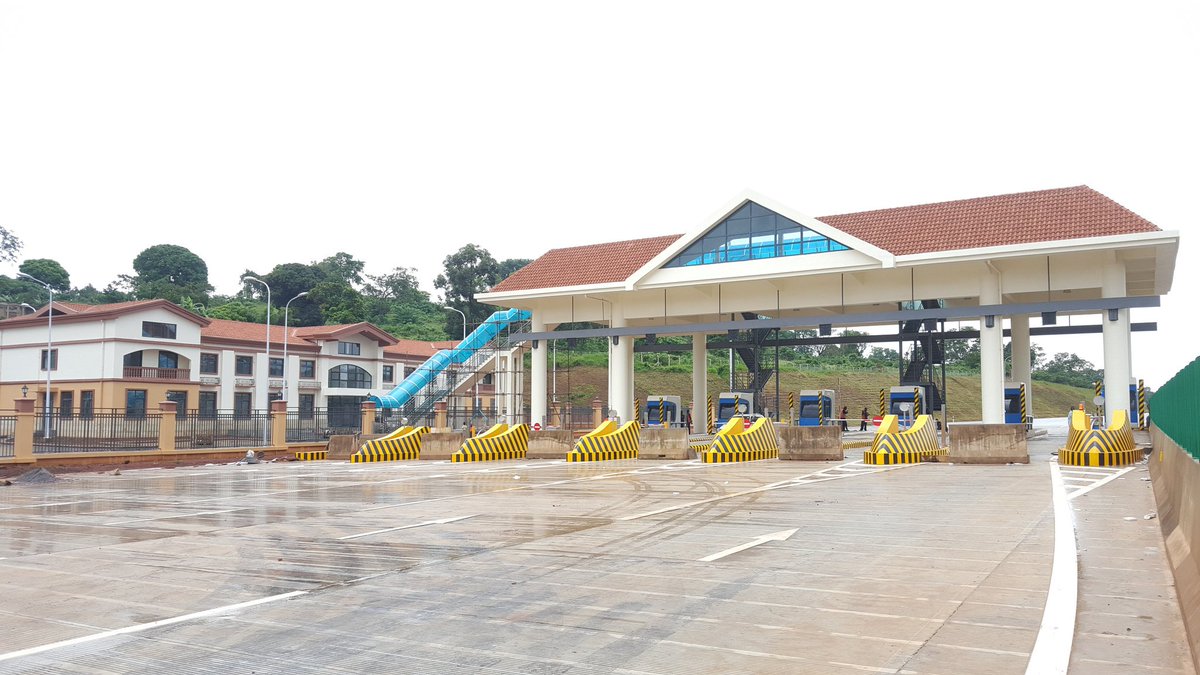
One of the Toll Plazas

According to the contractors, the 49.5 kilometres highway that will help decongest and enhance the trade movement in the central business district, has two sections starting from Busega on northern bypass to the existing Kampala- Entebbe road at Mpala, and a 12. 6km section commencing from Kajjansi interchange to Munyonyo.

Allan Sempebwa, the Uganda National Roads Authority (UNRA) Public Relations Officer noted that congestion in Kampala is increasing at an estimated rate of 4.5 per cent annually.

“Kampala is facing heavy traffic jam especially during rash morning and evening hours which the current roads can’t accommodate,” Mr. Sempebwa said yesterday while taking journalists on a guided tour of the highway.

The highway has three interchanges at Busega, Kajjansi and Abayita Ababiri, connecting to various trading centers, and has 19 overpass bridges and 17 underpasses for local people to access their properties along and around the road. It will be accessed after paying fees that will soon be revealed to the public.

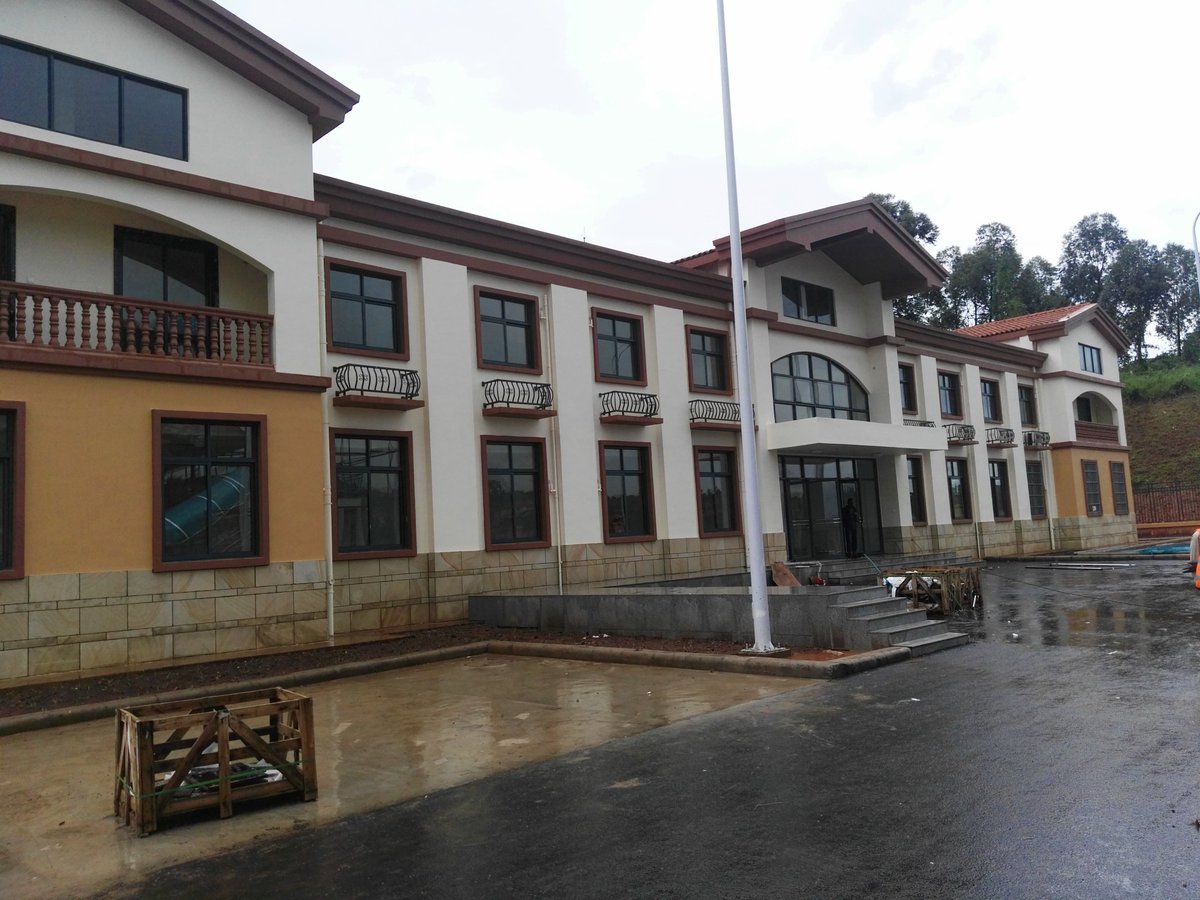
Accommodation facility along the Kampala-Entebbe Express Highway

“Payments will be made at various toll plazas constructed at Busega, Kajjansi and Mpala that comprise over 10 accommodation rooms each,” he added.

Before accessing toll gates, loaded vehicles will go through weigh bridges and wayward users will be subjected to fines and offloading excess cargo before being cleared.

Meanwhile, contractors said the 1450 metre bridge that was constructed in Nambigirwa swamp has not affected the environment basing on the factor that it is rested on well-spaced pillars dug six meters deep. The contractors noted that this is the longest bridges in East African region.

The 1450 metre bridge in Nambigirwa swamp

Currently, officials said, 91 per cent of the project has been executed and is expected to be handed over to UNRA in November this year.

Despite its progress, the project faced various changes which includes among others the compensation of land owners that culminated into re-alignment of the project.


Stories Continues after ad

Angela Katatumba, Jamaican artiste beaten at Chicken Tonight outlet

BRUISED: Angela Katatumba after being beaten and now demanding Shs1 billion.

Celebrity singer Angela Katatumba, daughter to deceased real estate tycoon Boney Katatumba, was recently involved in a brawl with staff of Chicken Tonight and sustained bruises.

Ms. Katatumba, who is also the Acting Consul of Pakistan to Uganda, in the company of visiting Jamaican artiste Kuzi Kz. This was before the altercation.

Ms. Katatumba, who is also the Acting Consul of Pakistan to Uganda, was on Thursday morning in the company of visiting Jamaican artiste commonly known as Kuzi Kz, but information about the altercation is scanty.

In a camera footage, Ms Katatumba is seen haggling with KFC staff identified as Manager Olubrwoth Ochoka, watchman Dennis Okirot and John Kaddu, a waiter.

The three are all facing assault and theft charges at Kabalagala Police Station under file number CRB353/18 after Katatumba, who sustained severe bruises to her left temple, reported the incident and a ‘missing Shs6 million’ that she said she left in her bag at the counter after the scuffle broke out.

But the incident has not gone without criticism and many are asking why the diplomat and heiress of the Katatumba Business Empire didn’t have her security detail given the odd hours at which she was travelling.

Meanwhile, her brother Allan Katatumba said the two parties had a standoff after Ms. Katatumba and her guest were served ‘wrong’ sauce.

Stories Continues after ad

Cheptegei breaks CWG 10,000m record to win Gold

Joshua Cheptegei of Uganda crosses ahead of Ahmed Mo of canada

Joshua Kiprui Cheptegei has completed the double by winning the men’s 10,000m after his 5,000m gold at the ongoing Commonwealth Games in Australia. He also set a Commonwealth Games record of 27:19:62 in the 10,000m.

The 21-year-old has become the third in history to win the 5,000m and 10,000m double at the Commonwealth Games. The last Ugandan to achieve the feat was Moses Kipsiro at the Delhi Games in 2010, while the previous CWG record of 27:45:39 was  held by Kenya’s Wilberforce Talel in 2002. Cheptegei beat Talel’s record by 25 seconds.

In today’s race Cheptegei came ahead of Mo Ahmed of Canada in the final lap while Kenya’s Rodgers Kwemboi held on for bronze coming in third. Jacob Kiplimo of Uganda came fourth.

Stella Chesang is another Ugandan who won Gold in the women’s 10000m (25 laps) final after clocking a time of 31:45.30. Mercyline Chelangat picked up Bronze after finishing third in the same race.

Uganda now has three Gold medals and one bronze, making it ranked the 14th country in the CWG and the third in Africa behind South Africa which has 11 gold, 10 silver and 5 bronze and Nigeria with 4 Gold, 3 silver and 7 bronze.


Stories Continues after ad

dfcu Bank accelerates digitization programme

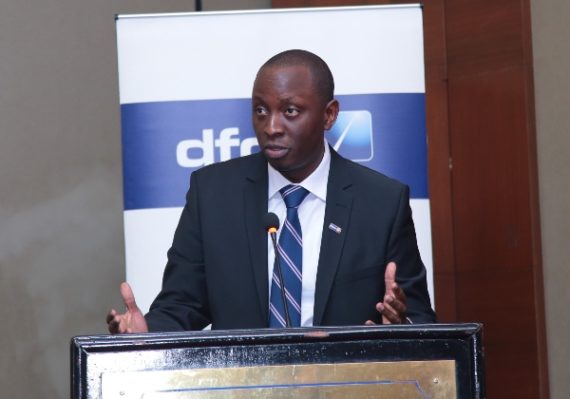
William Sekabembe Dfcu-Bank-Uganda’s-Chief of Business and-Executive Director-William-Sekabembe

The dfcu Bank is in the initial stages of designing an innovative solution for on-boarding new customers. This follows the signing of a contract with FinTech Company Laboremus Uganda on March 19, 2018 to accelerate the digitization of its banking systems.

According to officials of the partnering institutions, the contract will allow the partners to jointly design a solution that will drastically reduce the time and paperwork required for opening an account, while being adapted to the local market needs.

The officials further add that with the expansion of agency banking in Uganda, it is key to leverage technologies such as mobile, as well as take advantage of the new National ID card system.

All this, they say, will lead to banking that is safer and more convenient for customers, especially in remote areas with a special emphasis on SMEs, women in business, investment clubs and farmers.

“Technology and innovation have become key strategic areas of investment for any financial institution in the digital age. We want to leverage capacity locally and from abroad to supplement our own team and to fast track results on our banking experience,” says dfcu Chief of Business and Executive Director, William Sekabembe.

Laboremus Uganda, which is partially Ugandan owned, is part of the Laboremus Group from Norway which specialises within software for the banking sector.

In 2013, the company was set up as a joint venture in Uganda, with offices in Bugolobi. Developers in Kampala have for the last five (5) years, been closely involved in the development of solutions for the European market.

The company has a dynamic team of experts, consultants, innovators and digital transformation specialists, in addition to software developers.

The partnership between dfcu Bank and Laboremus will give dfcu access to technology and practices currently applied in Scandinavia, a region known to be ahead of the rest of the world when it comes to digital banking and FinTech.

In addition to development of key software, the partners will, through agile processes, develop innovations that will put dfcu bank at the forefront of the next generation of banking.

“Partnering with dfcu bank, the second-largest bank in Uganda, is a great opportunity for Laboremus to show that our combination of exposure to the Scandinavian market as well as deep knowledge of the local market can be a winning combination for innovation in the financial space,” Timothy Musoke, the Head of Technology at Laboremus adds.


Stories Continues after ad

Lawyer to sue for piracy of Mowzey Radio’s songs

The late Mowzey Radio

A lawyer representing fallen musician Moses Sekibogo Nakintije aka Mowzey Radio (RIP) has threatened to drag to court all people reproducing the deceased’s works without permission from the copyright holders.

In a statement to the public and media, lawyer John Katende says that several persons have started reproducing substantial parts and recomposing songs of Mozey Radio without license of the corporate owner and express consent of Angel Music.

“Furthermore, media houses are using compositions of Radio and Weasel without authorization.”

“Take notice that reproduction of a copyright work involves resemblance to, and actual use of, the copyright work and whether the infringing part of the copyright work formed a substantial part of that work,” Katende warns.

He added: “Take Notice that the copyright owner shall not hesitate to invoke the strong arm of the law against any person or all people or institutions that are infringing on the musical works of the late Moses Ssekibogo aka Mowzey Radio.”


Stories Continues after ad

KCB merges branches as it turns to agency banking

KCB Managing Director Joram Kiarie (R) with BoU Deputy Governor Dr. Louis Kasekende (C) and other guests

The ongoing digitalisation and shift to agency banking by Ugandan banks has reduced on the workload initially handled by their branches.

This has in turn reduced the relevance of some branches and as a cost cutting measure, some banks have started merging their branches.

One such bank is KCB Bank, which has announced today that it has merged two of its branches in the city centre.

“In line with KCB Bank Uganda’s strategy to focus on digital channels and the onset of agency banking, the bank has merged its Kikuubo and Ben Kiwanuka Street branches,” KCB’s MD, Joram Kiarie revealed.

According to Kiarie, the merger is aimed at optimizing existing branch networks as the bank rolls out agency banking to serve its customers better.

KCB customers have already been sent alerts explaining the merger while informing them that they will get the same service that they have been used to at Ben Kiwanuka branch.

“We are piloting agency banking and will soon roll it out across the country, this will extend our network and services even closer to our customers,” noted Kiaire.

Digital channels and agency banking are beginning to take root in the local financial sector which has led to local banks closing or merging some of their branches.


Stories Continues after ad

Uganda confirms it’s to receive refugees from Israel

State Minister of Disaster Preparedness Musa Ecweru

The State Minister of Disaster Preparedness Musa Ecweru has confirmed that Uganda is to receive refugees that have been sent away from Israel.

Addressing journalists at the media centre Friday morning, Ecweru revealed that the Ugandan government is to receive 500 refugees from Israel, finally acknowledging reports that have been in the public domain for some time now.

“The State of Israel working with other refugees’ managing organisations has requested Uganda to allow about 500 Eritreans and Sudanese refugees to relocate to Uganda. The Government and Ministry are positively considering the request. My work is to manage refugees that have accepted to relocate to a third party country. And Uganda accepted the 500 refugees from Israel and this is not a problem to Uganda,” he revealed.

“We already have millions of refugees in Uganda from Somalia, Ethiopia so the few from Israel won’t be a problem to Uganda as a third party country,” Ecweru added.

He however, denied claims that Uganda accepted to receive the refugees in exchange for money.

“The people saying on social media that countries give us money whenever we accept refugees to come in is false. In fact, we are the ones who spend on these refugees. We are slow but very sure on the issue of refugees that we host. To my knowledge, no refugees from Israel have come in yet. The ones coming are going to the settlement,” he added.

It ought to be remembered that at the peak of reports that Uganda was to receive refugees from Israel, the State Minister of Foreign Affairs Henry Okello Oryem rubbished the reports as ‘fake news’.

“There is no written agreement or any form of agreement between the government of Uganda and Israeli government to accept refugees from Israel,” Oryem told Reuters at the time.

Any suggestion to the contrary was “fake news … absolute rubbish,” he added.

Meanwhile, at the time of confirming the agreement to allow in refugees from Israel, Ecweru revealed this week that refugees in the country were requesting for more land in addition to the 2.5 acres given to each refugee that arrives in Uganda, a request that was turned down.

He said that instead the land they are being given now will be reverted to the owners when the refugees get back to their home countries.


Stories Continues after ad

Thousands to be evicted from Kigali suburb

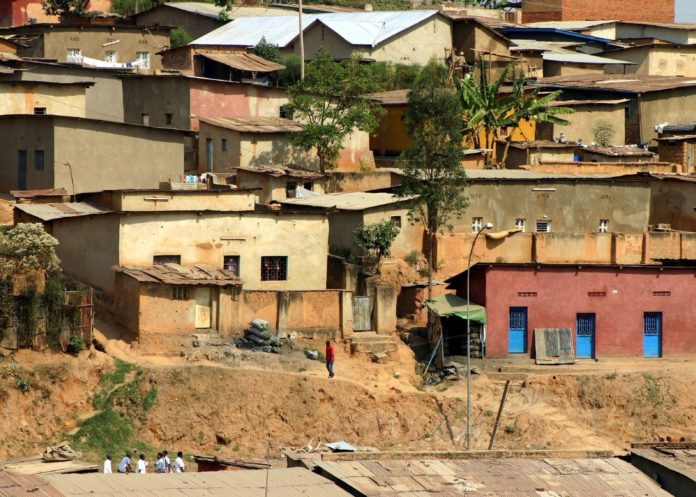
A Kigali slum on the outskirts of the city

About 1,000 families are readying to move out of a slum in the Rwandan capital as construction starts on a controversial city masterplan that aims to turn Kigali into Africa’s Singapore.

Ground was broken on the new $11.7 million Savannah Creek housing project in Busanza, some 13 km (8 miles) south of the city center, on March 31, Denis Karera, head of the private construction firm, told the Thomson Reuters Foundation by phone.

“We are talking about a housing estate that has all the infrastructure … roads, public lighting, sewage management treatment system, a school, public center and a market,” said Bruno Rangira, a spokesman for the city authority.

“Everyone will be moved.”

Africa has the fastest growing cities in the world, with 40 percent of its one billion people in towns and cities. But a lack of urban planning means sprawling slums are mushrooming alongside expensive housing and luxury flats.

Residents will be moved out of Kangondo slum, nestled between high-end residential areas in northern Kigali, popularly known as Bannyahe, meaning “Where are the toilets?” in the Kinyarwanda language, as people have to share pit latrines.

Their shacks will be replaced with new buildings in line with urban planning regulations.

Rangira said the relocation plan has faced resistance from landlords who want cash compensation instead but added that the city is working within the law.

Landlocked Rwanda has ambitions to be a tech-savvy logistics hub mirroring Singapore’s rags-to-riches rise, boasting years of solid economic growth and pristine streets, although critics say gains have come at the cost of political freedom.

“What we are doing now is mobilization for the master plan,” Rangira said, referring to the Kigali city master plan, which was introduced in 2013 to build an environmentally sustainable city and reduce the risk of landslides, a common hazard.

The ambitious plan was praised by urban planners for its focus on sustainable land use, and won several awards, although its strict implementation drew fire from human rights groups.

Kigali’s population is expected to almost triple to about 3 million people by 2030.

The authorities have pledged that the city’s numerous informal settlements, where the majority of residents live, will be a thing of the past by 2040 and have embarked on large-scale slum clearance.

But critics say the government is unfairly dispossessing people of their properties because the new houses are in a less central location where it is harder to find work.

“People who own houses there stand to lose more than tenants who can easily move elsewhere,” said Vincent Manirakiza, an urban planning expert with the University of Rwanda, who argues that it is more pro-poor to upgrade informal settlements.

REUTERS

Stories Continues after ad

Why Kampala sanitation project is at a slow pace: The inside story

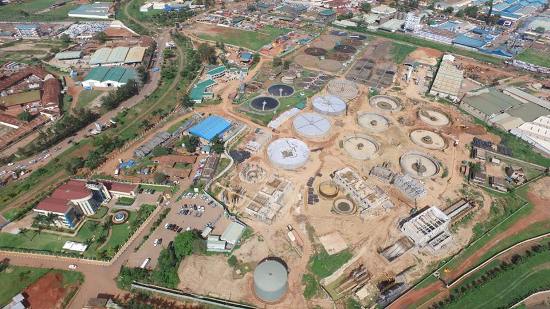
An aerial view of the NWSC treatment plant at Bugolobi on the outskirts of Kampala City.

The Kampala Sanitation Project is meant to improve sanitation for 1.5 million people in Kampala City and surrounding areas but some activities highlighted in the programme have stalled, with the blame cast on the contractor for failure to provide accurate data for quantities and required costs in the feasibility study.

‘The feasibility studies did not provide accurate data for quantities and required costs. This was exacerbated by the numerous start up challenges’, the African Development Bank, which has provided an extra US$19m loan to finish up the works that first consumed the biggest percentage US$35m AfDB on top of other loans from other donors.

Writing to the Country Manager AfDB Group Uganda Field Office on September 11, 2017, Finance Minister Matia Kasaija requested for the extra US$19m to finish the activities of the project.

In the letter he copied only to Finance Ministry Permanent Secretary, Keith Muhakanizi, Kasaija wrote: ‘The Kampala Sanitation Project (KSP-1) has a shortfall in funding and wish to request for additional funding for successful implementation of the project. This project is vital for the protection of Kampala’s natural environment through control of pollution of Lake Victoria’.

At the time he wrote the letter, Kasaija said that the project was at different stages of implementation. “The Bugolobi Waste Water Treatment Plant is at 86 percent and the Kinawataka Waste Water Pre-treatment Plant is at 30 percent (with expected completion date of April 2018),” he wrote.

The project is being implemented by the National Water and Sewerage Corporation (NWSC). But the extra US$19m will only be available on December 15, 2018 even though the money was approved by the AfDB on December 15, 2017 as shown by AfDB records.

“Since 2016, the program has witnessed accelerated implementation and is in advanced stages of implementation. The additional financing can therefore lead to completion of the outputs and yield benefits to the country in one year,” says the AfDB.

The US$35m AfDB loan to finance the project was approved on December 16, 2008 but the Loan agreement was signed on May 11, 2009 and became effective on February 18, 2010. The total amount disbursed so far as of end of August 2017 is US$32.44m (92.69 percent). But work remains to be done notwithstanding meager funds available.

The Auditor General John Muwanga in his audit report for the year ended June 2014, blamed government for delaying to sign the agreement, leading to the slow implementation of the project. “The loan was declared effective in February 2010, mainly due to delays in the approval processes of Government, i.e.; Cabinet approval, Parliament ratification, Legal Opinion from the Attorney General,” Muwanga wrote in a report on the project.

Design Modifications

According to the Auditor General, the initial design concept for the two Waste Water Treatment Plants for Nakivubo and Kinawataka catchments that had been recommended at the feasibility stage was low-tech, based on the upflow activated sludge blanket in combination with stabilization ponds.

Environmental concerns requiring “odour free” technology became prominent during the detailed design phase and therefore the initial design concept at feasibility had to change from medium technology to high-tech. He said the high-tech WWTP (Waste Water Treatment Plant) introduced much heavier process structures (digesters, sludge holding tanks).

“As a result of this design modification, the foundation of these heavy structures would require extensive soil replacement, filling and consolidation works for the whole site, including concrete piling as foundations for the heavier units. There were initial reservations to the changes in the waste water treatment concept that led to lengthy consultations, and as a result, 9 months were lost before all parties could agree on the treatment technology to be adopted,” Muwanga said in that report.

Financing Challenges

Owing to the changes in the waste water treatment concept from low-tech to high-tech, the programme costs increased. The cost of construction of the Waste Water Treatment Plants escalated from 33 million Euros (at feasibility) to 48.5 million Euros for the Nakivubo Water Treatment Plant (WWTP), while the Kinawataka WWTP costs shot up from 4 million Euros at feasibility to 19.5 million Euros at implementation stage.

Plants Site Location

As part of the final recommendations at the feasibility stage, it was agreed that all new sites for the waste water treatment plants be located at the lowest points possible to enable gravity flow without intermediate pumping or use of siphons. In this regard, the proposed siting of the WWTPs for the four drainage zones/catchment areas for metropolitan Kampala were in the middle of the Nakivubo, Kinawataka, Lubigi and Nalukolongo wetlands.

However, according to officials, the locations are characterised by poor soils which are highly compressible with low bearing capacities. Information obtained on the specific ground conditions obtaining on the proposed site locations (Nakivubo and Kinawataka sites), later established thick layers of highly compressible material of up to 35 meters for the case of Nakivubo. The thickness of this layer had been underestimated at feasibility stage at just 15 meters.

“Being a Design and Build contract, this information only became available when the construction contract had already been awarded. A cost analysis of alternative foundation types established that it would require a minimum of an additional 20 million Euros over and above the 48.5 million Euros to construct Nakivubo WWTP.

NWSC, in consultation with the development partners, agreed to relocate the programme site from Nakivubo to Bugolobi WWTP in order to keep construction costs within manageable levels as they signed the contract in January 20, 2014.

Issues at hand

Reports indicate currently the sewered area of Kampala serves about 7.3% of the population of the city, mainly in the central district business.  The sewerage treatment plant that serves the city is located in Bugolobi in Kampala: the Bugolobi sewerage treatment plant which was constructed in the 1940’s and upgraded in 1970 operates as a conventional treatment plant.

Only 55 percent of the sewage generated within the Nakivubo catchment is received at the sewage treatment plant. Owing to technical inadequacies in the sewerage infrastructure, the rest of the sewage ends up into wetlands around Kampala.

Further, majority of residents (92.7 percent) use on-site sanitation systems (septic tanks, pit latrines). However, in most of these areas, particularly in the densely populated slum areas of the city, provision of public and household on-site sanitation is never institutionally supported in terms of operation and maintenance.

Furthermore, cesspool emptier services, which are offered mainly by private sector on a cash-on-demand basis are inadequate. As a result, effluent from latrines and septic tanks are often discharged into the environment untreated.

Also, storm water from the city is largely drained through the Nakivubo open channel. This channel drains into Nakivubo swamp and ultimately into the Inner Murchison Bay of Lake Victoria, which is also the source of abstraction for the drinking water for Kampala.

Studies have shown that the Nakivubo swamp, which is a natural barrier, could offer significant pre-treatment to reduce pollution loading of the channel. However, due to high runoff, the channel has created a deep canal within the swamp, hence flowing undisturbed, straight into the lake.

Still, Kampala city generates about 25,000 tons of solid waste. However only 10 percent of this is collected. The rest of the solid waste is disposed via indiscriminate dumping and finds its way into the Nakivubo channel and /or the sewer network and ultimately into the Inner Murchison Bay. This has exacerbated the sanitation problems faced in the sewerage system and the Lake Victoria.


Stories Continues after ad