Stanbic Bank
Stanbic Bank
27.6 C
Kampala
Stanbic Bank
Stanbic Bank
Home Blog Page 1611

Reduced interest rates boost Stanbic Bank’s credit to private sector

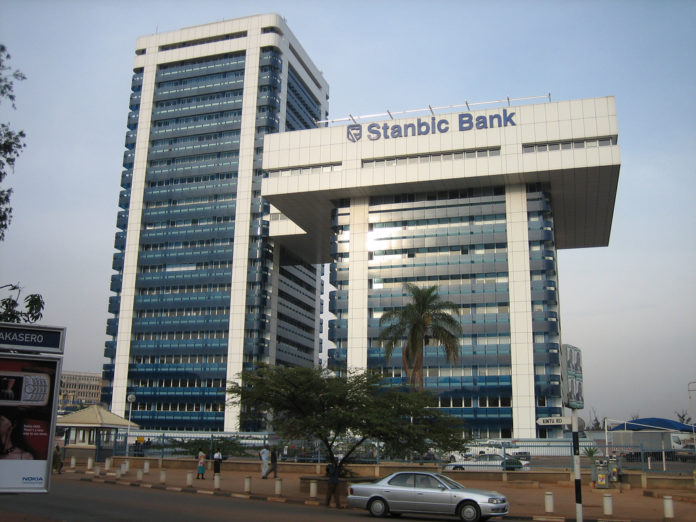
Stanbic Bank Uganda

Stanbic Bank’s latest financial report shows that it gave Shs157b as loans, which was 80 percent of the net industry credit.

The bank in its report says the periodical reduction of its prime lending rate over the past few years helped boost the loan figures upwards, with the bank’s overall loan book growing by 8 percent to Shs 2.13 trillion up from Shs1.98 trillion.

Stanbic Bank CEO Patrick Mweheire said in Kampala two days ago that the 17.5 prime lending rate pegged on the CBR is one of the lowest that customers can enjoy in the country.

He said the bank had played a key role in supporting Uganda’s continued economic recovery. “Our balance sheet grew by over Shs 800b to Ushs 5.4trn,” he said, adding that that allowed it to support projects like infrastructure across the country.

The report shows Stanbic provided financial instruments worth one trillion shillings including Bank Guarantees, Letters of Credit and Bid Bonds to contractors, suppliers and executing government agencies.

According to the bank, customer deposits also grew by approximately 18 percent to Shs3.62 trillion from Shs 3.06trillion, representing 20 percent of all bank deposits in the country.

Net profit for the bank rose to Shs200b from Shs191b realised in 2016. That was reached at with the help of the reduction of operating expenses that fell to Shs15b year-on-year. Investments in the further integration of digital technology within product and services also contributed to a reduction in costs, the bank said.

Analysing the bank’s key performance indicators Sam Mwogeza the Chief Financial Officer said the bank improved across all key financial indicators during the period. “Our credit loss ratio was just 1.3 percent compared to 1.8 percent registered in 2016 and continues to be well below the industry average,” he said.

Meanwhile, the board has approved a dividend pay-out of Shs90b, an increase of 50 percent when compared to dividend shareholders received in 2016. Earnings per share climbed to Shs3.92 from Shs3.73 in 2016.
 

Stories Continues after ad

Over 400 designs presented for new EAC logo

Current Emblem of East African Community

 The East African Community (EAC) is set for logo change to accommodate new members and create harmony among various organs within the body.

The exercise which is expected to conclude in November saw youths between ages of 18-35 from member states submit 485 different designs for consideration.

“We have narrowed down to ten applicants and expect to forward the top three to the council of ministers for approval in an exercise we expect to come to conclude before the end of this year,” said Jessica Eriyo, EAC Deputy Secretary General, responsible for Productive and Social Sectors.

The current logo embodies original three EAC member countries of Uganda, Kenya and Tanzania that into the arrangement during the times of presidents Milton Obote, Julius Nyerere and Jomo Kenyatta, father of Daniel Uhuru Kenyatta. The new logo is intended to include new entrants-Rwanda, Burundi and South Sudan, world’s youngest nation.

“Rebranding is important to enable the East Africa Community have a simple logo that can also be easily adopted in other organs of the body,” she said noting that the current logo has so many colours that needs to be replaced.

The EAC launched the rebranding competition in 2017 targeting to change its visual brand identity for eleven Organs and Institutions including the regional parliament and the court.

The council of ministers will consider the report of the top entrants in April 2018, where 438 proposed designs have been considered by regional brand experts.

The rebranding process aims to resolve among others the lack of a unique common identifier among the EAC organs and institutions, too many colours being used for the flag and logos, the EAC logo not being adaptable to the expansion of the community, two different visual identity symbols (the flag and the logo), lack of a visual brand connection between EAC Organs and Institutions.

A youth competition for designers and artists was launched in May 2017, and 438 entries were received by the EAC for consideration.

Dr. Kirsten Focken, GIZ – Programme Manager in a statement said that the German Government through GIZ supports the EAC rebranding, adding that the process would improve its brand awareness, visual identity and image among citizens, especially the youth.

Stories Continues after ad

DFCU makes Shs127b abnormal profit in 2 years after Crane Bank takeover

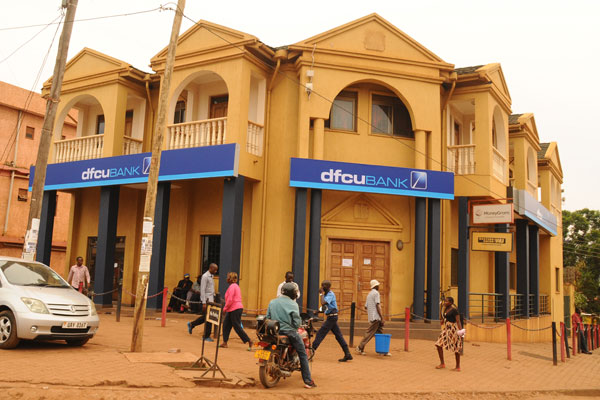
The Former Crane Bank Ntinda branch, which DFCU took over and illegally rebranded in its name, was ordered by the court to vacate and compensate Meera Investments because the property belongs to Meera.

The latest financial statement for DFCU bank shows that it made a net profit of Shs127.6 billion as of December 31, 2017, up from Shs46.2 billion registered in the same period in 2016.
In August 2017, DFCU bank announced net profits of Shs114 billion for the first six months of that year, after acquiring Crane Bank with mainly all its assets, deposits and loans.
The bank noted then that the acquision of Crane Bank in January that year helped it reap Shs114 billion in profits from Sh23 billion earned in the same period the previous year. That was a huge percentage increase.
Further analysis of the profit scale shows that DFCU made Shs13.2 billion net profit in the second half of 2017, far less, when compared to the first half, even as the statement shows that year-on-year, the bank raised its net profit by Sh81.4 billion.
Meanwhile the non-performing loans (NPLs) for the year rose by Shs38.3 billion to Shs96.6 billion in 2017, up from Shs58.3 billion in 2016. The bank wrote off Shs27.2 billion as bad loans compared to Shs5 billion written off in 2016.
The bank’s credit to customers rose to Shs1.3 trillion in 2017, up from Shs834.8 billion in 2016.More, customer deposits rose to Shs1.98 trillion from Shs1.13 trillion received a year earlier. That was attributed partly to the acquision of Crane Bank.

dfcu financial analysis
The bank’s total assets increased to a record Shs3 trillion, up from Shs1.7 trillion in 2016, like explained the boost in assets was a result of the acquisition of its rival Crane Bank. There is a pending case in court where former owners of Crane Bank are seeking recovery of assets, more so fixed assets.
The statement shows that DFCU’s core capital increased to Shs362 billion in 2017, up from Shs188 billion in 2016.
The management has earmarked Shs51 billion for dividends compared to Shs18.5 billion in 2016, meaning each shareholder will more cash on account.
So who are the shareholders? Dfcu is partly owned by the Commonwealth Development Corporation (CDC) a British government-owned company, together with other foreign firms like Rabo Development from the Netherlands and NorFinance from Norway who are shareholders in Arise B.V together with Norfund, a Norwegian government owned Private Equity firm and FMO, the Dutch Development Bank.
BoU transferred the liabilities (including deposits) of Crane Bank to DFCU Bank in 2017.
The leaked agreement between Bank of Uganda and DFCU indicated that the external owned bank got Crane Bank with assets valued at Shs1.3 trillion for just Shs200 billion (payment for liabilities).
The Agreement did not state the amounts of money paid by DFCU as a net purchase price; or the payment terms for monies, or the assets (outside branches) that DFCU was taking over.

DFCU Shareholding percentages

Arise BV 58.71 per cent
CDC Group of the United Kingdom 9.97 per cent
National Social Security Fund (Uganda) 7.69 per cent
Kimberlite Frontier Africa Naster Fund 6.15 per cent
2 undisclosed Institutional Investors 3.22 per cent
SSB-Conrad N. Hilton Foundation 0.98 per cent
Vanderbilt University 0.87 per cent
Blakeney Management 0.63 per cent
Bank of Uganda Staff Retirement Benefits Scheme 0.59 per cent
Retail investors 11.19 per cent
BoU staff retirement benefit scheme is 0.59 per cent

Stories Continues after ad

I have no sexual relationship with Lady Justice Musoke – Rukutana

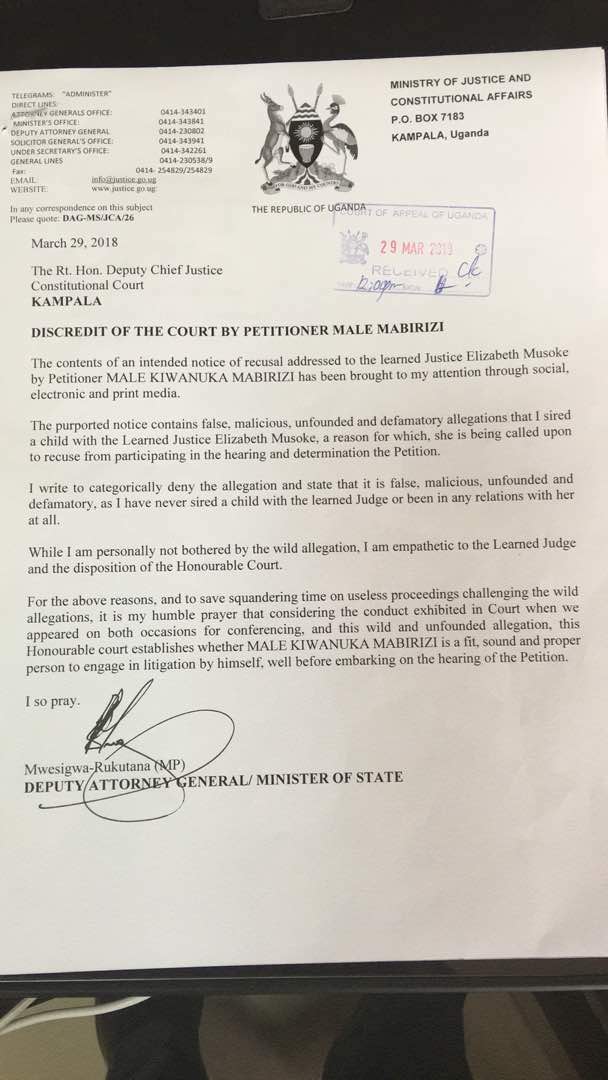
The Deputy Attorney General and State Minister of Constitutional Affairs Mwesigwa Rukutana has responded to rumours circulating in both the social and print media that he sired a child with Lady Justice Elizabeth Musoke.

Minister Mwesigwa Rukutana’s March 29 response follows a petition by Male Kiwanuka Mabirizi in a notice to the Deputy Chief Justice of the Constitutional Court Alphonse Owiny-Dollo, challenging Lady Justice Elizabeth Musoke to recuse herself from the hearing the age limit case in Mbale High Court. Mabirizi is one of the five petitioners challenging the manner in which the age limit cap (Article 102b) was expunged from the Constitution.

“…With the above, it is clear that when you decided to preside over the petition, you will be receiving submissions from the father of your child [ Rukutana]  and at the same time you will be hearing a case in which the father of your two children, Hilary Onek, is highly interested in, having voted in support the amendments ,” part of Mabirizi’s letter indicates.

The letter, which has since spread like bush fire, prompted Mwesigwa Rukutana to reply: “I write to categorically deny the allegation and state that is false, malicious, unfounded and defamatory, as I have never sired a child with the learned Judge or been in relations with her at all.”

The minister now wants court to establish whether Male Kiwanuka Mabirizi is of sound mind and fit to engage in litigation.

Stories Continues after ad

ICC should try officials implicated in refugee scandals – LoP

TRY THEM IN ICC: The Leader of Opposition in Parliament, Kasese Woman MP Winnie Kiiza

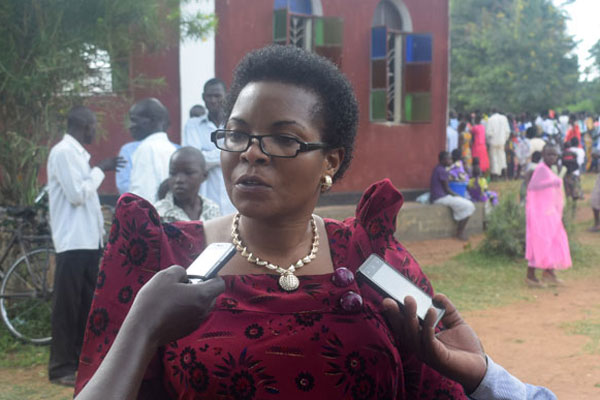
The Leader of the Opposition, Winfred Kiiza, says that officials accused of mismanaging funds for refugees should be tried by the International Criminal Court (ICC).

Kiiza, who was speaking during a live stream on social media organised by Parliament’s Communications and Public Affairs Department, said that such actions tantamount to crimes against humanity.

“For someone to subject a refugee to sexual abuse, trafficking and extorting money; that is inhuman and deserves to be punished,” said Kiiza.

The Government of Uganda was recently on the spot over allegations of misuse of funds for refugees, inflation of refugee numbers, bribery and trafficking of refugee girls.

And according to Kizza, government should take stern action against its officials causing confusion in the management of refugee funds.

Kiiza also said that instead of managing the refugee influx in the country, government agencies are fighting for the US$50 million that was borrowed from the International Development Association of the World Bank for communities hosting refugees.

“This poses a question as to whether we are receiving refugees for purposes of helping them or to take advantage of their plight to make money,” said Kiiza.

She also advised government to screen refugees in order to fight inflation of refugee numbers, as well as ensure that those with criminal intentions are not registered.

“If government can introduce the biometric system of registering refugees, it can help capture the actual numbers and enable the tracking of refugees,” said Kiiza.

About a month ago three officials from the refugee department of the Office of the Prime Minister including Commissioner Apollo Kazungu were interdicted on allegations of mismanaging aid meant for refugees, and inflating their numbers to benefit from increased funding.


Stories Continues after ad

EA court dismisses Uganda ‘walk to work’ case

PRESENTED LACKLUSTRE EVIDENCE: Kira Municipality MP Ibrahim Ssemujju Nganda

The East Africa First Instance Division court has dismissed the ‘walk to work’ case filed by the East African Law Society (EALS) brought against Uganda in respect to government’s reaction to the post-election protests in 2011.

Court said that the Applicant did not produce evidence to show which people were killed or their death certificates and the people injured or their medical reports.

The Deputy Principal Judge Isaac Lenoala, while delivering the Judgment said that the Applicant’s case was ‘weak’ and could not sustain the allegations as to whether Uganda committed the acts in violation of the Treaty for the Establishment of the East African Community (EAC) or Laws of Uganda under its Constitution.

Court further said that among the evidence produced by the Applicants through Affidavits were for James Aggrey Mwamu, who brought electronic evidence and he said that he was not there, he doesn’t know what happened and therefore his evidence was not authentic and reliable.

The other three: Samuel Muguya, Francis Mwijukye and Ssemujju Ibrahim Nganda were also on the spot, with court saying that Ssemuju Nganda brought a photocopies of a newspaper Article indicating that Dr Besigye Kiiza was arrested and others said that they participated in the walk to work protest and that people were killed, while others were injured and teargassed.

The case was filed by the East African Law Society  against the Republic of Uganda & the Secretary General of the East African Community 2nd Respondent) over the alleged violent disruption of peaceful demonstrations in Uganda on April 11, 2011, as being in contravention of human rights and therefore violating the Treaty for the Establishment of the East African Community in particular Articles 3, 4, 6(a), 7(2), 9, 10 and 11.

Court however said that: “We will not let Uganda go thinking all was okay” Justice Lenaola read. He added that, had the Court found sufficient evidence that these events occurred, and the Applicant brought credible, authentic and reliable evidence, court would have found the Government of Uganda to have violated the Treaty.

The Judgment was read by Hon Justice Isaac Lenaola, Deputy Principal Judge and Counsels present in Court to receive the Judgment were Phillip Mwaka (Principal State Attorney), Charity Nabaasa (Senior State Attorney) and Goretti Arinaitwe (State Attorney) all representing the AG Uganda, and Mr William Arnest for the Applicant (EALS) with Michel Ndayikengurukiye (Principal Legal Officer EAC).

Court ordered each party to bare its own costs because EALS filed the case in the wider interest of the Rule of Law of the Community.

Stories Continues after ad

Difficult to eliminate technical losses soon – UMEME

UMEME CEO Celestino Babungi

Electricity distributor Umeme says it won’t eliminate technical losses too soon as the process requires huge investment in the infrastructure spread over the years.

The company’s 2017 financial report released Thursday in Kampala shows distribution losses reduced to 17.2 percent during the year compared to 19.0 percent achieved in 2016, whereas the energy losses recorded in the first half of 2017 were 17.5 percent whereas losses in the second half averaged 16.9 percent.

However, Umeme officials said an independent survey showed that technical losses have come down to 7 percent, and alluded the slouch to old wires and meters, among infrastructure.

However, Umeme officials hope to reduce the figure further as they power more investments for the remaining period of the 20-year concession signed in 2005 between the company and government of Uganda.

The improved efficiency is attributed to heightened efforts to reduce commercial losses throughout their network through continuous metering installation audits, use of technology like smart metering for large consumers and community mobilization.

Releasing the financial report, UMEME officials said the regulator, the Electricity Regulatory Authority (ERA), asked the company to invest more in electricity access in the country where about 1.1 million customers have been connected.

Following President Yoweri Museveni recent letter to Energy minister Irene Muloni, querying the 17.5 percent technical losses in books, UMEME says it has invested heavily in infrastructure to bring down the losses even as more still remains to be done. This includes investment in about 7000 transformers, according to company CEO Celestino Babungi.

Pre-paid metering

According to the company financial report, customers on pre-paid metering has increased to 75.3 percent of the total customer base compared to 65.0 percent as of December 31, 2016. That was matched by an increase of Pre-paid revenue of 21.1 percent of total revenue from 16.3 percent as of December 31, 2016.

Government

Babungi says prepaid revenue growth has been supported by installation of customized pre-payment metering units at select Government of Uganda offices. This has led to minimizing domestic electricity arrears with some government offices paying upfront.

Meanwhile the report says UMEME’s revenue collection for the year remained strong, with an outturn of 100.2 percent compared to 98.4 percent during 2016. Balungi says the key drivers for the rise in revenue are improvements in the revenue cycle, increasing penetration of pre-payment metering and debt collection initiatives. The Company has focused on improving customer service and providing multiple payment channels to customers including leveraging existing banking and mobile money infrastructure, the report says.

Revenue increased by 8.7 percent during the year to Ushs 1.5 trn supported by a 7.5 percent rise in units sold to 2,760 GWh. Revenues from industrial customers increased by 13.2 percent. Gross Profit increased by 8.3 percent to Ushs 515.9b on account of improved distribution margins and continued reduction in energy losses. However, delayed approval of some capital investments by the regulatory authority (ERA) continues to negatively impact the gross margin.

The Umeme CEO Babungi says that the company is readying itself as the construction of major power dams like Karuma, Isimba and others near completions, accompanied by the development of industrial parks that will need more power. The company is also optimistic government will renew its contract, as it is considered the best electricity distributor in the region, running without government subsidies.


Stories Continues after ad

Uganda to benefit from US$194b African oil and gas projects

Oil drilling machinery

Uganda and nine other countries in Africa will spend US$194b on developing oil and gas fields between 2018 and 2025, according to projections by GlobalData, a major data and analytics company.

According to the report, Uganda Tanzania, Kenya, Senegal, Egypt, Algeria and Mauritania will share 29.2 percent of the total projected expenditure over the seven-year period.

Uganda has proven crude oil reserves of 6.5 billion barrels, about 2.2 billion of which is recoverable and preparations are underway to have the first crude oil produced by 2020.

Projections indicate that investment in the sector will approximately be US$8b (Shs27trillion) for the activities, including the drilling of about 500 wells and construction of associated infrastructure such as oil refinery and oil pipeline before the country can see first commercial production two years from now.

However on the African scene, the report says the US$194b, capital expenditure into conventional, unconventional and heavy oil projects would form US$88.9b, US$3b and US$1.9b tranches of the region’s capital spend respectively over the eight-year period.

“Conventional gas projects will require USD99.1b, while the investments into unconventional gas and coal bed methane (CBM) projects would total USD0.7b in upstream capital expenditure by 2025,” the company says.

Nigeria, Africa’s top oil exporter accounts for USD48.04b or over 24.8 percent of total capital expenditure into upcoming projects in Africa. The country has 24 announced and planned fields.

GlobalData expects 23.8 percent of capital expenditure in Africa to be spent in Mozambique over the next eight years.

Angola is expected to contribute about 11.3 percent to the total capital spending in Africa; the country has 8 planned and announced fields.


Stories Continues after ad

“She is not our sister” – the legend of Minister Namuganza as told by the Bukono Chief

Junior Land Minister Persis Namuganza.

When junior lands minister Persis Namuganza appeared before the Parliamentary committee inquiring into the diatribe she launched against the Kyabazinga of Busoga William Gabula IV and the Speaker of Parliament Rebecca Kadaga, she wept.

Why did Persis Namuganza weep? “Since those incidences happened, I cannot take water from our own home. Our own family; because she got people, my brothers and gave them money,” Ms. Namuganza said amid seemingly uncontrollable sobs.

But back in Bukono Chiefdom, Chief Godfrey Mutyaba Nkono, the cultural head of the family she was referring to, was watching and upset, he picked the phone and rang Eagle Online at around 6:30pm and went into a 45 minute litany about Minister Namuganza and her ‘heritage’.

“My brother I don’t know what has come over that girl (Ms Namuganza). She has never been our sister. As I speak to you we have finished writing a letter to be sent to the Kyabazinga distancing ourselves from her and narrating our family lineage to the Kingdom’s cultural head,” he said.

“But she is a princess and she says she is a daughter in the family of the chief of Bukono, I imagine you are denying her because you have personal issues with her since she also questions your enthronement as Chief. She thinks you simply were forced on the family and the people of Bukono ahead of your elder brothers, the EagleOnline prodded.

He laughed and said: “First, she not from the Ngobi clan where my family belongs. She is from the Muganza clan as her named clearly shows. She has never been a princess. Living with royals can never make you royalty.

“Her father was a herdsman called Ndimulodi from Bugwe who tended to cows in the Bukono’s chief’s palace. Unable to take care of her, he asked for help from our father who took her in and even tried to educate her.”

He further said: “Her first claim to be our family member was when my dad, in an attempt to give her a good life, asked the president, in one their chiefs’ meeting with him, to get for her ‘daughter Namuganza’ a job and that is how she got appointed deputy RDC for Luwero.”

Over a fortnight ago, Chief Mutyaba invited the Speaker of Parliament to Bukono as chief guest at the swearing in of the Chief’s cabinet.

Unhappy with the Speaker’s presence, Ms Namuganza, being the area MP, was peeved. She accused the Speaker of installing an illegitimate chief let alone being in her constituency without her invitation.

According to Ms Namguganza, the Speaker’s presence in Bukono was an affront on what she perceived to be her lordship over all matters Bukono. Annoyed, she went into a tirade overdrive attacking both the Speaker and the Kyabazinga of Busoga— she called on those loyal to throw stones at the duo calling them ‘merchants of discord’.

“Speaker Kadaga was never in Bukono to install me as Chief. That is the work of traditional and they already did. We invited the Speaker to just come as a chief guest.

“That girl (Namuganza) was opposed to the event because she claims I appointed people who are her political enemies as my ministers. She tried to stop the swearing on different occasions by asking intelligence to write reports to the police and army chiefs that I was swearing in FDC people and recruiting rebels. The President even sent people to verify and when it was found to be false we were cleared to proceed with our ceremony,” he said.

The ‘untraceable’ condolence money

When Godfrey’s father, Chief Christopher James Mutyaba Nkono, fell sick in 2013, the President saw in Ms Namuganza a close link through whom to channel any kind of help to the family.

“That was the first time I started hearing her confidently calling herself our sister. But a few months to my father’s death, he summoned me to his hospital bed and asked everyone, including that girl (Namuganza), to go outside.

The only people who remained there were his family and my dad introduced to me all his children including those he said were being doubted. He asked me to always take care of them. My dad never mentioned Namuganza,” Chief Mutyaba Nkono, said.

According to Chief Mutyaba Nkono, relations between their family and Ms Namuganza got strained after the old man died.

“The President gave her shs30 million to bring to us as condolence but that girl (Namuganza) came and started being tough at the funeral. She gave our three mothers shs1 million each and us the children two hundred and fifty thousand shillings and she disappeared with close to shs20 million. None of us followed her up.

“When we collected from among ourselves Shs2 million to finish our fathers’ grave we looked for her and trusted her as someone with political status. We gave her the money and asked her to look for someone to come and do the job. She disappeared with the money and since 2013, the first time she returned to our home was this year when she came to quarrel over the cabinet I had appointed,” he said.

According to the Bukono Chief, Minister Namuganza started crying the day she was summoned to Bukono by the late chief’s first wife and reminded about how she came to be associated to the family.

“My mother called her here and told her that she had quickly kicked the ladders she used on her way to top. She told her that everyone will be watching her to see how she will come down. She told her to stop claiming to be part of the family because she had abused the chief’s help. When she heard those words she started crying before her security guards,” he said.

Ms Namuganza could not be got for comment. Her phone number, with a call back tune of Judith Babirye’s Ndi Survivor (I am a survivor), went unanswered.

She did not also respond to WhatsApp and SMS messages we left on her cellphone.

The message read, “This is the editor of Eagle Online. I would to get your response on a series of statements Chief Mutyaba has made against your involvement with their family including but not limited to the statement that you have never been their sister and that you even disappeared with the shs2 million they had collected to finish their father’s grave, not to mention the Shs30 million the President gave as condolences. That your father was actually one Ndimulodi, a herdsman.”

This story will be updated with her comment the moment she gets back to us.


Stories Continues after ad

President Museveni assures Crime Preventers on their status

A huge crowd of the youth cheering the President Yoweri Kaguta Museveni as he arrived to address them during the National Crime Preventers Forum at the MTN Arena , in Lugogo , Kampala on Wednesday 28th March 2018.

President Yoweri Museveni has assured crime preventers in the country that they will maintain their duties as they are now regarded as a Reserve Army of the Uganda People’s Defence Forces (UPDF).

“A few weeks ago, I saw in the papers and somebody said that the fate of the crime preventers is to be decided by the new Inspector General of Police. I called the IGP and told him that this is not your problem,” he said as he received cheers from the gathering.

The President made the remarks while addressing a delegation of over 3,000 crime preventers’ co-ordinators from all regions of Uganda at Lugogo Indoor Stadium in Kampala.

President Museveni disclosed that the strategy of the programme was not that of the former IGP, Gen. Kale Kayihura, but that of the National Resistance Army (NRA) during the people’s protracted liberation struggle. He added that Gen. Kale Kayihura’s role was to diligently implement the programme  and highly commended the former IGP for overseeing the programme to its fruition.

“It was not a Kale Kayihura programme. Kale Kayihura was a loyal cadre who actively implemented it. Therefore, I want to salute Gen. Kale Kayihura for actively implementing the programme. I now regard you as a Reserve Army of the UPDF,” he said.

President Museveni further explained that during the bush days, NRA had layers of organisation that included, among others, militias who would guard villages. He, therefore, urged the administration of crime preventers to establish and consolidate village coordinators in order to effectively combat crime as crime is rampant in villages and perpetrators can easily be identified.

Mr. Museveni encouraged crime preventers to also be exemplary actors in poverty eradication in their areas to the level of becoming role model farmers. He advised the leadership of the Uganda Police to work jointly with Operation Wealth Creation to identify crime preventers per parish to be aided.

“Crime preventers should lead in the revolution of being crime preventers and wealth creators. You should work with OWC to single out those who can become model farmers so that they do not only get out of poverty but also become examples,” he counselled.

President Museveni informed the assembly of crime preventers the sectors of wealth creation that they should sensitize the youth about in their areas. The sectors include modern commercial agriculture with calculation, industry, services and Information Communication Technology (ICT) for Business Process Out-Sourcing.

The President expressed gratitude to learn that crime preventers have formed and decentralized their SACCOs, which he pledged to support come next financial year of 2018/2019.

The Minister for Security, Gen. Elly Tumwine, advised crime preventers to be disciplined and organised so as to effectively combat crime and corruption in the country, and added that the NRM revolution was founded and built along the same lines. He noted that a new generation has now emerged to continue with the struggle and will certainly deal with the vices of crime and corruption.

“The future belongs to the organised. Crime and corruption are like darkness; once torched, they will disappear and the two vices are in danger in Uganda,” he stressed.

The National Chairperson of Crime Preventers, Mr. Blaise Kamugisha, encouraged coordinators to continue with the noble cause of helping the Police to fight crime in order to make the country safe to live in.

The Deputy Inspector General of Police, Brigadier Muzeyi Sabiiti, among others, attended the meeting.


Stories Continues after ad