Stanbic Bank
Stanbic Bank
28.7 C
Kampala
Stanbic Bank
Stanbic Bank
Home Blog Page 1612

Chief justice says good lawyers may not make good judges

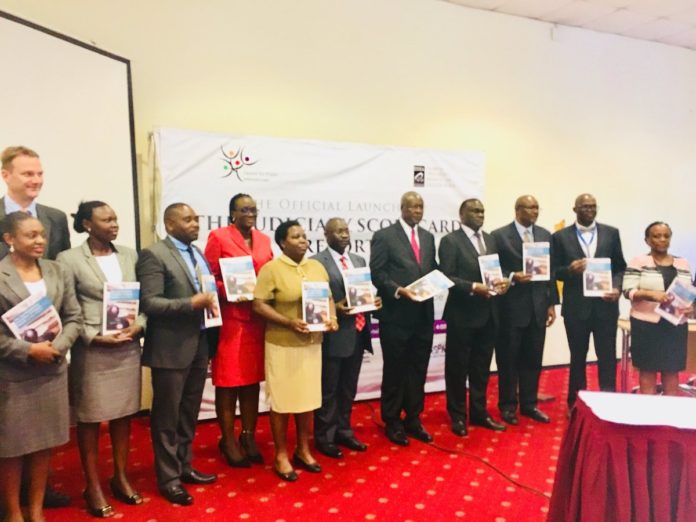
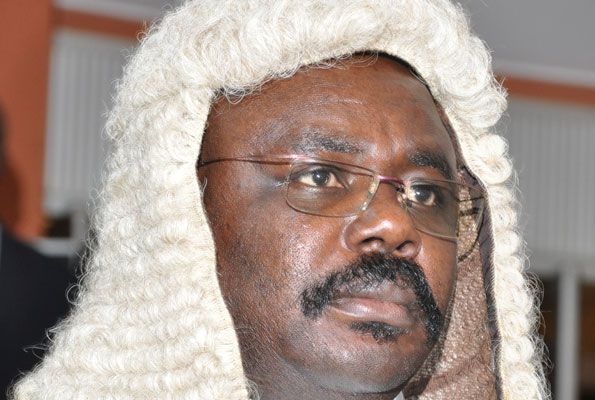
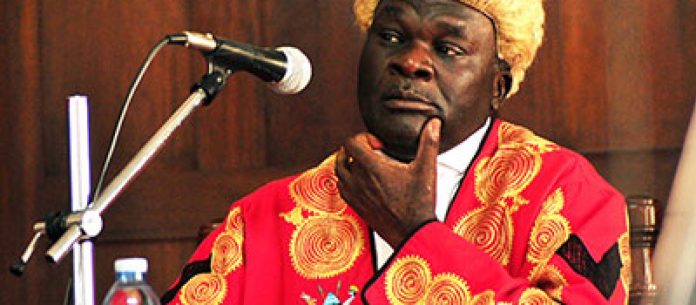
The Chief Justice of The Republic of Uganda, Bart M. Katureebe presiding over the launch of the Judiciary Scorecard Report 2018.

The Chief Justice, His Lordship, Bart Katureebe has said judges in Uganda need special training to help them do their work better.
“We need that training at induction, being a good scholar or lawyer does not necessarily mean that you will make a good judge,” he said
He added that government has built capacity of judicial officials. “We have strengthened the training of judicial officers. I don’t need to over emphasise the need of training,” he said.
He made the remarks Wednesday during the launch of Judiciary Scorecard at the Kampala Serena Hotel.
He continued that: “Once you’re confirmed as a judge, you need to transition naturally. We take part of the blame and now we welcome training of judges.”
“You might be a good lawyer but the moment you are transformed into a judge, you need to learn how to be a good judge which at times actually fails to work,” he said.
He said the judiciary has strengthened fighting against corruption. “Some people however speculate that they have lost a number of cases because judges were bribed. Sometimes, you criticise the judges for nothing,” he said, adding that they have set up hotlines to help the public report any judges involved in corruption activities.
Even with the limited resources, he said, “the judiciary must do work and this includes reporting in time to court as well. We have a lot of mindsets to change in order to move forward.”
According to the scorecard, the best performing court according to the legal professionals was the High Court circuit sitting in Arua which attained the highest score of 97.3 per cent in the overall assessment.
The courts were assessed on six parameters which included: Fairness in the administration of justice impartiality, professionalism, certainty, behaviour and attitude.
The Criminal Court, Supreme Court and Commercial Court Divisions received 93.2 per cent ,89.2 per cent & 86.9 per cent scores respectively mainly due to a strong perception about their impartiality, certainty, professionalism. The Land Division and Court of Appeal with 79.2 per cent and 72.2 per cent in overall assessment scores respectively were reportedly having challenges in all the six parameters.

Livingstone Ssewanyana observes that central region had a higher number of litigants (61 per cent) whose cases were mainly criminal and civil in nature. In the northern territory nearly a third of the interviews made with litigants were done with prisoner
The scorecard is meant to measure the performance of judicial officers from the perception formed by various stakeholders.
It contains performance measurements and parameters that are linked to vision, mission, values and mandate of the judiciary as given by the constitution.
Centre for Public Interest Law used and used the tools of structured interviews, key informant interviews, focus group discussions, observations and desk research to

Stories Continues after ad

Deputy Speaker, LoP attack ministers for withdrawing policy statements

RIP: Jacob Oulanyah

A decision by some ministries to stealthily withdraw their ministerial policy statements from parliament has angered the Deputy Speaker of Parliament Jacob Oulanyah and the Leader of Opposition, Winfred Kizza, even as the government chief whip Ruth Nankabirwa apologised.

Policy statements summarise the past performance of the sector and the plans for future expenditure and activities, and are submitted to Parliament for scrutiny before the National Budget is read.

And reacting to the reports, the Deputy Speaker said if the reports of withdrawal of the policy statements are confirmed, each of the ministers would have to individually apologise to the House.

“The laid policy statements were withdrawn from the Clerk’s office, meaning there was no business to handle during the recess,” Oulanyah said. Parliament resumed plenary sittings on March 27, 2018.

On the other hand LoP Kiiza said the withdrawal of the statements was a ploy by government to force MPs on the opposition to hurriedly consider and approve the budget without the necessary scrutiny.
“The government is looking at failing the work of LoP so that we don’t scrutinize these reports very well. By withdrawing them [policy statements] we have not finalized our alternative reports for committees’ consumption,” she said.

Oulanyah said that the decision by the ministers would derail the timelines of the preparation of the national budget for the financial year 2018/2019. Finance minister always reads the new budget in June, after reconciling sectoral budgets as presents by different ministries and agencies.

Oulanyah said the move means the Opposition Shadow Ministers could find it hard to present their alternative policy statements to the House by March 29 as they have to wait for government to present first.
Section 14 (1) of the Public Finance Management Act, 2015 instructs parliament to consider and approve the annual budget shall, by the 31st of May of each year, consider and approve the annual budget and work plan of government for the next financial year by May 31 every year. This goes with the Appropriation Bill and any other bills that may be necessary to implement the annual budget.

Oulanyah however said that alternative policy statements are not meant to be a critic of the government report but an addition which enhances the Committee reports about the statements.

Nankabirwa apologised on behalf of the ministers but hastened to say she was also surprised that some ministers had withdrawn policy statements. “It’s unfortunate that despite the delay, we have ministers who have decided to withdraw the reports. I do apologize for this,” Nankabirwa said.

Government expenditure (excluding domestic debt refinancing) is projected to amount to Shs22.6 trn in FY 2018/19. But like in the recent years, works and transport, energy and mineral development and education continue to enjoy a lion’s share of the budget.

Uganda has made significant strides in budget openness and has been recognised globally for innovating systems aimed at encouraging public participation and provision of free flow of budget information.

Stories Continues after ad

Museveni to inject Shs 1b in Crime Preventers SACCO

The President Yoweri Kaguta Museveni addressing at the National Crime Preventers Forum at the MTN Arena , in Lugogo , Kampala on Wednesday 28th March 2018.

President Yoweri Museveni has promised to inject Shs 1 billion in the Crime Preventer’s Savings and Credit Cooperative Organization (SACCO) to enable them get startup capital to improve their businesses.

Speaking to the Crime Preventers at Lugogo this morning, President Museveni implored them to form SACCOs in order to benefit from this initiative. With this intervention, he said, in July each district will get Shs 100 million to man down shooting unemployment cases and poverty in the country.

He cautioned them to be exemplary in averting crime and eradicating poverty in their ancestral villages. “Your leaders should work with Police and Operation Wealth Creation with one crime preventer at every parish to serve as an example for the rest,” he said.

Mr. Museveni also said that he, not the former Inspector General of Police Kale Kayihura, mooted the idea of enlisting the services of crime preventers.

“In the role of detecting crime, I need to sit down with your leaders to see how to handle it, criminals operate mainly in villages and if you have not yet developed village coordinators, and it is high time you do it. I regard you as a reserve army for Uganda People’s Defense Forces (UPDF), my idea is to have a small and equipped army with a big reserve,” Museveni noted, and lauded Gen. Kayihura for offering effective leadership to the Crime Preventers.

President Museveni’s meeting with crime preventers follows an earlier meeting with their head Blaise Kamugisha in Rwakitura, where the latter  vowed to work hand in hand with police to avert the rising crime which includes abduction, torture and murder.

The National Crime Preventer’s Forum (NCPF) was founded in 2013 with the aim of promoting community policing through sensitization, awareness and outreach.

However, since the formation of NCPF, political elites and legal scholars have said their activities as illegal.


Stories Continues after ad

Police ‘inquiries’ delay Rev Bakka treason case

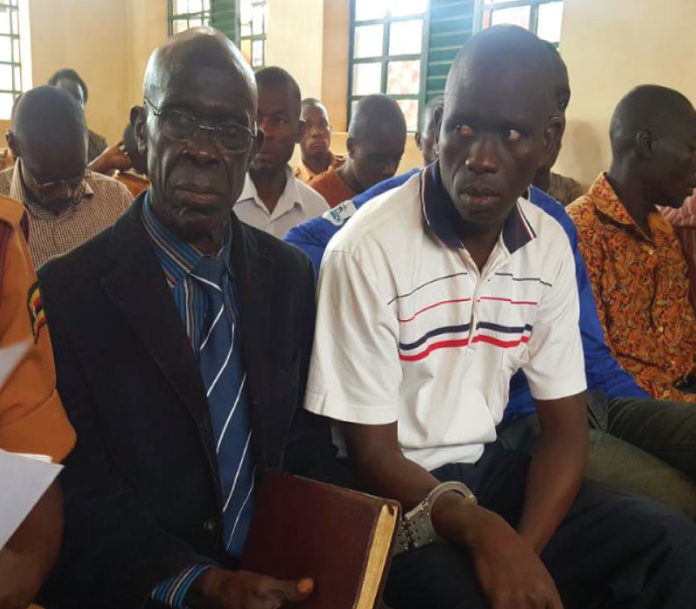
Reverend Isaac Bakka and his co-accused in court

The trial of veteran journalist Reverend Isaac Bakka has failed to kick off because the case file is incomplete.

Bakka and his three co- accused are charged with treason and have today appeared Wednesday before Nakawa Court Chief Magistrate Jamson Karemani for mention of the case, which failed to proceed.

State Prosecutor Ann Ntimba informed court that police inquiries are ongoing, and Karemani further remanded the accused to Luzira upper prison as police continues investigations.

The 68 year-old Bakka, a journalist working with BTN and Nile FM in Gulu, was allegedly kidnapped in January this year at a taxi stage in Mukono by unknown people.

Following a long search by his family members, friends and intervention of parliament and public pressure, security agencies later admitted to having picked up Bakka.

They subsequently took him to Nakawa court where he was charged with treason and remanded to Luzira prison.

Prosecution states that Bakka, a former Chaplain in Uganda Army under President Iddi Amin, connived with a one Godfrey Asea, George Ngungu and Innocent Mawe to contrive a plot to overthrow the government of Uganda between January 2017 and January 2018 within various districts in Uganda and in other countries such as Kenya and South Sudan.

This was allegedly through making utterances, acquisition of firearms and recruitment of individuals into armed forces.

The case has now been adjourned to the April 11, 2018.


Stories Continues after ad

Ugandan traditional football clubs need to observe trends in the game

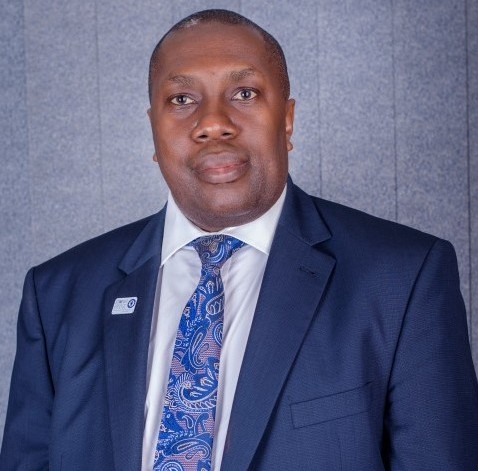
TO STAND FOR SC VILLA PRESIDENCY: The Lotteries and Gaming Regulatory Board CEO Edgar Agaba

Football is one of the most loved and popular sport in Uganda. But over the years, support, passion and emotion has shifted radically from the local clubs to the national team.

The Ugandan football fans are being increasingly put off from supporting their local teams because of lack of investment, poor administration at club level and bad infrastructure.

Big Ugandan traditional clubs like Express and Sport Club (SC) Villa ought to move on from history, bragging about past glory and instead adopt modern football by observing trends in the game including in administration. For example, today’s footballers won’t put in extra energy to get good results unless they have received salary. This is unlike the old days where they would even walk to training.

Express Football Club, referred to by the club fans as the Red Eagles or ‘Mukwano Gw’abangi’, is one of the most successful and supported teams in Ugandan football.  It is also the oldest football club in the country, having been founded in October 1957.

However, the current state of affairs at the club doesn’t reflect the tag ‘Mukwano gw’abangi’. For a club that has never been relegated to the second-tier, and one that should be competing for at least a trophy every season, they find themselves in the wrong path; out of the Stanbic Uganda Cup and sit in the relegation zone of the Azam Premier League.

In 2012, Express won the league with Sam Ssimbwa as the manager. Six years later, it is synonymous with mismanagement and chaos of both the club and the fans on and off the pitch.

Things started going downhill when Express appointed State Minister Florence Nakiwala Kiyingi as the club chairperson in 2016 replacing Francis Ntalazi. After a few months, fans demanded for her to be sacked due to lack of knowledge on how to run a football club and numerous administrative conflicts which resulted into team failures in terms of performance.

In February 2018, she was relieved of her duties after failing to live up to her expectations, never mind that she had earlier promised ‘heaven on earth. Hassan Bulwadda is now in charge till the end of the season.

Their shirt sponsor, Dstv is also off their jerseys due to the current state of the club and they have had four managers this season. Matia Lule, Douglas Bamweyana and Shafiq Bisaso all resigned from the club due to administrative hitches.

The Red Eagles has since then recruited George Nsimbe, one of Uganda’s most successful coaches, to try and avoid relegation.

Meanwhile, on Friday last week, they held #TheSaveExpressFCMukwanoGwabangiCampaignFestival at Wankulukuku stadium for all the Reds’ fans in which they collected over 30 million shillings.

Indeed, the situation at club level is not impressive and as if being haunted, SC Victoria University is no more on the scene of Ugandan football due to incompetent management by another politician, Muhammad Nsereko.

At SC Villa Jogoo, Emmanuel Ben Misagga took over as the club’s president at the start of the 2014/15 season.

After some years of administration turmoil for the most successful club in Ugandan football, SC Villa won their 9th Uganda Cup in his first year as the President.

Misagga’s ability to run a football club was questionable at the start because he was an untested person in the position. He has so far sacked six managers since he took over; Steven Bogere, Sam Simbwa, Antonio Flores, Ibrahim Kirya, Deo Sserwadda and Shafiq Bisaso.

But the Jogoos have steadily improved under Misagga and are now chasing the league with rivals Vipers SC and KCCA FC.

After a 14-year title wait, with coach Wasswa Bbbosa, they currently top the table, four points ahead of Vipers, with 9 games left to play. They last won the Premier League title under former Uganda Cranes coach coach Milutin ‘Micho’ Sredojevic in 2004.

SC Villa’s historic home ground, Nakivubo Stadium, was pulled down by city tycoon Hamis Kiggundu, to pave way for its redevelopment, forcing SC Villa to return to its roots in Masaka district. It’s not yet clear if they will return after renovation but most of the club’s fan base is located around Kampala.

Villa’s most successful period domestically remains the years 1998 to 2004 when the record 16-time league champions won seven straight titles.

And now sources say top club enthusiasts and supporters including Edgar Agaba, the Executive Director of the Lotteries and Gaming Regulatory Board (LRGB) want to enhance the popularity and competitiveness of SC Villa, and sources say Mr. Agaba, an SC Villa life member, wants to offer himself for club presidency come the next cycle of elections.

The rise of KCCA FC has been attributed to their good administration, organization and structure. The rebranding of KCC into KCCA in 2015 has saved the club from the same problems facing Express.

They are currently the most valuable team in the country having the most sponsors; Prime Media, StarTimes, MTN and Britam Insurance and earning over a billion shillings from them in a single season.

Being an institutional club, they are financially stable, making them a club that can play on the continent. Most Ugandan clubs usually pull out of the continental competitions (CAF Champions League and CAF Confederations Cup) citing lack of funds.

The ‘Kasasiro Boys’ have a fast growing fan base and made history this year by becoming the first Ugandan club to qualify for the group stages of CAF Champions League.

In the past five years, they have won the Ugandan Premier League four times and the Uganda Cup twice.

The emergence of fast-rising clubs like Onduparaka and Vipers get introduced in Ugandan football. Onduparaka was formed in 2011, reached the Uganda Cup final in 2015 and got promoted to the Uganda Premier League in 2016. They have Betway as the official sponsors with a deal worth UShs 600 million due to a good structure and have the best home support with a big fan base from Arua district.

Founded as Bunamwaya FC in 1969 and renamed Vipers Sports Club on 21 August 2012, the Venoms have reached the Uganda Cup final thrice and won the league once since rebranding.

All credit goes to Vipers’ club patron and president, Lawrence Mulindwa, who has invested a lot in the club climaxing with the recent launching of the St. Mary’s Stadium last year which has a capacity of 20,000.

Through his school St. Mary’s SSS Kitende, Mulindwa nurtures talent that feeds Vipers SC and provides almost half of the players on the national team, the Cranes.

Stories Continues after ad

UMEME earmarks 12b to pay shareholders

Over 5000 shareholders of UMEME, Uganda’s electricity distributor, will receive Shs12 billion in dividends, according to its 2017 financial report to be released tomorrow.

According to the report, the company will pay a dividend of Shs7.6 per share, lower than Shs18.8 it paid in 2016.

The payment of the dividends await the approval of the annual general meeting to be held in May, and the proceeds expected to be paid in early July are subject to withholding tax, where applicable.

The money will go to shareholders in the books of the company at close of business on June 20, 2018.

The report says revenue earnings for the year increased by 8.7 percent to Shs1.5 trillion boosted by a 7.5 percent jump in units sold. Revenues from industrial customers increased by 13.2 percent.

Further, the report indicates gross profit increased by 8.3 percent during the year to Shs515.9b on account of improved distribution margins and continued reduction in energy losses which have come down to 16.9 percent, from the 17.7 percent recorded in first half of 2017.

The company attributes the reduction to, ‘heightened efforts to reduce commercial losses throughout our network through continuous metering installation audits, use of technology like smart metering for large consumers and community mobilization’.

But the company says delayed approval of some capital investments by the regulatory authority continues to negatively impact the gross margin.

UMEME reports that electricity sales grew by 7.5 percent during the period, compared to 4.4 percent in 2016.

“We registered a 8.0% growth in sales to industrial customers compared to 5.2% in 2016, underpinned by the improved performance of Uganda’s economy and improved external market conditions in the neighbouring countries,” says the report.

Demand by domestic customers grew by 6.9 percent compared to 2.6 percent in 2016, on account of improved supply reliability, reduction in energy losses and additional customer connections.

Customers increased by 18.3 percent during the year to over 1.1m, with an extra of over 170,000 grid connections compared to over 150,000 in 2016.

Customers on pre-paid metering (Yaka) increased to 75.3 percent of the total customer base compared to 65.0 percent at December 31, 2016.


Stories Continues after ad

EAC keen on promoting intra-regional trade-Official

EAC Director General, Customs and Trade, Mr. Kenneth Bagamuhunda.

The East African Community (EAC) is working overdrive to enhance market access to regional and international markets through a comprehensive export promotion strategy, a top regional customs official has said.
Kenneth Bagamuhunda, the EAC Director General for Customs and Trade, said the bloc is implementing programmes aimed at promoting and strengthening intra- and inter-regional trade, particularly the removal of non-tariff barriers (NTBs) which are an obstacle to trade.
He was speaking at the recently conclude three- day workshop convened by the TradeComII Programme at the EAC Headquarters in Arusha, Tanzania. It was attended by participants from member states.
He said that the EAC had prioritized growth in its exports through value addition and capacity building for exporters to enable them know about export requirements especially in the European Union (EU).
Bagamuhunda further said mechanisms for the dissemination of applicable trade requirements and trade statistics were in place. Other measures to promote trade, he said, include the harmonization of regional standards and the implementation of the EAC Export Promotion Strategy.
He said that while key strategies and policies aimed at boosting trade exist, the biggest challenge was how to implement them.
“The elimination of tariffs is not a problem. The biggest problem is removing non-tariff barriers which keep on changing and coming up in different forms,” he said.
On the recently signed African Continental Free Trade Area (CFTA), Mr. Bagamuhunda said now was the time to push for the full implementation of the Tripartite Free Trade Area (TFTA) bringing together EAC, COMESA and SADC.
“The TFTA is the stepping stone to the CFTA because what remains in TFTA is its implementation. The Tripartite constitutes more than 60% of the Africa’s GDP and over half of the continent’s population,” he said.
Speaking at the event, Mr. Fabio di Stefano, Head of the Infrastructure and Regional Integration Sectors at the European Union Delegation in Tanzania, said the EU’s engagements with EAC focus mainly on trade and economic growth in the region.
The official said that political goodwill from EAC leaders will be critical if the region was to become integrated economically; adding that reforms to national laws and policies would also be required for the full implementation of protocols and agreements made at the regional level.
He said some of the key drivers of regional integration in East Africa were peace and security, and infrastructure development.
The EAC Secretariat plans to develop appropriate strategies on export development and the elimination of non-tariff barriers inhibiting trade among Partner States and between Partner States and their trading partners.
The strategies address the main constraints relating to the legal, regulating and institutional requirements at both the regional and Member States levels. The efforts will help boost Partner States capacity to supply the European markets through a sound and sustainable export promotion strategy.

Stories Continues after ad

Constitutional Court set to start age limit hearing

DCJ Alphonse Owiny Dollo

Constitutional Court has appointed five Judges of Court of Appeal to start the hearing of petitions filed by concern Citizens against age limit bill that was passed into law days after endorsing it in Parliament.
The appointed Judges are Deputy Chief Justice Alfonse Owiny Dollo, Remmy Kasule, Kenneth Kakuru, Elizabeth Musoke and Chebrion Barishaki.
In a meeting with both the litigant’s lawyer Wandera Ogalo and Deputy Attorney General Mwesigwa Rukutana, Justice Dollo implore both parties to leave political issues and resort to addressing legal matters, “politics is not necessary, if it was then, you would not have come to courts of law” he added.
“Since court announced Mbale as the venue where the case will herd, I consulted Chief Justice Bart Katureebe on the matter including convenience as it was stated by litigants, he said in a nutshell that, ‘their argument is baseless, judiciary has the jurisdiction to handle any matter in any court in Uganda.’
According to Dollo, Court will be looking into three issues which include the expunging of age limit cap that had been set at 75 years, the extension of Legislators’ terms in office from five to seven years and the suspension of 2021 elections to 20123.The hearing of the matter is scheduled to start on April 9, 2018 in Mbale.
Last year, six opposition legislators led by Winnie Kiiza, Uganda Law Society, Male Mabirizi among other concerned citizens petitioned the Constitutional Court challenging Age Limit Act auguring that the process of enacting the bill was marred with violence, assault of legislators, storming of Special Forces Command (SFC) in Parliamentary chambers and violations of human rights which among others contradicts with Parliamentary rules and procedures.

Stories Continues after ad

Ugandan youth win World Bank essay competition

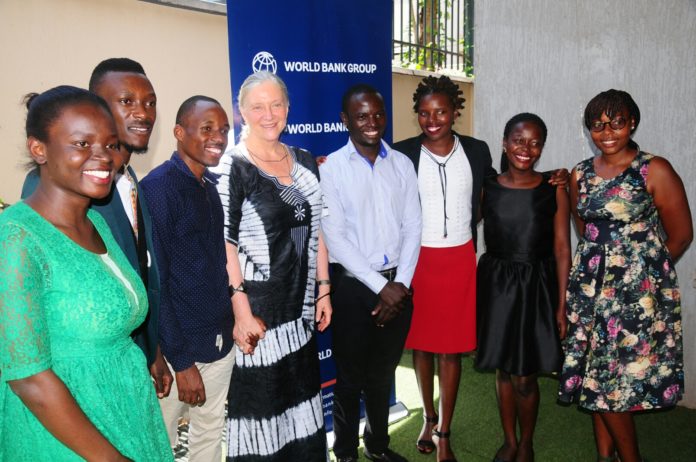
World Bank Country Manager Christina Malmberg Calvo, with the current and previous winners of the #Blog4Dev youth essay contest.

The World Bank yesterday announced the winners of its annual #Blog4Dev youth essay competition. The three winners are Tendo Namata, 26 years; Mary Helda Akongo, 24 years; and Douglas Dubois Semabala, 26 years.

The three were recognized at a gathering that brought together the finalists of past competitions since 2016. They will join the official Uganda country delegation to the 2018 Spring Meetings of the International Monetary Fund (IMF) and the World Bank Group taking place from April 13-22 in Washington DC, United States of America.

In addition to the all-expense paid trip to Washington DC, the three Ugandan winners will join winners from other African countries and engage in a number of activities, including meeting with senior government and World Bank officials to share their ideas and stories. Their essays are also posted on the World Bank Group blog site Nasikiliza, so they can share their ideas with young people in other parts of the world.

Now in its 3rd year, the #Blog4Dev series was initiated in 2016 to inspire youth to think creatively, innovatively and practically about solving some of the most pressing development challenges in Uganda. It aims to give youth a voice and harness their ideas to ensure they become part of the solutions.

Gender-based violence, the special theme of this year’s competition, poses a major development challenge in Uganda. Slightly more than half of girls and women in Uganda aged 15 to 29 have experienced physical violence since the age of 15, and 28 percent of women overall have experienced sexual violence in their lifetime.

“If Uganda takes strong action to end violence against women and girls now, US $2.4 billion will be saved every year by 2030. That is, there’s a big cost to inaction. The #Blog4Dev gives young people a chance to tell their stories so we can understand better the issues and take determined action,” said Christina Malmberg Calvo, World Bank Country Manager in Uganda.

Gender Based Violence (GBV) includes physical violence, rape and sexual assault, child and forced marriages, female genital mutilation, human trafficking, and the denial of resources and services. GBV knows no socio-economic or national boundaries and no country can afford it.

“Most interventions make the mistake of empowering select groups of girls more vulnerable to Sexual and Gender Based Violence but forget that if not duly helped, their communities will not be able to create a sustainable support structure to encourage their efforts towards both prevention and intervention. We realised that the villages possessed water committees that were very efficient when it came to cleaning and maintaining water resources, and could be used as platforms to sensitize communities against gender-based violence,” writes Tendo Namata in her winning blog. Embibo Gender-based Initiative, which Tendo runs in addition to her day-job, conducts outreach sensitizing school communities about gender-based violence in the Kamwenge area, in South Western Uganda.

Helda Mary Akongo, who works as an Operations and Programs Manager with Zimba Women, an organisation that uses technology to empower Ugandan women, further explained: “Encouraging victims to speak up, creating awareness, providing support for victims and educating them and the public about online and offline Gender-Based Violence is what it will take to end this vice. Technology can be used as an essential tool for combating this depravity, and it is precisely what I am setting out to do.”

In his blog, Douglas Dubois Sebamala makes a strong case for use of performance and creative arts to bring attention to gender-based violence, and help victims heal faster from their trauma. “Allowing creatives to share others’ stories through communal theatre pieces, anthologies, song or dance would have venting therapeutic resonance that can send information directly and return effective results faster than police threats of arrest,“saidSebamala, an actor on NTV’s Second Chance series who also works as a Public Relations Officers and Marketing Manager for Silent Voices Uganda.

The 2018 contest was open to Ugandan youth aged between 18 and 28 years and attracted more than 200 applicants. To participate, contestants submitted a 500-word essay on what it will take to end gender-based violence in Uganda. Essays were judged by the winners of the previous competition who included Stephen Katende and Fionah Komusana, finalists in 2016; and Mercy Melody Kayodi and Joseph Lule who took the top honours in 2017. A 5-member panel of judges comprising of World Bank staff interviewed the top five contestants and selected the final three.

Stories Continues after ad
UMEME to release financial report for 2017

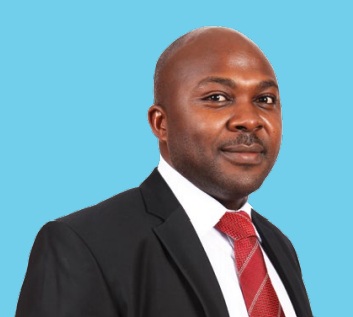
UMEME CEO Celestino Babungi

Uganda’s electricity distributor, UMEME says it will release its financial report for 2017 tomorrow Thursday even as members of the board and management met President Yoweri Museveni yesterday to explain why the company still has 17 percent technical losses in its books of accounts.
UMEME already presented its interim financial statements for the six months period ended 30 June 2017 highlighting the operational and financial performance.
The interim showed UMEME had reduced distribution losses reduced to 17.5 per cent in the six months to 30 June 2017, down from the 19 per cent achieved during 2016. The report says company achieved the reduction through the sustained efforts. But Museveni says Ugandans are paying high electricity tariffs because of technical losses he says the planned US $500 investment in related infrastructure should have eliminated such losses by now.
The interim report says revenue collection rate for the period averaged 99.9 per cent, up from the 98.4 per cent performance at 31 December 2016. The very good collection rate was achieved through continued investment in automated meter reading for our large power users, pre-payment metering for domestic connections and various collection campaigns to recover outstanding bills.
Shs99.1 billion (US $ 27.5million) was invested in the distribution network during the period.
Revenue grew by 6.9 per cent year-on-year to Shs704.4 billion in six months of 2017, driven by 6.7 per cent increase in units sold (GWh) and price adjustments. Electricity sales growth has been high in large industrial and domestic household consumers.
The interim report Gross Profit increased marginally at 2.6 per cent as cost of sales increased by 9.0 per cent influenced by a 9.6 per cent year-on-year increase in power purchase costs. Units purchased increased by 4.5 per cent to GWh 1,630.70. The gross profit was significantly affected by the capital investments excluded from the tariffs at the start of the year.
Dividends The Directors did not recommend the payment of an interim dividend to shareholders as it made after tax loss of Sh47.5 billion for the first six months ended in June 2017. Shareholders (investors), numbering over 5000, are waiting to see if they will get dividends when the full report is read.
Umeme is operating a 20-year Concession to distribute and supply electricity, until 1st March 2025 and confirms that it has seven (7) years left under the existing Concession.

Stories Continues after ad