Stanbic Bank
Stanbic Bank
18.4 C
Kampala
Stanbic Bank
Stanbic Bank
Home Blog Page 1611

FUFA inspects venues for Stanbic Uganda Cup final

Inspection team at one of the stadiums.

A seven man team from the Federation of Uganda Football Associations conducted an inspection of the facilities in Kumi Municipality where this year’s Uganda Cup final will be held.

The inspection team was led by FUFA Executive committee members Hamid Juma, Agnes Mugena, Richard Ochom (also the mayor of Kumi Municipality), John Odong (Chairperson, North East Region Football Association), Hajjati Aisha Nalule (FUFA Competitions Director), Ahmed Hussein (FUFA Communications manager), and Esther Musoke (FUFA Marketing Director).

Among the facilities inspected were the three proposed football fields; Boma play-ground, Kumi Technical School and Bishop Maraka College field, according to the Fufa website.

The dressing rooms (changing rooms), toilets, security concerns, the CSR project attached to the tournament were some of the issues that were ascertained before checking the playing surfaces.
The inspection team will convene and make resolutions before revisiting the facilities after a fortnight to confirm the venue for the final.

The final will be played on 27th May 2018.

Meanwhile, the quarter final draws for the remaining clubs will be held on Thursday, 12th April 2018 at FUFA house in Mengo starting 10am.

The eight remaining clubs are the holders KCCA, Sports Club Villa Jogoo, Vipers, Proline, Kansai Plascon, Kitara, Synergy Football club, Kampala Junior Team (KJT).

Last year’s final was held in Arua, at Onduparaka’s home ground where KCCA defeated Paidha Black Angels 2-1.
SC Villa and KCCA have won the Uganda Cup nine times, while URA is on three trophies. Express FC is the record winner of the Uganda Cup at 10.

Stories Continues after ad
Kadaga urges Ugandans abroad to invest home

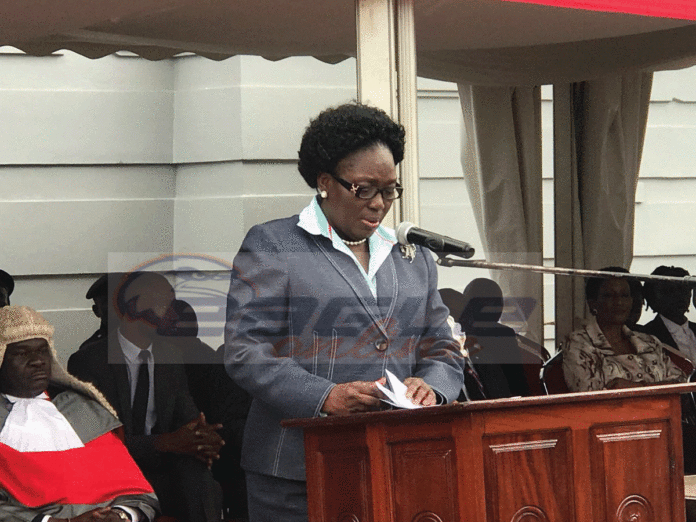
Speaker Rebecca Kadaga listening to Fahad Kateregga of Aziz Property Investments at the 8th AIM Conference.

The Speaker of Parliament Rebecca Kadaga has implored Ugandans in diaspora to invest back home saying government will offer them tax holidays for growth of their businesses.

Kadaga made the remarks at the 8th Annual Investment Meeting (AIM) in Dubai, bringing together countries engaging in trade with the United Arab Emirates with a major focus on foreign direct investments (FDIs).

Under the theme, Partnership for Inclusive Growth and Sustainable development Kadaga said, Ugandans in diaspora have the capacity to start businesses in Uganda adding that government is willing to support you. She engaged in discussion on the use of technology to the growth of the economy, and expressed her concern over the need to re-tool judges, lawyers and lawmakers to appreciate the need to expedite laws on technology.

“Technology is moving very fast and the laws to accompany the changes must be done quickly. We are in talks with the investors to see how they can help us in this regard,” said Kadaga.

“What are your plans for Sub-Saharan Africa? You are talking about Egypt, yet your airlines receive huge ticket inflows from Africans traveling to the UAE for business,” Kadaga noted in the three days forum.
She noted that most Sub- Saharan African economies have been left out of the progress of financial growth putting them on a parallel growth pattern compared to Middle East countries.

The meeting that launched on 09 April 2018, was opened by the Minister for Economy of the United Arab Emirates, H.E. Sultan Bin Saeed Al Mansoori, who noted that for cross investments to be possible, regional economic and investment data would have to be considered.

“Development efforts, policies of economic diversification and enhancement of productive capacities adopted by a number of countries have led to improved Gross Domestic Product (GDP) rates,” Al Mansoori noted.
He added that it was critical to address some of the major foreign direct investment issues facing both developed and developing countries so as to strengthen investment directed towards global economic growth.

Stories Continues after ad
Electricity: Bujagali loan repayment period pushed to 2032

The Dam at Bujagali Falls - Jinja, Uganda. Pictured in June 2011.

The government has started the process of modifying Bujagali Energy Limited’s license for the Bujagali 250MW hydropower dam after it agreed with the lenders to spread the loan repayment period by 10 years.

After negotiations that took more than two years, the government recently agreed with the World Bank’s International Finance Corporation, the lead lender, to spread the payment of the outstanding loan amount of US $402 million to the year 2032.

The Bujagali loans were split into two: the senior loan and the subordinate loan. The senior loan, which formed the largest amount of the entire credit facility, was supposed to be paid back by the year 2023, while the smaller but more expensive subordinate loans were to be serviced by 2027. The new changes mean that government will pay smaller interest payments but in total the amount will be more because of the spread. Due to this, the tariff from Bujagali, which is locked in at $0.11/ kWh and is one of the highest around the region, is expected to reduce in the short term but move up in the longer term.

The impact of this refinancing is expected to be felt in the tariff for the third quarter of this year. At 250MW, the Bujagali dam is currently the biggest power project in Uganda today. The dam accounts for more than a quarter of Uganda’s energy supply.

Reports say the Uganda Electricity Transmission Company Limited, with other government agencies, is amending the Implementation Agreement, the Power Purchase Agreement and the Liquidity Facility Agreement to incorporate the new terms of the financing. The approval of all this paperwork is expected to be done by the end of April 2007. The new amendments will supersede the agreement that was signed in 2007.

The closure of the negotiations brings to an end a long and tedious process for both sides. Tickled with the availability of a large amount of money from China, Uganda, and in particular President Museveni, started getting agitated over the expenses it was incurring from the Bujagali power dam – financial expenses and also in regards to the tariff.

The Bujagali dam, which was enjoying a cool 19 per cent return on investment under a take-or-pay arrangement, became a source of criticism in a number of Museveni’s speeches. It was partly as a result of the pressure from Museveni that Uganda looked to take a haircut on the interest payments on Bujagali. Facing political pressure, one of the shareholders in Bujagali Energy Limited, Sithe Global, looked for a way out.

The company started negotiating with a Norwegian company, SN Power AS, to buy its shares. Our sources say SN Power AS needed a guarantee that it would enjoy the 19 per cent return on equity as Sithe Global, which had been negotiated 10 years ago. Government argued that under the current circumstances, that figure needed to be knocked down to at least 15 per cent or else it would not sanction the Sithe Global-SN Power deal. SN Power declined and its negotiations with Sithe Global were then terminated in January 2017.

The African Development Bank also came up with another suggestion, also in late January 2017. The bank suggested to Uganda’s government that it would float a credit guarantee facility in the form of a $500 million bond. The bond was to be restructured in such a way that it would be repaid in 15 years. The bond holders were to be paid using revenue generated from the Bujagali dam. This suggestion was not sanctioned because the interest payments on the bond were higher than what government desired. In the end, the government was left with the option of offering a waiver of a 30 per cent corporation tax for Bujagali Energy Limited in exchange for a spread in the payment of the loan.

Stories Continues after ad
Debts force Black Mountain Resources to exit Namekara vermiculite mines

Namekara Vermiculite Mines

Australian company Black Mountain Resources has decided to sell its license for the Namekara vermiculite mine in exchange for a debt relief of about US$4.2m from one of its shareholders.

The company has struggled to pay off its debts, explaining that the demand for vermiculite on the international market had slumped. “The market conditions for consistent sales of vermiculite products have impacted on the Company’s ability to achieve the intended cash flow from the Namekara Vermiculite Mine as initially intended, and the company has been unable to consistently service its debt obligations, without extensions. Given this, and subject to shareholder approval, the company proposes to dispose of the Company’s 100% interest in the Namekara Vermiculite Mine,” Black Mountain Resources announced in February.

In March, after releasing its annual report for the year ended December 2017, Blackmountain Resources confirmed that it had “entered into a restructuring Heads of Agreement with its major creditor Richmond Partner Masters Limited under which it will dispose of its wholly owned subsidiary Namekara Mining Company Ltd and its Namekara Vermiculite Mine.” The sale of the license will see Blackmountain’s debt drop to US$460,000.

Analysts say that; “With vermiculite being a new source of income for Black Mountain Resources, the company is bound to face a number of challenges in the pricing of its product in order to grow its clientele, and an erratic commodity market, all of which could hit its bottom line.” The sale of the license comes less than five months after the company exited the mining industry in the United States of America, where it held some silver assets, claiming it needed to focus on developing the Namekara vermiculite mine.

The sale is bound to take the development of the Nameraka mine a couple of steps back even though some specialists consider the large flakes of vermiculite at the site to be world-class. Richmond Partners Master Limited, an investment firm that is a shareholder in Black Mountain Resources Limited, is now scouting for a mining company that can take up the Namekara vermiculite license.

When Richmond Partners Master finally lands on that company, it will cease being a shareholder in Black Mountain Resources Limited. Blackmountain Resources has now instead said it will concentrate on the phosphate resources and other minerals, at the nearby Busumbu mine for which it controls a 75 per cent interest in a mining license.
Black Mountain says it plans to invest at least $1 million each year for the next three years in the Busumbu phosphate project, taking it into commercial production within two years.

Black Mountain says its plans for the Busumbu phosphate include resource definition drilling, preliminary mine planning and optimisation studies, among others. The company considers the Busumbu project to be “one of two world-class” phosphate deposits in Uganda.

Stories Continues after ad
Oil companies race to issue tenders ahead of final investment decision

Oil Equipment belonging to Bemuga Forwarders.

There was a race to be on the National Supplier Database by March 31 as the upstream oil companies started calling for bids ahead of what is set to be a busy year in Uganda’s oil industry.

Some of our sources within the oil companies say that right up to the end of the second quarter of this year, there won’t be much work in the oil fields other than the preparation work of building camps and offering services ahead of a major oil drilling camps.

A source said the oil companies are in a rush to get a substantial amount of these services completed before the signing of the US$3.5b final investment decision for the crude oil pipeline, which is expected to be signed in the third quarter of this year.

Total and Cnooc spent much of March calling for bids. Total E&P, which is operating the Tilenga project, appears to be the busiest, especially after taking over Tullow Oil’s exploration area two. The French oil major is currently assessing bids for provision of social services and resettlement for the people who will be evicted to pave the way for the construction of the crude oil pipeline.

Other bids include: infield logistics services at Tilenga, transport services and construction of water projects, just to mention a few. Chinese firm Cnooc, which operates the Kingfisher oil field, is currently assessing bids for logistical services such as catering, lifting and material handling, and infield transport services, among others.

Local companies such as Bemuga Forwarders have imported trucks targeting some of these jobs. Oranto Petroleum, which has an exploration license for the Ngassa deep and shallow plays on the banks of Lake Albert, is on a major recruitment drive of its staff. The company is undertaking studies before it can engage in any heavy exploration works.

The Petroleum Authority of Uganda says any company that might have missed out on being listed on the national suppliers’ database for 2018 has a last opportunity to do so in July. There are more than 1,000 companies listed on the database, with the ratio between local Ugandan firms and foreign entities averaging about 55 per cent to 45 per cent in favour of the local firms.

Stories Continues after ad

Cement makers blame UMEME, URA for higher prices

Minister Kyambadde says govt will allow in cheap cement imports by mid May if local manufacturers don't cut prices.

Local cement manufacturers have blamed the increase of prices of the building material on the UMEME power outages and the Uganda Revenue Authority (URA).

The manufacturers said yesterday as they were meeting the Minister of Trade, Industry and Cooperatives Amelia Kyambadde to explain the cause of the increase in prices of the product. A 50 kilogram-bag of cement now costs Shs50, 000 in some parts of the country. Initially a bag cost between Shs35000-38000.

Representatives of Hima Cement said URA has delayed to clear its clinker (raw product for making cement). The product is held up by URA at the border, they said. She said further that government is to remove 10 percent import duty on clinker.

Morgan Gagranihe, the executive director of Tororo Cement, said that production from the company’s plant at Tororo had fallen by half to 0.6Mt per year from 1.2M per year due to power outages.

Minister Kyambadde pledged to help fast track the clearance of clinker while UMEME is to sort out the problem of power outages that are affecting production especially at Hima cement

To curb prices, Minister Kyambadde said government would start to regulate the export of cement allowing manufacturers to ration their exports to address the scarcity of the product back home. She said government would also recommend a cap on wholesale and retail prices.

Further, she said, the ministries of Trade and Energy would to fast track the mining license for limestone for Hima cement

Cement manufacturers have made a commitment, saying they will double their supply in the next three weeks
Kyambadde said if scarcity of cement persists towards mid-May, government will allow importation of cement at a special duty rate, something that local manufacturers don’t want.

Meanwhile a new cement plant- Simba Cement is to open in June 2018 and this is expected to increase production. Simba Cement Uganda Limited, is a wholly owned subsidiary of National Cement, Kenya Limited

As of March 2018, Uganda cement manufacturers had installed capacity of 6,800,000 tonnes of cement annually, with Tororo Cement taking 3.0 million tonnes (44 percent) and Hima Cement producing 1.9 million tonnes (28 percent). Simba Cement Uganda produces 1 million tonnes annually (15 percent). The remaining companies are responsible for the remaining 900,000 tonnes (13 percent).

In January 2018, Uganda’s consumption was estimated at 2.4 million tonnes annually; 35.3 percent of total annual production, although that percentage is on the rise, given the multitude of major, ongoing infrastructure projects in the country.
The remaining output that is not consumed locally is marketed to regional neighboring countries, including Rwanda, Kenya, South Sudan and eastern Democratic Republic of the Congo.

Stories Continues after ad

Help Africa explore its resources, Museveni urges foreign investors

President and his visitors.

President Yoweri Museveni has implored foreign investors to help Africa explore its vast resources potential, saying the continent presented immense business opportunities.
“There is a lot of sleeping in Africa. You find people who should know but instead don’t know,” said Museveni. “And also there has been sleeping in the West, they don’t care about what potential is in Africa.”
The President made the remarks at State House Entebbe as he witnessed the signing of the Project Framework Agreement between the government and the Albertine Graben Refinery Consortium (AGRC).
The agreement will ensure development, design, financing, construction, operation and maintenance of the oil refinery in Hoima District.
President Museveni said unlike China which seems to understand Africa’s potential and has been active in doing business with Africa, Western companies have been reluctant in taking up projects and investing in the continent.
“Africa is going to be a huge power house in terms of business,” said the President, who noted that African leaders and the NRM government in particular have resolved some of the obstacles to doing business like fragmented markets and confiscation of private companies by past regimes.
While congratulating the parties to the agreement, President Museveni said the composition of the AGRC showed that Western companies were also waking up to realise Africa’s potential.
“Africa and the West share a lot of history together and there is a need for them to use these past linkages to further economic business,” said the President.
The AGRC comprises YAATRA Africa (Mauritius), Lionworks Group Limited (Mauritius), Nuovo Pignone International SRL (a General Electric Company located in Italy) and SAIPEM SPA (Italy).
Uganda is represented in the consortium by the Uganda National Oil Company (UNOC), which is a limited liability petroleum company owned by the government.
The signing of the PFA means pre-Final Investment Decision (FID) activities like Front End Engineering and Design (FEED), Project Capital and Investment Costs Estimation (PCE), Environmental and Social Impact Assessments (ESIA) can commence.
Under this agreement, AGRC will be responsible for funding the pre-FID activities listed above and will also proceed to construct and operate the refinery.
The consortium has also been tasked to ensure Ugandans get jobs and skills out of the project.
The refinery, which will be developed as a commercial undertaking with focus on the regional market, will supply products like kerosene, petrol, diesel, heavy fuel oils, among others.
The refinery will have a refining capacity of 60,000 barrels per day, relying on crude oil from Uganda.
The entire project will be implemented by a Special Purpose Company, the Refinery Company, that will be incorporated by the private investors and the Uganda Refinery Holding Company, which is a subsidiary of the Uganda National Oil Company.
Uganda is estimated to have 6.5 billion barrels of oil deposits with an estimate of 1.4-1.7 billion barrels recoverable.
The Energy Minister, Eng. Irene Muloni, said the signing ceremony marked the end of the selection process that commenced in January 2017.
She said her ministry had done extensive consultations before arriving at who to assign the project, estimated to cost between $3-4 billion.
Eng Muloni saluted President Museveni for the guidance provided throughout the entire process.
In her remarks, Dr Josephine Wapakhabulo, the Chief Executive Officer, of the Uganda National Oil Company, said the development of the refinery will trigger a number of other investments in the energy-based industries, contributing to economic development and attainment of middle income status.
She added that the refinery will grow UNOC’s business portfolio and help unlock other planned investments at the Kabaale Industrial Park.
The Italian Ambassador, Domenico Fornara, commended President Museveni for his counsel, saying the project would enhance Uganda-Italy business relations.
Ambassador Deborah Malac of the US, congratulated the government upon conclusion of the selection process, saying she hoped more business opportunities would emerge for American companies after this project

Stories Continues after ad

Jinja polling officials arrested as Mwiru dares CIID directorate

ANT's Paul Mwiru

Jinja East Member of Parliament Paul Mwiru has dared the the Director of CIID, Grace Akullo to adduce evidence against the election officials police has arrested.

Mr. Mwiru has in a facebook message posted on his facebook page alleged that Ms Akullo and her directorate is acting on fabricated evidence to arrest his ‘innocent’ supporters.

“Grace Akullo who claims to be a Born-again Christian is being used by the NRM to fabricate evidence to back up the purported election petition challenging our victory. I am reliably informed that my supporters are being arrested and coerced to confess…….. in exchange for money,” alleges Mwiru in the post.

This comes after the police arrested the speaker of Jinja Municipal Council, Morris Bizitu and some ten individuals who served as polling official in the recent Jinja East MP by-election won by Mwiru.

The suspects were arrested from their various workplaces or homes and briefly held at Kiira Regional police headquarters along Bell Avenue in Jinja town. Later at around 7:00 pm on Monday , the polling officials, including six ladies were whisked to Jinja central division police headquarters where they were detained. Bizitu was taken to Kiira Road police station in Kampala.

“I have learned from police sources that they are under pressure to persecute my supporters and make up a case for National Resistance Movement. My advice to Akullo is that she desists from making unlawful orders and stop being used in politically driven matters,” laments Mwiru in his post adding that: The DPP and the Uganda Human Rights Commission and all other rights bodies are informed.

Kiira Regional police commander, Superintendent of police, Onesmus Mwesigwa told reporters on Monday April 10, 2018 that the detained polling officials are being held over voter registration malpractice.
Police says that the arrested individuals are said to have illegally added ghost voters in the registration Database.

Quoting the Electoral Commission Act, Mwesigwa said that the polling officials have been charged for “procuring registration of other persons not entitled to be on the register. Section 29 of the Election Commission states that any person who by himself or herself or any other person procures the registration of himself or herself or any other person on a voters roll for a constituency, knowing that he or she or that other person is not entitled to be registered on that voters roll or is already registered on it or on another voters roll; or by himself or herself or any other person procures the registration of a fictitious person, commits an offence and is liable on conviction to a fine not exceeding thirty currency points or to imprisonment not exceeding one year or to both.
Mwesigwa said the police have enough evidence to pin the suspects on the illegal transfer of names.
However, he refused to tell the media who the complainant in this matter is, saying that it will affect police investigations.

Contacted for a comment, the district Returning Officer, Rogers Sserunjogi denied knowledge about the arrests of his juniors officers.

A few days to the polling date, Mwiru told a press conference that there were some unknown names on the Jinja East voters’ register which allegations were later dismissed by the ecetoral commission. Mwiru was declared winner with 6,654 votes against NRM’s Nathan Igeme Nabeeta who got 5,034 votes.

The results were rejected by the ruling party. The NRM Secretary General, Justine Kasule Lumumba who told a press conference that the party legal team was evaluating the available evidence to see whether they would Mwiru’s victory in court.

Some sources said Mwiru had managed to have his diehards recruited into the electoral commission to handle the by-election as polling official

Stories Continues after ad

Busoga public university to start business this July – Minister Kizige

Busoga-University

Government has set aside Shs6 billion to ensure that a public university for Busoga kicks off by July 1 this year.
The matter was exhaustively discussed by cabinet yesterday, according to Karamoja State Minister, Moses Kizige who attended the meeting.

“In the budget for 2018/19, cabinet provided for Shs6 billion for startup of a public university in Busoga and another Shs6 billion for a public university in Tooro,” he said. Government last year voted to have Mountain of the Moon in Kabarole and Busoga universities in Iganga into public universities.

Kizige also said, after the cabinet meeting, he was given the instruments of appointment to set up a committee to spearhead the transition of Busoga University into a public university.

The committee is chaired by Dr. John Chrizostom Muyingo, State Minister for Higher Education. On government side is the Permanent Secretary in the Ministry of Education, Alex Kakooza, and Commissioner for Higher Education and the Executive Director National Council for Higher Education. On the side of the former Busoga university are; Bishops Nathan Ahimbisibwe (South Ankole Diocese) Rt. Rev. Dr. Fred Sheldon Mwesigwa (Ankole), Rt. Rev. Paul Naimanhe Mukembo (Busoga Diocese), Rt. Rev. Michael Kyomya (retired), Dr. David Kantale Kazungu, Dr. Edward Gamuwa and Iganga district LC 5 Chairman, Patrick Kayemba.

The committee is to agree on the headquarters of the university, evaluate the present value of developments, the status of continuing students, and compensation to the church if any, using the Shs6 billion.
“I have been given (by the president) the instrument appointing the committee members and most of them have received theirs,” Kizige said.

Contacted today, April 10, 2018 moments before filing this story to ascertain whether all members had received their appointment letters, the minister who was attending the burial of the mother of the Presidency Minister, Esther Mbayo said he would have delivered all the letters by the closure of business today because of the urgency of the matter.

“All those in Kampala and in the west received their letters. Today I am handling the remaining few from this region immediately after the burial,” he affirmed.

Kizige said the reason government was working so fast to have the university opened was because they want the students who were pursuing different programs at the former (Busoga) University to see them through their education if they qualify for the programs they were admitted to.

On Thursday, March 15, 2018 at State House Entebbe President Museveni met Busoga University stakeholders with whom he agreed on the government takeover of the institution. The First Lady and Minister of Education and Sports, Janet Museveni who was in the meeting expressed her optimism that the new committee will be able to streamline the challenges that have faced Busoga University for the benefit of all.

During the meeting, the Busoga University delegation, led by the Archbishop of the Church of Uganda, the Most Rev. Stanley Ntagali who is also the Chairman of the Board of Trustees of the Church of Uganda welcomed the president’s idea of government taking over the management of Busoga University. He said that through discussion, the team would streamline the details regarding the land on which the institution is located that belongs to the Church of Uganda.
“The reason government took over Busoga University is because president Museveni wants to enable people in Busoga to continue having education, explains Kizige said.

At the March 15, meeting, Museveni told the stakeholders that the new university must be independent of church.
Initially the church wanted a memorandum of understanding with government, but this was rejected by the president. The church then offered the land and existing premises to government unconditionally.

Mixed reactions
But the news has received mixed reactions from the people of Busoga especially the politicians, analysts and the church.

“Wonderful and well-done Kizige, this is all good news……..we continue to pray for all those involved to steer this to fruition,” posted the former Kigulu MP, Edward Balidawa on Busoga Beyond Politics a Whatsapp forum bringing together all big shots in the region despite their political affiliations.

Another prominent person who applauded the team that lobbied for the takeover of Busoga University by government is former works minister, Asuman Kiyingi. But former Kamuli district LC V chairman, Salaamu Musumba said would only believe after the university starts its operations.

“Even in 2005 they (government) made a Shs6 billion support pledge to Busoga! The list is too loooong. Its elasticity is like political saliva,” she posted in response to members who were excited by the news.
But Isaac Imaka an analyst argued that government should use the 6 billion to establish a public university in Busoga separate from the church owned Busoga University or at worst, the university should be co-owned by the church and government.

Good for Busoga
In December last year, the Executive Director of the National Council for Higher Education, Prof John Asibo Opuda, in a correspondence said the provisional license of Busoga University had been revoked after its failure to recruit qualified staff, teaching unaccredited courses and graduating students, who do not meet the minimum academic standards.

Later that month, a team of stakeholders from Busoga led by the speaker of parliament, Rebecca Kadaga met president Musveni and asked government to take over the university.

Museveni in a January 8, 2018 letter to the minister of Education and Sports , Janet Kataha Museveni directed the ministry to take over two universities; Mountains of the Moon and Busoga University.

Museveni notes in the letter that although government didn’t plan to take over the two private universities, there is need to come to the rescue of students studying there.

“I am writing to direct you to take over two private universities which some of our people acting in good faith, started many years ago. The two universities are Mountains of the Moon and Busoga University,” Museveni’s letter reads in part.

In the letter, Museveni also notes that given the popularity of university education, government has established public universities in West Nile, Lango, Teso, Ankole, Kabale, Acholi and Bukedi and that there are plans to establish more in Bugisu, Sebei, Masaka, Bunyoro, Mubende and Karamonja.
Last year, the management of Mountains of the Moon University applied to government to take it over and turn it into a public university.

The private institution located in Fort Portal, was established in 2005 by a team of eminent people from Tooro region, as a community university.

Prof. John Kasenene, the Vice Chancellor Mountains of the Moon University, said they can no longer afford the high costs of running the institution and face a huge challenge to pay staff salaries and improve infrastructure.
Management argues that once government takes over the university, it will enhance the salaries of staff members, improve infrastructures and enable their students to access education loans.

The founders include Prof Edward Rugumayo, Justice Seith Manyindo and Local Government Minister, Tom Butime, among others.

Stories Continues after ad

Canadian firm hires top deal maker ahead of funding Uganda cobalt

Mahendra_Naik

Canada’s M2 Cobalt has appointed a top deal maker of mergers and acquisitions as the company prepares for what could be an aggressive foray into Uganda’s cobalt industry, the company said in a statement to the media.
The company said the appointment of Mahendra Naik as an advisor to its board of directors “brings a wealth of expertise in helping to grow junior resource companies into world players.” According to his profile, Naik is a Chartered Professional Accountant and was one of the founding directors and key executives for IAMGOLD Corporation, a listed gold mining company with a market capitalization of $3 billion.

As chief financial officer for IAMGOLD, Naik is said to have put together US$550m in major debt and equity financings in the 1990s. He is said to understand Africa’s mining industry quite well. The appointment of Naik comes right after M2 Cobalt embarked on its exploration programme for cobalt in Bujagali in eastern Uganda and in Kilembe in the western after assembling teams at its mining sites.

Among other activities, M2 Cobalt also launched aerial drone surveys over its mining sites, with a high resolution magnetic and electromagnetic airborne survey planned for its Kilembe property. In a company statement, Dean Besserer, the technical advisor and manager of the exploration program, is quoted saying: “This is an exciting time for M2 Cobalt as the next phase of exploration commences.
Uganda is vastly under-explored, and the Company has designed a comprehensive exploration program within its very large land package… Some of our licenses are very close to, and are on trend with, the former producing Kilembe mine which was historically a significant producer of high-grade copper and cobalt.”
In January, M2 Cobalt Corp. completed the acquisition of seven exploration licenses that span 1,564 square kilometers for a cash consideration of $1.1 million and some shares. The money, on top of some shares in the company, was given to the earlier shareholders of the mining licenses, who are listed as 1126302 B.C. Ltd.

Five of these licenses are in the Bujagali property and stretch 1,371 square kilometers, while the other two are in Kilembe, totaling 193 square kilometers. In coming to Uganda, M2 Cobalt will try to achieve what Kasese Cobalt Company Limited failed to do – to turn cobalt resources into the lucrative mineral that it is.

Kasese Cobalt Company Limited collapsed after a drop in prices on the international market and the depletion of copper tailings from the neighbouring Kilembe Mines Limited. The increasing popularity of electric cars and electronics has turned around the fortunes of cobalt, with demand expected to jump 40 per cent in 2018.

Apple is now trying to skirt the bloody hotspots of DR Congo, one of the main producers of the mineral, to get the cobalt directly from certified miners. BWW and Volkswagen are said to be increasing their budgets for the purchase of cobalt. The Economist magazine recently reported that “each new electric vehicle uses about 10kg of cobalt.” A tonne of cobalt now goes for just over $85,000, up from $30,000 a decade back.

Stories Continues after ad