Stanbic Bank
Stanbic Bank
24.7 C
Kampala
Stanbic Bank
Stanbic Bank
Home Blog Page 1615

PM Rugunda calls for increased Intra African trade

Called for peace: Uganda PM Ruhakana Rugunda

Intra-African trade is extremely low and currently accounts for only 10% of all commerce on the continent, Uganda’s Prime Dr. Ruhakana Ruganda, has said, calling for increased trade through regionl blocs.

Speaking during the official opening session of the East African Business Council (EABC) 20th anniversary celebrations in Nairobi, Kenya where the Prime Minister represented President Yoweri Museveni,  Dr. Rugunda called for concerted efforts between African governments and the private sector to enable the continent attain its development objectives, which he said, could drive the masses out of poverty.

“Since the inception of the EABC, there has been progress towards achieving the integration process through trade and policy reviews, tax harmonization, discussions on the Northern Corridor, stakeholder engagements to improve the free movement of goods and services within the region,” he said.

Rugunda said that the region still faces many challenges along the route to full integration including the need for full harmonization of policies and laws.

“This is a process that is taking time for all Partner States but a lot of progress has been made in this direction. We have to keep the momentum,” he said.

The Prime Minister further noted that doing business as blocs was increasingly becoming the norm as evidenced by the signing earlier this week in Kigali of the Continental Free Trade Agreement (CFTA) by the leaders of over 40 African countries.

He said that the AfCFTA, which will come into force within six months, would increase prosperity for 1.2b Africans, adding that it was a true learning experience for businesses across the globe.

Rugunda hailed EABC for striving to see to it that regional integration process is achieved with meaning and tangible results for the citizens of the East African Community (EAC).

In his remarks, Kenya’s Minister for Cooperatives, Trade and Industry Adan Mohammed said that the private sector in East Africa had also contributed to the challenges to intra-regional trade including non-tariff barriers to trade.

Mohammed said that the private sector had brought about NTBs by pushing their respective home governments to push for national interests as opposed to the regional integration agenda for the sake of preserving their markets.

He said the EAC as the most integrated regional economic bloc in terms of trade and infrastructure development, adding that the Community needs to stick together when negotiating trade agreements with other regional economic communities because there is strength in numbers.

Speaking at the event, Kenya’s Minister for EAC and Northern Corridor Development, Peter Munya, said the region faced a challenge in the implementation of agreed protocols.

“National laws need to be aligned to regional protocols. Partner States also need to push for law reforms back home. The other alternative is to pass overarching laws at the regional level to replace existing legislation. This has been done with success in the European Union,” Munya said.

He called for a review of the Common External Tariff and efforts to make the EAC Single Customs Territory work better, adding that the Community may need to establish a regional institution to make this possible.

EABC Chairman Jim Kabeho emphasized the importance of local content especially in huge infrastructure projects being undertaken by governments in the region.

“The local business sector should be allowed to participate in major projects including at the inception. All materials for these projects like cement and steel should be sourced locally rather than abroad. China currently dominates the supply of construction materials. Sourcing materials locally will lead to expanded sales as well as capacity building for local businesses,” said Kabeho.

On agriculture, Mr. Kabeho said that though EAC Partner States’ economies were agriculture-based this was not reflected in their budgets with minimal allocations going to the sector.

EAC Secretary General Amb. Liberat Mfumukeko disclosed that EAC and EABC had worked closely over the years with both institutions benefitting from the synergies of working together.

Amb. Mfumukeko said that through this partnership, EAC and EABC had contributed towards the conclusion of several regional legal instruments such as the Customs Union, Common Market and Monetary Union Protocols, One Stop Border Posts Act, the Framework on the elimination of non-tariff barriers to trade, and development of trade standards.

Also present at the event was the Chairperson of the EAC Council of Ministers, Kirunda Kivejinja, who is also Uganda’s 2nd Deputy Prime Minister and Minister for EAC Affairs.


Stories Continues after ad

How to maintain that one percent edge

By Martin Zwilling

No company or entrepreneur gets it right every time. As an angel investor, I have found that people claiming a perfect record are either lying to themselves, or they are not taking enough risk to enable a big payback. In the long run, your ability to thrive in business today is more about how you prepare for and handle the inevitable exceptions and failures, than shooting for perfection.

In trying to put a practical edge on this message, I found some help in a new book, ‘The One Percent Edge’, by Susan Solovic. She has been there, as a serial entrepreneur, internet pioneer, attorney, and media personality. She offers some good lessons for every modern business and entrepreneur that I can paraphrase here, with insights from my own experience:

Not every customer is predictable, so expect exceptions. Of course, it’s important to put standard processes in place for all transactions, returns, and service requests, but a policy of “no exceptions” is not competitive today. A special case handled individually can be your best advertising, through social media and this world of instant communication.

For example, when a grieving customer informed a T-mobile customer representative that her husband had just passed away with a $2000 overdue bill, with all funds frozen, the customer’s account balance was forgiven. She was even offered unlimited minutes for the following two months. She shared her joy online, with over 29K views and likes.

Train customer support personnel for complex situations. By the time a customer decides to reach beyond a front-line employee, the situation is already complex. The age-old approach of putting marginal or new employees in support is a recipe for disaster. Put your best employees in support, and continually enhance customer support satisfaction.

Give employees the authority and incentives they need. Above all, employees must have your trust and empowerment to make exceptions where appropriate, and solve problems on the spot. One of the best approaches I have seen is managers providing rewards for problem solving, including visible public recognition for their peers to see.

For example, the transport staff at the Staten Island University Hospital Radiology Lab has the tough and tiring job of wheeling patients around for testing. When an employee witnessed another solving a problem or going the extra mile, they would nominate them for a Go the Extra Mile (GEM) certificate. These make everyone more empowered.

Respond to customer special requests in real time. For better or for worse, the Internet and social-media-based customer access have made consumers expect virtually immediate responses to their issues. I still regularly hear from customers that wait for days or weeks after submitting a web form, or get stuck in telephone queues for an hour.

Offer a great customer experience, not just a product. Today lasting customer loyalty requires an experience that goes far beyond the initial product or service. This includes marketing, social media, the buying experience, as well as service. If that experience falls short of the mark, your business will suffer, no matter how great your service is.

Many negative customer experiences can actually be turned into positives, if you quickly acknowledge the problem, resolve it, and spread the positive message before the negative one gets amplified. Don’t repeat the ‘United Breaks Guitars’ experience, which now has been published as a book on what not to do.

Be accountable, and admit and correct mistakes quickly. Successful leaders and businesses are humble and transparent enough with themselves and others to admit mistakes and correct them quickly. In this way, those around them, including customers, can benefit from their learning, and feel a positive relationship and trust.

Learn from the companies that get it right. Etsy is an example of a company that has a tremendous reputation with customers. Every user gets a unique experience, and this gives them a feeling of being special and well-cared for. The team works hard to personalize the customer journey so that users feel more connected with the experience.

Remember, you don’t have to be perfect to outperform the competition. Only one percent above the rest is still the top. No quantum leap is required to get there – just make small incremental improvements in all areas of your business, and you too can avoid the pain of a radical overhaul (when it may be too late anyway), while increasing your agility and resilience.


Stories Continues after ad

Miguna Miguna returns to Kenya today

Controversial Kenyan politician Miguna Miguna

Deported Kenyan opposition lawyer, Miguna Miguna, will be returning to the country today, following court orders that reversed his controversial deportation to Canada last month.

Miguna was deported to Canada on February 6, 2018 after being dramatically arrested for his role in the mock swearing-in of Raila Odinga as the People’s president.

The High Court however ordered the government to facilitate his return after having ruled that his deportation was illegal.

His lawyers led by James Orengo said they were satisfied with efforts made by the government to facilitate his return as ordered by the courts.

“We are happy and satisfied with work that has been done so far in compliance with the court order and we will keep on consulting until Miguna arrives and safely enters in the territory of Kenya,” said Orengo.

Orengo confirmed that the Ministry of Interior will allow Miguna safe entry into the country, and added that they have requested government to allow Miguna’s lawyers, family and friends to receive him at the airport.

As part of the reconciliation deal reached between opposition leader Raila Odinga and Kenyan president Uhuru Kenyatta, government agreed to withdraw charges against all those involved in Odinga’s illegal inauguration including Miguna.

Miguna’s lawyers consequently also confirmed that they will no longer pursue the court case once Miguna is back, stating his return to the country is the important subject.

Miguna who has since criticised the reconciliation between Odinga and the government, has staged several talks in Canada, US and UK ahead of his return.

“I am scheduled to arrive at the Jomo Kenyatta International Airport on Monday, March 26, 2018 at 2:30pm aboard Emirates EK19 via Dubai,” he said in a statement.

The vocal opposition politician has been meeting Kenyans in the diaspora, discussing various issues with them including dual citizenship, while also promising to pursue the struggle to fight electoral injustices in the country.


Stories Continues after ad

South Africa police say may issue Zuma summons this week

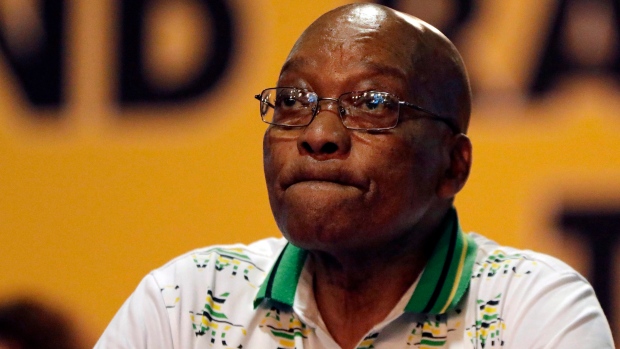
WHAT NEXT: former South African President Jacob Zuma.

South African police could this week issue former president Jacob Zuma with a court summons relating to corruption charges over a years-old $2.5 billion arms deal, a spokesman for the Hawks investigative crime unit said on Sunday.
The National Prosecuting Authority (NPA) last week said it would seek to prosecute Zuma on 16 charges, including fraud, racketeering, corruption and money laundering.
Zuma could not be reached for comment on Sunday. He has repeatedly denied the allegations. A court appearance would be a dramatic development on a continent where former presidents rarely face their accusers in court.
“We are of the view everything will be finalised soon. Hopefully this week,” Hawks spokesman Hangwani Mulaudzi told Reuters.
News24, citing sources close to the case, reported that Zuma would be summoned to appear in the Durban High Court on April 6. Mulaudzi declined to comment.
Zuma, who was forced to resign by his ruling African National Congress last month, was at the center of a 1990s deal to buy European military kit that has cast a shadow over politics in South Africa for years.
Zuma was deputy president at the time of the arms deal. Schabir Shaikh, his former financial adviser, was found guilty and jailed in 2005 for trying to solicit bribes for Zuma from a French arms company.
The 16 counts were filed against Zuma but then dropped by the NPA shortly before he successfully ran for president in 2009.
Since his election nine years ago, his opponents have fought a lengthy legal battle to have the charges reinstated. Zuma countered with his own legal challenges.

Stories Continues after ad

President Museveni asks for answers on Umeme contract

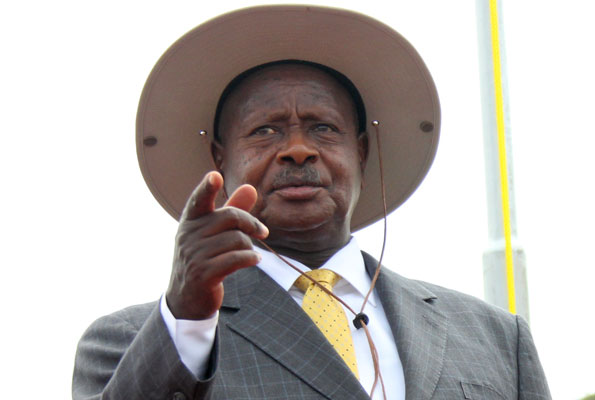
President Museveni

Just as you thought the Umeme issue is long dead and one of those very many governance storms that raise only to die with the wind, President Museveni has written a missive asking the IGG to look into the Umeme contract and the controversies therein.
He has ordered the minister if energy not to renew Umeme’s contract unless the ministry avails him with a satisfactory explanations on the controversies surrounding the concession.
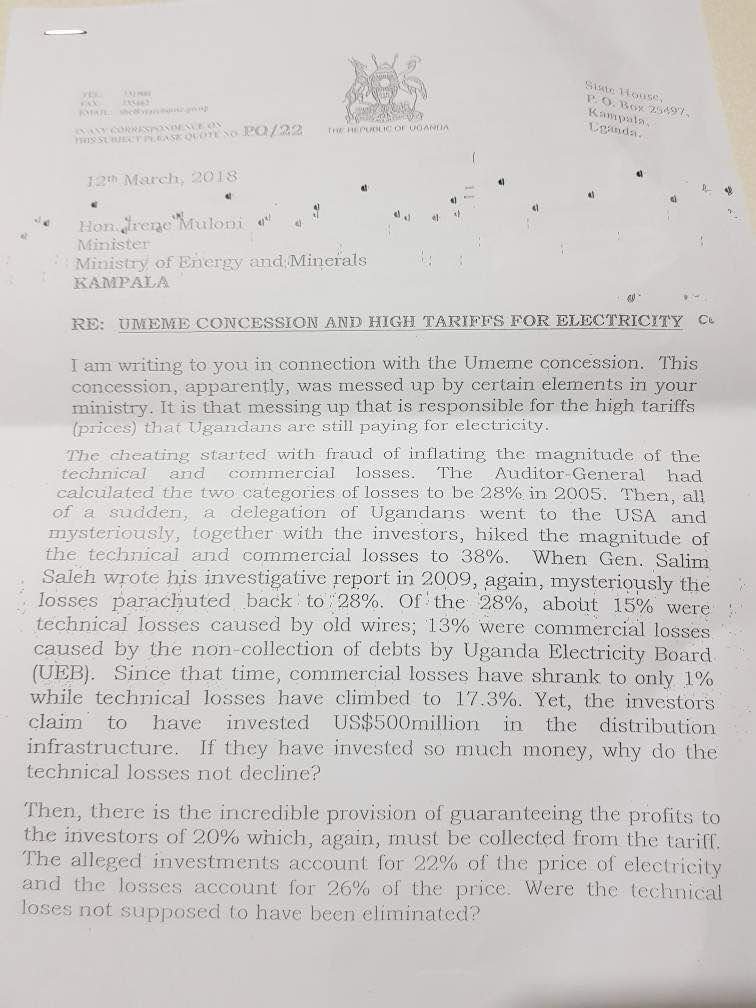
In a March 12 letter to Ministry of Energy, Irene Muloni, President Museveni paints an image of someone who is at last fed up of the controversies surrounding the Umeme concession and the fact that a poor job by the government negotiators led Ugandans to paying through the nose for power tariffs and what’s the matter sorted fast.


“This concession was, apparently, messed up by certain elements in your ministry. It is that messing up that is responsible for the high tariffs that Ugandans are still paying for electricity,” the letter reads in part and goes on to narrate the investigations government has been doing into the concession since 2005 when the Auditor General looked into the inflated technical and commercial loses which he put at 28 per cent only for government officials to connive with the investors and hiked it to 38 per cent.
In the letter, the President asks why the electricity consumer continues to suffer the blunt of paying too much for electricity.
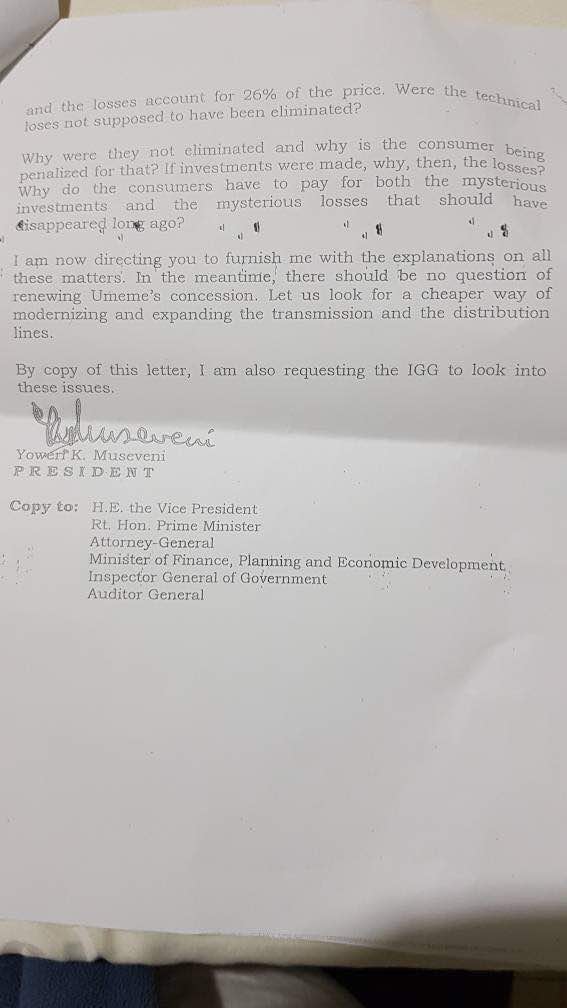
“Why do consumers have to pay for both the mysterious investments and the mysterious loses that should have disappeared long ago?” the president asks.
He further orders, “I am now directing you to furnish me with the explanations on all these matters. IN the meantime, there should be no question of renewing Umeme’s concession. Let us look for a cheaper way of modernizing and expanding the transmission and the distribution lines.
“By copy of this letter, I am also requesting the IFF to look into these issues.”

Stories Continues after ad

DFCU: Will the Crane Bank ‘halo’ ruffle shareholders?

AT THE CENTRE OF STANDOFF: Former Crane Bank

The Development Finance Company of Uganda (DFCU), one of the biggest financial institutions in Uganda is owned by a consortium of 10 investors, the majority shareholder being Arise BV with 58.71 percent shares.


Rabo Development from the Netherlands and NorFinance from Norway are shareholders in Arise B.V together with Norfund, a Norwegian government owned Private Equity firm and FMO, the Dutch Development Bank.

Notable shareholders include the Commonwealth Development Corporation, a British government-owned company, the third biggest shareholder with 9.97 percent shares and the National Social Security Fund (NSSF), the fourth biggest shareholder, with 7.69 percent shareholding.

Other shareholders include 4 Kimberlite Frontier Africa Naster Fund 6.15%; two undisclosed Institutional Investors 3.22 %;  SSB-Conrad N. Hilton Foundation 0.98%;  Vanderbilt University 0.87%; Blakeney Management 0.63%; Bank of Uganda Staff Retirement Benefits Scheme 0.59%  and other retail investors  with11.19% shares.

Early last year the DFCU came to the spotlight after it emerged that it had acquired the biggest indigenous bank, the Crane Bank, reportedly under unclear circumstances.

At the time the Crane Bank shareholders were contesting the acquisition of their bank, calling on Bank of Uganda to allow them recover ‘bad loans’ by disposing off the collateral reportedly in excess of Shs600 billion.

And last week, in a three-part series the EagleOnline published the story of how the Bank of Uganda (BoU) and DFCU officials reportedly connived against the Crane Bank Limited and swept a whopping Shs600 billion under the carpet for their own benefit, at no corresponding cost.

In a 4-page leaked document dubbed: ‘The major contentious issues with the Purchase of Assets and Assumption of Liabilities Agreement entered into between Bank of Uganda and DFCU Bank Limited dated 25th of January 2027’, the shareholders of Crane Bank said that when the BoU was taking over their bank, it classified a set of loans of about Shs600bn as ‘non-performing loans’ and subsequently removed them from the list of assets of the CBL balance sheet.

The document containing the said details was reportedly signed by among others the Governor Professor Emmanuel Tumusiime Mutebile, on behalf of BoU and Juma Kisaame and William Sekabembe, Managing Director and Executive Director respectively, on behalf of DFCU Bank.

By press time today, it was not possible to get the CBL sale agreement between BoU and DFCU Bank, but according to the shareholders, among them tycoon businessman Sudhir Ruparelia, the officials of the two financial institutions endorsed a fraudulent transaction in which they (shareholders) also lost capital of Shs350 billion (as payment for the loans), as a result.

‘By this arrangement, these non-performing (loans) were no longer the property of CBL, but belonged to the shareholders who had paid for them with their capital contributions,’ the shareholders wrote, adding that they also had to part with about Shs85 billion, reportedly paid to the BoU in three installments of US$8m, US$7.5m and US$8m.

Further, the shareholders point a particular finger at Justine Bagyenda, the immediate former Director Bank Supervision, for being responsible for the mess in which DFCU would later reportedly account for the loans, albeit fraudulently.

‘Justine Bagyenda of Bank of Uganda then gave permission to secretly account for these bad loans on a secret basis outside the official books of DFCU! How can a regulator allow a bank to have secret side books of account?’ they wondered, but not before saying that officials involved in the sale were acting with fraudulent intent.

‘Bank of Uganda did this knowing that although these non-performing loans were classified as worthless for accounting purposes, they were fully secured by valuable securities and a large portion of them were collectable,’ the shareholders wrote.

The shareholders further impute that BoU and DFCU officials shared the spoils accruing from the loans, for which they had already paid over Shs400 billion.

‘Bank of Uganda officials therefore secretly entered into a side accounting arrangement with DFCU bank to collect from these loans and secretly account for and share proceeds of these collections amongst DFCU and BoU officials’, the shareholders charged.

The ongoing Crane Bank, BoU and DFCU standoff in which millions of dollars are being spent in litigation costs is the biggest post-Independence financial saga, and has so far drawn ‘fast blood’ between the BoU Governor Professor Emmanuel Tumusiime Mutebile, Justine Bagyenda, the former Executive Director of Bank Supervision and the Inspector General of Government Justice Irene Mulyagonja Kakooza.


Stories Continues after ad

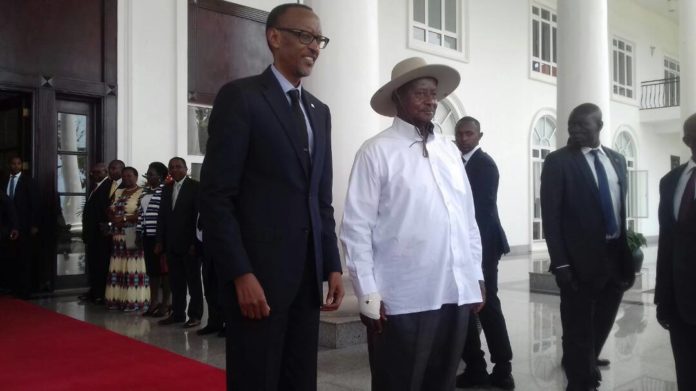
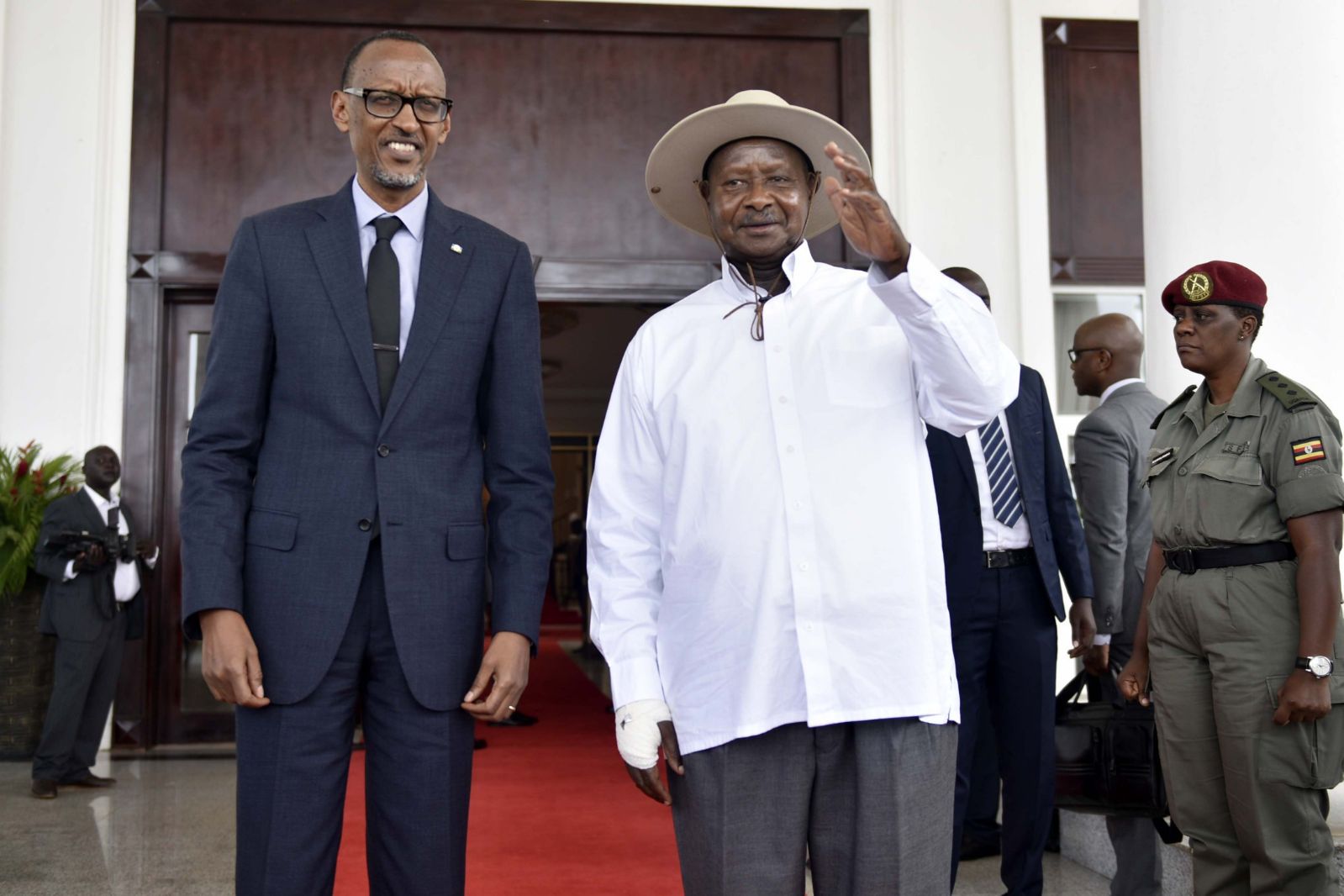
Kagame in Uganda for talks with Museveni

Rwanda's President Paul Kagame poses for a photo with President Museveni

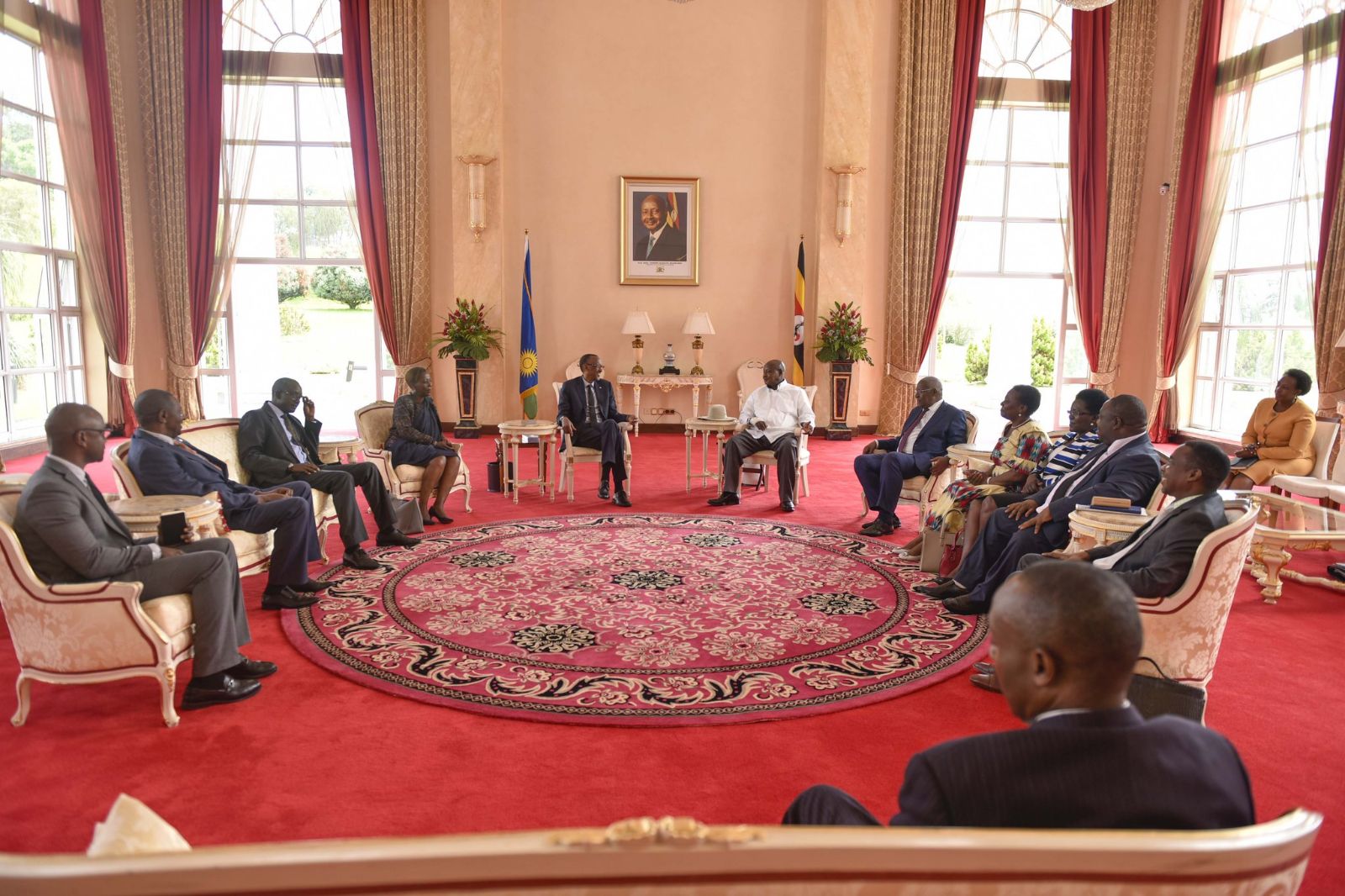
Rwanda President Paul Kagame has this morning arrived in Uganda for a one-day visit, and will hold talks with host President Yoweri Museveni at State House Entebbe.

Presidents Paul Kagame and Yoweri Museveni at State House Entebbe today

By press time details of the meeting between the two presidents were scanty but officials had earlier indicated the talks would focus on bilateral relations.

Presidents Paul Kagame and Yoweri Museveni and members of their respective delegations at State House Entebbe today

Kagame’ visit comes at a time when relations between Rwanda and Uganda are reportedly frosty following a series of events officials from both countries say are aimed at undermining each other’s sovereignty.

And just last week President Museveni failed to attend the Africa Continental Free Trade Area (AfCFTA) Summit in Kigali, reportedly on the advice of his ‘advance team’.

The two presidents, former comrades-in-arms during the bush war between 1981 and 1985 that brought the National Resistance Movement/Army (NRM/A) government to power in 1986 last met at the AU Heads of State Summit in Addis Ababa early this year.

Stories Continues after ad

Bagyenda’s accounts to be frozen on Monday- Source

Embattled former Executive Director in charge of Supervision at Bank of Uganda Justine Bagyenda.

A source in the Financial Intelligence Authority has intimated to Eagle Online that embattled Bank of Uganda Director, Justine Bagyenda’s bank accounts will be frozen on Monday.
The move is a result of Ms Bagyenda’s failure to appear before the Authority’s investigations team to explain matters surrounding her source of monies she holds on bank accounts in Diamond Trust and Barclays Bank.
If the Authority implements its decision on Monday, the source said, Ms Bagyenda will not be able to access her monies until all doubts about its source are cleared.
Earlier on the Authority’s head, Sydney Asubo, had told this newspaper that they had got sufficient information from whistleblowers which they are working hard to corroborate, a thing which had made them extend an invite Ms Bagyenda, who was also the Authority’s Board chairperson before she got into murky waters, to help with the investigations.
Ms Asubo said that if the information from the whistleblower is found to be true, it will be shared with other security and law enforcement agencies for proper action.
Over a fortnight ago, this newspaper broke a story about Ms Bagyenda’s close to shs20Billion shillings on two separate bank accounts which had amassed in a space of six years. The twenty billion is separate from another shs2B petty cash account in Centenary Development Bank plus a plethora of properties she has strewn across the city.
Last week the former chairman of public accounts committee Nandala Mafabi vowed to petition parliament for Bagyenda’s to account for the sources of her wealth and be charged with money laundering in case she fails.
The Banks where Ms Bagyenda has the monies have since apologized to her for the leaks and are investigating the source of the leaks.
For DTB, the investigation, reportedly led them to one of their staff who, the Bank leadership claims, was ‘compromised’ and actively participated in leaking account details of their client while Barclays in press released says internal disciplinary measures are being undertaken.

Stories Continues after ad

The loans that crippled Crane Bank

AT THE CENTRE OF STANDOFF: Former Crane Bank

By Our Reporter
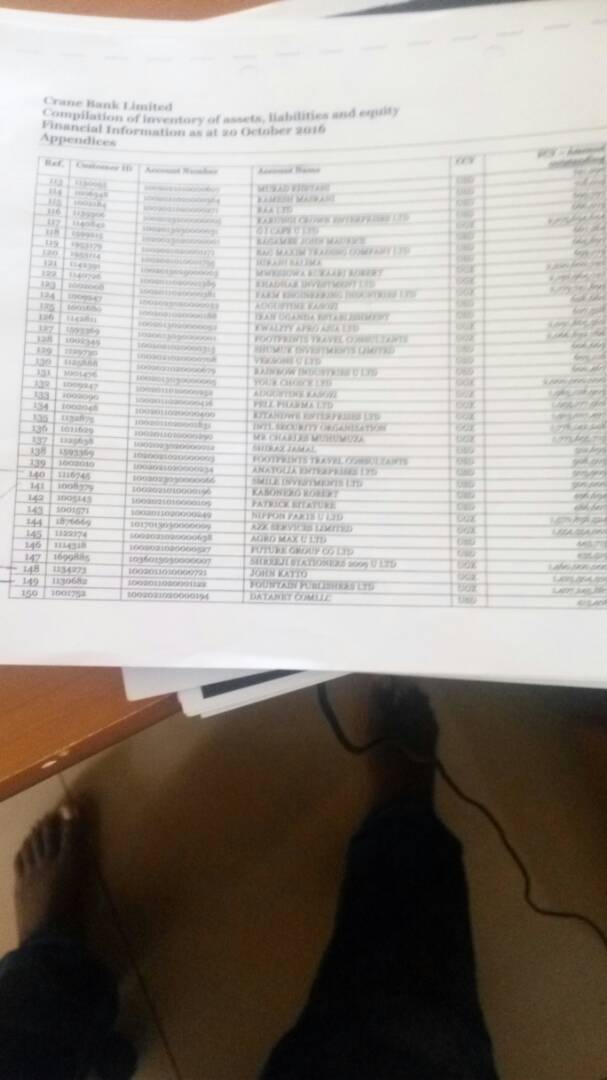
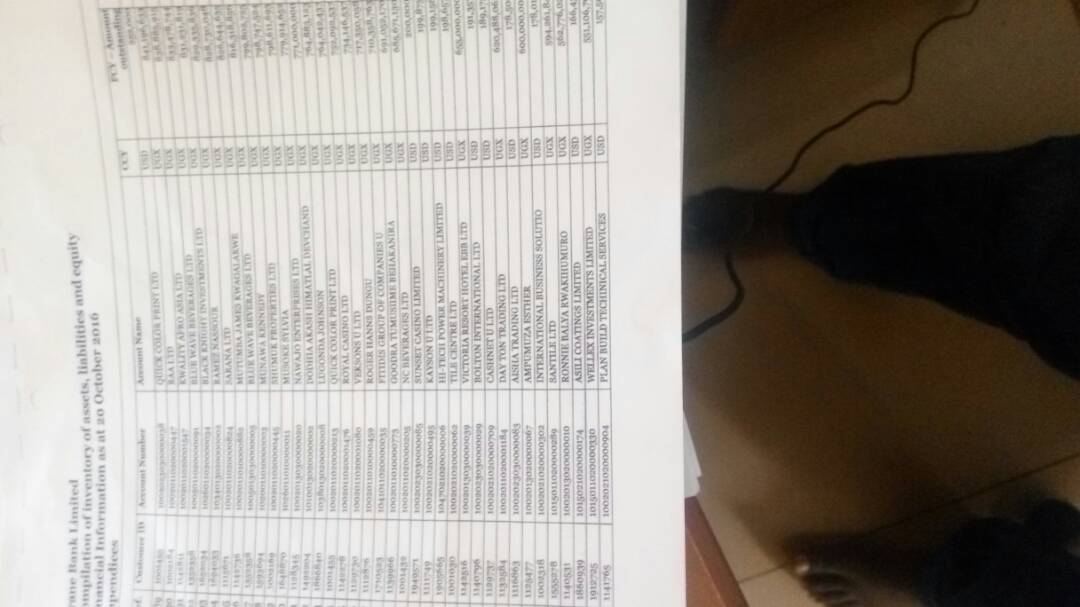
Before its untimely sale to rival DFCU Bank, Crane Bank had lent clients net loans worth Sh700 billion as of October 20, 2016, according to a compiled financial report of the bank, showing that it was a key player in the country’s economy even though it was sold.
According to the leaked details of the customers contained in stolen book from former Crane Bank bosses, the asset base of Shs1.2 trillion at the time had bailed out 429 clients including individuals and companies even as its liabilities stood at Shs1.3 trillion against total equity and reserves of Shs130.9 billion. Customer deposits at the time amounted to a total of Shs977.2 billion

Data available shows big names, some politicians and businessmen who were servicing loans with the bank. Key among them include: New Vision’s Robert Kabushenga (Shs176.9m), Dr Ham Mukasa Mulira (Shs175m) and Henry Muganwa Kajura (Shs200m). Red Pepper’s Arinaitwe D. Rugyendo had a loan of Shs503.9m.
Other borrowers at the time included key figures like Patrick Bitature, former minister John Nasasira and businessman Robert Kabonero among others. Companies like Shumuk Investments, Harris International, Fountain Publishers and University Bookshop Makerere among others who took loans in hundreds of millions.
During the sale of Crane Bank then by the Bank of Uganda, shareholders argued that much as the liabilities were unfavorably, they were recovering debts from borrowers, something the central bank didn’t listen to. That was worsened as BOU handed over land titles of Crane Bank’s properties to DFCU.

Crane Bank Crane was the fourth largest bank by the time it was taken over by the central bank with branches in all regions of the country, employing thousands in direct and direct jobs. At one point it was one the top taxpayers in the country.
More drama however ensued as DFCU Bank in mid-August announced net profits of Shs114 billion for the first half of 2017 year up from Shs23 billion in the same period last year.
DFCU attributed the profit majorly to the acquision of Crane Bank. The company’s balance sheet jumped t Shs3.05trn as of June 2017 from Shs1.8 trillon in December 2016. Its customer had numbers grow by 50 per cent in the period under review and its branch network grew from 43 to 67 with 100ATMs. But this was because it had acquired Crane Bank.
As DFCU celebrated its profit which was over 70 percent, sections of watchers in the public was wondering how a loss-making Crane Bank, as alleged by BOU, would turn around to boost profits of its rival within the shortest time.

Some have argued that the sale of Crane by BOU was for reasons best known to Governor Emmanuel Tumusiime Mutebile and sacked director of Supervision Christine Bagyenda. Mutebile at one hinted Bagyenda whose job was to scrutinize performance banks had failed totrack Crane Bank, something that displeased Bagyenda. That shows the two top officials were not on the same page as Mutebile announced the sale of Crane Bank.
Court case
With Bagyenda now sacked, it is not clear whether she will be on the side of BOU in the case it accused Sudhir Ruparelia, the former Crane Bank proprietor, of taking out billions of shillings from the financial institution, causing its collapse. Sudhir denies wrong doing, arguing partly that at the takeover his bank, most of the money had been given out as loans as highlighted in the report. Sudhir blames BoU for flouting key terms of a Confidential Settlement and Release Agreement (CSRA) he signed with the central bank.
During that accounting period, Crane bank had balance with the bank of Uganda of Shs78.7b. But it also had balance and placements with other banks of above Shs10b.
Ownership

With a paid up capital of Shs210 billion, the bank was mostly owned by members of Sudhir Ruparelia family (6). Other shareholders were; White Sapphire Limited and Tom Mugenga, who had the least shares of Shs70, 014.
DFCU is partly owned by CDC, Rabo Development from the Netherlands and NorFinance from Norway who are shareholders in Arise B.V together with Norfund, a Norwegian government owned Private Equity firm and FMO, the Dutch Development Bank.

Stories Continues after ad

Former PM Amama Mbabazi scoops international appointment

Former Prime Minister Amama Mbabazi

Former Prime Minister of Uganda and presidential candidate John Patrick Amama Mbabazi is all smiles after being appointed to the board of trustees of the Brazzaville Foundation.
Managed by distinguished and experienced individuals, develops cross-border and regional projects to address key economic and environmental problems. In doing so it aims to promote regional dialogue and peaceful cooperation to the benefit of both people and the environment.
The Foundation also seeks to facilitate dialogue and achieve a better understanding between conflicting parties wherever informal diplomacy, bridge-building and discreet, pragmatic engagement offer an alternative way forward. It can do on its own initiative or at the request of the parties to a conflict or at the invitation of regional or multilateral organisations.
Amama’s Citation for the new position reads as;
Amama Mbabazi is a former Prime Minister of Uganda (2011-14). He studied law at Makerere University and is a lawyer by profession. He played an important role in the resistance to dictatorship in Uganda (1972-86) and was a founding member and later Secretary General of the National Resistance Movement (NRM). He was a member of Parliament for 20 years.
Before becoming Prime Minister, he held several Cabinet posts, including Minister of Defence, Minister of Security and Attorney General. As Minister of State for Foreign Affairs, he negotiated the Lusaka Peace Agreement that ended hostilities in the DRC, secured the withdrawal of foreign forces and re-established central government administration. He also represented Uganda in the IGAD mediation in the Sudan conflict.
In the 2016 Presidential election, he was the only candidate to criticise discrimination against the LBGT community. Among his many other positions, he was a member of the University Council of the Islamic University of Uganda, a founding member of the Uganda AIDS Commission (1990-1995) and chairman of the Board of Trustees of the Joint Clinical Research Centre which contributed to vaccine development and HIV care.
Other individuals on the board include former Nigerian president Olusegun Obasanjo, Kgalema Motalanthe who served as President of South Africa between September 25, 2008 and May 9, 2009.
Other distinguished individuals on the board are; are Cecilia Attias, Xavier Guerrand Hermes, Dar Stenback, Philip von und zu Liechtenstein, Dr Mathews Phosa, Dr Jose Ramos Horta, Kabine Komora and Sundeep Waslekar.

Stories Continues after ad