Stanbic Bank
Stanbic Bank
18.9 C
Kampala
Stanbic Bank
Stanbic Bank
Home Blog Page 1616

Employees don’t quit their Job; they quit their boss!

Brigette Hyacinth

Employees might join companies, but they leave managers. Too many managers view their position as one of entitlement rather than one of responsibility. In days past, managers would focus on developing their employees. Today they are more focused on self-promotion and securing their position.

A managers’ job is to facilitate a good working environment for his/her employees. The focus should be to help everyone around you succeed. Managers define culture, and culture under-girds the lasting health, success and sustainability of an organization.

The biggest danger of leadership: Arrogance

According to research from the University Of Washington Foster School Of Business, humble people are more likely to be made the most effective leaders. It turns out, humility offers a competitive advantage.
So why has an arrogant or narcissistic leader become the norm?

It has been historically perceived that humility is a sign of weakness and an antithesis to leadership. There is still an expectation that successful leaders are more arrogant than humble. Narcissism is mistaken for self-confidence and toxic leaders seem to be in control of everything.

They are able to provide short-term results but the truth is they leave a trail of destruction in their path. Organizations pay heavily for such managers with low engagement, high turnover and reduced productivity.
Arrogant leaders have a shelf-life within their organizations. They may “rule the day” but eventually people tire of them and their tactics, which lessens overall commitment from the team. Intimidation and threats of punishment
can only work for so long.

The x- factor of great leadership is not personality, it’s humility.” -Jim Collins
The Power of Humility in the Workplace
Leading with humility means focusing on others and practicing servant leadership. Humble leaders:
1. They put people first. There focus is on serving others. They do not get consumed by seeking out more power. Instead, they seek more ways to help others.

2. They admit their mistakes. All leaders make mistakes. Humble leaders own up to them. They don’t play the blame game when things go wrong. Instead they hold themselves accountable. Vulnerability builds trust.
3. They share information and delegate. Humble leaders are aware of their strengths and weaknesses. They realize that they cannot do everything. They delegate because the work is more important than their ego.
4. They listen – They are approachable to employees and this allows them to create an environment of open communication and effective feedback.

5. They do not hesitate to give credit where credit is due. They appreciate the contributions of others. They are quick to recognize and reward the efforts of team members.
6. They are empathetic to those in their charge. They genuinely care about employees and employees can feel this sincerity. Empathy allows them to build healthy relationships and bond with team members.
7. They are authentic. They are the same person in every situation. This makes them trustworthy. Authenticity goes hand in hand with integrity. They are individuals of integrity.

“No matter how educated, talented, rich or cool you believe you are, how you treat people tells all. Integrity is everything.”
Humility doesn’t mean that leaders can’t make tough decisions. A humble leader should not be mistaken for a weak one. It takes strength, courage, and wisdom to practice humility. I have learned that the best leaders are selfless and more concerned with the well-being of their team than with personal titles or status symbols.

Easily offended leaders with inflated egos don’t build strong teams. You cannot be an effective leader if you feel that you are better than your subordinates. No one likes dealing with egomaniacs. Arrogance is a deterrent; it destroys relationships and lowers employee morale whereas genuine humility has a way of winning others over.
Good leaders empower. Bad ones micromanage. It is dreadful to work under a manager who is more worried about pushing their weight around than building relationships. The role of any leader within a corporate framework is to build up the team and to encourage growth.

If we want employees to feel commitment to the organization; we need to show we respect and value them. This takes humility. For loyalty, there has to be a relationship that develops between employee and employer and this develops over time through trust that gets built and sustained. Once people trust you, they will follow your lead. You won’t need to flaunt your title to get them to do the best possible job.

People might tolerate a boring job or long commute, but they are more prone to leave if their boss treats them poorly.
Humble leaders get the best from people. They have more influence, they retain top talent, and they earn more respect and loyalty than those who rely upon ego and power. Want to be a good boss? Start by taking a slice or two of humble pie!
The Writer is Author: The Future of Leadership: Rise of Automation, Robotics and Artificial Intelligence

Stories Continues after ad

An echo of Goodhart’s law: Dynamic management and foreign exchange reserves

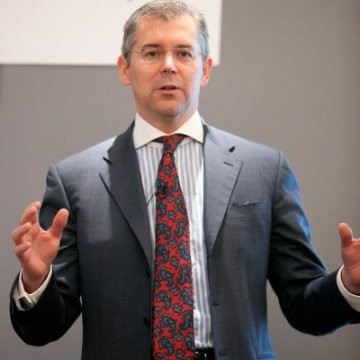
Gary Smith

By Gary Smith
It can be argued that China’s deployment of foreign exchange reserves between mid-2014 and the end of 2016 was the most unsuccessful use of such reserves in history.

Around US $1tillion was spent and, despite this, the renminbi declined in value against the dollar by almost 15 per cent. The outcome confounded conventional theory. The relationship between reserves deployment and currency value did not work as expected.

In defence of Beijing, it is impossible to say where the currency might have moved if the reserves had not been deployed. Capital controls played an important part, to halt and then reverse currency weakness in 2017.

However, these factors should not deflect from recognising that intervention to support the currency not only appeared to be unsuccessful, but counterproductive. When the intervention ended, the renminbi rose in value. This adds to the mystery.

The Chinese experience was not unique. There is plenty of evidence to suggest this outcome is probable. A vicious circle can develop, where the use of reserves creates a sense of unease that undermines the currency, as happened in Russia in 2014, South Korea in 2008, and across Asia in 1997.

In these cases the size and rate of depletion became the focus of market attention. Instead of simply being a tool to help achieve currency stability, the reserves became a policy objective in themselves. This is a variation on Goodhart’s law, which can be summarised as stating that when a measure becomes a target, it ceases to be a good measure.
A nation without foreign exchange reserves will be viewed as vulnerable on multiple levels. But a nation with reserves may also look vulnerable the moment they are utilised. As the head of reserves at a central bank with more than US $100 billion in reserves noted at a recent OMFIF seminar, it’s not how much you have, but whether you have had any need to spend.

The concept of reserves adequacy can be rendered redundant by the act of usage.
These circumstances have led to some questions about whether the use and, in turn, accumulation of reserves is pointless. The answer to these questions hinges on the purpose of foreign exchange reserves. In 2018 they are much more than a tool for currency intervention.
Although managing the value of domestic currencies might have been the original reason to hold and accumulate reserves, this use has a poor record of success. In terms of the list of reasons to hold reserves, this should be a candidate for relegation.

To have value as a threat to the foreign exchange markets, reserves (and the assets of related sovereign funds) may need to be more than 100 per cent of GDP, as in Hong Kong and Singapore, rather than the 40 per cent of GDP in China in 2014.
There are two conclusions, with overlapping implications. First, any argument that suggests a need for greater foreign exchange reserves should also demand a more dynamic approach to their management. Second, a relegation of the currency intervention motivation for holding reserves in turn argues for a promotion of the case for the conservation of reserves.
This implies a diminished need for liquidity, and hence greater justification for pursuing yield- enhancing strategies.

Gary Smith is Member of the Strategic Relationship Management Team at Barings and Member of the OMFIF Advisory Council.

Stories Continues after ad

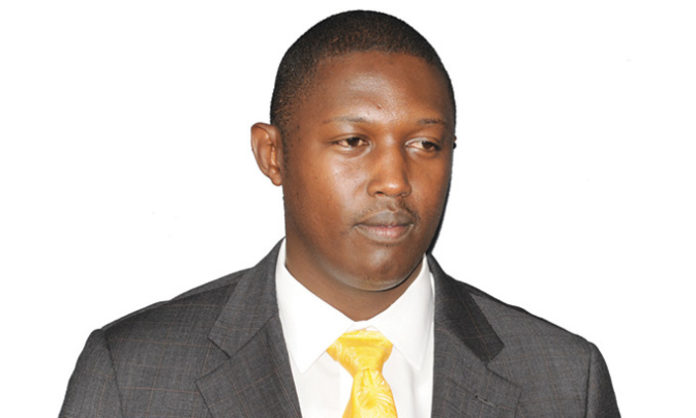
Jinja West MP named in plan to sell off Kimaka airstrip

IN THE SPOT: Moses Grace Balyeku.

Works Minister Azuba distances self from plan

A source at Civil Aviation Authority has intimated to Eagle Online that there is a move by a section of politicians from Jinja to parcel out Kimaka Airstrip land to investors.

The move, the source said is being orchestrated by Mr. Moses Balyeku, the Jinja West MP who apparently has been pestering the Authority’s leadership for a while.
Attempts to get a detailed response from the legislator were futile as he didn’t response to multiple telephone calls. When we texted him, his response a terse, “not true” comment.

On seemingly hitting a dead end at the Aviation Authority, our source says, the legislator got a buy in of the works minister Engineer Monica Azuba Ntege, who is the political head of the Authority and is apparently pushing through the plan.
However, Minister Azuba said she was hearing about the matter of investors for the first time. Although she hinted on some other land already being availed for the airstrip , she said she was instead investigating the veracity of the arguments from within the Authority that the airstrip that the coming Standard Gauge Railway project is going to eat into the airstrip’s land and therefore it is prudent to have it moved to a different place.

“I found in motion a situation where they wanted to move the airport to a different station on information that SGR was going to take part of the airstrip. So I started finding out if it’s true and whether where they want to take airstrip actually exists.

“I wanted to find out if it (SGR) affected the airstrip or the remaining land as it is it is enough to serve the operations of the airport; then it’s another story. The issue of investors I am hearing it for the first time and from you. I have no idea that the reason is to be given to investors,” she said.

We couldn’t get hold of the SGR project spokesperson Diana Apio as her phone went unanswered but the Managing Director of Civil Aviation Authority, Dr. David Kakuba said.“The best which I can assure you is that the district asked for information about that and we told them that the SGR will not pass through the airstrip’s land. The SGR is going to pass that side of Nile Resort. We assured them that if that is the case (SGR taking part of the airstrip land) forget about the SGR we are still in charge of our property”.
Adding “This is a national property if the sell is to happen procedure has to be followed,”.

President Yoweri Museveni some time back while touring Busoga region promised to rehabilitate the airstrip in a bid to promote tourism in the region. Busoga region is home to the Source of River Nile and other major tourist attractions.

Kimaka is one of twelve upcountry airports that are administered by the Uganda Civil Aviation Authority.
In 2005, government has earmarked Shs350 million for the first phase of the rehabilitation of Kimaka Airstrip in Jinja municipality, the Civil Aviation Authority (CAA) managing director has said.

There were plans to build the runway, renovate staff quarters, the terminal building and fire house.
CCA had plans to turn the airstrip into a bigger commercial facility to boost trade, Jinja being a few kilometers away from the Uganda-Kenya Border.
Eagle Online couldn’t get comments from both Mayor Majid Batambuze and Town Clerk Francis Byabagambi as they never answered their mobile phones.

Stories Continues after ad

Court Martial rejects Kitatta bail application again

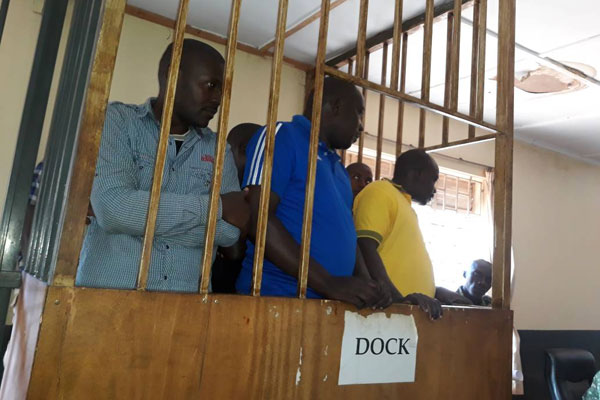
Abdallah Kitatta with his co-accused in the dock at Makindye

The ‘patron’ for the boda-boda 2010 motorcyclists Abdallah Kitatta has for the second time been denied bail by the General Court Martial (GCM) sitting in Makindye.

Appearing before the seven-member panel chaired by Lt Gen Andrew Guti, prosecution led by Lt Ambrose Baguma and Sgt Raphael Mugisha opposed the release of the suspect, saying he might interfere with the ongoing investigations. The matter was then adjourned to May 7, 2018 a day when the GCM is expected to pronounce itself on Kitatta’s bail application.

Last month Kitatta’s lawyer Shaban Sanywa, applied for saying his client is the serving Chairman for National Resistance Movement (NRM) for Rubaga division and that he also needs special treatment due to his deteriorating health condition.

Kitatta was arrested by a joint force of Uganda People’s Defence Forces (UPDF) and Internal Security Organization (ISO) and is currently facing five counts including failure to protect war material and being in unlawful possession of military stores contrary to the UPDF Act.

His co-accused include Sowali Ngobi, Amon Twinomujuni, Joel Kibirige, Matia Ssenfuka, Hassan Ssebata and Johnson Kayondo. Others are Hassan Ssengoba, Sunday Ssemwogerere, John Ssebandeke, Hussein Mugema, Fred Bwanika and Ibrahim Sekajja.


Stories Continues after ad

Big Brother Naija House Finale: Winner scoops 25m Naira

OUT! Bally-gets-evicted-from-the-Big-Brother-Naija-house

After three months of suspense, drama, intrigue and controversy, Africa’s biggest reality show, Big Brother Naija: Double Wahala came to an end with the in-house pilot, Miracle, emerging as the winner of 25 million Naira cash, an SUV and other prizes with a combined worth of N45 million.

Former Big Brother Naija housemate, Bisola, hosted a live viewing in Lagos, Nigeria, and coverage of the show switched between the venues.

Nigerian serial hitmaker, Davido, kicked off proceedings with his hit track, ‘Fia’ and the five finalists, Tobi, Cee-C, Nina, Miracle and Alex were then joined in the house by Ebuka, who gave them opportunity to clear the air on several controversial issues.

The first eviction of the night was then announced, as Nina was told to leave the Big Brother House.

Viewers also got the chance to hear from past housemates who were in attendance at the Lagos venue, as Bisola probed them on their relationships and ventures outside the house.

A pair of performances followed, first with ‘Legbegbe’ crooner Mr. Real thrilling viewers and then Kaffy and the Magneto Dance Crew performing expertly choreographed dance moves.

Another eviction was up next, as Alex was also evicted from the Big Brother Naija house.

Following further performances by Dice Ailes and Kaffy, Tobi became the next housemate to be evicted, leaving Miracle and Cee-C as the top two finalists.

After a very tense moment on stage, the venue erupted as Miracle Igbokwe was unveiled as the winner of Big Brother Naija: Double Wahala, with the Regional Director of M-Net West Africa, Wangi Mba-Uzoukwu presenting a cheque for 25 million naira.


Stories Continues after ad

Mengo SS is central region champ in 2018 Stanbic National Schools Championship

FLASHBACK: Patrick Mweheire  Stanbic Bank  CEO (centre), Barbara Kasekende Stanbic CSI Manager (4th left) and Brian Mulondo, Quiz Master of the National Schools Championship pose for a group picture with students at the launch of the 2018 Stanbic National Schools Championship. 

Stanbic Bank has unveiled the 2018 regional winners of the National Schools Championship after a debate competition which involved four schools in each region contesting for the regional title.

The schools crowned winners in the Northern, Eastern, Central and Western regions include; Muni Girls Secondary School, Nakanyonyi Girls Secondary School, Mengo Senior School and Bweranyangi Girls’ Senior Secondary School, respectively.

Congratulating the schools upon their great success, Barbara Kasekende, Stanbic Bank CSI Manager said: “The Stanbic National Schools competition journey thus far has been challenging for the students but fruitful at the same time. I am more than excited for the schools that have made it this far and cannot wait to see what more these brilliant students have to offer.  It has been a learning curve not only for the students but those who witnessed the debates as well.”

The regional debate competitions are in the fourth stage of the Stanbic National Schools Championship which started with classroom competitions, oral quiz competition, and essay competition, running under the theme: ‘Empowering the job creators of tomorrow, seeks to nurture skills beyond the class room’.

The four finalist schools will be hosted at a training boot camp which will equip the students with business soft skills, how to develop a business plan, networking, communication skills that they will need to succeed in the real world.

The students will then be tasked to develop and execute a business plan in their respective schools, with the best being crowned 2018 Stanbic National Schools Champions at the Grand finale to be held in Kampala on July 5, 2018.


Stories Continues after ad

Musician Walukaga, Minister clash over child neglect

INTERVENED: Florence Nakiwala Kiyingi, the Minister of State for Youth and Children Affairs

The Minister of State for Youth and Children Affairs Florence Nakiwala Kiyingi has ordered for the evacuation of musician Mathias Walukaga’s housemaid who claims he is the father of her child.

Minister Nakiwala Kiyingi says that this is after she got information that a plan to abduct Aisha Namugerwa and her child was underway.

According to Minister Nakiwala Kiyingi, she picked interest in the matter after following it in the media where Namugerwa accused Walukaga of neglecting her and the child. Earlier the mother of the baby had cried out to authorities to help her bring Walukaga to order so he could provide for the ailing child.

The Minister then ordered that the two be evacuated from Mubende to Naguru Reception Center for treatment before the kid is subjected to a DNA test together with Walukaga.

However, Walukaga denied being the father of the child. He says that it is instead one of his dancers, one Twaha Mawanda, who he says was in a relationship with his housemaid.

He was also reluctant to take a DNA test, further attracting the intervention of Minister Nakiwala Kiyingi.

Meanwhile, the mother of the kid says she has nothing against Walukaga but that she wants the kid to know its right father.


Stories Continues after ad

Energy Minister Muloni woos German investors

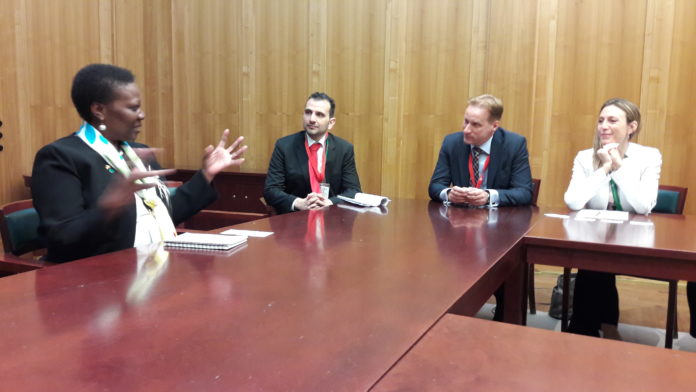
Energy Minister Irene Muloni (L) with Germany officials and investors

Energy and Mineral Development Minister Eng. Irene Muloni has urged German investors to consider investing in Uganda energy sector.

In a dialogue hosted by among others the Federal Government and the German Renewable Energy Federation (BEE), Minister Muloni said Uganda has 20 independent power producers generating over 70 per cent of the country’s electricity supply. She also said that the country, which has a liberalized economy, has set up a number of Industrial Parks to ensure that there is a sustainable market for energy.

“Recently Uganda approved a free connection policy for everyone near existing networks, investing in Uganda, investors will be tapping on its largely unexploited and undeveloped renewable energy resources,” Minister Muloni said at the Fourth Berlin Energy Transition Dialogue in Germany.

The Minister also said Uganda offers tax holidays to credible investors for a period of five to 15 years with a vast market of products in East and Central Africa.

The event was opened by the new Federal Foreign Minister Mr. Heiko Maas, and is aimed at developing strategies for the ‘intelligent transformation of the energy system, the transport sector and the heating supply’.

In the meeting, participants called for transitions to newer, cleaner energy systems noting that current energy systems are simply unsustainable on all accounts of social, economic, and environmental criteria.

“Germany regarded the energy policy as a platform for cooperation, for dialogue and for international exchange and gave the Berlin Energy Transition Dialogue,” the new Minister was quoted as saying.

The keynote speaker, Mr. Peter Altmaier said engaging in discussion with participants and partners on innovative business models and technologically advanced and forward-looking solutions which would accelerate the global energy transition and make it more economically and socially attractive for all.


Stories Continues after ad

Burkina Faso President calls for closer cooperation with Uganda

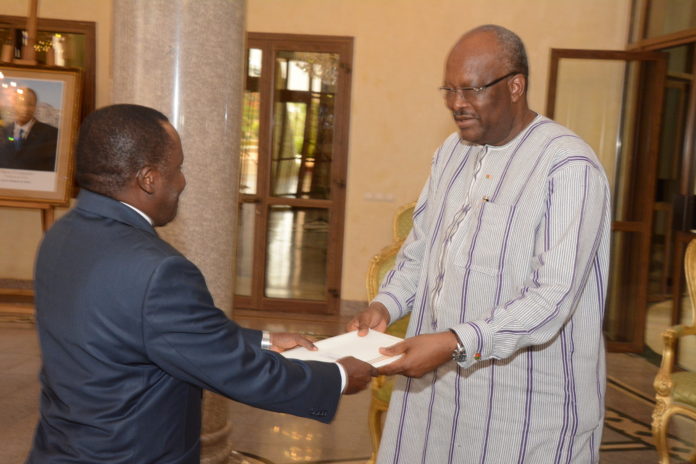
Amb. Nelson Ocheger presenting his credentials

Burkina Faso President Rock Marc Christian Kabore has called for closer bilateral cooperation between his country and Uganda.

President Kabore made the remarks while receiving letters of credence accrediting Nelson Ocheger as Ambassador Extraordinary and Plenipotentiary of Uganda to Burkina Faso.

During the ceremony which took place at the Presidential Palace in the Burkinabe Capital, Ouagadougou, President Kabore highlighted, among others, human capacity building, trade, and agriculture as areas where the two countries could cooperate for their mutual benefit. He called for a legal framework to facilitate the cooperation.

He said that while the African Union has laid a foundation for integration of the African continent, not much progress has been made, yet integration has the potential to improve the welfare of the African people.

Amb. Nelson Ocheger on his part appreciated the President’s commitment to closer cooperation with Uganda. He said there was the need for collaboration in the areas of defense and security since the later have a strong bearing in the economic growth and development of the two countries.

The new Ugandan envoy reiterated Uganda’s determination to fight terrorism in all its forms and called for more cooperation in this endeavor.

President Kabore agreed that security is an area where Uganda and Burkina Faso can cooperate and share experience since Uganda was previously faced with the problem of terrorism but had successfully tackled it.

The meeting was attended by the Foreign Affairs Minister of Burkina Faso, Alpha Barry and Ms. Hajarah Kalinaki, the Second Secretary at the Uganda High Commission.


Stories Continues after ad

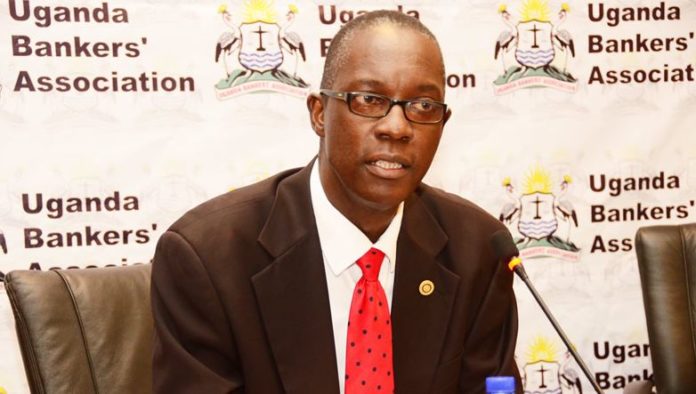
UBA to launch new agent banking platform to support financial inclusion drive

UBA BOSS Humphreys Owor

Uganda Bankers Association (UBA) and its partner institutions will on April 25, 2018 launch a new Shared Agent Banking Platform in Kampala, Eagle Online understands.

Sources said the platform will enable the 25 commercial banks in Uganda to extend their services to remote areas where they expect also to increase access, address cash challenges and provide a range of products and services that are expected to bring some of the rural people into the country’s financial system.

Key note speakers expected at the launch event at the association’s headquarters in Muyenga-Kampala are UBA CEO Wilbrod Humphreys Owor, MD-Electics Group Paul Mbugua, CEO Diamond Trust Bank Varguese Thambi and ABC Bank CEO Richard Yego.

Under a joint venture partnership, UBA and Eclectics International early last year signed an agreement where the latter was to design, develop, deploy and operate the inter-operable shared platform that connects all member banks to the agent network spread across the Country.

Supported with agents, the platform is expected to help bring the big percentage of the country’s informal sector into the financial system where monetary policy and targeted interventions can be directed.

The platform will enable all agents provide agent banking services to existing customers of all the UBA member banks as well as bring on board the unbanked, unserved and underserved segments of the population for financial services. Also under the arrangement, banks will continue to drive the recruitment of customers and marketing of their other products and services.

The benefits that accrue from the establishment of the shared Agent Banking Platform include increased points of presence at a reduced cost of expansion with opportunity to upgrade technology at minimal cost.

UBA says the initiative is a sustainable step for member banks to reduce their costs of operations, which benefits will be passed on to their customers and the wider population by way of access to more cost effective channels.

More, there will be the introduction of new mass market products and secure lending opportunity for banks to extend loans to agents among others Owor said last year.


Stories Continues after ad