Stanbic Bank
Stanbic Bank
18.5 C
Kampala
Stanbic Bank
Stanbic Bank
Home Blog Page 1620

ISO boss implores African intelligence services to share information

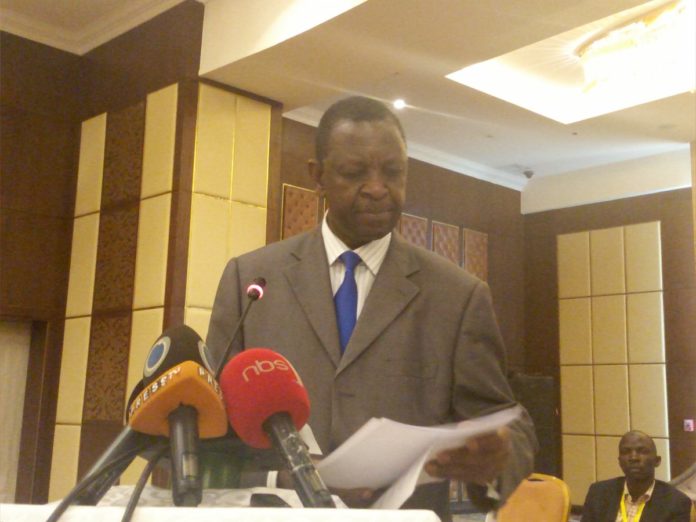
ISO Director General Col. Kaka Bagyenda

The Director General of Internal Security Organisation (ISO) Col Kaka Bagyenda has implored African states to share information and strengthen bilateral relationships in a bid to contain terrorism.

Addressing heads of intelligence and security services from 12 African states about armed groups and negative forces, Col Kaka said national intelligence services can use internet and modern technology such as satellite phones to share information and knowledge on weapons to track down the emerging terrorist groups.

“Modern technology can be used to enrich the power of old age procedures against terrorist groups on the continent, It is empirical for Nations, Regions and Continents to work together in a bid to contend and control all emerging security threats for safety and peace in the region,” Col Kaka said at the Pearl of Africa Hotel in Kampala.

He lauded the Committee of Intelligence and Security Services of Africa (CISSA) for its continued support in ensuring peace on the African continent.

Col. Kaka’s remarks come at a time when African countries face the paradox of the Allied Democratic Forces (ADF) in Eastern Democratic Republic of Congo (DRC); the Al-Shabaab in Somalia and Kenya and, the Boko Haram in Nigeria that have killed innocent people under the guise of establishing Islamic caliphates.

Meanwhile, Uganda’s Deputy Chief of Defense Forces Lt. Gen. Wilson Mbadi has implored African nations to share intelligence to effectively deal with armed terrorist groups on the continent.


Stories Continues after ad

AAU has made tremendous achievements in last 50 years

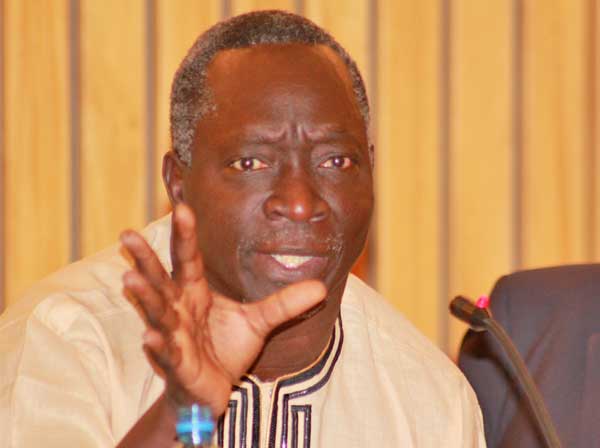
Prof. Adipala Ekwamu

By Prof. Adipala Ekwamu

Since the creation of the Association of African Universities (AAU) in 1967, there has been a rapid increase in the rate of technological advancement which has created profound changes in workforce demands and economic realities.  There has also been a significant increase in the number of universities across the continent calling for pragmatic approaches to foster collaboration across the continent. AAU has responded to these changes and adapted to meet the needs of its members, helped to find solutions to many of these new challenges by providing a platform for research, reflection, Consultation, debate, cooperation and collaboration.


The Association has also provided leadership in the identification of emerging issues and support for debating them and facilitating appropriate follow-up action by its members, partners and other stakeholders. I congratulate all members of AAU for the pivotal role that each of them have played in the success of the organization. Indeed members have developed open and trusting relationships based on mutual respect and common interests. I truly believe that that these relationships are a key reason for AAU longevity and its success.

By 2050, Africa’s population will cross the 2 billion mark, the majority of whom will be young and by 2025 a quarter of all young persons under 25 in the world will be African. This is our greatest capital and they must be appropriately empowered into the intellectual capital that Africa needs, with relevant skills, especially in Science, Technology and Innovation.

In addition we must also include Women who make up more than half of the African population and also form over 70% of the agricultural workforce.  As we pursue our ambitious goal of building shared prosperity, we must do this by developing the full potential of women.  We must implement deliberate strategies to ensure girls’ access to basic education; to higher education including science, technology, research and innovation; and increasing the number of women in academia and research.

As part of our efforts in this direction, in 2017, together with other partners, we launched the Forum for African Women Vice Chancellors, where Professor Mabel Imbuga, the current Vice Chancellor of Jomo Kenyatta University of Agriculture and Technology, is the Chairperson of the Forum. In addressing all these issues, I see the AAU playing a very important role.

Still, Africa must invest much more in education, science, research and technology to meet its own development targets, and claim its stake in the world and knowledge economy. It must also strengthen collaboration between universities and industry; and accelerate intra-African research and scientific cooperation.  These are the core thrusts of the RUFORUM Vision 2030 Strategy: The African Universities’ Agenda for Agricultural Higher Education, Science, Technology and Innovation – AHESTI We seek support from the AAU and national, regional and global partners, but more so African Governments, to help us achieve the Vision and strengthen the contribution of African Universities to the attainment of Agenda 2063. We must break the barriers across our continent, build a sense of belief and responsibility among our new generation for the future of our continent. Clearly education and universities are a key vehicle for achieving this dream. So as Universities and higher education networks, we must forge greater partnership and alliances to support the aspiration of our people: ‘The Africa We Want’.

I commend the AAU for taking the steps to increase its presence in the various regions in the continent and congratulate Sudan Government for allowing the hosting of the regional office in Sudan, more specifically at the University of Khartoum. My humble request especially to the Government of Sudan is to continue supporting the AAU Regional Office and indeed AAU endeavours.

To note also is that RUFORUM will be hosting the Sixth African Higher Education Week and RUFORUM Biennial Conference, the week of 22-26 October 2018 in Nairobi, Kenya. The theme of the Conference is ‘Aligning African Universities to accelerate attainment of Africa Agenda 2063’.

I take this opportunity to invite AAU and its membership, and other actors to join us for the event in Nairobi. I also take this opportunity to inform you that RUFORUM will hold its Annual Convening for 2019 in Accra, Ghana; the 2020 convening here in Khartoum, the 2021 Seventh African Higher Education Week in the Republic of Benin, and the 2022 convening in Morocco. We invite all of you to these events.

I wish AAU and its member Universities a productive and prosperous future and I, and the RUFORUM Network look forward to working closely with you to achieve our shared goals. Long live AAU.


The Writer is the Executive Secretary, Regional Universities Forum for Capacity Building in Agriculture -RUFORUM

Stories Continues after ad

Keys to real business engagement – Be a disruptor

By Martin Zwilling

According to recent survey, job satisfaction for employees is at an all-time low. Only 13 percent of workers are fully engaged in their job. The sad part is that is seems to be getting worse, rather than better. One obvious alternative is to become an entrepreneur. As a mentor to many aspiring entrepreneurs, I’m often asked what it takes to switch and get real satisfaction from this lifestyle.

I found some great help in outlining the elements of this process in the classic book, ‘ Disruptors’ by Kunal Mehta. It’s a collection of stories from real-life young entrepreneurs, all of whom chose to break away from the comfort and security of unfulfilling corporate careers to be entrepreneurs. It outlines their perspectives, struggles, and heartbreaks, as well as their successes.

In fact, Mehta focuses on a special class of entrepreneurs that he calls disruptors. These are ones behind many of the modern game-changing companies, like Pinterest and Foursquare. He notes that they all seem to exhibit a special extra focus on preparedness, duality (one foot in reality and the other foot out), and a keen self-awareness of what they have and what they want.

Yet I know from experience that being an entrepreneur in any fashion is not for everyone. It takes at the very least a special blend of confidence, passion, determination, leadership, and problem-solving abilities. Given these, Mehta outlines five specific steps to get started and stay ahead of the game, which I agree are essential and have paraphrased here:

Be open to new opportunities and options. Too many people flat-line in their careers and accept being unhappy because they think there are few other options available to them. It’s up to you to constantly look for options inside and outside your own network, and be willing to make the adjustments to capitalize on them. Be prepared to experiment.

Build the courage to “Think Different.” Fear is a dangerous emotion with which to guide your actions. Put it behind you by setting your own realistic metrics for success and happiness. Quit looking for critics to flood disbelief on your vision. If your intentions are genuine and your work ethic is strong, meaningful and lasting success is likely.

Expand your support group and test your limits. Find the men and women you wish to be more like, talk to them, study them, and learn from them. Surround yourself with people who are constantly striving to be better, and support each other. Erase the qualms about failing, and willingly accept failure if it comes, as the ultimate learning opportunity.

Focus your efforts on creating value, not wealth. The glamour of wealth will quickly tarnish if you don’t feel passionate about the work you are doing. Find a role where you can work seven days a week without it feeling like a chore. Learn new skills that will make you an expert in that domain, and both satisfaction and wealth will follow.

Take action now. Overcome complacency and re-test your limits to create impact in a more meaningful way. Set long-term goals, short-term goals, and micro-goals. Then write them down. By writing these goals, you add validity to each target and create a mental desire to see them fulfilled. Then accomplish one, sense the progress, and add another.

Thus it’s clear to me that your journey from corporate America/world to being an entrepreneur does not begin with just an innovative idea, or an annoying dissatisfaction. It has to start long before that, with a mindset event that drives a real change in behavior. That could be a burning need to fix a wrong, disdain of an existing system, or just the desire to be one’s own boss.

Regardless of the motivation, you should expect that the journey will be longer than you anticipate, and require immense courage. The rewards, as reported by everyone who has been there, will still be well worth it.

I do believe that every aspiring entrepreneur needs to look inward first, to understand their own drivers. So don’t be afraid to take a hard look in the mirror. Old habits die hard, and the longer you wait, the harder it will be to make the jump, and your odds of success go down. It’s a lot more fun to be a disruptor than to wish you were one.


Stories Continues after ad

Gov’t agencies sign MOU to protect intellectual property rights

campaigning aid for intellictual property rights

The Uganda National Bureau of Standards and Uganda Registration Service Bureau have signed a Memorandum of Understanding (MoU) to enforce standards and protect intellectual property rights in the country with the aim to foster creativity and job creation.
The signing of the MOU on Tuesday in Kampala means the two institutions will work together to track local manufacturers and traders and sensitize the public on issues of concern. They will also share information and have a common position on matters of interest as well as have joint enforcement programs.
Under the MOU URSB will ensure the public upholds compulsory standards before an application for a trademark can be granted.
The MoU was signed by the Registrar General of URSB Bemanya Twebaze and the Executive Director UNBS, Dr. Ben Manyindo.
During the signing ceremony, Mr. Bemanya Twebaze said that “this would result in a more sufficient and easily accessible service and a more visible coordination action from the government against counterfeits and substandard goods that will improve the environment of doing business in Uganda”.
On the other hand, Dr. Ben Manyindo said that, “the synergies that will accrue from this cooperation will go a long way in protecting the consumers while protecting intellectual property rights of manufacturers.”
UNBS is responsible for matters of Standardization, quality assurance, metrology and Testing while URSB is responsible for registration of Business names, companies and legal documents, Intellectual Property Rights (patents, trademarks, industrial designs and copyright). It also does civil registration such as registration of all marriages and conducts civil marriages. The Bureau also handles Insolvency matters.

Stories Continues after ad
Age limit case moved from Kampala to Mbale

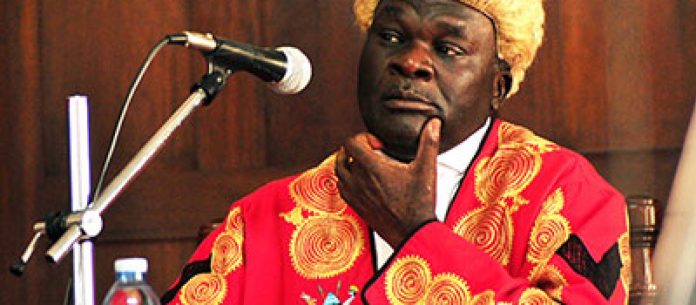
DCJ Alphonse Owiny Dollo

Constitutional Court has fixed April 4, 2018 as the date for hearing of petitions filed by concerned citizens challenging age limit bill that was last year signed into law by President Museveni few days after its endorsement in the August house.
Last year, six opposition legislators, Uganda Law Society, Male Mabirizi among other concerned citizens petitioned the Constitutional Court challenging Age Limit Act on grounds that the process of enacting the bill was marred with violence, assault of legislators, storming of Special Forces Command (SFC) in parliamentary chambers and violations of human rights which among others contradicts with parliamentary rules and procedures.
In a conference that aimed at paving way for a joint hearing and how the case will be handled, Deputy Chief Justice Owiny Dollo told petitioners that the hearing of the case will start on April 4, 2017 in Mbale High Court.
According to Justice Dollo, judiciary has the jurisdiction to handle any matter in any court in Uganda.
“It is just a mere change of location but jurisdiction remains the same, petitioners should sacrifice and travel to Mbale for hearing of the case.” He said.
He added“Court observed that petitioner’s issues cuts across therefore petitioners should constitute themselves as a team and present their case for hearing to start.”
Upon Dollo advice, litigants complained about the convenience of the place saying that Mbale is too far adding that MPs who include the Opposition Chief Whip Semujju Nganda, Leader of Opposition in Parliament, Winnie Kiiza, have a lot of work to handle in Kampala.
However Justice Dollo assured petitioners that nobody is going to arm twist judiciary , vowing to determine case basing on merits, “Don’t worry you will get references on the case via social media. ”He added.

Stories Continues after ad

Obote II Minister Kham Karegyesa dead

Former Assistant Minister for Animal Industry in the Milton Obote II regime Karegyesa Karekaho (Kham) has died aged 94.

Recently, Karekaho was airlifted by chopper from his Rukungiri home and brought to International Hospital Kampala (IHK) for treatment. He was later taken back home.

Until his death Karegyesa was among the few surviving former ministers of Milton Obote’s 1980s cabinet.

“He was a very nice man; a man who was faithful to the party (UPC) and he was a nationalist who brought unity in Kigezi,” his cabinet colleague Dr. James Rwanyarare said, when contacted.

Details of the burial will be communicated, a family source said.

Stories Continues after ad
Xi Jinping warns any attempt to split China is ‘doomed to fail’

Xi Jinping

Chinese President Xi Jinping has delivered a fervently nationalistic closing speech to parliament, painting China as the rising global power.
Mr Xi said “achieving total unity” was the “collective hope of all Chinese people” and any attempts to divide it were “doomed to fail”.
The speech was a strong warning against any attempt at separatism from places like Taiwan and Hong Kong.
Mr Xi also warned China could not be complacent about its development.
Meanwhile, Premier Li Keqiang used his once-a-year news conference to say China was committed to global co-operation on trade.
He said China would further open up its economy and “ensure that both domestic and foreign firms” were “able to compete on fair terms in China’s large market”. Chinese officials have made similar pledges in the past.
The premier’s comments are a marked contrast to the recent protectionist rhetoric and threats of tariffs from the Trump administration in the US.
‘Punished by history’
Xi Jinping became president in 2013 and now looks likely to lead China indefinitely, after the National People’s Congress (NPC) – a rubber-stamp parliamentary session that meets once a year – voted to remove a two-term limit on the presidency from the constitution.
He is now considered the most powerful Chinese leader since Mao Zedong, the founder of modern China, and has further cemented his position by moving many of his key allies in to leadership roles during the NPC.
In his speech in the Great Hall of the People, Mr Xi highlighted major achievements of Chinese history, like the invention of gunpowder and the writings of Confucius.
He laid out his own grand vision for China, saying history had proven that “only socialism can save China”.
Chinese people, he said, “have the spirit of fighting the bloody battle against our enemies to the bitter end”.
Who is left to challenge Xi?
By Stephen McDonell, BBC News, Beijing
In a way it wasn’t so much what Xi Jinping said in his Congress closing speech that matters but the fact that he said it. This had traditionally been a day for China’s number two leader, the premier, to dominate the stage with an annual press conference.
Not any more: President Xi emerges with a keynote speech pushing nationalist buttons and, all of a sudden, he is on the front page where he wants to be.
The pushing of Premier Li Keqiang to one side will not seem strange to China watchers, who have seen an already powerful Xi Jinping becoming virtually untouchable at this Congress.
The limited check-and-balance provision of presidential term limits has gone; his philosophy under his own name is in the country’s constitution; his chief tool for destroying enemies – the anti-corruption crackdown – has been widened into other parts of society and it’s hard to see who is left to be able to challenge President Xi in any way whatsoever.
Pointing at China’s global ambitions, he said his country would be strong but not aggressive and would not develop itself at the expense of the rest of the world.
But he warned that China had to be united to prosper, and it was “absolutely impossible to separate any inch of our great country’s territory from China”.
“All acts and tricks to separate the country are doomed to fail and will be condemned by the people and punished by history.”
The comments were a clear warning to places like Taiwan, which is self-ruling but considered by Beijing to be a a rebel region that must be reunited with the mainland – by force if necessary.
The issue remains a major potential flashpoint. Last week US President Donald Trump angered Beijing by signing a new law which encourages the sending of top officials to Taiwan to meet their counterparts there, and vice-versa.
When asked about Mr Xi’s speech, Taiwanese foreign ministry spokesman said he hoped “countries of similar ideology”, such as the US, Japan and the EU, would support Taiwan’s role in maintaining regional peace.
There have also been vocal calls for greater autonomy or even independence for Hong Kong in recent years – and China says it is fighting an Islamist separatist insurgency in Xinjiang province.

Dissenting voices or protests are not tolerated at the NPC, which brings together 3,000 delegates who are theoretically elected but in reality handpicked by the government.
Among other major changes this year, the NPC confirmed a major shake-up of ministries, introducing several new bodies overseeing areas like the environment, army veterans and culture.
Key positions including the central bank head and chief economic advisor were appointed, and the NPC ratified a law to set up a new powerful anti-corruption agency, far extending the reach of Mr Xi’s flagship campaign.
The anti-corruption drive has seen more than a million officials disciplined, but is seen by some observers as a tool to sideline his political rivals.
Though it was overwhelmingly backed by parliament, the decision to lift the presidential term limits has been criticised both abroad and within China.
In the run-up to the NPC, former state newspaper editor Li Datong wrote to lawmakers that scrapping term limits for the president and vice-president would sow the seeds of chaos.
“This is against the tide of civilisation and won’t stand the test of time,” he told BBC Chinese. “It will be considered a farce in Chinese history in the future.”

Stories Continues after ad

MPs order Auditor General to probe Crane Bank sale, Bagyenda

TO AUDIT BoU: Auditor General John Muwanga

Parliament has directed the Auditor General John Muwanga to conduct a comprehensive audit into Bank of Uganda’s contentious sale of Crane Bank with a particular interest into the role played by the former director of bank supervision Justine Bagyenda.

TO BE AUDITED: Outgoing Bank of Uganda Executive Director in charge of supervision, Justine Bagyenda.

AG Muwanga has 30 days to clear the air over why the central bank closed Crane Bank in October 2016 and why its shareholders and directors have not been explained the circumstances surrounding the bank’s closure.

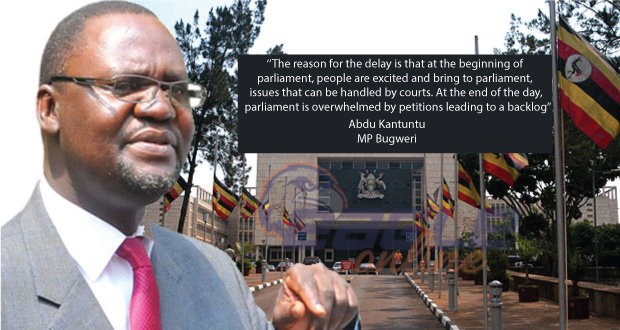
A photo montage of Bugweri County MP Abdu Katuntu and the Parliament

Abdu Katuntu, the Chairman of the Committee on Commissions, Statutory Authorities and State Enterprises (COSASE) confirmed this afternoon that his committee will handle the inquiry.

Bagyenda, the former head of supervision at BoU, will be probed for potential money laundering following leaks from Diamond Trust Bank and Barclays Bank, exposing bank accounts teeming with thousands of unexplained dollars.

Nathan Nandala Mafabi

Budadiri East MP Nandala Mafabi and one of the senior MPs on the Committee told journalists at Parliament on Monday that Bagyenda faces charges of flouting the Anti-Money laundering Act 2013, given her unexplained money running into thousands of dollars.

“We are going to carryout investigations and we are going to deal with those banks because they have been doing illegal things with Bagyenda. Actually those banks should be closed because they have been involved in money laundering,”Mr Mafabi said.

Recently, the Eagle Online broke investigative stories which revealed that Bagyenda had a bank balance of Shs19, 302, 441,183, details of three bank accounts which were seen.

At about the same time the Diamond Trust Bank (DTB) apologized to Ms. Bagyenda about the ‘leaking’ of confidential documents, subsequently suspending one of its staff. The BoU followed suit, also suspending one Shafiq Mpanga, an official in the supervision department.


Stories Continues after ad

World’s last male Northern White rhino dies in Kenya

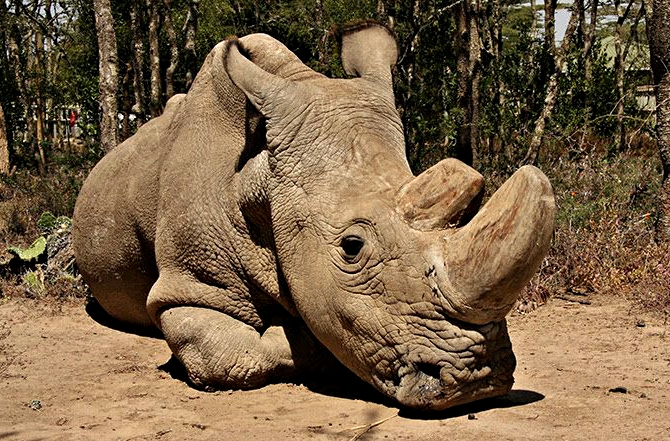
Kenya’s Ol Pejeta Conservancy has confirmed the death of the world’s only remaining male Northern White Rhino which died yesterday, leaving only two females of the doomed subspecies alive.

The Conservancy said in a statement that it decided to euthanize the 45-year-old rhino, named Sudan, due to untreatable and debilitating health problems.

‘The rhino suffered from health complications which affected his muscles and bones, resulting in extensive skin wounds’, part of the statement said.

According to the statement, the rhino’s health condition worsened significantly in the last 24 hours and was unable to stand up and was suffering a great deal.

The rhino (Sudan) is said to have refused to mate naturally with females, forcing conservationists to put it on the dating app Tinder, in a last-bid to raise US$ 9m for fertility treatment.


Stories Continues after ad

Ugandan men embracing circumcision – survey

A man undergoing clinical circumcision

The percentage of men who have been circumcised in Uganda has increased over the past 10 years, from 24 percent in 2006 to 46 percent in 2016, the Uganda Demographic and Health Survey 2016 indicates.

According to the survey carried out in 15 regions of Uganda with over 5300 men participate, most men who undergo circumcision opt for health professionals as opposed to traditional practitioners.

The survey indicates the percentage of men who are circumcised is highest in the age group 20-24 (50 percent) and lowest in 40-49 age group.  Yet young men are more likely to have been circumcised by a health professional than their old counterparts, with 27 percent aged 15-24 clinically circumcised (by a health professional) compared with 13 percent of men aged 40-49.

The survey further reveals that the proportion of men who are circumcised is highest in urban centres than in rural areas, but with men in Bugisu region at 83 percent, more than six times as likely to be circumcised as men in Acholi region at 12 percent.

The men who participated in the survey included Catholics, Anglicans, Seventh Day Adventists, Muslims, Pentecostal and others, with the Muslims showing the highest percentage of being circumcised, distantly followed by Pentecostals and Anglicans.

Globally, male circumcision has been associated with a lower risk of HIV transmission from infected women to men.


Stories Continues after ad