Stanbic Bank
Stanbic Bank
20.1 C
Kampala
Stanbic Bank
Stanbic Bank
Home Blog Page 1622

UMEME earmarks 12b to pay shareholders

Over 5000 shareholders of UMEME, Uganda’s electricity distributor, will receive Shs12 billion in dividends, according to its 2017 financial report to be released tomorrow.

According to the report, the company will pay a dividend of Shs7.6 per share, lower than Shs18.8 it paid in 2016.

The payment of the dividends await the approval of the annual general meeting to be held in May, and the proceeds expected to be paid in early July are subject to withholding tax, where applicable.

The money will go to shareholders in the books of the company at close of business on June 20, 2018.

The report says revenue earnings for the year increased by 8.7 percent to Shs1.5 trillion boosted by a 7.5 percent jump in units sold. Revenues from industrial customers increased by 13.2 percent.

Further, the report indicates gross profit increased by 8.3 percent during the year to Shs515.9b on account of improved distribution margins and continued reduction in energy losses which have come down to 16.9 percent, from the 17.7 percent recorded in first half of 2017.

The company attributes the reduction to, ‘heightened efforts to reduce commercial losses throughout our network through continuous metering installation audits, use of technology like smart metering for large consumers and community mobilization’.

But the company says delayed approval of some capital investments by the regulatory authority continues to negatively impact the gross margin.

UMEME reports that electricity sales grew by 7.5 percent during the period, compared to 4.4 percent in 2016.

“We registered a 8.0% growth in sales to industrial customers compared to 5.2% in 2016, underpinned by the improved performance of Uganda’s economy and improved external market conditions in the neighbouring countries,” says the report.

Demand by domestic customers grew by 6.9 percent compared to 2.6 percent in 2016, on account of improved supply reliability, reduction in energy losses and additional customer connections.

Customers increased by 18.3 percent during the year to over 1.1m, with an extra of over 170,000 grid connections compared to over 150,000 in 2016.

Customers on pre-paid metering (Yaka) increased to 75.3 percent of the total customer base compared to 65.0 percent at December 31, 2016.


Stories Continues after ad

EAC keen on promoting intra-regional trade-Official

EAC Director General, Customs and Trade, Mr. Kenneth Bagamuhunda.

The East African Community (EAC) is working overdrive to enhance market access to regional and international markets through a comprehensive export promotion strategy, a top regional customs official has said.
Kenneth Bagamuhunda, the EAC Director General for Customs and Trade, said the bloc is implementing programmes aimed at promoting and strengthening intra- and inter-regional trade, particularly the removal of non-tariff barriers (NTBs) which are an obstacle to trade.
He was speaking at the recently conclude three- day workshop convened by the TradeComII Programme at the EAC Headquarters in Arusha, Tanzania. It was attended by participants from member states.
He said that the EAC had prioritized growth in its exports through value addition and capacity building for exporters to enable them know about export requirements especially in the European Union (EU).
Bagamuhunda further said mechanisms for the dissemination of applicable trade requirements and trade statistics were in place. Other measures to promote trade, he said, include the harmonization of regional standards and the implementation of the EAC Export Promotion Strategy.
He said that while key strategies and policies aimed at boosting trade exist, the biggest challenge was how to implement them.
“The elimination of tariffs is not a problem. The biggest problem is removing non-tariff barriers which keep on changing and coming up in different forms,” he said.
On the recently signed African Continental Free Trade Area (CFTA), Mr. Bagamuhunda said now was the time to push for the full implementation of the Tripartite Free Trade Area (TFTA) bringing together EAC, COMESA and SADC.
“The TFTA is the stepping stone to the CFTA because what remains in TFTA is its implementation. The Tripartite constitutes more than 60% of the Africa’s GDP and over half of the continent’s population,” he said.
Speaking at the event, Mr. Fabio di Stefano, Head of the Infrastructure and Regional Integration Sectors at the European Union Delegation in Tanzania, said the EU’s engagements with EAC focus mainly on trade and economic growth in the region.
The official said that political goodwill from EAC leaders will be critical if the region was to become integrated economically; adding that reforms to national laws and policies would also be required for the full implementation of protocols and agreements made at the regional level.
He said some of the key drivers of regional integration in East Africa were peace and security, and infrastructure development.
The EAC Secretariat plans to develop appropriate strategies on export development and the elimination of non-tariff barriers inhibiting trade among Partner States and between Partner States and their trading partners.
The strategies address the main constraints relating to the legal, regulating and institutional requirements at both the regional and Member States levels. The efforts will help boost Partner States capacity to supply the European markets through a sound and sustainable export promotion strategy.

Stories Continues after ad
Constitutional Court set to start age limit hearing

DCJ Alphonse Owiny Dollo

Constitutional Court has appointed five Judges of Court of Appeal to start the hearing of petitions filed by concern Citizens against age limit bill that was passed into law days after endorsing it in Parliament.
The appointed Judges are Deputy Chief Justice Alfonse Owiny Dollo, Remmy Kasule, Kenneth Kakuru, Elizabeth Musoke and Chebrion Barishaki.
In a meeting with both the litigant’s lawyer Wandera Ogalo and Deputy Attorney General Mwesigwa Rukutana, Justice Dollo implore both parties to leave political issues and resort to addressing legal matters, “politics is not necessary, if it was then, you would not have come to courts of law” he added.
“Since court announced Mbale as the venue where the case will herd, I consulted Chief Justice Bart Katureebe on the matter including convenience as it was stated by litigants, he said in a nutshell that, ‘their argument is baseless, judiciary has the jurisdiction to handle any matter in any court in Uganda.’
According to Dollo, Court will be looking into three issues which include the expunging of age limit cap that had been set at 75 years, the extension of Legislators’ terms in office from five to seven years and the suspension of 2021 elections to 20123.The hearing of the matter is scheduled to start on April 9, 2018 in Mbale.
Last year, six opposition legislators led by Winnie Kiiza, Uganda Law Society, Male Mabirizi among other concerned citizens petitioned the Constitutional Court challenging Age Limit Act auguring that the process of enacting the bill was marred with violence, assault of legislators, storming of Special Forces Command (SFC) in Parliamentary chambers and violations of human rights which among others contradicts with Parliamentary rules and procedures.

Stories Continues after ad
Ugandan youth win World Bank essay competition

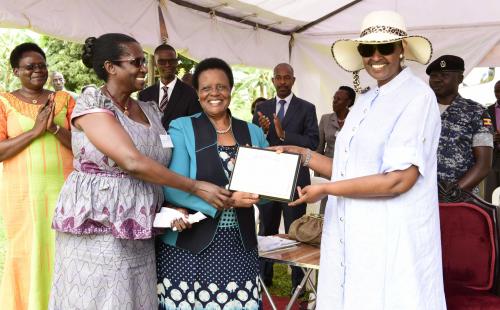
World Bank Country Manager Christina Malmberg Calvo, with the current and previous winners of the #Blog4Dev youth essay contest.

The World Bank yesterday announced the winners of its annual #Blog4Dev youth essay competition. The three winners are Tendo Namata, 26 years; Mary Helda Akongo, 24 years; and Douglas Dubois Semabala, 26 years.

The three were recognized at a gathering that brought together the finalists of past competitions since 2016. They will join the official Uganda country delegation to the 2018 Spring Meetings of the International Monetary Fund (IMF) and the World Bank Group taking place from April 13-22 in Washington DC, United States of America.

In addition to the all-expense paid trip to Washington DC, the three Ugandan winners will join winners from other African countries and engage in a number of activities, including meeting with senior government and World Bank officials to share their ideas and stories. Their essays are also posted on the World Bank Group blog site Nasikiliza, so they can share their ideas with young people in other parts of the world.

Now in its 3rd year, the #Blog4Dev series was initiated in 2016 to inspire youth to think creatively, innovatively and practically about solving some of the most pressing development challenges in Uganda. It aims to give youth a voice and harness their ideas to ensure they become part of the solutions.

Gender-based violence, the special theme of this year’s competition, poses a major development challenge in Uganda. Slightly more than half of girls and women in Uganda aged 15 to 29 have experienced physical violence since the age of 15, and 28 percent of women overall have experienced sexual violence in their lifetime.

“If Uganda takes strong action to end violence against women and girls now, US $2.4 billion will be saved every year by 2030. That is, there’s a big cost to inaction. The #Blog4Dev gives young people a chance to tell their stories so we can understand better the issues and take determined action,” said Christina Malmberg Calvo, World Bank Country Manager in Uganda.

Gender Based Violence (GBV) includes physical violence, rape and sexual assault, child and forced marriages, female genital mutilation, human trafficking, and the denial of resources and services. GBV knows no socio-economic or national boundaries and no country can afford it.

“Most interventions make the mistake of empowering select groups of girls more vulnerable to Sexual and Gender Based Violence but forget that if not duly helped, their communities will not be able to create a sustainable support structure to encourage their efforts towards both prevention and intervention. We realised that the villages possessed water committees that were very efficient when it came to cleaning and maintaining water resources, and could be used as platforms to sensitize communities against gender-based violence,” writes Tendo Namata in her winning blog. Embibo Gender-based Initiative, which Tendo runs in addition to her day-job, conducts outreach sensitizing school communities about gender-based violence in the Kamwenge area, in South Western Uganda.

Helda Mary Akongo, who works as an Operations and Programs Manager with Zimba Women, an organisation that uses technology to empower Ugandan women, further explained: “Encouraging victims to speak up, creating awareness, providing support for victims and educating them and the public about online and offline Gender-Based Violence is what it will take to end this vice. Technology can be used as an essential tool for combating this depravity, and it is precisely what I am setting out to do.”

In his blog, Douglas Dubois Sebamala makes a strong case for use of performance and creative arts to bring attention to gender-based violence, and help victims heal faster from their trauma. “Allowing creatives to share others’ stories through communal theatre pieces, anthologies, song or dance would have venting therapeutic resonance that can send information directly and return effective results faster than police threats of arrest,“saidSebamala, an actor on NTV’s Second Chance series who also works as a Public Relations Officers and Marketing Manager for Silent Voices Uganda.

The 2018 contest was open to Ugandan youth aged between 18 and 28 years and attracted more than 200 applicants. To participate, contestants submitted a 500-word essay on what it will take to end gender-based violence in Uganda. Essays were judged by the winners of the previous competition who included Stephen Katende and Fionah Komusana, finalists in 2016; and Mercy Melody Kayodi and Joseph Lule who took the top honours in 2017. A 5-member panel of judges comprising of World Bank staff interviewed the top five contestants and selected the final three.

Stories Continues after ad

UMEME to release financial report for 2017

UMEME CEO Celestino Babungi

Uganda’s electricity distributor, UMEME says it will release its financial report for 2017 tomorrow Thursday even as members of the board and management met President Yoweri Museveni yesterday to explain why the company still has 17 percent technical losses in its books of accounts.
UMEME already presented its interim financial statements for the six months period ended 30 June 2017 highlighting the operational and financial performance.
The interim showed UMEME had reduced distribution losses reduced to 17.5 per cent in the six months to 30 June 2017, down from the 19 per cent achieved during 2016. The report says company achieved the reduction through the sustained efforts. But Museveni says Ugandans are paying high electricity tariffs because of technical losses he says the planned US $500 investment in related infrastructure should have eliminated such losses by now.
The interim report says revenue collection rate for the period averaged 99.9 per cent, up from the 98.4 per cent performance at 31 December 2016. The very good collection rate was achieved through continued investment in automated meter reading for our large power users, pre-payment metering for domestic connections and various collection campaigns to recover outstanding bills.
Shs99.1 billion (US $ 27.5million) was invested in the distribution network during the period.
Revenue grew by 6.9 per cent year-on-year to Shs704.4 billion in six months of 2017, driven by 6.7 per cent increase in units sold (GWh) and price adjustments. Electricity sales growth has been high in large industrial and domestic household consumers.
The interim report Gross Profit increased marginally at 2.6 per cent as cost of sales increased by 9.0 per cent influenced by a 9.6 per cent year-on-year increase in power purchase costs. Units purchased increased by 4.5 per cent to GWh 1,630.70. The gross profit was significantly affected by the capital investments excluded from the tariffs at the start of the year.
Dividends The Directors did not recommend the payment of an interim dividend to shareholders as it made after tax loss of Sh47.5 billion for the first six months ended in June 2017. Shareholders (investors), numbering over 5000, are waiting to see if they will get dividends when the full report is read.
Umeme is operating a 20-year Concession to distribute and supply electricity, until 1st March 2025 and confirms that it has seven (7) years left under the existing Concession.

Stories Continues after ad

Kampala voted East Africa’s best city to live in

An arial view of Kampala city.

Kampala is the best city to live in East Africa, according to the latest global survey of capitals offering quality life.
The New York-based consultancy Mercer, in its 2018 quality of living survey, ranks Uganda’s capital at position 172 out of 231 cities, having improved by one position to cement its score as the region’s best city to stay.
To rank the cities, the survey examined the levels of traffic congestion, quality of public transport, electricity supply and banking services.
Other indicators include crime levels, education, political stability, housing, food availability and entertainment.
Kenya’s Nairobi came in second at position 186 while Rwanda’s Kigali came in third at position190, having improved two positions, while Tanzania’s Dar es Salaam stagnated at position 199.
The ranking offers a preview of a country’s level of development and the city’s ability to attract and retain investors, expatriates and tourists.
It also guides multinationals in their assessment of the pay for their staff in different countries in which they have operations.
“Factors such as climate, disease and sanitation standards, ease of communications, and physical remoteness can often affect the success of a foreign assignment,” says the report.
Moreover, the local political and social environment, political violence, and crime may give rise to potentially uncomfortable, inconvenient, or even dangerous situations. To encourage mobility, reliable information is needed to help calculate fair, consistent expatriate compensation for hardship locations, says the report.
Kampala which is run by Kampala City Capital Authority (KCCA) headed by executive director Jennifer Musisi has in the past few years witnessed the expansion of roads to cut traffic jams, garbage collection as well as installation of streetlights and widening of sewerage channels.
Port Louis of Mauritius emerged Africa’s best city to live in after being ranked at position 83 globally followed by South Africa’s Durban and Cape Town.
Globally, Vienna emerged top for nine years in a row, followed by Zurich while the bottom is Baghdad in Iraq.
KCCA’s mission is to offer quality services to city dwellers. An independent survey released by the World Bank in December last year reveled that about 90 percent of Kampala residents are satisfied with KCCA’S improved roads, signalized junctions, street lights and walkways.

Stories Continues after ad

Sort out thieves at BoU Museveni tells Mutebile

President Museveni and Governor Mutebile at an earlier event.

President Yoweri Museveni has ordered Bank of Uganda Governor, Emmanuel Tumusiime Mutebile to ‘sort’ out ‘thieves’ at Bank of Uganda.
Museveni who met the Inspector General of Government and a team from BoU on Monday at State House after cabinet lectured the two sides to sort out bickering that could easily hurt the economy but also warned of thieves at BoU.
A tough talking Museveni told me Mutebile that BoU had performed well but the emerging reports that individuals at the central bank had amused wealth were disturbing and such individuals should be fished out.
According to sources at the said meeting, Museveni who seem to have equipped himself well with the current literature on the central bank argued that corruption at the bank could easily manipulate staff not to perform their duties as they are compromised by the sector the supervise.
“What is coming out of the bank isn’t good and that is an area where IGG should get involved by arresting those that are corrupt. Mutebile you should put your ears on ground and sort out these thieves. Otherwise I will come for them myself you don’t” Museveni said while looking directly in the face of Deputy Governor Louis Kasekende.
This website has learnt that at the said meeting, Mutebile tabled board minutes of the last board that gave him powers to restructure staff at the bank. It ought to be to be known that Mutebile is both governor and chairman of the board.

Eagle Online couldn’t verify whether the president’s call to Mutebile to sort out thieves was triggered by the revelation by leaked bank account details that revealed that former Executive Director in charge of Supervision at BoU, Justine Bagyenda had huge sums of money in several banks accounts. Bagyenda is now being investigated by Financial Intelligence Authority, Inspectorate of Government and Uganda Revenue Authority for allegations of money laundering and tax evasion from income on her properties.
According to sources, the president is said to have told the IGG pay attention to areas of investigation if there is any and not to be drawn in individual conflicts by personal interests between government officials.
The meeting which was known by few individuals was first denied to having taken place by the Minister of Information and Communication Frank Tumwebaze when he told a government daily that wasn’t true that the meeting was taking place. The paper had written earlier on its online version that Museveni was meeting the two sides.
Museveni’s meeting comes at the time when the IGG and Governor Mutebile are locked in exchange over whether IGG has powers to investigate Mutebile.
Recently, the IGG faced with the conundrum as to whether the Bank of Uganda Governor acted within his powers to make administrative changes at the Central Bank, one of which involved the retirement of Justine Bagyenda, the erstwhile Director of Bank Supervision. Ms. Bagyenda has since sought the protection of the IGG, who in turn has reportedly blocked the changes made by Mutebile.
‘This is to direct the Board of Directors of BoU not to ratify any actions or decisions taken by the Governor on or around February 7, 2018 in relation to the impugned appointments and transfers until such time as the investigation by the Inspectorate has been concluded or until this office directs otherwise’, the IGG’s March 12 letter states in part.
But in his five-page strongly-worded letter which he copied to among others President Yoweri Museveni, Speaker Rebecca Kadaga and Prime Minister Dr. Ruhakana Rugunda and finance minister Matia Kasaija,. Mutebile draws the attention of the IGG to Article 162 (2) of the Constitution that guarantees the independence of the BoU from direction of any authority in the country. Others copied in include the Attorney General, the Auditor General and members of the BoU Board of Directors. ‘In performing its functions, the Bank of Uganda shall conform to this Constitution but shall not be subject to the direction or control of any person or authority,’ the Article states in part.
Mutebile adds: ‘The Article in question is clear, unequivocal and unambigious on the Independence of the Bank of Uganda and the fact that Bank of Uganda is not subject to the direction or control of any person or authority and therefore no outsider, including your office can interfere with the decisions of the Bank of Uganda’.
Writing in his column in the Daily Monitor, seasoned lawyer, Peter Mulira says the powers given to the Inspectorate and to the IGG are not executive powers and they are limited to enabling powers to carry out the functions set out in Article 225.
“These powers are reserved for the Director of Public Prosecutions under Article 120 of the Constitution and can only be exercised by him following police investigations. In short the Inspectorate’s power to prosecute any person is qualified by Article 120.”
He added “If the Governor of the Bank of Uganda were to succumb to the directives of the Inspectorate, he would be in breach of this provision of the Constitution.”

Stories Continues after ad

‘CHOGM businesswomen’ mark 11 years

The British High Commissioner Peter West CMG with the women

Members of the dfcu Women in Business programme have marked over a decade since its launch in Uganda during the 2007 Commonwealth Heads of Government Meeting (CHOGM) held in Kampala.

To mark this momentous day and ahead of the 2018 CHOGM that will be held in London in April, the British High Commissioner Peter West CMG hosted a reception at his residence to celebrate the achievements registered, using the opportunity to also recognise five exceptional women who are part of the dfcu Women in Business programme.

“I welcome this opportunity to congratulate and recognise talented Ugandan Women in Business. The initiative for celebrating women in business was launched during the Commonwealth Heads of Government Meeting in Uganda in 2007 by dfcu Bank.

Next month the UK will host CHOGM in London under the theme ‘Towards  a  Common  Future,” High Commissioner West said, adding that trade  and  gender  equality  are  among  the  priorities  that  the Commonwealth Heads of State will discuss.

The Women in Business programme, which was started by dfcu Bank and enjoys a mentorship partnership from the Cherie Blair Foundation, founded by former British Prime Minister Tony Blair’s wife Cherie, now boasts of over 35,000 members.

Of these 23,000 have been trained in running a business and financial management, with a key focus on increasing the women’s access to financial services and credit facilities.

Although women make over 50% of Uganda’s population, a huge percentage of this number do not have adequate access to finance but the Women in Business programme is addressing this inequality.

This lack of access is attributed to low financial literacy, such as, keeping adequate profit and loss accounts, writing business plans and articulating projections -all are key skills in accessing bank credit.

Of the over 35,000-member pool, 4,000 are, thanks to the programme now credit-ready, and have received business loans from dfcu Bank to boost their businesses.

Meanwhile, earlier in 2012, the Women in Business program constituted a five all-female Women in Business Advisory Council, which has a wide scope of expertise to support the bank in gender focused strategy formulation as well as build the capacity and develop the business skills for the women to enable them to continuously make informed business decisions as a primary goal.

According to Rosemary Mutyabule, a member of the dfcu Bank Women in Business Advisory Council, dfcu understands the difficulty women face with limited working capital, lack of collateral to secure loans, limited market information, networks and so much more.

“Financial literacy, which is a core element of the programme, plays a major role in ensuring that women who make up a higher percentage of the population have the requisite knowledge, skills and confidence to make informed choices as far as financial management is concerned and more importantly take advantage of the financial services available.

“When women are more financially literate, they are more productive and are able to make a significant contribution to the economy,” she adds.

A further milestone that was achieved since the Women in Business campaign was launched in 2007, was the opening of the Women in Business Advisory Center in 2015.

This is a one-stop-shop for critical business services like financial and business-to-business advisory services.

The dfcu Women in Business program has signed a Memorandum of Understanding with the Uganda Law Society, Institute of Certified Public Accountants as well as Makerere University School of Business to further train their members on crucial business matters of law of contracts, accounting best practices and best business management practices.


Stories Continues after ad

UCC revokes 22 FM radio licenses over ‘witchcraft’ advertising

UCC ED Godfrey Mutabazi regulates communications sector

The Uganda Communications Commission (UCC) has Tuesday suspended the license of Nation Media Group (NMG) affiliate Dembe FM and 22 other radio stations for promoting and advertising witchcraft content and, aiding and abetting electronic fraud.

In a statement UCC boss Godfrey Mutabazi said the other stations whose licenses have been suspended include Metro FM; Nile FM; Kagadi Broadcasting Services; Emambya FM; Village Club FM; Radio Kitara and Packwach FM. Others are: Tropical FM, Apex FM, Bamboo FM, Ssebo FM, Eastern Voice FM, EyeFM, Victoria FM, RFM, Kiira FM, Tiger FM, Greater African Radio, Dana FM, Gold FM, Hits FM and Radio 5.

Of the closed stations, two belonged to veteran radio presenter DJ Nesta, who previously worked at Endigyito FM, one of the biggest radio stations in Western Uganda, before relocating to UBC Radio where he briefly worked before moving to Fort Portal to set up Gold FM.

His other station, Hits FM, was based in Kamwenge.


Stories Continues after ad

Kadaga blames African leaders for worsening refugee crisis

The Speaker while at the 138th Inter-Parliamentary Union Assembly in Geneva

The Speaker Rebecca Kadaga has criticized African leaders for the rising number of African refugees to Europe and North America, who make dangerous crossings through the Mediterranean, while fleeing harsh economic conditions and conflicts in their countries.

In the recent past, up to 13 million Africans have endured the deadly journey through the Mediterranean and other dangerous routes to Europe, with many living under constant threat of arrest and deportation.

“Today, many of our countries are independent, yet the violation of human rights, insecurity, exclusion from social and economic opportunities, conflict, injustice and corruption have caused the involuntary migration of millions, to a life of uncertainty, torture, slavery and incarceration in squalid conditions and in detention camps in Europe,” said Kadaga.

The Speaker was presenting at the 138th Inter-Parliamentary Union Assembly in Geneva under the theme ‘Strengthening the Global Regions for migrants and refugees; the need for evidence based policy solutions’.

Kadaga hailed Uganda’s refugee policy, but said the United Nations High Commission for Refugees (UNHCR) should extend infrastructure and environmental support to the country.

“Our hosting of refugees has come at a cost in terms of the destruction of the environment. The refugees do not come with firewood from their countries; they have destroyed our environment.  It is important the UNHCR puts in place re-afforestation programs for the host countries,” said Speaker Kadaga.

Uganda has been hailed as an ideal refugee hosting country, a credential boosted by the Refugee Summit held in June 2017.

In presence of international dignitaries including the Secretary General of the United Nations Antonio Guterres, the country raised over $350 million.

Experts blame the growing number of mainly African immigrants to Europe on harsh political environments, unemployment and the ever growing population.

East African Legislative Assembly Speaker Martin Ngoga said Parliaments should address income inequality, which he said is a main cause of ‘refugeeism’.

“It is imperative for Parliaments to ensure that the Member States and regional blocs re-affirm commitments to the observance of peace and security, and address inequalities and parity to resource allocation,” said Ngoga.

The conference comes at a time when rightist anti-immigration parties are having growing political influence in Europe and the Americas.


Stories Continues after ad