Stanbic Bank
Stanbic Bank
19.9 C
Kampala
Stanbic Bank
Stanbic Bank
Home Blog Page 1630

Ugandans dominate RUFORUM Post-Doctoral Fellowships

Eight Ugandans have benefitted from the Regional Universities Forum for Capacity Building in Agriculture (RUFORUM), to attend a two-year post-doctoral programme dubbed ‘Wajao’, funded by Carnegie Corporation of New York.

The eight Ugandans are Sarah Akello, Anthony Egeru, Hellen Biruma Kongai, James Sekandi, Jane Yatuha, Richard Sebuliba Mutumba, Deboarah Alio and Gabriel Karubanga.

The call for the fellowships attracted 34 applicants from nine African countries among whom the RUFORUM Technical Committee selected 19 recipients during their meeting convened on February 22, 2018 at the RUFORUM Secretariat.

The 19 fellowships were awarded based on, among other criteria, the nature of the proposed fellowship, a clear deployment and mentorship plan, as well as a demonstrated plan to support research and mentorship of graduate students.

Since 2009, RUFORUM, a consortium of 85 universities in 35 African countries with support from the Carnegie Corporation and other agencies has contributed to the training of 436 PhD graduates, 97% of whom upon completion of their studies return to their home countries and integrate back into teaching and research.

The two year post-doctoral fellowships help to scale up RUFORUM’s commitment to strengthening postgraduate training and academic mobility in Africa, including retention.


Stories Continues after ad

400 women entrepreneurs to benefit from dfcu financial training

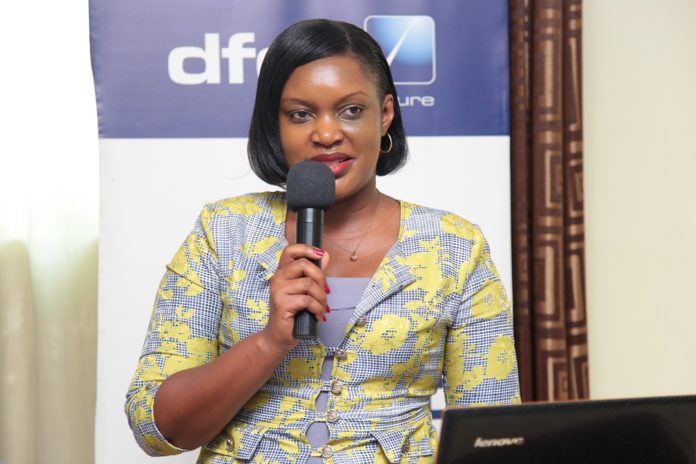
As part of the celebrations to mark the women’s month of March, dfcu Bank has organised a series of financial literacy sessions across the country to inspire and empower women to tackle the challenges they face in business.

In pushing for progress among women entrepreneurs, dfcu Bank established the Women in Business program (dfcuWiB) in 2007 to support Ugandan women entrepreneurs achieve their full potential. The program was motivated by a number of factors including the fact that despite women being over 50% of the population of Uganda, this was not proportionate to the ratio of women who are banked.

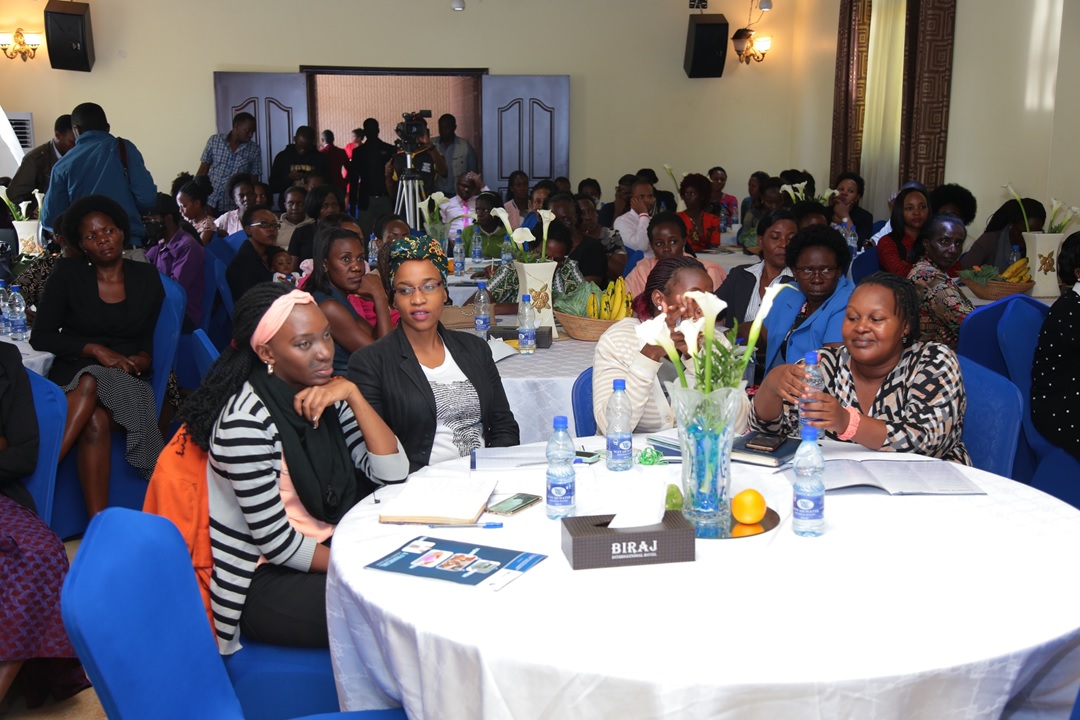
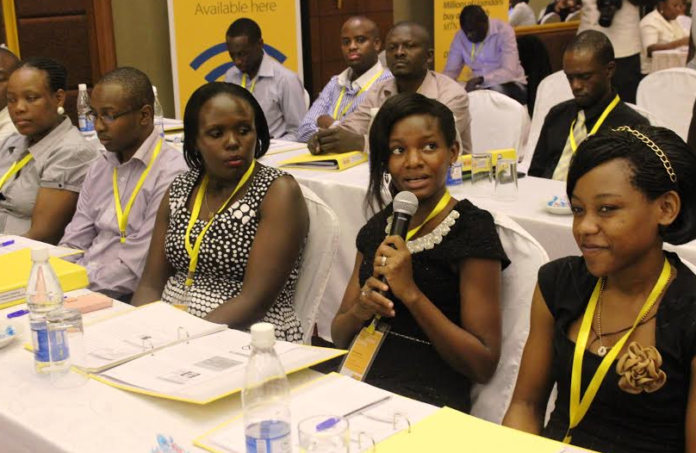
Some of the participants that turned up for the dfcu Bank financial literacy training sessions at Biraj Hotel.

Meanwhile, over 400 women engaged in trade and agribusiness are set to benefit from these sessions to be held in Kampala, Mbale, Gulu and Mbarara, and the dfcu WiB Manager Victoria Byenkya says overall 30,000 women have so far registered for the programme.

“We have seen a significant uptake of the program with over 30,000 members currently registered – testament to the hunger and desire for growth. In order to address the knowledge & skills gap we run capacity-building sessions throughout the year and currently have over 20,000 women that have benefited from this,” Ms. Byenkya says.

And, speaking during the first session at the Biraj Hotel in Nakasero down town Kampala, dfcu Bank’s Head of Consumer Banking, Denis Kibuukamusoke said gender imbalances in accessing credit are a major concern to women.

“The majority of women tend to have low financial literacy levels and therefore have challenges documenting their business, articulating their plans and projections, which are key in assessing bank credit. Since inception of the Women in Business program over 4,000 women have benefited from the dfcu WiB loans but this number could be a lot better,” Mr. Kibuukamusoke noted.

“For dfcu Bank, helping women to overcome financial barriers while supporting them in their quest for growth is not just a business proposition; it is in fact an obligation,” he added.

In 2012, dfcu Bank established the Women Business Advisory Services to press for women’s economic empowerment while increasing their financial literacy as well as creating business linkages for them. Through these advisory services at the dfcu WiB Centre, regular customized workshops are undertaken in fields such as; financial advisory, business to business linkage advisory, marketing and branding, legal advisory and human resource advisory.

To make this possible, dfcu Bank collaborated with Makerere University Business School (MUBS), Uganda Law Society (ULS) and the Institute of Certified Public Accountants of Uganda (ICPAU) to offer business and financial advisory services to thousands of women, especially those engaged in productive economic activity at no cost.


Stories Continues after ad

UK agency to invest billions in Africa’s infrastructure

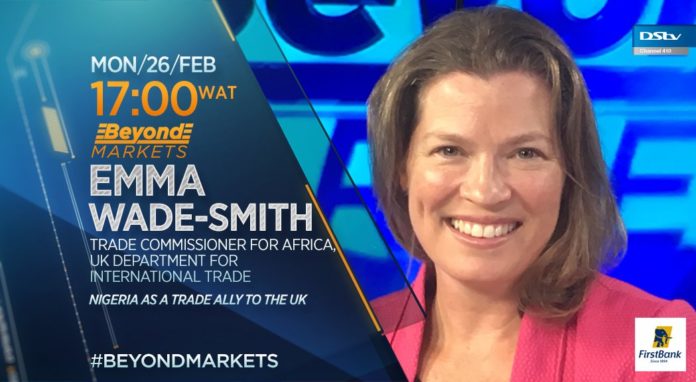
Emma Wade-Smith

The United Kingdom’s Department for International Trade (DIT) has pledged billions of Pounds Sterling in lending and guarantees to African countries to help them tackle a chronic infrastructure backlog.

In Africa DIT is currently tracking numerous active infrastructure projects across the continent which it believes could benefit from UKEF funding.

One such project that has already benefitted is Uganda’s Kabaale International Airport which, when completed, will be the East African nation’s second-largest airport, thanks to the £215m loan it received from UKEF in December 2017, the largest-ever facility granted to an African country by the export credit agency.

“Africa’s infrastructure challenges not only inhibit its ability to trade with the rest of the world but are also a significant obstacle to intra-African trade, both of which are critical to the continent’s economic growth agenda,” said Emma Wade-Smith, the UK’s Trade Commissioner for Africa.

He added: “Finance is a critical component of infrastructure development and the combined risk appetite of £21.4bn we have across the region to facilitate projects is a clear sign of the UK’s belief in Africa’s long-term economic growth trajectory.”

DIT in Africa has a presence in 21 countries across the continent, can enable the provision of these facilities through UK Export Finance (UKEF), the United Kingdom’s export credit agency, a part of DIT.

Loans can be extended in the local currencies of 9 African countries for projects ranging from transportation, mining and general construction, though they must include at least 20% UK content and meet all other lending criteria.

For example, UKEF has the ability to support infrastructure projects in South Africa (up to £4bn), Kenya (up to £1bn) and Nigeria (up to £750m).

“Of course, projects must still meet all the lending requirements before we’re able to disburse any funding. But in terms of capacity, we have the ability to provide significant funding for infrastructure projects across Africa,” Wade-Smith added.

Although Africa is the second-fastest urbanizing region in the world behind Asia, but the continent still struggles from a chronic lack of basic infrastructure.

Data compiled by the Washington DC-based Brookings Institution show that 319 million people across Sub-Saharan Africa have no access to reliable drinking water; 620 million have no access to electricity; while only 34% of the continent’s people have adequate road access.

“There is enormous scope for Africa to boost its exports to the UK and indeed other parts of the world if it can address its infrastructure backlog,” says Wade-Smith.

“The research shows that in the long-term trade is better than aid and without adequate infrastructure it will be very difficult for Africa to boost its ability to buy and sell with the rest of the world,” she added.

DIT in Africa has been instrumental in establishing the Africa Infrastructure Board, which brings together UKEF, the Department for International Development (DfID) as well as UK infrastructure and mining companies that are already active in Africa.

Its ambition is for UK government and industry to work together to identify major infrastructure projects across Africa that can benefit from the UK’s extensive expertise in the fields of finance, engineering and governance, as well as health and safety.

“UKEF’s risk appetite for Africa has more than doubled in the last few years in line with Africa’s improving economic and socio-political fundamentals,” said Wade-Smith.

“The continent is becoming increasingly democratic and economically stable, which is heartening as with infrastructure commitments one needs to be in it for the long haul,” she said.


Stories Continues after ad

Energy scarcity a constraint to development – PAP MPs

LR Hon. Mamadou Aliou Conde of Guinea, Hon. Okot Ogong and UN Environment Africa Rep. Juliette Biao.

Pan African Parliament legislators have singled out access to energy as one of the major barriers to the development of the continent’s industrial and agricultural sectors and urged the United Nations find solutions to the problem.

Legislators were concerned that the UN was making glitzy presentations but not doing much to address the problems affecting the continent.

While making a presentation to PAP’s Committee on Transport, Energy and Communications on Tuesday, March 6, 2018, Dr. Juliette Biao Koudenoukpo, the Regional Representative, UN Environment in Africa, had to put aside her presentation to discuss the MPs concerns about the continent’s development.

Dr. Biao told the Committee that, with over 600 million people in Africa with no access to electricity and over 730 million people relying on traditional biomass (wood fuel and charcoal), it would take Africa until 2080 to achieve universal access to electricity.

“UN Environment, in collaboration with member states and its partners is undertaking energy projects in Africa with a view of addressing some of the challenges facing the continent,” she told MPs.

Giving an example of the Africa Geothermal Centre of Excellence which is being established in Kenya, she explained that Centre would create a critical mass of young scientists, engineers, drillers, technicians, among others to ensure secured and sustainable geothermal development in Africa.

Legislators however, were interested in the actual financial disbursements to address the problem of energy on the continent.

Hon. Okot Ogong (Uganda) inquired about the funds the UN was giving Africa. “Close to one billion people in Africa have no access to power. It is lack of funds that stops Africa from constructing energy generating plants.” he said adding that, “the UN should provide concessional loans for power. In Uganda we wanted to construct hydro and solar plants but we had to borrow billions of dollars from China.”

Okot Ogong expressed dissatisfaction with what he termed lengthy and complicated procedures for accessing money for the Green Energy Fund.

“We are actually not begging because there is the Carbon Energy Fund which should come to Africa but it isn’t. When are they going to pay Africa for the damage the developed economies have done to the environment,” he asked.

He further noted that while Africa contributes less than four per cent to the global greenhouse gas emissions, the continent is the most vulnerable to the effects of climate change. He said the pledge by industrialised countries to help poorer nations reduce greenhouse gas emissions and address the effects of climate change was still a mirage.

Hon. Ousmane Koure Jackou (Niger) observed that besides having an abundance of mineral wealth, the continent was not benefiting from its rich resources.

“We are the biggest producers of many raw materials but these are not benefiting us. Do we really have the political will so that we have energy in our countries?” he asked.

Hon. Nassou Katou (Togo) inquired about what had happened with the project of “electrifying Africa” where developed economies had pledged to light up the continent.

“The South is in darkness while the North is fully lit. I do not know what has happened to the project.”

In 2013, President Obama launched Power Africa, a partnership among the United States, African governments, bilateral and multilateral development partners, and the private sector to improve access to electricity in sub-Saharan Africa, but according to the MPs, not much has been done.

In her response to the concerns from the MPs, Dr. Juliette Biao Koudenoukpo, said that the right to health, food and education is the responsibility of governments and not the UN. She explained that what was needed was leadership by governments and states getting their priorities right.

“There is money in countries but it’s a matter of setting priorities. Whom did Morocco ask for money for renewable energy projects? If governments do not practice leadership, no one will. The private sector will never contribute to a corrupt government,” she said.

UN Environment, is a lead organisation that coordinates environmental matters within the UN system. Previously known as the United Nations Environment Programme (UNEP), it focuses on thematic areas such: climate change, disasters and conflict, environmental governance, harmful substances and hazardous waste among others.

Stories Continues after ad

Umeme cautions public on safety

With heavy rains pouring across the country, Umeme Limited, the power distributor, is cautioning the public to be vigilant against fallen poles and sagging lines.
Mr. Stephen Ilungole, Umeme, head of Public Affairs encourages the public to report illegal connections and power thefts through the utility’s various free communication channels.
“I want to appeal to the public to support us by reporting incidents of illegal connections that continue to claim innocent lives,” Ilungole said.
At least ten people die weekly due to electrocution in Uganda, according to the 2014 Uganda Police Force crime report.
Most of the cases are reportedly in Eastern Uganda and Kampala city, especially in the slums where there are high cases of illegal power connections.
In the city slums, residents connect power through usually buried bare cables. Most of these cables are exposed to water during the rainy season, causing injuries and in worst cases deaths.
In 2016, Umeme organized a campaign dubbed “Wuuyo,” which was aimed at creating awareness on the dangers of illegal power connections, thefts and vandalism.
Ilungole believes that by creating public awareness, will help prevent electricity related injuries and fatalities to the public.
“The key objective for us is to create awareness for safe use of electricity and to alert the public on what to do in the event of an electrical accident,” he said.
He asked the public to be vigilant by reporting all illegal connections, unsafe network conditions or broken poles and conductors through the utility’s various free communication channels.

Stories Continues after ad
Uganda, Turkey discuss labour export

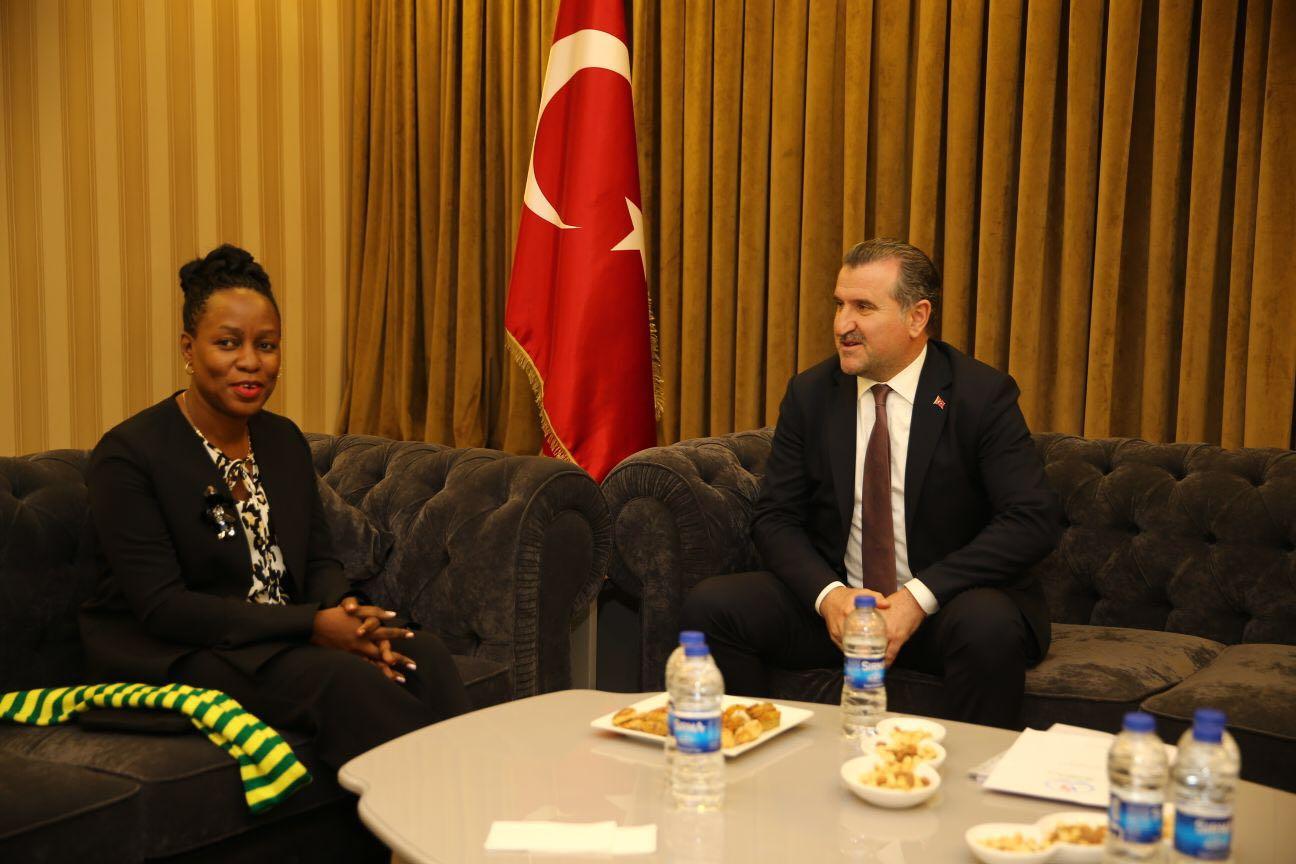
The Minister of State for Youth and Children Florence Nakiwala Kiyingi cuts the ribbon at the World Islamic Forum

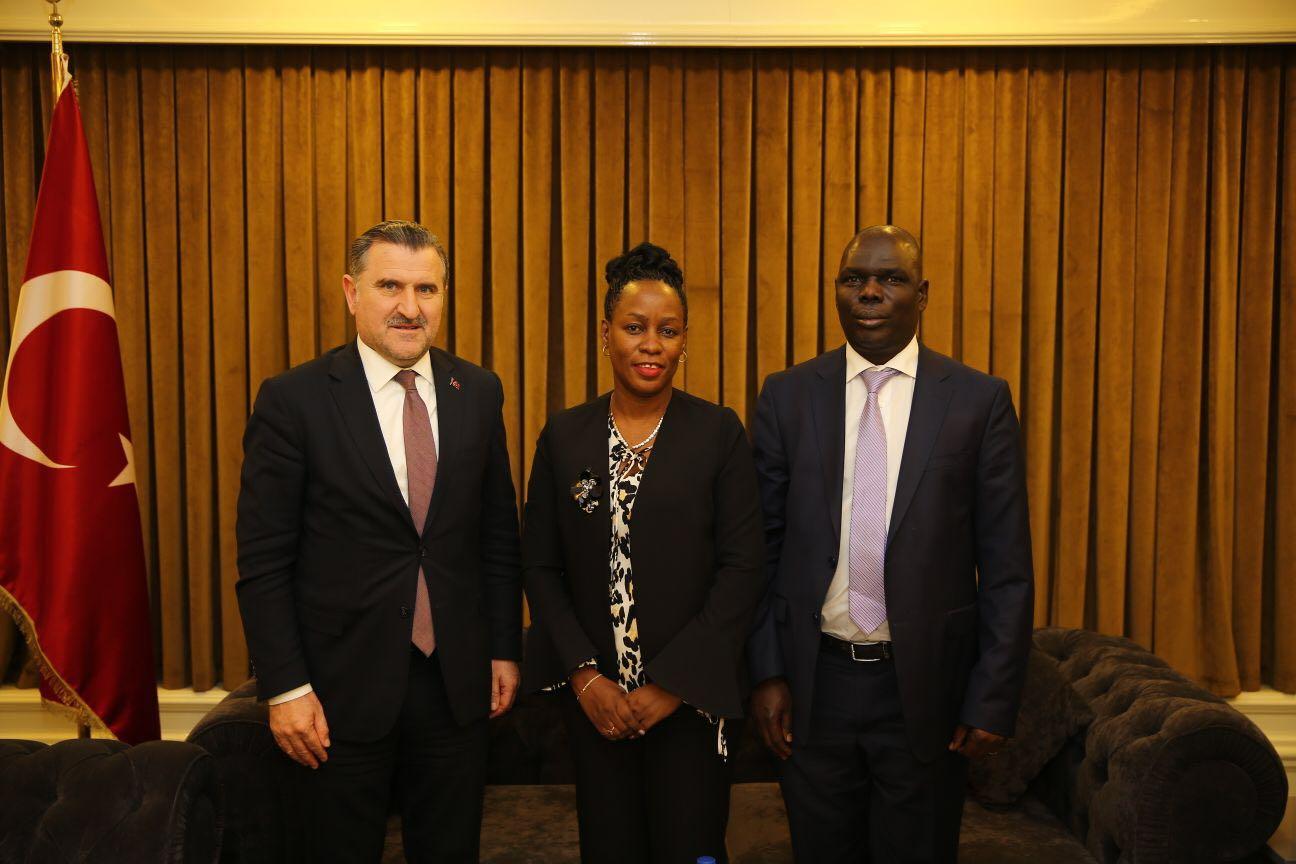
The Minister of State for Youth and Children Affairs Florence Nakiwala Kiyingi and her Turkish counterpart Osman Askin Bak have held talks on labour export and youth exchange programmes.

Hon Nakiwala in meeting with Turkey Minister of Youth and Sports

Ms. Kiyingi and Askin Bak were meeting on the sidelines of the 8th World Islamic Forum which was held from March 1-3 in Istanbul, Turkey, where the Ugandan minister, who was the chief guest, said that education and spiritual morals contribute to the development of the youth, shaping them into useful members in the communities.

Hon Nakiwala -C- with Ambassador Mubiru -R and Turkish Minister of Youth and Sports – L

Accompanying the Minister was Uganda’s Ambassador to Turkey Stephen Mubiru, and Ms. Nasikye Tolofaina, Second Secretary at the Embassy.

‘The World Islamic Forum (WIF) is a global organization that strategically contributes to the deepening of the common agenda and soci-economic integration by bringing together representatives of the Organization of Islamic Cooperation (OIC) Member States and thinkers in the World of Islam, who live all over the world, in the framework of multi-dimensional themes,’ a release indicates.

With the cooperation of Organisation of Islamic Conference (OIC), the summits organized annually are held under different themes in different cities. The first one was in 2010 held in Istanbul with successive summits held in Islamabad, Khartoum, Malaysia, Cairo, Baghdad. The next youth summit will be held in Baku, Azerbaijan on April 17-19, 2018.


Stories Continues after ad
Amb. Madhvani presents credentials to renewable energy agency

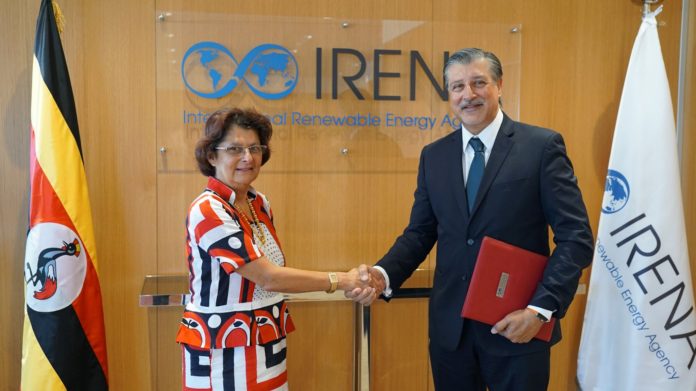
Ambassador Nimisha Madhvani, presenting her credentials to IRENA Director General Adnan Z. Amin

Uganda’s Ambassador to the United Arab Emirates Nimisha Madhvani has been appointed as the country’s Permanent Representative to the Abu Dhabi-based International Renewable Energy Agency (IRENA).

According to a release by the Ministry of Foreign Affairs, Ambassador Nimisha Madhvani, accompanied by Daniel Sekabembe, the Second Secretary, presented her credentials to IRENA Director General Adnan Z. Amin at a brief ceremony held at the IRENA headquarters in eco-friendly Masdar City, Abu Dhabi.

She expressed readiness to work with the Director-General and his team to consolidate the good relations between Uganda and IRENA, and invited him to visit the East African country called the ‘Pearl of Africa’.

The Director-General expressed his appreciation for Uganda’s ongoing efforts at realizing its potential in clean renewable energy deployment in areas like rural electrification, enabling policy and legislative frameworks being put in place and renewed his commitment to continued IRENA support.

The Ambassador informed that Uganda is striving towards clean and renewable energy which is manifested in the setting up of alternate energy projects in biomass, Wind, thermal energy as well as Uranium enrichment for peaceful purposes. Uganda wishes further to develop solar energy to keep prices down and affordable to all and for industrialization as well.

IRENA is an inter-governmental Organisation that supports countries in their transition to a sustainable energy future and serves as the principal platform for international cooperation. It was founded in Bonn, Germany, in January 2009, and promotes the widespread adoption and sustainable use of all forms of renewable energy in the pursuit of sustainable development.

The African Clean Energy Corridor, which includes Uganda, is one of the major achievements of IRENA thus far.


Stories Continues after ad
Stanbic Uganda Cup: SC Villa qualify for round of 16

SC Villa players (in blue) playing against Proline. Both teams have qualified for the Round of 16

The 2015 Uganda Cup winners SC Villa booked a place in the last 16 of the Stanbic Uganda Cup after defeating Bright Stars 2-0 in a game played at Mutesa II Stadium, Wankulukuku on Tuesday evening.

George Ssenkaba opened the scoring for the Jogoos six minutes into the first half before Godfrey Lwesibawa stretched the lead seven minutes later, in a game that saw Bright Stars FC midfielder Moses Okot sent off after being shown a red card in second half.

The Jogoos have played Bright Stars on three occasions this season, winning two games (1-0 in the League in Masaka and yesterday’s victory) and a 1-1 draw in the league over the weekend in Mwerere, Kawempe.

SC Villa and KCCA have won the Uganda Cup nine times, while URA is on three trophies. Express FC is the record winner of the Uganda Cup at 10.

The dates for the round of 16 draw will be confirmed by the FUFA communications department.

The Uganda Cup was first held in 1971. KCCA are the current holders.

This year’s Stanbic Uganda Cup final will be played during the last weekend of June in Kumi district, with the winners representing Uganda in the CAF Confederation Cup.

The other teams that are already in the round of 16 are: SC Vipers, Soana, KCCA FC, UPDF, Kitara, Kansai Plascon, Mbarara City, Seeta United, BUL, Ndejje University, Busula SC, Kiira United, KJT FC, Synergy and Proline FC.

Stories Continues after ad

UDB readies Shs6b fund to boost innovative SMEs

Participants at an SME training organised by MTN

Small and Medium Enterprises (SMEs) in Uganda have been given another boost to grow bigger with the new Shs6b equity and venture fund facilitated by the Uganda Development Bank (UDB).

The UDB board chairman, Samuel Sejjaaka, said in Kampala that the bank is ready to avail mid-term credit and expertise to organized SMEs in the country.

Ssejjaaka said this during the ceremony to award millions of cash to the best enterprising projects in agriculture and manufacturing.

“We are putting forward Shs6b out of our capital and we will invest in equity viable projects,” he said, adding that the bank would also invest Shs1 billion in venture capital to help firms grow their businesses and create jobs.

Speaking at the same event in Kampala, Prof. William Bazeeyo, the Chief of Party at Resilient Africa Network, urged government to avail interest free loans to key SMEs dealing in agricultural value addition. Bazeeyo argued that interest free loans could help innovative firms to break even, adding that “some emerging economies across the world have piloted such incentives”.

A recent I-Growth Accelerator Survey 2017 shows that Uganda’s import bill is high because of the limited innovations and inclusive technologies that have failed to make manufacturing equipment and machinery.

However, the State Minister for Finance in charge of General Duties Dr Gabriel Ajedra speaking of the local SMEs said there was need to protect them from outside competitors if they were to grow into large scale production enterprises.

“Ministry of Finance will impose higher taxes on imports where we have products available on the local market,” he said, adding that the cost of acquiring raw materials in Uganda was expensive compared to Kenya and Tanzania. He said the next national budget would come with provisions to give local manufacturers a competitive edge over foreign ones.

Government last year introduced the Buy Uganda Build Uganda (BUBU) Policy, aimed at encouraging Ugandans to buy goods produced within the country instead of spending on imported items. Government believes the policy will help develop the local industries as well as help create jobs.

In Uganda Small Enterprises employ between 5 and 49 and have total assets between Shs10 million but not exceeding Shs100 million.


Stories Continues after ad
URA to prosecute invoice-defaulting traders

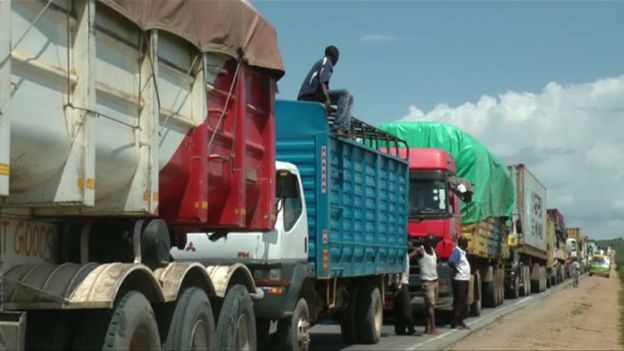
Trucks carrying goods

The Uganda Revenue Authority (URA) Commissioner General Doris Akol, has urged the business community to use receipts or invoices in their transactions, saying that those who fail to adhere to the guideline will be punished or prosecuted in courts of law.

“Any person who fails to issue a receipt/invoice that meets the minimum set standard may face penalties…or prosecution as provided for under the law,” Akol warns the public.

She says that goods transported on road without proper documentation (receipt, invoice and import documents) will be considered not to have paid taxes and will be seized, ‘in accordance with Section 35 of the Tax Procedure Code 2014’.

According to Akol, a receipt/ invoice is a document issued by a seller to a buyer as evidence of a business transaction. “Generally, a proper receipt/invoice should be duplicate, with original kept with the buyer and the duplicate copy by the seller,” she says.

In a public notice released Tuesday, Akol reminds the business community and the general public that Section 15 (1) of the Tax Procedure Code (TPC) requires every taxpayer to maintain records for a period of five years to enable his/her liability to be readily ascertained.

However, according to Akol, Section 22(2) (m) as amended, prohibits deductions on expenditure above Shs5m in one single transaction on goods and services from a supplier who does not have a Taxpayer Identification Number (TIN).

She says a proper receipt has nine features that include; words ‘receipt’ or ‘invoice’, name, address  and TIN of seller, business name and address of recipient, serial number of the invoice, the volume of goods or services supplied, the selling price per unit and total value among others.

The Commissioner General highlights some of the benefits of issuance of receipts/invoices as fair competition, reduced cost of compliance, better services, improved planning, control and decision making for taxpayers and access to business opportunities.

Analysts say URA’s warning on receipts/invoices is one way of ensuring that taxpayers meet their obligations instead of trying to evade taxes. In the financial year 2017/18 URA is expected to collect taxes worth over Shs15 trillion and so far officials at the Authority say just about 40 percent has been collected, almost three months to the end of the financial year.


Stories Continues after ad