Stanbic Bank
Stanbic Bank
17.8 C
Kampala
Stanbic Bank
Stanbic Bank
Home Blog Page 1635

Easter gift: Fortebet’s punter stakes Shs8k wins Shs37.6m

What a way to enter this long Easter holiday with a none-loan Shs37 million. Just like many other winners, cash from Fortebet continued to flow to another customer (punter) after staking only 8000/= and winning a whopping Shs37, 689,340.

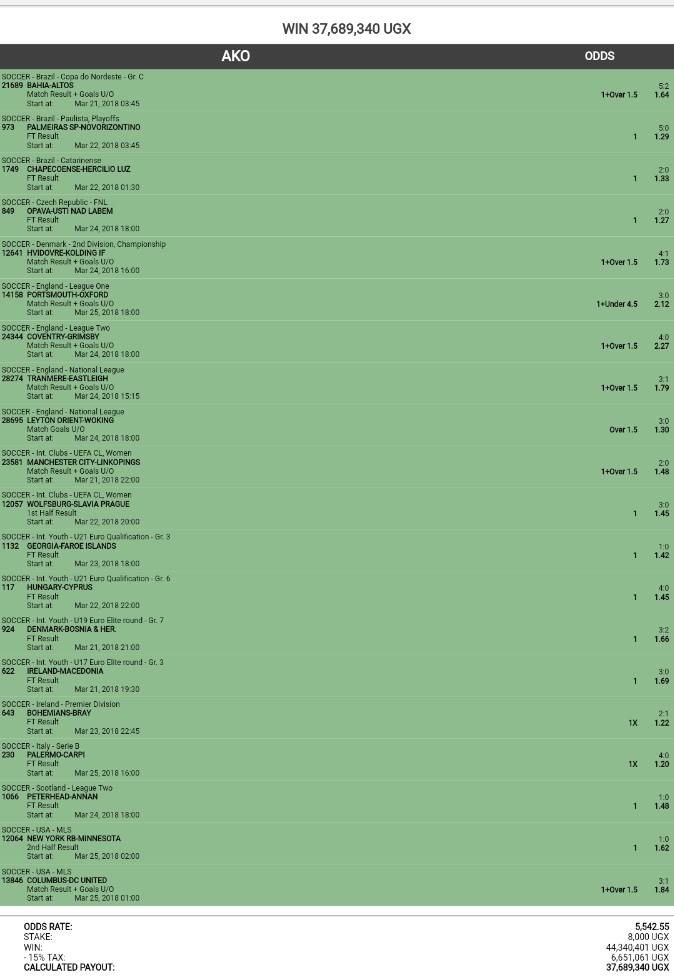
Most interestingly, this lucky punter selected 20 games and they all won. His winning trick was only one-selecting as many home wins as possible. Below is how he selected the winning games;
On his betting slip, he selected a total of 10 games, confident that the home teams would win.
These matches included; Palmeras SP-Novorizontino and Chapecoense-Hercilio Luz (from Brasil), Opova-Usit Nad Labem (from Zchec Republic), Wolfsburg-Slavia Prague (UEFA women’s Champions League). Under the same category, he also matches from under 21 Euro qualifiers and these included; Georgia-Faroe Islands, Hungary Cyprus, Denmark-Bosinia & Her and Ireland-Macedonia.
To make his 10 games under this category, he too selected these matches; Peterhead-Annan from Scotland league 2 and New York RB-Minesota from USA MLS. All the above home teams won their games.
He now needed more 10 teams to make his betting ticket complete. He therefore went ahead to select home wins plus atleast 2 match goals. These matches included; Bahia-Altos (from Brasil), Hvidovre-Kolding IF (Denmark second division), Portsmouth-Oxford (English League 1), Coventry-Grimsby (English League 2), Tranmere-Eastleigh (English National Luague), Manchester City-Linkopings (Women Champions League) and Columbus-DC United from USA MLS.

He too selected 2 more teams and predicted that they would either win at home or afford a draw as the worst. These included; Bohemans-Gray (Ireland Premier Division) and Perlamo-Carpi (Italian Serie B). Leyton Orient-Working from English National League is the other match the punter saw will earn him money. He predicted that the match would end with atleast 2 goals and indeed it ended 3-0. This betting slip carried a total odd of 5,542.55, generating the above money.

As soon as he won, his money was instantly paid out to him as Fortebet usually does
https://www.fortebet.ug

Stories Continues after ad

Ugandan diplomat urges Chinese to invest in Uganda

Uganda’s Ambassador to China, Dr. Chrispus Kiyonga, has wooed Chinese enterprises to invest in Uganda, saying the country offers huge investment opportunities, which come with a conducive business environment.

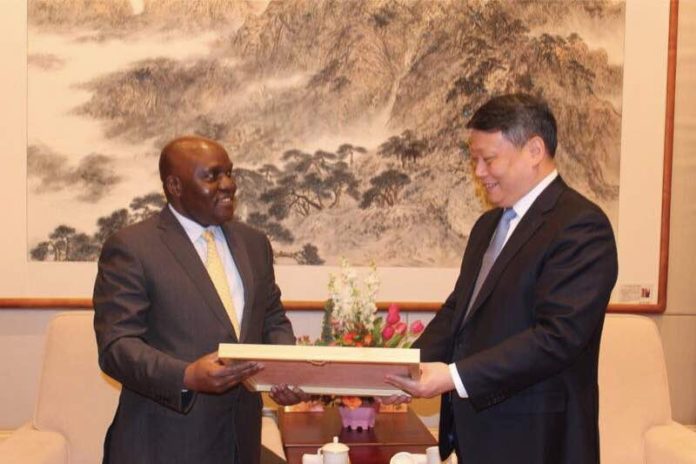
Ambassador Kiyonga made the call while meeting the Governor of the People’s Government of Liaoning Province, Tang Yijun. The two officials discussed the progress in developing the China-Uganda Liao Shen Industrial Park in Kapeka and other potential areas of cooperation. The Vice Governor Chen Lvping and senior officials of the provincial government also attended the meeting held on March 29, 2018 in Shenyang city.

Dr. Kiyonga briefed the Chinese on the progress of the industrial park in Kapeka. He said the Ugandan government is committed to providing investment incentives for leading enterprises from China.

Liao Shen industrial park is the first provincial-level industrial park project in Uganda with the backing of a Provincial government in China. Kiyonga appreciated the provincial government for supporting the development of the Park, adding that this would significantly contribute to creating employment opportunities, technology transfer, and expand the revenue base among others.

Governor Tang Yijun committed to strengthening of the relations between Uganda and the Province and said that joint efforts will bring about the success of the Liao Shen Park and provide a platform for future cooperation. The two officials also discussed and agreed further cooperation in other sectors such as agriculture, tourism, education, and mining. The mechanisms for cooperation will be further discussed at technical level.

During the visit to Shenyang, Kiyonga also addressed an investment promotion conference to raise awareness about the business environment and investment incentives in Uganda. He observed that the Liao Shen industrial Park symbolizes the friendship between the peoples of Uganda and China. The investment promotion event held at Friendship Hotel on March 30, 2018 was graced by the presence of senior level Provincial authorities that lauded the government of Uganda for the commitment and facilitation in the development of the Park.

Huang Yang, Vice Director General of the Liaoning Provincial Department of Commerce mentioned that 20 companies had committed to invest in the Park with three enterprises in advanced stages of entering production. He urged enterprises from Liaoning to accelerate the construction of the Liao Shen industrial park as well as participate in the infrastructural development and industrialization of Uganda.

Zhang Hao, Chairman of Zhang Group that is overseeing the development of the Industrial park briefed participants on the design capacity of the park, the progress of construction, the operation and management mode and the advantages of investing in the Park. Zhao Yali, former Ambassador of China to Uganda, also addressed the conference and emphasized the potential for bilateral cooperation between Uganda and China in the commercial and economic sectors.

The Conference in Shenyang co-organised by the Embassy, the Liaoning Provincial authorities and the management of Liao Shen Industrial Park is a continuation of efforts to boost Chinese investments in Uganda. Over 200 representatives from leading enterprises attended the event. The conference follows a similar event organized in Wenzhou, Zhejiang Province on 26th March 2018.

Stories Continues after ad

VP Ssekandi woos Mumbai investors

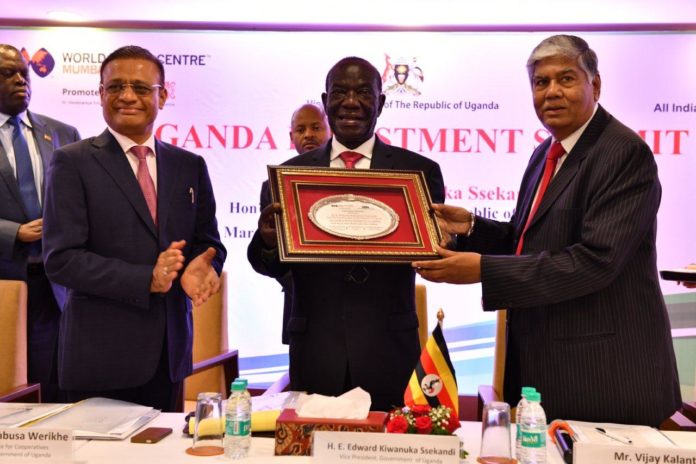
VP Edward Sekandi and Indian delegation.

The Vice President, Edward Kiwanuka Ssekandi, currently on commercial diplomacy trip in India, has assured the Indian investors of government of Uganda commitment in providing a conducive environment for business, which he said was one of the countries top priorities.

He said that Uganda is already becoming a prime investment destination in Africa due to a predictable business environment, liberalized economy, market accessibility and security for investment, first arrival privileges in tax exemptions and a stable political environment.

The Vice President who was yesterday speaking at the at the first Uganda-India investment conference at the World Trade Centre in the Arabian sea coastal city of Mumbai assured Indian business executives of the government’s resolve in ensuring a stable, safe and conducive environment for business.

Ssekandi said that, whereas Uganda’s population has about 40 million people with a growing middle- class, investment in the county avails opportunities for access to the East African Community market of up to 140 million people and the COMESA market of 400 million people adding that with the just signed free trade area, Africa was now an area where to make money.

He said the conference that Uganda was now more inclined to commercial diplomacy because doing business with the rest of the world was a more logical and mutually beneficial than waiting for overseas assistance a path he said through which Uganda will generate more true fiends with whom they will trade on more balanced terms.

He noted that Government was prioritizing investment, trade and tourism as important areas of focus saying Uganda now is the principle hub of business consultations, knowledge dissemination and business interaction in the great lakes region of Africa and that the Indians known for their investment resilience would find Uganda a great place to do business.

Ssekandi said that the trade between India and Uganda was less than 600 million dollars saying Uganda aims at accelerating trade and investment between the two countries to generate more collaboration to double the trade in the next year and raise it to 2,000 million dollars the next three years.

Speaking at the same function, Minister of State for Trade, Ministry of Trade, Industry and Co-operatives, Michael Werikhe said Uganda has a competitive advantage in agro-processing, fisheries, minerals and Uganda has also found itself in the world map for its rich crude oil reserves and refinery capacity.

He also said that farmers in Uganda produce crops 3 times in a year as the country is gifted with tropical and temperate climate zones and also because 90 per ecnt of land is arable saying with investment in advanced farming technologies one can produce four times a year.

Speaking about the ease of doing business in Uganda, State Minister for Agriculture, Joy Kabatsi told the Mumbai businessmen and women that investors can register a business in Uganda in 2-3 days saying that Government has launched one-stop-centre for all procedures such as work permit, environment assessment, tax compliance.

Uganda High commissioner to India Grace Akello said the Conference was a landmark event in the history of India-Uganda relationship which she said dates back to 120 years and called for renew of relationship by exploring new frontiers for collaboration, especially with city of Mumbai which is India’s commercial bedrock.

Exim Bank MD David Rasquinha confirmed his bank willingness to support Uganda projects saying, Uganda is a gateway to 150 million consumer market in East Africa. The economy of Uganda is growing 60 per cent faster than other African countries and urged Indians to explore opportunities in the food processing sector.

He said the Government of Uganda has already seeking funding from EXIM Bank for development projects such as Uhuru Hydro Power Project US $270 million, US $141 million for electricity lines and substations project, US $ 64 million dairy project, US $ 100 million Kampala industrial and business park project, among others.

All India Association of Industries, Chairman, World Trade Centre Mumbai Vijay Kalantri, called for the need to encourage SMEs to explore business in Uganda saying India has a vast and vibrant MSME sector covering a wide range of activities and that given Uganda’s rich natural resources, there was opportunity that the co-operation could be explored with great advantage.

The conference also addressed by Uganda’s Honorary Consul in Mumbai Madhusudan Agrawal, was attended by over 3000 participants including consular corps, Government officials, representatives of trade and industry, financial institutions, education institutions and members and civil society.

All India Association of Industries, Chairman, World Trade Centre Mumbai Vijay Kalantri, called for the need to encourage SMEs to explore business in Uganda, saying India has a vast and vibrant MSME sector covering a wide range of activities and that given Uganda’s rich natural resources, there was opportunity that the co-operation could be explored with great advantage.

The conference also addressed by Uganda’s Honorary Consul in Mumbai Madhusudan Agrawal, was attended by over 3000 participants including consular corps, Government officials, representatives of trade and industry, financial institutions, education institutions and members and civil society.

The two-day event co-sponsored by Ajanta Pharma, WAPCOS and Exim Bank and Uganda High Commission, also featured several business to business engagements and presentations on investment and tourism opportunities in Uganda and cultural programmes.

Stories Continues after ad

Tips for busy startup founders seeking more results

Martin Zwilling

By Martin Zwilling
If you define your self-worth as an entrepreneur by how busy you are, it’s time to find another lifestyle. We all know people who are extraordinarily busy, but never seem to accomplish anything. For survival, entrepreneurs need to be all about accomplishing results that matter for themselves, their team, and their customers. That’s productivity.
Why is this so hard? In an eye-opening Franklin Covey study, respondents indicated that 40 per cent of their time was being spent on things that were not important to them or their companies. That is a huge hit on productivity. For insight, I recommend the details provided in a classic book “The five Choices: The Path to Extraordinary Productivity,” by Kory Kogon, Adam Merrill, and Leena Rinne.
Although the authors focus has been on large organizations, I believe concepts are even more relevant to entrepreneurs and startups. Every entrepreneur should consciously follow these five key actions and implementation tips, to compete and survive, as well as to get the personal satisfaction they expect from the lifestyle:
Act on the important, don’t react to the urgent. Filter the vitally important business priorities from the urgent for the moment, but less important ones, and keep your focus on what matters most to your success as a startup. This will increase your return on the moment (ROM) in the midst of fierce distractions.
Go for extraordinary, don’t settle for ordinary. To change the world, as envisioned by your passion, you need to achieve extraordinary results on the important things. That means identifying the few most important roles you play in the startup right now, giving a framework for balance, motivation, and fulfillment.
Schedule the big rocks, don’t sort gravel. You can never achieve major milestones by just sorting through the gravel faster. Decide what is most important and get those activities in the bucket before the week begins. Spend at least thirty minutes each week planning your schedule to execute with excellence on those important things.
Rule your technology, don’t let it rule you. Turn technology into a productivity engine, rather than a burden, to battle the avalanche of email, texts, and social-media alerts that threaten your productivity. Put order into the chaos by using technology to place all incoming information into four categories: appointments, tasks, contacts, and documents.
Fuel your fire, don’t burn out. There are only two sources of energy: a clear and motivating purpose, and a healthy body. Manage the five primary energy drivers of moving, eating, sleeping, relaxing, and connecting to create a pattern of life that fuels your fire and keeps you from burning out before your startup achieves success.
In addition to following these choices personally and entrepreneur has to instill the same priorities and values into every member of the team, through leadership. Every business culture is built by the actions of its leaders, primarily through the startup process. Here are some ideas on how you can exercise leadership in creating a high productivity culture throughout the team:
• Regularly share your commitment to productivity with everyone.
• Practice productivity planning with your key team members.
• Create an environment where it is safe for people to make better decisions about where they are spending their time, attention, and energy.
• Break the assumption that everything you ask for is needed immediately.
• Provide and encourage the best use of technology to manage information overload.
• Reward highly productive efforts, just as you might reward good emergency responses.
• Encourage an aura of healthy energy and living versus anything for the cause.
Whether you are the entrepreneur leader or a team member, remember Pareto’s Law, which asserts that 80 per cent of all outputs result from 20 per cent of the inputs. It’s not the hours you work, but the work you put into those hours. Think seriously about which 20 percent of your tasks will produce more results than the other 80 per cent combined. That’s extraordinary productivity.

Stories Continues after ad

Agriculture ministry publishes list of certified coffee seed gardens

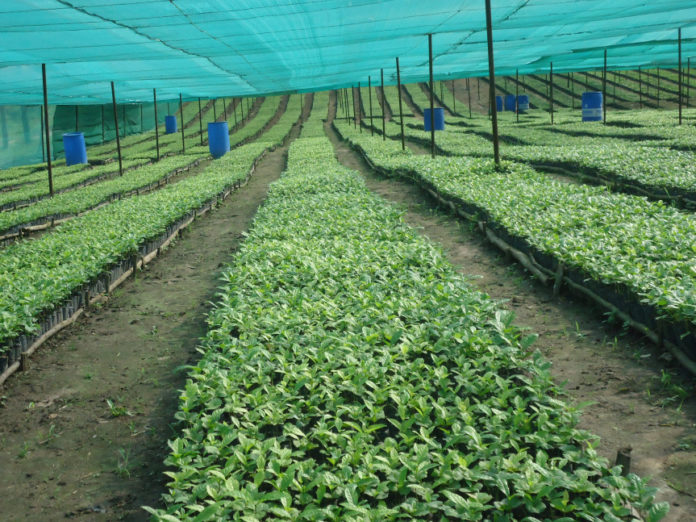
Kabango Coffee Germination Centre

The Ministry of Agriculture Animal Industry and Fisheries in partnership with the Uganda Coffee Development Authority (UCDA) and the National Coffee Research Institute (NaCORI) has released a list of certified coffee seed gardens in central, eastern, north western, south western and western Uganda, the sector Minister Vincent Ssempijja says in the latest press release.
According to the minister Ssempijja, the three agencies certified the coffee seed gardens after the re-assessment of the gardens. The selected gardens where those whose owners complied with the requisite requirements for seed production.
The analysis of the press release means those not certified will lose business and only the producers operating the certified gardens will supply elite seed to UCDA and private coffee nursery operators for purposes of propagating quality coffee planting material for farmers.
The minister in the press release says that private coffee nursery operators will be required to obtain the coffee seed purchase receipts from the authorized suppliers. “The seed purchase receipts will be required during the nursery certification process and seedlings availability assessments,” says the minister.
According to the press release 21 producers with a combined 195MT of coffee planting material were certified, with the least producers owning 1MT while the biggest-Kaweri Coffee Plantation in Mityana district owning 50MT.
Uganda grows both Arabica and Robusta coffee with the latter being produced in large quantities though it is exported at a lesser price per kilogram compared to the former.
UCDA in its February 2018 report says 131,329,908 coffee seedlings were planted in all the coffee growing regions of the country and that 208,020,003 seedlings are available for planting in the five coffee growing regions between March and May 2018.
That publication of the list of certified coffee seed producers comes as part of the implementation of the coffee roadmap in which the country targets to produce 20 million 60-kg bags per year by 2025.

Stories Continues after ad

Botswana’s president bids farewell to power

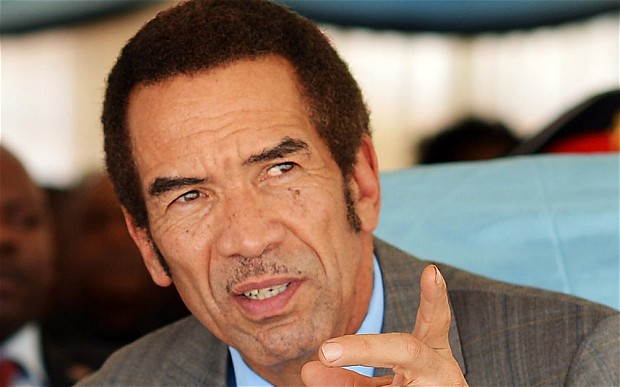
President Ian Khama

Botswana’s President Ian Khama, 65, has wrapped up a nationwide “farewell tour” as he prepares to step down on Saturday after a decade in power, AFP news agency reports.
Mr Khama’s decision is in sharp contrast to some other African leaders who have tried to change the constitution to extend their rule.
Mr Khama is stepping down 18 months before the next election is due, and will hand power to his deputy, President Mokgweetsi Masisi.
He has toured all of Botswana’s 57 constituencies since December, in a long goodbye to his supporters in a country which has a population of about 2.2 million.

Vice President and incoming president mokgweetsi masisi.

In his ancestral village on Tuesday, he rejected pleas from villagers to remain in office, saying he took office only because his predecessor, Festus Mogae, persuaded him to do so, AFP reports.
“I was a soldier, I didn’t have interest to join politics, I had future plans, away from politics,” he told the crowd of thousands.
He will be succeeded by Vice President Mokgweetsi Masisi, a full 18 months before elections.

Stories Continues after ad

Bar where Mowzey Radio sustained deadly injuries reopens

De-Bar

Entebbe hangout, De-Bar where fallen musician Moses Ssekibogo met his death has reopened.

The reopening of the bar followed negotiations between its owners and Entebbe municipal Council which closed it shortly after the musician’s death.

De Bar’s manager, George Egessa agreed to fulfill the conditions set by the council among which included apologising to the public.

RIP: Mozey Radio.

He called a press conference Friday and asked for forgiveness from Radio’s family and the entire music industry.

CCTV cameras were also installed within the bar and its premises.

He added that De Bar will always have a side memorial function in February to remember the life of the fallen singer Mowzey radio.

De Bar was closed by Entebbe Municipal Council early February shortly after Mowzey Radio’s death.

The reason for the closure was because De Bar is where the musician met injuries that led to his death.

He was beaten into coma at De Bar after an altercation with Egesa.

Ten days after the incident, Mowzey Radio passed on in the intensive care unit at Case Hospital in Kampala.

Stories Continues after ad

I forgave Museveni like Jesus forgave those who crucified him-Besigye

Dr. Kizza Besigye

Former presidential candidate, Dr. Kizza Besigye has encouraged believers to forgive each other just as Jesus did to all who wronged him saying whoever forgives shall inherit the Kingdom of God.
In his Easter message to Ugandans, Besigye said, Jesus was persecuted, humiliated just as Museveni’s government has for years been torturing him however, he has honestly been forgiving and leaving them to God as Jesus did.
“Some people advised us to take up arms against the military junta but I advised them that we can’t kill fellow Ugandans as the targeted people clinging onto power have capacity to flee this country leaving innocent people to die for what they were not part of. For years I have been in struggle, my focus has always been on how to revive this country from Kleptocracy that goes ahead to misappropriate funds for people seeking for asylum.” He said at his Katonga road office.
He noted that the Economy, security is dysfunctional, as they celebrate Easter festivals, he implored them to take a stand against oppression, extremisms, adding that God will reward them for struggle.
With grief Besigye said they always talk about dialogue, but it cannot workout in the country where others disrespect the rule of law, many have been mysteriously killed but instead of surrendering that they have failed in their duties instead they continue hoodwinking Ugandans that the situation is in control.
Besigye believes that Ugandans can disable the current regime the was sworn in 2016 without using any violent mean that degrades human rights instead will continue exerting pressure till they surrender this country to other ‘focused leaders’.
Besigye who has for years launched various campaigns against the current regime said Jesus died for all believers’ sins; they are too willing to sacrifice for the betterment of this nation.
Easter, also called Pascha (Greek, Latin) or Resurrection Sunday, is a festival and holiday celebrating the resurrection of Jesus from the dead, described in the New Testament as having occurred on the third day of his burial after his crucifixion by the Romans at Calvary.

Stories Continues after ad
URA collects more than planned revenue in February

The Performance of the Economy Report for February shows that the Uganda Revenue Authority (URA) collected taxes worth Shs1, 125.0b against a target of Shs1, 123.6b.

The more-than-targeted revenue was attributed to international trade which saw taxes collected rise above target by Shs42.7 billion (8.8 percent). “This overage in collections on international trade taxes more than offset shortfalls in domestic taxes,” says the report.

According to the report, indirect domestic taxes were short of their target for the month by Shs 41.2b as value added tax (VAT) especially on manufactured products, services and construction among other sub sectors came out low than expected.

On the other hand, direct domestic taxes for February also registered a shortage of Shs4.1b, most of which resulted from withholding tax and rental income tax items.

On a positive note, the report says, corporate tax and tax on bank interest registered surpluses, although these were more than offset by the shortages in the categories discussed above.

Meanwhile, non-tax revenues to government amounted to Shs35.9b against a target of Shs 25.5b. The report attributed the good performance to the improved efficiency in collections following the transfer of the responsibility to collect all nontax revenue on behalf of Government from MDAs to URA.

Govt spending

Total Government spending during February amounted to Shs1, 337.0b against Shs1, 413.7b, which translates to a performance of 94.6 percent or Shs76.7b.The report attributes the performance largely to development spending, which underperformed at only 61.7 percent against the projection for the month.

According g to the report, development spending totaled to Shs399.6b against a projection of Shs647.4b and was attributed to low execution of a number of projects.

Projection execution was affected by lengthy procurement process, which delayed the start of some road infrastructure projects; including Kigumba-Masindi-Hoima Road Project, Rwenkunye-Apac Road Project, and Muyembe–Nakapiripit Road Project.

Stories Continues after ad
FIFA appoints 36 referees for World Cup duty

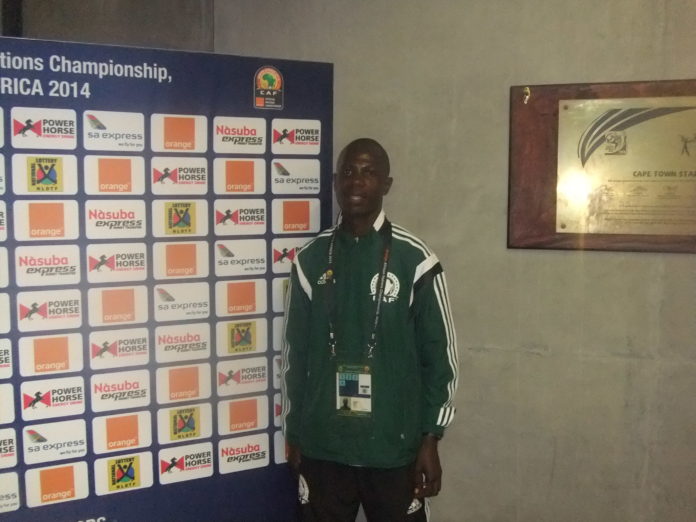
FAILED: Ugandan Referee Mark Sonko failed to make the FIFA World Cup 2018 cut

FIFA has named 36 referees from 46 different countries to officiate at the 2018 FIFA World Cup in Russia, with six of them coming from the African continent.

Ugandan FIFA referee Mark Ssonko was among the 17 officials CAF had shortlisted among those nominated to officiate at the 2018 World Cup in Russia but he failed to make the cut.

Range Marwa from Kenya, Burundi’s Jean Claude Birumushahu and Sudan’s Ahmed Wareed were selected as assistant referees from the East African region, for the World Cup in which England will be without a refereeing representative for the first time in 80 years.

Preparations for appointing the referees kicked off in September 2014 not only for the 32 participating teams. FIFA based on each referee’s skills and personality, as well as his level of understanding of football and ability to read both the game and the various tactics employed by teams.

Between now and the World Cup in June, the selected referees, assistant referees and Video Assistant Referees will be monitored and supported by FIFA Refereeing on an individual basis to ensure they are fully prepared.

The World Cup will take place in Russia between June 14th to July 15th. Africa will be represented by Nigeria, Egypt, Senegal, Morocco and Tunisia.

Meanwhile, Ali Tomusange remains the only Ugandan referee to officiate at the World Cup, having officiated four games at the 2002 World Cup in South Korea and Japan.

Before Tomusange, Keith Bukenya was the first Ugandan to be selected to officiate at the 1982 FIFA World Cup in Spain, but he died a few months to the opening ceremony.


The 2018 Referees: Gianluca Rocchi (Italy), Damir Skomina (Slovenia), Clément Turpin (France), Felix Brych (Germany), Çakır (Turkey), Sergei Karasev (Russia), Norbert Hauata (Tahiti), Matthew Conger (New Zealand), Enrique Cáceres (Paraguay), Andrés Cunha (Uruguay), Néstor Pitana (Argentina), Sandro Ricci (Brazil), Wilmar Roldán (Colombia), Julio Bascuñán (Chile), Mark Geiger (United States), Jair Marrufo (United States), Ricardo Montero (Costa Rica), John Pitti (Panama), César Arturo Ramos (Mexico), Joel Aguilar (El Salvador), Malang Diedhiou (Senegal), Bakary Gassama (Gambia), Gehad Grisha (Egypt), Janny Sikazwe (Zambia), Bamlak Tessema Weyesa (Ethiopia), Mehdi Abid Charef (Algeria), Alireza Faghani (Iran), Ravshan Irmatov (Uzbekistan), Mohammed Abdulla Hassan Mohamed (United Arab Emirates), Ryuji Sato (Japan), Nawaf Shukralla (Bahrain), Alireza Faghani (Iran), Ravshan Irmatov (Uzbekistan), Mohammed Abdulla Hassan Mohamed (United Arab Emirates), Ryuji Sato (Japan) and Fahad Al-Mirdasi (Saudi Arabia).

Stories Continues after ad