The Inspector General of Police Gen Kale Kayihura has refuted claims that the Director General of Internal Security Organisation, Col. Kaka Bagyenda recorded a statement with police over the death of Finnish and Sweden nationals who died in Ugandan hotels.
Last month Alex Nordlarndar Sebastien Andreas, a Swedish national and Terasvouri Tuomas Juha Petteri, a Finnish national respectively died in Sheraton and pearl of Africa Hotel after they alleged entered into the country on a forged Col. Bagyenda’s invitation letter.
In a press briefing held at police headquarters Naguru, Kayihura said Col Bagyenda has never recorded statement with police and he will never, ‘those are just rumors’
‘’Col. Kaka has replied our letter that was jotted seeking for clarification whether the reported letter that received the deceased is from his office, he said that was a forged document, with a forged signature.’’ Gen. Kayihura said.
According to results from government analytical laboratory presented by Dr. Moses Byaruhanga the Director Medical Services in police, Alex Nordlarndar Sebastien Andreas’ samples contained cocaine among other toxins and the unknown brown substance that was found in his mouth also contained Nacotics.
Terasvouri Tuomas Juha Petteri, a Finnish entrepreneur had drug toxicities in body as per the postmortem report.
Kayihura also noted that police has made some progress in investigations in the deaths of these foreigners and that the main mission is to establish whether it was intentional death or manslaughter or accidental.
Petteri and his colleague allegedly presented an invitation letter at the airport indicating that Col Bagyenda had invited him to the country. Sources say that Petteri owned a security company in Finland and perhaps intended to engage in similar business in Uganda, hence the need to engage with people charged with security.
Available information indicates that Sebastian, who was holding Swedish passport No 91056284, arrived in the country on February 5 and was booked into his room at 3 am. He was discovered dead that morning after his wife’s calls went unanswered and she alerted the hotel management who checked his room.
ISO boss not implicated in mysterious death of foreigners-Kayihura
Gov’t creates over 250 new town councils
Government has created new administrative units/local government units across the country upgrading some to town councils.
The latest increase in the number of administrative units means that there will be increasing spending as most of the new administrative structures come with new office bearers and expenditure.
However, the new structures come with a burden on the population in such areas as they have more tax encumbrances. They also uplift the standard of living for the population as services and infrastructures like roads, water and power are brought nearer the people
BELOW IS THE LIST
List of Newly Created Municipalities, Sub Counties and Town Councils_2018
Uganda should never close its door on refugees
By Natasha Mariam
Lately, the media has been awash with the stories about the corruption scandal in the Office of the Prime Minister (OPM) where some officials have already been suspended to ensure clean investigations into the matter. For several decades, Uganda has been generously hosting refugees and asylum seekers from a number of countries, including the Democratic Republic of Congo, Somalia, South Sudan, Rwanda, Eritrea and Burundi.
It is unfortunate for Uganda since its global reputation as a refugee friendly and welcoming country has been soiled by this scandal. Some of the allegations that have been made range from alleged mismanagement of food assistance, inflation of refugee numbers, refugees being required to pay bribe in order to get registered and allegations that scholarships meant for refugees are instead going to Ugandans. Investigations into the matter are ongoing and as part of the investigations, OPM and United Nations High Commissioner for Refugees (UNHCR) have already started the biometric re-enrollment system to certify the actual number of refugees and all those found guilty of the crimes will be apprehended and brought to justice. Therefore, Ugandans, the international community and refugees should be positive that the system will be cleaned.
According to the OPM records, by February 28, 2015, Uganda had 433,595 refugees, on 5th January 2016 (end of 2015) the number increased to 512,691, by 30th December 2016 the number was 982,716 and by 2nd January 2018 (end of 2017) total number is 1,395,146 and currently as by 8th February 2018, the total number is 1,411,794. The numbers might even be higher given the fact that Uganda is receiving approximately 3450 refugees from DR Congo fleeing the ethnic clashes. As per these records we see that Uganda has always been willing to welcome and accommodate refugees only that the sudden rise of the numbers of the refugees overwhelmed the country and therefore made it easy for hitches to be created in the system and it is for this reason that the OPM is re-registering the refugees to clarify on the actual number of refugees in the country.
The Uganda Refugee Policy, embodied in the 2006 Refugees Act and 2010 Refugees Regulations, has many impressive aspects which include the open door policy to all asylum seekers irrespective of their nationality or ethnic affiliation, granting refugees relative freedom of movement and the right to seek employment, providing prima facie asylum for refugees of certain nationalities, and giving a piece of land to each refugee family for their own exclusive (agricultural) use.
With the South Sudan conflict in 2017 which doubled the number of refugees from 500, 000 to over 1.2million refugees, overwhelmed Uganda.
Such a large number of refugees in a country like Uganda which is not better economically than the sending country can disrupt the delivery of essential services since we have to share our limited resources with these refugees. In most cases the host country may not have the right plan and resources to deal with such large numbers. It is for this reason that Uganda hosted the Solidarity Summit in order to raise resources that would assist us in the different refugee programs. Different countries pledged money and out of the $523million that was pledged $358.6 million (Ugshs 1.25trillion) has already been realized. The ongoing investigations should look at all those involved in the scandal right from the top to the bottom including the different implementing partners.
Despite the scandal, Uganda is still a peace loving country and it will not close its doors to refugees. Uganda’s history especially in reference to the times of Idd Amin is not one to be proud of as many Ugandans were refugees in different countries around the world. As the Prime Minister always says “Today it is them, tomorrow it could be anyone of us” this is one of the reasons Uganda will not stop receiving refugees. In addition some refugees have been able to contribute to the communities in which they are staying by starting up businesses which have employed both refugees and the members of the host community.
According to officials, Uganda is committed to zero tolerance to corruption, therefore everyone should be assured that the investigations will leave no stone unturned and all those involved will be seriously be dealt with and refugee operations in Uganda will move on well as they have always been doing.
The Writer is an intern at Uganda Media Centre
Shs700bn not for paying salaries – finance minister
Finance minister Matia Kasaija has refuted reports that government is planning to borrow over Shs700 billion shillings to pay public servants’ salaries.
Addressing reporters at the Uganda Media Centre, Mr. Kasaija clarified that he submitted a proposal to Parliament, seeking for authority from the House to borrow additional Shs736 billion from the domestic financial market to finance the budget for FY 2017/18, of which Shs48 billion will go towards meeting shortfalls in civil servants salaries and wages.
“This money ( is to) meet the financing obligations of on-going infrastructure projects whose certificates will fall due this financial year as well as other statutory obligations such as wages,” Mr. Kasaija said.
Further, according to the minister, the borrowing is to mitigate the revenue shortfalls recorded at Shs324 billion in VAT, trade and excise taxes.
He also noted that borrowing will not have any significant impact on the private sector given that liquidity in the market currently amounts to two trillion shillings.
Last year government employees from different sectors including health and judiciary went on strike, demanding for salary enhancement and the improvement of their welfare and working conditions.
In response the government this year committed itself to addressing their concerns.
Probe recruitment and award of ranks in police – DP
The Democratic Party (DP) has said government should set up a probe committee to investigate the recruitment and rank awarding procedures for police officers.
Fred Mwesigwa, the DP Deputy Publicity Secretary said the development would help weed out wrong elements in the police force who, he said, connive with gangs like ‘Kifeesi’ to terrorise Ugandans.
“We don’t hate police, instead we condemn their evil acts such as robbery, conning of investors, hiring of guns to wrong doers. I hear Siraj Bakaleke hired a gun to the so called Brian White which he used to shoot one Victor Bitwire at his home in Buziga,” Mwesigwa said.
He also urged the Inspector General of Police (IGP) to speak out about the five police officers including the Regional Police Commander for Kampala South Siraj Bakaleke, who were arrested in connection to the alleged robbery of over Shs1.4 billion from Korean investors.
Last week Bakaleke was forced out of office, while police officers Isaac Munezero, the Officer in charge Crime Intelligence Katwe Police Station; George Kayongo, Kenneth Zirintuusa and Patrick Ochen were arrested to Nalufenya where they are detained.
Sources told this website that the South Koreans identified as Park Seunghoon and Hang Shingu were scheduled to meet some ‘gold dealers’ at Acacia Mall in Kampala through their lawyer only identified as Wanyoto. However, it is said the two were surrounded by ‘security operatives’, put on gun point and asked to hand over the money they had.
Meanwhile, the DP has threatened to withdraw its membership form Inter Party Organization on Dialogue (IPod) saying other parties including National Resistance Movement (NRM) have not worked towards the growth of democracy.
According to Mwesigwa, despite the introduction of multiparty politics, government has not allowed its competitors to fully enjoy their political rights.
Currently, it is NRM holding the leadership of IPoD but the DP says it is ready to quit because the ruling party failed to engage them over age limit removal bill that was signed into law.
NITA-U set to roll-out multi-billion NBI ‘Missing Links Project’
The National Information Technology Authority Uganda (NITA-U) has been cleared to roll out the National Backbone Infrastructure (NBI) Missing Links Project, after the Authority’s top officials met and updated members of the Parliamentary Committee on ICT about the multi-billion venture.
Today’s meeting that cleared NITA-U to embark on the project was a follow-up on queries raised by Budadiri West MP Nathan Nandala Mafabi, who had sought information on the procurement details of the Missing Links Project undertaking hat involves the laying out of concentric rings connected through optical fiber cable that will ensure self-resilient National Communications Infrastructure.
During the interactive meeting, the Chairperson of the Parliamentary ICT Committee Annette Nyakecho noted that Paragraph 24.7 of the World Bank Guidelines 2014 bars NITA-U from sharing information in any form relating to the evaluation until the publication of the award of the contract.
She also welcomed views from the committee members on how to proceed in-light of two letters from the World Bank and the Public Procurement and Disposal of Public Assets Authority that provided guidance that the procurement was ongoing and the evaluation report wasn’t available to enable the investigation into the allegations made.
Consequently, Ms Nyakecho directed that NITA-U officials be invited back once the Missing Links procurement process had been concluded.
In response, NITA-U welcomed the development. ‘NITA-U welcomes this guidance from the Parliamentary ICT committee, World Bank and the Public Procurement and Disposal of Public Assets Authority (PPDA) as it will allow for the conclusion of the procurement process of the national strategic project, Missing Links,’ a February 20 release by the Authority reads in part.
Through NITA-U, the government of Uganda (GoU) is implementing the National Data Transmission Backbone Infrastructure and e-Government Infrastructure (NBI/EGI) project to connect all major towns across the country including Government Ministries, Departments and Agencies via an optical fiber cable network so as to reduce the cost of public administration, support delivery of secure e-Government services as well as enhance communications services in the country.
Following the successful completion of Phases I – III of the NBI/EGI Project, and to ensure the network is able to consistently provide 99.9%, the Missing Links project was started upon. The expected benefits of the Missing Links project include among other objectives, improving redundancy for the existing National Data Transmission Backbone Infrastructure (NBI) by creating more rings on the NBI and create redundant routes across the country.
Other objectives include extending the reach of the NBI/EGI to other major towns and regions that are not covered under the current scope of Phase I – III, and extending connectivity to the major border points across the country to achieve regional connectivity.
Competition soars as banks reduce prime lending rates
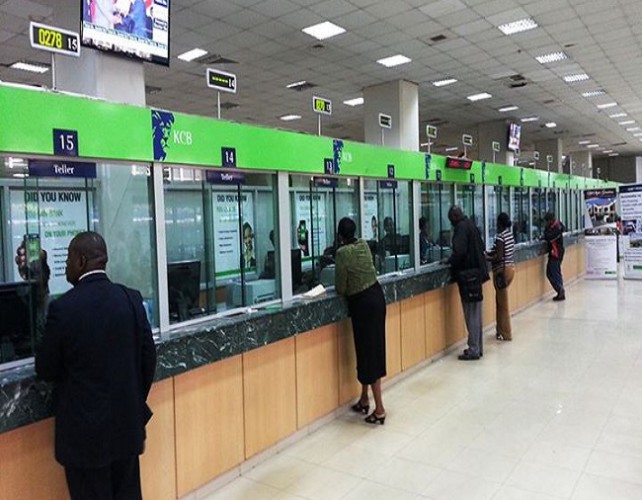
Stiff competition in Uganda’s banking industry has forced commercial banks to cut their prime lending rates (PLR) in a bid to attract borrowers back to the banking halls which were hitherto aloof to most of the borrowers due to higher interest rates charged on loans.
The latest banks to announce the cutting of prime lending rates (PLR) are the Bank of India (BOI) and Standard Chartered Bank. BOI has cut its PLR to 18 percent per annum effective March 22 even though the bank says PLR in dollars will remain unchanged, which means importers will continue borrowing at that rate.
On the other hand, Standard Chartered has tabled 19.3 percent for shilling loans per annum effective March 15, 2017. The changes in interest rates come at the time when corporate companies are releasing their end year financial statements.
According to analysts, more banks will cut their PLRs but it is not clear whether Stanbic Bank, one of the biggest in the country by capitalization will further reduce its PRL as it has been charging shilling loans at 18 percent per annum.
Early February the Bank of Uganda (BoU) reduced the Central Bank Rate (CBR) by 50 basis points to 9.0 percent, this was according to a Monetary Policy Statement for February 2018 issued to the press in Kampala by Professor Emmanuel Tumusiime-Mutebile, the Governor Bank of Uganda.
“Given the objective of keeping inflation close to the target and the estimated spare capacity in the economy, a cautious easing of monetary policy is warranted to further boost private sector credit growth and to strengthen the economic growth momentum,” Prof. Mutebile said at the time.
The reduction of the CBR is supposed to entice commercial banks cut their PLRs so that more credit flows to the private sector for investments. Currently the average commercial bank interest rate is above 20 percent and is seen by analysts as too expensive for borrowers. Banks say non performing loans (NPLs) are part of the reasons for higher interest rates in Uganda.
But Prof. Mutebile in the February monetary statement said NPLs as a percentage of gross loans have declined from a peak of 10.5 percent in December 2016 to 5.6 percent in December 2017, which he added should support credit extension.
According to Prof. Mutebile, the growth of private sector credit in Uganda remains below historic levels and that the cost of credit remains relatively high for micro and small loans while the cost to corporates have declined.
However, Prof. Mutebile said there are indications of a revival in private investment activity; as reflected by the recovery of Foreign Direct Investment, which grew by 18.5 percent in 2017 compared to a decline of 30.5 percent in 2016. He added that shilling credit extended by 10.8 percent in December 2017 compared to 7.9 percent in December 2016.
He said that although public investment programmes could substantially raise output and be self-financing in the long run, “transitional challenges of funding these investments can be formidable and may crowd out private sector borrowing, thus delaying the growth benefits of public investment.
Commercial banks in Uganda have been accused of lending to government which gives them assurance to pay back through offering treasury bills and bonds. They also target salaried employees in corporate companies and the civil service, leaving out majority of the population engaged in agriculture and the general informal sector.
CNaPS in Uganda for Caf Champions League clash against KCCA
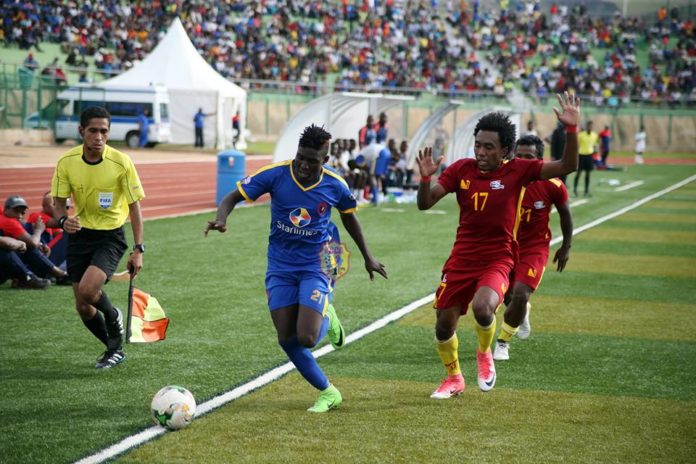
CNaPS Sport are already in Kampala ahead of their return leg against KCCA FC tomorrow. The team from Madagascar touched down at Entebbe International Airport yesterday morning and trained at the StarTimes Stadium later in the evening.
A contingent of 31 people including 20 players arrived in the country to help them progress against the Ugandan champions.
CNaPS won KCCA 2-1 in the first leg of the CAF Champions League preliminary game at Vontovorona stadium in Madagascar.
Derrick Nsibambi’s scored KCCA’s crucial away goal but was cancelled out by Ratolojanahary Fenosoa’s second half penalty while Francis Rafaralahy’s added time goal sealed the win for the hosts.
KCCA can progress to the first round of the competition with a 1-0 win on the away goals’ rule.
The winner between the two clubs will face either Ethiopia’s St George or South Sudan’s Al Salam Wau.
CAF Champions League
Wednesday, 21st February 2018
KCCA Vs CNaPS Sport
StarTimes Stadium, Lugogo (4pm)
Tourism: Katonga set to become National Park
Katonga Game Reserve that lies on the northern banks of River Katonga is to become the 11th National Park in Uganda, according to officials at Uganda Wildlife Authority (UWA).
The Game Reserve that stretches over 210 square kilometres in Ibanda and Kamwenge districts was gazetted in 1998 but now UWA has started a drive to upgrade it to a national park to boost wildlife and tourism.
UWA’s Veterinary official Dr Patrick Atimnedi says Katonga is an additional tourism package which brings products closer to tourists, especially those from Kibaale National Park and the Rwenzori cluster.
Dr. Atimnedi has of recent been in the wilderness with other veterinarians, trans-locating zebras, topis and elands to Katonga, and the veterinarian says the antelope family arrival brings to life UWA’s dream of making Katonga an antelope epicentre.
The reserve already has an estimated 2,000 impalas, 1,000 bushbucks, 500 waterbucks and an unspecified number of the less known but globally attractive sitatunga – a local breed of swamp-dwelling antelope.
Katonga is also going to be Uganda’s third national park with zebras, and is expected to attract tourists with tight schedules.
In 2015 five zebras were introduced to the game reserve but UWA says, three of the five zebras walked 153km back to Mburo National Park.
The animals were then loaded onto trucks and driven to their new home. After the translocation of 46 zebras and about 30 topis, UWA took a group of journalists to see how the animals were adopting to their new home.
In a more than Shs5 billion investment plan, UWA intends to promote Katonga as the ‘source of the source of River Nile’, the longest river in the world.
Katonga and Kagera are the main rivers that pour into Lake Victoria, from which the Nile flows all the way to the Mediterranean Sea.
Katonga, a 220km-long river, is said to originate from Bihanga in Kamwenge district where three rivers – Kitonga, Mpanga and Rushango converge.
From there, Katonga flows in two directions; westwards to pour into Lake George and northwards into Lake Wamala in Mubende, and later into Lake Victoria to connect to River Nile.
“This is a [tourism] product we are seriously looking at because this offers a unique experience. Guests will take a walk along the river to the source of the source of the Nile and in the process view the sitatungas,” Dr. Atimnedi noted.
This is a 35km stretch of River Katonga and it will take a tourist about five days of activity-packed trek.
UWA has already secured the approval of the National Environment Management Authority (NEMA) and is waiting for the proposal to be endorsed by cabinet and later parliament so that Katonga can become a national park.
Other National Parks
UWA’s outgoing Executive Director Dr. Andrew Seguya, says 95 per cent of Uganda’s tourism resources are nature-based. Tourism contributes 10 per cent of Uganda’s GDP and is the country’s top foreign exchange earner.
Tourists favour Ugandan national parks because they offer a variety of species. While they all have a wide variety of wild animals, each has a special ‘X-factor’.
Murchison Falls National Park (Masindi/Nwoya)
Uganda’s biggest national park is arguably also its best-known, in part because of the magnificent falls that tourists can trek up for a more intimate experience. The Victoria Nile separates the park into the northern and southern banks, and Murchison also has some of the best accommodation facilities.
Lake Mburo National Park (Kiruhura)
This acacia-savannah park is favoured for its extensive wetland, birding, as well as trophy hunting, heavily controlled by UWA.
Queen Elizabeth National Park (Kasese)
With its Ishasha tree-climbing lions, shoebill stork, Kazinga Channel and Mweya peninsula, it is no wonder Queen Elizabeth is a very popular park.
Mgahinga Gorilla National Park (Kisoro)
Semliki National Park (Bundibugyo)
Situated on the floor of the Albertine rift valley, Semliki is famous for birding and primates. It boasts more than 400 bird species and 300 butterfly species and has hot springs.
Mt Rwenzori National Park (Kasese/Kabarole)
This is a mountain park, popular with climbers, and offers a rocky mountain experience, with a snow-capped peak.
Mt Elgon National Park (Mbale)
Where Rwenzori is rocky, climbing the Elgon is a forested affair. The forest changes and fascinates the higher one goes, with unique bamboo and other tree species. The breath-taking caves and waterfalls are
Covering three of the eight Virunga mountain volcanoes, Mgahinga gives both the mountaineering and gorilla tracking experiences.
Kidepo Valley National Park (Karamoja)
Kidepo is a savannah park loved for its pure, totally wild experience. It is also the Ugandan park with ostriches, cheetahs, not to mention the mountain-dwelling Ik community that makes for amazing visits.
Bwindi Impenetrable Forest National Park (Kabale)
Where gorilla-tracking in Mgahinga gives the volcanic mountains experience, trekking through mountainous Bwindi’s dense tropical forest in search of the gorillas is a different ball game. The park was declared a UNESCO natural world heritage site in 1994.
Kibaale National Park (Kibaale)
When one thinks of chimpanzee tracking in Uganda, the first park in mind is this forested sanctuary in Tooro Kingdom.
Museveni, Kenyatta to commission Busia One Stop Border Post
Presidents Yoweri Museveni and Uhuru Kenyatta will on February 24 officially commission the One Stop Border Post (OSBP) at Busia, an event expected to be attended by politicians, businessmen and residents from both sides of the border.
The Busia border, shared between Uganda and Kenya, is one of the busiest in East Africa, with an average of 894 vehicles crossing per day. In 2011, the time to cross the border was variable taking between a few hours and up to five days. Delays create extra costs for traders.
The US$5.5m project was implemented by The Kenya National Highway Agency (KNHA) and Uganda’s Ministry of Works and Transport (MoWT).
The one-stop border post at Busia opened in early 2016, paving the way for speedy clearances of goods moving within the main trade corridor between Uganda and Kenya.
The Busia OSBP is one other similar projects that have been built in the region with the Support of Trade Mark East Africa. The projects are expected to reduce the time to transport goods across the Busia border, which in turn will contribute to reducing trade costs in East Africa.
Some other One Stop Border Posts in East Africa have been built at Malaba (Uganda/Kenya), Katuna (Uganda/Rwanda), Mutukula (Uganda/Tanzania), Rusumo (rwanda/Tanzania) and Namanga (Kenya/Tanzania).