Stanbic Bank
Stanbic Bank
17.4 C
Kampala
Stanbic Bank
Stanbic Bank
Home Blog Page 1657

Minister Amelia Kyambade boasts of increased sugar production

Trade Minister Amelia Kyambadde

Trade, Industry and Cooperatives Minister Amelia Kyambadde has hailed her ministry for the high rate at which the sugar industry in Uganda is growing.
While presenting a ministerial statement to parliament on Tuesday, Kyambadde said the sugar industry is one of the fastest growing industries in Uganda contributing over Shs290 billion in taxes in 2016/17 and employing over 60,000 Ugandans directly and indirectly.
According to Amelia, the Industry also produces over 100 megawatts of electricity from bagasse of which over 40megawatts is supplied to the national grid.
However, she noted that the taxes and the power generated have reduced of recent. “Currently, there are 30 licensed sugar mills in the country although only 11 are in operation while the rest are at different stages of development,” she said.
She further revealed that over the last 10 years sugar production has been increasing by nearly 12 per cent annually making Uganda the only sugar surplus producing country in East Africa Kenya produced 327,000 metric turns against page of demand of over 800,000 metric turns in 2017, Tanzania had a shortage of over 200,000 metric turns and Rwanda a shortage of 70,000 metric turns
The Minister also explained the hike in sugar prices last year which hit a maximum of Shs8 500 per kilo in some parts of the Country.
“The hiked prices were as a result of prolonged drought that stretched for a period of nine months from early 2016, increased regional demand of Uganda’s sugar especially in Kenya and Rwanda and increased cost of sugar cane from Shs85, 000 in 2016 to Shs175, 000 in 2017, she explained.
She also said her ministry has confirmed with Uganda Revenue Authority that there is no direct importation of duty free sugar, no dumping of sugar and smuggling which is mainly done by boda bodas through our porous borders and who repackaged in branded bags of Kakira, Kinyara and Lugazi sugar making it difficult for URA to seize.
According to Kyambadde, operations by seized over 55 metric turns of illicit sugar from July to December 2017.
“Sugar millers have stock piled over 0,000 metric tons of sugar as shown below, company sugar stock (MT) as at 12 02 2018 Kakira Sugar 13,712 Kinyara Sugar 22,099 SCOUL Lugazi 8,05 Mayuge Sugar ,000 GM Sugar 2,000 Kaliro Sugar,” she said.
She said smuggling of duty free sugar has not only hurt the sugar industry but also the out growers of sugarcane whose livelihoods entirely depend on supply of sugarcane to the factories, affected electricity generation and shall eventually affect other industries that depend on by products of sugar cane such as distillers of spirits, other beverages, bakeries and animal feed industries
She noted that to bring this current situation under control the government has agreed to undertake operation to curtail smuggling of sugar across borders commencing this week and allow controlled export of sugar to the regional market.
She revealed that she is contacting her colleague from Tanzania to have 25,000 metric turns of sugar exported to Tanzania and also formally contacting Kenyan colleague express our concern to the flow of sugar from across our common borders.

Stories Continues after ad

Kirumira denied bail, sent back to Nalufenya

FLASHBACK: Muhammad-Kirumira-arrives-for-trial.

Former Buyende District Police Commander Assistant Superintendent of Police (ASP) Muhammed Kirumira has been denied bail after court directed him to present three sureties above his rank.
The police officer was this month arrested by Police Flying Squad officers after they forcefully broke into his house in Bulenga along the Kampala-Mityana Highway a day after he announced his resignation from police.
Last week ASP Kirumira applied for bail and Court Chairman SCP Denis Odongpiny vowed to look into his bail application however in his ruling in the afternoon, Odongpiny said Kirumira must present three sureties above his rank for him to be released on bail.
‘’Kirumira is free to appeal to police council in case he is not contented’’. SCP Denis Odongpiny said in his ruling.
Upon that chaos ensued as Kirumira protested over stringent bail conditions saying that there was no way he could get senior police officers above his rank when all his phones were taken off from him.
‘’I can never be intimidated, which kind of job is this’’. He said as he matched around the tribunal room.
The embattled police officer who is facing various charges of crimes torture, extortion, corruption, bribery, unlawful arrests and excessive use of authority has always been appearing before the tribunal whenever he is required.
Last week the court chairman granted the prosecutor leave to withdraw torture charges that were leveled against Kirumira due to lack of witnesses. After the hearing, Kirumira was driven to Nalufenya

Stories Continues after ad

Coca-Cola Uganda expands product line

NEW: Coca-Cola team launching Fuze Tea at Century Bottling Company, Namanve...

Beverage giant Coca-Cola has announced an expansion of their product line with the official launch of Fuze Tea – a unique blend of tea extract and fruit flavors created through a fusion of tea, fruit, herbs and other natural ingredients.

Launched at the Coca-Cola bottling plant in Namanve, the preservative-free beverage comes in two flavors – Peach and Apple & Lemon Grass.

According to Coca-Cola Uganda Brand Manager, Miriam Limo, consumers’ tastes have evolved and so has Coca-Cola’s offerings and the launch of Fuze Tea is testament to the company’s innovation agenda.

“We recognize that our consumers’ have diverse tastes and preferences, and the launch of Fuze Tea gives us a unique opportunity to give our consumers a refreshing beverage to enjoy as they go about their busy schedules. This brand promises to deliver a unique great tasting refreshment with the benefits of tea,” Ms Limo said.

Following the launch of Fuze Tea, Coca-Cola will hold a series of activations with the aim of creating awareness and availing an opportunity for consumers to sample and purchase the refreshing drink.

“We shall set up Fuze Tea booths at universities, workplaces and malls to give our on-the-go consumers an opportunity to interact with the refreshing beverage,” stated Coca-Cola’s Marketing Manager Maggie Kigozi.

During the breakfast launch, media and staff were invited to sample the different Fuze Tea flavors and learn more about their ingredients.

Fuze Tea is currently available in 52 countries worldwide and is currently launching in 37 other countries across Europe. In East Africa, Uganda is the first country to launch Fuze Tea, with rollouts expected to follow in other markets.


Stories Continues after ad

Big Brother Naija: Real nominations begin

BIG BROTHER NAIJA HOST: Nigerian lawyer-cum-media personality Ebuka Obi-Uchendu.

After spending the last week awaiting feedback on their fate in the House, the Big Brother Naija housemates were on Sunday able to collectively heave a sigh of relief upon discovering the evictions were a hoax.

Hosted by the ever suave Ebuka Obi-Uchendu, Sunday’s live show was yet more entertainment for studio guests and viewers at home as Nigerian songbird Niniola thrilled with her hit tracks Maradona and Sicker.

The housemates’ relief was however short-lived as they were yet again tasked with competing for the Head of House title.

An interesting twist occurred as all the male housemates and Vandora were disqualified from the challenge following their failure to adhere to Big Brother’s instructions.

Khloe subsequently emerged as Head of House after competing with previous contentants Ifu and Bam Bam.

Things are however bound to get testy as the real nominations happen on Monday the 12th of February with the first set of evictions to follow on the next live show, with host Ebuka announcing that more than one pair of housemates will be evicted.

Voting for nominated housemates begin at 6.30 Nigerian time, and viewers can vote via SMS, mobile site and website.

To vote via SMS, simply text the word “Vote” followed by the team name to 32052. Voting costs N30 per SMS.

To vote via mobile site & website, simply register on africamagic.tv/bbvote with your mobile number & password, then enter the OTP number and vote for free.

Voting opens at 6:30 on Monday and closes at 9:00pm Nigerian time on Thursday.


Stories Continues after ad

DP to punish renegade party leaders

DP President Norbert Mao

The Democratic Party (DP) is set to summon leaders advocating for the censure of party President General Norbert Mao.

The development follows the tabling of a report by a probe committee chaired by Polly Mukiibi that was appointed by the DP National Executive Committee (NEC) last year, and tasked to investigate the behavior of top party leaders who are reportedly saying that Mao had failed to manage the DP.

In a press briefing held at party headquarters, Mao said NEC will meet and discuss the report that will culminate into punishing whoever will be found culpable of undermining his authority.

Some of those who could face disciplinary action include Lord Mayor Erias Lukwago of now-defunct splinter group Solida; Mukono MP Betty Nambooze Bakireke of ‘rebel’ group ‘Bad DP’ and Samuel Walter Lubega of the Truth and Justice Forum, all of who have, at different times during Mao’s presidency, been accused of dividing DP along tribal lines.

Meanwhile, Mao has said that the DP National Council will meet in Mbarara to honour the late Boniface Byanyima for his contribution to the party. At the Mbarara NC meeting, Mao added, members will also formulate policies that will guide the party in various undertakings.

According to Mao, the party will also rally behind Forum for Democratic Change (FDC) candidate Paul Mwiru in Jinja East by-election.

“He (Mwiru) stands for a common voice; in the next elections the party will continue advocating for the voting out of legislators who supported the removal of presidential age limit,” Mao said.


Stories Continues after ad

UPDF officers beat up journalist covering land wrangle in Kimaka

Brig. Karemire, Confirmed the death.

Uganda Peoples Defence Forces (UPDF) officers attached to Kimaka Army Barracks on February 12, 2018 attacked Ivan Lubega, a Jinja-based journalist attached to Kiira FM and Bukedde TV, inflicted him with injuries on his right hand and destroyed his camera in the process.

Lubega was covering a scuffle in Jinja that had ensued over land in Kimaka which is next to the military barracks. The wrangle between army officers attached to Kimaka military barracks, parents, teachers and pupils of Guardian Kimaka Primary school started at about 9:00am.

It is alleged that the said school is located on land belonging to the army, and a letter written to the Headmaster James Muwaya directed him to close business by the end of 2017. However, on February 2 the school secured an interim court order restraining the army from accessing the land until the matter is disposed of.

When contacted, Lubega told Human Rights Network for Journalists-Uganda that while he and his colleagues Hakim Kanyere and Isaac Kintu of NBS and NTV, respectively, were covering the scuffle, the army officers started chasing after them but his colleagues managed to escape.

“Although I told the army officer that I am a journalist, he could not stop beating me…. he told me ‘toa kamera yako’ meaning, remove your camera. I sustained injuries on my right hand and my camera was destroyed,” Lubega told HRNJ-Uganda.

Lubega, who filed a case of assault and malicious damage to property vide SD 30/12/02/18 at Jinja Central Police Station, added that while at the police station, he met the army officer who was commanding the operation, a one Col Kihuta who allegedly told him: “The best you can do is to go back home and treat yourself because the army is part of the government and you cannot succeed in this case,” Kihuta told Lubega.

The Busoga sub region army spokesperson Lieutenant Amos Nsamba told HRNJ-U that he was disappointed with the manner in which the journalists were handled, adding that he does not support acts of beating up journalists in the line of duty. He advised journalists to wear press jackets for easy identification.

“We condemn this act of violence against journalists and the response Col. Kihuta gave towards the assaulted Journalist. It’s wrong for the state agents to use their powers to influence the justice system. We implore the Uganda Police Forces to handle the matter professionally and timely so that the journalist gets justice,” the HRNJ-Uganda National Coordinator Robert Ssempala, said.

And contacted on phone today, UPDF spokesperson Brigadier Richard Karemire said: “We look at the whole incident; the background, how it built up upto yesterday and solve it amicably. We bring all the sides together and solve it. I am issuing a statement shortly.”


Stories Continues after ad

Kitatta remanded to Luzira

Abdallah Kitatta with his co-accused in the dock at Makindye

Embattled Boda Boda 2010 ‘patron’ Abdallah Kitatta and his thirteen co-accused have been remanded to Luzira Prison till March 27 by the General Court Martial sitting in Makindye.

The others charged alongside Kitatta are Matia Ssenfuka, Joel Kibirige, Hassan Ssemata, Jonathan Kayondo, Ssengooba Hassan, Sande Ssemwogerere, John Ssebandeke, Hussein Mugema, Fred Bwanika and Amon Twinomujuni.

The group appeared before the GCM chaired by Lieutenant General Andrew Gutti, and was charged with unlawful possession of military firearms.

According to prosecution, three of the suspects were in January arrested at Wakaliga in Rubaga division and found in possession of an SMG rifle and a pistol without a valid fire arm certificate.

‘Abdallah Kitatta, Sowali Ngobi and Ibrahim Ssekajja were found in unlawful possession of a fire arm contrary to Section 3 and section 2 of the fire arms act’, Lt. Gen. Gutti read the charges.

They were arrested on January 20 in a joint security agencies’ operation, charged by the Chieftaincy of Military Intelligence (CMI) Unit Disciplinary Committee (UDC) and remanded to Kigo prison.

If convicted, the suspects face death or life imprisonment sentences because the charges against them are capital in nature.

All the suspects denied the charges, and asked court to avail them with an interpreter for Luganda.


Stories Continues after ad

How to win key decision points with today’s customers

Today’s customers are much more in control of their buying decision, as they have more choices and more information than ever before. Almost instantly, via the Internet or on their smartphone in the store, they can find the lowest price alternative or their favorite features, without waiting for push marketing or listening to your best sales person.

This can be an advantage to startups who don’t have the resources and brand awareness of mature businesses, if they understand and position themselves to win in the decisive moments of the new customer buying process. These decisive moments, and how to respond, are outlined in Robert H. Bloom’s classic book, ‘The New Experts: Win Today’s Newly Empowered Customers’.

Bloom is a widely known expert on managing business growth, and he starts by summarizing the three key weapons of current customers, which include an instant summary of choices, prices, and features. His research indicates that they don’t have any old-fashioned customer loyalty, and they want precisely what appeals to them at the moment, preferably customized just for them.

New startups actually have a flexibility advantage over more mature businesses in anticipating and reacting to the four key decisive moments that Bloom outlines and I have observed in the new customer buying process:

Survive the now-or-never moment. You only get one chance to make a great first impression. If you can’t get a positive customer perception at this first moment, you will likely never get another chance – with so many other alternatives. The key to winning in that moment is to think like a buyer, not the seller. Build a relationship and trust quickly.

Win the make-or-break moment. You win here by getting the customer immediately engaged, and keeping him there, by knowing their interests and expectations better than any competitor or alternative. Avoid the extended period of evaluation and negotiation during which the customer will likely move to other transaction alternatives.

Sustain the keep-or-lose moment. The buying process is just the beginning of the customer experience, and it has to remain a good one throughout the time that your customer actually uses your product or service. Great startups manage to continually improve the relationship through outstanding follow-on support and service.

Capitalize on the multiplier moment. Of course you want your customer to come back, but the best ones also become your evangelists in bringing their friends to you, and broadcasting their positive experiences to the world through social media. This is a key moment where your customer acquisition costs go way down, and your profits go way up.

This new world is all about empowered customers. As an entrepreneur and startup, you should love this environment and cater to it. Many existing businesses see it as a big problem, and can’t adapt easily. That’s your chance to step in and compete at every moment of the customer buying process, usage experience, and follow-on events.

As you bring on employees to facilitate your growth, they have to embrace the new reality. Empowered customers required empowered employees, and your internal business processes have to be aligned with the same principles and the same smartphone and Internet technologies. Make sure you adopt the right hiring practices and training to keep your team responsive.

Then you have to trust the team to think and act proactively on behalf of your vision and mission. Of course, both you and they will make mistakes, which are the best learning experiences. Continuous innovation and change are the keys to staying current, reducing complexity, and delivering the winning customer experience to keep you ahead of the competition.

What most companies don’t realize is that businesses don’t drive customer trends anymore, customers drive business trends. Consumers are well aware of the latest technologies, and their expectations are usually ahead of even the most forward-thinking startups. It’s up to you to understand and capitalize on the decisive moments of empowered customers, or you will become a “has-been” before you even start.


Stories Continues after ad

Investments in infrastructure to boost Ugandan economy – finance

Finance Minister: Matia Kasaija.

Uganda’s economy is projected to grow by five percent in financial year 2017/18, above the 4 percent growth registered in fiscal year 2016/17, according to the latest Debt Sustainability Analysis Report released by the Ministry of Finance Planning and Economic Development (MFPED).

According to the report, the 5 percent growth will be driven by higher growth rates in agriculture and services, supported by improved implementation of infrastructure projects and a return to normal weather conditions.

“Real GDP growth is expected to average at about 5.9 percent in the medium-term and 6.7 percent in the long-term,” adds the report which continues that this growth will be supported by enhanced productive capacity from the completion of infrastructure projects, investment in agriculture, regional integration and oil production, as well as enhanced efficiency in resource allocation.

Meanwhile, the ministry reports that the annual headline inflation is expected to drop to an average of 4.9 percent in financial year 2017/18, from 5.7 percent in financial year 2016/17. According to the report, this is to be achieved on account of low food crop inflation supported by normalization of weather conditions; low demand pressures and a relatively stable exchange rate.

In the medium term, the report indicates, headline inflation is projected to average 5.3 percent, rising to 6.1 percent in the long term. “Core inflation is expected to stabilize around the BOU’s 5 percent target in the medium to long term,” it says.

Further, financial year 2017/18, the Ugandan Shilling is expected to depreciate against the US Dollar by an average of 4.1 percent, compared to 2.7 percent in financial year 2016/17. “This will be driven by Government dollar demand arising from infrastructure investments, the expected monetary policy tightening in the USA and a rise in international crude oil prices,” says the report.

However, in the medium term, the exchange rate is projected to depreciate by an average of 3.7 percent and 0.3 percent in the long-run as the country is expected to start earning oil revenues.

Tax revenue

The report says that like in financial year 2016/17, tax revenue as a percentage of GDP is expected to increase by 0.3 percent, to Shs.14, 403bn in the current financial year. In financial year 2018/19, it is projected to increase by 0.7 percent to Shs.16, 692bn on account of a combination of improved tax administration and new tax measures.

“Specific attention will be paid to: expansion of withholding tax agents; determination of rentable values for commercial properties; improving on data analysis (audit information), improving VAT compliance of the telecom sector by enforcing the commission model rather than the discount model; debt recovery; and engaging the Judiciary to expedite tax cases, among others,” says the report.

However, the ministry projects that in the medium term, tax revenue will grow by 0.5 percent of GDP to reach a peak of 18.4 percent in the long term; driven by reforms in the tax system and efficiency in tax administration.

‘This will also require investments in tax collection systems, equipment and human resources’, it says.


Stories Continues after ad

BoU reduces February Central Bank Rate

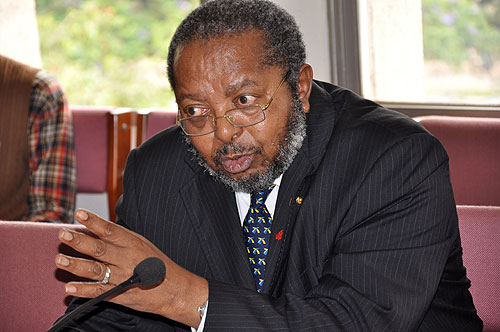
BoU Governor Prof Emmanuel Tumusiime Mutebile.

The Bank of Uganda (BoU) has reduced the Central Bank Rate (CBR) by 50 basis points to 9.0 percent. The band on the CBR will be maintained at +/-3 percentage points and the margin on the rediscount rate at 4 percentage points on the CBR, the bank says.

‘Given the objective of keeping inflation close to the target and the estimated spare capacity in the economy, a cautious easing of monetary policy is warranted to further boost private sector credit growth and to strengthen the economic growth momentum’, the Governor Bank of Uganda, Professor Emmanuel Tumusiime-Mutebile, wrote in the Monetary Policy Statement for February 2018 issued to the press in Kampala.

Further, Prof. Mutebile said the Bank has consequently reduced the rediscount rate and the bank rate to 13.0 percent and 14.0 percent, respectively.

Mutebile said there are indicators of a revival in private investment activity as reflected by the recovery of Foreign Direct Investment, which grew by 18.5 percent in 2017 compared to a decline of 30.5 percent in 2016. He added that shilling credit extended by 10.8 percent in December 2017 compared to 7.9 percent in December 2016.

There was also an increase of imports of raw materials and capital goods, which grew by 17.4 percent in 2017 compared to a decline of 21.1 percent in 2016.

‘These developments, coupled with an improving global economic outlook, could strengthen domestic economic activity,’ he noted.

Economic growth for Financial Year 2017/18 is now projected in the range of 5.0-5.5 percent, a positive payoff for the current stimulatory monetary policy,” he said.

Prof. Mutebile said non-performing loans as a percentage of gross loans have declined from a peak of 10.5 percent in December 2016 to 5.6 percent in December 2017, which he said should support credit extension.

However, he said that although public investment programmes could substantially raise output and be self-financing in the long run, ‘transitional challenges of funding these investments can be formidable, and may crowd out private sector borrowing, thus delaying the growth benefits of public investment’.

According to Prof. Mutebile, in the next five years, economic growth is projected to average 6.3 percent, boosted by public investments, increasing growth in consumption, and improved agricultural productivity.

There are nonetheless downside risks to this outlook, he says adding that  the growth of private sector credit remains below historic levels and that the cost of credit remains relatively high for micro and small loans while the cost to ‘corporates’ have declined.


Stories Continues after ad